

The Black Desert of Egypt is one of the most dramatic, the most geologically extraordinary, and the most visually arresting natural landscapes in the entire Western Desert of Egypt, a vast volcanic plateau and mountain region whose ancient dolerite and basalt rock formations create a landscape of such alien and primordial beauty that travelers who encounter it for the first time consistently describe the experience as unlike anything else available in the natural heritage of the Egyptian desert world. Located in the Giza and Minya Governorates of the Western Desert approximately 50 kilometers north of the Bahariya Oasis and approximately 370 kilometers southwest of Cairo on the desert highway that connects the Egyptian capital to the great oasis chain of the Western Desert, the Black Desert takes its name from the millions of dark black volcanic stones and the dark grey and black dolerite-capped hills and mountains that characterize its landscape, creating a visual environment of extraordinary geological drama in which the black volcanic rocks of the ancient desert surface contrast with the golden sand between the volcanic outcrops to produce one of the most immediately striking and the most consistently photographed natural landscape compositions in all of Egypt. This extraordinary destination is accessible through Egypt Desert Safari Tours and Egypt Travel Packages, both of which WOW Egypt Tours proudly offers to travelers from around the world as part of Egypt Tours Packages that encompass the complete natural and geological heritage of the magnificent Western Desert landscape.
The Black Desert Egypt forms the northern gateway to the famous Western Desert safari circuit that also encompasses the White Desert to the south and the Bahariya Oasis at its heart, and it is almost universally visited as the opening and the most immediately dramatic chapter of the complete Western Desert safari experience that WOW Egypt Tours organizes for travelers seeking the most comprehensive and the most personally rewarding encounter with the extraordinary natural heritage of Egypt's Western Desert. The geological contrast between the Black Desert and the White Desert, visited in the same safari programme, is one of the most dramatic natural landscape contrasts available at any pair of destinations within driving distance of each other in the entire Egyptian natural heritage landscape, with the dark volcanic drama of the Black Desert giving way after a drive of approximately 100 kilometers through the Bahariya Oasis to the ethereal chalk-white landscape of the White Desert in a geological and visual transformation so complete that the two deserts seem to belong to entirely different geological worlds. The Black Desert also contains within its boundaries one of the most historically interesting viewpoints in the Western Desert, the English Mountain or Gebel El Ingilizi, a prominent volcanic peak from whose summit the WWII British military forces observed the surrounding desert landscape during the North African Campaign, and whose current accessibility to visitors makes it the most rewarding elevated viewpoint available in the immediate vicinity of the Bahariya Oasis. The Black Desert, combined with the White Desert and the Bahariya Oasis in a comprehensive Western Desert safari, provides one of the most complete and the most personally extraordinary natural heritage experiences available anywhere in Egypt.

What Is The Black Desert?
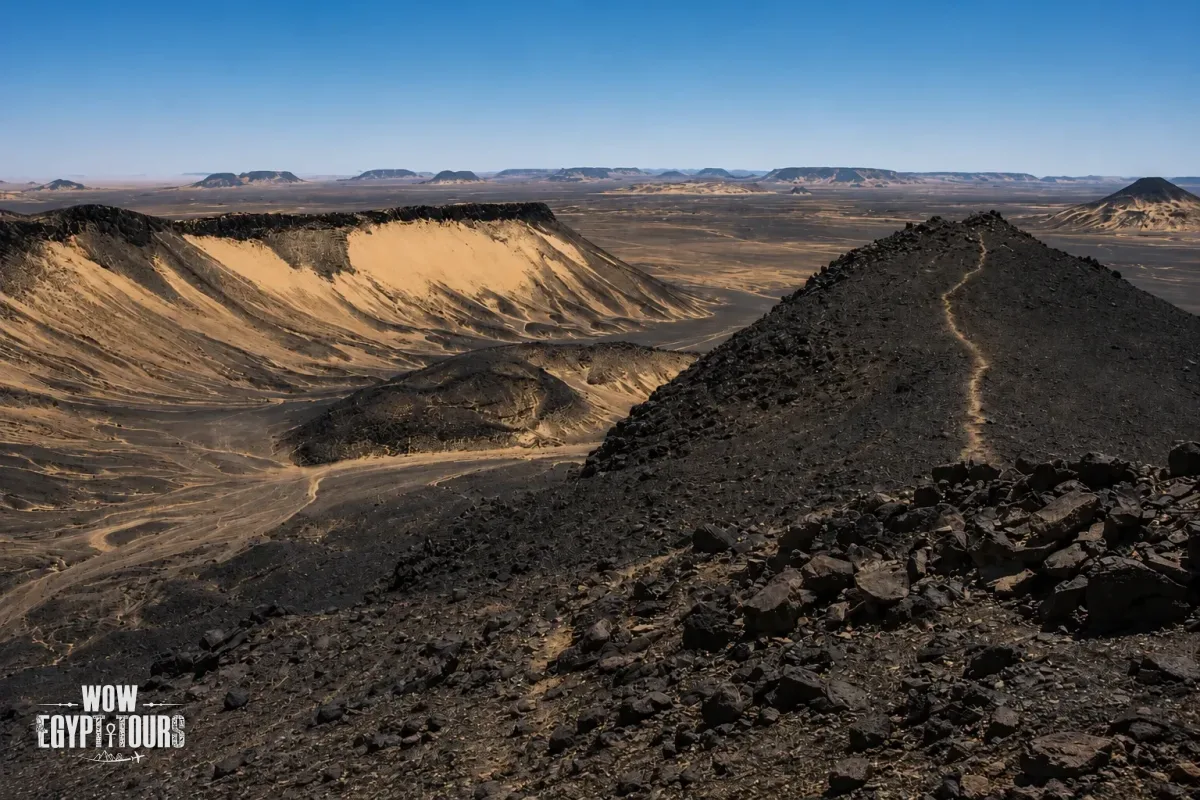
The Black Desert is a volcanic desert landscape in the Western Desert of Egypt, characterized by ancient mountains, hills, and plains covered with black and dark grey dolerite and basalt stones that were deposited by volcanic activity in the ancient geological past and that give the entire region its characteristic dark coloration and its dramatically alien visual character. The black stones of the Black Desert are the product of the erosion of ancient volcanic rock formations that cap the limestone and sandstone hills and plateaus of the region, releasing dark dolerite and basalt fragments that gradually accumulate on the desert floor around the base of the volcanic-capped hills in a process of natural rock weathering that has been proceeding for millions of years. The result of this geological process is a landscape whose surface, viewed from any elevated point, appears uniformly dark grey to black against the golden sand of the inter-dune and inter-hill areas, a visual impression so dominant and so immediately striking that it gives the entire region its most fundamental character and its most commonly used name in both Arabic and international tourism usage.
The Black Desert landscape extends for approximately 50 kilometers in its longest dimension, encompassing a varied terrain of conical volcanic hills, flat dark plains covered with dolerite pebbles and cobbles, occasional larger isolated volcanic peaks, and the surrounding sandy desert between the volcanic elements that provides visual contrast and navigational reference for travelers crossing the region. The most distinctive individual landforms within the Black Desert are the numerous perfectly conical black-topped volcanic hills that rise from the desert floor at intervals throughout the landscape, their symmetrical forms and their uniformly dark rock caps giving them an appearance of geological precision and aesthetic regularity that seems almost architectural rather than natural, as if each cone-shaped hill had been deliberately designed and constructed rather than shaped by the random forces of erosion and volcanic deposition over millions of years.
What Created The Black Desert?
The Black Desert was created by a complex and extended geological process that began with the volcanic activity that produced the dolerite and basalt rocks now covering the desert surface, continued with the long-term weathering and erosion of the ancient volcanic rock formations that released the dark stones from their parent rock masses, and culminated in the progressive accumulation of the released dark volcanic rock fragments on the desert floor to create the characteristic black stone landscape visible today. The geological history of the Black Desert region is part of the broader volcanic and tectonic history of the Western Desert of Egypt, which records in its rock formations the complex sequence of geological events that have shaped the North African landscape over hundreds of millions of years from the ancient Precambrian continental basement through successive episodes of marine submersion, sedimentary deposition, volcanic activity, and erosion that have created the extraordinarily varied and extraordinarily ancient geological landscape of the Egyptian desert.
The specific volcanic episode that produced the dolerite rocks of the Black Desert occurred in the Cretaceous period, approximately 100 to 80 million years ago, when volcanic intrusions of molten basaltic magma pushed up through the overlying sedimentary rock of the region and solidified as dolerite sills and dykes within the host rock. Over the subsequent tens of millions of years, the overlying sedimentary rock was progressively eroded away by wind and water, exposing the harder and more erosion-resistant dolerite formations at the surface and eventually leaving the dolerite as the cap rock of the hills and mountains whose lower portions are composed of the softer underlying sedimentary rock. The continued erosion of the dolerite cap rock itself then releases the dark fragments that accumulate on the desert floor around the base of each volcanic-capped hill, creating the black stone plains that characterize the lower terrain between the hills and that give the entire region its distinctive dark coloration when seen from any elevated viewpoint. This process of cap rock erosion and fragment accumulation is still proceeding in the Black Desert today, and the dark stone carpet of the desert floor is in a sense a geological clock recording the millions of years of slow erosion that have progressively dismantled the ancient volcanic formations of the Western Desert landscape.
The English Mountain And Its WWII History
The most historically significant individual landmark within the Black Desert landscape is the English Mountain, known in Arabic as Gebel El Ingilizi, a prominent volcanic peak rising to approximately 200 meters above the surrounding desert floor that served as a British military observation post during the North African Campaign of the Second World War and that preserves on its summit and upper slopes the remnants of the British military presence that give it both its English designation and its principal historical interest. The North African Campaign of 1940 to 1943, fought primarily in Libya and Egypt between the Allied forces under commanders including Generals Wavell, Auchinleck, and Montgomery and the Axis forces under Field Marshal Erwin Rommel, was one of the most significant and the most dramatically contested military campaigns of the entire Second World War, whose outcome determined the strategic balance in the Mediterranean theater and whose desert battles, including El Alamein in 1942, are among the most celebrated and the most intensively studied military engagements of the 20th century.
The British military presence in the Bahariya Oasis and the surrounding desert during the Western Desert Campaign was part of the broader strategic deployment of forces throughout Egypt in anticipation of a possible Axis advance from Libya into the Egyptian interior, and the English Mountain served as one of the observation points from which British forces monitored the surrounding desert landscape for signs of enemy activity or movement. The practical military value of the English Mountain as an observation post derived from its commanding height above the surrounding flat desert terrain, which provides from its summit one of the finest panoramic views of the Black Desert and the surrounding Western Desert landscape available at any accessible elevated point in the entire Bahariya region, making it simultaneously a significant historical site and the most rewarding natural viewpoint available to visitors to the Black Desert. The climb to the summit of the English Mountain, a moderate ascent of approximately 30 to 45 minutes over the dark volcanic rock of the mountain's upper slopes, rewards visitors with the most dramatic available overview of the Black Desert landscape in all its extraordinary geological character, providing a perspective on the volcanic hills, the dark stone plains, and the golden sand between them that is simply unavailable from ground level within the desert terrain itself.
Black Desert Location In Egypt
The Black Desert is located in the Western Desert of Egypt, in the northern reaches of the Bahariya Oasis region in the Giza Governorate, approximately 50 kilometers north of the main settlement of Bahariya Oasis (Bawiti) and approximately 370 kilometers southwest of Cairo along the Desert Road that connects the Egyptian capital with the Western Desert oasis chain. The Black Desert occupies the terrain on both sides of the Desert Road between Cairo and Bahariya for a stretch of approximately 50 kilometers, making it the first dramatic desert landscape encountered by travelers driving south from Cairo toward the oasis and providing an immediate and powerful introduction to the geological drama of the Western Desert before the road descends into the Bahariya depression. The Black Desert borders the northern approach to the Bahariya Oasis depression and transitions gradually into the oasis landscape as the road descends from the desert plateau into the fertile and archaeologically significant oasis valley. To the south and west of the Bahariya Oasis lies the White Desert, the other great natural landscape destination of the Western Desert safari circuit, whose chalk-white rock formations provide the most dramatic possible visual contrast with the black volcanic landscape of the Black Desert visited earlier in the safari programme. WOW Egypt Tours provides private four-wheel-drive vehicle transportation to and through the Black Desert as part of all comprehensive Western Desert Safari Tours and Egypt Desert Safari programmes.
Black Desert Fun Facts
The Black Desert landscape of conical volcanic hills capped with dark dolerite rock is so geologically distinctive and so immediately visually striking that it has attracted the attention of geologists and earth scientists from around the world as one of the finest and the most accessible natural exposures of the Cretaceous volcanic geology of the Western Desert of Egypt, providing a rare opportunity to observe and study the complete sequence of dolerite intrusion, host rock erosion, and volcanic fragment accumulation that characterizes the geological history of this distinctive landscape type. The conical hills of the Black Desert are particularly valued by geologists as unusually regular and unusually well-preserved examples of the erosional landform created when a volcanic rock cap protects an underlying softer rock from erosion while the surrounding terrain is progressively stripped away, producing the characteristic cone shape whose symmetry approaches that of a geometrically regular cone in the finest examples.
The Black Desert is part of the same geological province as the famous Bahariya Iron Ore deposits, whose discovery and subsequent commercial exploitation in the mid-20th century transformed the economic landscape of the Bahariya Oasis region and brought significant infrastructure development to what had previously been one of the most isolated and the most economically marginal oasis communities in the Western Desert. The iron ore of Bahariya, like the dolerite of the Black Desert, is a product of the Cretaceous volcanic episode that introduced iron-rich magmatic material into the sedimentary rocks of the Western Desert, creating in the Bahariya region one of the most significant iron ore deposits in North Africa whose exploitation by the Egyptian government began in the 1960s and continues to the present day.
The Bahariya Oasis, to which the Black Desert serves as the northern gateway, has in recent decades become one of the most archaeologically significant sites in the entire Western Desert of Egypt, following the accidental discovery in 1996 of what has been described as one of the most significant ancient Egyptian archaeological finds of the 20th century: a vast Greco-Roman period cemetery containing hundreds of mummies, many decorated with golden funerary masks and elaborate painted mummy cartonnage, in an area of the oasis that has been named the Valley of the Golden Mummies. The Valley of the Golden Mummies is estimated to contain the remains of up to ten thousand mummies from the Greco-Roman period, making it potentially the largest ancient mummy cemetery ever discovered in Egypt and one of the most significant archaeological sites in the entire Nile Valley heritage landscape. While systematic excavation of the site is ongoing and public access is currently restricted to specific areas, the existence of the Valley of the Golden Mummies gives the Bahariya Oasis region an archaeological dimension that significantly enriches the natural heritage experience of the Black Desert and the broader Western Desert safari circuit.
Why Is It Called The Black Desert?
The Black Desert takes its name from the most immediately obvious visual characteristic of the landscape: the pervasive dark black and dark grey coloration of the volcanic dolerite and basalt rocks that cover the desert surface, cap the conical hills and mountains, and give the entire region its distinctive dark appearance when viewed from any elevated perspective. The Arabic name for the region, Al-Sahara Al-Sawda, translates directly as the Black Desert in the same straightforward descriptive mode, reflecting the immediate visual impression made on Arabic-speaking desert travelers by the dramatically dark coloration of a landscape otherwise dominated by the golden and ochre tones of the sand and sandstone that characterize most of the Western Desert terrain. The name Black Desert perfectly captures both the primary visual reality of the landscape and the most fundamental geological fact about the region, the volcanic dolerite origin of the dark rocks that give the desert its color, making it one of the most accurate and the most descriptively complete natural landscape names in the entire Western Desert heritage vocabulary. The name also carries within it the implicit contrast with the nearby White Desert, which derives its own name from the brilliant white chalk rock formations that characterize its landscape, and the combination of the Black Desert and the White Desert as the two primary natural landscape destinations of the Western Desert safari circuit creates a geographical naming system of elegant simplicity and complete descriptive accuracy that has served the tourism communication needs of the Western Desert safari industry since the development of the circuit as a major Egyptian tourism destination in the late 20th century.
Black Desert History
The geological history of the Black Desert spans hundreds of millions of years from the ancient Precambrian continental basement of the Western Desert through the Cretaceous volcanic episode that created the dolerite rock of the desert landscape, and the human history of the region encompasses the complete arc of human presence in the Western Desert from the prehistoric communities of the wet Saharan period through the ancient Egyptian oasis civilizations to the Islamic medieval period and the modern era of geological exploitation and nature tourism. The Black Desert landscape itself, in the form currently visible to visitors, has been developing through the slow process of volcanic cap rock erosion and dark stone accumulation since the Cretaceous period approximately 80 to 100 million years ago, making it one of the most ancient and the most geologically deep landscape experiences available at any accessible natural site in Egypt.
The human history of the Bahariya Oasis region, to which the Black Desert serves as the northern approach, is extensive and archaeologically significant, spanning at least five thousand years of continuous oasis settlement from the Old Kingdom period of ancient Egypt, when Bahariya was an important agricultural and administrative center within the western oasis chain that provided the Egyptian state with wine, dates, and other agricultural products not available in the Nile Valley, through the New Kingdom period when the oasis served as a military outpost and a way-station on the desert trade routes, through the remarkable Greco-Roman period of the Valley of the Golden Mummies, and through the successive Islamic, Ottoman, and modern Egyptian periods that have shaped the current character of the Bahariya oasis community. The WWII military history of the English Mountain within the Black Desert adds a more recent historical dimension to the landscape's human heritage, connecting the ancient geological terrain to one of the most significant military conflicts of the 20th century in a juxtaposition of geological deep time and modern historical drama that is among the most thought-provoking available at any natural heritage site in the Western Desert.
The modern tourism history of the Black Desert began in the 1980s and 1990s as the Western Desert safari circuit, combining the Bahariya Oasis, the Black Desert, Crystal Mountain, and the White Desert, was developed as a major Egyptian tourism product attracting primarily European adventure travelers seeking an alternative to the more crowded and more conventionally archaeological tourism of the Nile Valley. The development of safari infrastructure including four-wheel-drive vehicle tours, desert camping programmes, and oasis-based accommodation has transformed the Black Desert from a remote and rarely visited geological curiosity into one of the most popular and the most internationally recognized natural heritage destinations in the Egyptian tourism landscape, visited by tens of thousands of Egyptian and international travelers annually as part of the Western Desert safari circuit that WOW Egypt Tours organizes with the most comprehensive and the most expertly guided programme available.
The Story Of The Western Desert Safari Circuit
The story of the Western Desert safari circuit, of which the Black Desert is the most dramatic opening chapter, is the story of the development of one of Egypt's most distinctive and most personally extraordinary travel experiences, a journey into the geological and cultural heart of the North African desert that provides a complete contrast to the archaeological and urban heritage experiences of the Nile Valley and that reveals a dimension of Egypt's natural heritage that most visitors, focused on the ancient monuments of Luxor, Aswan, and Cairo, never encounter. The Western Desert of Egypt, covering approximately two-thirds of the country's total land area in a vast expanse of sand sea, rock desert, and isolated oasis, is the single largest continuous desert landscape in the world and one of the most geologically diverse and the most archaeologically significant desert environments on the African continent, whose ancient lakes, prehistoric rock art, Pharaonic oasis settlements, and extraordinary natural rock formations together constitute a natural and cultural heritage landscape of outstanding importance that has attracted the attention of geologists, archaeologists, naturalists, and adventure travelers from around the world.
The Black Desert, as the first dramatic landscape of the Western Desert safari circuit encountered when driving south from Cairo, serves as the psychological and visual introduction to the desert experience that sets the emotional tone for everything that follows, replacing the urban and agricultural landscape of the Nile Valley with the primordial geological drama of the volcanic desert in a transition of immediate and overwhelming impact. The subsequent journey through the Bahariya Oasis, with its extraordinary Valley of the Golden Mummies and its traditional oasis culture, then south through the spectacular Crystal Mountain to the ethereal white landscape of the White Desert and its extraordinary sculpted chalk formations, creates a complete natural and cultural narrative arc that takes the traveler from the geological drama of the volcanic Black Desert through the human cultural richness of the ancient oasis to the otherworldly beauty of the chalk White Desert in a journey of continuous and continuously varied extraordinary natural heritage. WOW Egypt Tours designs and executes the most comprehensive and the most personally rewarding Western Desert safari itineraries available, combining the Black Desert with all the major natural and cultural heritage destinations of the Western Desert circuit in programmes of two to five days from Cairo.
Black Desert Key Features
The Conical Volcanic Hills
The most immediately striking and the most distinctively geological features of the Black Desert landscape are the numerous perfectly conical hills whose dark dolerite rock caps give them their characteristic black coloration and their geometrically regular cone-shaped profiles. These volcanic hills, of varying sizes from relatively modest elevations of 20 to 30 meters above the surrounding desert floor to the more substantial heights of 80 to 100 meters achieved by the largest and the most prominent examples, are distributed throughout the Black Desert landscape in a pattern determined by the original distribution of the Cretaceous dolerite intrusions that created the cap rocks, creating a visual landscape of extraordinary repetitive drama in which the same cone-on-plain form is repeated at different scales and in different compositions across the full extent of the desert terrain. The regularity of the cone forms, each one a near-perfect symmetrical mound of dark rock rising from the flat dark stone plain, creates an aesthetic experience that feels simultaneously completely natural and completely impossible, as if the desert floor had been populated with mathematically precise geometric solid forms by some process combining the random forces of erosion with the precision of a geometric construction programme. The climb up the slope of any of the larger conical hills to their dark rock summit provides not only the most physically immediate encounter with the ancient volcanic geology of the Black Desert but also the finest elevated views of the surrounding landscape that are available at any point within the desert terrain itself.
The Dark Stone Plains
Between and around the conical volcanic hills, the flat plains of the Black Desert are covered with a carpet of dark grey to black dolerite and basalt pebbles, cobbles, and occasional larger boulders that represent the accumulated product of millions of years of slow erosion from the overlying volcanic cap rocks of the hills above. These dark stone plains, extending for kilometers in every direction between the volcanic hills and creating the most visually uniform and the most geologically informative surfaces of the Black Desert landscape, are one of the most distinctive and the most immediately recognizable geological features of the region, giving the desert floor a uniformly dark coloration that is visible from great distances and that creates the most powerful visual impression of the Black Desert landscape when viewed from any elevated position within the terrain. Walking across the dark stone plains, with the crunch of the volcanic pebbles underfoot and the dark horizon of the stone carpet extending to the base of the next volcanic hill, is one of the most immersive and the most geologically tactile natural heritage experiences available in the Western Desert, combining the visual drama of the landscape with the direct physical contact of walking on and among the ancient volcanic rocks that give the Black Desert its most fundamental character.
The English Mountain Summit And WWII Remnants
The English Mountain, Gebel El Ingilizi, is the most prominent single summit in the northern Black Desert landscape and the most historically significant individual landform in the region, providing from its summit the finest panoramic view of the complete Black Desert landscape available at any accessible elevated point and preserving on its upper slopes the remnants of the WWII British military observation post that gives the mountain its English designation. The climb to the summit of the English Mountain, ascending approximately 200 meters above the surrounding desert floor on a moderately steep path over the dark volcanic rock of the mountain's upper slopes, takes approximately 30 to 45 minutes at a comfortable walking pace and rewards the effort with the most dramatically comprehensive panoramic view of the Black Desert landscape available anywhere in the region. From the summit, the complete extent of the Black Desert can be seen in every direction, with the conical volcanic hills dotted across the dark stone plains as far as the eye can reach in the extraordinary clarity of the Western Desert atmosphere, the distant escarpments of the desert plateau visible on the northern horizon, and the beginning of the Bahariya Oasis depression visible to the south as the terrain begins to drop away toward the fertile oasis valley far below. The WWII remnants on the mountain's upper slopes, including the traces of the British military observation post and the various inscriptions and markings left by the soldiers who occupied the summit position during the North African Campaign, add a dimension of human historical drama to the geological grandeur of the summit panorama that gives the English Mountain visit a quality of multi-layered heritage depth unavailable at any other single point in the Black Desert.
Crystal Mountain
At the southern edge of the Black Desert landscape, on the transition zone between the volcanic black terrain of the Black Desert and the chalk white formations of the approaching White Desert, the Crystal Mountain stands as one of the most geologically extraordinary and the most visually spectacular natural formations in the entire Western Desert safari circuit. The Crystal Mountain is not actually a mountain in the conventional sense but a large isolated rock formation composed of crystalline calcite and barite crystals embedded in a matrix of limestone and sandstone, whose exposed crystalline surfaces catch the desert light and create flashes and glints of brilliant translucent and reflective mineral beauty that are entirely unlike anything else visible in the dark volcanic landscape of the Black Desert to the north or the white chalk landscape of the White Desert to the south. The Crystal Mountain is a standard stop on all Western Desert safari programmes and provides a fascinating geological and aesthetic transition point between the two primary desert landscapes of the circuit, its crystalline mineral beauty serving as a visual and geological bridge between the ancient volcanic drama of the Black Desert and the chalk erosional elegance of the White Desert.
The Desert Light And Color Changes
The Black Desert is extraordinarily responsive to the quality and the direction of the natural desert light, changing its visual character dramatically through the course of the day as the sun moves across the sky and the quality of its illumination transforms the visual character of the dark volcanic surfaces. In the early morning, the low eastern sun rakes across the dark stone plains and the conical hill surfaces at a shallow angle that reveals the texture and the three-dimensional character of the volcanic rock surface in extraordinary detail, with each individual pebble and cobble casting its own small shadow to create a surface of immense visual complexity that the overhead light of midday completely flattens. In the late afternoon, the warm orange and red light of the setting desert sun transforms the dark grey and black of the volcanic rock surfaces into a warm palette of deep burgundy, rust, and amber that is entirely unlike the cold dark grey of the midday surface, creating a visual magic in the desert landscape that consistently surprises and delights visitors who expect the Black Desert to remain uniformly dark through the complete daily light cycle. The most dramatically beautiful light in the Black Desert occurs in the 30 to 60 minutes around sunrise and sunset, when the low-angle light at its most horizontal illuminates the dark stone surfaces with a quality of light so warm, so directional, and so texturally revealing that the entire landscape seems to glow from within rather than simply to reflect the light from without.
Why Is The Black Desert Important?
The Black Desert is important for reasons that span natural geological heritage, scientific educational value, tourism economic development, and the broader significance of the Western Desert safari circuit as Egypt's primary adventure and natural heritage tourism destination. As a geological site, it is one of the finest and the most accessible natural exposures of Cretaceous volcanic geology in the Western Desert of Egypt, providing a rare opportunity to observe and understand the complete sequence of volcanic rock formation, erosional exposure, and fragment accumulation that characterizes the geological history of the region and that is typically only visible in the fragmentary and less complete exposures available at scattered locations throughout the broader Western Desert landscape. As a natural heritage destination, it is the most dramatically volcanic and the most immediately visually overwhelming landscape experience available in the Egyptian desert tourism circuit, providing the essential geological counterpoint to the chalk-white formations of the White Desert and the crystalline mineral beauty of Crystal Mountain that together make the Western Desert safari circuit one of the most naturally diverse and the most personally extraordinary travel experiences available anywhere in Egypt.
The economic importance of the Black Desert and the broader Western Desert safari circuit for the Bahariya Oasis community is also significant, as the tourism infrastructure of guide services, four-wheel-drive vehicle operations, desert camping, and oasis accommodation that has developed around the Western Desert safari circuit provides a substantial and growing source of income for the oasis communities whose agricultural economy alone would be insufficient to support the population at current and projected levels. WOW Egypt Tours includes the Black Desert as a featured destination on all Western Desert Safari Tours and Egypt Desert Safari programmes, recognizing it as the most geologically dramatic and the most visually immediate natural heritage experience of the complete Western Desert circuit.
What Are Some Interesting Facts About The Black Desert?
A Landscape Created By Cretaceous Volcanoes
The fundamental geological fact about the Black Desert, the fact that all its visual drama, all its dark coloration, and all its extraordinary conical hill forms derive from a single episode of volcanic activity that occurred approximately 80 to 100 million years ago in the Cretaceous period, gives the landscape a dimension of deep geological time that is one of the most immediately humbling and the most philosophically profound aspects of the Western Desert safari experience. To stand in the Black Desert among the ancient volcanic rocks and to know that the dark stones underfoot were formed when the continents were in different positions, when the sea covered much of North Africa, and when the dinosaurs were still the dominant land animals of the planet, is to experience the most direct encounter with the deep geological past available at any natural heritage site in Egypt outside the geological exposures of the Precambrian basement rocks of the Sinai and the Eastern Desert. The Black Desert is not simply a beautiful natural landscape; it is a page in the geological biography of the Earth, written in volcanic rock approximately 90 million years ago and preserved in the extraordinarily dry and stable desert environment of the Western Desert to be read by anyone who takes the time to understand what the dark stones they are walking among actually represent.
Gateway To The Valley Of The Golden Mummies
The proximity of the Black Desert to the Bahariya Oasis and to the extraordinary Valley of the Golden Mummies discovered there in 1996 gives the geological heritage of the Black Desert a direct connection to one of the most sensational archaeological discoveries of the late 20th century in Egypt, a discovery that transformed the scholarly and public understanding of the Bahariya Oasis region from a geological curiosity and adventure tourism destination to a site of major archaeological significance in the national and international heritage landscape. The Valley of the Golden Mummies, discovered when an antiquities inspector's donkey stumbled into an underground tomb chamber north of Bahariya town, has been estimated to contain the remains of up to ten thousand mummies from the Greco-Roman period, many decorated with elaborate gilded cartonnage, golden masks, and painted linen wrappings of exceptional quality and artistic sophistication, making it potentially the largest ancient mummy cemetery in Egypt and one of the most significant archaeological sites in the entire Nile Valley heritage record. The ongoing excavation of the Valley of the Golden Mummies by the Egyptian Supreme Council of Antiquities, conducted in stages as resources permit, continues to yield new mummies and new artifacts that enrich the scholarly understanding of the Greco-Roman period in the Western Desert oasis communities, and the partial public accessibility of the site through organized archaeological site visits provides an extraordinary additional heritage dimension to the Black Desert and Bahariya Oasis safari programme.
Where Black Meets White
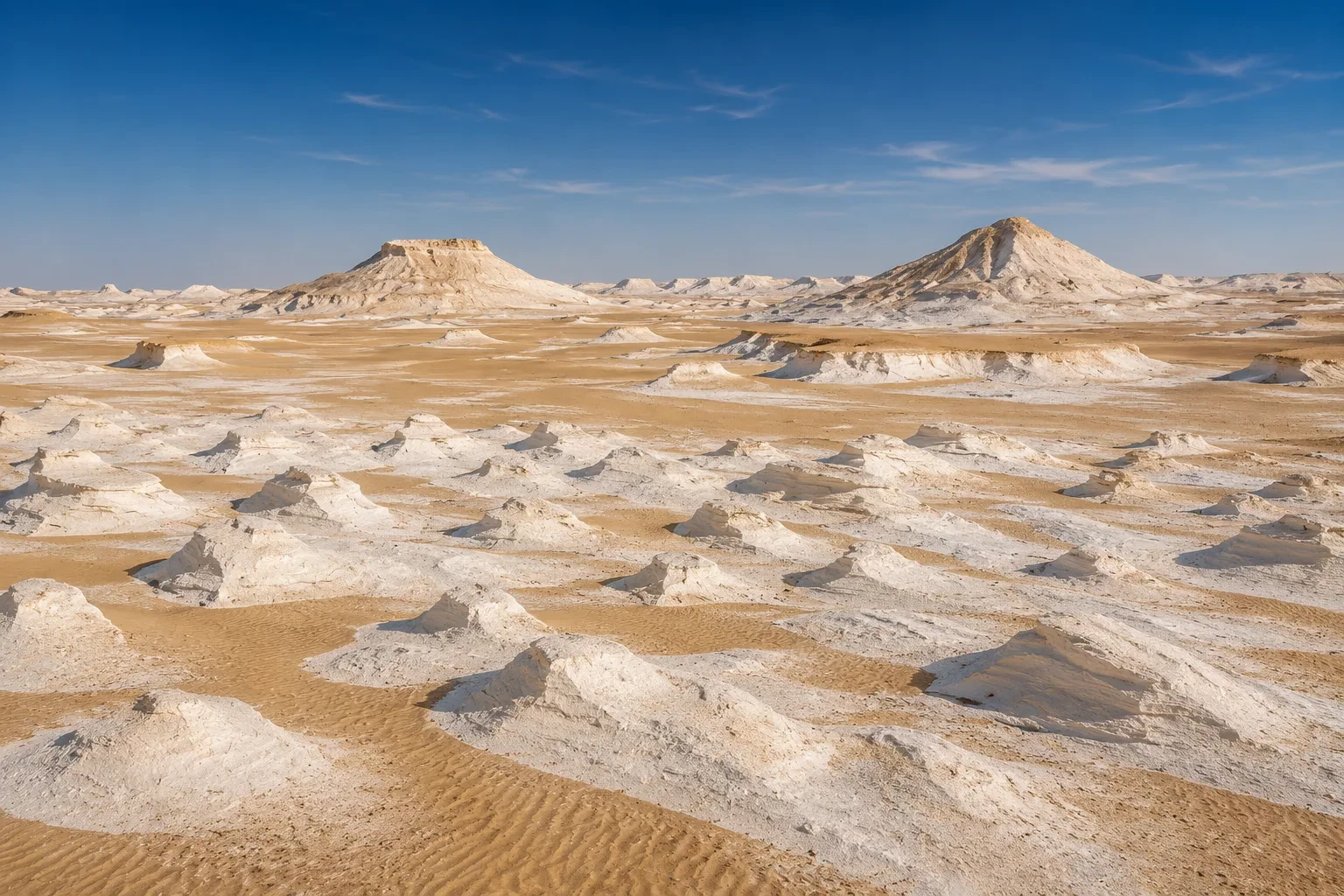
One of the most dramatically beautiful and the most geologically informative natural landscape transitions available anywhere in Egypt occurs at the southern edge of the Black Desert landscape as the volcanic dark terrain of the Black Desert gives way to the chalk-white formations of the northern White Desert in a visual transformation of such completeness and such immediate impact that virtually every traveler who experiences it on the Western Desert safari describes it as one of the most remarkable natural landscape transitions they have ever witnessed anywhere in the world. The geological explanation for this dramatic transition is straightforward: the dark dolerite-capped volcanic geology of the Black Desert gives way to the chalk and limestone geology of the Farafra Depression that underlies the White Desert landscape, a change of bedrock geology that is expressed in the most dramatically visual possible way by the transition from the uniformly dark coloration of the volcanic landscape to the uniformly brilliant white of the chalk formations that characterizes the White Desert landscape to the south. The Crystal Mountain, encountered at the boundary between the two desert landscapes as a standard stopping point on the Western Desert safari circuit, serves as the most explicit geological marker of this extraordinary transition, its crystalline mineral composition representing a completely different geological process from either the volcanic rocks of the Black Desert or the chalk formations of the White Desert and providing a mineralogical bridge between the two primary desert landscapes of the circuit.
What Is So Special About The Black Desert?
The Most Primordially Dramatic Landscape In The Egyptian Desert
What makes the Black Desert uniquely special among all the natural heritage destinations of the Egyptian Western Desert is the quality of primordial geological drama that its volcanic landscape creates, a sense of encountering the Earth's geological past in its most raw and most physically immediate form that is available at very few other accessible natural heritage sites in Egypt or in the broader North African landscape. The dark volcanic hills, the black stone plains, the geological deep time of the Cretaceous volcanic episode that created the landscape, and the extraordinary isolation of the Western Desert environment together create a natural heritage experience of such immediate and overwhelming physical presence that virtually every visitor who experiences the Black Desert describes it as one of the most genuinely affecting natural environments they have encountered anywhere in the world. The Black Desert is not a pretty landscape in the conventional sense of managed natural beauty; it is a landscape of geological power and geological truth, a place where the long history of the Earth is written in volcanic rock with a directness and a physical immediacy that no museum exhibit or documentary film can substitute for, and where the visitor's own physical presence in the ancient volcanic terrain creates the most profound possible encounter with the geological deep time that underlies every landscape on the planet but is most directly and most visually available in the extraordinary exposures of the Black Desert.
The Perfect Counterpoint To The White Desert
The Black Desert is also uniquely special for the role it plays as the perfect geological and visual counterpoint to the White Desert that is its most natural and its most frequently combined natural heritage partner in the Western Desert safari circuit. The contrast between the dark volcanic drama of the Black Desert and the ethereal chalk-white elegance of the White Desert is one of the most complete natural landscape contrasts available at any pair of sites within driving distance of each other in the entire Egyptian natural heritage landscape, and the experience of moving from one to the other in the course of a single safari programme creates a journey of geological education and aesthetic discovery of extraordinary impact and extraordinary personal memorability. The two deserts together tell the complete story of the Western Desert's geological history in the most dramatically visual and the most immediately comprehensible way possible, with the Black Desert documenting the volcanic past and the White Desert documenting the chalk erosion present, and the traveler who experiences both in the same programme acquires in the most direct and the most personally compelling way available a genuine understanding of the geological processes that have created one of the most extraordinary natural landscapes in the world.
Black Desert Through The Ages: From Ancient Geology To Modern Discovery
The Black Desert landscape has been developing through the slow geological processes of volcanic rock erosion and dark stone accumulation since the Cretaceous period, approximately 80 to 100 million years ago, making its geological history one of the longest and the most ancient of any accessible natural heritage site in Egypt. The human history of the Black Desert region is intertwined with the broader history of the Bahariya Oasis and the Western Desert oasis chain, whose communities have recognized the geological distinctiveness of the Black Desert landscape and incorporated it into their cultural geography since ancient times. The ancient Egyptians of the Bahariya Oasis era, whose remarkable Greco-Roman period cemetery is represented by the Valley of the Golden Mummies, were certainly familiar with the Black Desert landscape as the northern approach to their oasis homeland, though the specific cultural significance they attached to the volcanic terrain is not documented in the archaeological record.
The WWII British military presence on the English Mountain represents the most recent historical chapter in the Black Desert's human history, bringing the ancient geological landscape into direct contact with the 20th century's most consequential military conflict and leaving on the summit of the mountain the physical traces that give it both its English name and its historical interest for contemporary visitors. The development of the Western Desert safari circuit in the 1980s and 1990s, driven primarily by the growing international demand for adventure travel and natural heritage tourism experiences beyond the conventional Nile Valley archaeological programme, transformed the Black Desert from a remote and rarely visited geological feature into a major tourism destination attracting tens of thousands of visitors annually. Today the Black Desert is one of the most recognized and the most frequently visited natural heritage destinations in the Egyptian Western Desert, integrated into the comprehensive Western Desert safari programmes that WOW Egypt Tours offers as the most expertly guided and the most completely organized desert safari experience available in Egypt.
Black Desert Natural Heritage Conservation
The Black Desert landscape is protected as part of the broader Western Desert natural heritage zone managed by the Egyptian Environmental Affairs Agency and the Egyptian Ministry of Tourism and Antiquities, whose conservation responsibilities encompass both the geological and the archaeological heritage of the Western Desert oasis region. The management of tourism in the Black Desert and the broader Western Desert safari circuit, including the regulation of four-wheel-drive vehicle access, the control of camping locations and practices, and the supervision of commercial guide operations, is intended to ensure that the natural geological landscape of the Black Desert is preserved in its current extraordinary state for future generations of visitors and scholars. The fragility of the desert ecosystem, which includes not only the geological formations but also the sparse desert vegetation and the invertebrate and vertebrate fauna adapted to the extreme desert conditions of the Western Desert, requires that all visitors to the Black Desert adhere to the responsible tourism practices and the environmental guidelines established by the Egyptian conservation authorities and communicated to visitors through the licensed guide services of reputable safari operators including WOW Egypt Tours.
Best Time To Visit The Black Desert
The best time to visit the Black Desert is during the cooler months from October through April, when the Western Desert climate provides the most comfortable conditions for outdoor desert exploration, with daytime temperatures ranging from approximately 15 to 25 degrees Celsius and the cold desert nights that make open-air desert camping at the Black Desert or the White Desert one of the most atmospherically extraordinary natural heritage experiences available in Egypt. The summer months from May to September bring extreme heat to the Western Desert, with daytime temperatures regularly exceeding 40 to 45 degrees Celsius, making outdoor desert activities in the full heat of the day genuinely dangerous without extraordinary preparation and confining comfortable desert exploration to the very early morning and the late afternoon hours. The winter months of December through February offer the most comfortable daytime temperatures and the clearest desert skies of any season, but also the coldest nights when temperatures in the desert can drop to near freezing or below, requiring warm sleeping bags and appropriate cold-weather camping equipment for any overnight desert programme. The spectacular desert sunsets and the extraordinary starry skies of the Western Desert, visible on all clear nights throughout the year but most reliably on the longer nights of the winter season, are among the most celebrated and the most personally affecting natural experiences of any Western Desert safari programme. WOW Egypt Tours operates Western Desert Safari programmes year-round and advises on optimal seasonal timing for all desert destinations.
Black Desert Opening Hours
The Black Desert is an open natural landscape accessible throughout the daylight hours every day of the year without formal opening or closing times, subject to the regulations of the Egyptian conservation authorities regarding vehicle access and camping in the protected desert area. Access to the Black Desert by private vehicle from the Cairo to Bahariya Desert Road is straightforward during daylight hours, with the painted rocks and volcanic hills of the landscape visible from the road and easily accessible for short visits by any private vehicle. Extended exploration of the interior of the Black Desert landscape, including the climb to the summit of the English Mountain and access to the more remote sections of the dark volcanic terrain beyond the road margin, requires the use of a four-wheel-drive vehicle and the services of a licensed desert guide. Desert camping in the Black Desert area is subject to the regulations of the Egyptian Environmental Affairs Agency and requires the use of designated camping areas as identified by licensed guide services.
Black Desert Entrance Fees
Access to the Black Desert area may be subject to a conservation area fee payable at the checkpoint on the Desert Road between Cairo and Bahariya, whose current rate should be confirmed with WOW Egypt Tours at the time of booking as desert area access fees in Egypt are subject to periodic adjustment by the Egyptian conservation authorities. The conservation fee contributes to the management and preservation of the extraordinary natural heritage of the Western Desert region including both the Black Desert and the White Desert landscapes. All conservation area fees and local guide fees for the Black Desert visit are included in the comprehensive Western Desert Safari Tour and Egypt Desert Safari programmes offered by WOW Egypt Tours.
How To Get To The Black Desert
The Black Desert is located approximately 370 kilometers southwest of Cairo on the Desert Road that connects Cairo with the Bahariya Oasis, a drive of approximately 3.5 to 4 hours by private vehicle. The Black Desert landscape begins approximately 50 kilometers north of the Bahariya Oasis main settlement of Bawiti, with the first conical volcanic hills and dark stone plains becoming visible from the Desert Road as the road descends toward the Bahariya depression. The standard approach to the Black Desert for Western Desert safari programmes is therefore a full day's drive from Cairo, typically departing in the early morning to arrive at the northern Black Desert by late morning, spend several hours exploring the volcanic landscape and climbing the English Mountain, and continue to the Bahariya Oasis for the first night's accommodation. The return journey from the Black Desert to Cairo after a complete Western Desert circuit via the White Desert typically takes a different route through the Farafra Oasis and back north to Cairo, providing a comprehensive overview of the Western Desert landscape in both directions. WOW Egypt Tours provides private four-wheel-drive vehicle transportation for all Black Desert visits as part of comprehensive Western Desert Safari Tours and Egypt Desert Safari programmes, with all navigation, desert guide services, and camping arrangements organized and managed by WOW Egypt Tours's experienced desert operations team.
How Long To Spend At The Black Desert
Most Western Desert safari programmes allocate approximately 2 to 4 hours for the Black Desert visit, which is sufficient time to explore the volcanic landscape on foot from a vehicle base, to climb to the summit of the English Mountain for the panoramic view of the complete Black Desert landscape, and to examine the dark stone plains and the conical volcanic hills at close range. Travelers with a particular interest in geology, in the WWII history of the English Mountain, or in the photography of the volcanic landscape in different lighting conditions may wish to allow additional time at specific features of the Black Desert. Overnight camping in the Black Desert allows the extraordinary experience of sunset and sunrise in the volcanic landscape, providing the most dramatically beautiful light conditions of the entire day for the photography of the dark rock surfaces and the most complete immersion in the primordial silence of the ancient geological terrain that is the defining quality of the extended Black Desert experience. The Black Desert is almost universally combined in a Western Desert safari programme with the Crystal Mountain and the White Desert, which together provide the most complete available natural heritage experience of the Western Desert geological heritage in a single multi-day programme.
Tips For Visiting The Black Desert
Climb the English Mountain as early in your Black Desert visit as possible, before the heat of the day makes the ascent uncomfortable and before the overhead sun of midday flattens the visual quality of the panoramic view from the summit, as the early morning or late afternoon light from a low angle provides the most dramatic and the most texturally revealing illumination of the volcanic rock surfaces visible from the summit. Walk into the dark stone plains away from the vehicles to experience the most complete immersion in the volcanic landscape, as the full impact of the Black Desert's primordial geological character is only accessible from within the dark stone terrain rather than from the road margin or from the vehicle. Look carefully at the individual dark stones of the desert floor and notice the variety of geological forms, textures, and mineralogical characters represented in the accumulated volcanic fragments, as the Black Desert is not simply a uniformly dark landscape but a complex geological assembly of different rock types and erosional forms that rewards close examination with a wealth of geological detail. Plan the Black Desert visit for either early morning or late afternoon to experience the most beautiful desert light conditions, as the warm low-angle light of these times of day transforms the dark volcanic rock surfaces from flat grey to a rich palette of warm dark colors of extraordinary visual beauty. Time your departure from the Black Desert to arrive at Crystal Mountain in the late afternoon for the most spectacular light on the crystalline mineral surfaces that define its visual character. A licensed desert guide from WOW Egypt Tours with specific knowledge of the Black Desert's geology, history, and natural heritage is essential for the fullest appreciation of the landscape and its significance.
What To Wear At The Black Desert
The Black Desert is an exposed outdoor desert site with no shade whatsoever and extreme temperature ranges between the hot midday and the potentially cold night, requiring comprehensive and versatile clothing appropriate for all desert conditions. In the cooler months from October through April, the daytime requires lightweight, breathable, long-sleeved clothing that covers the arms and legs for sun protection, combined with a wide-brimmed hat and generous sunscreen, while the evenings and nights require warm fleece layers, a warm jacket, and in the coldest winter months a thermal base layer and a very warm sleeping bag for overnight camping. In the summer months, the extreme midday heat requires all outdoor activities to be limited to the very early morning and the late afternoon, with the full midday confined to the air-conditioned vehicle interior, and all outdoor clothing should provide maximum ventilation while maintaining sun protection. Sturdy, closed-toe walking shoes or hiking boots with good ankle support and good grip are strongly recommended for the uneven volcanic rock surfaces of the Black Desert, which include sharp dolerite edges, loose stones, and the occasional significant gradient on the hill and mountain slopes, making sandals and flat-soled shoes genuinely hazardous for extended walking in the terrain. Carry at least 2 to 3 liters of water per person for any Black Desert visit lasting more than one hour, and significantly more for overnight camping programmes in the summer months.
Photography At The Black Desert
The Black Desert is one of the most photogenically distinctive and the most consistently rewarding natural landscape photography destinations in the entire Egyptian desert heritage, combining the immediately striking visual contrasts of the dark volcanic rock against the golden sand with the dramatic geological forms of the conical hills and the extraordinary quality of the Western Desert light at different times of day to create photography conditions of exceptional richness and natural drama. The most spectacular photography results are consistently achieved in the late afternoon golden hour and at sunset, when the warm orange and red light from the west transforms the dark grey volcanic surface into a rich palette of warm dark colors of extraordinary visual beauty and complexity, creating a landscape of such immediate and overwhelming color drama that even the most modest camera or smartphone can capture images of genuine artistic quality. Early morning photography, with the cool clear desert dawn light illuminating the volcanic rock surfaces from the east in raking diagonal beams that reveal every individual pebble and the subtle textures of the ancient volcanic rock, provides a different but equally extraordinary photography experience. The summit of the English Mountain provides the finest panoramic photography of the complete Black Desert landscape, allowing wide-angle compositions that include the full extent of the volcanic terrain from the northern escarpments to the southern oasis, while ground-level photography from among the dark stones and at the base of the conical hills provides the most dramatically immersive and the most compositionally intense close-range images of the volcanic geology. A wide-angle lens or the widest available smartphone setting is most useful for capturing the scale and the panoramic character of the Black Desert landscape. Photography is freely permitted throughout the Black Desert landscape without restriction. Professional photography or filming for commercial purposes may require advance permits.
Black Desert Tours
Western Desert Safari: Black Desert, White Desert, And Bahariya Oasis
This is the classic and most comprehensive Western Desert safari programme, combining the Black Desert, the Bahariya Oasis, Crystal Mountain, and the White Desert in a complete circuit of the most extraordinary natural and cultural heritage destinations of the Egyptian Western Desert, available in durations of two to five days from Cairo depending on the depth of exploration desired at each destination.
What Is Covered
Private four-wheel-drive vehicle from Cairo along the Desert Road southwest. Arrival at the Black Desert approximately 50 kilometers north of Bahariya. Guided exploration of the Black Desert volcanic landscape including the dark stone plains and the conical volcanic hills. Guided climb to the summit of the English Mountain for the panoramic view of the complete Black Desert landscape and explanation of the WWII military history. Continue to the Bahariya Oasis for dinner and first night accommodation. Following day: Valley of the Golden Mummies archaeological site visit. Drive south through the Crystal Mountain stopping point for the mineral crystal formations. Enter the White Desert National Park for guided exploration of the extraordinary white chalk rock formations. Desert camp in the White Desert with sunset, stargazing, and sunrise experiences. Return to Cairo via Farafra Oasis on the final day.
Duration
2 Days 1 Night minimum (rushed), 3 Days 2 Nights recommended (comfortable), 4 to 5 Days for extended exploration.
Includes
Private four-wheel-drive vehicle, licensed desert guide, all accommodation in Bahariya Oasis and desert camping, all meals from dinner on Day 1 through breakfast on final day, conservation area fees, and all required desert logistics. All through WOW Egypt Tours Egypt Desert Safari Tours.
Black Desert And English Mountain Half-Day Excursion From Bahariya
For travelers already based in the Bahariya Oasis, this focused half-day excursion explores the Black Desert landscape and the English Mountain summit in the most time-efficient format available, ideal as a standalone desert experience or as a component of a longer Bahariya-based programme.
What Is Covered
Private four-wheel-drive vehicle from Bahariya Oasis accommodation. Guided exploration of the nearest Black Desert volcanic hills and dark stone plains. Guided climb to the English Mountain summit with WWII history explanation and panoramic landscape photography. Return to Bahariya accommodation.
Duration
Half day from Bahariya, approximately 3 to 4 hours total including driving.
Includes
Private four-wheel-drive vehicle, desert guide, and conservation fees. Through WOW Egypt Tours Egypt Desert Safari Tours.
Combine The Black Desert With Your Egypt Tours Package
The Black Desert is featured as a distinctive desert natural heritage destination across the WOW Egypt Tours travel products that include the Western Desert. Browse the options below to find the Egypt experience that includes the Black Desert.
Egypt Tour Packages: Multi-day guided Egypt tours organized by duration, including 2 Days Egypt Packages, 3 Days Egypt Packages, 4 Days Egypt Packages, 5 Days Egypt Packages, 6 Days Egypt Packages, 7 Days Egypt Packages, 8 Days Egypt Packages, 10 Days Egypt Packages, and longer itineraries. All packages that include the Western Desert feature the Black Desert as the opening geological chapter of the comprehensive Western Desert safari programme. All packages include private vehicle, licensed guide, accommodations, conservation fees, and all desert logistics.
Egypt Travel Packages: Themed Egypt travel packages designed around specific travel styles and interests, including Egypt Honeymoon Travel Packages, Egypt Budget Travel Packages, Egypt Family Travel Packages, Egypt Luxury Travel Packages, Egypt Adventure Travel Packages, Egypt Cultural Travel Packages, and Egypt Christmas and New Year Travel Packages. The Black Desert is particularly well suited to Adventure, Cultural, and Family themed packages for the extraordinary combination of geological drama, historical interest, and physical desert experience it provides. All packages include private transportation, licensed guide, accommodations, meals, and all desert logistics.
Egypt Desert Safari Tours: Specialized desert safari programmes covering the extraordinary natural and cultural heritage of Egypt's desert landscapes including the Western Desert circuit of the Black Desert, Bahariya Oasis, Crystal Mountain, and the White Desert. The Black Desert is the featured opening destination of all Western Desert-focused Egypt Desert Safari Tours, combined with the complete circuit of the Western Desert's most extraordinary natural and archaeological heritage in programmes of two to five days from Cairo. All Desert Safari Tours include private four-wheel-drive vehicle, licensed desert guide, all accommodation, all meals, conservation fees, and all required desert logistics.
Egypt Nile Cruise Packages: Complete Egypt travel packages combining Cairo sightseeing with a fully guided Nile cruise. The Black Desert can be added as a Western Desert extension to any Egypt Nile Cruise Package for travelers wishing to combine the ancient Nile Valley heritage with the extraordinary natural geological heritage of the Egyptian Western Desert.
Nile River Cruises: All WOW Egypt Tours Nile cruise options. The Black Desert is available as a Western Desert extension from Cairo added to any Nile River Cruise itinerary.
Luxor Aswan Nile Cruises: The classic Upper Egypt Nile cruise route. The Black Desert is available as a Western Desert extension from Cairo combined with any Luxor-Aswan cruise programme.
Nearby Attractions To The Black Desert
The Black Desert is the northern gateway to the complete Western Desert safari circuit and its most naturally combined nearby attractions are the extraordinary natural and archaeological heritage destinations of the Bahariya Oasis and the southern White Desert landscape that together constitute the most comprehensive available Western Desert safari experience. The Bahariya Oasis itself, the fertile oasis valley approximately 50 kilometers south of the Black Desert, is the primary base for all Western Desert safari operations and the location of the extraordinary Valley of the Golden Mummies, the Greco-Roman period mummy cemetery discovered in 1996 that may contain the remains of up to ten thousand ancient Egyptians decorated with golden masks and elaborate painted cartonnage. The Valley of the Golden Mummies, combined with the Bahariya Museum displaying the most significant mummies and artifacts recovered from the site, provides the most immediately dramatic and the most archaeologically significant heritage experience in the entire Western Desert region, giving the Black Desert safari programme a human historical dimension that complements the geological drama of the volcanic landscape with extraordinary power.
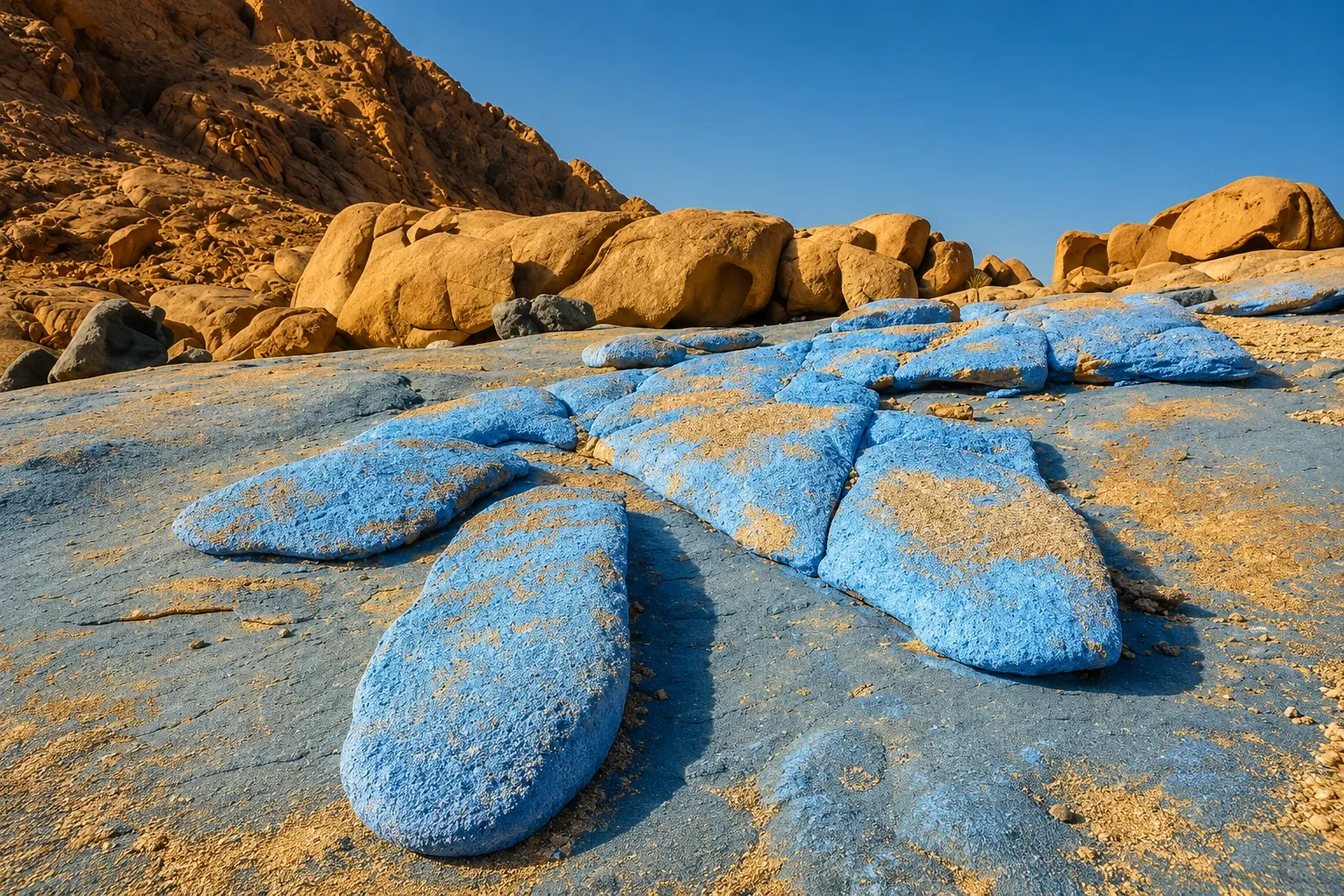
Crystal Mountain, encountered at the southern edge of the Black Desert landscape on the road between Bahariya and Farafra, is a standard stopping point on all Western Desert safari programmes and one of the most mineralogically spectacular natural formations in the entire Egyptian desert heritage, its crystalline calcite and barite surfaces flashing with brilliant mineral light that provides a dramatic visual transition between the dark volcanic landscape of the Black Desert to the north and the white chalk formations of the White Desert to the south. The White Desert itself, the most celebrated and the most internationally recognized natural heritage destination of the entire Egyptian desert circuit, lies approximately 100 kilometers south of the Bahariya Oasis in the Farafra Depression, where its extraordinary sculpted chalk formations including the famous mushroom rocks, the chicken rock, and the rabbit rock create the most otherworldly and the most immediately astonishing natural landscape experience available anywhere in Egypt. The Blue Desert of Sinai, in the South Sinai Peninsula, provides a completely different desert landscape experience in a different geographical region that together with the Black Desert and the White Desert constitutes the most complete available programme of Egypt's extraordinary desert natural heritage. All these destinations are accessible through the Egypt Desert Safari Tours and Egypt Travel Packages offered by WOW Egypt Tours.
Frequently Asked Questions About The Black Desert
What is the Black Desert of Egypt?
The Black Desert is a volcanic desert landscape in the Western Desert of Egypt approximately 50 kilometers north of the Bahariya Oasis and 370 kilometers southwest of Cairo, characterized by ancient black and dark grey dolerite volcanic rocks that cover the desert surface and cap the numerous conical hills and mountains of the landscape, creating one of the most dramatically geological and the most visually arresting natural heritage environments in all of Egypt. It is the opening destination of the Western Desert safari circuit and is featured on Egypt Desert Safari Tours and Egypt Travel Packages offered by WOW Egypt Tours.
Why is the Black Desert black?
The Black Desert is black because its landscape is dominated by dark grey to black dolerite and basalt volcanic rocks that were formed by Cretaceous volcanic activity approximately 80 to 100 million years ago. These volcanic rocks cap the numerous conical hills of the region and have been progressively eroded over millions of years to release dark volcanic fragments that accumulate on the desert floor, creating the characteristic dark stone carpet that gives the entire region its black coloration.
What is the English Mountain in the Black Desert?
The English Mountain, known in Arabic as Gebel El Ingilizi, is a prominent volcanic peak approximately 200 meters above the surrounding desert floor that served as a British military observation post during the North African Campaign of World War II. It provides the finest panoramic view of the complete Black Desert landscape from its summit and preserves WWII military remnants that give it its English name and its historical interest.
How long does it take to get to the Black Desert from Cairo?
The Black Desert is approximately 370 kilometers southwest of Cairo on the Desert Road, a drive of approximately 3.5 to 4 hours by private vehicle. The Black Desert landscape begins approximately 50 kilometers north of the Bahariya Oasis, which is the primary oasis base for Western Desert safari programmes.
What is the Valley of the Golden Mummies near the Black Desert?
The Valley of the Golden Mummies is an extraordinary Greco-Roman period mummy cemetery discovered in 1996 in the Bahariya Oasis, approximately 50 kilometers south of the Black Desert. It is estimated to contain the remains of up to ten thousand ancient Egyptians decorated with golden masks and elaborate painted cartonnage, making it potentially the largest ancient mummy cemetery ever discovered in Egypt and one of the most significant archaeological finds of the 20th century.
What is Crystal Mountain?
Crystal Mountain is a large isolated rock formation at the southern edge of the Black Desert landscape, composed of crystalline calcite and barite crystals embedded in a limestone and sandstone matrix, whose exposed crystalline surfaces catch the desert light to create brilliant flashes of mineral beauty. It is a standard stopping point on all Western Desert safari programmes, serving as the geological transition point between the Black Desert and the White Desert.
What is the best time of year to visit the Black Desert?
October through April is the most comfortable period, with daytime temperatures of 15 to 25 degrees Celsius. Winter nights can be very cold, requiring warm sleeping bags for camping. Summer visits are possible with very early morning and late afternoon timing, as midday temperatures can exceed 45 degrees Celsius.
Can I camp overnight in the Black Desert?
Yes. Overnight desert camping in the Black Desert is one of the most atmospheric and the most personally extraordinary natural heritage experiences available in the Egyptian Western Desert, allowing sunset, stargazing, and sunrise in the volcanic landscape. Desert camping requires a licensed desert guide and is organized through WOW Egypt Tours as part of comprehensive Western Desert Safari programmes.
Is the Black Desert suitable for children?
Yes, the Black Desert is an excellent destination for children who respond enthusiastically to the dramatic volcanic landscape and the adventure of desert exploration. Children should be protected from the sun with appropriate clothing and sunscreen, must wear sturdy footwear for the volcanic rock terrain, and must be accompanied by adults at all times. Sufficient water is essential for all members of the group including children.
What is the difference between the Black Desert and the White Desert?
The Black Desert is a volcanic landscape approximately 50 kilometers north of Bahariya Oasis, characterized by dark dolerite volcanic rocks formed approximately 100 million years ago in the Cretaceous period. The White Desert is a chalk landscape approximately 45 kilometers southwest of Farafra Oasis, characterized by brilliant white chalk rock formations sculpted by wind erosion into extraordinary shapes. The two deserts are dramatically different in color, geology, and visual character and are visited together as the two primary natural heritage destinations of the Western Desert safari circuit.
Do I need a four-wheel-drive vehicle to visit the Black Desert?
Extended exploration of the Black Desert terrain beyond the roadside margin requires a four-wheel-drive vehicle and a licensed desert guide for safe navigation of the volcanic rock surfaces and sandy desert terrain. Short roadside visits are accessible by standard vehicle on the Desert Road, but the most rewarding Black Desert experience, including the English Mountain climb, requires four-wheel-drive access to the interior landscape. All WOW Egypt Tours Western Desert Safari programmes use appropriate four-wheel-drive vehicles throughout.
What geological age are the rocks of the Black Desert?
The dolerite volcanic rocks of the Black Desert were formed approximately 80 to 100 million years ago during the Cretaceous geological period, when volcanic intrusions of basaltic magma pushed through the overlying sedimentary rock of the Western Desert and solidified as dolerite sills and dykes. The subsequent erosion that exposed these volcanic rocks at the surface has been proceeding for the last few tens of millions of years, creating the current landscape of dark volcanic hills and stone-covered plains.
How do I book a Black Desert safari tour with WOW Egypt Tours?
You can book any Egypt Desert Safari Tour, Egypt Tours Package, or Egypt Travel Package that includes the Black Desert directly through WOW Egypt Tours. Our team of travel specialists will arrange everything from private four-wheel-drive vehicle and licensed desert guide to accommodation in the Bahariya Oasis, desert camping equipment, conservation fees, and all the logistics of the complete Western Desert safari experience, ensuring a seamless and unforgettable encounter with one of the most primordially dramatic and the most geologically extraordinary natural landscapes in all of Egypt.