

The Blue Desert of Sinai is one of the most unexpected, the most visually astonishing, and the most philosophically resonant landscape art installations in the entire world, a field of ancient black volcanic rocks in the dramatic desert terrain of the South Sinai Peninsula that were painted a brilliant cobalt blue by the Belgian artist Jean Verame in 1980 as a gesture of peace and reconciliation following the Camp David Accords that ended decades of conflict between Egypt and Israel, creating in the silence of the Sinai wilderness a permanent artistic monument to the possibility of peace that has attracted travelers, artists, photographers, and seekers of extraordinary natural and human experience from every country in the world for more than four decades. Located approximately 25 kilometers from the town of Dahab and approximately 10 kilometers from the town of Saint Katherine in the interior of the South Sinai Peninsula, the Blue Desert is set in a landscape of such raw and dramatic beauty, with the ancient granite mountains of the Sinai rising in every direction, the desert floor stretching in silence between the painted rocks and the distant peaks, and the extraordinary quality of the Sinai desert light transforming the blue pigment on the ancient stone surfaces through the daily cycle of morning clarity, midday intensity, and sunset magnificence, that it has become one of the most photographed and the most memorably beautiful destinations in the entire Sinai heritage and natural landscape. This extraordinary destination is accessible through Egypt Desert Safari Tours and Egypt Travel Packages, both of which WOW Egypt Tours proudly offers to travelers from around the world as part of Egypt Tours Packages that encompass the complete natural and cultural heritage of the extraordinary Sinai Peninsula.
The Blue Desert Sinai is not simply a curiosity or a tourist attraction in the conventional sense. It is a genuine work of landscape art of the first order, conceived and executed by an internationally recognized artist who chose one of the most ancient and the most dramatically beautiful desert landscapes in the world as the canvas for a statement about the most fundamental human aspiration, the desire for peace between peoples who have been in conflict, and who used the most basic artistic medium, pigment applied to natural stone, to create in the silence of the desert a monument whose message is simultaneously the most universal and the most personally affecting of any modern art installation in Egypt. The blue rocks of the Blue Desert, scattered among the ancient black volcanic boulders of the Sinai desert floor in a composition that is part deliberate artistic arrangement and part natural accident of topography and human interaction with the desert landscape, create a visual experience so profoundly unexpected in the context of the surrounding natural desert environment that the first sight of them, whether arriving by vehicle or on foot from the surrounding desert, consistently produces in visitors a response of genuine surprise and genuine wonder that is among the most immediately powerful aesthetic encounters available at any site in the Egyptian natural and cultural heritage landscape. The Blue Desert is most naturally visited as part of a comprehensive Sinai desert programme that also includes the ancient granite mountains, the extraordinary monastic heritage of WOW Egypt Tours St. Katherine's Monastery, and the broader natural and human heritage of one of the most ancient and the most spiritually significant wilderness landscapes in the world.

Who Created The Blue Desert?
The Blue Desert was created by Jean Verame, a Belgian artist born in 1936 who has spent his career making large-scale landscape art installations in the most dramatic and the most geographically significant natural environments in the world, including the deserts of Morocco, Chad, and Tibet as well as Sinai, always using the same fundamental approach of applying brilliant mineral pigments to natural rock surfaces to create works of art that are simultaneously human interventions in natural landscapes and genuine partnerships between the artist's vision and the geological character of the terrain he chooses. Verame is one of the most significant figures in the tradition of land art or earth art that emerged in the 1960s and 1970s as artists began to work directly with natural landscapes on a scale impossible to achieve in any gallery or museum, and his work in Sinai is widely regarded as among the most successful and the most emotionally powerful of his career, perfectly matched between the scale of the artistic gesture and the spiritual significance of the landscape in which it is placed.
The Blue Desert project was conceived and executed in 1980, in the period immediately following the signing of the Camp David Accords in 1978 and the subsequent Egyptian-Israeli Peace Treaty of 1979 that ended the state of war between Egypt and Israel that had been a defining feature of the Middle Eastern political landscape since the founding of the Israeli state in 1948. Verame obtained the support of the Egyptian government and the personal patronage of President Anwar Sadat for the project, working with a team of Bedouin laborers over a period of several months to apply approximately ten tonnes of blue paint to the ancient black volcanic rocks of the Sinai desert in the area between the towns of Dahab and Saint Katherine, creating the Blue Desert installation that has remained in place in the Sinai landscape ever since. The choice of the Sinai Peninsula as the location for a monument to peace was itself deeply symbolic, as the Sinai had been the primary theater of the three wars between Egypt and Israel and its return to Egyptian sovereignty under the Camp David agreement was the most tangible expression of the peace that Verame's installation was designed to celebrate. The choice of blue, the color of sky and sea and the color universally associated with the United Nations and with international peace, gave the installation its most immediately comprehensible symbolic dimension.
Who Was Jean Verame?
Jean Verame is one of the most distinctive and the most internationally recognized figures in the tradition of landscape or earth art, a Belgian artist whose career has been defined by a consistent commitment to working with the most ancient and the most geologically dramatic natural environments in the world on a scale of artistic intervention that no indoor or gallery-based art practice could ever approach. Born in Belgium in 1936, Verame developed his distinctive artistic practice in the context of the broader international land art movement that emerged in the late 1960s and that included such celebrated figures as Robert Smithson, whose Spiral Jetty in the Great Salt Lake of Utah is the most famous single work of landscape art in the American tradition, and Andy Goldsworthy, whose more intimate interventions in natural landscapes have attracted a different but equally devoted international following. Verame's practice differs from most of his contemporaries in the land art tradition in its consistent use of industrial paint pigments applied to natural rock surfaces, a technique that produces works of immediate visual impact and long-term physical durability rather than the deliberately impermanent or process-based works that characterize much of the land art tradition.
His most celebrated works before the Sinai project included large-scale painted rock installations in the deserts of Morocco, where his use of intense mineral pigments applied to the ancient sandstone and granite boulders of the Moroccan desert created landscape art works of considerable critical recognition and popular appeal. The invitation to work in Sinai under the patronage of President Sadat represented the most politically significant commission of his career, and the scale and the ambition of the Blue Desert project, involving ten tonnes of paint applied over several months to an area of desert several kilometers in extent, was the largest single landscape art installation he had undertaken to that point. Verame has subsequently worked in several other landscapes including the Tibetan plateau and the deserts of Chad, but the Blue Desert of Sinai remains the most widely known and the most frequently visited of all his works, visited by hundreds of thousands of travelers annually and reproduced in photography collections, travel literature, and art historical surveys throughout the world.
Blue Desert Sinai Location
The Blue Desert is located in the interior of the South Sinai Peninsula in the Sinai Governorate of Egypt, approximately 25 kilometers west of the town of Dahab on the Gulf of Aqaba coast and approximately 10 kilometers north of the town of Saint Katherine, in the desert terrain between the coastal Red Sea resort communities of the eastern Sinai and the ancient granite mountain landscape of the interior that includes the sacred peak of Jebel Musa, known in the Christian tradition as Mount Sinai, and the ancient monastery of Saint Katherine. The Blue Desert site is accessible from Dahab by private vehicle along the road that crosses the interior of the South Sinai Peninsula toward Saint Katherine, with the painted rocks visible from the roadside at a point approximately 25 kilometers from the Dahab junction, making it accessible as a stopping point on the road between Dahab and Saint Katherine rather than requiring a dedicated out-and-back trip to a remote site. The surrounding landscape of the Blue Desert is the characteristic South Sinai desert terrain of ancient black volcanic and granite rocks, sandy desert floor, and the distant mountain peaks of the Sinai massif that give the region its dramatic natural character. WOW Egypt Tours provides private air-conditioned transportation to the Blue Desert as part of comprehensive Sinai Desert Safari Tours and Sinai heritage programmes.
Blue Desert Sinai Fun Facts
Jean Verame used approximately ten tonnes of blue paint to create the Blue Desert installation in 1980, applying the paint over a period of several months to the ancient volcanic rocks of the Sinai desert with the assistance of a team of local Bedouin laborers. The paint used was a specially formulated mineral-based pigment designed to withstand the extreme temperature variations, the intense solar radiation, and the occasional rain of the Sinai desert environment, and the fact that the blue pigment is still clearly visible on the rock surfaces more than four decades after its original application is a testament both to the quality of the paint formulation and to the extraordinary durability of mineral pigments applied to porous volcanic rock surfaces in a very dry desert environment.
The Camp David Accords of 1978, which provided the political context and the personal inspiration for the Blue Desert installation, were negotiated at the presidential retreat of Camp David in the mountains of Maryland between Egyptian President Anwar Sadat, Israeli Prime Minister Menachem Begin, and American President Jimmy Carter over a period of thirteen days in September 1978, resulting in a framework agreement for peace between Egypt and Israel that was formalized as the Egyptian-Israeli Peace Treaty in March 1979. Sadat and Begin were jointly awarded the Nobel Peace Prize in 1978 for their roles in the Camp David negotiations, and the subsequent peace treaty was the first formal peace agreement between Israel and any of its Arab neighbors, a landmark in the diplomatic history of the Middle East whose significance in the context of the Blue Desert installation gives the painted rocks of the Sinai a political and historical resonance that extends far beyond the purely artistic dimension of the work.
The Blue Desert is located in the territory of the South Sinai Bedouin communities, whose presence in the Sinai Peninsula predates the modern Egyptian state by many centuries and whose deep knowledge of the Sinai desert landscape, its geography, its seasonal patterns, and its natural resources, gives them a unique relationship to the landscape art installation that represents a very different kind of relationship to the desert than the tourist or artistic visitor's encounter. The Bedouin communities of the South Sinai have incorporated the Blue Desert into their daily landscape in a process of naturalization that has made the painted rocks part of the familiar environment of their traditional territory, and their role as guides, transport providers, and cultural interpreters for visitors to the Blue Desert and the broader Sinai landscape gives them an active and economically significant stake in the tourism that the installation generates.
Why Is It Called The Blue Desert?
The Blue Desert takes its name from the most immediately obvious visual characteristic of the installation: the brilliant cobalt blue color of the painted rocks that distinguishes them dramatically from the surrounding natural desert landscape of black volcanic boulders and sandy desert floor. The name is both a straightforward descriptive designation and a paradox, since deserts are by definition landscapes of earthen, sandy, or rocky colors in the warm spectrum of ochre, brown, red, and black that characterize the natural mineral palette of arid environments throughout the world, and the introduction of the intensely cool and aquatic color of cobalt blue into this landscape of warm earth tones creates a visual and conceptual dissonance so complete and so immediately powerful that the name Blue Desert captures perfectly the experience of encountering the installation for the first time. The Arabic name for the site, Al-Sahara Al-Zarqa, translates directly as the Blue Desert in the same straightforward descriptive mode, and it is by this name that the installation is universally known among the Egyptian, Bedouin, and international communities that visit and write about it. The name also carries within it the symbolic resonance of the color blue itself, the color of sky and sea and the color most universally associated with peace, tranquility, and hope, giving the designation Blue Desert a depth of connotative meaning that reinforces the political and humanistic message of Jean Verame's original artistic conception.
Blue Desert Sinai History
The history of the Blue Desert as a human creation is inseparable from the history of the Camp David peace process and the Egyptian-Israeli peace that it was designed to celebrate, placing the painted rocks of the Sinai in the context of one of the most significant diplomatic events of the 20th century and giving the artistic installation a historical narrative that extends far beyond the purely aesthetic into the domain of political history and international relations. The Camp David Accords of September 1978 and the subsequent Egyptian-Israeli Peace Treaty of March 1979 represented a fundamental transformation of the political landscape of the Middle East, ending more than thirty years of intermittent armed conflict between Egypt and Israel and establishing the framework for a permanent peace between the two countries that remains in effect to the present day. The Sinai Peninsula, whose occupation by Israel since 1967 and subsequent return to Egypt under the Camp David framework was the most tangible expression of the peace settlement, was therefore the most appropriate and the most symbolically powerful location in which to create a permanent artistic monument to the peace that had been achieved.
Jean Verame's project was supported by President Sadat personally, who recognized the political and cultural significance of a major international art installation celebrating the Egyptian-Israeli peace in the landscape of the Sinai itself, and the Egyptian government provided the logistical support, the military access permissions, and the official endorsement that made the large-scale painting project feasible in the remote desert terrain. The work was carried out over several months in 1980, with Verame and his Bedouin collaborators applying the blue paint to the selected rocks in a composition that was partly determined by the natural distribution of the volcanic boulders in the desert landscape and partly by Verame's artistic decisions about which rocks to paint, which to leave natural, and how to create the most visually effective composition within the given terrain. The completion of the Blue Desert installation in 1980 was marked by an inauguration ceremony attended by Egyptian officials and by the international art world, and the installation immediately attracted significant international media and cultural attention as one of the most remarkable and the most politically resonant landscape art works of the late 20th century.
In the decades since its creation, the Blue Desert has become increasingly established as one of the most distinctive and the most internationally recognized natural and cultural heritage destinations in the South Sinai Peninsula, attracting a continuously growing audience of visitors ranging from art enthusiasts and photography travelers to spiritually motivated desert seekers and political history aficionados who come specifically to stand in the painted landscape and reflect on the peace message that the blue rocks embody. The paint has weathered somewhat over the four decades since its application, with some rocks showing fading or flaking of the original pigment surface, and periodic restoration work has maintained the most visible sections of the installation in a state of reasonable preservation. The ongoing presence of the Blue Desert in the Sinai landscape as a permanent feature rather than a temporary installation gives it a quality of historical depth and landscape belonging that most temporary art installations cannot achieve, and the integration of the painted rocks into the daily landscape of the local Bedouin communities gives the work a living social context that art gallery or museum installations can never replicate.
The Story Of The Blue Desert And Peace
The story of the Blue Desert is ultimately a story about the relationship between art and peace, about the power of artistic gesture to make political and humanistic aspirations physically present in a landscape, and about the extraordinary capacity of a simple act of painting, color applied to stone, to carry a message of universal significance across decades and across cultural boundaries to every visitor who encounters the painted rocks in the silence of the Sinai desert. Jean Verame's choice of the Sinai as the site for his peace monument was not accidental but the result of a profound understanding of the symbolic geography of the Sinai Peninsula, which is simultaneously one of the most anciently sacred landscapes in the world's three Abrahamic religious traditions, the landscape where Moses received the Law and where the Children of Israel wandered in the wilderness, and the landscape that had been the primary theater of the Arab-Israeli wars and whose return to Egypt under the Camp David peace was the most concrete and the most humanly significant expression of the diplomatic peace that Sadat and Begin had achieved.
The use of blue, the specific color choice that gives the Blue Desert its name and its most immediate visual impact, was not simply an aesthetic preference but a carefully considered symbolic decision that draws on the universal human associations of blue with sky and sea and peace, and on the specific international symbolic associations of the color with the United Nations flag and with the aspiration to a world governed by international law and cooperation rather than by national military power. The application of this color of peace to the ancient rocks of the Sinai, the landscape of the most ancient and the most humanly significant peace aspirations of the Abrahamic religious traditions, creates a visual synthesis of political aspiration and spiritual landscape that gives the Blue Desert a depth of meaning well beyond what the purely aesthetic qualities of the painted rocks alone could convey. Visitors who come to the Blue Desert with knowledge of this historical and symbolic context invariably describe the experience of standing among the painted rocks as one of the most moving and the most personally affecting encounters with the aspiration to human peace available at any single site in Egypt, and many describe the experience as genuinely spiritual in a way that transcends the purely aesthetic response to the visual beauty of the installation.
Blue Desert Sinai Key Features
The Painted Rocks And Their Desert Setting
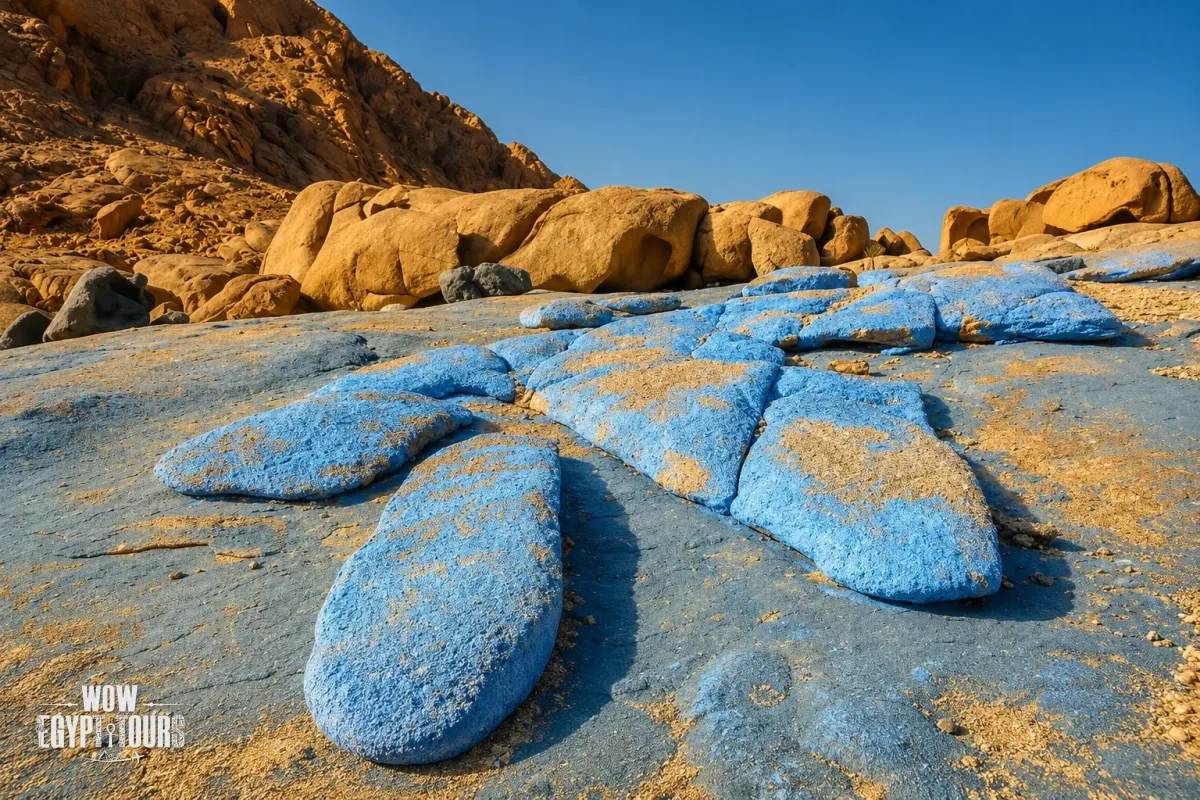
The core of the Blue Desert installation consists of a collection of ancient black volcanic and granite rocks of various sizes, ranging from boulders of several metres in diameter to smaller stones of manageable human scale, painted in cobalt blue and scattered across an area of desert terrain several kilometres in extent between the Dahab to Saint Katherine road and the surrounding desert landscape. The rocks are not arranged in any strictly geometric or formally composed pattern but occupy their natural positions in the desert landscape, modified by Verame's selection of which rocks to paint and the compositional decisions he made about the distribution of blue among the larger field of natural unpainted stones, creating a work whose formal organization is simultaneously natural and artistic, determined partly by the geological accident of how the ancient volcanic rocks came to rest in their current positions and partly by the artist's eye for composition and visual effect across the scale of the desert landscape. The contrast between the brilliant cobalt blue of the painted surfaces and the deep black and ochre of the surrounding natural rocks and desert floor is the primary visual experience of the Blue Desert installation, a contrast of such immediate and startling power that it creates the impression of encountering something fundamentally wrong with the natural order of the landscape, as if the sky has descended to the desert floor or the sea has invaded the inland desert in a visual impossibility that the mind takes a moment to process before recognizing its human artistic origin.
The Light Effects Through The Day
The Blue Desert installation is extraordinarily responsive to the quality and the direction of the natural light of the Sinai desert, changing its visual character dramatically through the course of the day as the sun moves from its early morning position in the east through the overhead intensity of midday to the warm horizontal light of the late afternoon and sunset. In the early morning, the low eastern sun rakes across the painted rock surfaces at a shallow angle that emphasizes the texture of the volcanic rock beneath the paint and creates complex shadow patterns on the blue surfaces that give the stones a three-dimensional tactile richness quite different from the flat plane of pure color that the midday overhead sun creates. In the late afternoon and at sunset, the warm orange and red light of the setting sun mixes with the cobalt blue of the painted surfaces to create color combinations of extraordinary visual complexity and beauty, transforming the pure conceptual statement of the blue rocks into a shifting painterly composition of mixed colors that changes minute by minute as the sun descends toward the desert horizon. Photographers who visit the Blue Desert consistently report that the late afternoon light provides the most visually spectacular and the most photographically rewarding conditions of any time of day, though the clarity of the morning light and the relative coolness of the early hours also have strong advocates among those who have experienced the installation at different times.
The Surrounding Sinai Mountain Landscape
The Blue Desert does not exist in isolation but is embedded in one of the most dramatically beautiful mountain desert landscapes in the world, surrounded by the ancient granite peaks of the South Sinai massif that rise in every direction from the desert floor in complex and constantly changing profiles of red, pink, ochre, and black rock that provide the most visually spectacular natural backdrop available to any landscape art installation in Egypt. The specific area of the South Sinai in which the Blue Desert is located is among the most geologically dramatic sections of the entire Sinai Peninsula, with the ancient Precambrian granite and volcanic rocks of the region exposed in their raw geological character by the extreme aridity of the desert environment, providing a landscape of such immediate visual power and such ancient geological presence that it has been recognized as a sacred and spiritually significant environment by the religious traditions of three civilizations over the course of more than three thousand years. The juxtaposition of Jean Verame's human artistic intervention with this primordial natural landscape is one of the most consistently remarked upon qualities of the Blue Desert experience by visitors who describe the encounter as a confrontation between human aspiration and geological time of deeply affecting proportions.
The Bedouin Cultural Landscape
The Blue Desert exists within the living cultural landscape of the South Sinai Bedouin communities, whose presence in the Sinai Peninsula as the indigenous human community of the desert gives the landscape art installation a social and cultural context that transforms it from a purely aesthetic object into a community-embedded cultural landmark. The Bedouin communities of the South Sinai, including the Jebeliyya tribe who have inhabited the Saint Katherine mountain area since Byzantine times and who claim descent from the soldiers sent by the Emperor Justinian to guard the monastery, have incorporated the Blue Desert into their territory and their economy as a visitor attraction that generates income through guided tours, camel excursions, and the sale of locally produced crafts and refreshments to the tourists who visit the site. The Bedouin guides who accompany visitors to the Blue Desert bring to the experience a depth of knowledge about the desert landscape, its geology, its plants and animals, its seasonal patterns, and its cultural significance that no external professional guide can replicate, and their perspective on the blue rocks as features of a landscape they have inhabited and worked for generations gives the visitor a very different and very enriching perspective on the installation from the purely art historical or political historical accounts provided by conventional touristic interpretation.
Why Is The Blue Desert Important?
The Blue Desert of Sinai is important for reasons that span landscape art history, political and diplomatic history, the natural heritage of the Sinai Peninsula, and the cultural and economic life of the South Sinai Bedouin communities. As a work of landscape art, it is the most internationally recognized and the most widely visited land art installation in the entire Middle East and North Africa, a work of genuine artistic significance and genuine visual power that has attracted the sustained attention of the international art world for more than four decades and that continues to generate scholarly and critical engagement as one of the major works of the land art tradition in a non-Western geographic context. As a monument to a specific political and diplomatic achievement, the Egyptian-Israeli peace of 1978 to 1979, it is the most tangible and the most aesthetically powerful artistic commemoration of the most significant Middle Eastern peace settlement of the 20th century, giving the abstract diplomatic achievement of the Camp David process a physical and visual presence in the landscape of the Sinai itself that no amount of documentary or archival material can substitute for.
As a natural heritage destination, the Blue Desert draws visitors into the extraordinarily beautiful and geologically dramatic landscape of the South Sinai mountains that is one of the most ancient and the most visually spectacular desert environments in the world, providing the occasion for the experience of a natural landscape of the highest quality in a political and institutional context, the regulated access to the South Sinai interior, that ensures its preservation and sustainable use. WOW Egypt Tours includes the Blue Desert as a featured destination on all Sinai-focused Egypt Desert Safari Tours and comprehensive Sinai heritage programmes, recognizing it as one of the most distinctive and the most personally affecting natural and cultural heritage experiences available in the South Sinai Peninsula.
What Are Some Interesting Facts About The Blue Desert?
Art Made To Celebrate Peace In A Land Of Ancient Faith
The choice of the Sinai Peninsula as the site of the Blue Desert installation gives the painted rocks a relationship to the religious heritage of the landscape that adds an extraordinary additional layer of meaning to the work's peace message. The Sinai is sacred ground to the three great monotheistic religions of the world, Judaism, Christianity, and Islam, all three of which have specific and profound connections to the landscape in which the blue rocks are painted. For Judaism and Christianity, Mount Sinai (Jebel Musa) is the mountain where Moses received the Ten Commandments and where the fundamental covenant between God and the Hebrew people was established, making the Sinai desert one of the most theologically charged landscapes in the entire biblical tradition. For Christianity, the monastery of Saint Katherine at the foot of Jebel Musa, founded in the 6th century CE by the Emperor Justinian and continuously inhabited by Eastern Orthodox monks since that date, is one of the oldest continuously occupied monastic institutions in the world and a site of pilgrimage of the highest significance for the Eastern Christian tradition. For Islam, the Sinai is the landscape of the Prophet Moses (Musa), one of the greatest prophets in the Islamic tradition, and the spiritual power of the landscape is recognized in the Islamic tradition with a reverence entirely comparable to its significance in the Jewish and Christian traditions. The decision to paint a peace monument in this landscape of three faiths gives the Blue Desert a multi-religious significance that reinforces its universal peace message with the authority of the oldest and the most humanly fundamental aspiration to peace in all three religious traditions.
Ten Tonnes Of Blue
The sheer physical scale of the Blue Desert project, involving ten tonnes of blue paint applied to the ancient rocks of the Sinai desert over a period of several months, gives the installation a dimension of physical commitment and practical achievement that is often overlooked in the more conceptually focused discussions of the work's political and artistic significance. Transporting ten tonnes of paint to a remote desert location in the interior of the South Sinai Peninsula in 1980, before the current road infrastructure of the region had been developed, was itself a significant logistical challenge, requiring the collaboration of the Egyptian military, the local Bedouin community, and the personal organizational energy of Verame and his team to accomplish. The physical labor of applying the paint to the rocks, which in the desert environment required working in conditions of extreme heat and direct sun exposure while maintaining the quality and the consistency of the painted surfaces across the full extent of the installation, was equally demanding, and the involvement of Bedouin laborers in this physical work gave the community a direct investment in the creation of the installation that is itself part of the work's human story. The fact that ten tonnes of paint, applied to the rocks of the Sinai desert more than forty years ago, still produces the immediate and overwhelming visual impact visible to visitors today is the clearest possible evidence of the quality of Verame's material choices and the durability of his artistic vision.
Where The Desert Sky Meets The Desert Floor
The most consistently remarked-upon quality of the visual experience of the Blue Desert, in the accounts of visitors from every cultural and aesthetic background who have written about it, is the extraordinary sensation it creates of a fundamental confusion between sky and earth, between the blue of the atmosphere overhead and the blue of the painted rocks underfoot, between the vertical dimension of the open desert sky and the horizontal dimension of the desert floor on which the painted rocks lie. This confusion, this visual and conceptual dissolution of the normal categorical distinction between sky and earth that is the most fundamental organizing principle of the human visual perception of landscape, is not a simple or superficial effect but a genuinely disorienting and genuinely profound perceptual experience that operates on the viewer at a level below conscious aesthetic appreciation and above simple surprise, producing a response that many visitors describe as approaching the meditative or even the mystical in its quality of disrupting the ordinary categories through which we perceive and understand the natural world. The Blue Desert, in this sense, is not simply an aesthetic object but a perceptual instrument, a work of art whose most fundamental effect is not to be admired from a distance but to be experienced from within, in the disorienting blue landscape that Verame created in the ancient rocks of the Sinai wilderness.
What Is So Special About The Blue Desert?
The Most Unexpected Beautiful Place In Egypt
What makes the Blue Desert uniquely special among all the natural and cultural heritage destinations in Egypt is the extraordinary quality of surprise it generates, the complete impossibility of adequately preparing any visitor for the visual and emotional impact of the painted blue rocks in the context of the surrounding natural desert landscape, regardless of how many photographs they have seen or how detailed the descriptions they have read before arrival. Egypt has many extraordinary ancient monuments that are more historically significant, many natural landscapes that are more geologically dramatic, and many cultural experiences that are more intellectually or spiritually profound than the Blue Desert, but very few destinations in the entire country produce in the visitor the quality of absolute visual surprise and genuine aesthetic wonder that the first sight of the blue rocks in the Sinai desert creates in almost every visitor who encounters them for the first time. This quality of surprise, of encountering something so completely unexpected and so visually extraordinary in a landscape that nothing in the surrounding natural environment could have prepared you to expect, is the most distinctive and the most consistently reported quality of the Blue Desert experience, and it is a quality that the site generates for virtually every visitor regardless of their prior knowledge, their aesthetic background, or the number of times they have visited other famous art works or natural wonders in Egypt or elsewhere in the world.
Art And Nature In Perfect Partnership
The Blue Desert is also uniquely special for the quality of the partnership it achieves between human artistic creation and the natural landscape in which it is embedded, a partnership that is one of the most fundamental aspirations of the land art tradition but that in practice proves extraordinarily difficult to achieve with genuine artistic effectiveness. Jean Verame's choice of the specific terrain, the specific rock types, and the specific color for the Blue Desert installation demonstrates a sensitivity to the landscape and an understanding of how human artistic intervention can enhance rather than diminish the power of a natural environment that is entirely characteristic of his best work. The blue paint does not simply cover the rocks; it reveals them, drawing attention to their ancient volcanic forms and their geological textures in ways that the natural unpainted landscape does not, making each painted rock simultaneously a work of art and a more vivid presence of natural stone than the surrounding unpainted rocks can achieve. This quality of artistic enhancement of natural perception, of making the ancient rocks more visible as geological and natural objects through the act of painting them, is one of the most subtle and the most significant achievements of the Blue Desert installation, giving it a depth of artistic success that goes well beyond the immediately obvious and genuinely important political and symbolic dimensions of the work.
Blue Desert Sinai Through The Ages: From Creation To The Present
The Blue Desert was created in 1980 in the immediate aftermath of the Egyptian-Israeli Peace Treaty of 1979, during a period of considerable optimism about the prospects for broader Middle Eastern peace that the Camp David Accords had seemed to inaugurate. The assassination of President Anwar Sadat in October 1981 by Egyptian Islamic extremists who opposed the peace with Israel cast a long shadow over the peace process and over the broader aspirations that Verame's installation had been created to celebrate, and the subsequent decades of continued conflict in the broader Middle Eastern region gave the Blue Desert's peace message a quality of aspiration rather than of accomplished reality that made it simultaneously more poignant and more necessary as a reminder of what was possible in the political world when leaders of courage and vision made the choices that the immediate situation demanded. The Blue Desert has remained in the Sinai landscape through all the political and military events of the subsequent four decades, surviving the First and Second Intifada, the Gulf Wars, the Egyptian Revolution of 2011, and the subsequent period of political instability in the broader region as a permanent and physically durable reminder of the single most significant peace achievement in the history of the modern Middle East.
Today the Blue Desert is one of the most visited and the most widely photographed natural and cultural heritage destinations in the South Sinai Peninsula, attracting visitors from throughout Egypt, from the Arab world, from Europe, North America, and Asia who come to see the painted rocks, to reflect on their peace message, and to experience the extraordinary natural landscape of the South Sinai in which they are embedded. The tourism infrastructure surrounding the Blue Desert has developed considerably since the early years after the installation's creation, with organized tours, guided Bedouin excursions, and comprehensive Sinai desert safari programmes that combine the Blue Desert visit with the other major natural and cultural heritage destinations of the South Sinai, including the Saint Katherine Protectorate, Jebel Musa, and the extraordinary desert landscapes of the Sinai interior, all available through WOW Egypt Tours as part of the comprehensive Egypt Desert Safari Tours and Egypt Travel Packages that the company offers.
Blue Desert Sinai And Nature Conservation
The Blue Desert is located within or immediately adjacent to the Saint Katherine Protectorate, the largest protected natural area in the Sinai Peninsula and one of the most important nature conservation zones in Egypt, which was established in 1996 to protect the extraordinary biodiversity of the South Sinai mountain ecosystem, including numerous endemic plant species found nowhere else in the world, rare wildlife species adapted to the extreme desert environment, and the ancient agricultural terraces of the Bedouin communities that represent one of the most sophisticated systems of desert water harvesting in the ancient world. The presence of the Blue Desert within this protected natural and cultural landscape means that visiting the installation is simultaneously a visit to one of the most significant nature conservation areas in Egypt, providing the opportunity to experience the extraordinary natural heritage of the South Sinai mountains in the context of a legally protected and actively managed conservation zone. The regulation of visitor access to the Saint Katherine Protectorate and the surrounding desert areas ensures that the natural landscape in which the Blue Desert is embedded is maintained in a state of conservation that gives future visitors the same quality of encounter with the ancient geological and biological heritage of the South Sinai that current visitors enjoy.
Best Time To Visit The Blue Desert Sinai
The best time to visit the Blue Desert is during the cooler months from October through April, when the South Sinai desert climate provides the most comfortable conditions for outdoor desert exploration, with daytime temperatures in the range of 15 to 25 degrees Celsius and the brilliant desert sun that makes the blue paint on the rocks most vivid without the extreme heat that the summer months bring. The summer months from May to September bring extreme heat to the South Sinai desert, with daytime temperatures regularly exceeding 40 degrees Celsius in the interior desert locations, making outdoor desert visits in the middle of the day genuinely hazardous without appropriate preparation and making the very early morning and the late afternoon the only comfortable outdoor visiting times. The winter months of December through February offer the most pleasant daytime temperatures for the outdoor desert visit, with occasional cool to cold nights that require warm layers for any evening or overnight desert experience, but with the most reliable clear skies and the most brilliant desert light of any season that provide the finest possible photography conditions for the blue rocks and their surrounding landscape. WOW Egypt Tours plans all Blue Desert visits as part of comprehensive Sinai programmes at the optimal time of day for the specific desert safari itinerary.
Blue Desert Sinai Opening Hours
The Blue Desert is an open outdoor site in the South Sinai desert landscape that is accessible throughout the daylight hours every day of the year without formal opening or closing times. Access to the site is regulated by the requirements of the Saint Katherine Protectorate management authority, which requires visitors to the protected area to use official guide services and to follow the established protocols for desert tourism in the Sinai interior. The most practically accessible visiting hours are approximately from sunrise to approximately one to two hours before sunset, allowing sufficient daylight for the drive to the site, the visit itself, and the return journey before the desert roads become challenging to navigate in darkness. Many visitors prefer to time their Blue Desert visit for the late afternoon when the desert light is at its most beautiful, planning to leave the site at or shortly after sunset and return to their Dahab or Saint Katherine base in the early evening.
Blue Desert Sinai Entrance Fees
Access to the Blue Desert as part of the Saint Katherine Protectorate area requires the payment of a protectorate entrance fee whose current rate should be confirmed with WOW Egypt Tours at the time of booking, as conservation area fees in Egypt are subject to periodic adjustment by the Egyptian Environmental Affairs Agency. The protectorate fee for entry to the South Sinai protected area contributes directly to the conservation and management of the extraordinary natural heritage of the Saint Katherine region, including the endemic plant species, the wildlife habitats, and the Bedouin cultural landscape that make the area one of the most significant nature conservation zones in Egypt. All protectorate fees and local guide fees for the Blue Desert visit are included in the comprehensive Sinai Desert Safari Tour and Egypt Travel Package programmes offered by WOW Egypt Tours.
How To Get To The Blue Desert Sinai
The Blue Desert is located approximately 25 kilometers west of Dahab on the road that crosses the South Sinai interior toward Saint Katherine, accessible by private vehicle along the paved highway that connects the eastern Sinai coastal communities with the mountain interior. The drive from Dahab takes approximately 30 to 40 minutes on the well-maintained desert highway, passing through spectacular mountain desert scenery before reaching the section of road adjacent to the Blue Desert site where the painted rocks are visible from the roadside. From Saint Katherine, the Blue Desert is approximately 10 kilometers north on the same road, a drive of approximately 15 to 20 minutes. The site is most commonly visited as a stopping point on the road between Dahab and Saint Katherine rather than as a dedicated out-and-back trip, making it a natural component of any Sinai itinerary that combines the coastal resort town of Dahab with the mountain heritage of the Saint Katherine area. WOW Egypt Tours provides private air-conditioned transportation and Bedouin guide arrangements for all Blue Desert visits as part of comprehensive Sinai Desert Safari Tours and Egypt Travel Packages.
How Long To Spend At The Blue Desert
Most visitors spend approximately 45 minutes to one and a half hours at the Blue Desert, which is sufficient time to walk through the painted rock landscape from multiple angles and viewpoints, to take photographs in different lighting conditions and from different perspectives, to absorb the visual and atmospheric experience of the installation in its desert setting, and to discuss the historical, artistic, and political context of the work with a knowledgeable guide. Visitors with a serious interest in landscape art history, in the political history of the Camp David peace process, or in the photography of the installation in different lighting conditions may wish to allow up to two hours. Photographers who wish to capture the installation in the finest possible late afternoon light may prefer to time their arrival to approximately 2 hours before sunset and stay until the colors have developed fully in the golden hour light that provides the most visually spectacular conditions for photographing the blue rocks against the warm desert landscape. The Blue Desert visit is most naturally and most efficiently combined in a single day's Sinai programme with a visit to Saint Katherine's Monastery and Jebel Musa, creating the most complete available single-day experience of the South Sinai's extraordinary heritage and natural landscape.
Tips For Visiting The Blue Desert Sinai
Time your Blue Desert visit for the late afternoon if at all possible, arriving approximately 2 hours before sunset, as the combination of the warm golden light with the cobalt blue of the painted rocks creates the most visually spectacular and the most photographically rewarding conditions of any time of day, transforming the installation from a striking visual curiosity into a genuinely extraordinary landscape art experience of the first order. Walk into the painted rock landscape from the road rather than simply viewing it from the vehicle, as the experience of being physically surrounded by and among the blue rocks is fundamentally different from and much more powerful than the experience of viewing them from the road margin, and the scale and the distribution of the painted rocks in relation to the surrounding natural landscape is most completely apprehended from within the installation rather than from its periphery. Carry significantly more water than you think you will need, as the South Sinai desert environment is far more desiccating than most visitors from temperate climates are accustomed to, and even moderate physical activity in the desert heat produces rapid fluid loss that must be replaced. Ask your guide to explain the political and historical context of the Blue Desert and the story of Jean Verame and his Bedouin collaborators before you enter the painted landscape, as this context enormously enriches the experience of the installation beyond its purely visual dimension. Wear sturdy footwear suitable for walking on uneven rocky desert terrain, as the desert floor between the painted rocks includes loose stones, sandy patches, and uneven surfaces that require more supportive footwear than beach sandals or flat town shoes. A licensed guide from WOW Egypt Tours with specific knowledge of the Sinai landscape, the Bedouin cultural context, and the art historical significance of the installation is essential for the fullest possible Blue Desert experience.
What To Wear At The Blue Desert Sinai
The Blue Desert is an outdoor desert site in the South Sinai interior with direct sun exposure and no shade whatsoever in most areas of the installation, requiring comprehensive sun protection and practical desert clothing for all visits. Lightweight, loose-fitting, long-sleeved clothing that covers the arms and legs provides the best combination of sun protection and ventilation in the dry desert heat, and is preferable to short-sleeved clothing or shorts that leave skin directly exposed to the intense desert sun. A wide-brimmed hat with a full brim is absolutely essential, as the desert sun in the South Sinai is significantly more intense than the sun in the Mediterranean coastal areas and the cool desert air at higher altitudes can mask the intensity of solar radiation until sunburn is already well advanced. Very generous quantities of high-SPF sunscreen applied to all exposed skin areas including the face, neck, hands, and any other exposed areas are essential. Sturdy, closed-toe walking shoes with good ankle support are required for the desert terrain, which includes loose stones, sandy surfaces, and the occasional need to step over or around larger rocks. A hat cord or hat clip to secure the hat against the desert wind is recommended, as the Sinai desert can produce surprisingly strong gusts that take hats off at inconvenient moments. Carry at least two liters of water per person for any visit lasting more than 30 minutes in the desert environment, and more in the summer months or when hiking beyond the immediate roadside access area.
Photography At The Blue Desert Sinai
The Blue Desert of Sinai is one of the most extraordinarily photogenic destinations in all of Egypt, combining the immediately striking visual contrast of cobalt blue painted rocks against the natural black and ochre desert landscape with the dramatic natural backdrop of the South Sinai mountain peaks and the extraordinary quality of the desert light at different times of day to create photography conditions of exceptional richness and variety. The most spectacular photography results are consistently achieved in the late afternoon and golden hour, when the warm low-angle light from the west illuminates the blue surfaces with a warm-tinted directional light that creates the most complex and the most visually beautiful color interactions between the blue paint and the warm desert palette of the surrounding natural landscape. Early morning photography, with the cool clear light of the Sinai dawn illuminating the blue rocks from the east, produces a different but equally beautiful quality, with the cool morning light rendering the blue surfaces at their most saturated and most color-accurate in the relatively pure white light of the pre-midday sun. Midday overhead light creates the flattest but the most color-saturated rendering of the blue surfaces, which can be striking in its own way but lacks the textural richness and shadow complexity of the low-angle morning and afternoon light. A polarizing filter is particularly effective at the Blue Desert, reducing the glare on the painted rock surfaces and significantly increasing the saturation and the contrast of the blue color against the natural desert tones. Photography from within the installation, kneeling among the blue rocks with the camera at ground level looking up and across the landscape, produces the most dramatically immersive and the most compositionally distinctive photographs available at the site, as opposed to the more conventional standing viewpoint that most visitors automatically adopt. Photography is freely permitted at the Blue Desert without restriction. Professional photography or filming for commercial purposes may require advance permits from the relevant Egyptian authorities.
Blue Desert Sinai Tours
Sinai Desert Safari: Blue Desert, Saint Katherine, And Jebel Musa
This comprehensive Sinai Desert Safari programme combines the Blue Desert visit with the most significant natural and cultural heritage destinations of the South Sinai interior, providing the most complete available single or multi-day experience of the extraordinary landscape of the Sinai Peninsula.
What Is Covered
Private vehicle from Dahab, Sharm El Sheikh, or Saint Katherine accommodation. Guided visit to the Blue Desert installation with comprehensive explanation of Jean Verame's artistic career, the political context of the Camp David peace, and the art historical significance of the installation in its desert landscape. Visit to Saint Katherine's Monastery, one of the oldest continuously inhabited Christian monasteries in the world, founded in the 6th century CE by the Emperor Justinian at the foot of the sacred mountain of Jebel Musa. Optional guided ascent of Jebel Musa, the Mount Sinai of the biblical tradition, most powerfully experienced as a pre-dawn ascent to watch the sunrise from the sacred summit. Optional exploration of the Saint Katherine Protectorate's desert landscape with Bedouin guide.
Duration
One to three days depending on the specific programme selected. A one-day programme from Dahab or Sharm El Sheikh covers the Blue Desert and Saint Katherine's Monastery as a single long-day excursion. A two or three-day programme allows the full Jebel Musa experience, the Blue Desert at optimal late afternoon light, and exploration of the broader Saint Katherine Protectorate landscape.
Includes
Private air-conditioned vehicle, Bedouin guide for desert sections, protectorate entrance fees, and accommodation in Saint Katherine on overnight programmes. All arrangements through WOW Egypt Tours as part of comprehensive Egypt Desert Safari Tours or Egypt Travel Packages.
Sinai Blue Desert Photography Safari
This specialized photography safari is designed specifically for photographers who wish to capture the Blue Desert installation in the finest possible light conditions and from the full range of available perspectives and viewpoints, with the programme timed to arrive at the site in the late afternoon for the golden hour photography that provides the most visually spectacular conditions.
What Is Covered
Private vehicle timed for late afternoon arrival at the Blue Desert. Extended photography session at the installation in the late afternoon and golden hour light, with guide assistance in identifying the most productive viewpoints and compositions for different camera and equipment types. Optional return to the site for early morning photography on a second day for photographers who wish to capture the installation in both late afternoon and early morning light conditions.
Duration
Half day from Dahab for the afternoon session only, or a full day including return to Saint Katherine accommodation for overnight, with early morning Blue Desert photography session on the following day.
Includes
Private vehicle, Bedouin guide, protectorate fees, and accommodation on overnight programmes. All through WOW Egypt Tours Egypt Desert Safari Tours.
Combine The Blue Desert Sinai With Your Egypt Tours Package
The Blue Desert of Sinai is featured as a distinctive desert natural and cultural heritage destination across the WOW Egypt Tours travel products that include the Sinai Peninsula. Browse the options below to find the Egypt experience that includes the Blue Desert.
Egypt Tour Packages: Multi-day guided Egypt tours organized by duration, including 2 Days Egypt Packages, 3 Days Egypt Packages, 4 Days Egypt Packages, 5 Days Egypt Packages, 6 Days Egypt Packages, 7 Days Egypt Packages, 8 Days Egypt Packages, 10 Days Egypt Packages, and longer itineraries. All packages that include the Sinai Peninsula can feature the Blue Desert as a component of the Sinai programme. All packages include private air-conditioned transportation, private licensed guide, accommodations, protectorate entrance fees, and private transfers throughout Egypt.
Egypt Travel Packages: Themed Egypt travel packages designed around specific travel styles and interests, including Egypt Honeymoon Travel Packages, Egypt Budget Travel Packages, Egypt Family Travel Packages, Egypt Luxury Travel Packages, Egypt Adventure Travel Packages, Egypt Cultural Travel Packages, and Egypt Christmas and New Year Travel Packages. The Blue Desert is particularly well suited to Adventure, Cultural, and Honeymoon themed packages for the unique combination of natural beauty, artistic significance, and peaceful desert atmosphere it provides. All packages include private transportation, licensed guide, accommodations, meals, and private transfers.
Egypt Desert Safari Tours: Specialized desert safari programmes covering the extraordinary natural and cultural heritage of Egypt's desert landscapes including the Sinai Peninsula, the White Desert, and the Black Desert. The Blue Desert of Sinai is a featured destination on Sinai-focused Egypt Desert Safari Tours, combined with the Saint Katherine Protectorate, Jebel Musa, and the broader natural landscape of the South Sinai in programmes of one to several days' duration. All Desert Safari Tours include private vehicle, Bedouin guide, protectorate fees, and all required desert logistics.
Egypt Nile Cruise Packages: Complete Egypt travel packages combining Cairo sightseeing with a fully guided Nile cruise. The Blue Desert of Sinai can be added as a Sinai extension to any Egypt Nile Cruise Package for travelers wishing to combine the ancient Nile Valley heritage with the extraordinary natural and artistic heritage of the South Sinai desert. All packages include private transportation, licensed guide, and private transfers.
Nile River Cruises: All WOW Egypt Tours Nile cruise options. The Blue Desert of Sinai is available as a Sinai Peninsula extension from Cairo added to any Nile River Cruise itinerary for travelers wishing to experience both the Nile Valley and the Sinai desert heritage in a single Egypt journey.
Luxor Aswan Nile Cruises: The classic Upper Egypt Nile cruise route. The Blue Desert of Sinai is available as a Sinai extension from Cairo combined with any Luxor-Aswan cruise programme for travelers adding the Sinai desert experience to their Upper Egypt heritage journey.
Nearby Attractions To The Blue Desert Sinai
The Blue Desert is located in the South Sinai desert landscape between the coastal town of Dahab and the mountain town of Saint Katherine, and its most naturally and most frequently combined nearby attractions are the extraordinary natural and cultural heritage destinations of the South Sinai interior that lie along the same road corridor. Saint Katherine's Monastery, approximately 10 kilometers south of the Blue Desert, is the most historically significant and the most spiritually important single monument in the entire South Sinai Peninsula, one of the oldest continuously inhabited Christian monasteries in the world and the guardian of the most significant collection of early Christian manuscripts and Byzantine icons outside Istanbul and Athens. Jebel Musa, the Mount Sinai of the biblical and Quranic traditions, rises directly above the monastery and can be ascended by a well-marked trail to the sacred summit, where the panoramic views across the Sinai mountains at dawn from the peak that tradition identifies as the mountain of the Mosaic revelation are among the most spiritually charged and the most visually spectacular available at any accessible summit in Egypt.
The Saint Katherine Protectorate, encompassing a much broader area of the South Sinai mountain landscape beyond the immediate monastery and mountain site, contains an extraordinary range of natural heritage including the world's largest concentration of endemic plant species in a small geographic area, the ancient Bedouin agricultural terraces that represent one of the finest examples of traditional desert water management in the world, and a geological landscape of Precambrian granite and volcanic rock of such ancient formation and such dramatic visual character that it has been described by geologists as one of the most significant geological heritage landscapes in the entire Middle East. The coastal town of Dahab, approximately 25 kilometers east of the Blue Desert on the Gulf of Aqaba coast, provides the most conveniently located base for Blue Desert visits, with its combination of comfortable accommodation, seafront restaurants, and the extraordinary natural beauty of the Gulf of Aqaba providing a very different but equally rewarding natural experience from the desert interior. The other desert attractions of Egypt including the White Desert and the Black Desert of the Western Desert provide complementary desert landscape experiences that together with the Blue Desert of Sinai constitute the most complete available programme of Egypt's extraordinary desert heritage. All these destinations are accessible through the Egypt Desert Safari Tours and Egypt Travel Packages offered by WOW Egypt Tours.
Frequently Asked Questions About The Blue Desert Sinai
What is the Blue Desert of Sinai?
The Blue Desert of Sinai is a landscape art installation created in 1980 by the Belgian artist Jean Verame, consisting of approximately ten tonnes of cobalt blue paint applied to ancient volcanic rocks in the South Sinai desert between Dahab and Saint Katherine to celebrate the Egyptian-Israeli peace following the Camp David Accords. The installation creates a striking and profoundly unexpected visual experience in the black and ochre desert landscape of the South Sinai, making it one of the most distinctive and the most internationally recognized natural and cultural heritage destinations in the Egyptian Sinai Peninsula. It is featured on Egypt Desert Safari Tours and Egypt Travel Packages offered by WOW Egypt Tours.
Why were the rocks painted blue?
Jean Verame painted the Sinai desert rocks blue as an artistic gesture of peace and celebration following the Egyptian-Israeli Peace Treaty of 1979, under the personal patronage of Egyptian President Anwar Sadat. The color blue was chosen for its universal associations with sky, sea, peace, and the United Nations, and the Sinai was chosen as the most symbolically powerful location for a peace monument as the primary theater of the previous Egyptian-Israeli wars and the territory returned to Egypt under the Camp David peace settlement.
Who was Jean Verame?
Jean Verame is a Belgian landscape artist born in 1936 who has created large-scale painted rock installations in the most dramatic desert and mountain landscapes in the world, including Morocco, Chad, Tibet, and Sinai. He is one of the leading figures in the international land art tradition and the Blue Desert of Sinai is his most widely known and most frequently visited work.
How much paint was used to create the Blue Desert?
Approximately ten tonnes of specially formulated mineral blue pigment was used to create the Blue Desert installation over a period of several months in 1980, applied by Verame and a team of Bedouin laborers to the ancient volcanic rocks of the Sinai desert.
Where exactly is the Blue Desert?
The Blue Desert is located approximately 25 kilometers west of Dahab and approximately 10 kilometers north of Saint Katherine, on the road that crosses the South Sinai interior between the Gulf of Aqaba coast and the mountain town of Saint Katherine. The painted rocks are visible from the roadside.
What is the best time of day to visit the Blue Desert?
The late afternoon, approximately 2 hours before sunset, provides the most visually spectacular conditions for the Blue Desert, when the warm golden light from the west creates extraordinary color interactions with the cobalt blue painted surfaces and the surrounding natural desert landscape. Early morning also provides beautiful, clear desert light. Midday overhead sun is the least visually interesting but produces the most color-saturated rendering of the blue.
Is the Blue Desert within a protected natural area?
Yes. The Blue Desert is located within or immediately adjacent to the Saint Katherine Protectorate, the largest protected natural area in the Sinai Peninsula established in 1996, which protects an extraordinary desert mountain ecosystem of significant biodiversity including numerous endemic plant species. Entry to the protectorate area requires the payment of a conservation fee.
What is the connection between the Blue Desert and the Camp David Accords?
The Blue Desert was created specifically to celebrate the Camp David Accords of 1978 and the subsequent Egyptian-Israeli Peace Treaty of 1979, which ended more than thirty years of intermittent armed conflict between Egypt and Israel. President Anwar Sadat personally patronized Verame's project, and the choice of the Sinai, the territory returned to Egypt under the Camp David settlement, as the location for the peace monument gives the installation its most immediately powerful symbolic dimension.
Can I visit the Blue Desert independently?
Reaching the Blue Desert requires a vehicle as it is approximately 25 kilometers from Dahab in the desert interior, and access to the Saint Katherine Protectorate area requires official guide services. All visits are best arranged through WOW Egypt Tours as part of a comprehensive Sinai Desert Safari programme that includes private vehicle, Bedouin guide, and all required protectorate arrangements.
What other attractions can I combine with the Blue Desert?
The Blue Desert is most naturally combined with Saint Katherine's Monastery and Jebel Musa (Mount Sinai), which are approximately 10 kilometers to the south on the same road. Together these three destinations provide the most complete available experience of the South Sinai's natural, cultural, and spiritual heritage in a single or two-day programme. The White Desert and Black Desert of the Western Desert provide complementary desert landscape experiences in a separate region of Egypt.
Is the Blue Desert suitable for children?
Yes. The Blue Desert is an excellent destination for children who respond with enthusiasm to the surprising and visually striking colored rocks, and whose imagination the peace story of the installation engages in an age-appropriate way. Children should always be accompanied by adults in the desert environment and should be protected from the sun with appropriate clothing, hat, and sunscreen. Sufficient water must be carried for all children members of the group.
What is the difference between the Blue Desert and the White and Black Deserts?
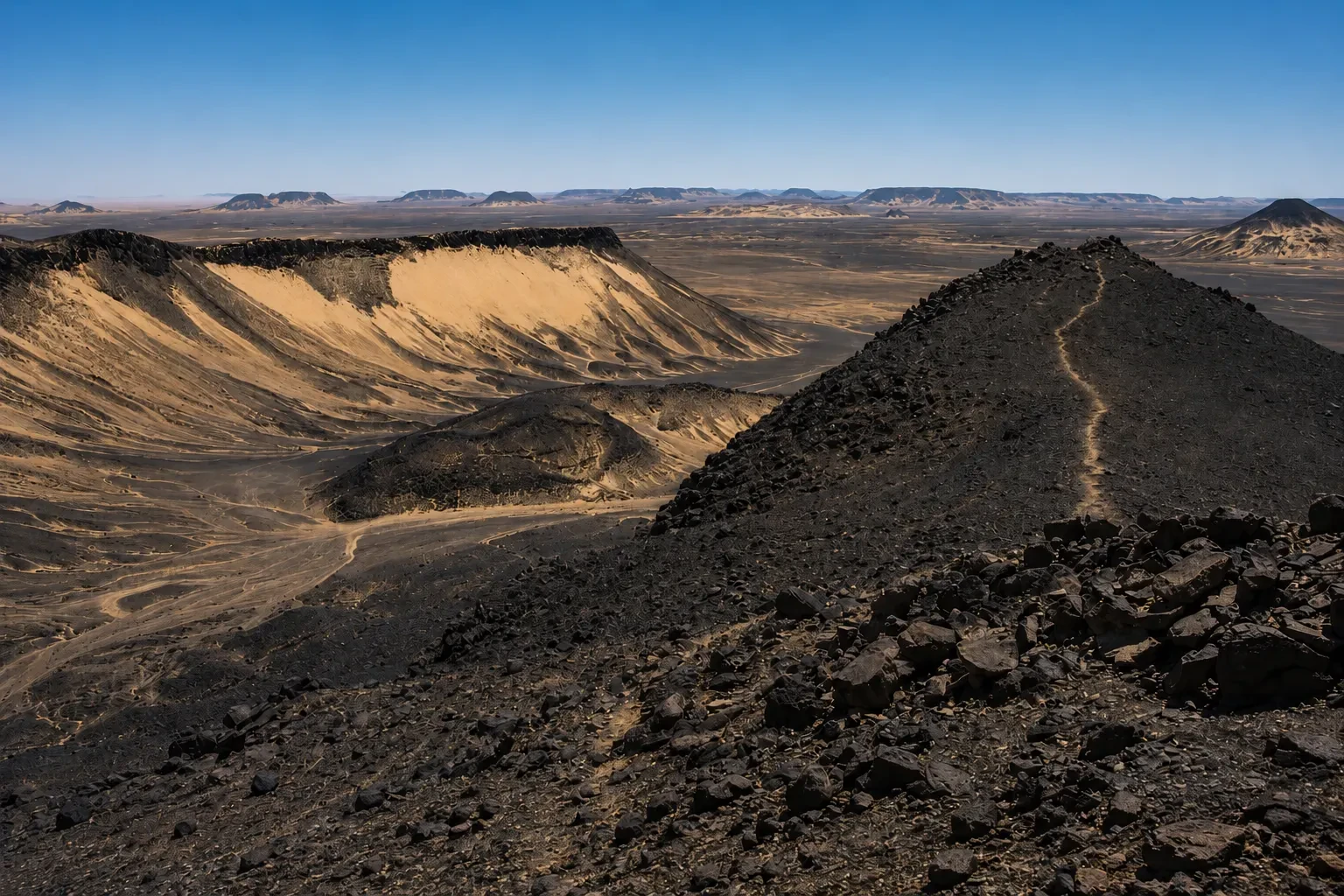
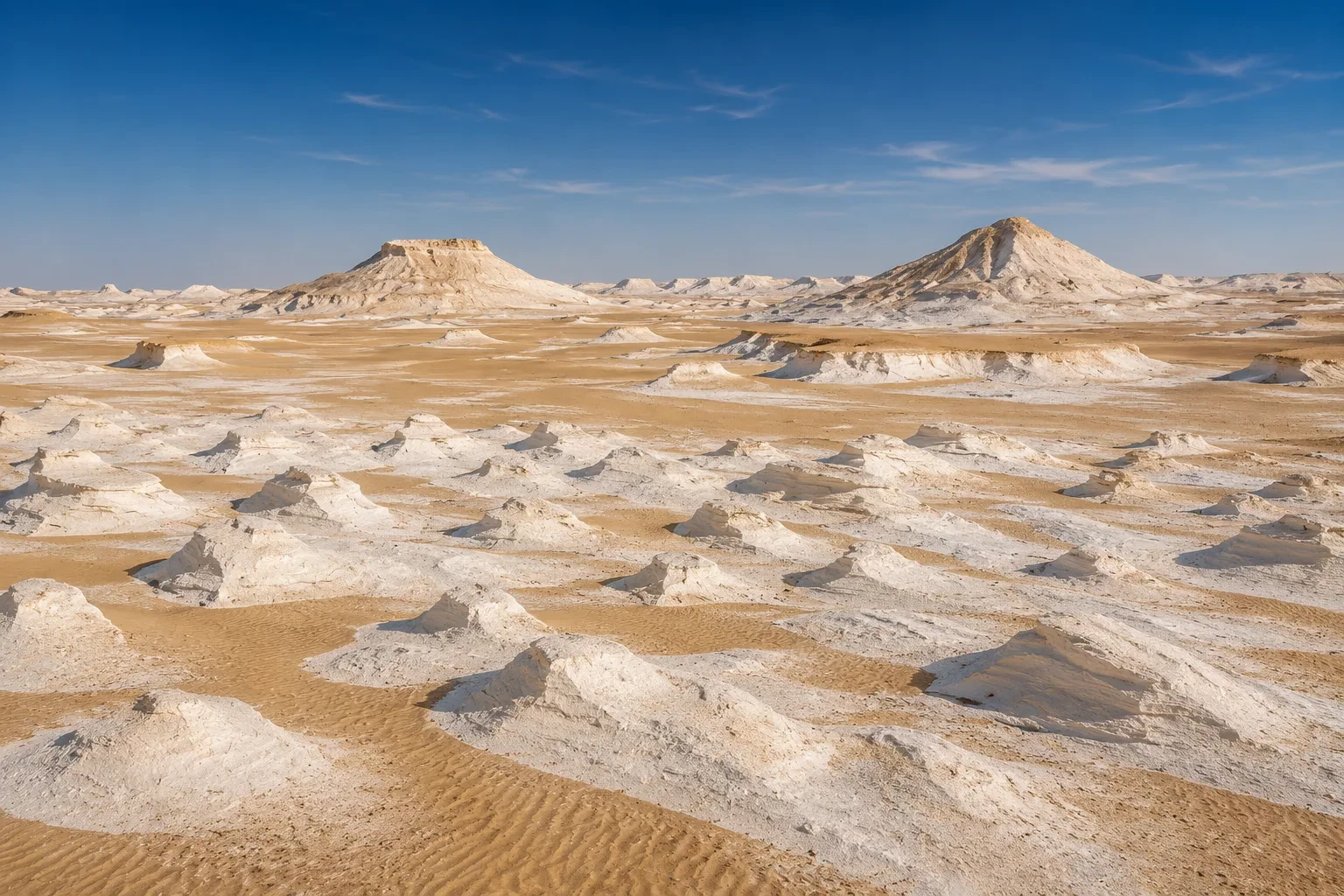
The Blue Desert of Sinai is a human-made landscape art installation in the South Sinai Peninsula created by the artist Jean Verame in 1980. The White Desert and the Black Desert are entirely natural geological formations in the Western Desert of Egypt, in the Farafra and Bahariya oasis region respectively, whose extraordinary white chalk rock formations and black volcanic rock landscapes were created entirely by natural geological processes without any human artistic intervention. All three are among the most visually extraordinary desert landscape destinations in Egypt and all are accessible through the Egypt Desert Safari Tours of WOW Egypt Tours.
How do I book a Blue Desert Sinai tour with WOW Egypt Tours?
You can book any Egypt Desert Safari Tour, Egypt Tours Package, or Egypt Travel Package that includes the Blue Desert of Sinai directly through WOW Egypt Tours. Our team of travel specialists will arrange everything from private vehicle and Bedouin guide to protectorate fees and accommodation in Saint Katherine or Dahab, ensuring a seamless and unforgettable encounter with one of the most extraordinary and the most philosophically resonant landscape art installations in the world, set in the most ancient and the most spiritually significant desert wilderness on earth.