

The Abu Al-Abbas Al-Mursi Mosque is the most beautiful, the most spiritually significant, and the most architecturally magnificent Islamic sacred building in all of Alexandria, a masterpiece of Andalusian-influenced North African mosque architecture that rises from the Mediterranean waterfront Corniche of the city in a composition of four minarets, carved stone facades, ornate decorative arcades, and soaring interior domes of such visual splendor and such immediate spiritual power that it consistently astonishes every visitor who encounters it, whether arriving at the Eastern Harbor waterfront for the first time or returning to one of the most beloved and the most deeply revered Islamic sacred sites in the Egyptian Mediterranean world. Named after the 13th century Andalusian Sufi scholar and saint Abu Al-Abbas Ahmad ibn Idris Al-Mursi, who was born in Murcia in Islamic Spain in 1219 CE and who died in Alexandria in 1287 CE after a lifetime of Sufi teaching, spiritual guidance, and sacred scholarship that established him as the primary spiritual authority of Ptolemaic Alexandria's medieval Islamic successor city and as the patron saint of Alexandrian sailors and fishermen whose protection he is still invoked to provide more than seven hundred years after his death, the mosque is simultaneously a living house of Muslim worship, an active Sufi sacred center, and the primary architectural monument of Islamic civilization in the city of Alexander the Great. This extraordinary landmark is a featured attraction on Alexandria Day Tours, Cairo and Alexandria Day Tours, and Alexandria Port Excursions, all of which WOW Egypt Tours proudly offers to travelers from around the world as part of Egypt Tours Packages and Egypt Travel Packages that include the magnificent heritage of Alexandria.
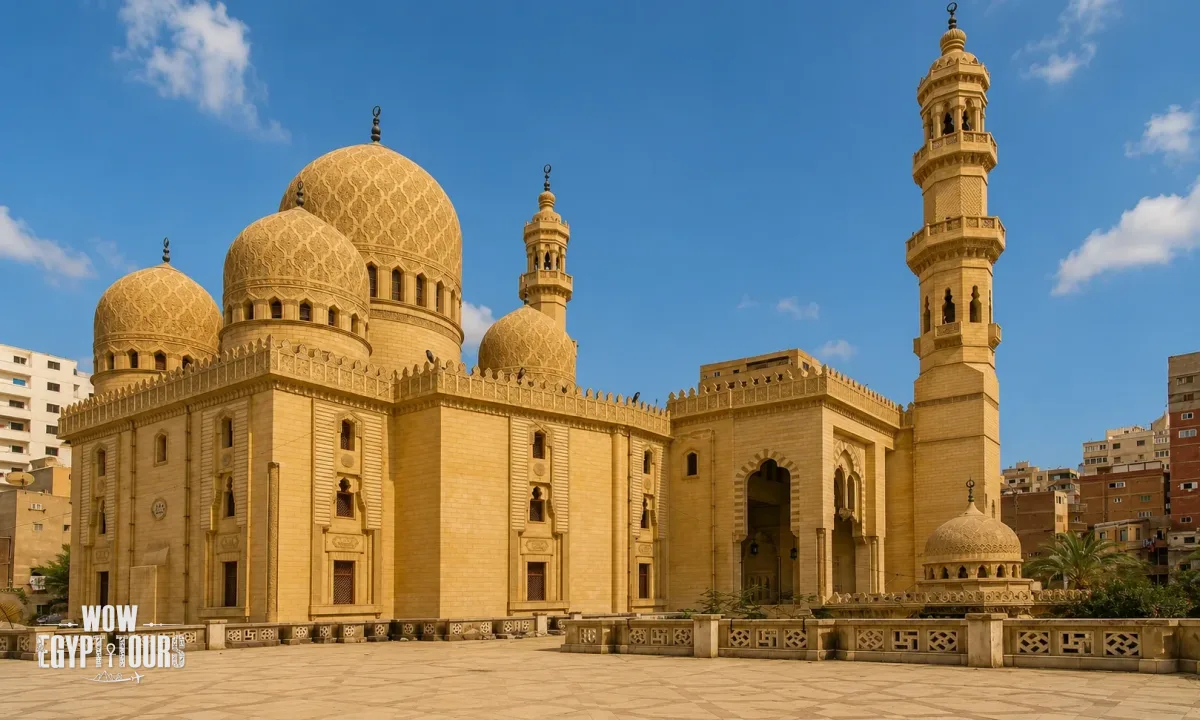
The Abu Al-Abbas Al-Mursi Mosque Egypt stands at the center of the Mosque Square on the Alexandria Corniche, approximately 1 kilometer west of the Citadel of Qaitbay and approximately 1 kilometer east of the Bibliotheca Alexandrina, in a waterfront position of such urban prominence and such maritime visibility that it serves as the most immediately recognizable landmark on the Eastern Harbor waterfront for ships approaching Alexandria from the sea. The mosque shares the Mosque Square with three other historic sacred buildings, the mosques of Sidi Yaqut Al-Arsh, of the Imam Al-Busiri the poet of the celebrated Burda poem, and of Abu Al-Hasan Al-Shadhili the founding master of the Shadhiliyya Sufi order of which Abu Al-Abbas was the greatest disciple, creating in the Mosque Square one of the most significant concentrations of Sufi Islamic sacred geography in the entire North African world and a pilgrimage destination of profound importance for the followers of the Shadhiliyya Sufi tradition throughout Egypt, the Arab world, and beyond. The current mosque building was designed by the Italian architect Mario Rossi and completed in 1943, replacing an earlier 18th century mosque that itself replaced the original 13th century shrine built above the tomb of the saint shortly after his death, and its extraordinary architectural quality, combining Andalusian and Moroccan decorative traditions with the spatial ambitions of the great North African mosque tradition, makes it the finest example of 20th century Islamic revival architecture in Alexandria and one of the most beautiful mosque buildings in the entire Egyptian heritage landscape.

Who Built The Abu Al-Abbas Al-Mursi Mosque?
The Abu Al-Abbas Al-Mursi Mosque in its current magnificent form was designed by the Italian architect Mario Rossi and completed in 1943, but the history of sacred building on this site begins in the late 13th century, shortly after the death of the saint Abu Al-Abbas Al-Mursi in 1287 CE, when the Alexandrian community built the first shrine above his tomb in recognition of his spiritual authority and his continuing intercessory power on behalf of the city and its people. This original 13th century shrine, the direct ancestor of the current mosque, established the tradition of sacred commemoration at the site that has continued without interruption for more than seven hundred years, through successive phases of building, expansion, and reconstruction that reflected the growing importance of the Abu Al-Abbas cult in the religious life of Alexandria and of North Africa more broadly.
The most historically documented pre-modern phase of the mosque was the building commissioned by the Algerian merchant Muhammad Al-Bousairi in 1775 CE, during the Ottoman period of Egyptian administration, who funded the construction of a substantial new mosque above the saint's tomb as an act of devotional piety and civic beneficence, providing Alexandria with the most significant Islamic sacred building the city had possessed since the medieval period. This Ottoman-period mosque served the community for approximately a century and a half before the decision was made in the early 20th century to replace it with the much grander and more architecturally ambitious structure that would do appropriate justice to the spiritual importance of the saint and the devotional needs of the rapidly growing 20th century Alexandrian community. Mario Rossi, the Italian architect who designed the current mosque as part of his extensive practice in Islamic religious architecture in Egypt during the first half of the 20th century, drew on the rich traditions of Andalusian and Moroccan mosque architecture, the same traditions that had produced the great mosques of Fez, Granada, and Seville in the medieval Islamic world from which Abu Al-Abbas himself had originally come, to create a building that honors the saint's Andalusian origins while expressing the devotional ambitions of the 20th century Egyptian Islamic revival in architectural terms of the highest quality.
Who Was Abu Al-Abbas Al-Mursi?
Abu Al-Abbas Ahmad ibn Idris Al-Mursi was one of the most celebrated and the most spiritually influential Sufi masters in the history of Islamic mysticism in the western Islamic world, a scholar, a teacher, and a saint whose life and whose spiritual legacy have shaped the religious culture of Alexandria and of the entire North African Islamic world for more than seven centuries since his death. He was born in 1219 CE in the city of Murcia in the Iberian Peninsula, in the Islamic kingdom of Al-Andalus, into a family of pious Islamic scholars, and received his early religious education in the tradition of the Maliki school of Islamic law that was the dominant legal tradition of the western Islamic world. His encounter with the great Sufi master Abu Al-Hasan Al-Shadhili, the founder of the Shadhiliyya Sufi order, transformed his religious life, and he became Al-Shadhili's most beloved and most spiritually accomplished disciple, accompanying his master on his travels through Tunisia and Egypt and absorbing from him the complete teaching of the Shadhiliyya path.
After the death of Al-Shadhili in 1258 CE during a pilgrimage journey in Egypt, Abu Al-Abbas Al-Mursi settled in Alexandria, where he became the head of the Shadhiliyya order and spent the remaining thirty years of his life as the primary Sufi teacher and spiritual guide of the Alexandrian community. His teaching attracted students and disciples from across the Islamic world, and his spiritual authority was recognized by scholars, rulers, and ordinary Muslims throughout Egypt and North Africa as the continuation of the Shadhiliyya tradition in its most authentically transmitted form. Among his most famous disciples was the Egyptian poet Muhammad Al-Busiri, who composed the Burda or Cloak Poem, the most celebrated eulogy of the Prophet Muhammad in the entire Arabic literary tradition, while in the spiritual company of Abu Al-Abbas Al-Mursi, and whose mosque in the same Mosque Square commemorates this extraordinary connection between the two most celebrated figures of 13th century Alexandrian Islamic culture. Abu Al-Abbas Al-Mursi died in Alexandria in 1287 CE and was buried in the city where he had spent his most spiritually productive decades, and his tomb immediately became a major pilgrimage destination for Muslims throughout North Africa and beyond, a status it has maintained without interruption for more than seven hundred years to the present day. He is venerated throughout the Islamic world as a master of the Shadhiliyya path, as a scholar of extraordinary learning, and as the patron saint and spiritual protector of Alexandria and of all those who work on the sea.
The Shadhiliyya Sufi Order And Its Alexandrian Heritage
The Shadhiliyya Sufi order, founded by Abu Al-Hasan Al-Shadhili in the 13th century CE, is one of the most important, the most widely distributed, and the most spiritually influential of all the Sufi orders of the Islamic world, with communities and followers throughout Egypt, North Africa, the Levant, the Arabian Peninsula, sub-Saharan Africa, South Asia, and the Western world. The order takes its name from its founder, whose spiritual path, characterized by inward contemplation, gratitude, trust in God, and the cultivation of spiritual states through systematic practice of the Shadhiliyya wird or daily litany, provided the methodological foundation for a tradition of Islamic mystical practice that has continued to attract followers and to produce significant spiritual teachers in an unbroken chain of transmission from the 13th century to the present day.
The Alexandrian heritage of the Shadhiliyya order is of particular historical significance because it was in Alexandria that the order's first major phase of institutional consolidation and community building took place, under the leadership of Abu Al-Abbas Al-Mursi after the death of the founding master Al-Shadhili. The Mosque Square in Alexandria, with the shrines of Al-Shadhili, Abu Al-Abbas, and the Imam Al-Busiri in immediate proximity, constitutes the most concentrated and the most historically significant sacred geography of the early Shadhiliyya tradition available anywhere in the world, making the Abu Al-Abbas Al-Mursi Mosque not simply a beautiful Islamic building but the primary institutional monument of one of the most important and the most historically influential Sufi traditions in the history of Islamic civilization. For followers of the Shadhiliyya order throughout the world, a visit to the Abu Al-Abbas Al-Mursi Mosque and the surrounding Mosque Square is a pilgrimage of the highest spiritual significance, a direct encounter with the founding generation of their tradition at the very site where that tradition was established and transmitted in the 13th century Islamic world of Alexandria.
Abu Al-Abbas Al-Mursi Mosque Location In Alexandria
The Abu Al-Abbas Al-Mursi Mosque stands on the Mosque Square on the Alexandria Corniche waterfront, approximately 1 kilometer west of the Citadel of Qaitbay and approximately 1 kilometer east of the Bibliotheca Alexandrina, on the same Eastern Harbor waterfront road that connects the two most celebrated monuments of Alexandria's ancient and modern heritage in a single walkable stretch of Mediterranean waterfront. The mosque occupies a prominent position directly on the Corniche with its facade facing the Eastern Harbor and the Mediterranean beyond, making it a dominant element of the waterfront skyline as seen from the harbor and from the approaching sea. The Mosque Square in which it stands, officially named after the saint, is one of the most significant public spaces in the Alexandrian urban landscape, visited daily by local residents making their prayers, by pilgrims from throughout Egypt and the Islamic world visiting the saint's tomb, and by tourists exploring the waterfront heritage of the city. The site is accessible from most central Alexandria hotels in approximately 5 to 15 minutes by private vehicle, and from the Citadel of Qaitbay in approximately 5 minutes. WOW Egypt Tours provides private air-conditioned transportation to the Abu Al-Abbas Al-Mursi Mosque on all Alexandria Day Tours, Cairo and Alexandria Day Tours, and Alexandria Port Excursion programmes.
Abu Al-Abbas Al-Mursi Mosque Fun Facts
The Abu Al-Abbas Al-Mursi Mosque is one of the largest and the most architecturally elaborately decorated mosques in North Africa and the eastern Mediterranean world, with an interior prayer hall capable of accommodating approximately three thousand worshippers simultaneously and an exterior that presents to the Alexandrian waterfront a facade of extraordinary decorative richness combining four minarets, multiple decorative arches, carved stone ornament in the Andalusian and Moroccan tradition, and a silhouette of such visual authority that it has been a dominant element of the Alexandrian waterfront skyline since the mosque's completion in 1943. The mosque complex covers a total area of approximately 3,680 square meters, making it one of the largest single religious building footprints in the city of Alexandria.
The architect Mario Rossi, who designed the Abu Al-Abbas Al-Mursi Mosque, was an Italian architect who had converted to Islam and who became the most prolific designer of Islamic sacred architecture in Egypt during the first half of the 20th century, responsible for more than forty mosque buildings throughout Egypt and Sudan. Rossi's synthesis of traditional Islamic architectural vocabulary with 20th century construction techniques produced buildings of considerable architectural quality and genuine spiritual authority, and the Abu Al-Abbas Al-Mursi Mosque is widely regarded by architectural historians of Islamic Egypt as his finest single work, the building in which his mastery of the North African and Andalusian mosque tradition is most completely and most elegantly expressed. His other notable work in Alexandria is the Qaid Ibrahim Mosque.
The saint's annual moulid, or birthday celebration, held in honor of Abu Al-Abbas Al-Mursi in the Islamic month of Safar, is one of the most significant and the most colorful Islamic popular festivals in Alexandria, attracting hundreds of thousands of pilgrims, devotees, and celebrants from throughout Egypt and from the North African Islamic world to the Mosque Square for a week of prayers, Sufi spiritual ceremonies, music, and communal celebration that transforms the normally dignified and quietly devotional atmosphere of the Mosque Square into one of the most spectacular expressions of popular Islamic religious culture available anywhere in the Mediterranean world.
Why Is The Mosque Called Abu Al-Abbas Al-Mursi?
The mosque is named after the saint Abu Al-Abbas Ahmad ibn Idris Al-Mursi whose tomb it contains and whose sacred memory it perpetuates in the urban landscape of Alexandria. The full name of the saint combines his honorific title Abu Al-Abbas, his given name Ahmad, his father's name ibn Idris, and his nisba or geographical epithet Al-Mursi, meaning the one from Murcia, which identifies his birthplace in the Iberian city of Murcia in the Islamic kingdom of Al-Andalus. The epithet Al-Mursi is the most commonly used individual identifier for the saint in Islamic devotional and scholarly literature, distinguishing him from the several other significant religious figures who bore the given name Ahmad and the title Abu Al-Abbas in the 13th century Islamic world, and anchoring his identity firmly in the Andalusian cultural origin that made his presence in Alexandria a living connection between the two most creatively productive poles of the medieval Islamic world, the western Iberian and North African Islamic culture of Al-Andalus and the eastern Mediterranean Islamic culture of Egypt and the Nile Valley. The mosque's name has remained constant through the multiple phases of building and rebuilding at the site since the 13th century, providing a continuous thread of sacred commemoration that connects the current 1943 building directly back to the original 13th century shrine built above the saint's tomb in the years immediately following his death.
Abu Al-Abbas Al-Mursi Mosque History
The history of the Abu Al-Abbas Al-Mursi sacred site begins in 1287 CE with the death of the saint in Alexandria and the immediate establishment of a shrine above his tomb by the Alexandrian Muslim community who recognized his spiritual authority and his intercessory power. This original 13th century shrine, modest in its initial construction but immediately significant as a pilgrimage destination, established the sacred geography of the Mosque Square as the primary center of Sufi Islamic devotion in Alexandria for all subsequent centuries. The shrine was progressively expanded and elaborated through the Mamluk and early Ottoman periods as the prestige and the popularity of the Abu Al-Abbas cult grew throughout Egypt and North Africa, attracting increasing numbers of pilgrims and devotees whose financial contributions funded successive phases of building improvement and decoration.
The most significant pre-modern phase of building at the site was the construction of a new mosque by the Algerian merchant Muhammad Al-Bousairi in 1775 CE, during the mature Ottoman period of Egyptian administration, replacing the earlier medieval structures with a substantial new mosque that served the community for approximately 150 years before the decision was made to undertake the comprehensive reconstruction that produced the current building. The 19th century development of Alexandria under the Khedival administration and the rapid growth of the city's population and urban infrastructure created both the need and the financial resources for a mosque of much greater scale and architectural ambition than the Ottoman-period building could provide, and the major fundraising effort that supported the construction of the current mosque attracted contributions from Muslim communities throughout Egypt, North Africa, and the Islamic world, reflecting the universal significance of the Abu Al-Abbas Al-Mursi shrine as a sacred destination of the entire Shadhiliyya tradition.
The current mosque, designed by Mario Rossi and completed in 1943, represents the most ambitious and the most architecturally accomplished phase of building at the site, a 20th century masterwork of Islamic revival architecture that draws deeply on the Andalusian and Moroccan mosque traditions most appropriate to the saint's geographic origin while expressing the devotional aspirations of the Egyptian Muslim community in the mid-20th century in architectural terms of the highest quality. The mosque has served as the primary Islamic sacred building of the Alexandrian waterfront since its completion, and its growing reputation as one of the most beautiful mosques in Egypt has made it an important destination for Muslim visitors from throughout the Arab world and increasingly for international heritage tourists seeking to understand the Islamic dimension of the extraordinary multi-layered cultural heritage of Alexandria.
The Story Of The Saint From Andalusia
The story of Abu Al-Abbas Al-Mursi is the story of one of the most remarkable spiritual journeys in the history of medieval Islamic civilization, a narrative that begins in the sophisticated Iberian Islamic culture of 13th century Murcia, passes through the transformative encounter with a great Sufi master in the ports and cities of the western Mediterranean, and ends in the cosmopolitan harbor city of Alexandria where a scholar born among the orange groves and the marble fountains of Al-Andalus became the primary spiritual guide of Egypt's most important Mediterranean port and the patron saint of its sailors, fishermen, and sea-going community. The medieval Islamic city of Murcia, the birthplace of Abu Al-Abbas, was one of the most culturally refined cities of 13th century Al-Andalus, a center of Islamic scholarship, poetry, and mystical philosophy in the extraordinarily creative Andalusian tradition that produced in the same century such remarkable intellectual figures as Ibn Arabi, the supreme metaphysician of Sufi Islam, whose influence on the philosophical tradition of Islamic mysticism has been compared to Aristotle's influence on the philosophical tradition of the rational sciences.
The encounter between the young Ahmad Al-Mursi and the Sufi master Abu Al-Hasan Al-Shadhili, which took place in the early years of Al-Mursi's adult life and which transformed him from a talented young scholar into a dedicated mystic and spiritual seeker, established the relationship that would define his entire subsequent life and that would make him the primary vehicle for the transmission of the Shadhiliyya teaching to the broader Islamic world. Following his master from the western Mediterranean to Egypt, settling in Alexandria after Al-Shadhili's death on pilgrimage, and building in that cosmopolitan port city the institutional and community structures of the Shadhiliyya order, Abu Al-Abbas Al-Mursi created in the harbor city of Alexandria a spiritual community of extraordinary depth and vitality that attracted disciples from across the Islamic world and produced among its members some of the most celebrated poets, scholars, and mystics of the 13th century Islamic Mediterranean. That spiritual community, centered on the saint's tomb in the Mosque Square on the Alexandria Corniche, continues to attract pilgrims, seekers, and visitors from throughout the Islamic world more than seven hundred years after the saint's death, testifying to the extraordinary durability and the continuing vitality of the spiritual legacy he established in the medieval harbor city of his adopted home.
Abu Al-Abbas Al-Mursi Mosque Architecture And Key Features
The Four Minarets And The Exterior Facade
The most immediately dramatic and the most photographically celebrated feature of the Abu Al-Abbas Al-Mursi Mosque is its extraordinary exterior composition, dominated by four elegant minarets of octagonal and circular form that rise above the mosque's decorated stone facade and give the building its distinctive and immediately recognizable silhouette on the Alexandria waterfront skyline. The four minarets, positioned at the corners of the mosque complex and varying slightly in form and detail to reflect the layered history of the building and the subtle variations of the Andalusian minaret tradition, collectively create a vertical composition of striking visual power that is visible from great distances along the Eastern Harbor waterfront and that makes the mosque the dominant sacred architectural element in the most important public space of the modern city center. The exterior facade of the mosque, facing the Corniche waterfront and the Mediterranean beyond, is covered in richly carved stone ornament in the Andalusian and Moroccan decorative tradition, with interlacing geometric patterns, arabesque floral motifs, calligraphic bands of Quranic inscription, and a series of decorative arches and recessed niches that create a visual surface of extraordinary complexity and beauty, animated by the changing light of the Mediterranean day.
The Main Prayer Hall And The Domes
The interior of the Abu Al-Abbas Al-Mursi Mosque is one of the most beautiful and the most spiritually powerful Islamic interior spaces in the Egyptian Mediterranean world, a great prayer hall of noble proportions and extraordinary decorative refinement whose multiple domes, carved plaster ornament, marble floors, and intricately detailed woodwork combine to create an atmosphere of sacred beauty and contemplative depth that is the most direct available encounter with the highest achievements of the North African and Andalusian mosque interior tradition. The main prayer hall is covered by a series of domes and semi-domes of varying sizes, the largest central dome rising above the mihrab, the niche indicating the direction of Mecca, and providing the spatial focus and the vertical culmination of the interior composition, while the surrounding smaller domes and vaulted bays create a complex overhead spatial landscape of great visual richness. The carved plaster stalactite work, or muqarnas, that fills the transition zones between the domes, the arches, and the walls is executed to the highest standard of the North African muqarnas tradition, with individual stalactite cells of great delicacy and precision arranged in compositions of fractal complexity that reward extended visual attention with continuously revealed layers of geometric subtlety.
The Tomb Of The Saint
The most sacred and the most spiritually significant space in the entire mosque complex is the tomb chamber of the saint Abu Al-Abbas Al-Mursi, housed in a side area of the mosque proper, whose carved wood cenotaph draped in embroidered green cloth marks the resting place of the saint's physical remains and constitutes the primary focus of the pilgrimage activities that bring devout Muslims to the mosque from throughout Egypt and the Islamic world. The tomb chamber is a space of intense devotional activity at all hours of the mosque's opening, with a continuous flow of pilgrims and ordinary worshippers approaching the saint's tomb to offer their prayers, to recite the Fatiha, to present their supplications, and to seek the saint's intercession with the divine for their personal needs, their families, their health, and their livelihoods. The atmosphere of the tomb chamber, with its constant low murmur of prayers and its thick devotional energy accumulated from more than seven centuries of continuous sacred activity at this site, is one of the most immediately moving and the most genuinely spiritually affecting experiences available to any visitor, whether Muslim or non-Muslim, who approaches it with appropriate respect and open attention.
The Mosque Square And The Four Sacred Buildings
The Abu Al-Abbas Al-Mursi Mosque stands at the center of the historic Mosque Square, which also contains three other sacred buildings of significant historical and spiritual importance: the mosque of Sidi Yaqut Al-Arsh, the mosque of the Imam Al-Busiri the poet of the Burda, and the mosque of Abu Al-Hasan Al-Shadhili the founding master of the Shadhiliyya order. Together these four sacred buildings create the most concentrated Sufi sacred geography in the Egyptian Mediterranean world, a square devoted entirely to the commemoration of the founding generation of the Shadhiliyya order and the greatest literary achievement associated with its early community, making the Mosque Square one of the most historically and spiritually significant Islamic sacred precincts in the entire North African and eastern Mediterranean Islamic world. Walking through the Mosque Square and visiting the different sacred buildings in their spatial relationship to each other, the visitor experiences the complete picture of the extraordinary Sufi intellectual and spiritual community that flourished in 13th century Alexandria around the teaching of Abu Al-Abbas Al-Mursi and his founding master, a community whose legacy in the form of the Shadhiliyya order and its worldwide followers makes it one of the most consequential gatherings of spiritual teachers in the history of Islamic civilization.
The Interior Calligraphy And Decorative Arts
Throughout the interior of the Abu Al-Abbas Al-Mursi Mosque, bands and panels of Arabic calligraphic inscription in the thuluth, naskh, and kufic scripts carry verses from the Quran, hadith of the Prophet, and devotional texts of the Shadhiliyya tradition in a continuous programme of sacred text that transforms the carved plaster and painted wood surfaces of the interior into a comprehensive visual expression of Islamic spiritual literature. The calligraphy in the mosque is executed to the highest standard of the Egyptian Islamic calligraphic tradition, and the variety of scripts used, with the bold monumentality of kufic, the flowing elegance of thuluth, and the controlled precision of naskh appearing in different zones of the interior composition, creates a visual richness that rewards the visitor who takes the time to decipher individual inscriptions and to appreciate the relationship between the textual content and the architectural context of its display.
Why Is The Abu Al-Abbas Al-Mursi Mosque Important?
The Abu Al-Abbas Al-Mursi Mosque is important for reasons that encompass Islamic religious history, Sufi spiritual tradition, architectural achievement, and the living religious culture of the Mediterranean Islamic world. As a religious monument, it is the primary tomb mosque and the principal shrine of one of the most significant Sufi masters in the history of the western Islamic world, a site of continuous sacred activity and pilgrimage for more than seven hundred years whose spiritual importance for the Shadhiliyya tradition and for the broader Islamic community of Alexandria and North Africa is the most immediate and the most fundamental dimension of its significance. As an architectural achievement, it is the finest 20th century mosque building in Alexandria, a masterwork of Islamic revival architecture whose synthesis of Andalusian and North African decorative traditions with the spatial ambitions of the great Egyptian mosque tradition produces an interior of exceptional beauty and exterior of outstanding visual distinction.
As a component of the broader Alexandria heritage experience, the Abu Al-Abbas Al-Mursi Mosque provides the most complete and the most immediately accessible encounter with the Islamic dimension of the city's extraordinary multi-layered cultural heritage, complementing the ancient Greco-Roman heritage of the Catacombs of Kom El Shoqafa and Pompey's Pillar, the Mamluk military heritage of the Citadel of Qaitbay, the modern cultural heritage of the Bibliotheca Alexandrina, and the ancient civic heritage of the Roman Amphitheatre with the most personally moving and the most humanly immediate experience of continuous sacred tradition in the complete Alexandria heritage programme. WOW Egypt Tours includes the Abu Al-Abbas Al-Mursi Mosque as a standard destination on all comprehensive Alexandria heritage programmes.
What Are Some Interesting Facts About The Abu Al-Abbas Al-Mursi Mosque?
The Patron Saint Of Alexandrian Sailors
One of the most vivid and the most humanly immediate dimensions of the Abu Al-Abbas Al-Mursi cult is the saint's role as the patron and the spiritual protector of the sailors, fishermen, and maritime workers of Alexandria, a role that derives from the marine geography of his Alexandrian ministry and from the ancient Islamic tradition of associating Sufi saints with the protection of specific professional communities and specific categories of human vulnerability. Alexandrian fishermen and sailors have invoked the blessing and the intercession of Abu Al-Abbas for their voyages and their catches since the medieval period, bringing offerings to his tomb before setting out to sea and returning to give thanks for their safe return, and this maritime devotional tradition has given the cult of the saint a particularly vivid and particularly practically grounded dimension that is entirely absent from the more purely intellectual and more theologically abstract dimensions of the Shadhiliyya spiritual tradition. Today the fishermen and sailors of the Alexandria harbor continue to honor this tradition, and a visit to the mosque in the early morning hours when the fishing community is returning from their night's work or preparing for the next voyage reveals the living reality of the saint's continued intercessory role in the daily working life of the Alexandria waterfront community.
The Imam Al-Busiri And The Burda
The connection between the Abu Al-Abbas Al-Mursi Mosque and the adjacent mosque of the Imam Al-Busiri in the Mosque Square creates one of the most historically poignant and the most literarily significant sacred geographical associations in the entire Islamic world, linking the site of the saint's tomb directly to the site where the most celebrated poetic tribute to the Prophet Muhammad in the entire Arabic literary tradition was composed by a disciple of Abu Al-Abbas Al-Mursi. Muhammad Al-Busiri, the 13th century Egyptian poet who composed the Qasida al-Burda, or Poem of the Cloak, while in the spiritual community of Abu Al-Abbas Al-Mursi in Alexandria, created in this poem one of the supreme masterworks of Arabic sacred literature, a devotional eulogy of the Prophet Muhammad that has been recited, memorized, set to music, and copied in calligraphy throughout the Islamic world for seven centuries and that remains today one of the most widely known and most deeply beloved texts in the entire Islamic literary tradition. The poem was composed, according to the most celebrated account, while Al-Busiri was suffering from a physical illness and experienced a vision of the Prophet in which the Prophet placed his cloak over the sick poet, and the Burda commemorates this vision in verse of such beauty and such spiritual intensity that it has moved Muslims to tears in every century and every culture of the Islamic world since its composition in 13th century Alexandria.
Designed By A Muslim Italian Architect
The story of the Italian architect Mario Rossi and his role in the creation of the Abu Al-Abbas Al-Mursi Mosque is one of the more unexpected and more personally interesting biographical narratives associated with any major Islamic sacred building in Egypt, a story of personal religious conversion and architectural vocation that produced one of the most significant Islamic buildings in the modern Egyptian Mediterranean world. Rossi, born in Italy and trained in the European architectural tradition, converted to Islam during his career in Egypt and devoted the remainder of his professional life to the design of Islamic sacred buildings throughout Egypt and Sudan, developing in the process a personal synthesis of traditional Islamic architectural vocabulary with modern construction techniques that allowed him to design buildings of genuine architectural quality and genuine spiritual authority. His conversion gave him both the personal motivation and the insider's access to the Islamic architectural tradition that his work required, and the Abu Al-Abbas Al-Mursi Mosque, as the largest and the most architecturally ambitious of all his Egyptian commissions, represents the fullest expression of his architectural vision and his Islamic devotional commitment in a single building of extraordinary beauty.
What Is So Special About The Abu Al-Abbas Al-Mursi Mosque?
The Most Beautiful Mosque In Alexandria
What makes the Abu Al-Abbas Al-Mursi Mosque uniquely special among all the Islamic sacred buildings of Alexandria, and arguably among all the Islamic sacred buildings of the Egyptian Mediterranean coast, is the extraordinary quality of its architectural beauty, which combines the visual splendor of the Andalusian and North African mosque tradition with the spiritual depth and the centuries-accumulated devotional energy of one of the most continuously venerated Sufi shrines in the Islamic world to create a sacred space of such immediate and overwhelming quality that virtually every visitor who enters the mosque, whether Muslim or non-Muslim, experienced as a believer or as a heritage tourist, describes the encounter as one of the most powerful and the most personally affecting architectural and spiritual experiences of their entire Alexandria visit. The mosque achieves its effect through the combination of architectural beauty and living sacred atmosphere, the formal qualities of the domes, the muqarnas, the calligraphy, and the marble floors operating in combination with the human reality of continuous worship, prayer, and pilgrimage activity that fills the mosque at all hours of the day with a quality of sacred human presence that no heritage monument can simulate or replace.
A Living Sacred Tradition In A Heritage City
The Abu Al-Abbas Al-Mursi Mosque is also uniquely special as the most powerful example available in Alexandria of a living religious tradition that has maintained its spiritual vitality and its community significance across more than seven centuries of continuous Islamic life in the city, through all the political, cultural, and social transformations that have characterized Alexandrian history from the 13th century to the present. Unlike the ancient monuments of the city, whose significance is entirely historical and whose encounter with visitors is mediated by the distance of centuries, the Abu Al-Abbas Al-Mursi Mosque is fully alive in the present, functioning daily as a house of worship, a place of pilgrimage, a community center, and a spiritual sanctuary for the Muslim community of Alexandria in the same way that it has functioned since the saint's death in 1287 CE. This quality of unbroken continuity between the historical past and the living present, between the 13th century saint and the 21st century worshippers who continue to seek his intercession at his tomb, gives the mosque a dimension of living heritage that is simply unavailable at any other site in the Alexandria heritage programme.
Abu Al-Abbas Al-Mursi Mosque Through The Ages: From Saint To Shrine To Masterpiece
The seven centuries of continuous sacred presence at the Abu Al-Abbas Al-Mursi Mosque site from the saint's death in 1287 CE to the present constitute one of the most remarkable examples of unbroken religious site continuity in the history of Islamic Egypt, a testimony to the extraordinary durability of the devotional tradition established by Abu Al-Abbas and to the sustained ability of the Shadhiliyya spiritual community to maintain and renew its sacred institutions through the multiple political and cultural changes that have characterized the history of Alexandria and Egypt from the Mamluk period through the Ottoman era, the 19th century Khedival modernization, the 20th century nationalist revolution, and the contemporary period of Egyptian national cultural heritage management. Each major phase of building at the site has both preserved and transformed the sacred tradition, maintaining the essential continuity of the pilgrimage and the devotional practice while adapting the physical environment of the shrine to the changing architectural ambitions and the expanding community needs of successive centuries.
Today the Abu Al-Abbas Al-Mursi Mosque stands as one of the most visited Islamic sacred sites in the Egyptian Mediterranean world, receiving hundreds of thousands of pilgrims, worshippers, and tourists annually and continuing to serve both its primary function as the principal shrine of Abu Al-Abbas Al-Mursi and its secondary function as the most impressive example of Islamic architectural achievement in the city of Alexandria. The mosque's growing recognition among international heritage tourists as one of the most beautiful and the most culturally significant sacred buildings in the Egyptian Mediterranean has added an important new dimension to its traditional pilgrimage role, bringing visitors from every religious background into contact with one of the most profound and most continuously vital expressions of Islamic sacred tradition available anywhere in the North African Mediterranean world.
Abu Al-Abbas Al-Mursi Mosque UNESCO Recognition
The Abu Al-Abbas Al-Mursi Mosque is recognized as one of the most significant Islamic cultural monuments in Egypt within the framework of the Egyptian Ministry of Tourism and Antiquities and is listed as a protected heritage building under Egyptian national heritage law. The mosque is included in the broader assessment of the Islamic architectural heritage of Alexandria that contributes to the consideration of the city's historic urban landscape for potential UNESCO World Heritage designation. The extraordinary quality of Mario Rossi's architectural design, the historical significance of the site as the primary shrine of one of the most important Sufi masters in North African Islamic history, and the exceptional quality of the carved decorative programme make the mosque one of the most internationally recognized examples of 20th century Islamic architecture in Africa and the Middle East.
Best Time To Visit The Abu Al-Abbas Al-Mursi Mosque
The Abu Al-Abbas Al-Mursi Mosque is open to visitors throughout the day and is most rewarding to visit outside the five daily prayer times when the mosque is most actively used for worship and when visitors can move freely through the interior spaces without disrupting the prayers of the congregation. The most beautiful times to visit are in the early morning, when the eastern light illuminates the exterior facade in warm golden tones and the mosque is filled with the peaceful atmosphere of the morning prayer community, and in the late afternoon before sunset, when the light on the Mediterranean waterfront creates a spectacular backdrop for the exterior photography and the interior is bathed in the warm diagonal light of the late afternoon sun entering through the high windows. Friday midday and the time of the five daily prayers are the most crowded and the most devotionally intense moments at the mosque, when non-Muslim visitors should be particularly respectful and unobtrusive in their presence. The annual moulid of Abu Al-Abbas Al-Mursi in the Islamic month of Safar is the most colorful and the most atmospherically extraordinary time to visit the mosque and the Mosque Square, but the very large crowds require careful planning. WOW Egypt Tours plans all mosque visits at the optimal time for the specific Alexandria day itinerary.
Abu Al-Abbas Al-Mursi Mosque Opening Hours
The Abu Al-Abbas Al-Mursi Mosque is open to worshippers and to respectful visitors every day of the week from before the dawn prayer through the night prayer, effectively from approximately 4:30 AM to 10:00 PM throughout the year. The mosque is a living active place of worship with the five daily prayers observed at their canonical times throughout the year, and the prayer times vary seasonally with the changing hours of sunrise and sunset. Non-Muslim visitors are welcome to visit the mosque during non-prayer times; during the prayer times themselves, visitors should either wait outside or observe quietly and respectfully from the margins of the prayer area without moving through the central prayer space. The specific prayer times change daily according to the Islamic prayer calendar and are posted at the mosque entrance. The mosque is particularly crowded on Friday mornings before and after the midday congregational prayer and during the holy month of Ramadan when large numbers of worshippers attend the evening tarawih prayers.
Abu Al-Abbas Al-Mursi Mosque Entrance Fees
There is no entrance fee to visit the Abu Al-Abbas Al-Mursi Mosque, which is an active place of Islamic worship open to all respectful visitors without charge, following the universal Islamic tradition of free access to the mosque as the house of God available to all who come in a spirit of respect and sincerity. Modest donations to the mosque maintenance fund, available through the boxes provided in the entrance area, are appreciated by the mosque administration and contribute to the ongoing maintenance of the building and the services it provides to the worshipping community. WOW Egypt Tours includes visits to the Abu Al-Abbas Al-Mursi Mosque on all Alexandria Day Tours and Alexandria Port Excursion programmes as a standard component of the complete Alexandria cultural heritage experience.
How To Get To The Abu Al-Abbas Al-Mursi Mosque
The Abu Al-Abbas Al-Mursi Mosque is located on the Mosque Square on the Alexandria Corniche waterfront, approximately 1 kilometer west of the Citadel of Qaitbay and approximately 1 kilometer east of the Bibliotheca Alexandrina, in one of the most accessible and the most easily navigated positions of any heritage site in Alexandria. The mosque is directly on the Corniche waterfront road and is visible from considerable distances along the eastern harbor as a distinctive multi-minareted structure of considerable visual prominence. The Citadel of Qaitbay, which is typically visited on the same programme as the mosque, is approximately 5 minutes by private vehicle or a pleasant 15-minute waterfront walk. WOW Egypt Tours provides private air-conditioned transportation to the Abu Al-Abbas Al-Mursi Mosque on all Alexandria Day Tours, Cairo and Alexandria Day Tours, and Alexandria Port Excursion programmes.
How Long To Spend At The Abu Al-Abbas Al-Mursi Mosque
Most visitors spend approximately 30 to 45 minutes at the Abu Al-Abbas Al-Mursi Mosque, which is sufficient time for a complete exterior examination of the four minarets and the carved facade, a thorough interior visit including the main prayer hall, the decorative domes and muqarnas, the calligraphic bands, and the saint's tomb chamber, and a walk through the Mosque Square to appreciate the spatial relationship of the four sacred buildings. Visitors with a particular interest in Islamic architecture, Sufi sacred tradition, or the specific history of the Shadhiliyya order may wish to allow up to one hour for a more extended and more meditative engagement with the building and its surroundings. The mosque is most naturally combined in an Alexandria day programme with the immediately adjacent walk to the Citadel of Qaitbay, whose dramatic position at the tip of the Pharos peninsula is only 1 kilometer along the same Corniche waterfront, making the combined Eastern Harbor waterfront walk between the Bibliotheca Alexandrina, the Mosque Square, and the Citadel one of the most beautiful and the most culturally comprehensive urban heritage promenades available in any Mediterranean city.
Tips For Visiting The Abu Al-Abbas Al-Mursi Mosque
Visit the mosque exterior before entering to appreciate the complete architectural composition of the four minarets, the carved stone facade, and the spatial relationship of the mosque with the other sacred buildings of the Mosque Square, as the external visual impact of the building is one of its most immediately powerful and most photographically rewarding dimensions. Remove shoes before entering the mosque and carry them in hand or leave them on the shoe racks provided at the entrance, following the universal Islamic mosque etiquette that keeps the prayer area clean and sacred. Women must cover their hair with a headscarf before entering, which can be borrowed at the mosque entrance if not brought personally. Enter the mosque quietly and with appropriate reverence, recognizing that the mosque is an active place of worship where the atmosphere of prayer and meditation is the dominant reality. If the prayer time begins during your visit, move quietly to the side margins of the prayer hall and wait respectfully until the prayer concludes before continuing your visit. Ask your guide to explain the significance of the saint, the Shadhiliyya order, and the history of the Mosque Square before entering the tomb chamber, as this context makes the experience of the tomb chamber far more meaningful and more moving. A licensed guide from WOW Egypt Tours with knowledge of Islamic history and Sufi tradition significantly enriches the mosque visit.
What To Wear At The Abu Al-Abbas Al-Mursi Mosque
Appropriate dress for visiting the Abu Al-Abbas Al-Mursi Mosque requires modest clothing that covers the body according to Islamic standards of decorum. For women, this means clothing that covers the arms to the wrist, the legs to the ankle, and the hair completely, with a headscarf or hijab essential before entering the mosque. Tight or form-fitting clothing is not appropriate. For men, long trousers covering the leg to at least below the knee and a shirt covering the shoulders and upper arms are required; shorts are not permitted inside the mosque. Both men and women should avoid clothing with printed text, images, or decorative elements that might be considered disrespectful in an Islamic sacred context. Shoes are removed before entering the prayer area and can be carried in hand, left on the shoe racks at the entrance, or stored in the plastic bags sometimes provided for visitors. The mosque entrance area typically provides loaner abayas and headscarves for female visitors who arrive without appropriate covering, though bringing your own modest dress is always preferable. The marble floors of the interior can be cool, so socks are recommended for comfort.
Photography At The Abu Al-Abbas Al-Mursi Mosque
Photography at the Abu Al-Abbas Al-Mursi Mosque requires sensitive judgment and respectful behavior, recognizing that the mosque is an active place of Islamic worship where the primary activity is prayer, contemplation, and devotion rather than tourism. Photography of the exterior of the mosque and the Mosque Square is freely permitted and enthusiastically recommended, as the four minarets, the carved stone facade, and the overall architectural composition of the building in its waterfront setting are among the most photographically spectacular subjects in all of Alexandria. Photography inside the mosque is generally permitted for the architectural spaces, the decorative elements, and the overall interior composition, but should be done quietly and without flash, and should never intrude on worshippers at prayer or at the saint's tomb without their explicit consent. Photography directly of individuals praying or engaged in devotional activities at the tomb should not be attempted without permission. The most beautiful exterior photography is achieved in the early morning or late afternoon when the Mediterranean light illuminates the carved stonework at an angle that creates the greatest surface relief and color richness. Photography of the four minarets against the Mediterranean sky creates some of the most spectacular compositions available at any religious building in Alexandria.
Abu Al-Abbas Al-Mursi Mosque Tours
Alexandria Day Tour From Cairo Including Abu Al-Abbas Al-Mursi Mosque
This comprehensive full-day tour from Cairo covers the most significant cultural and heritage destinations in Alexandria, with the Abu Al-Abbas Al-Mursi Mosque as the most beautiful Islamic sacred building and the most spiritually significant active heritage site in the complete Alexandria programme.
What Is Covered
Private vehicle from Cairo hotel to Alexandria along the Desert Road (approximately 2 to 2.5 hours). Guided visit to the Bibliotheca Alexandrina. Guided visit to the Abu Al-Abbas Al-Mursi Mosque including the exterior four-minaret facade, the complete interior prayer hall with its domes and muqarnas, the calligraphic decoration, and the saint's tomb chamber, with expert guided explanation of the saint's life, the Shadhiliyya order, and the Mosque Square sacred geography. Guided visit to the Citadel of Qaitbay. Combined guided visit to the Catacombs of Kom El Shoqafa and Pompey's Pillar. Return to Cairo by private vehicle arriving in the early evening.
Duration
Full day from Cairo, approximately 30 to 45 minutes at the mosque and proportionate time at each additional site, with approximately 2 to 2.5 hours driving each way.
Includes
Private air-conditioned vehicle from Cairo hotel, private licensed guide with expertise in Islamic history, Sufi tradition, and Alexandrian heritage, and entrance fees to all sites that have admission charges.
Alexandria Day Tour: Complete Cultural Programme Including Abu Al-Abbas Al-Mursi Mosque
This full-day Alexandria city tour covers the complete range of Alexandria's most significant cultural and heritage attractions, with the Abu Al-Abbas Al-Mursi Mosque providing the Islamic sacred heritage dimension of the comprehensive programme.
What Is Covered
Guided visit to the Bibliotheca Alexandrina. Combined guided visit to the Catacombs of Kom El Shoqafa and Pompey's Pillar. Roman Amphitheatre at Kom El Dikka. Abu Al-Abbas Al-Mursi Mosque with complete guided explanation of the saint's spiritual legacy, the mosque architecture, and the Mosque Square. Citadel of Qaitbay. Optional: Greco-Roman Museum.
Duration
Full day from Alexandria hotel or cruise ship terminal, approximately 30 to 45 minutes at the mosque and proportionate time at each additional site.
Includes
Private air-conditioned transportation from hotel or port, private licensed guide with Alexandrian heritage expertise including Islamic history, and entrance fees to all sites that have admission charges.
Alexandria Port Excursion Including Abu Al-Abbas Al-Mursi Mosque
For cruise ship passengers arriving at Alexandria Port, this shore excursion includes the Abu Al-Abbas Al-Mursi Mosque as the Islamic sacred heritage highlight of the complete Alexandria programme.
What Is Covered
Private vehicle from Alexandria Port. Combined guided visit to the Catacombs of Kom El Shoqafa and Pompey's Pillar. Abu Al-Abbas Al-Mursi Mosque. Citadel of Qaitbay. Optional: Bibliotheca Alexandrina. Return transfer to Alexandria Port before ship departure.
Duration
Full day or half day from Alexandria Port depending on ship schedule and port time availability.
Includes
Private air-conditioned vehicle from Alexandria Port, private licensed guide, entrance fees to all sites that have admission charges, and guaranteed return transfer to the ship.
Combine The Abu Al-Abbas Al-Mursi Mosque With Your Egypt Tours Package
The Abu Al-Abbas Al-Mursi Mosque is featured as a standard destination across the full range of WOW Egypt Tours travel products that include Alexandria. Browse the options below to find the Egypt experience that includes the mosque.
Egypt Tour Packages: Multi-day guided Egypt tours organized by duration, including 2 Days Egypt Packages, 3 Days Egypt Packages, 4 Days Egypt Packages, 5 Days Egypt Packages, 6 Days Egypt Packages, 7 Days Egypt Packages, 8 Days Egypt Packages, 10 Days Egypt Packages, and longer itineraries. All packages that include Alexandria feature the Abu Al-Abbas Al-Mursi Mosque as a standard component of the Alexandria programme. All packages include private air-conditioned transportation, private licensed guide, accommodations, entrance fees to all sites that require admission, and private transfers throughout Egypt.
Egypt Travel Packages: Themed Egypt travel packages designed around specific travel styles and interests, including Egypt Honeymoon Travel Packages, Egypt Budget Travel Packages, Egypt Family Travel Packages, Egypt Luxury Travel Packages, Egypt Adventure Travel Packages, Egypt Cultural Travel Packages, and Egypt Christmas and New Year Travel Packages. The Abu Al-Abbas Al-Mursi Mosque is particularly well suited to Cultural, Luxury, and Honeymoon themed packages for its architectural beauty and its spiritual atmosphere. All packages include private transportation, licensed guide, accommodations, meals, and private transfers.
Egypt Nile Cruise Packages: Complete Egypt travel packages combining Cairo sightseeing with a fully guided Nile cruise. Alexandria and the Abu Al-Abbas Al-Mursi Mosque can be added as an extension to any Egypt Nile Cruise Package for travelers wishing to combine the ancient Nile Valley heritage with the Islamic and Mediterranean heritage of Alexandria.
Nile River Cruises: All WOW Egypt Tours Nile cruise options. Alexandria and the Abu Al-Abbas Al-Mursi Mosque are available as an extension from Cairo added to the beginning or end of any Nile River Cruise itinerary.
Cairo Tours: Day tours from Cairo covering the major attractions of the Egyptian capital and its environs. Cairo-based travelers can visit Alexandria and the Abu Al-Abbas Al-Mursi Mosque as a full-day excursion from Cairo by private vehicle or train. All tours include private air-conditioned transportation, private licensed guide, entrance fees, and private transfers.
Alexandria Tours: Dedicated day tours based in Alexandria covering the complete range of the city's cultural and heritage attractions. The Abu Al-Abbas Al-Mursi Mosque is featured as a standard stop on the full-day Alexandria heritage tour, typically visited in the afternoon in combination with the adjacent Citadel of Qaitbay on the Eastern Harbor waterfront. All tours include private air-conditioned transportation, private licensed guide with expertise in Islamic Alexandrian heritage, entrance fees to all sites with admission charges, and private transfers.
Alexandria Port Excursions: Shore excursion programmes from Alexandria Port for Mediterranean cruise ship passengers, coordinated around each ship's port schedule with guaranteed return to the ship before departure. The Abu Al-Abbas Al-Mursi Mosque is featured on comprehensive Alexandria Port Excursion programmes, providing the Islamic sacred heritage dimension of the complete Alexandria experience. All excursions include private air-conditioned vehicle from the port, private licensed guide, entrance fees to all sites with admission charges, and guaranteed return transfer to the ship.
Nearby Attractions To The Abu Al-Abbas Al-Mursi Mosque
The Abu Al-Abbas Al-Mursi Mosque occupies the most central and the most strategically positioned location on the Eastern Harbor Corniche of any heritage site in Alexandria, placing it within easy walking or driving distance of the most significant monuments on both sides of the waterfront. The most immediately proximate attraction is the Citadel of Qaitbay, approximately 1 kilometer to the west along the Corniche, which shares the same Mediterranean waterfront setting and provides the complementary medieval Islamic military heritage to the sacred Islamic heritage of the mosque in a combined Eastern Harbor waterfront programme of outstanding cultural richness. The walk from the mosque to the Citadel along the Corniche, with the Eastern Harbor on one side and the historic buildings of the waterfront on the other, is one of the most pleasant and the most historically evocative urban waterfront walks available in any Egyptian city.
Approximately 1 kilometer to the east along the same Corniche, the Bibliotheca Alexandrina provides the modern cultural counterpart to the mosque's sacred Islamic tradition, the two institutions together representing the most powerful expression available in the modern Alexandria waterfront of the city's dual identity as both a great Mediterranean intellectual center and a deeply Islamic sacred city. The Catacombs of Kom El Shoqafa and Pompey's Pillar are approximately 4 to 5 kilometers south of the mosque in the southwestern city. The Roman Amphitheatre is approximately 2 to 3 kilometers east in the central city. The ancient Lighthouse of Alexandria site, the Greco-Roman Museum, and the broader Alexandria Pride of the Mediterranean heritage landscape are all accessible through the Alexandria Day Tours and Alexandria Port Excursions offered by WOW Egypt Tours.
Frequently Asked Questions About The Abu Al-Abbas Al-Mursi Mosque
What is the Abu Al-Abbas Al-Mursi Mosque?
The Abu Al-Abbas Al-Mursi Mosque is the most beautiful and the most architecturally magnificent Islamic sacred building in Alexandria, a masterpiece of Andalusian-influenced North African mosque architecture completed in 1943 to the design of the Italian architect Mario Rossi, housing the tomb of the 13th century Andalusian Sufi saint Abu Al-Abbas Ahmad ibn Idris Al-Mursi who died in Alexandria in 1287 CE. The mosque is the primary shrine of one of the most significant figures in the history of the Shadhiliyya Sufi order and the patron saint of Alexandrian sailors and fishermen. It is a standard destination on all Alexandria Tours and Alexandria Port Excursions offered by WOW Egypt Tours.
Who was Abu Al-Abbas Al-Mursi?
Abu Al-Abbas Ahmad ibn Idris Al-Mursi was born in Murcia, Islamic Spain, in 1219 CE and died in Alexandria in 1287 CE. He was the most accomplished disciple of Abu Al-Hasan Al-Shadhili, founder of the Shadhiliyya Sufi order, and became the head of the order after Al-Shadhili's death, settling in Alexandria where he spent thirty years as the city's primary Sufi teacher and spiritual guide. He is venerated as a master of the Shadhiliyya path and as the patron saint and protector of Alexandria and of those who work at sea.
What is the Shadhiliyya Sufi order?
The Shadhiliyya is one of the most important and most widely distributed Sufi orders in the Islamic world, founded by Abu Al-Hasan Al-Shadhili in the 13th century CE and transmitted by his disciple Abu Al-Abbas Al-Mursi, whose tomb mosque is the primary institutional monument of the order's early Alexandrian community. The order is characterized by inward contemplation, gratitude, and trust in God, and has followers throughout Egypt, North Africa, the Levant, sub-Saharan Africa, South Asia, and the Western world.
Who designed the current mosque building?
The current mosque was designed by Mario Rossi, an Italian architect who converted to Islam and who became the most prolific designer of Islamic sacred architecture in Egypt during the first half of the 20th century. The mosque was completed in 1943 and is regarded by architectural historians as Rossi's finest work, a masterful synthesis of Andalusian and Moroccan mosque architectural traditions with 20th century construction techniques.
What is the Mosque Square?
The Mosque Square is the historic public square on the Alexandria Corniche where the Abu Al-Abbas Al-Mursi Mosque stands alongside three other sacred buildings: the mosques of Sidi Yaqut Al-Arsh, of the Imam Al-Busiri the poet of the Burda, and of Abu Al-Hasan Al-Shadhili the founding master of the Shadhiliyya order. Together the four sacred buildings create the most significant concentration of Shadhiliyya Sufi sacred geography in the Islamic world.
What is the Burda poem and its connection to this mosque?
The Burda or Qasida al-Burda is the most celebrated eulogy of the Prophet Muhammad in the entire Arabic literary tradition, composed by the Egyptian poet Muhammad Al-Busiri while he was a disciple in the spiritual community of Abu Al-Abbas Al-Mursi in 13th century Alexandria. Al-Busiri's mosque in the adjacent Mosque Square commemorates this extraordinary connection, linking the site directly to the composition of the most beloved Islamic devotional poem.
Is there an entrance fee for the mosque?
No. There is no entrance fee to visit the Abu Al-Abbas Al-Mursi Mosque, which is an active place of Islamic worship open to all respectful visitors without charge. Modest voluntary donations to the mosque maintenance fund are appreciated.
What is the dress code for visiting the mosque?
Women must cover their hair completely with a headscarf and wear clothing covering the arms to the wrist and legs to the ankle. Men must wear long trousers and shirts covering the shoulders. Shoes are removed before entering the prayer area. Headscarves and abayas can usually be borrowed at the mosque entrance if needed.
Can non-Muslims visit the mosque?
Yes. Non-Muslim visitors are welcome to visit the Abu Al-Abbas Al-Mursi Mosque with respectful dress and respectful behavior. Visitors should avoid entering during the five daily prayer times or wait quietly at the margins of the prayer hall if the prayer begins during their visit. The tomb chamber of the saint is accessible to respectful visitors of all faiths.
How does the mosque look from outside?
The mosque presents to the Corniche waterfront a facade of extraordinary decorative richness dominated by four elegant minarets of varying form that give the building its distinctive multi-minareted silhouette, with a carved stone facade featuring interlacing geometric patterns, arabesque floral motifs, Quranic calligraphic bands, and a series of decorative arches in the Andalusian and Moroccan tradition that creates one of the most visually spectacular Islamic building facades in the Egyptian Mediterranean world.
What is the saint's annual moulid celebration?
The annual moulid of Abu Al-Abbas Al-Mursi, held in the Islamic month of Safar, is one of the most significant Islamic popular festivals in Alexandria, attracting hundreds of thousands of pilgrims, devotees, and celebrants from throughout Egypt and the North African Islamic world to the Mosque Square for a week of prayers, Sufi spiritual ceremonies, music, and communal celebration.
Why is the saint the patron of sailors?
Abu Al-Abbas Al-Mursi became the patron saint of Alexandrian sailors and fishermen through the ancient Islamic tradition of associating Sufi saints with the protection of specific professional communities and categories of human vulnerability, combined with the marine geography of his Alexandrian ministry at the Mediterranean harbor city. Alexandrian sailors have invoked his blessing and intercession for their voyages and their safety at sea since the medieval period.
What other Alexandria attractions are near the mosque?
The Citadel of Qaitbay is approximately 1 kilometer west along the same Corniche. The Bibliotheca Alexandrina is approximately 1 kilometer east. Together the mosque, the Bibliotheca, and the Citadel make the Eastern Harbor Corniche walk the most culturally comprehensive urban waterfront promenade in Alexandria.
How do I book an Abu Al-Abbas Al-Mursi Mosque tour with WOW Egypt Tours?
You can book any Alexandria Day Tour, Cairo and Alexandria Day Tour, Alexandria Port Excursion, Egypt Tours Package, or Egypt Travel Package that includes the Abu Al-Abbas Al-Mursi Mosque directly through WOW Egypt Tours. Our team of travel specialists will arrange everything from private transportation and licensed guides to all the logistics of the complete Alexandria cultural experience, ensuring a seamless and unforgettable encounter with the most beautiful Islamic sacred building and the most spiritually alive ancient Sufi shrine in the heritage landscape of the city of Alexander the Great.