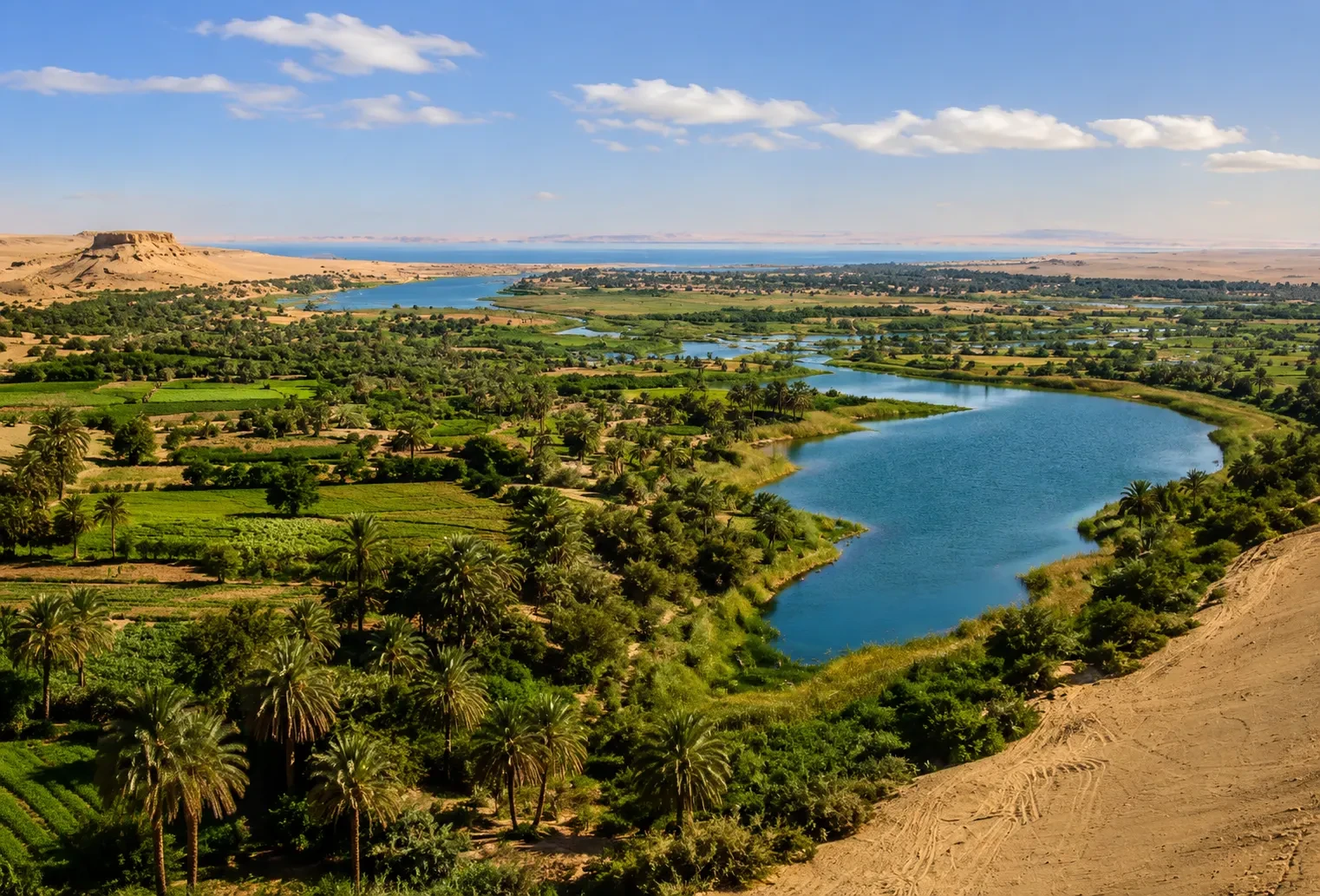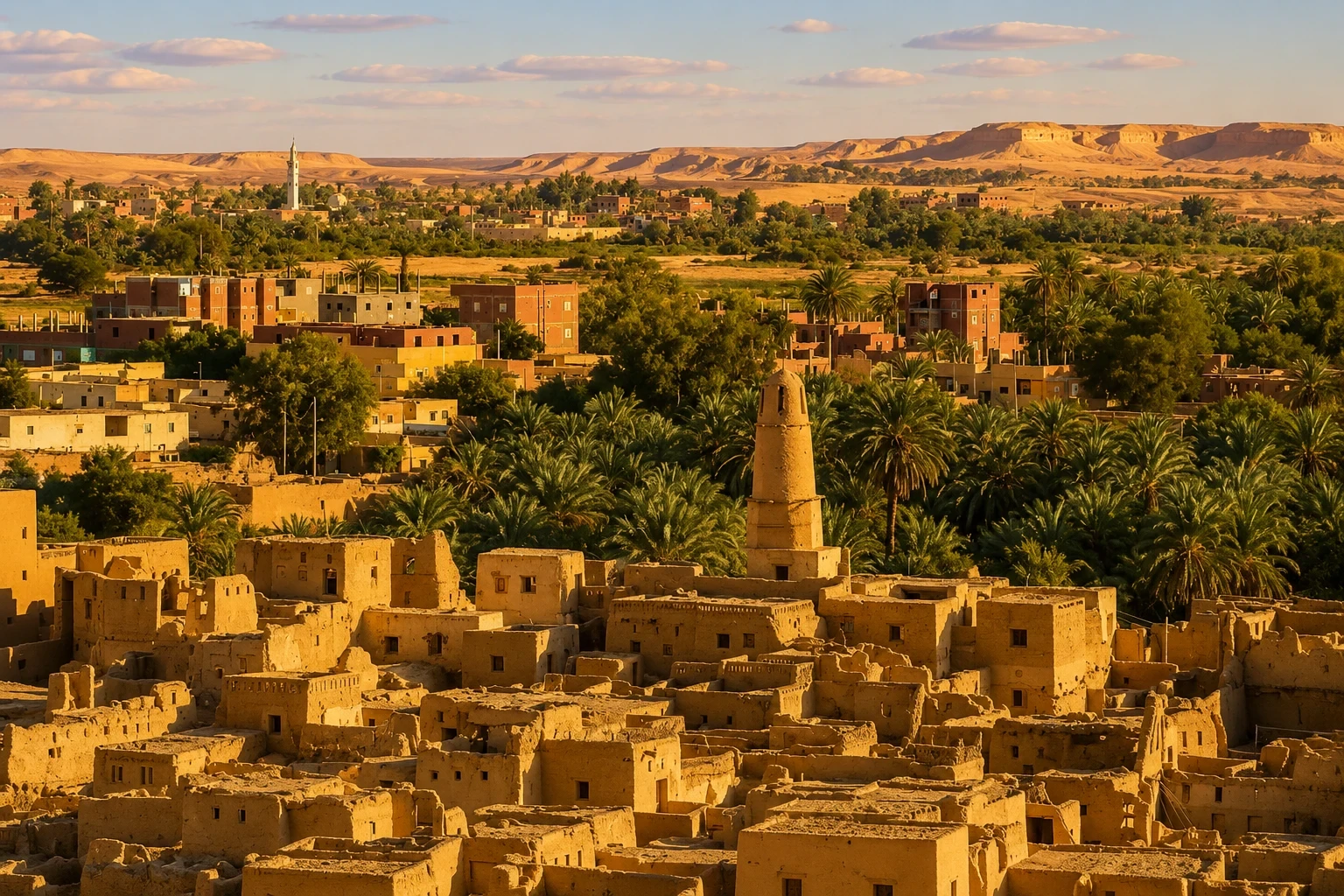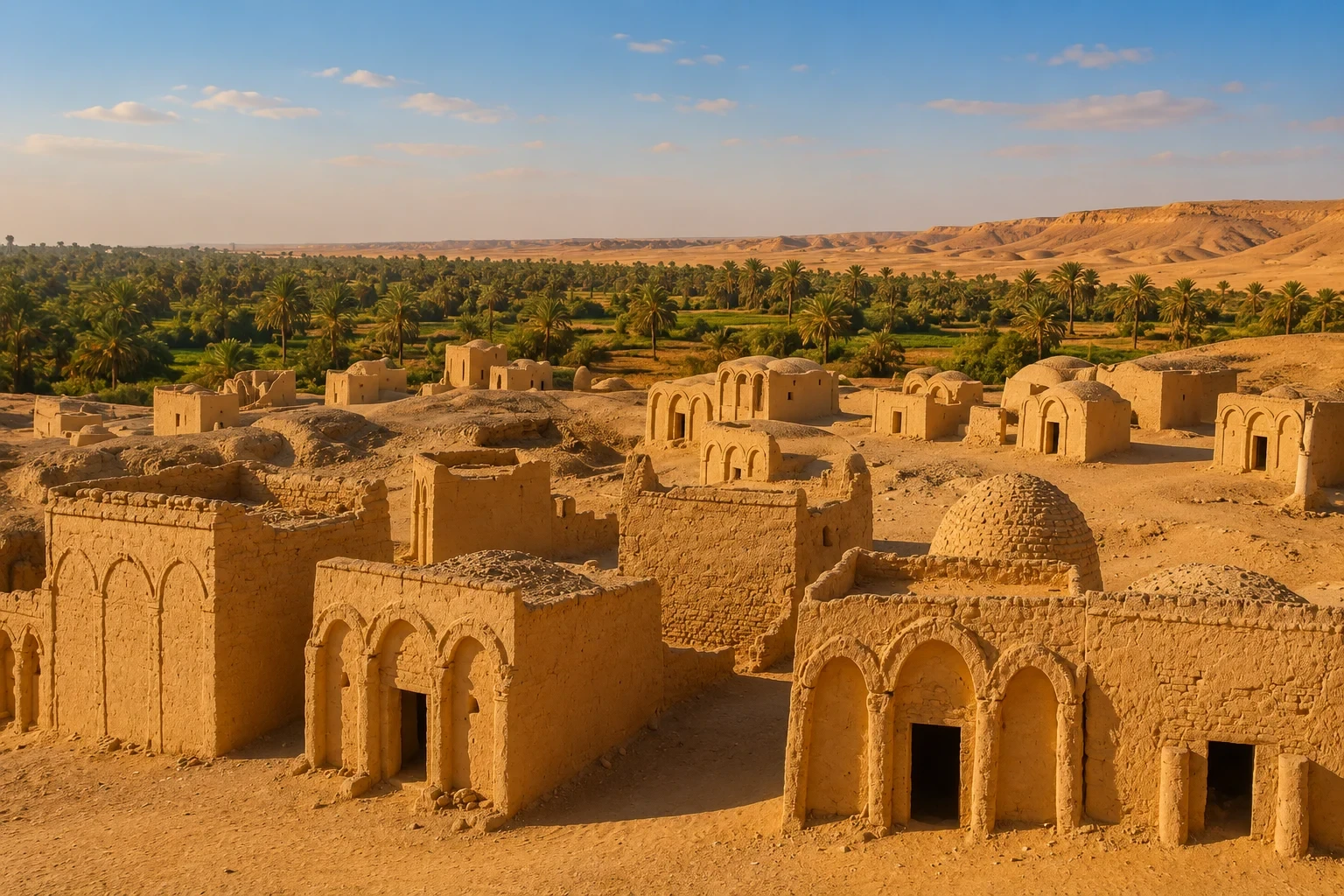

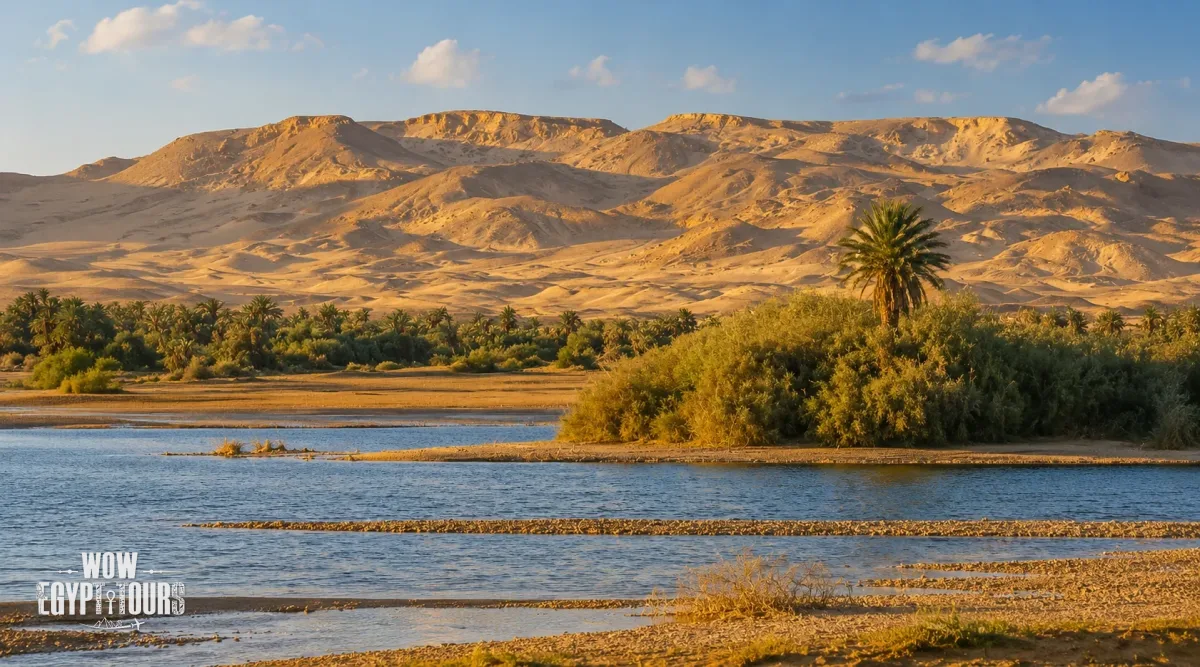

The Faiyum Oasis is the largest, the most agriculturally productive, the most archaeologically layered, and the most easily accessible of all the great oasis destinations in the Egyptian Western Desert, a magnificent natural depression approximately 90 kilometers southwest of Cairo whose fertile landscape of date palm gardens, mango orchards, strawberry fields, lotus-covered waterways, and the vast blue expanse of Lake Qarun creates one of the most beautiful and the most historically resonant natural and agricultural environments available anywhere in the Egyptian interior, and whose extraordinary concentration of Pharaonic royal monuments, Greco-Roman ancient cities, UNESCO-protected prehistoric fossil landscapes, and unique natural heritage experiences makes it the single most diverse and the single most reward-rich heritage destination within a short drive of the Egyptian capital. Known since antiquity as the Garden of Egypt for the extraordinary fertility of its Nile-fed soils and the extraordinary variety of its agricultural production, and celebrated in the ancient Egyptian and Greco-Roman literary traditions as one of the most beautiful and the most pleasurable landscapes in the entire Nile Valley world, the Faiyum Oasis is a destination of such immediate natural beauty and such extraordinary archaeological richness that travelers who invest the time to explore it beyond the conventional Cairo-Pyramids-Luxor circuit of Egyptian tourism consistently discover it to be one of the most unexpected and the most personally rewarding heritage discoveries available anywhere in the country. This extraordinary destination is accessible through Egypt Desert Safari Tours and Egypt Travel Packages, both of which WOW Egypt Tours proudly offers to travelers from around the world as part of Egypt Tours Packages that encompass the complete natural and cultural heritage of the Egyptian Western Desert and oasis landscape.
The Faiyum Oasis Egypt is unique among all the great Western Desert oases in its fundamental geological and hydrological character, being fed not by the underground artesian aquifer system that sustains the more remote oases of Bahariya, Farafra, Dakhla, and Kharga, but by the waters of the Nile itself, delivered through the ancient Bahr Yussef canal, the natural overflow channel of the Nile that has been feeding the Faiyum depression with Nile flood waters since at least the Old Kingdom period of ancient Egyptian civilization, creating in the desert depression a permanently irrigated agricultural landscape of extraordinary productivity whose connection to the Nile River makes it technically different in character from the artesian oases of the deeper Western Desert while belonging fully to the cultural and geographical tradition of the Egyptian oasis world. The most extraordinary and the most internationally significant natural heritage site in the entire Faiyum region is Wadi El Hitan, the Valley of the Whales, a UNESCO World Heritage Site of outstanding universal geological and paleontological value located in the Western Desert approximately 150 kilometers southwest of Cairo, whose extraordinary fossil field of ancient whale skeletons, preserved in situ in the desert sedimentary rock where they fell to the sea floor approximately 37 to 40 million years ago, provides the most complete and the most scientifically significant fossil record of whale evolution available at any paleontological site in the world and gives the Faiyum region a dimension of natural scientific heritage that is unique in the Egyptian landscape and unique in the broader African natural heritage record. WOW Egypt Tours includes the Faiyum Oasis, Lake Qarun, Wadi El Hitan, and the remarkable archaeological heritage of the Faiyum region as destinations on Egypt Desert Safari Tours and Egypt Travel Packages for travelers seeking the most complete encounter with this extraordinary and remarkably accessible region.

What Is The Faiyum Oasis?
The Faiyum Oasis, also spelled Fayoum, Fayyum, or Fayum in various transliterations of the Arabic name, is a large natural depression in the limestone plateau of the Egyptian Western Desert located in the Faiyum Governorate approximately 90 to 100 kilometers southwest of Cairo, comprising an area of approximately 1,800 square kilometers of agricultural land, urban settlement, lake, and desert landscape that makes it by far the largest and the most extensively cultivated of the Egyptian oasis depressions. The Faiyum depression descends to approximately 45 meters below sea level at its deepest point in the southwestern part of Lake Qarun, making it one of the most significant below-sea-level depressions in all of Africa and one of the most distinctive topographic features of the Egyptian Western Desert plateau. The oasis landscape is extraordinarily varied, encompassing the densely cultivated agricultural areas of the central and northern depression, the extensive bird-rich wetlands and salt marshes of the Lake Qarun shoreline, the dramatic escarpment landscape of the northern and eastern desert margins where the limestone plateau drops sharply to the oasis floor, the extraordinary fossil landscape of Wadi El Hitan to the southwest, and the remarkable Wadi El Rayan protected area with its unique desert waterfalls and lakes to the west, together creating the most topographically and ecologically diverse oasis landscape in the Egyptian Western Desert and the most heritage-rich single oasis destination within practical day-trip distance of Cairo.
The Faiyum is home to a population of approximately three million people, making it one of the most densely populated oasis regions in Egypt and one of the most economically significant agricultural areas in the country, producing roses for the Egyptian perfume and cosmetics industry, lotus flowers for ceremonial and decorative use, strawberries, mangoes, grapes, olives, and a vast range of other agricultural products that give the Faiyum its ancient reputation as the Garden of Egypt and that continue to supply the Cairo market and the Egyptian agricultural export trade with high-quality produce of exceptional variety and volume. The main city of Faiyum (Medinet El Faiyum), the regional capital and the largest urban center in the oasis, is a bustling provincial Egyptian city of considerable character and considerable heritage depth, whose ancient urban fabric, traditional waterwheel installations, covered markets, and Coptic Christian churches provide a living urban heritage experience entirely different from the purely natural or purely archaeological heritage of the surrounding landscape.
Who Built The Great Monuments Of The Faiyum?
The most significant ancient monuments of the Faiyum were built by the pharaohs of the Middle Kingdom 12th Dynasty, particularly Amenemhat III and Senusret II, who recognized in the Faiyum depression the most productive and the most strategically significant agricultural resource available to the Egyptian state outside the main Nile Valley and who invested extraordinary resources in the hydraulic engineering and the agricultural development of the oasis as a model royal estate and a primary source of grain and luxury agricultural products for the Egyptian royal household. The Middle Kingdom pharaohs were responsible not only for the great pyramid monuments of the Faiyum, the Hawara Pyramid of Amenemhat III and the Lahun Pyramid of Senusret II, but also for the vast hydraulic engineering works that expanded the agricultural productivity of the oasis by regulating the Nile waters entering through the Bahr Yussef canal and managing the Lake Moeris reservoir system that the ancient Faiyum represented in its most developed form.
Amenemhat III, who reigned approximately from 1855 to 1808 BCE during the 12th Dynasty, is the most closely associated of all the ancient Egyptian pharaohs with the Faiyum Oasis, having built both his pyramid at Hawara near the entrance to the Faiyum depression and the legendary mortuary complex known in ancient literature as the Labyrinth, described by the Greek historian Herodotus and the geographer Strabo as more astonishing than the pyramids themselves in the complexity and the variety of its thousands of rooms, columns, and courts, and as the greatest architectural achievement of the ancient Egyptian world outside the Giza pyramid complex itself. The Ptolemaic rulers, who inherited the ancient Egyptian state from Alexander the Great's successors in the 3rd century BCE, were equally devoted patrons of the Faiyum, investing heavily in the reclamation and development of new agricultural land in the oasis depression and settling thousands of Macedonian and Greek military veterans as farmer-colonists in the newly developed areas, creating the remarkably cosmopolitan Greco-Roman agricultural community whose extraordinary funerary portraits, the famous Fayum mummy portraits, are the most celebrated and the most personally affecting artistic legacy of the ancient Faiyum heritage.
The Fayum Mummy Portraits: The Faces Of Ancient Egypt
The most celebrated and the most internationally recognized artistic legacy of the ancient Faiyum Oasis is the extraordinary collection of painted mummy portraits known throughout the world as the Fayum mummy portraits, encaustic or tempera panel paintings of such immediate visual power, such technical mastery, and such intense individual human presence that they have been consistently described by art historians of every cultural background as the most beautiful, the most personally affecting, and the most immediately accessible ancient portraits in the entire classical world, transcending the cultural and temporal distance of nearly two thousand years to create a direct visual encounter with individual ancient human beings of extraordinary emotional intensity and extraordinary artistic accomplishment. The Fayum mummy portraits were produced in the Faiyum Oasis and throughout Egypt during the Roman period, approximately from the 1st through the 4th centuries CE, as replacements for the traditional ancient Egyptian stylized mummy masks that had been used in the ancient Egyptian funerary tradition for three thousand years, with the new Greco-Roman period portraits adopting the artistic techniques of the contemporary Greek and Roman traditions of illusionistic panel painting to create realistic individual facial likenesses of the deceased that were incorporated into the mummy wrappings over the face of the body.
The technical medium of the Fayum portraits, encaustic painting using heated beeswax pigments applied to thin wooden panels in the most demanding and the most technically sophisticated painting technique of the ancient world, allowed the ancient artists of the Faiyum workshops to achieve a quality of direct and immediate realism, a sense of the living presence of the individual depicted, that the wax medium's richness and luminosity gives to the painted surface and that no other ancient painting medium quite achieves. The direct gaze of the portrait subjects, their individual physiognomies of extraordinary variety and specificity, their personal jewelry, their hairstyles fashionable to specific Roman-period decades, and above all the quality of individual psychological presence that the finest examples of the tradition project from their painted surfaces across nearly two thousand years of time, have made the Fayum mummy portraits the single most universally admired and the most personally affecting ancient art tradition accessible to modern viewers in any medium, ancient paintings that speak directly and powerfully to the human condition in a way that the more formal and more hieratic conventions of mainstream ancient Egyptian or ancient Greek art cannot quite replicate. The Fayum portraits in the collection of the Greco-Roman Museum in Alexandria, the Cairo Museum, and the great international museum collections of Europe and North America where the finest individual examples are held, are consistently described by visitors who encounter them for the first time as one of the most moving and the most personally affecting encounters with ancient art available at any heritage site or any museum in the world.
Faiyum Oasis Location In Egypt
The Faiyum Oasis is located in the Faiyum Governorate of Egypt, approximately 90 to 100 kilometers southwest of Cairo by road, making it by far the most accessible of all the Egyptian oasis destinations from the Egyptian capital and the only major Egyptian oasis that is realistically accessible as a comprehensive one-day excursion from Cairo for travelers with limited time. The main city of Faiyum (Medinet El Faiyum) is connected to Cairo by a direct desert highway that crosses the Giza plateau south of the Pyramids and descends into the Faiyum depression through the dramatic escarpment landscape of the oasis rim, a drive of approximately 1.5 to 2 hours by private vehicle. The Wadi El Hitan UNESCO World Heritage Site, the most internationally significant heritage destination in the entire Faiyum region, is located approximately 150 kilometers southwest of Cairo in the desert west of Lake Qarun, approximately 45 kilometers from the main Faiyum city, accessible from the city by four-wheel-drive vehicle on a desert track of approximately 45 to 60 minutes. Wadi El Rayan with its protected desert lakes and unique natural waterfalls is located approximately 30 kilometers southwest of the main Faiyum city, accessible by paved road in approximately 30 to 40 minutes. Lake Qarun, the great saltwater lake of the Faiyum depression, lies along the northern edge of the agricultural landscape approximately 12 to 15 kilometers north of the main city. WOW Egypt Tours provides private air-conditioned vehicle and four-wheel-drive transportation for all Faiyum heritage programmes as part of Egypt Desert Safari Tours and Egypt Travel Packages.
Faiyum Oasis Fun Facts
The Faiyum Oasis contains within its boundaries or immediately adjacent to it Egypt's only naturally occurring waterfall, located in the Wadi El Rayan protected area where the water of the upper Wadi El Rayan lake spills over a dramatic rock ledge into the lower lake in a cascade of desert water that is entirely unique in the Egyptian natural landscape, combining the visual drama of falling water with the extraordinary silence and the extraordinary aridity of the surrounding Western Desert landscape to create one of the most unexpected and the most visually surprising natural heritage experiences available anywhere in Egypt. The Wadi El Rayan waterfall, though relatively modest in scale compared to major world waterfalls, has the singular distinction of being the only permanent natural waterfall in the entire Egyptian desert landscape and is therefore one of the most photographed natural features in the Faiyum region, attracting visitors who come specifically to witness the surreal sight of freely flowing and freely falling water in one of the most arid landscapes in the world.
The ancient Lake Moeris, the vast artificial reservoir that the ancient Egyptians created in the Faiyum depression by engineering the Bahr Yussef canal to flood the oasis depression with Nile overflow waters during the inundation season and by constructing regulatory dams to retain the water as a reservoir during the dry season, was described by the ancient Greek historian Herodotus as one of the most impressive engineering achievements of the ancient world, a reservoir of such enormous extent, approximately 1,700 square kilometers at its greatest extent in the Middle Kingdom period, that it served as a buffer against both flood and drought for the entire Nile Valley agricultural system of ancient Egypt. The modern Lake Qarun, the diminished saltwater remnant of the ancient Lake Moeris, covers approximately 214 square kilometers today, a fraction of the ancient lake's greatest extent but still one of the most significant lake ecosystems in the Egyptian landscape and one of the most important waterbird habitats in North Africa.
The famous rose water and rose oil products of the Faiyum, produced from the extensive rose cultivation in the agricultural areas of the oasis, have been recognized as some of the finest in the Middle East for centuries, and the Faiyum rose harvest, conducted in the spring when the rose gardens of the oasis are in full bloom, is one of the most visually spectacular and the most aromatically extraordinary agricultural events in the Egyptian calendar, attracting visitors from Cairo and from across Egypt to witness the harvest and to purchase the fresh-pressed rose water and rose oil products whose quality is celebrated throughout the Egyptian and regional perfume and cosmetics industry.
Why Is It Called Faiyum Oasis?
The name Faiyum, also spelled Fayoum, Fayyum, or Fayum, derives from the ancient Coptic name Pi-yom or Phiom, meaning the sea or the lake, a reference to the great Lake Moeris that dominated the ancient landscape of the Faiyum depression and that gave the entire region its most immediately defining geographical character as the Egyptian landscape of the great lake. The ancient Coptic name Pi-yom itself derives from the even older ancient Egyptian name Pa-yam, meaning the sea, applied to the ancient lake of the Faiyum depression whose enormous extent in the Middle Kingdom period, approximately 1,700 square kilometers of open water, made it the most significant inland body of water in the entire Egyptian landscape and the most immediately dominant geographical feature of the oasis region. The Arabic name Faiyum is a simple Arabic phonetic adaptation of the Coptic Pi-yom, following the standard linguistic pattern by which Arabic adapted ancient Egyptian and Coptic place names throughout Egypt after the Arab conquest of 641 CE, and the name has remained in consistent use in both Arabic and international geographical and heritage literature from the medieval period to the present. The name Faiyum therefore preserves in its phonetic form the direct linguistic descendant of the ancient Egyptian word for sea or lake applied to the ancient Lake Moeris more than four thousand years ago, making it one of the oldest continuously used geographical names in the entire Egyptian landscape and one of the most direct surviving linguistic connections between the ancient Egyptian language and the modern Arabic toponymy of Egypt.
Faiyum Oasis History
The history of human occupation in the Faiyum Oasis extends further back in time than at any other comparable area of the Egyptian Western Desert, with archaeological evidence for prehistoric human presence in the Faiyum depression dating back to approximately 8,000 years ago, when the Neolithic agricultural communities of what archaeologists call the Faiyum A culture established the first known agricultural settlements in the region and began the cultivation of wheat and barley whose extraordinary productivity in the fertile oasis soils laid the agricultural foundation for all subsequent phases of the Faiyum's extraordinary historical development. The Faiyum A Neolithic communities, who lived around the shores of the ancient lake when it was at a much higher level than today and whose flint tools, grain storage pits, and agricultural remains are preserved in the ancient lakeshore deposits, are among the earliest documented agricultural communities in the entire North African archaeological record, making the Faiyum Oasis one of the most archaeologically significant prehistoric landscapes in the continent.
The ancient Egyptian Pharaonic period saw the Faiyum Oasis reach its greatest political and agricultural significance as the primary royal agricultural estate and hydraulic engineering showcase of the Middle Kingdom 12th Dynasty, approximately 2000 to 1800 BCE, when the pharaohs Amenemhat I, Senusret II, and above all Amenemhat III undertook the most ambitious irrigation and land reclamation engineering programme in the history of ancient Egypt, transforming the Faiyum depression into a model agricultural landscape of extraordinary productivity by regulating the Nile waters entering through the Bahr Yussef canal and creating the vast Lake Moeris reservoir system that served as a natural flood control and irrigation buffer for the entire Egyptian Nile Valley agricultural system. The pyramid monuments of Amenemhat III at Hawara and of Senusret II at Lahun, built in the desert margins of the Faiyum depression in the traditional royal pyramid tradition of the Old Kingdom, together with the legendary Labyrinth mortuary complex of Amenemhat III described by ancient classical authors as the supreme architectural achievement of the ancient world, represent the most tangible surviving evidence for the extraordinary royal investment in the Faiyum region during the Middle Kingdom golden age.
The Ptolemaic period from the 3rd century BCE onwards brought another peak of development and prosperity to the Faiyum, as the Ptolemaic rulers undertook a systematic programme of land reclamation and settlement in the newly drained and newly cultivated areas of the depression, establishing dozens of new agricultural communities populated by Macedonian and Greek military veteran settlers who developed the extraordinary multicultural farming society whose Greco-Roman period funerary art, the famous Fayum mummy portraits, is the most celebrated and the most internationally recognized artistic legacy of the ancient Faiyum heritage. The Roman period continued the agricultural and commercial prosperity of the Ptolemaic era, and the Faiyum communities of the Roman period, with their extraordinary literacy, their active commercial and legal document production, and their celebrated painted funerary portraits, are among the most extensively documented of all the ancient provincial communities of Roman Egypt, providing a vivid and unusually personal picture of daily life, commercial activity, and cultural aspiration in an ancient agricultural community of remarkable vitality and complexity.
The Story Of Wadi El Hitan And The Ancient Whales
The story of Wadi El Hitan, the Valley of the Whales, is one of the most extraordinary geological discovery stories in the history of Egyptian natural heritage, a narrative that reveals how the most unlikely desert landscape in the world, one of the most arid and the most remote corners of the Egyptian Western Desert, conceals beneath its sun-baked surface the fossilized remains of creatures that lived not in a desert but in a warm shallow sea approximately 37 to 40 million years ago, and that their discovery and scientific study has provided the single most important and the single most complete fossil record of the evolution of whales from land-dwelling mammals to ocean creatures available at any paleontological site in the entire world. The ancient sea that covered what is now the Egyptian Western Desert in the Eocene geological period, approximately 37 to 40 million years ago, was a warm shallow ocean called the Tethys Sea, an ancient body of water that covered much of what is now the Mediterranean region and North Africa in a marine environment of extraordinary biological richness, whose sediments, now exposed in the eroded desert landscapes of the Faiyum and the Western Desert, preserve one of the finest and the most scientifically productive fossil records of Eocene marine life in the world.
The ancient whales whose fossil remains are preserved in the Wadi El Hitan desert sediments, belonging to the extinct cetacean family Basilosauridae, are scientifically extraordinary because they represent the transitional evolutionary stage between the land-dwelling mammal ancestors of modern whales and the fully aquatic marine mammals that whales subsequently became, preserving in their fossilized skeletons the evidence for anatomical features, including vestigial hind limbs, that document the progressive anatomical transformation from terrestrial to aquatic lifestyle in one of the most dramatic evolutionary transitions in the entire history of mammalian evolution. The presence of vestigial hind legs on the ancient whale skeletons of Wadi El Hitan, tiny reduced limb bones preserved in the fossil record long after they had lost any significant functional role in the animal's locomotion, is the most striking and the most scientifically significant single anatomical feature of the Wadi El Hitan fossils, providing direct physical evidence for the evolutionary history of whale locomotion that was previously known only from theoretical reconstruction and incomplete fossil records at other sites. The scientific importance of the Wadi El Hitan fossil field, which contains not only the whale skeletons but also the fossils of the ancient sea turtles, sharks, rays, dugongs, and other marine creatures that shared the ancient Tethys Sea environment with the ancestral whales, led to its designation as a UNESCO World Heritage Site in 2005 and its recognition as one of the most scientifically significant paleontological sites in the entire world.
Faiyum Oasis Key Attractions And Features
Wadi El Hitan UNESCO World Heritage Site
Wadi El Hitan, the Valley of the Whales, is the single most internationally significant heritage site in the entire Faiyum region and one of the most scientifically important natural heritage sites in the entire African continent, designated a UNESCO World Heritage Site in 2005 in recognition of its outstanding universal value as the world's most complete and most scientifically significant fossil record of whale evolution. The Wadi El Hitan protected area, located approximately 150 kilometers southwest of Cairo in the desert west of Lake Qarun, encompasses a spectacular desert landscape of wind-eroded sandstone and limestone formations in whose exposed rock surfaces the fossilized skeletons of ancient Eocene whales lie preserved in situ exactly where they fell to the sea floor approximately 37 to 40 million years ago, creating a paleontological site of extraordinary visual drama and extraordinary scientific significance that has no parallel at any accessible natural heritage site in Egypt or in the broader North African landscape. The visitor experience at Wadi El Hitan, managed by the Egyptian Environmental Affairs Agency within the framework of the Wadi El Hitan Protected Area, is organized around a series of marked fossil trails that allow visitors to walk among the ancient whale skeletons preserved in the desert rock surface, accompanied by licensed guides who explain the scientific significance of the fossils, the geological history of the ancient Tethys Sea, and the extraordinary evolutionary story that the Wadi El Hitan fossil record documents. The site also includes a purpose-built visitor center and fossil museum that provides the interpretive framework for understanding the paleontological significance of the fossil field before the trail walk, and that houses selected fossil specimens and scientific displays about the evolution of whales and the ancient marine environment of the Eocene Western Desert.
Lake Qarun And Waterbird Heritage
Lake Qarun, the great saltwater lake of the Faiyum depression, is one of the most significant natural heritage features of the entire Faiyum landscape, a hypersaline lake of approximately 214 square kilometers that occupies the deepest part of the Faiyum depression at approximately 45 meters below sea level and that serves as one of the most important waterbird habitats in North Africa and one of the most significant staging areas on the East Atlantic-Mediterranean bird migration flyway. The lake, a diminished remnant of the ancient Lake Moeris that once covered approximately 1,700 square kilometers of the Faiyum depression in its greatest Middle Kingdom extent, supports extraordinary concentrations of resident and migratory waterbirds throughout the year, including egrets, herons, cormorants, flamingos, ducks, waders, terns, and numerous other species whose concentrations on the lake's shores and open water make Qarun one of the finest birdwatching destinations in the entire Egyptian landscape and one of the most rewarding natural heritage experiences available in the Faiyum region for travelers with an interest in wildlife and natural history. The lake's shoreline landscape, with its combination of open water, reed beds, salt marshes, and the dramatic escarpment of the desert plateau rising behind the northern shore, creates a panoramic natural heritage composition of extraordinary visual beauty that is unlike anything available at any comparable natural destination within the same driving distance of Cairo. The ancient ruins of Dimeh el-Siba (Soknopaiou Nesos), a Greco-Roman period temple complex and ancient town site whose mudbrick ruins rise from the desert at the northern shore of Lake Qarun, add an extraordinary archaeological dimension to the natural heritage experience of the lakeside landscape.
Wadi El Rayan Protected Area And The Desert Waterfalls
The Wadi El Rayan Protected Area, located approximately 30 kilometers southwest of the main Faiyum city in the desert landscape west of the main agricultural oasis, is one of the most biologically diverse and the most visually surprising protected natural areas in the Egyptian Western Desert, encompassing two artificial lakes created by the drainage of agricultural irrigation water from the Faiyum oasis into the desert depression since the 1970s and the extraordinary desert waterfall that connects the upper and lower lakes in the only naturally flowing and freely falling water cascade available in the Egyptian desert landscape. The Wadi El Rayan lakes, though hydrologically the product of modern agricultural drainage rather than ancient natural hydrology, have developed in the decades since their creation into significant wildlife habitats supporting substantial populations of resident and migratory waterbirds, desert gazelles, desert foxes, and various reptile species in a remarkably rich desert ecosystem that is one of the most biologically productive protected areas in the western Faiyum landscape. The desert waterfall between the upper and lower Wadi El Rayan lakes, while modest in scale relative to major world waterfalls, is visually extraordinary in its desert context, the sight and sound of freely flowing water descending over ancient desert rock in one of the most arid landscapes in the world creating a natural experience of such complete unexpectedness and such genuine sensory richness that it consistently produces the same response of astonished delight in visitors as the most celebrated natural spectacles of much larger scale in other parts of the world. The broader Wadi El Rayan landscape, with its combination of desert lakes, desert escarpments, sand dunes, and the extraordinary natural light of the Western Desert at different times of day, is one of the most photogenically beautiful and the most environmentally distinctive natural heritage destinations in the entire Faiyum region.
The Hawara Pyramid And The Labyrinth Site
The Hawara Pyramid of Amenemhat III, located at the entrance to the Faiyum depression approximately 10 kilometers south of the main Faiyum city, is the most significant and the most historically resonant Pharaonic monument in the entire Faiyum region, a Middle Kingdom royal pyramid of mudbrick construction with a limestone casing that has been severely eroded over the millennia to reveal its internal mudbrick structure in a dramatically ruined form whose very ruination gives it a quality of ancient geological presence and archaeological authenticity that the better-preserved stone pyramids of the Giza and Dahshur complexes cannot quite match. The Hawara Pyramid is most historically significant not for the pyramid itself but for the remarkable funerary complex that surrounded it, the legendary structure known to the ancient Greeks and Romans as the Labyrinth, a vast mortuary temple complex of thousands of rooms, columns, courts, and corridors that the ancient historian Herodotus, who visited it in the 5th century BCE and recorded his response in astonished superlatives, described as surpassing in its complexity and its architectural ambition even the pyramids of Giza themselves, and that the geographer Strabo, writing in the 1st century BCE, called the most astonishing building he had ever seen in any of his extensive travels throughout the ancient Mediterranean world. The Labyrinth complex has been almost entirely robbed of its stone and reduced to a field of sand and ancient debris by two and a half millennia of systematic stone quarrying, but its legendary status in the ancient literary tradition and the occasional archaeological finds of decorated stone blocks, column fragments, and architectural elements that have been recovered from the site give it a quality of historical significance and imaginative resonance that elevates the modest visible remains far beyond their physical character.
The Lahun Pyramid And Kahun
The Lahun Pyramid of Senusret II, located at the southern entrance to the Faiyum depression approximately 100 kilometers south of Cairo near the modern town of El Lahun, is the other major Middle Kingdom royal pyramid of the Faiyum region, built by the pharaoh Senusret II of the 12th Dynasty approximately 1880 to 1874 BCE as his royal tomb and the focus of a mortuary cult establishment that also included the famous ancient workers' town of Kahun discovered adjacent to the pyramid by the British archaeologist Flinders Petrie in 1889. The Lahun Pyramid, constructed of mudbrick with a limestone casing similar to the Hawara Pyramid, has been eroded to a similar state of partial ruination, but the associated workers' town of Kahun (also known as Hetep-Senusret) is one of the most archaeologically significant urban sites of the ancient Egyptian Middle Kingdom period, preserving the remains of a complete planned ancient Egyptian town whose grid-plan layout, standardized house types, and extraordinary collection of ancient papyrus documents recovered from the ruins provide the most complete available picture of daily life in an ancient Egyptian planned settlement of the Middle Kingdom period. The Kahun Papyri, a collection of ancient Egyptian documents including medical texts, mathematical texts, veterinary texts, and administrative records recovered from the Kahun ruins by Petrie, are among the most significant ancient Egyptian documentary discoveries of the 19th century, providing direct and detailed evidence for the practical knowledge, the administrative procedures, and the daily concerns of a Middle Kingdom Egyptian community of remarkable cultural sophistication.
Karanis And The Greco-Roman Heritage
The ancient Greco-Roman city of Karanis, known today by the Arabic name Kom Oshim, is one of the most extensively excavated and the most archaeologically informative Greco-Roman period urban sites in the entire Egyptian landscape, a large ancient agricultural town founded in the 3rd century BCE under the Ptolemaic land reclamation and settlement programme and occupied continuously through the Roman period until approximately the 5th century CE when its population gradually drifted away as the agricultural productivity of its surrounding land declined. The excavations at Karanis, conducted primarily by the University of Michigan between 1924 and 1935, revealed an extraordinary quantity and variety of ancient objects and documents including thousands of ancient papyrus texts, glass objects, coins, household ceramics, textile fragments, agricultural implements, and personal possessions of the ancient Karanis community that have made the Karanis material one of the most extensively studied and the most richly documented ancient Egyptian provincial communities in the entire scholarly literature of classical archaeology. The on-site Kom Oshim Museum, located at the Karanis site approximately 35 kilometers north of the main Faiyum city, displays the most significant finds from the Karanis excavations and provides the most accessible and the most comprehensively interpreted encounter with the Greco-Roman period heritage of the Faiyum landscape available at any site in the region.
The Traditional Waterwheels Of Faiyum
The ancient irrigation waterwheel, known in Arabic as the saqiya, is the most immediately visible and the most characteristically distinctive technological feature of the traditional Faiyum agricultural landscape, a simple but extraordinarily effective ancient water-lifting device that has been used in the Faiyum oasis since at least the Ptolemaic period to raise irrigation water from the canals fed by the Bahr Yussef into the higher-level agricultural fields of the oasis where gravity alone cannot deliver the water. The sound of the traditional Faiyum waterwheels, the rhythmic creaking and splashing of the ancient wooden mechanism as it is turned by draft animals walking in a circle around the waterwheel axle, is one of the most evocative and the most persistently atmospheric sounds of the traditional Faiyum landscape, as immediately characteristic of the oasis soundscape as the call to prayer is of the Egyptian urban soundscape or the sound of the Nile wind is of the Upper Egyptian river landscape. The waterwheels of Faiyum, some of which are still functional traditional wooden mechanisms while others have been preserved as heritage monuments, are one of the most photographed and the most visually distinctive cultural heritage features of the Faiyum landscape, attracting visitors who come specifically to photograph and to experience the living tradition of this ancient agricultural technology in one of the few remaining contexts in Egypt where it continues to function in its original setting.
Why Is Faiyum Oasis Important?
The Faiyum Oasis is important for reasons spanning prehistoric archaeology, ancient Egyptian royal heritage, Greco-Roman provincial culture, natural paleontological heritage, ecological conservation, living agricultural tradition, and the practical geography of Egyptian tourism as the most accessible oasis destination from Cairo. As a prehistoric site, the Neolithic agricultural communities of the Faiyum A culture represent some of the earliest documented farmers in North Africa. As a Pharaonic royal heritage landscape, the Hawara and Lahun pyramids and the legendary Labyrinth of Amenemhat III document the most intensive royal investment in an oasis landscape in the entire history of ancient Egypt. As a Greco-Roman heritage landscape, the communities of the Ptolemaic and Roman Faiyum produced the Fayum mummy portraits, the most internationally celebrated and the most personally affecting ancient Egyptian artistic tradition outside the great pharaonic monuments of the Nile Valley. As a natural heritage landscape, Wadi El Hitan is a UNESCO World Heritage Site of outstanding universal value housing the world's most complete fossil record of whale evolution. As an ecological landscape, Lake Qarun and Wadi El Rayan together constitute one of the most significant waterbird habitat complexes in North Africa and one of the most biologically diverse protected natural areas in the Egyptian Western Desert.
As a living agricultural and cultural landscape, the Faiyum's rose gardens, lotus waterways, traditional waterwheels, and extraordinary agricultural productivity give it a quality of living heritage authenticity and sensory richness that no purely archaeological or purely natural heritage site can replicate. WOW Egypt Tours includes the Faiyum Oasis in its Egypt Desert Safari Tours and Egypt Travel Packages as the most accessible and the most comprehensively heritage-rich oasis destination within the practical day-trip range of Cairo, recognizing it as one of the most genuinely surprising and the most personally rewarding heritage discoveries available to any traveler who ventures beyond the conventional Cairo-Pyramids-Luxor circuit of Egyptian tourism.
What Are Some Interesting Facts About Faiyum Oasis?
Whales In The Desert
The single most immediately astonishing fact about the Faiyum Oasis and its surrounding desert landscape is the presence of fossilized whale skeletons preserved in the desert rock of Wadi El Hitan, approximately 37 to 40 million years old and lying in situ exactly where they fell to the floor of the ancient Tethys Sea when the landscape now occupied by the driest desert in the world was the bottom of a warm shallow ocean. The intellectual and emotional impact of standing in the desert heat surrounded by the silence of the Western Desert and looking at the fossil skeleton of an ancient whale lying in the desert rock at your feet, knowing that this creature was swimming in a warm sea in the space now occupied by the desert air around you approximately 40 million years ago, is one of the most genuinely mind-expanding geological experiences available at any natural heritage site in Egypt, a direct confrontation with the deep geological time and the extraordinary transformations of the Earth's surface that gives the Wadi El Hitan experience a quality of philosophical profundity unique in the Egyptian natural heritage landscape. The fact that these ancient whales had vestigial hind legs, visible in the most complete fossil specimens as tiny reduced limb bones preserved in the rock, adds the further layer of evolutionary biological significance to the geological deep time experience, making Wadi El Hitan simultaneously one of the most geologically extraordinary and one of the most biologically significant accessible natural heritage sites in all of Africa.
The Labyrinth That Amazed The Ancient World
The legendary Labyrinth of Amenemhat III, described by Herodotus in the 5th century BCE as containing three thousand rooms equally divided between underground and above-ground chambers, with courts and columned halls of such variety, such complexity, and such architectural magnificence that the building surpassed in his estimation all the temples and all the other monuments of Greece and Egypt combined, is one of the most tantalizing and the most frustratingly lost architectural monuments in the entire history of the ancient world, a building of such evident magnificence and such overwhelming ancient literary documentation that its almost complete physical disappearance in the two and a half millennia since Herodotus's visit represents one of the most significant losses of ancient architectural heritage in the history of Mediterranean civilization. The site of the Labyrinth, immediately south of the Hawara Pyramid, is a field of ancient debris, sand, and the occasional visible stone block or architectural fragment whose modest visible remains give almost no indication of the extraordinary structure that once occupied the site, and the contrast between the legendary literary descriptions and the empty reality of the current site creates one of the most poignant encounters with ancient cultural loss available at any heritage site in Egypt, a place where the visitor must rely entirely on the ancient literary imagination to populate the empty landscape with the three thousand rooms and the countless columns and courts that made the Labyrinth the most astonishing building of the ancient world.
Egypt's Only Desert Waterfall
The desert waterfall of Wadi El Rayan, where the water of the upper artificial lake cascades over a rock ledge into the lower lake in the only naturally flowing waterfall in the entire Egyptian desert landscape, is one of the most unexpected and the most surreally beautiful natural experiences available anywhere in the country, a natural phenomenon so completely at odds with the expectations created by the surrounding desert landscape that it invariably produces in visitors the same response of complete and delighted astonishment that the most celebrated natural wonders of much greater physical scale produce in visitors who encounter them for the first time. The sound of freely flowing and freely falling water in the desert silence, the sight of white water cascading over desert rock in one of the driest landscapes in the world, and the presence of the lake's surface birds and the desert wildlife in immediate proximity to the falling water create a natural experience of extraordinary sensory richness and extraordinary ecological incongruity that is unique in the Egyptian natural heritage landscape and that gives the Wadi El Rayan waterfall a quality of complete distinctiveness and complete personal memorability that no other natural feature of comparable modest physical scale in Egypt can match.
What Is So Special About Faiyum Oasis?
The Most Complete Heritage Destination Near Cairo
What makes the Faiyum Oasis uniquely special among all the oasis and desert heritage destinations accessible from Cairo is the extraordinary completeness and the extraordinary diversity of its heritage offering, which encompasses within the boundaries of a single governorate accessible within 2 hours of the Egyptian capital a UNESCO World Heritage paleontological site of outstanding universal value, one of the most significant ancient Egyptian royal monument complexes outside the Giza and Luxor heritage corridors, one of the most extensively studied Greco-Roman provincial city sites in Egypt, Egypt's only desert waterfall, one of the most important waterbird habitats in North Africa, the living agricultural tradition that produced the famous Fayum mummy portraits, extraordinary prehistoric archaeological sites documenting the earliest farmers in North Africa, and the most beautiful and the most productive agricultural oasis landscape in the Egyptian Western Desert. No other single destination within the same travel distance of Cairo offers anything approaching this combination of heritage richness and heritage diversity, and the consistent undervaluation of the Faiyum in the conventional Cairo heritage tourism programme is one of the most significant missed opportunities in the entire Egyptian tourism landscape.
Where The Ancient And The Natural World Meet
The Faiyum is also uniquely special for the quality of synthesis it achieves between ancient human heritage and natural heritage, the way in which the same landscape contains simultaneously the most spectacular natural paleontological heritage in Egypt, the most celebrated Pharaonic agricultural monument complex in the country, the most internationally famous ancient Egyptian portrait painting tradition, and the most extraordinary natural waterfall in the entire Egyptian desert world. This synthesis of the ancient and the natural, the geological and the human, the prehistoric and the contemporary, creates a heritage landscape of such extraordinary density and such genuine depth that it rewards exploration at every level of curiosity and expertise, offering different but equally extraordinary experiences to the geological heritage enthusiast, the ancient history scholar, the natural wildlife observer, the agricultural heritage traveler, and the first-time visitor who simply wants to experience the most beautiful and the most surprising oasis landscape in Egypt in the most accessible and the most conveniently located heritage destination in the country.
Faiyum Oasis Through The Ages
The complete history of the Faiyum Oasis from the Neolithic period of approximately 8,000 years ago through the Pharaonic golden age of the Middle Kingdom, the cosmopolitan Greco-Roman centuries, the Christian Coptic period, the medieval Islamic era, and the modern Egyptian national period traces one of the most continuously occupied and the most historically layered of all the great Egyptian oasis landscapes, a region that has been at the center of Egyptian agricultural and political life in multiple different historical periods and that has produced at different moments of its history cultural achievements of the highest significance and the broadest international impact. The Neolithic Faiyum A culture of approximately 6,000 BCE, the Middle Kingdom hydraulic engineering and pyramid building of approximately 1,900 BCE, the Ptolemaic land reclamation and Greek settlement of approximately 300 BCE, the Roman period Karanis community and mummy portrait tradition of approximately 100 CE, the Coptic Christian monastic tradition that established significant monastic communities in the Faiyum desert margins, and the medieval Islamic agricultural community that preserved and developed the oasis tradition through the Ottoman and modern periods, each constitute a distinct and historically significant chapter in the extraordinary biography of a landscape that has been continuously inhabited, continuously cultivated, and continuously historically significant for approximately eight thousand uninterrupted years.
The modern development of the Faiyum in the 19th and 20th centuries, including the expansion of the agricultural land through new irrigation projects, the growth of the main city of Faiyum into a significant regional urban center, the discovery of Wadi El Hitan and its eventual designation as a UNESCO World Heritage Site in 2005, and the development of the Wadi El Rayan Protected Area and its associated tourism infrastructure, have added contemporary dimensions to the Faiyum heritage landscape that make it as rich and as rewarding a destination for the modern traveler as it has been at every previous period of its extraordinary history.
Faiyum Oasis UNESCO Recognition
The Faiyum Oasis region contains the Wadi El Hitan UNESCO World Heritage Site, designated in 2005 as an area of outstanding universal geological and paleontological value for its extraordinary fossil record of ancient whale evolution in the Eocene sediments of the Western Desert. The UNESCO citation for Wadi El Hitan specifically recognizes the site as containing the most complete fossil record of the evolution of whales from land mammals to ocean creatures available at any accessible paleontological site in the world, and as a site of extraordinary scientific importance for the understanding of one of the most dramatic evolutionary transitions in the entire history of mammalian evolution. The UNESCO designation has brought significant international attention and international scientific engagement to the Wadi El Hitan site and to the broader Faiyum heritage landscape, and has catalyzed the development of the visitor center, the fossil trail infrastructure, and the protected area management system that makes the Wadi El Hitan heritage accessible to visitors in an environmentally responsible and scientifically appropriate framework.
Best Time To Visit Faiyum Oasis
The best time to visit the Faiyum Oasis is during the cooler months from October through April, when the pleasant Mediterranean-influenced climate of the oasis depression provides the most comfortable conditions for outdoor heritage site exploration, wildlife observation at Lake Qarun and Wadi El Rayan, and the desert walk at Wadi El Hitan. The spring months of March and April are particularly special in the Faiyum for the rose harvest season, when the rose gardens of the oasis are in full bloom and the air of the agricultural landscape is heavy with the extraordinary fragrance of the rose fields being harvested for rose water and rose oil production, creating one of the most aromatically extraordinary and the most visually beautiful seasonal agricultural experiences available anywhere in Egypt. The migratory bird concentrations at Lake Qarun and Wadi El Rayan are most spectacular during the spring and autumn migration seasons, approximately March through May and September through November, when the greatest variety and the greatest concentrations of migratory species are present on their passage between European and African destinations. The summer months of June through August bring warm to hot conditions to the Faiyum, with temperatures in the high 30s to low 40s Celsius making the midday hours uncomfortable for extended outdoor activity, but the relative proximity of Cairo and the availability of lake breezes at the Qarun shoreline make the Faiyum significantly more manageable in summer than the more remote desert oases. WOW Egypt Tours organizes Faiyum programmes throughout the year and provides expert guidance on optimal seasonal timing for all oasis and desert activities.
Faiyum Oasis Opening Hours
The Wadi El Hitan Protected Area and its fossil trails are open daily from 8:00 AM to 5:00 PM throughout the year. The Kom Oshim Museum at the Karanis site is open Saturday through Thursday from 9:00 AM to 5:00 PM. The Wadi El Rayan Protected Area with its waterfalls and desert lakes is open daily from 8:00 AM to 5:00 PM. The Hawara Pyramid site and the Lahun Pyramid site are accessible throughout daylight hours with licensed guides. Lake Qarun shoreline access is generally unrestricted throughout the day. The main Faiyum city and its traditional waterwheels are accessible throughout the day and the early evening. Specific hours may vary seasonally and visitors are advised to confirm current opening times with WOW Egypt Tours at the time of booking.
Faiyum Oasis Entrance Fees
Wadi El Hitan Protected Area: EGP 70 for adults, EGP 35 for students.
Wadi El Rayan Protected Area: EGP 5 per vehicle.
Kom Oshim Museum (Karanis): EGP 60 for adults, EGP 30 for students.
Hawara Pyramid and Lahun Pyramid sites: fees subject to confirmation with WOW Egypt Tours at time of booking.
All entrance fees for Faiyum Oasis heritage sites are included in the Egypt Desert Safari Tours and Egypt Travel Packages offered by WOW Egypt Tours.
How To Get To Faiyum Oasis
The Faiyum Oasis is the most accessible of all the Egyptian oasis destinations from Cairo, located approximately 90 to 100 kilometers southwest of the Egyptian capital by road and accessible by private vehicle in approximately 1.5 to 2 hours via the Faiyum Desert Road that departs from the southwestern suburbs of Cairo south of the Giza Pyramids. The road passes through the desert plateau of the Giza escarpment before descending through the dramatic limestone cliff landscape of the Faiyum oasis rim into the green agricultural landscape of the depression below, providing one of the most immediately dramatic approaches of any oasis destination in Egypt as the desert landscape gives way to the suddenly lush and suddenly colorful oasis floor. Wadi El Hitan within the Faiyum region requires an additional 45 to 60 minutes of four-wheel-drive vehicle travel on a desert track from the main Faiyum road, making a standard private vehicle sufficient for most Faiyum heritage programme elements but a four-wheel-drive vehicle essential for the Wadi El Hitan fossil trail visit. WOW Egypt Tours provides private vehicle and four-wheel-drive vehicle transportation for all Faiyum Oasis heritage programmes as part of Egypt Desert Safari Tours and Egypt Travel Packages, handling all transportation logistics from Cairo to all Faiyum sites.
How Long To Spend At Faiyum Oasis
The Faiyum Oasis is rich enough in heritage and natural attractions to reward spending one to two days, but is also accessible enough to the Cairo visitor to make an extremely rewarding one-day programme feasible for travelers with limited time. A focused one-day programme from Cairo can comfortably include Wadi El Hitan (the UNESCO fossil whale site) and either Lake Qarun or Wadi El Rayan, providing the most internationally significant natural heritage experiences of the complete Faiyum landscape. A full day programme can additionally include the Kom Oshim Museum at Karanis, the traditional waterwheels of the Faiyum city, and the agricultural landscape drive through the date palm and rose gardens of the oasis. A two-day programme from Cairo with one overnight in the Faiyum allows the most complete experience of the oasis landscape, encompassing Wadi El Hitan, Lake Qarun birdwatching at dawn or dusk, Wadi El Rayan and the desert waterfall, the Hawara or Lahun Pyramid sites, the Kom Oshim Museum, and an exploration of the main Faiyum city's traditional markets and waterwheel heritage in the most relaxed and the most personally rewarding format. WOW Egypt Tours designs Faiyum Oasis programmes in all durations from focused one-day excursions from Cairo to comprehensive two-day heritage explorations.
Tips For Visiting Faiyum Oasis
Prioritize Wadi El Hitan as the first and the most time-protected element of any Faiyum programme, as the UNESCO World Heritage fossil site is the most internationally significant heritage destination in the entire region and the experience of walking among the ancient whale skeletons in the desert requires sufficient time for both the scientific interpretation provided by the guide and the personal absorption of the extraordinary geological and evolutionary significance of the site. For the Wadi El Hitan visit, arrive as early as possible after the site opens at 8:00 AM, as the early morning desert light on the fossil-bearing rock surfaces provides the finest photography conditions and the most comfortable walking temperatures of any time of day. For Lake Qarun birdwatching, visit at dawn or in the late afternoon when the waterbird activity on the lake's surface and shoreline is most concentrated and most visually spectacular. For Wadi El Rayan, time the waterfall visit for either the early morning or the late afternoon when the light on the water and the surrounding desert landscape is at its most beautiful and the air temperature is most comfortable for the short walk from the vehicle park to the waterfall viewpoint. The spring rose harvest season in March and April provides the most extraordinary sensory bonus of any Faiyum programme, with the fragrance of the rose fields adding an olfactory dimension to the visual heritage experience that is completely unique to this specific seasonal window. A licensed guide from WOW Egypt Tours with specific expertise in the Faiyum geological, paleontological, and archaeological heritage is essential for the fullest appreciation of all the oasis's extraordinary and diverse heritage dimensions.
What To Wear At Faiyum Oasis
The Faiyum Oasis programme combines outdoor fossil trail walking in exposed desert terrain, lakeside wildlife observation, agricultural landscape walking, and archaeological site visits, requiring practical, comfortable clothing appropriate for all these different environments. For the Wadi El Hitan desert fossil trail, lightweight, breathable, long-sleeved clothing with a wide-brimmed hat and generous sunscreen is essential, as the open desert environment of the fossil site has no shade whatsoever and the desert sun exposure during the trail walk is direct and intense regardless of the season. Sturdy, closed-toe walking shoes with good grip and ankle support are necessary for the uneven desert rock surfaces of the fossil trail. For Lake Qarun birdwatching, comfortable, dark or neutral-colored clothing that does not alarm the waterbirds is recommended, with binoculars if available. For Wadi El Rayan waterfall visit, comfortable walking shoes suitable for a short walk on a desert path are required. For agricultural landscape driving and city exploration, comfortable casual clothing is appropriate. Carry at least two liters of water per person for the Wadi El Hitan desert trail walk and for any other extended outdoor activities in the desert landscape of the western Faiyum. A light warm layer is recommended for early morning birdwatching visits to Lake Qarun in the cooler months, when the lakeside air can be noticeably cool before the sun rises.
Photography At Faiyum Oasis
The Faiyum Oasis offers the most photographically diverse range of subjects of any oasis destination in the Egyptian Western Desert, encompassing the paleontological drama of the ancient whale skeletons in the Wadi El Hitan desert rock, the birdlife concentrations of Lake Qarun, the surreal desert waterfall of Wadi El Rayan, the ancient ruined pyramid silhouettes of Hawara and Lahun, the traditional wooden waterwheel mechanisms of the Faiyum agricultural landscape, the rose fields and the lotus-covered waterways of the oasis gardens, and the fishing boat activity on Lake Qarun in its spectacular escarpment and desert setting. Wadi El Hitan photography is most spectacular in the early morning and late afternoon when the low-angle desert light rakes across the fossil-bearing rock surfaces and creates dramatic shadows that reveal the three-dimensional character of the ancient whale bones in the rock in a way that the overhead midday light completely flattens. The desert waterfall of Wadi El Rayan is most powerfully photographed from the viewpoint directly overlooking the cascade, with the surrounding desert landscape providing the extraordinary contrast backdrop that gives the image of water in the desert its most immediate visual impact. Lake Qarun birdlife photography is best from the southern shoreline at dawn and dusk with a telephoto lens for the individual species portraits and a wide-angle for the concentrations of birds on the lake surface. Photography is freely permitted at all Faiyum sites except where specific signs indicate restrictions in individual sensitive zones of the Wadi El Hitan protected area. Professional photography or filming for commercial purposes may require advance permits from the relevant Egyptian authorities.
Faiyum Oasis Tours
Faiyum Complete Heritage Safari: Wadi El Hitan, Lake Qarun, And Wadi El Rayan
This comprehensive Faiyum heritage safari programme combines the three most extraordinary natural heritage destinations of the Faiyum landscape in the most complete and the most personally rewarding single-day or two-day format available, covering the UNESCO fossil whale site of Wadi El Hitan, the extraordinary waterbird landscape of Lake Qarun, and the unique desert waterfall of Wadi El Rayan in a programme that provides the fullest possible encounter with the natural, geological, and paleontological heritage of the most remarkable oasis landscape within two hours of Cairo.
What Is Covered
Private vehicle and four-wheel-drive vehicle from Cairo. Morning guided visit to Wadi El Hitan UNESCO World Heritage Site including the fossil whale trail with full scientific explanation of the ancient whale evolution story, the Eocene Tethys Sea geological history, and the significance of the vestigial hind limbs preserved in the fossil specimens. Wadi El Hitan visitor center and fossil museum. Afternoon visit to Lake Qarun with guided birdwatching and exploration of the ancient ruins of Dimeh el-Siba on the northern shore. Wadi El Rayan Protected Area including the desert waterfall between the upper and lower lakes. Return to Cairo in the evening, or overnight in Faiyum accommodation for a second day programme including the archaeological and agricultural landscape heritage.
Duration
One full day from Cairo for the natural heritage focus programme. Two days with one overnight in Faiyum for the most comprehensive programme including archaeological sites and agricultural landscape.
Includes
Private vehicle and four-wheel-drive vehicle from Cairo, licensed guide with Faiyum geological and natural heritage expertise, all site entrance fees, and all logistics. All through WOW Egypt Tours Egypt Desert Safari Tours.
Faiyum Archaeological Heritage Programme: Pyramids, Labyrinth, And Greco-Roman Cities
This focused archaeological heritage programme covers the most significant Pharaonic and Greco-Roman ancient monuments of the Faiyum landscape, providing the most complete available guided encounter with the archaeological heritage of the region from the Middle Kingdom pyramids through the legendary Labyrinth site to the Greco-Roman cities of Karanis and Medinet Madi.
What Is Covered
Private vehicle from Cairo. Guided visit to the Hawara Pyramid of Amenemhat III and the Labyrinth site, with expert explanation of the ancient classical descriptions and the archaeological significance. Guided visit to the Kom Oshim Museum at Karanis with the extensive Greco-Roman artifact collection. Guided visit to the Lahun Pyramid of Senusret II and the adjacent Kahun ancient workers' town site. Traditional Faiyum waterwheels visit and agricultural landscape drive through the palm gardens and rose fields. Return to Cairo.
Duration
Full day from Cairo.
Includes
Private vehicle from Cairo, licensed archaeological guide with Faiyum heritage specialization, all site entrance fees, and all logistics. All through WOW Egypt Tours Egypt Desert Safari Tours.
Combine Faiyum Oasis With Your Egypt Tours Package
The Faiyum Oasis is featured as one of the most accessible and the most heritage-rich oasis destinations across the WOW Egypt Tours travel products. Browse the options below to find the Egypt experience that includes the Faiyum Oasis.
Egypt Tour Packages: Multi-day guided Egypt tours organized by duration, including 2 Days Egypt Packages, 3 Days Egypt Packages, 4 Days Egypt Packages, 5 Days Egypt Packages, 6 Days Egypt Packages, 7 Days Egypt Packages, 8 Days Egypt Packages, 10 Days Egypt Packages, and longer itineraries. All packages that include the Faiyum feature the Wadi El Hitan UNESCO World Heritage Site, Lake Qarun, and Wadi El Rayan as the primary natural heritage destinations and the Hawara Pyramid and Kom Oshim Museum as the primary archaeological destinations. All packages include private vehicle, licensed guide, accommodation if overnight, entrance fees, and all logistics.
Egypt Travel Packages: Themed Egypt travel packages including Egypt Honeymoon Travel Packages, Egypt Budget Travel Packages, Egypt Family Travel Packages, Egypt Luxury Travel Packages, Egypt Adventure Travel Packages, Egypt Cultural Travel Packages, and Egypt Christmas and New Year Travel Packages. The Faiyum Oasis is particularly suited to Adventure, Nature, Cultural, and Family themed packages for its extraordinary combination of UNESCO paleontological heritage, natural wildlife landscapes, and ancient Egyptian monuments. All packages include private transportation, licensed guide, accommodations, meals, and private transfers.
Egypt Desert Safari Tours: Specialized desert safari programmes for which the Faiyum Oasis, particularly the Wadi El Hitan UNESCO World Heritage Site, is a featured natural heritage destination. Egypt Desert Safari Tours covering the Faiyum are organized as standalone Faiyum-focused programmes or as part of broader Western Desert itineraries that combine the Faiyum with the Bahariya Oasis, the Black Desert, and the White Desert in the most comprehensive available Western Desert heritage circuit.
Egypt Nile Cruise Packages: The Faiyum Oasis can be added as a Western Desert extension to any Egypt Nile Cruise Package for travelers wishing to combine the ancient Nile Valley heritage with the extraordinary natural, paleontological, and archaeological heritage of the Faiyum depression.
Nile River Cruises: All WOW Egypt Tours Nile cruise options. The Faiyum Oasis is available as an extension from Cairo added to any Nile River Cruise itinerary for travelers adding the extraordinary fossil whale heritage of Wadi El Hitan to their Egypt journey.
Luxor Aswan Nile Cruises: The Faiyum Oasis is available as an extension from Cairo combined with any Luxor-Aswan cruise programme.
Nearby Attractions To Faiyum Oasis
The Faiyum Oasis's proximity to Cairo makes it naturally combinable with the most celebrated ancient monuments of the greater Cairo region, including the Giza Pyramids and Sphinx, the Step Pyramid of Saqqara, and the Memphis Museum, all of which are accessible from the route between Cairo and the Faiyum. The Meidum Pyramid, an early 4th Dynasty pyramid of historical significance as a transitional monument between the step pyramid and the true pyramid traditions of ancient Egyptian royal architecture, is located approximately 30 kilometers southeast of the main Faiyum city on the road back toward Cairo and is a natural stopping point for travelers returning from the Faiyum to Cairo with an interest in the complete development sequence of ancient Egyptian pyramid architecture.
Within the Faiyum region itself, the principal heritage attractions are organized in three distinct geographical zones: the western desert zone encompassing Wadi El Hitan and Wadi El Rayan, the northern zone encompassing Lake Qarun and the Dimeh el-Siba ruins, and the eastern zone encompassing the Hawara and Lahun pyramid sites and the Kom Oshim Museum. The Bahariya Oasis, the most commonly combined oasis destination with the Faiyum in extended Western Desert safari circuits, is approximately 200 to 250 kilometers north of the Faiyum depression via the desert road system of the Western Desert plateau, providing a natural extension of the Faiyum visit into the complete Black Desert and White Desert circuit for travelers with sufficient time. The Siwa Oasis in the far northwest, the Dakhla Oasis and Kharga Oasis in the south, and the Farafra Oasis with its adjacent White Desert provide additional oasis heritage experiences for travelers undertaking the most comprehensive possible Egyptian Western Desert oasis circuit. The Blue Desert of Sinai in the South Sinai Peninsula provides a completely different desert landscape and desert art experience for travelers wishing to add the Sinai desert heritage to their Egyptian oasis circuit. All destinations are accessible through the Egypt Desert Safari Tours and Egypt Travel Packages offered by WOW Egypt Tours.
Frequently Asked Questions About Faiyum Oasis
What is Faiyum Oasis?
Faiyum Oasis is the largest and the most accessible of the Egyptian oasis destinations, located approximately 90 kilometers southwest of Cairo in a natural depression fed by Nile waters through the ancient Bahr Yussef canal. It is remarkable for the Wadi El Hitan UNESCO World Heritage Site (Valley of the Whales fossil field), Lake Qarun, the desert waterfall of Wadi El Rayan, the Hawara and Lahun pyramids, the Greco-Roman cities of Karanis and Medinet Madi, and the extraordinary Fayum mummy portrait tradition of the Roman period. It is accessible through Egypt Desert Safari Tours and Egypt Travel Packages offered by WOW Egypt Tours.
What is Wadi El Hitan?
Wadi El Hitan, the Valley of the Whales, is a UNESCO World Heritage Site in the western desert of the Faiyum region, approximately 150 kilometers southwest of Cairo, containing the world's most complete and most scientifically significant fossil record of ancient whale evolution. The fossilized skeletons of ancient Eocene whales approximately 37 to 40 million years old lie preserved in situ in the desert rock, including specimens with vestigial hind legs that document the evolutionary transition from land mammal to ocean creature.
Why is the Faiyum called the Garden of Egypt?
The Faiyum has been called the Garden of Egypt since antiquity because of the extraordinary fertility of its Nile-fed agricultural soils and the extraordinary variety of its agricultural production, which includes roses, lotus flowers, mangoes, strawberries, grapes, olives, dates, and many other crops that give the oasis its character as the most productive and the most agriculturally diverse region in the Egyptian Western Desert.
What are the Fayum mummy portraits?
The Fayum mummy portraits are encaustic or tempera panel paintings produced in the Faiyum Oasis and throughout Egypt during the Roman period (1st through 4th centuries CE), used as realistic individual facial likenesses of the deceased incorporated into mummy wrappings. They are widely regarded as the most immediately affecting and the most technically accomplished ancient portraits in the entire classical world, transcending two thousand years of cultural distance to create a direct visual encounter with individual ancient Egyptians of extraordinary personal immediacy.
What is the Labyrinth of Amenemhat III?
The Labyrinth is the legendary mortuary temple complex of the Middle Kingdom pharaoh Amenemhat III, built adjacent to the Hawara Pyramid approximately 1855 BCE, described by the ancient historian Herodotus as containing three thousand rooms and surpassing in its complexity and architectural magnificence even the pyramids of Giza. The complex has been almost entirely robbed of its stone and has largely disappeared, but its legendary ancient literary status makes the Hawara site one of the most historically resonant heritage experiences in the Faiyum.
What is Lake Qarun?
Lake Qarun is a hypersaline lake of approximately 214 square kilometers occupying the deepest part of the Faiyum depression at approximately 45 meters below sea level, a diminished remnant of the ancient Lake Moeris that was once approximately 1,700 square kilometers in extent. It is one of the most important waterbird habitats in North Africa, supporting extraordinary concentrations of resident and migratory waterbirds throughout the year.
What is Wadi El Rayan?
Wadi El Rayan is a protected area approximately 30 kilometers southwest of the main Faiyum city, containing two artificial lakes created by oasis drainage water and the extraordinary desert waterfall that connects them, the only naturally flowing waterfall in the entire Egyptian desert landscape. The protected area also supports significant desert wildlife and provides one of the most visually surprising natural heritage experiences available in the Faiyum region.
How far is Faiyum from Cairo?
Faiyum is approximately 90 to 100 kilometers southwest of Cairo, a drive of approximately 1.5 to 2 hours by private vehicle, making it the most accessible of all Egyptian oasis destinations from Cairo and the only major Egyptian oasis realistically accessible as a comprehensive one-day excursion from the capital.
What is the best time to visit Faiyum Oasis?
October through April is the most comfortable period. The spring months of March and April are special for the rose harvest season. The migration seasons of March through May and September through November bring the greatest waterbird concentrations to Lake Qarun and Wadi El Rayan.
Do I need a four-wheel-drive vehicle for Faiyum?
A four-wheel-drive vehicle is specifically required for the Wadi El Hitan fossil trail visit, which is accessed by a desert track approximately 45 to 60 minutes from the main Faiyum road. All other major Faiyum heritage sites including Lake Qarun, Wadi El Rayan, the pyramid sites, and the Kom Oshim Museum are accessible by standard vehicle on paved roads. All WOW Egypt Tours Faiyum programmes include appropriate vehicles for all sites.
Can I see ancient whale fossils at Wadi El Hitan?
Yes. At Wadi El Hitan UNESCO World Heritage Site, you walk among the fossilized skeletons of ancient Eocene whales approximately 37 to 40 million years old, preserved in situ in the desert rock surface exactly where they fell to the ancient sea floor. The fossil specimens, including some with visible vestigial hind legs, are visible along marked trails with licensed guide interpretation. Removing any fossils or rocks from the site is strictly prohibited.
What other oases can I combine with Faiyum?
The Bahariya Oasis with the Black Desert and White Desert is the most commonly combined oasis destination with the Faiyum in extended Western Desert safari circuits. The Siwa Oasis, Farafra Oasis, Dakhla Oasis, and Kharga Oasis provide additional oasis heritage experiences for travelers undertaking the complete Egyptian Western Desert oasis circuit. All are accessible through WOW Egypt Tours Egypt Desert Safari Tours.
How do I book a Faiyum Oasis tour with WOW Egypt Tours?
You can book any Egypt Desert Safari Tour, Egypt Tours Package, or Egypt Travel Package that includes the Faiyum Oasis directly through WOW Egypt Tours. Our team of travel specialists will arrange everything from private vehicle and four-wheel-drive transport and licensed specialist guides to all site entrance fees, the Wadi El Hitan fossil trail programme, the Lake Qarun birdwatching, the Wadi El Rayan waterfall visit, and all the logistics of the most comprehensive and the most personally rewarding available encounter with the most diverse and the most heritage-rich oasis landscape within two hours of Cairo.