

The Temple of Khnum at Esna is one of the most beautifully preserved and historically fascinating ancient temples in Egypt, and a destination that every traveler on the Nile between Luxor and Aswan must experience. Located in the heart of the modern town of Esna in Upper Egypt, approximately 55 kilometers south of Luxor and 155 kilometers north of Aswan, the Esna Temple is the most completely preserved Ptolemaic and Roman temple hypostyle hall in existence, a building of extraordinary architectural refinement and extraordinary scholarly interest whose walls and columns preserve one of the most complete collections of astronomical, religious, and administrative texts available from any ancient Egyptian sacred site. This remarkable landmark sits at the heart of some of Egypt's greatest travel experiences, including Luxor Day Tours, Esna Temple Tours, Dahabiya Nile River Cruises, and Luxor Aswan Nile River Cruises, all of which WOW Egypt Tours proudly offers to travelers from around the world. The Temple of Khnum at Esna is also a highlight of Egypt Tours Packages, Egypt Travel Packages, and Safaga Shore Excursions, making it one of the most rewarding and intellectually stimulating ancient sites on the entire Upper Egyptian Nile.
Built and decorated primarily during the Ptolemaic and Roman periods between approximately 300 BCE and 250 CE, the Esna Temple Egypt is dedicated to the ram-headed creator god Khnum, his consort the goddess Nebtu, and their divine child, and is celebrated above all for the extraordinary completeness and variety of its carved column and wall decoration, which covers every surface of the surviving hypostyle hall with an astonishing wealth of religious, astronomical, mythological, and administrative texts. What makes the Esna Temple unique among all the Ptolemaic temples of Upper Egypt is the fact that it was still in active use as a Roman temple longer than any other surviving ancient Egyptian temple, with the latest dated decoration on its walls produced under the Roman emperor Decius in approximately 250 CE, making the Temple of Khnum at Esna one of the last ancient Egyptian temples in the world to receive new religious decoration. Visiting the Esna Temple is not simply a sightseeing stop on the Nile route; it is an encounter with the final flowering of a three-thousand-year tradition of ancient Egyptian sacred architecture, preserved in the heart of a living modern town in one of the most intimate and accessible ancient temple settings in all of Egypt.
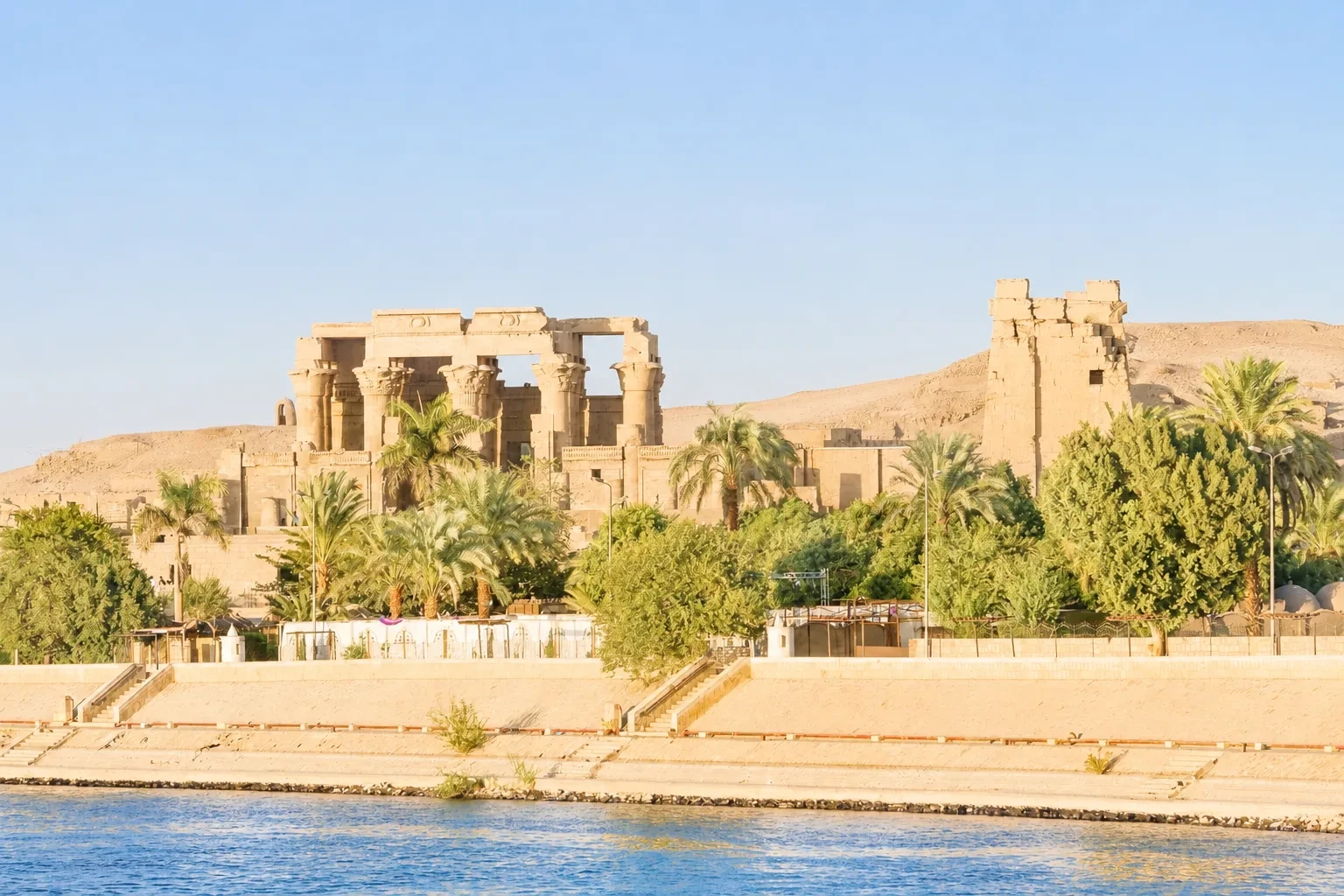
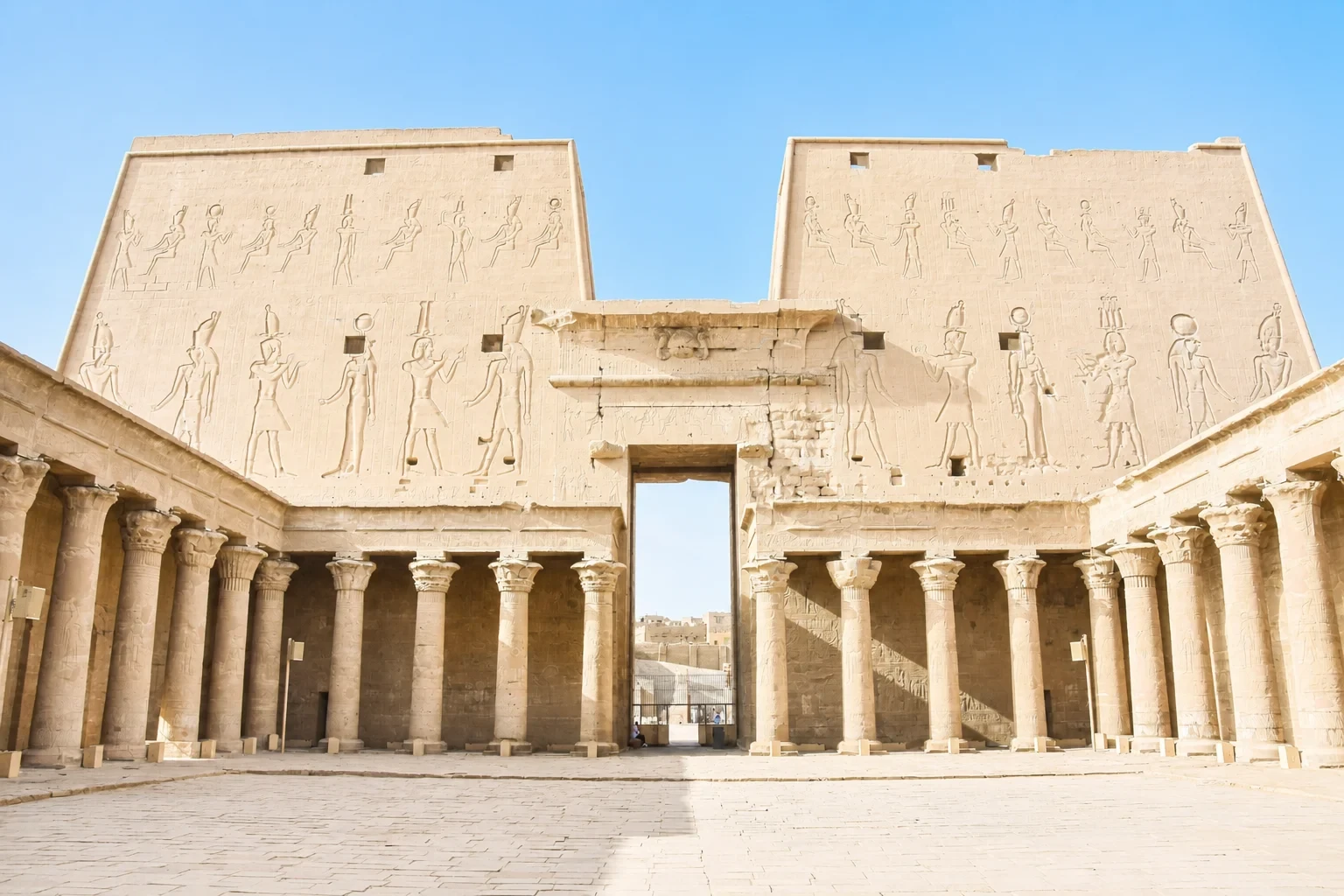
The Temple of Khnum at Esna can be visited as part of a day tour from Luxor and is ideally combined with the Temple of Horus at Edfu and the Temple of Kom Ombo for a comprehensive experience of the great Ptolemaic and Roman temples of the Upper Egyptian Nile Valley.

Who Built The Temple Of Khnum At Esna?
The Temple of Khnum at Esna was built and decorated over a remarkably extended period spanning both the Ptolemaic and Roman eras. The earliest Ptolemaic contributions to the current building date to the reigns of Ptolemy III Euergetes I and Ptolemy IV Philopator in the 3rd century BCE, though earlier temples on the same site are attested from the New Kingdom period and perhaps earlier. The main hypostyle hall that survives today was constructed primarily during the reign of Ptolemy VI Philometor in the mid-2nd century BCE, but its decoration continued to be added, extended, and revised by successive Ptolemaic rulers, Roman emperors, and even local priests over the following four centuries.
The Roman emperors who left their names and images on the walls of the Esna Temple include Augustus, Claudius, Vespasian, Titus, Domitian, Trajan, Hadrian, Antoninus Pius, Marcus Aurelius, Commodus, Septimius Severus, Caracalla, Geta, Macrinus, Diadumenian, Severus Alexander, Gordian III, and Decius, whose cartouche of approximately 250 CE is the latest known royal decoration in any surviving ancient Egyptian temple. This extraordinary sequence of Roman imperial names, all presented in purely Egyptian style as the pharaoh performing offerings before the gods, gives the Esna Temple a unique historical character as a monument that bridges the full span from Ptolemaic Egypt to the later Roman Empire.
Who Was Khnum?
Khnum was one of the most ancient and most theologically significant deities in the entire ancient Egyptian religious tradition, worshipped since the earliest periods of Egyptian civilization as the divine creator who fashioned the bodies of human beings and the gods themselves on his potter's wheel from the fertile Nile clay. The ram-headed god Khnum was associated with the creative power of the annual Nile flood, which brought the life-giving silt that fertilized the fields of Egypt and sustained the civilization of the Nile Valley, and with the primordial creative act by which all living things were brought into existence from the formless chaos of the pre-creation world.
At Esna, Khnum was venerated in a particular form known as Khnum-Ra, combining his creative aspect with the solar power of the sun god Ra, and was the principal deity of a complex divine family that included his consort Nebtu, a goddess associated with the waters of the Nile, and their divine child. The temple at Esna was the most important center of the Khnum cult in Upper Egypt, and the annual festivals of Khnum celebrated here attracted worshippers from throughout the Nile Valley. The famous cosmogonic hymn to Khnum inscribed on the walls of the Esna Temple hypostyle hall is one of the most eloquent and philosophically sophisticated divine hymns in the entire corpus of ancient Egyptian religious literature, describing Khnum's creative act in terms of extraordinary theological complexity and poetic beauty.
Esna Temple Location In Egypt
The Temple of Khnum at Esna is located in the center of the modern town of Esna in Upper Egypt, on the west bank of the Nile River, approximately 55 kilometers south of Luxor and 155 kilometers north of Aswan. The temple is set approximately nine meters below the level of the surrounding modern town, excavated from the accumulated debris of centuries of occupation that had completely buried the ancient building, and is reached by descending a broad staircase from the modern street level into what appears to be an enormous archaeological pit in the heart of the town. Nile cruise ships pass through the Esna Lock just north of the town, and visitors arriving by cruise ship often visit the temple during the wait for the lock. The town of Esna itself is a lively and authentic Upper Egyptian market town, and the walk from the Nile landing through the bazaar to the temple is one of the most atmospheric approaches to any ancient site in Egypt. WOW Egypt Tours provides private air-conditioned transportation directly from Luxor hotels to the Temple of Khnum at Esna on all Day Tours, Egypt Tours Packages, Egypt Travel Packages, and Safaga Shore Excursions.
Esna Temple Fun Facts
The Temple of Khnum at Esna is unique among all surviving ancient Egyptian temples in that only the hypostyle hall has been excavated: the rest of the original temple building, including the inner sanctuary rooms, the vestibules, and the rear portions of the complex, still lies buried beneath the modern town of Esna and has never been fully excavated. The surviving hypostyle hall measures approximately 37 meters long and 20 meters wide, supported by 24 columns arranged in four rows, each with a different and elaborately carved composite capital combining lotus, papyrus, palm frond, and floral designs in a variety of patterns that makes no two columns in the hall exactly alike.
The astronomical ceiling of the Esna Temple hypostyle hall is one of the most remarkable and scientifically significant carved surfaces in ancient Egypt, depicting the complete ancient Egyptian astronomical calendar including the 36 decans, the circumpolar stars, the monthly lunar cycle, and the positions of the planets throughout the year, in one of the most detailed and complete astronomical charts surviving from the ancient world. The texts on the columns and walls of the hall include a remarkable cryptographic hymn to Khnum written entirely in hieroglyphs composed of ram figures, and another cryptographic text composed entirely of crocodile hieroglyphs, representing the most elaborate surviving examples of ancient Egyptian cryptographic writing and demonstrating the extraordinary intellectual creativity and theological sophistication of the late period Esna priesthood.
Why Is The Esna Temple Called By This Name In Egypt?
The modern name Esna is the Arabic form of the ancient Egyptian name Iunyt, later Isna or Sna, which referred to the town and its sacred site. The ancient Greek name for the city was Latopolis, meaning the City of the Lates Fish, a reference to the Nile perch, the large predatory fish that was the sacred animal of the goddess Neith in this region and was venerated and mummified at a sacred fish cemetery in the town, mummies from which have been recovered from excavations in the Esna area. The Temple of Khnum at Esna is also frequently referred to simply as the Esna Temple, the Khnum Temple, or the Khnum Temple at Esna, all of which are used interchangeably in scholarly literature and tourism to refer to the surviving hypostyle hall and its extraordinary collection of Ptolemaic and Roman decoration.
Esna Temple History
The history of the sacred site at Esna stretches back to the earliest periods of ancient Egyptian civilization. The site was sacred to Khnum from at least the New Kingdom period, and earlier temples on the site are attested from the reigns of Thutmose III and other New Kingdom pharaohs, fragments of whose decoration have been found reused as building material within the current structure. The town of Esna was also the site of an important sacred fish cult dedicated to the Nile perch, whose mummified remains were deposited in a necropolis near the temple.
Construction of the main hypostyle hall of the current Temple of Khnum at Esna began during the Ptolemaic Period, with the earliest reliefs dating to the reign of Ptolemy VI Philometor in the mid-2nd century BCE. However, unlike the great Ptolemaic temples of Edfu and Dendera, where construction was completed within a defined period of a few centuries, the Esna Temple received new decoration continuously for more than five centuries, with Roman emperors from Augustus in the 1st century BCE to Decius in approximately 250 CE all adding their names and images to the walls and columns of the hypostyle hall. This extraordinary duration of active religious use gives the Esna Temple a historical depth and a diversity of decoration that is unique among surviving ancient Egyptian sacred buildings.
After the abandonment of the traditional Khnum cult in the early Christian era, the temple was gradually buried under the accumulating debris of the medieval town of Esna that grew up around it, until only the tops of the columns were visible above the surface. The French Egyptologist Auguste Mariette partially excavated the temple in the 1860s, and complete excavation of the surviving hypostyle hall was carried out by the Egyptian Antiquities Service in the 20th century, leaving the hall in its current condition approximately nine meters below the surrounding street level. Ongoing conservation work by an Egyptian-German archaeological mission has been restoring and documenting the painted decoration of the hall since the early 2000s, bringing to light a spectacular polychrome painted ceiling that was concealed under centuries of soot and grime.
The Story Of Building The Temple Of Khnum At Esna
The story of the Esna Temple is the story of a sacred tradition that refused to die. While the great Ptolemaic temples of Edfu and Kom Ombo were completed within a relatively defined period and then closed with the spread of Christianity in the 4th century CE, the Temple of Khnum at Esna continued to receive new royal decoration for more than 550 years after the laying of its foundation stones, with Roman emperors presenting themselves as pharaohs before the ancient Egyptian gods on its walls well into the 3rd century CE. This extraordinary longevity of the Esna Temple as an actively maintained royal cult institution reflects both the enduring importance of the Khnum cult in the religious life of Upper Egypt and the remarkable cultural persistence of ancient Egyptian religious traditions under Greek and Roman political rule.
The decision of successive Roman emperors to add their names to the walls of the Esna Temple was not a casual act but a deliberate political and religious statement, confirming their legitimacy as rulers of Egypt by participating in the ancient institution of pharaonic temple patronage. The Roman imperial names at Esna are all written in hieroglyphic cartouches in exactly the same format as those of the Ptolemaic rulers and the ancient pharaohs, and the images accompanying them show the emperor in the standard costume of the Egyptian king performing the standard offering rituals before Khnum and his divine family. The Esna Temple is therefore not only a monument to the Khnum cult but a remarkable document of the cultural negotiations through which three successive foreign ruling dynasties, the Macedonian Ptolemies, and then the Roman emperors, sought to integrate themselves into the world's oldest and most continuously maintained religious tradition.
Esna Temple Architecture And Features
The Hypostyle Hall
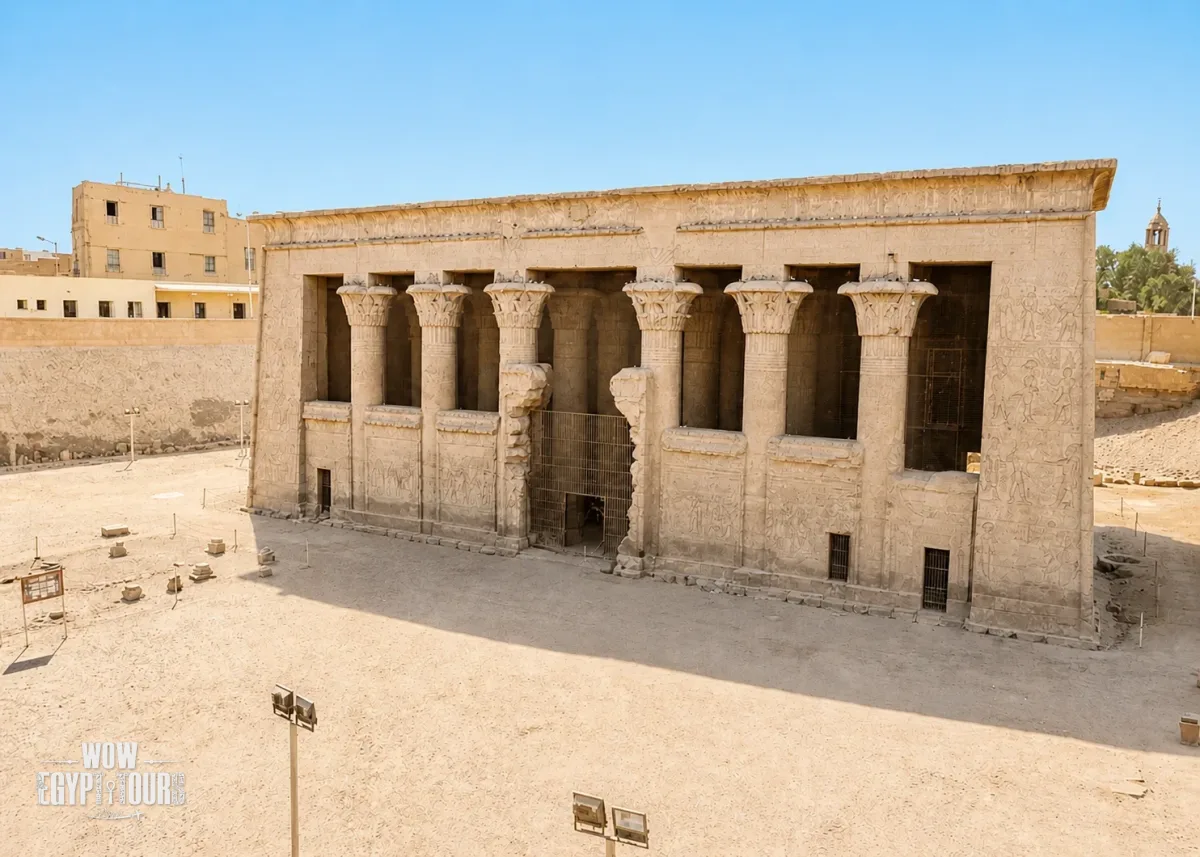
The surviving Temple of Khnum at Esna consists entirely of the great hypostyle hall, the only portion of the original temple complex that has been fully excavated from beneath the modern town of Esna. The hall measures approximately 37 meters long by 20 meters wide and is supported by 24 columns arranged in four rows of six, with an additional two columns flanking the entrance facade to create a total of 26 columns visible to visitors entering the site. Each column is approximately 11.5 meters high and bears an elaborately carved composite capital combining lotus buds, papyrus umbels, palm fronds, and grape vine leaves in a variety of different designs. No two capitals in the hall are exactly alike, making the hypostyle hall of the Esna Temple one of the most varied and inventive collections of ancient Egyptian column capitals in existence. The columns are covered from base to capital with carved hieroglyphic texts and relief images of the Ptolemaic and Roman rulers making offerings before Khnum, Nebtu, and the other deities of the Esna divine family.
The Entrance Facade
The entrance facade of the surviving Esna Temple hypostyle hall faces north toward the Nile and is one of the most remarkable surviving examples of late Ptolemaic decorative architecture in Egypt. The facade consists of six intercolumnar screen walls connecting the front row of columns to create a partially enclosed screen effect, with the central bay open as the main entrance doorway. The intercolumnar screen walls are decorated with relief scenes of the Ptolemaic and Roman emperors in the presence of the gods, and the upper portions of the facade bear a large cornice decorated with the solar winged disk in relief, flanked by vertical columns of dedicatory inscription. The overall composition of the entrance facade is one of the most elegant surviving examples of the standard Ptolemaic temple facade design, giving a strong impression of what the entrance faces of the better-known Ptolemaic temples such as the Edfu Temple and the Dendera Temple originally looked like in their full decorative splendor.
The Astronomical Ceiling
The ceiling of the hypostyle hall of the Temple of Khnum at Esna is one of the most scientifically and artistically significant ancient surfaces in Egypt. It bears one of the most complete ancient Egyptian astronomical charts in existence, depicting the 36 decans of the Egyptian calendar, the circumpolar stars, the months and seasons of the Egyptian year, and the positions of the major planets throughout the astronomical cycle. The astronomical ceiling was extensively decorated in vivid polychrome paint, and recent conservation work by the Egyptian-German mission has revealed a spectacular palette of colors including deep blues, brilliant yellows, rich reds, and vivid greens that was almost completely hidden under centuries of black soot from the fires lit inside the temple when it was used as a cotton factory and storage warehouse in the 19th century. The recovery of the painted astronomical ceiling is one of the most dramatic conservation achievements in recent Egyptian archaeology and has transformed the visual experience of the Esna Temple for modern visitors.
The Cryptographic Texts
Among the most extraordinary and intellectually remarkable features of the Temple of Khnum at Esna are two cryptographic texts inscribed on the walls and columns of the hypostyle hall, which represent the most elaborate surviving examples of ancient Egyptian cryptographic writing. One text, a hymn to Khnum, is written entirely in hieroglyphs in the form of ram figures, exploiting the phonetic values of the ram hieroglyph in various positions and attitudes to spell out the words of the hymn without using any other signs. The second cryptographic text uses crocodile hieroglyphs in a similar way. These extraordinary texts, which required considerable learning and ingenuity to compose and to read, demonstrate the remarkable intellectual creativity of the Esna priestly community in the late Ptolemaic and Roman periods, and represent one of the most unusual examples of ancient Egyptian textual virtuosity surviving from any period.
The Hymn To Khnum
The walls of the Temple of Khnum at Esna preserve a remarkable collection of divine hymns, of which the most celebrated is the great cosmogonic hymn to Khnum that occupies a prominent position on the north entrance wall of the hypostyle hall. This hymn describes Khnum as the primordial creator who fashioned all living things on his potter's wheel, from the gods and the pharaoh to the humblest creatures of the Nile Valley, and celebrates his identity as the source of all life, creativity, and divine order in the universe. The hymn is written in the elevated literary style of the late period priestly tradition, with a density and elegance of theological expression that places it among the finest examples of ancient Egyptian sacred poetry. Its presence at the entrance to the Temple of Khnum at Esna ensured that every visitor to the hypostyle hall would be immediately confronted with the supreme theological statement of the temple: that Khnum, the ram-headed creator of the Nile, was the ultimate source and sustainer of all existence.
The Roman Imperial Decoration
One of the most historically remarkable features of the Temple of Khnum at Esna is the presence on its walls and columns of the names and images of more than fifteen Roman emperors, from Augustus in the 1st century BCE to Decius around 250 CE. These imperial names, inscribed in hieroglyphic cartouches in exactly the same format as those of the ancient pharaohs, and accompanied by relief images of the emperors in the standard costume of the Egyptian king performing offerings before Khnum and his divine family, represent the most extensive collection of Roman imperial names in any surviving ancient Egyptian temple. The presence of emperors such as Claudius, Domitian, Trajan, Hadrian, and Caracalla alongside the earlier Ptolemaic rulers on the walls of the same building gives the Esna Temple a unique historical character as a document of the full span of ancient Egyptian sacred art tradition from the Ptolemaic to the late Roman Period.
The Esna Lock And Nile Setting
Immediately north of the town of Esna, the Esna Barrage and Lock controls the flow of the Nile through this reach of the river and regulates the passage of Nile cruise ships between Luxor and Aswan. All Nile cruise ships traveling between Luxor and Aswan must pass through the Esna Lock, which can take from 30 minutes to several hours depending on traffic, and the enforced waiting time at the lock provides Nile cruise visitors with an ideal opportunity to visit the nearby Temple of Khnum at Esna. The approach to the temple from the Nile landing, through the lively bazaar of the modern Esna town with its textile and craft shops, is one of the most atmospheric and authentically Egyptian approaches to any ancient site on the Nile cruise route.
Why Is The Temple Of Khnum At Esna Important?
The Temple of Khnum at Esna is important for several interconnected reasons that together make it one of the most significant ancient temples in the Upper Egyptian Nile Valley. Historically, it is the latest decorated ancient Egyptian temple in existence, with the cartouche of the Roman emperor Decius dated to approximately 250 CE representing the final instance of pharaonic temple decoration in the entire three-thousand-year history of ancient Egyptian sacred art. The presence of more than fifteen Roman imperial names on its walls makes it the primary surviving document of the Roman participation in the ancient Egyptian temple tradition in the form of pharaonic decoration.
Scientifically, the astronomical ceiling of the Esna Temple is one of the most complete ancient Egyptian astronomical charts in existence, providing essential evidence for the ancient Egyptian calendar, astronomical traditions, and the knowledge of the sky accumulated by the ancient priestly communities of Upper Egypt. Linguistically, the cryptographic texts at Esna represent the most elaborate surviving examples of ancient Egyptian cryptographic writing and provide unique evidence for the intellectual creativity and theological sophistication of the late period Esna priesthood. WOW Egypt Tours includes the Temple of Khnum at Esna as a featured stop on Dahabiya Nile River Cruises and as a dedicated destination on Luxor Day Tours that combine the three great Ptolemaic temples of the Upper Nile Valley.
What Are Some Interesting Facts About The Esna Temple?
The Last Decorated Ancient Egyptian Temple
The Temple of Khnum at Esna holds a unique and poignant place in the history of ancient Egyptian civilization as the last ancient Egyptian temple to receive new royal decoration. The cartouche of the Roman emperor Decius, inscribed on the walls of the Esna hypostyle hall around 250 CE, is the latest known instance of a ruler being depicted in the traditional pharaonic style performing offerings before the ancient Egyptian gods, marking the effective end of a tradition of sacred royal art that had been maintained continuously for more than three thousand years. Standing in the hypostyle hall of the Temple of Khnum at Esna and reading the names of Roman emperors inscribed in hieroglyphic cartouches alongside those of the Ptolemaic kings, visitors are witnessing the final phase of one of the most extraordinary cultural institutions in human history.
The Recovered Painted Ceiling
One of the most dramatic recent achievements in Egyptian heritage conservation is the ongoing restoration of the painted astronomical ceiling of the Temple of Khnum at Esna by an Egyptian-German mission that has been working at the site since 2018. When the team began their work, the ceiling of the hypostyle hall was almost entirely black with soot accumulated over centuries from fires lit inside the temple when it was used as a cotton storage warehouse in the early 19th century. As the conservation team has systematically removed the soot layer by layer, they have revealed beneath it a ceiling of spectacular painted astronomical decoration in brilliant and vivid colors, with deep blue star fields, golden solar symbols, richly colored deity figures, and detailed astronomical diagrams that were completely invisible before the conservation work began. The ongoing restoration of the Esna ceiling is one of the most exciting and publicly visible heritage conservation projects in Egypt today, and visitors to the temple can witness different stages of the restoration work and compare the dramatic before-and-after effect of the revealed painted surfaces.
The Temple Buried In A Modern Town
The physical situation of the Temple of Khnum at Esna is unlike that of any other major ancient monument in Egypt. Rather than standing in open desert landscape or beside a modern road, the Esna Temple is embedded in the center of a densely built modern town, reached by walking from the Nile landing through an animated bazaar street past textile shops, spice merchants, and coffee houses, and then descending approximately nine meters below street level into the excavated hypostyle hall. The modern buildings of Esna press in on all sides above the temple precinct, and the visitor experience of arriving at the top of the staircase and looking down to see the 24 columns of the ancient hypostyle hall rising from their excavated pit below is one of the most unexpected and dramatically contrasting encounters between the ancient and modern worlds available anywhere in Egypt.
What Is So Special About The Temple Of Khnum At Esna?
Ancient Egypt In The Heart Of A Living Town
What makes the Temple of Khnum at Esna uniquely special among all the ancient temples of the Upper Egyptian Nile Valley is the quality of its urban context. While the great temples of Edfu and Kom Ombo stand at the edge of their respective towns with organized visitor infrastructure, the Esna Temple is embedded in the living fabric of the modern town in a way that creates an extraordinary juxtaposition of ancient and contemporary Egypt. The walk through the Esna bazaar to reach the temple is itself one of the most authentic and memorable experiences on the entire Nile cruise route, with the colors, smells, and sounds of an active Upper Egyptian market town providing a human context for the ancient monument that no amount of archaeological signage could replicate. For travelers who want to experience ancient Egypt not as a sanitized heritage attraction but as a living presence within a real community, the Temple of Khnum at Esna offers something that no other site on the Nile cruise route can match.
The Temple That Is Still Being Revealed
The Esna Temple also has the unique quality of being a monument that is visibly and dramatically changing in front of visitors' eyes, as the ongoing conservation project systematically reveals the brilliant painted decoration of the astronomical ceiling from beneath its centuries-long covering of black soot. Each section of ceiling that the conservation team cleans reveals a spectacle of color and detail that has been invisible since the early 19th century, and visitors who return to the Esna Temple even a year or two apart find a noticeably different and continuously more spectacular ceiling above them. The experience of visiting the Temple of Khnum at Esna is therefore genuinely unique in Egyptian cultural tourism: it is a visit to a monument in the process of its own rediscovery, where the work of conservation and revelation is actively ongoing and openly visible to any interested visitor.
Esna Temple Through The Ages: From Ancient Egypt To The Present
The history of the Temple of Khnum at Esna after its completion spans more than two thousand years of continuous transformation. During the late Roman Period, the temple continued to function as an active religious institution well into the 3rd century CE, with the Khnum cult maintained by a dedicated priesthood and celebrated in annual festivals that attracted worshippers from throughout the surrounding region. After the Christianization of Egypt in the 4th and 5th centuries CE, the temple was closed and converted to Christian use, with crosses carved on some of the ancient relief figures and a Coptic community established in the surrounding town.
During the medieval and Ottoman periods, the temple was progressively buried under the accumulating debris of the town, until only the tops of the columns were visible above ground. In the early 19th century, the partly accessible interior of the temple was used as a cotton storage warehouse, during which period the fires lit for warmth and light inside the building deposited the thick layer of black soot on the ceiling and upper walls that conservation work is currently removing. The French archaeologist Auguste Mariette partially excavated the temple in the 1860s, and complete excavation of the hypostyle hall to its ancient floor level was carried out by the Egyptian Antiquities Service in the mid-20th century, creating the current archaeological pit setting of the monument. The Egyptian-German conservation mission that began work at the temple in 2018 has produced the most spectacular results in the recent history of the site, revealing the painted astronomical ceiling in a condition of extraordinary beauty and detail that has transformed scholarly and public understanding of the artistic achievement of the Esna Temple priesthood.
Esna Temple UNESCO World Heritage Status
The Temple of Khnum at Esna is part of the broader landscape of Upper Egyptian Nile Valley heritage recognized internationally as among the most outstanding cultural concentrations in the world. The Nile River Valley between Luxor and Aswan, encompassing the great Ptolemaic temples at Esna, Edfu, and Kom Ombo together with the monuments of the ancient cities of Luxor and Aswan, represents one of the most concentrated assemblages of ancient monumental architecture in the world and is subject to comprehensive international conservation attention. The Esna Temple is recognized as one of the most important individual ancient monuments in the Upper Nile Valley for its unique historical significance as the last decorated ancient Egyptian temple and for its extraordinary astronomical and cryptographic texts.
Best Time To Visit The Temple Of Khnum At Esna
The best time to visit the Temple of Khnum at Esna is during the cooler months from October through April, when temperatures in Upper Egypt are moderate and both the outdoor approach through the Esna bazaar and the enclosed interior of the hypostyle hall are comfortable for an extended visit. Because the temple is set approximately nine meters below street level, the interior of the hall is naturally sheltered from direct sun and is significantly cooler than the outdoor temperature even in summer, making the Esna Temple one of the more manageable summer visits among the major ancient sites of Upper Egypt. The temple can be visited at any time of day, but the conservation work on the ceiling typically takes place during the morning hours when the light is best for detailed work, and visiting during these hours gives the additional interest of watching the conservation team at work. WOW Egypt Tours plans all day tour and Nile cruise visits to the Temple of Khnum at Esna at the optimal time for the season and the specific itinerary.
Esna Temple Opening Hours
The Temple of Khnum at Esna is open to visitors every day of the week, including public holidays. The temple opens at 6:00 AM and closes at 5:00 PM from October to April, and from 6:00 AM to 6:00 PM from May to September. Because the temple is set below street level and the interior is naturally cool, it is accessible and comfortable throughout the day even in summer. Nile cruise visitors typically visit during the morning or early afternoon while their ship waits to pass through the Esna Lock.
Esna Temple Entrance Fees
Adults: EGP 200
Students: EGP 100
Keep your ticket safe throughout your visit. Entrance fees to the Temple of Khnum at Esna are included in all Esna Temple Tours, Luxor Day Tours, Egypt Tours Packages, and Safaga Shore Excursions booked through WOW Egypt Tours.
How To Get To The Temple Of Khnum At Esna
Esna is located approximately 55 kilometers south of Luxor and 155 kilometers north of Aswan on the west bank of the Nile. From Luxor, the Temple of Khnum at Esna is reached by private car or minibus along the main Nile Valley highway in approximately 45 to 60 minutes, making it an easy half-day excursion from Luxor or a natural first stop on a longer day tour south through Edfu and Kom Ombo. From Aswan, Esna is reached in approximately 2 to 2.5 hours by private vehicle. Nile cruise ships pass through the Esna Lock just north of the town, and visitors arrive at the Esna waterfront by the ship's gangway from where the bazaar walk to the temple takes approximately 10 to 15 minutes on foot.
All Luxor Day Tours and Safaga Shore Excursions with WOW Egypt Tours include private air-conditioned transportation directly to and from the Temple of Khnum at Esna. All Dahabiya Nile River Cruise itineraries include a guided shore excursion to the temple as a standard stop.
How Long To Spend At The Temple Of Khnum At Esna
Most visitors spend between 30 minutes and one hour at the Temple of Khnum at Esna, which is sufficient time to walk through the complete hypostyle hall, examine the carved column capitals and wall reliefs, appreciate the astronomical ceiling in its current state of restoration, locate the cryptographic ram and crocodile texts, and read the major religious inscriptions with a guide's explanation. Visitors with a particular interest in ancient Egyptian astronomy, cryptographic writing, or Roman imperial participation in Egyptian temple traditions may wish to allow one to one and a half hours. The Esna Temple is naturally combined on the same day with the Temple of Horus at Edfu approximately 50 kilometers to the south and optionally the Temple of Kom Ombo further south for a full Upper Nile Valley Ptolemaic temple day from Luxor.
Tips For Visiting The Temple Of Khnum At Esna
Allow time to walk through the Esna bazaar before and after visiting the temple, as the approach through the animated market street is one of the most authentically Egyptian experiences on the entire Nile cruise route. Look carefully at the column capitals as you enter the hypostyle hall, as no two are alike and the variety and inventiveness of their composite floral designs is extraordinary. Ask your guide to point out the cryptographic ram text and crocodile text on the walls, which are among the most remarkable and unusual inscriptions in any ancient Egyptian temple. Look up at the ceiling throughout your visit to follow the progress of the ongoing conservation work and to appreciate the difference between the still-sooted sections and the recently revealed painted astronomical decoration. A licensed Egyptologist guide from WOW Egypt Tours is strongly recommended: the astronomical content of the ceiling, the theological significance of the Khnum hymn, and the historical importance of the Roman imperial decoration are all greatly enriched by expert explanation. The temple is below street level and receives no direct sunlight, so no hat or sunscreen is needed inside the hall, but bring a light layer in winter as the underground setting can be cool.
What To Wear At The Temple Of Khnum At Esna
The Temple of Khnum at Esna is a fully enclosed interior space approximately nine meters below street level, with no direct sun exposure at any time of day. Lightweight, breathable clothing covering the shoulders and knees is recommended as a mark of respect for the ancient sacred site, and is also practical for the outdoor walk through the Esna bazaar to reach the temple entrance. Because the interior is naturally cool and receives no direct sunlight, a wide-brimmed hat and sunscreen are not necessary inside the hypostyle hall, though they are useful for the outdoor portions of the visit including the staircase descent and any time spent in the upper courtyard area around the temple precinct. Comfortable, flat walking shoes are adequate for the level stone floor of the hypostyle hall. In winter, a light additional layer is recommended as the below-ground location and the thick stone walls can make the interior noticeably cool.
Photography At The Temple Of Khnum At Esna
The Temple of Khnum at Esna is a rewarding photography destination, offering the unique visual combination of the dramatic below-street-level archaeological pit setting, the 24 elaborately carved columns with their diverse composite capitals, the recently revealed sections of the painted astronomical ceiling glowing in vivid color above the dark stone columns, and the fascinating contrast between the restored and unrestored sections of the ceiling that documents the conservation process in progress. Photography with a standard camera or smartphone is permitted throughout the hypostyle hall. Flash photography is strictly prohibited near all carved and painted surfaces. For photography of the painted ceiling details and the dim interior spaces, a camera with good low-light capability is strongly recommended. The most dramatic photographs of the overall hall are taken from the far end of the space looking back toward the entrance facade, with the rows of elaborately carved columns receding in perspective toward the light of the entrance. Photography of the conservation team at work, if they are present during your visit, is permitted from a respectful distance. Professional photography or filming requires a separate permit from Egypt's Ministry of Tourism and Antiquities.
Esna Temple Tours
Single Attraction Visit: Esna Temple Tour
This tour covers the Temple of Khnum at Esna as a standalone visit from Luxor. It is suitable for travelers with a particular interest in Ptolemaic and Roman temple decoration, ancient Egyptian astronomy, the cryptographic texts of the late priestly tradition, or the extraordinary ongoing conservation of the painted ceiling.
What Is Covered
Full guided visit of the Temple of Khnum at Esna including the entrance facade, the complete hypostyle hall with its 24 diverse column capitals, the astronomical ceiling with conservation work in progress, the cryptographic ram and crocodile texts, the great hymn to Khnum on the entrance wall, and the Roman imperial decoration programme.
Duration
30 minutes to 1 hour inside the temple, plus travel time from Luxor of approximately 45 to 60 minutes each way.
Includes
Private air-conditioned transportation from Luxor, private licensed Egyptologist guide, and entrance fees. Available for morning and afternoon departures.
Day Tour To Esna, Edfu And Kom Ombo From Luxor
This full-day tour from Luxor travels south along the Nile Valley road to visit three of the most impressive Ptolemaic and Roman temples in Egypt in a single day: the Temple of Khnum at Esna, the Temple of Horus at Edfu, and the Temple of Sobek and Haroeris at Kom Ombo. It is the most comprehensive single-day Upper Nile Valley temple experience available from Luxor.
What Is Covered
The Temple of Khnum at Esna, approximately 55 kilometers south of Luxor, with a guided visit of the hypostyle hall, the astronomical ceiling, and the cryptographic and cosmogonic texts. The Temple of Horus at Edfu, the largest and most completely preserved Ptolemaic temple in the world, with a full guided visit from entrance pylon to inner sanctuary. The Temple of Sobek and Haroeris at Kom Ombo with a guided visit of the unique double temple, the medical instruments relief, the Nilometer, and the Crocodile Museum.
Duration
Full day from Luxor, with approximately 30 to 45 minutes at Esna, 1.5 to 2 hours at Edfu, and 1 to 1.5 hours at Kom Ombo, with travel time between sites included.
Includes
Private air-conditioned transportation from Luxor, private licensed Egyptologist guide, and entrance fees to all three temples. Available for early morning departures.
Day Tour To Esna And Edfu From Luxor
This half-day or full-day tour from Luxor combines the Temple of Khnum at Esna with the Temple of Horus at Edfu for a focused experience of two of the finest surviving Ptolemaic temples on the Upper Nile.
What Is Covered
The Temple of Khnum at Esna with a full guided visit of the hypostyle hall, the astronomical ceiling, and the cryptographic texts. The Temple of Horus at Edfu with a full guided visit of the complete temple programme from entrance pylon to innermost sanctuary.
Duration
Full day from Luxor, approximately 30 to 45 minutes at Esna and 1.5 to 2 hours at Edfu.
Includes
Private air-conditioned transportation from Luxor, private licensed Egyptologist guide, and entrance fees to both temples. Available for morning departures.
Safaga Shore Excursions Combined With The Temple Of Khnum At Esna
Safaga Port is located on the Red Sea coast, approximately 175 kilometers from Esna via the Eastern Desert road and the Nile Valley highway. Due to this distance and the additional travel time involved in a round trip from Safaga, the Temple of Khnum at Esna cannot be comfortably visited as a standalone single-day Safaga shore excursion. WOW Egypt Tours therefore offers an overnight Safaga shore excursion programme that makes a visit to the Esna Temple fully possible for Red Sea cruise passengers as part of a comprehensive Upper Nile Valley itinerary.
Overnight Safaga Shore Excursion Via Luxor To Esna, Edfu And Kom Ombo
Day 1: Depart Safaga Port by private air-conditioned vehicle. Travel to Luxor via the Eastern Desert highway, approximately 3 hours. Full guided visit of the major Luxor West Bank sites: Valley of the Kings, Temple of Hatshepsut, and Colossi of Memnon. Evening guided visit of Luxor Temple and optional Karnak Sound and Light Show. Overnight in Luxor at a selected hotel.
Day 2: Early morning departure from Luxor southward. Guided visit of the Temple of Khnum at Esna, approximately 55 kilometers south of Luxor. Continue south to the Temple of Horus at Edfu with a full guided visit. Optional continuation to the Temple of Kom Ombo subject to available time. Return to Safaga Port via the Eastern Desert road. Return to ship.
Includes
Private air-conditioned vehicle throughout, private licensed Egyptologist guide, one night accommodation in Luxor, entrance fees to all included sites, and return transfer to the ship. All overnight Safaga Shore Excursions are coordinated with each ship's schedule to confirm departure and return timings in advance.
Dahabiya Nile River Cruise
A Dahabiya Nile River Cruise is a small-vessel sailing experience on the Nile between Luxor and Aswan aboard a traditional wooden dahabiya. WOW Egypt Tours operates dahabiya cruises with private cabins, all meals, a private licensed Egyptologist guide on board, and guided shore excursions at every stop. The Temple of Khnum at Esna is a featured stop on all Dahabiya itineraries in both directions.
4 Days 3 Nights Dahabiya Nile River Cruise From Aswan To Luxor
Route: Aswan to Luxor, sailing north.
Itinerary
Day 1: Embarkation in Aswan. Visit to Philae Temple and the Unfinished Obelisk. Sail north to Kom Ombo. Guided visit to Kom Ombo Temple and Crocodile Museum. Continue to Gebel el Silsila. Overnight on board.
Day 2: Guided visit to Gebel el Silsila. Sail to the Village of Basaw. Guided visit to Village of Basaw. Continue to Edfu. Guided visit to the Temple of Horus at Edfu. Overnight on board.
Day 3: Sail to El Kab. Guided visit to El Kab Tombs. Sail to El Hagaz Island. Swimming stop. Overnight on board.
Day 4: Sail to Esna. Visit Khnum Temple at Esna. Disembarkation in Esna. Transfer to Luxor, approximately 55 kilometers (35 miles).
Includes
Private cabin, all meals on board, private licensed Egyptologist guide, entrance fees to all temple visits including the Temple of Khnum at Esna, and private transfers.
5 Days 4 Nights Dahabiya Nile River Cruise From Luxor To Aswan
Route: Luxor to Aswan, sailing south.
Itinerary
Day 1: Embarkation in Luxor. Transfer to Esna, approximately 55 kilometers (35 miles). Visit Khnum Temple at Esna. Sail to El Hagaz Island. Overnight on board.
Day 2: Sail to El Kab. Guided visit to El Kab Tombs. Continue to Edfu. Guided visit to the Temple of Horus at Edfu. Sail to the Village of Basaw. Guided visit to Village of Basaw. Overnight on board.
Day 3: Sail to Gebel el Silsila. Guided visit to Gebel el Silsila. Sail south to Kom Ombo. Guided visit to Kom Ombo Temple and Crocodile Museum. Sail to Daraw Village. Overnight on board.
Day 4: Guided visit to Daraw Village. Sail to Herbiab Island. Swimming stop. Philae Sound and Light Show. Overnight on board.
Day 5: Optional Abu Simbel visit available by air or road. Guided visits to Philae Temple, the High Dam, and the Unfinished Obelisk. Disembarkation in Aswan.
Includes
Private cabin, all meals on board, private licensed Egyptologist guide, entrance fees to all temple visits including the Temple of Khnum at Esna, and private transfers.
8 Days 7 Nights Dahabiya Nile River Cruise Round Trip From Luxor (Via Aswan)
Route: Luxor and Aswan, sailing north and south.
Itinerary
Day 1: Embarkation in Luxor. Transfer to Esna, approximately 55 kilometers (35 miles). Visit Khnum Temple at Esna. Sail to El Hagaz Island. Overnight on board.
Day 2: Sail to El Kab. Continue to Edfu. Guided visit to the Temple of Horus at Edfu. Sail to the Village of Basaw. Guided visit to Village of Basaw. Overnight on board.
Day 3: Sail to Gebel el Silsila. Sail south to Kom Ombo. Guided visit to Kom Ombo Temple and Crocodile Museum. Sail to Daraw Village. Overnight on board.
Day 4: Guided visit to Daraw Village. Sail to Herbiab Island. Swimming stop. Philae Sound and Light Show. Overnight on board.
Day 5: Optional Abu Simbel visit available by air or road. Guided visits to Philae Temple, the High Dam, and the Unfinished Obelisk. Sail north to Kom Ombo. Continue to Gebel el Silsila. Overnight on board.
Day 6: Guided visit to Gebel el Silsila. Sail to the Village of Basaw. Continue to Edfu. Guided visit to the Temple of Horus at Edfu. Overnight on board.
Day 7: Sail to El Kab. Guided visit to El Kab Tombs. Sail to El Hagaz Island. Swimming stop. Overnight on board.
Day 8: Disembarkation in Esna. Transfer to Luxor, approximately 55 kilometers (35 miles).
Includes
Private cabin, all meals on board, private licensed Egyptologist guide, entrance fees to all temple visits including the Temple of Khnum at Esna, and private transfers.
8 Days 7 Nights Dahabiya Nile River Cruise Round Trip From Aswan (Via Luxor)
Route: Luxor and Aswan, sailing north and south.
Itinerary
Day 1: Embarkation in Aswan. Visit to Philae Temple and the Unfinished Obelisk. Sail north to Kom Ombo. Guided visit to Kom Ombo Temple and Crocodile Museum. Continue to Gebel el Silsila. Overnight on board.
Day 2: Guided visit to Gebel el Silsila. Sail to the Village of Basaw. Continue to Edfu. Guided visit to the Temple of Horus at Edfu. Overnight on board.
Day 3: Sail to El Kab. Guided visit to El Kab Tombs. Sail to El Hagaz Island. Swimming stop. Overnight on board.
Day 4: Sail to Esna. Visit Khnum Temple at Esna. Sail to El Hagaz Island. Overnight on board.
Day 5: Sail to El Kab. Continue to Edfu. Guided visit to the Temple of Horus at Edfu. Sail to the Village of Basaw. Guided visit to Village of Basaw. Overnight on board.
Day 6: Sail to Gebel el Silsila. Sail south to Kom Ombo. Guided visit to Kom Ombo Temple and Crocodile Museum. Sail to Daraw Village. Overnight on board.
Day 7: Guided visit to Daraw Village. Sail to Herbiab Island. Swimming stop. Philae Sound and Light Show. Overnight on board.
Day 8: Disembarkation in Aswan.
Includes
Private cabin, all meals on board, private licensed Egyptologist guide, entrance fees to all temple visits including the Temple of Khnum at Esna, and private transfers.
Luxor And Aswan Nile River Cruise
The Luxor and Aswan Nile River Cruise is a standard Nile cruise product operated aboard a full-size cruise ship between Luxor and Aswan. WOW Egypt Tours operates this cruise in both directions with private licensed Egyptologist guides, all meals included, private cabins, and guided shore excursions at every port of call. The Temple of Khnum at Esna is accessible to all cruise passengers who visit during the transit through the Esna Lock.
4 Days 3 Nights Luxor And Aswan Nile River Cruise From Aswan To Luxor
Route: Aswan to Luxor, sailing north.
Itinerary
Day 1: Embarkation in Aswan. Guided visits to Philae Temple, the High Dam, and the Unfinished Obelisk. Overnight on board in Aswan.
Day 2: Sail north to Kom Ombo. Guided visit to Kom Ombo Temple and Crocodile Museum. Continue to Edfu. Overnight on board.
Day 3: Guided visit to the Temple of Horus at Edfu. Continue north toward Luxor. Pass through the Esna Lock. Optional visit to Khnum Temple at Esna during lock transit. Guided visit to Luxor Temple and Karnak Temple. Overnight on board in Luxor.
Day 4: Optional Sunrise Hot Air Balloon available. Guided visits to Valley of the Kings, Queen Hatshepsut Temple, and Colossi of Memnon. Disembarkation in Luxor.
Includes
Private cabin, all meals on board, private licensed Egyptologist guide, entrance fees to all temple visits including the Temple of Khnum at Esna, and private transfers.
5 Days 4 Nights Luxor And Aswan Nile River Cruise From Luxor To Aswan
Route: Luxor to Aswan, sailing south.
Itinerary
Day 1: Embarkation in Luxor. Guided visits to Luxor Temple and Karnak Temple. Overnight on board in Luxor.
Day 2: Optional Sunrise Hot Air Balloon available. Guided visits to Valley of the Kings, Queen Hatshepsut Temple, and Colossi of Memnon. Pass through the Esna Lock. Visit to Khnum Temple at Esna. Sail south to Edfu. Overnight on board.
Day 3: Guided visit to the Temple of Horus at Edfu. Continue to Kom Ombo. Guided visit to Kom Ombo Temple and Crocodile Museum. Overnight on board.
Day 4: Continue south toward Aswan. Guided visits to Philae Temple, the High Dam, and the Unfinished Obelisk. Overnight on board in Aswan.
Day 5: Optional Abu Simbel visit available by air or road. Disembarkation in Aswan.
Includes
Private cabin, all meals on board, private licensed Egyptologist guide, entrance fees to all temple visits including the Temple of Khnum at Esna, and private transfers.
8 Days 7 Nights Luxor And Aswan Nile River Cruise Round Trip From Luxor (Via Aswan)
Route: Luxor and Aswan, sailing north and south.
Itinerary
Day 1: Embarkation in Luxor. Guided visits to Luxor Temple and Karnak Temple. Overnight on board in Luxor.
Day 2: Guided visits to Luxor Museum. Pass through the Esna Lock. Visit to Khnum Temple at Esna. Sail south to Edfu. Overnight on board.
Day 3: Guided visit to the Temple of Horus at Edfu. Continue to Kom Ombo. Guided visit to Kom Ombo Temple and Crocodile Museum. Overnight on board.
Day 4: Continue south toward Aswan. Guided visits to Philae Temple, the High Dam, and the Unfinished Obelisk. Overnight on board in Aswan.
Day 5: Abu Simbel visit available by road. Sound and Light Show at Philae Temple. Overnight on board in Aswan.
Day 6: Guided visits to Nubian Village. Sail north to Kom Ombo. Guided visit to Kom Ombo Temple. Continue north. Overnight on board.
Day 7: Guided visits to Valley of the Kings, Queen Hatshepsut Temple, and Colossi of Memnon. Pass through the Esna Lock. Visit to Khnum Temple at Esna. Overnight on board in Luxor.
Day 8: Optional Sunrise Hot Air Balloon available. Disembarkation in Luxor.
Includes
Private cabin, all meals on board, private licensed Egyptologist guide, entrance fees to all temple visits including the Temple of Khnum at Esna, and private transfers.
8 Days 7 Nights Luxor And Aswan Nile River Cruise Round Trip From Aswan (Via Luxor)
Route: Luxor and Aswan, sailing north and south.
Itinerary
Day 1: Embarkation in Aswan. Guided visits to Philae Temple, the High Dam, and the Unfinished Obelisk. Overnight on board in Aswan.
Day 2: Sail north to Kom Ombo. Guided visit to Nubian Village and Kom Ombo Temple and Crocodile Museum. Continue to Edfu. Overnight on board.
Day 3: Continue north toward Luxor. Pass through the Esna Lock. Visit to Khnum Temple at Esna. Guided visit to Luxor Museum and Karnak Sound and Light Show. Overnight on board in Luxor.
Day 4: Guided visits to Luxor Temple and Karnak Temple. Overnight on board in Luxor.
Day 5: Optional Sunrise Hot Air Balloon available. Guided visits to Valley of the Kings, Queen Hatshepsut Temple, and Colossi of Memnon. Pass through the Esna Lock. Visit to Khnum Temple at Esna. Sail south to Edfu. Overnight on board.
Day 6: Guided visit to the Temple of Horus at Edfu. Continue to Kom Ombo. Guided visit to Kom Ombo Temple. Overnight on board.
Day 7: Sound and Light Show at Philae Temple. Overnight on board in Aswan.
Day 8: Abu Simbel visit available by road. Disembarkation in Aswan.
Includes
Private cabin, all meals on board, private licensed Egyptologist guide, entrance fees to all temple visits including the Temple of Khnum at Esna, and private transfers.
Combine The Temple Of Khnum At Esna With Your Egypt Tours Package
The Temple of Khnum at Esna is included as a featured stop across the full range of WOW Egypt Tours travel products. Browse the options below to find the Egypt experience that is right for you.
Egypt Tour Packages: Multi-day guided Egypt tours organized by duration, including 2 Days Egypt Packages, 3 Days Egypt Packages, 4 Days Egypt Packages, 5 Days Egypt Packages, 6 Days Egypt Packages, 7 Days Egypt Packages, 8 Days Egypt Packages, 10 Days Egypt Packages, and longer itineraries. All packages include private air-conditioned transportation, private licensed Egyptologist guide, accommodations, entrance fees to all included sites including the Temple of Khnum at Esna, and private transfers throughout Egypt.
Egypt Travel Packages: Themed Egypt travel packages designed around specific travel styles and interests, including Egypt Honeymoon Travel Packages, Egypt Budget Travel Packages, Egypt Family Travel Packages, Egypt Luxury Travel Packages, Egypt Adventure Travel Packages, Egypt Cultural Travel Packages, and Egypt Christmas and New Year Travel Packages. All packages include private air-conditioned transportation, private licensed Egyptologist guide, accommodations, meals, entrance fees to all included sites, and private transfers.
Egypt Nile Cruise Packages: Complete Egypt travel packages combining Cairo sightseeing with a fully guided Nile cruise between Luxor and Aswan, available as Cairo and Nile Cruise Packages, Egypt and Nile Cruise Packages, and Nile Cruise and Red Sea Packages. All packages include private cabin on board, all meals, private licensed Egyptologist guide, entrance fees to all temple visits including the Temple of Khnum at Esna, and private transfers.
Nile River Cruises: All WOW Egypt Tours Nile cruise options between Luxor and Aswan, available across four ship categories — Standard, Deluxe, Ultra Deluxe, and Luxury — as well as private Dahabiya sailing vessels. The Temple of Khnum at Esna is accessible on all Nile River Cruise itineraries during the Esna Lock transit. All cruises include private cabin on board, all meals, private licensed Egyptologist guide, entrance fees to all temple visits, and private transfers.
Luxor Aswan Nile Cruises: The classic Upper Egypt Nile cruise route between Luxor and Aswan, available in both directions and in durations of 4 Days 3 Nights, 5 Days 4 Nights, and 8 Days 7 Nights round trip. The Temple of Khnum at Esna is accessible on all itineraries during the Esna Lock transit. All cruises include private cabin on board, all meals, private licensed Egyptologist guide, entrance fees to all sites, and private transfers.
Standard Nile Cruises: Comfortable standard-category cruise ships sailing between Luxor and Aswan, available in 4 Days 3 Nights, 5 Days 4 Nights, and 8 Days 7 Nights itineraries in both directions. Includes standard cabin on board, all meals, private licensed Egyptologist guide, entrance fees to all temple visits, and private transfers.
Deluxe Nile Cruises: Deluxe-category cruise ships with enhanced cabin comfort and upgraded dining, sailing between Luxor and Aswan in 4 Days 3 Nights, 5 Days 4 Nights, and 8 Days 7 Nights itineraries in both directions. Includes deluxe cabin on board, all meals, private licensed Egyptologist guide, entrance fees to all temple visits, and private transfers.
Ultra Deluxe Nile Cruises: Ultra deluxe-category cruise ships offering superior cabins, premium dining, and an elevated onboard experience, sailing between Luxor and Aswan in 4 Days 3 Nights, 5 Days 4 Nights, and 8 Days 7 Nights itineraries in both directions. Includes ultra deluxe cabin on board, all meals, private licensed Egyptologist guide, entrance fees to all temple visits, and private transfers.
Luxury Nile Cruises: Luxury-category cruise ships with the finest cabins, exceptional cuisine, and premium onboard facilities, sailing between Luxor and Aswan in 4 Days 3 Nights, 5 Days 4 Nights, and 8 Days 7 Nights itineraries in both directions. Includes luxury cabin on board, all meals, private licensed Egyptologist guide, entrance fees to all temple visits, and private transfers.
Dahabiya Nile Cruises: Private small-vessel sailing experience aboard a traditional wooden dahabiya between Luxor and Aswan, available in four itineraries: 4 Days 3 Nights Dahabiya From Aswan To Luxor, 5 Days 4 Nights Dahabiya From Luxor To Aswan, 8 Days 7 Nights Dahabiya Round Trip From Luxor via Aswan, and 8 Days 7 Nights Dahabiya Round Trip From Aswan via Luxor. Includes private cabin on board, all meals, private licensed Egyptologist guide, entrance fees to all temple visits including the Temple of Khnum at Esna, and private transfers.
Luxor Tours: Day tours from Luxor covering the major sites of Upper Egypt, including full-day tours from Luxor to the Temple of Khnum at Esna combined with the Temple of Horus at Edfu and the Temple of Kom Ombo. All tours include private air-conditioned transportation, private licensed Egyptologist guide, entrance fees to all included sites, and private transfers.
Nearby Attractions To The Temple Of Khnum At Esna
The Temple of Khnum at Esna is the northernmost of the great Ptolemaic temples of the Upper Egyptian Nile Valley, situated approximately 55 kilometers south of Luxor and serving as the natural starting point for any southward journey through the chain of great Upper Nile temples. Approximately 50 kilometers to the south, the Temple of Horus at Edfu is the largest and most completely preserved Ptolemaic temple in the world and the essential companion visit to the Esna Temple on any Upper Nile Valley itinerary. Approximately 115 kilometers south of Esna, the Temple of Sobek and Haroeris at Kom Ombo offers the unique experience of the only double temple in ancient Egypt, with its dramatic Nile riverside setting and remarkable Crocodile Museum.
Between Esna and Edfu, the ancient rock tombs and enclosure walls of El Kab preserve some of the earliest decorated private tombs in Egypt. The ancient sandstone quarries of Gebel el-Silsila, between Edfu and Kom Ombo, are one of the most atmospheric ancient sites on the entire Nile. To the north, the great ancient city of Luxor offers the complete range of pharaonic monuments from both banks of the Nile, including the Valley of the Kings, Karnak Temple, Luxor Temple, the Temple of Hatshepsut, and the Luxor Museum. All these sites are accessible through the Nile cruise itineraries, day tours, Egypt Tours Packages, and Safaga Shore Excursions offered by WOW Egypt Tours.
Frequently Asked Questions About The Temple Of Khnum At Esna
What is the Temple of Khnum at Esna?
The Temple of Khnum at Esna, also known as the Esna Temple, is a remarkably preserved Ptolemaic and Roman temple hypostyle hall dedicated to the ram-headed creator god Khnum, located in the center of the modern town of Esna in Upper Egypt, approximately 55 kilometers south of Luxor. It is the last ancient Egyptian temple to have been decorated in the traditional pharaonic style, with the latest decoration dating to the Roman emperor Decius around 250 CE. The Esna Temple is a featured stop on Luxor Day Tours, Dahabiya Nile River Cruises, and Luxor Aswan Nile River Cruises offered by WOW Egypt Tours.
Why is the Esna Temple unique?
The Temple of Khnum at Esna is unique for several reasons: it is the last decorated ancient Egyptian temple, with Roman imperial names on its walls dated up to approximately 250 CE; it has the most varied collection of column capitals of any ancient Egyptian temple, with no two capitals in its 24-column hypostyle hall alike; it contains the most elaborate cryptographic texts in ancient Egyptian art; and its astronomical ceiling, currently being restored by an Egyptian-German conservation mission, is one of the most complete ancient Egyptian star charts in existence.
Who was Khnum?
Khnum was the ancient ram-headed creator god who fashioned the bodies of human beings and the gods themselves on his potter's wheel from the fertile Nile clay. He was associated with the life-giving power of the Nile flood and was venerated as the primordial creative force behind all living things. The Temple of Khnum at Esna was the most important center of his cult in Upper Egypt.
Who built the Esna Temple?
The main hypostyle hall of the Temple of Khnum at Esna was constructed primarily during the reign of Ptolemy VI Philometor in the mid-2nd century BCE, but its decoration was added continuously over the following five centuries by successive Ptolemaic rulers and Roman emperors from Augustus to Decius, making it the most chronologically diverse decorated ancient Egyptian temple in existence.
What are the cryptographic texts at Esna?
The cryptographic texts at the Temple of Khnum at Esna are two remarkable inscriptions written entirely in hieroglyphs composed of a single sign type repeated in different positions: one text uses only ram hieroglyphs, and another uses only crocodile hieroglyphs, to spell out complete religious hymns. These texts represent the most elaborate surviving examples of ancient Egyptian cryptographic writing and demonstrate the extraordinary intellectual creativity of the Esna priestly community.
What is the painted ceiling at Esna Temple?
The astronomical ceiling of the Esna Temple hypostyle hall is one of the most complete ancient Egyptian star charts in existence, depicting the 36 decans, the circumpolar stars, the lunar cycle, and the planetary positions of the Egyptian calendar. The ceiling was largely hidden under centuries of black soot when conservation work began in 2018, and the ongoing restoration by an Egyptian-German mission is progressively revealing a spectacular polychrome painted surface in brilliant colors that has transformed the visual experience of visiting the temple.
What are the opening hours of the Temple of Khnum at Esna?
The Temple of Khnum at Esna is open daily from 6:00 AM to 5:00 PM from October to April, and from 6:00 AM to 6:00 PM from May to September, including public holidays.
How much does it cost to enter the Temple of Khnum at Esna?
The entrance fee is EGP 200 for adults and EGP 100 for students. Entrance fees are included in all Esna Temple Tours, Luxor Day Tours, Egypt Tours Packages, and excursions booked through WOW Egypt Tours.
How long does it take to visit the Temple of Khnum at Esna?
Most visitors spend between 30 minutes and one hour at the Esna Temple, which is sufficient to walk through the hypostyle hall, examine the column capitals and wall reliefs, and view the astronomical ceiling restoration in progress with a guide's explanation.
What is the best time of year to visit the Esna Temple?
October to April is the most comfortable period. Because the temple is set approximately nine meters below street level and enclosed by thick stone walls, it is naturally cool throughout the year and is one of the more comfortable ancient sites to visit even in summer.
How do I get to the Temple of Khnum at Esna?
Esna is located approximately 55 kilometers south of Luxor on the west bank of the Nile. All Luxor Day Tours with WOW Egypt Tours include private transportation directly to and from the Esna Temple. Nile cruise passengers visit during the Esna Lock transit.
Can I visit the Esna Temple as a day trip from Luxor?
Yes. The Temple of Khnum at Esna is an easy day trip from Luxor, approximately 45 to 60 minutes by private vehicle. It is most productively combined with the Temple of Horus at Edfu and the Temple of Kom Ombo for a comprehensive three-temple Upper Nile Valley day excursion from Luxor.
Is a guide necessary at the Temple of Khnum at Esna?
A guide is not required to enter but is strongly recommended. The astronomical content of the ceiling, the theological significance of the Khnum hymn and the cryptographic texts, and the historical importance of the Roman imperial decoration are all greatly enriched by expert explanation. WOW Egypt Tours provides licensed Egyptologist guides on all Esna Temple Tours, Luxor Day Tours, and Nile Cruises.
Can I take photographs at the Temple of Khnum at Esna?
Photography with a standard camera or smartphone is permitted throughout the hypostyle hall. Flash photography is strictly prohibited near all carved and painted surfaces. A camera with good low-light performance is recommended for photographing the astronomical ceiling and the interior of the hall. Professional filming requires a separate permit.
What should I wear to visit the Temple of Khnum at Esna?
Lightweight clothing covering the shoulders and knees, comfortable flat walking shoes, and a light layer in winter as the below-ground setting can be cool. A wide-brimmed hat and sunscreen are not needed inside the temple but are useful for the outdoor walk through the Esna bazaar to reach the entrance.
What is the Esna Lock?
The Esna Lock is a navigational lock on the Nile River just north of Esna that regulates the water level between the upper and lower reaches of this section of the river and controls the passage of all Nile cruise ships traveling between Luxor and Aswan. All ships must pass through the lock, which can take from 30 minutes to several hours depending on traffic, providing cruise passengers with a natural opportunity to disembark and visit the nearby Temple of Khnum at Esna.
What is the difference between the Esna Temple and the Edfu Temple?
The Temple of Horus at Edfu is the largest and most completely preserved ancient Egyptian temple in existence, with its full architectural programme from pylon to sanctuary intact. The Temple of Khnum at Esna survives only as its hypostyle hall, which is the most completely preserved and most elaborately decorated ancient Egyptian temple hypostyle hall in existence, with its extraordinary diverse column capitals, astronomical ceiling, and cryptographic texts giving it a unique character as a monument of priestly intellectual creativity and late period religious virtuosity.
What Nile cruise options include the Temple of Khnum at Esna?
All WOW Egypt Tours Nile River Cruises, including both Luxor Aswan Nile River Cruises and Dahabiya Nile River Cruises, include the Temple of Khnum at Esna as a standard stop on all itineraries, with cruise passengers visiting during the Esna Lock transit or as a dedicated shore excursion. All cruises are available as part of WOW Egypt Tours Egypt Tours Packages and Egypt Travel Packages.
Can I visit the Temple of Khnum at Esna as part of a Safaga Shore Excursion?
Yes, though WOW Egypt Tours recommends an overnight excursion programme to allow a comfortable and comprehensive visit. The overnight Safaga Shore Excursion combines Luxor sightseeing on the first day with visits to the Temple of Khnum at Esna and the Temple of Horus at Edfu on the second day before returning to Safaga. Our team handles all transportation, accommodation, guiding, entrance fees, and logistics.
How do I book an Esna Temple Tour with WOW Egypt Tours?
You can book any Esna Temple Day Tour from Luxor, combined Esna, Edfu and Kom Ombo Tour, Dahabiya Nile River Cruise, Luxor Aswan Nile River Cruise, Egypt Tours Package, Egypt Travel Package, or Safaga Shore Excursion directly through WOW Egypt Tours. Our team of travel specialists will arrange everything from private transportation and licensed Egyptologist guides to hotel pick-up and entrance fees, ensuring a seamless and unforgettable experience of the Temple of Khnum at Esna and all the wonders of the Upper Egyptian Nile Valley.