

The Temple of Seti I at Abydos is one of the most sacred, most historically significant, and most artistically magnificent ancient monuments in Egypt, and a destination that every traveler with a deep interest in ancient Egyptian civilization must experience. Located approximately 130 kilometers north of Luxor and 60 kilometers north of the Temple of Hathor at Dendera on the west bank of the Nile River in the Sohag Governorate of Upper Egypt, the Abydos Temple stands at the most sacred site in all of ancient Egypt, the city of Osiris, the lord of the dead and the god of resurrection, whose eternal presence transformed this desert site into the spiritual heart of the pharaonic civilization for more than three thousand years. This extraordinary landmark sits at the heart of some of Egypt's greatest travel experiences, including Luxor Day Tours, Abydos Temple Tours, combined Abydos and Dendera Tours, and excursions from the major Red Sea ports, all of which WOW Egypt Tours proudly offers to travelers from around the world. The Temple of Seti I at Abydos is also a highlight of Egypt Tours Packages, Egypt Travel Packages, and Safaga Shore Excursions, making it one of the most reverential and artistically breathtaking ancient sites available anywhere in Upper Egypt.
Built during the reign of Pharaoh Seti I of the 19th Dynasty between approximately 1294 BCE and 1279 BCE and completed by his son Ramesses II, the Abydos Temple Egypt is dedicated to the god Osiris and to six other major deities of the Egyptian pantheon, and is universally regarded as containing the finest painted relief decoration of any ancient Egyptian temple in existence. The extraordinary quality of the carved and painted surfaces in the Abydos Temple, executed with a delicacy and precision that exceeds anything in the great royal tombs of the Valley of the Kings or the Ptolemaic temples of the Upper Nile Valley, places it in a category entirely its own among the sacred monuments of ancient Egypt. The temple also contains the famous Abydos King List, one of the most important historical documents in the entire corpus of ancient Egyptian royal records, and is adjacent to the mysterious Osireion, the subterranean cenotaph of Osiris built by Seti I and continued by Merenptah, which is one of the most enigmatic and most atmospherically powerful ancient structures in Egypt. Visiting the Temple of Seti I at Abydos is not simply a sightseeing stop; it is an encounter with the most sacred ground in ancient Egypt and with the most sublime painted art of the New Kingdom at the height of its achievement.
The Temple of Seti I at Abydos can be visited as a single-day excursion from Luxor, and is most magnificently experienced when combined with the Temple of Hathor at Dendera, approximately 60 kilometers south, for a comprehensive exploration of two of the most important ancient religious sites in Upper Egypt in a single extraordinary day.

Who Built The Temple Of Seti I At Abydos?
The Temple of Seti I at Abydos was built by Pharaoh Seti I, the second pharaoh of the 19th Dynasty, who ruled Egypt from approximately 1294 BCE to 1279 BCE. Seti I was one of the greatest warrior pharaohs and most prolific builders of the New Kingdom, conducting successful military campaigns in Libya, the Levant, and Nubia that restored Egyptian imperial prestige after the disruptions of the Amarna Period, and commissioning a programme of temple building and artistic creation that left an indelible mark on the sacred landscape of both Upper and Lower Egypt. The tomb of Seti I in the Valley of the Kings, KV17, is widely regarded as the most magnificent royal tomb in the entire necropolis, and the temple he built at Abydos is regarded by many scholars as the most beautiful ancient Egyptian temple in existence, demonstrating the extraordinary artistic ambition and technical accomplishment of the royal workshops under his patronage.
Seti I did not live to see the complete decoration of the Abydos Temple. When he died around 1279 BCE, significant portions of the temple interior remained unfinished or only partially decorated. His son and successor Ramesses II completed the decoration of the unfinished sections, though the quality of Ramesses II's contributions is widely considered inferior to that of his father's artists, reflecting the difference in artistic standards between the two reigns. A second temple at Abydos, built entirely by Ramesses II, stands approximately one kilometer to the north of the Seti I temple and reflects the artistic style of the Ramesside Period in a complementary but distinctly different manner. Both temples are accessible to visitors at Abydos, and together they represent the full artistic range of the 19th Dynasty Theban school at the most sacred site in ancient Egypt.
Who Was Osiris And Why Was Abydos Sacred?
Osiris was the most universally beloved and theologically central deity in the entire ancient Egyptian religious tradition, the god of death and resurrection, the lord of the underworld, the divine judge of the dead, and the eternal king of the afterlife. His myth, the most famous and most emotionally powerful divine narrative in ancient Egyptian religion, tells of his murder by his evil brother Seth, the faithful quest of his wife Isis to recover his scattered body parts, the miraculous conception of their son Horus, and ultimately the resurrection of Osiris as the eternal ruler of the kingdom of the dead while his son Horus took his place as the living pharaoh on the throne of Egypt. The myth of Osiris touched every ancient Egyptian directly: every person hoped to be identified with Osiris after death, every dead person was called an Osiris and was subject to the divine judgment of the god, and every pharaoh performed the Osirian resurrection rites to ensure both his own eternal life and the continuation of the divine order of the world.
Abydos was sacred above all other sites in Egypt as the place where the head of Osiris was believed to be buried, the most important relic of the murdered god, and where the god himself was believed to be physically present in the earth beneath the desert. For this reason, Abydos was the most important pilgrimage destination in ancient Egypt for more than two thousand years, and the annual festival of Osiris celebrated here each year attracted worshippers from every part of Egypt and from the surrounding lands who came to witness the sacred drama of the death and resurrection of the god. The privilege of being buried at Abydos, or at least of having a commemorative stela erected there, was sought by Egyptians of all social classes from the earliest periods of history, and the site is surrounded by the remains of thousands of votive stelae and cenotaphs erected over millennia by pious Egyptians who wished to participate eternally in the sacred festivals of the god of resurrection.
Abydos Temple Location In Egypt
The Temple of Seti I at Abydos is located on the western edge of the cultivation in the Sohag Governorate of Upper Egypt, approximately 130 kilometers north of Luxor and 60 kilometers north of the Temple of Hathor at Dendera. The ancient site of Abydos is set where the desert meets the agricultural land, with the great temple of Seti I visible from the approach road as a massive rectangular enclosure rising above the flat cultivation. Behind the temple, the desert rises toward the gebel, the limestone cliffs at the edge of the western desert plateau, and the ancient cemeteries of Abydos extend across several kilometers of desert landscape behind and around the temple complex, with burial mounds, funerary chapels, and archaeological excavation areas stretching in every direction. WOW Egypt Tours provides private air-conditioned transportation directly from Luxor hotels to the Temple of Seti I at Abydos on all Day Tours, Egypt Tours Packages, Egypt Travel Packages, and excursions from the Red Sea ports.
Abydos Temple Fun Facts
The Temple of Seti I at Abydos is unique among all surviving ancient Egyptian temples in having seven parallel sanctuary chapels dedicated to seven different deities: Osiris, Isis, Horus, Ptah, Ra-Horakhty, Amun-Ra, and the deified Seti I himself. This seven-chapel plan, with seven separate axial progressions from the entrance through the hypostyle halls to seven separate inner sanctuaries, is unlike the plan of any other ancient Egyptian temple and reflects the unique theological character of Abydos as the sacred city of Osiris where the entire divine family of the resurrection myth and the principal gods of the Egyptian state were honored simultaneously.
The painted relief decoration of the Temple of Seti I at Abydos is universally regarded by Egyptologists as the finest ancient Egyptian temple painting in existence, with a quality of color, draughtsmanship, and carving technique that exceeds even the celebrated paintings of the Valley of the Kings and the decorated tomb chapels of the Theban West Bank. The figures of gods and pharaohs in the Seti I temple are rendered with a grace, precision, and luminosity of color that makes them appear less like carved stone than like windows opening onto a divine world of eternal golden beauty, and standing before these painted walls is consistently described by visitors as one of the most overwhelming aesthetic experiences available anywhere in Egypt.
The Abydos King List, preserved on the wall of the gallery corridor in the Seti I temple, is one of the most important historical documents in the entire history of Egyptology, listing 76 cartouches of the pharaohs of Egypt from Menes, the legendary first king of the unified Egyptian state, to Seti I himself in chronological sequence. This list, which omits the Hyksos rulers, the Amarna pharaohs, and several other dynastically inconvenient rulers, is one of the primary sources for the reconstruction of ancient Egyptian royal chronology.
Why Is The Abydos Temple Called By This Name In Egypt?
The modern name Abydos is the Greek form of the ancient Egyptian name Abdju, which referred to the sacred town and its necropolis that were the center of the Osiris cult from the earliest periods of Egyptian history. The ancient Egyptian name Abdju is sometimes translated as the Hill of the Symbol, a reference to the sacred reliquary in the form of a post or pillar topped with the head of the god that was the original cult object of Osiris at this site, predating the fully anthropomorphic divine image that became standard in later periods. The modern Arabic name for the site area is El-Araba el-Madfuna, meaning the Buried Arabia, a description of the ancient city that lay buried under the desert sands. The formal scholarly name for the site, Abydos, has been in use in European Egyptological literature since the time of the Napoleonic expedition and is now the universally recognized designation for this extraordinary complex of ancient monuments in the desert west of the Nile in the Sohag Governorate.
Abydos Temple History
The history of Abydos as a sacred site stretches back to the very dawn of Egyptian civilization and beyond, making it one of the most archaeologically rich and historically deep ancient sites in the entire Nile Valley. The earliest significant royal monuments at Abydos date to the Predynastic and Early Dynastic periods, when the rulers of the 1st and 2nd Dynasties, the first pharaohs of the unified Egyptian state, chose Abydos as their primary burial ground. The royal cemetery of Abydos, known today as Umm el-Qaab, the Mother of Pots, from the ancient ceramic offerings deposited there by millions of pilgrims over the millennia, contains the tombs of at least a dozen of the earliest kings of Egypt, including the tomb of Narmer, often identified as the first pharaoh of the unified Two Lands.
Throughout the Old Kingdom, Middle Kingdom, and New Kingdom, successive pharaohs built cenotaphs, temples, and memorial chapels at Abydos to participate in the sacred traditions of the Osiris cult, and the desert landscape around the ancient town is covered with the remains of thousands of royal and private votive monuments spanning more than two thousand years of continuous religious activity. The most significant surviving monuments at Abydos are the Temple of Seti I, universally regarded as the artistic masterpiece of the 19th Dynasty, the Temple of Ramesses II approximately one kilometer to the north, and the Osireion, the mysterious subterranean cenotaph of Osiris built by Seti I and completed by Merenptah. After the New Kingdom, Abydos continued to receive pilgrims and votive dedications through the Late Period and Ptolemaic Period, and the site was visited and recorded by ancient Greek travelers including Herodotus and Strabo. Modern archaeological investigation of Abydos began in the 19th century and continues today, with Egyptian, American, and international missions regularly making significant new discoveries in the vast archaeological landscape surrounding the principal temples.
The Story Of Building The Temple Of Seti I At Abydos
Seti I chose to build his great memorial temple at Abydos for reasons that were simultaneously theological, political, and deeply personal. Theologically, Abydos was the most sacred site in Egypt, the home of Osiris and the destination of every Egyptian soul seeking eternal life, and for a pharaoh of the 19th Dynasty who was consciously rebuilding the prestige of the monarchy after the disruptions of the Amarna Period, building at the most sacred site in the land was both a religious obligation and a political statement of restored divine order. Politically, the great temple building projects of the New Kingdom pharaohs at Abydos were demonstrations of royal piety, generosity, and legitimate pharaonic status, and Seti I's choice to build the most magnificently decorated temple in the history of Abydos was a direct assertion of his dynasty's claim to stand in the succession of the greatest pharaohs of Egyptian history.
But the Seti I temple at Abydos was also an expression of personal religious devotion of an unusually intense kind. Seti I clearly had a deep personal commitment to the Osirian traditions of Abydos, and the extraordinary investment he made in the quality of the temple's decoration, employing the finest artists in Egypt to produce relief carving and painting of unprecedented refinement, reflects a genuine desire to create the most beautiful possible earthly house for the gods of the resurrection in the place where the god himself was believed to be physically present. The result, one of the most sublime artistic achievements of the ancient world, stands as a permanent monument to the extraordinary devotion and artistic ambition of a pharaoh who died before his work was complete, leaving his son to finish what he had begun.
Abydos Temple Architecture And Key Features
The Entrance Pylon And Forecourts
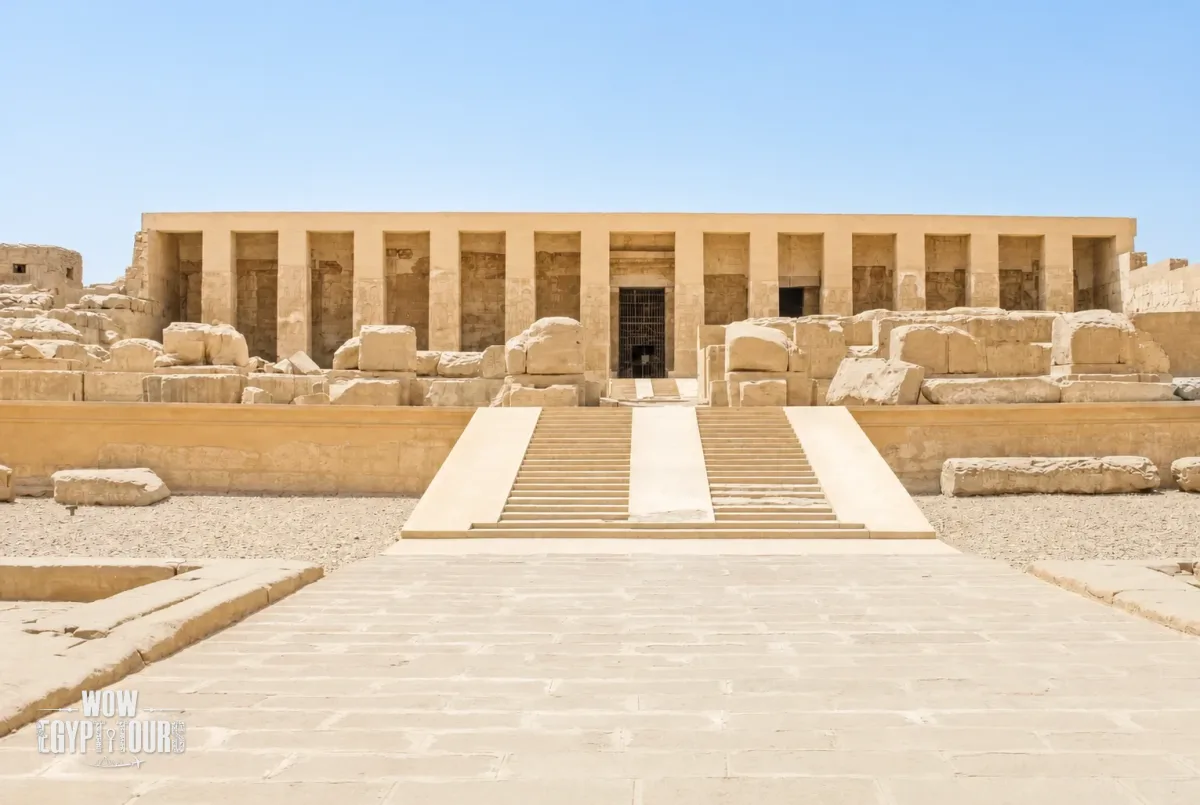
The original entrance to the Temple of Seti I at Abydos was through a massive pylon gateway, now largely destroyed, that opened into a series of two open courtyards giving access to the main temple facade. The first pylon and its courtyard were decorated by Ramesses II with large-scale painted reliefs celebrating his military campaigns, distinguishable from the artistic style of his father's work by their bolder execution and somewhat coarser quality. The second courtyard is better preserved and gives visitors their first view of the main facade of the temple interior, with its seven doorways corresponding to the seven sanctuary chapels within, framed by the columns of the portico above which the painted relief frieze of Seti I offering to the gods is still partially visible. The approach to the temple through these outer courtyards creates a progressive sense of anticipation for the extraordinary painted interior that lies within.
The First Hypostyle Hall
The first hypostyle hall of the Temple of Seti I at Abydos is a broad columned space decorated by Ramesses II after his father's death, with the characteristic bold and slightly stylized relief work of the Ramesside Period covering the columns and walls. Although the artistic quality of the Ramesses II decoration in the outer hypostyle hall is generally considered less refined than Seti I's own work in the inner portions of the temple, it is still of very high quality by any standard outside the exceptional benchmark set by the Seti I master painters, and provides an interesting point of comparison that allows visitors to appreciate how dramatically the artistic standard changed between the two reigns.
The Second Hypostyle Hall And The Finest Painted Reliefs
The second hypostyle hall, decorated under the direct supervision of Seti I's own master painters, is where the artistic revelation of the Abydos Temple fully reveals itself. The walls, pillars, and ceilings of this inner hypostyle hall are covered with painted carved reliefs of extraordinary quality that represent the absolute pinnacle of ancient Egyptian temple painting, executed in a palette of exceptional richness and subtlety with a draughtsmanship that combines perfect formal precision with a sense of individual grace and divine presence that is unlike anything in any other ancient Egyptian temple. The figures of gods and pharaohs in the second hypostyle hall glow with an inner light of golden skin tones, brilliant white linen, turquoise jewelry, and rich blue and red divine regalia that make them appear simultaneously formal and alive, hieratic and human, timeless and immediate. Standing in the second hypostyle hall of the Seti I temple surrounded by these painted walls is consistently described by visitors as one of the most overwhelming aesthetic and spiritual experiences available anywhere along the Nile.
The Seven Sanctuary Chapels
Beyond the second hypostyle hall, the Temple of Seti I at Abydos divides into its unique seven parallel sanctuary chapels, each dedicated to one of the seven principal divine residents of the temple: Osiris, Isis, Horus, Ptah, Ra-Horakhty, Amun-Ra, and the deified Seti I himself. Each chapel follows a parallel architectural programme, progressing from an antechamber through a vestibule to the innermost sanctuary where the divine cult statue was kept in its portable shrine. The painted decoration of each chapel is specifically designed for its divine resident, with the appropriate mythological scenes, divine associations, and ritual texts for that particular deity covering every available wall surface in Seti I's most refined and exquisitely detailed painted relief style. The Osiris chapel, dedicated to the primary divine resident of Abydos, is the most extensively decorated and the most theologically complex of the seven, with detailed scenes of Osirian mythology covering its walls in a visual programme of extraordinary richness and depth. Each of the seven chapels preserves its original painted vaulted ceiling with astronomical and decorative scenes, creating an experience of complete divine enclosure when standing within any one of the sanctuary spaces.
The Gallery Of The King List
One of the most historically significant spaces in the Temple of Seti I at Abydos is the long gallery corridor that runs along the southern side of the main temple building, connecting the inner hypostyle hall with the suite of rooms associated with the Osiris complex at the rear of the temple. On the wall of this gallery, a long carved relief shows the young Prince Ramesses standing beside his father Seti I as the pharaoh performs offerings before a list of 76 royal cartouches arranged in three horizontal rows representing the kings of Egypt from Menes, the legendary founder of the unified state, to Seti I himself. This Abydos King List, one of the three surviving ancient Egyptian royal king lists alongside those from the temple at Saqqara and the Turin Royal Canon papyrus, is one of the primary sources for the reconstruction of ancient Egyptian royal succession and chronology. The list is also notable for what it omits: the Hyksos rulers of the Second Intermediate Period, the Amarna pharaohs Akhenaten, Smenkhkare, and Neferneferuaten, and the first pharaoh of the 18th Dynasty Ahmose who expelled the Hyksos, all of whom were considered dynastically inconvenient and were deliberately excluded from the official royal succession as presented in the Abydos list.
The Osiris Complex
Behind the seven sanctuary chapels at the rear of the Temple of Seti I at Abydos, a complex of rooms and corridors is dedicated to the Osirian mysteries, the most sacred rituals performed at Abydos in connection with the death and resurrection of the god. This complex, accessible through the Osiris sanctuary, includes a series of decorated rooms connected with specific episodes of the Osirian mythology and ritual cycle, some of which preserve the most intimate and theologically complex painted scenes in the entire temple. The Osirian complex is one of the most rarely documented and least published sections of the Abydos temple and contains painted reliefs of extraordinary quality that remain incompletely recorded even in the modern Egyptological literature.
The Osireion
Accessible behind the main temple of Seti I, the Osireion is one of the most mysterious and most atmospherically powerful ancient structures in Egypt, a subterranean cenotaph of Osiris built by Seti I and substantially completed by his successor Merenptah around 1210 BCE. The Osireion consists of a long descending passageway leading to a vast underground hall built from enormous blocks of red granite and quartzite in a deliberately archaic style that imitates the Old Kingdom funerary architecture of the pyramid age. At the center of the main hall, an island of stone is surrounded on three sides by water channels fed by the Nile, symbolizing the primordial mound of creation emerging from the waters of the primeval ocean, the mythological landscape of Osirian resurrection in its most literal and most physically realized form. The walls of the Osireion are covered with texts from the Book of the Dead, the Book of Gates, and the Book of Caverns, the same funerary texts that decorated the great royal tombs of the Valley of the Kings, and some of the finest examples of New Kingdom calligraphic painting survive on these walls in a state of preservation that makes them among the most beautiful ancient inscriptions in Egypt. The Osireion is currently partly flooded due to rising groundwater levels, and visitors can see the underground hall from the viewing platform at the end of the descending passageway without descending to the flooded floor level.
The Temple Of Ramesses II At Abydos
Approximately one kilometer to the north of the Seti I temple, the Temple of Ramesses II at Abydos is a substantial and well-preserved New Kingdom mortuary temple that complements rather than duplicates the experience of the Seti I temple. The Ramesses II temple is somewhat smaller than the Seti I structure and is decorated in the bold, confident Ramesside style that distinguishes the work of Ramesses II's own artists from the more delicate tradition of his father. The temple preserves significant areas of original painted decoration, including a famous scene showing young Ramesses II as a warrior prince at the Battle of Kadesh, and the outer walls bear cartouche lists and royal titulary in the characteristic monumental Ramesside style. For visitors with sufficient time, the Ramesses II temple provides an excellent complement to the Seti I temple and rounds out the experience of the ancient sacred landscape of Abydos.
Why Is The Temple Of Seti I At Abydos Important?
The Temple of Seti I at Abydos is important for reasons that are simultaneously artistic, historical, theological, and archaeological. Artistically, it is the greatest surviving example of ancient Egyptian painted relief decoration, the monument against which all other ancient Egyptian temple painting must be measured, and the clearest expression of the supreme achievement of the New Kingdom artistic tradition at the height of its technical and aesthetic accomplishment. No other temple in Egypt, not even the celebrated inner rooms of the Valley of the Kings tombs, can match the painted surfaces of the Seti I temple for the sustained quality and the luminous beauty of their color and draughtsmanship.
Historically, the temple preserves the Abydos King List, one of the three primary sources for the reconstruction of ancient Egyptian royal chronology, and numerous other inscriptions and relief scenes that document key aspects of 19th Dynasty royal ideology and religious practice. Theologically, it is the most important New Kingdom mortuary temple at the most sacred site in ancient Egypt, the monument that embodied the pharaoh's eternal participation in the Osirian resurrection at the very place where Osiris himself was believed to be buried. Archaeologically, it stands at the center of one of the richest and most extensively excavated ancient sites in the Nile Valley, surrounded by the remains of royal tombs, private monuments, and votive deposits spanning more than three thousand years of continuous human veneration of the Osirian sacred landscape. WOW Egypt Tours includes the Temple of Seti I at Abydos as a featured destination on Luxor Day Tours, combined Abydos and Dendera Tours, Egypt Tours Packages, and excursions from the Red Sea ports.
What Are Some Interesting Facts About The Abydos Temple?
The Finest Painted Reliefs In Ancient Egypt
The painted relief decoration of the Temple of Seti I at Abydos has been described by generations of Egyptologists as the most beautiful ancient Egyptian temple painting in existence, and this judgment has never been seriously challenged by any scholar who has seen the work in person. The figures of the gods rendered in the inner hypostyle hall and the seven sanctuary chapels achieve a quality of formal perfection combined with an impression of living divine presence that is without parallel in the entire corpus of ancient Egyptian sacred art. The skin tones of the divine figures shift between golden amber and warm honey depending on the angle of the light, the white linen draperies of the offering scenes seem to flutter with a suggestion of breeze, and the details of jewelry, headdresses, and divine insignia are rendered with a microscopic precision that rewards close examination indefinitely. The experience of seeing these paintings in person for the first time is consistently described by visitors as transformative, a confrontation with ancient artistic achievement that goes beyond the merely impressive into something genuinely sublime.
The King List And The Gaps In History
The Abydos King List is one of the most important and most discussed historical documents in Egyptology, not only for what it contains but for what it deliberately omits. The list presents a continuous succession of 76 royal cartouches from Menes to Seti I, arranged in three rows on the gallery wall, with the young Prince Ramesses standing beside his father to learn the names of his royal predecessors. However, the list excludes at least seventeen rulers from the official sequence, including all the Hyksos rulers of the Second Intermediate Period, the Amarna pharaohs Akhenaten, Smenkhkare, Neferneferuaten, and Tutankhamun, and several other rulers considered dynastically or religiously inconvenient. The selective nature of the Abydos King List is itself a historical document of great significance, revealing which rulers the 19th Dynasty considered legitimate predecessors and which they wished to erase from the official record of Egyptian royal succession.
The Osirian Pilgrimage And The Votive Landscape
One of the most historically remarkable aspects of the Abydos site is the evidence it provides for the largest and most sustained popular religious pilgrimage in the ancient world. For more than two thousand years, from the Old Kingdom period to the late New Kingdom and beyond, ordinary Egyptians of all social classes made the journey to Abydos to erect votive stelae, small cenotaphs, and commemorative chapels in the sacred landscape of the Osirian city, believing that proximity to the burial place of Osiris would ensure their participation in the divine resurrection festival for eternity. The desert landscape around the Seti I temple is covered with the remains of thousands of these private Osirian monuments, many of which preserve the names and biographical details of individuals who would otherwise be entirely unknown to history. The Abydos pilgrimage tradition was the most democratic institution in ancient Egyptian religious life, and the evidence it has preserved for the beliefs and aspirations of ordinary ancient Egyptians is of incalculable historical value.
What Is So Special About The Temple Of Seti I At Abydos?
The Most Sacred Ground In Ancient Egypt
What makes the Temple of Seti I at Abydos uniquely special among all the ancient temples of Upper Egypt is the combination of supreme artistic achievement with supreme sacred significance. No other site in Egypt combines the most beautiful temple painting with the most sacred theological landscape in the way that Abydos does. Standing in the seven sanctuary chapels of the Seti I temple, surrounded on all sides by painted divine figures of extraordinary grace and beauty in the most sacred city of the most universally beloved god of the Egyptian pantheon, visitors experience a quality of sacred presence and aesthetic overwhelming that is available nowhere else along the Nile. The Abydos Temple is not simply the most beautiful ancient Egyptian temple; it is the most beautiful ancient Egyptian temple built at the holiest place in ancient Egypt, a combination that creates an experience of historical and spiritual depth that is genuinely unique in the heritage of humanity.
Seven Sanctuaries For Seven Gods
The unique seven-chapel plan of the Seti I temple also makes it architecturally special in a way that no other ancient Egyptian temple can match. The experience of walking through the second hypostyle hall and choosing which of the seven doorways to enter is itself a kind of liturgical act, a choice among seven divine presences each with their own sacred space, their own mythological associations, and their own painted programme of divine encounter. No other ancient Egyptian temple offers the visitor this kind of structured multiplicity of sacred destinations within a single unified architectural experience, and the seven-chapel plan gives the Abydos temple a spatial complexity and a ritual richness that makes it inexhaustible as a subject of study and meditation.
Abydos Temple Through The Ages: From Ancient Egypt To The Present
The history of the Temple of Seti I at Abydos after the New Kingdom is one of gradual decline from active religious use, periodic reuse by successive cultures, and ultimate rediscovery and scholarly appreciation. During the Third Intermediate Period and Late Period, the temple continued to receive some religious attention and votive deposits, reflecting the enduring importance of the Abydos sacred tradition in Egyptian religious life. During the Ptolemaic Period, the Greek rulers added some dedications to the site, and the Abydos pilgrimage tradition continued to attract worshippers from throughout Egypt who came to participate in the annual Osirian festival mysteries.
During the early Christian era, Coptic Christians occupied parts of the temple, removing or defacing some of the carved divine figures in the inner rooms and painting Coptic crosses on some walls, though the overall state of preservation of the temple's painted decoration remained extraordinary. The medieval and Ottoman periods saw the gradual burial of some portions of the surrounding landscape under accumulated debris, while the main temple building remained substantially accessible. The modern scientific rediscovery of Abydos began with the Napoleonic expedition of 1798 and was dramatically advanced by Auguste Mariette's systematic excavation of the site beginning in 1858, which revealed the full extent of the ancient sacred landscape and confirmed the extraordinary historical significance of the Seti I temple and its associated monuments. Ongoing Egyptian and international archaeological work at Abydos continues to produce significant new discoveries, including the recent identification of additional previously unknown royal tombs of the Early Dynastic Period, confirming that the Abydos archaeological landscape is far from exhausted and continues to yield important new evidence for the earliest periods of Egyptian civilization.
Abydos Temple UNESCO World Heritage Status
The Temple of Seti I at Abydos is part of the broader landscape of Upper Egyptian heritage recognized internationally as among the most outstanding cultural concentrations in the world. The ancient site of Abydos, encompassing the Seti I temple, the Ramesses II temple, the Osireion, the royal tombs of the Early Dynastic Period, and the vast landscape of private Osirian monuments, is recognized as one of the most important individual archaeological sites in Egypt for its extraordinary historical depth, spanning more than three thousand years of continuous religious activity at the most sacred site in the ancient Egyptian world. The extraordinary painted decoration of the Seti I temple is internationally recognized as the finest surviving example of New Kingdom temple painting and as one of the supreme artistic achievements of the ancient world.
Best Time To Visit The Temple Of Seti I At Abydos
The best time to visit the Temple of Seti I at Abydos is during the cooler months from October through April, when temperatures in Upper Egypt are moderate and both the outdoor approach through the archaeological landscape and the enclosed interior of the temple are comfortable for extended exploration. Because a significant portion of the temple interior is enclosed under its partially intact roof, the inner sanctuary rooms are sheltered and relatively cool even in warmer months, making the Abydos Temple more manageable in summer than fully open-air sites. If visiting during summer, plan to arrive at the temple in the early morning when the air is coolest. WOW Egypt Tours plans all visits to the Temple of Seti I at Abydos at the optimal time of day for the season and the specific itinerary, whether as a single-site visit or combined with the Temple of Hathor at Dendera.
Abydos Temple Opening Hours
The Temple of Seti I at Abydos is open to visitors every day of the week, including public holidays. The temple opens at 7:00 AM and closes at 5:00 PM from October to April, and from 7:00 AM to 6:00 PM from May to September. The Osireion behind the main temple is also open during normal visiting hours. Visitors who prefer the most peaceful and uncrowded experience should arrive as early as possible after opening, before the main tourist groups arrive from Luxor.
Abydos Temple Entrance Fees
Adults: EGP 260
Students: EGP 130
Keep your ticket safe throughout your visit. Entrance fees to the Temple of Seti I at Abydos are included in all Abydos Temple Tours, combined Abydos and Dendera Tours, Luxor Day Tours, Egypt Tours Packages, and excursions from the Red Sea ports booked through WOW Egypt Tours.
How To Get To The Temple Of Seti I At Abydos
The Temple of Seti I at Abydos is located approximately 130 kilometers north of Luxor and 60 kilometers north of the Temple of Hathor at Dendera on the west bank of the Nile River in the Sohag Governorate. From Luxor, the temple is reached by private car or minibus along the main Nile Valley highway in approximately one and a half to two hours. From the Dendera Temple, Abydos is approximately one hour further north by private vehicle. From Sohag or Assiut to the north, the site is accessible in approximately one to two hours by road.
For travelers coming from the Red Sea ports, the Temple of Seti I at Abydos is accessible from Safaga Port via the Eastern Desert road in approximately 3 to 3.5 hours, making it accessible as a single-day shore excursion from Safaga. The combined Abydos and Dendera tour from Safaga requires an overnight stay in Luxor. All Luxor Day Tours, combined Abydos and Dendera Tours, and Red Sea port excursions with WOW Egypt Tours include private air-conditioned transportation directly to and from the Temple of Seti I at Abydos.
How Long To Spend At The Temple Of Seti I At Abydos
Most visitors spend between one and a half and two and a half hours at the Temple of Seti I at Abydos, which is sufficient time to walk through both hypostyle halls, visit the seven sanctuary chapels, view the Abydos King List in the gallery corridor, explore the Osiris complex, and see the Osireion at the rear of the main temple. Visitors who also wish to visit the Temple of Ramesses II approximately one kilometer to the north should allow an additional 30 to 45 minutes. Visitors with a particular interest in the painted relief decoration, the mythology of Osiris, or the historical content of the King List may wish to allow two and a half to three hours at the main temple.
The Temple of Seti I at Abydos is ideally combined in a single day from Luxor with the Temple of Hathor at Dendera, approximately 60 kilometers to the south. Allow approximately six to seven hours from Luxor for the combined Abydos and Dendera day tour, with a very early morning departure of approximately 6:00 AM to maximize time at both temples.
Tips For Visiting The Temple Of Seti I At Abydos
Spend as much time as possible in the seven sanctuary chapels, where the finest painted reliefs in the temple are found, and allow your eyes to adapt to the interior light before trying to examine the painted details. Ask your guide to explain the difference in artistic quality and style between the sections decorated by Seti I's own artists and those completed by Ramesses II after his father's death, as this comparison is one of the most illuminating art historical experiences available in any ancient monument. Do not miss the Abydos King List in the gallery corridor, and ask your guide to identify the rulers who are present and those who were deliberately omitted. Visit the Osireion behind the main temple for one of the most atmospherically powerful ancient architectural experiences in Egypt, even if the current water level prevents descent to the floor. A licensed Egyptologist guide from WOW Egypt Tours is absolutely essential at Abydos: the theological complexity of the seven-chapel programme, the mythological content of the Osirian scenes, and the historical significance of the King List all require expert interpretation to be fully appreciated. Do not touch any painted or carved surfaces anywhere in the temple under any circumstances.
What To Wear At The Temple Of Seti I At Abydos
The Temple of Seti I at Abydos combines enclosed interior spaces with an open outdoor approach through the ancient archaeological landscape, requiring practical and adaptable clothing. Lightweight, breathable clothing covering the shoulders and knees is recommended for both comfort and respect for the sacred site. A wide-brimmed hat and sunscreen are essential for the outdoor approach to the temple and for the visit to the Osireion. Comfortable, closed-toe walking shoes with good grip are necessary for the uneven stone floors within the temple and the sandy desert terrain around the Osireion. For the enclosed inner sanctuary rooms, a light layer is useful in winter as the thick stone walls and partially intact roof can make the interior noticeably cool.
Photography At The Temple Of Seti I At Abydos
The Temple of Seti I at Abydos is one of the most photographically rewarding ancient sites in Egypt, offering the opportunity to photograph the finest painted relief decoration in the ancient world in its original architectural context. Photography with a standard camera or smartphone is permitted throughout most areas of the temple. Flash photography is strictly prohibited near all painted and carved surfaces, as the intense light causes irreversible damage to the ancient pigments. For photography in the seven sanctuary chapels and the inner hypostyle hall, a camera with excellent low-light performance is absolutely essential, as these spaces receive very little natural light and the painted walls can only be fully appreciated and photographed with adequate sensitivity. The second hypostyle hall receives better natural light and is more easily photographed with a standard camera. The gallery corridor with the King List is relatively well lit by natural light from the entrance end. The Osireion is best photographed from the descending passageway entrance with a wide-angle lens. Professional photography or filming with specialized equipment requires a separate permit from Egypt's Ministry of Tourism and Antiquities.
Abydos Temple Tours
Single Attraction Visit: Abydos Temple Tour From Luxor
This full-day tour from Luxor visits the Temple of Seti I at Abydos as a single dedicated excursion. It is suitable for travelers with a particular interest in New Kingdom painted relief art, the mythology and theology of Osiris, the history of the early New Kingdom, or the sacred landscape of the most important pilgrimage site in ancient Egypt.
What Is Covered
Full guided visit of the Temple of Seti I at Abydos including the entrance pylon and forecourts with the Ramesses II reliefs, the first and second hypostyle halls, the seven sanctuary chapels dedicated to Osiris, Isis, Horus, Ptah, Ra-Horakhty, Amun-Ra, and the deified Seti I, the Osiris complex, the gallery corridor with the Abydos King List, and the Osireion. Optional additional visit to the Temple of Ramesses II approximately one kilometer to the north, subject to available time.
Duration
1.5 to 2.5 hours at the Seti I temple, plus approximately 1.5 to 2 hours each way from Luxor by private vehicle.
Includes
Private air-conditioned transportation from Luxor, private licensed Egyptologist guide, and entrance fees. Available for early morning departures only to allow sufficient time at the site given the distance from Luxor.
Combined Abydos And Dendera Tour From Luxor
This full-day tour from Luxor combines the Temple of Seti I at Abydos with the Temple of Hathor at Dendera, approximately 60 kilometers to the south, creating the most comprehensive and contrasting ancient temple experience available on any single day excursion from Luxor. The theological contrast between the New Kingdom Osirian temple at Abydos and the Ptolemaic Hathorian temple at Dendera, the artistic contrast between Seti I's incomparable painted reliefs and the Roman-period polychrome ceiling at Dendera, and the historical contrast between the most sacred city of the most important god of the dead and the most complete Ptolemaic divine complex in Egypt together create an experience that spans the full range of ancient Egyptian sacred architecture and art across more than a thousand years of temple building tradition.
What Is Covered
The Temple of Seti I at Abydos with a full guided visit of the main temple, the seven sanctuary chapels, the Abydos King List, and the Osireion. The Temple of Hathor at Dendera with a full guided visit of the outer hypostyle hall with the painted astronomical ceiling, the inner sanctuary complex, the accessible crypts, the rooftop chapels with the Dendera Zodiac cast, the Cleopatra and Caesarion relief, and the Roman birth house.
Duration
Full day from Luxor, approximately 1.5 to 2 hours at each temple, with travel time between sites included. A very early morning departure from Luxor of approximately 6:00 AM is strongly recommended to maximize time at both temples.
Includes
Private air-conditioned transportation from Luxor, private licensed Egyptologist guide, and entrance fees to both temples. Available for early morning departures only due to the total distance involved.
Safaga Shore Excursion: Single Day To Abydos Temple
Safaga Port is located on the Red Sea coast, approximately 280 to 300 kilometers from the Temple of Seti I at Abydos via the Eastern Desert road and the Nile Valley highway. While the journey is long, the Abydos Temple is accessible from Safaga Port as a single-day shore excursion, with the journey taking approximately 3 to 3.5 hours each way and leaving sufficient time for a complete guided visit to the temple within a long port day.
What Is Covered
Full guided visit of the Temple of Seti I at Abydos including both hypostyle halls, the seven sanctuary chapels, the Abydos King List in the gallery corridor, the Osiris complex, and the Osireion. The Temple of Ramesses II nearby is accessible as an optional addition subject to available time.
Duration
Full day from port departure to port return, approximately 11 to 12 hours including transfers.
Includes
Private air-conditioned vehicle from Safaga Port, private licensed Egyptologist guide, entrance fees to the Temple of Seti I at Abydos, and return transfer to the ship. All Safaga Shore Excursions are coordinated around each ship's port schedule to guarantee return to the vessel before departure.
Safaga Shore Excursion: Overnight To Abydos And Dendera
For travelers wishing to combine both the Temple of Seti I at Abydos and the Temple of Hathor at Dendera from Safaga Port, WOW Egypt Tours offers an overnight shore excursion programme that makes both temples accessible within two days from the Red Sea.
Itinerary
Day 1: Depart Safaga Port by private air-conditioned vehicle. Travel to the Temple of Seti I at Abydos, approximately 3 to 3.5 hours via the Eastern Desert road and Nile Valley highway. Full guided visit of the Temple of Seti I at Abydos including the seven sanctuary chapels, the King List, and the Osireion. Optional visit to the Temple of Ramesses II. Travel south to Luxor, approximately 1.5 to 2 hours. Guided visit of Luxor Temple in the evening. Overnight in Luxor at a selected hotel.
Day 2: Early morning guided visit of Karnak Temple. Travel north to the Temple of Hathor at Dendera, approximately 1 hour from Luxor. Full guided visit of the Dendera Temple including the outer hypostyle hall with the painted astronomical ceiling, the rooftop chapels with the Dendera Zodiac cast, the underground crypts, the Cleopatra relief, and the sacred lake. Return to Safaga Port via the Eastern Desert road, approximately 2.5 to 3 hours. Return to ship.
Includes
Private air-conditioned vehicle throughout, private licensed Egyptologist guide, one night accommodation in Luxor, entrance fees to all included sites, and return transfer to the ship. All overnight Safaga Shore Excursions are coordinated with each ship's schedule to confirm departure and return timings in advance.
Dahabiya Nile River Cruise
A Dahabiya Nile River Cruise is a small-vessel sailing experience on the Nile between Luxor and Aswan aboard a traditional wooden dahabiya. WOW Egypt Tours operates dahabiya cruises with private cabins, all meals, a private licensed Egyptologist guide on board, and guided shore excursions at every stop. The Abydos Temple is located north of Luxor rather than on the Luxor-Aswan river route, so it is not included as a standard cruise stop. However, the Temple of Seti I at Abydos can be visited as an optional private excursion from Luxor on the first or last day of any Dahabiya cruise itinerary, allowing Dahabiya cruise passengers to combine the small-vessel river experience with a visit to the most sacred ancient site in Egypt.
4 Days 3 Nights Dahabiya Nile River Cruise From Aswan To Luxor
Route: Aswan to Luxor, sailing north.
Itinerary
Day 1: Embarkation in Aswan. Visit to Philae Temple and the Unfinished Obelisk. Sail north to Kom Ombo. Guided visit to Kom Ombo Temple and Crocodile Museum. Continue to Gebel el Silsila. Overnight on board.
Day 2: Guided visit to Gebel el Silsila. Sail to the Village of Basaw. Guided visit to Village of Basaw. Continue to Edfu. Guided visit to the Temple of Horus at Edfu. Overnight on board.
Day 3: Sail to El Kab. Guided visit to El Kab Tombs. Sail to El Hagaz Island. Swimming stop. Overnight on board.
Day 4: Sail to Esna. Visit Khnum Temple at Esna. Disembarkation in Esna. Transfer to Luxor, approximately 55 kilometers (35 miles). Optional private excursion to Abydos Temple from Luxor on the disembarkation day, subject to arrival time and scheduling.
Includes
Private cabin, all meals on board, private licensed Egyptologist guide, entrance fees to all site visits, and private transfers. Abydos Temple excursion available as an optional addition on disembarkation day.
5 Days 4 Nights Dahabiya Nile River Cruise From Luxor To Aswan
Route: Luxor to Aswan, sailing south.
Itinerary
Day 1: Optional private excursion to Abydos Temple from Luxor on the embarkation day, departing very early morning. Embarkation in Luxor. Transfer to Esna, approximately 55 kilometers (35 miles). Visit Khnum Temple at Esna. Sail to El Hagaz Island. Overnight on board.
Day 2: Sail to El Kab. Guided visit to El Kab Tombs. Continue to Edfu. Guided visit to the Temple of Horus at Edfu. Sail to the Village of Basaw. Guided visit to Village of Basaw. Overnight on board.
Day 3: Sail to Gebel el Silsila. Guided visit to Gebel el Silsila. Sail south to Kom Ombo. Guided visit to Kom Ombo Temple and Crocodile Museum. Sail to Daraw Village. Overnight on board.
Day 4: Guided visit to Daraw Village. Sail to Herbiab Island. Swimming stop. Philae Sound and Light Show. Overnight on board.
Day 5: Optional Abu Simbel visit available by air or road. Guided visits to Philae Temple, the High Dam, and the Unfinished Obelisk. Disembarkation in Aswan.
Includes
Private cabin, all meals on board, private licensed Egyptologist guide, entrance fees to all site visits, and private transfers. Abydos Temple excursion available as an optional addition on embarkation day.
8 Days 7 Nights Dahabiya Nile River Cruise Round Trip From Luxor (Via Aswan)
Route: Luxor and Aswan, sailing north and south.
Itinerary
Day 1: Embarkation in Luxor. Transfer to Esna, approximately 55 kilometers (35 miles). Visit Khnum Temple at Esna. Sail to El Hagaz Island. Overnight on board.
Day 2: Sail to El Kab. Continue to Edfu. Guided visit to the Temple of Horus at Edfu. Sail to the Village of Basaw. Guided visit to Village of Basaw. Overnight on board.
Day 3: Sail to Gebel el Silsila. Sail south to Kom Ombo. Guided visit to Kom Ombo Temple and Crocodile Museum. Sail to Daraw Village. Overnight on board.
Day 4: Guided visit to Daraw Village. Sail to Herbiab Island. Swimming stop. Philae Sound and Light Show. Overnight on board.
Day 5: Optional Abu Simbel visit available by air or road. Guided visits to Philae Temple, the High Dam, and the Unfinished Obelisk. Sail north to Kom Ombo. Continue to Gebel el Silsila. Overnight on board.
Day 6: Guided visit to Gebel el Silsila. Sail to the Village of Basaw. Continue to Edfu. Guided visit to the Temple of Horus at Edfu. Overnight on board.
Day 7: Sail to El Kab. Guided visit to El Kab Tombs. Sail to El Hagaz Island. Swimming stop. Overnight on board.
Day 8: Disembarkation in Esna. Transfer to Luxor. Optional private excursion to Abydos Temple from Luxor on the disembarkation day.
Includes
Private cabin, all meals on board, private licensed Egyptologist guide, entrance fees to all site visits, and private transfers. Abydos Temple excursion available as an optional addition.
8 Days 7 Nights Dahabiya Nile River Cruise Round Trip From Aswan (Via Luxor)
Route: Luxor and Aswan, sailing north and south.
Itinerary
Day 1: Embarkation in Aswan. Visit to Philae Temple and the Unfinished Obelisk. Sail north to Kom Ombo. Guided visit to Kom Ombo Temple and Crocodile Museum. Continue to Gebel el Silsila. Overnight on board.
Day 2: Guided visit to Gebel el Silsila. Sail to the Village of Basaw. Continue to Edfu. Guided visit to the Temple of Horus at Edfu. Overnight on board.
Day 3: Sail to El Kab. Guided visit to El Kab Tombs. Sail to El Hagaz Island. Swimming stop. Overnight on board.
Day 4: Sail to Esna. Visit Khnum Temple at Esna. Sail to El Hagaz Island. Overnight on board.
Day 5: Sail to El Kab. Continue to Edfu. Guided visit to the Temple of Horus at Edfu. Sail to the Village of Basaw. Guided visit to Village of Basaw. Overnight on board.
Day 6: Sail to Gebel el Silsila. Sail south to Kom Ombo. Guided visit to Kom Ombo Temple and Crocodile Museum. Sail to Daraw Village. Overnight on board.
Day 7: Guided visit to Daraw Village. Sail to Herbiab Island. Swimming stop. Philae Sound and Light Show. Overnight on board.
Day 8: Disembarkation in Aswan.
Includes
Private cabin, all meals on board, private licensed Egyptologist guide, entrance fees to all site visits, and private transfers.
Luxor And Aswan Nile River Cruise
The Luxor and Aswan Nile River Cruise is a standard Nile cruise product operated aboard a full-size cruise ship between Luxor and Aswan. WOW Egypt Tours operates this cruise in both directions with private licensed Egyptologist guides, all meals included, private cabins, and guided shore excursions at every port of call. The Temple of Seti I at Abydos is located north of Luxor and is not on the standard Luxor-Aswan cruise route. Cruise passengers who wish to visit Abydos should arrange a private day excursion from Luxor on the first or last day of their cruise itinerary.
4 Days 3 Nights Luxor And Aswan Nile River Cruise From Aswan To Luxor
Route: Aswan to Luxor, sailing north.
Itinerary
Day 1: Embarkation in Aswan. Guided visits to Philae Temple, the High Dam, and the Unfinished Obelisk. Overnight on board in Aswan.
Day 2: Sail north to Kom Ombo. Guided visit to Kom Ombo Temple and Crocodile Museum. Continue to Edfu. Overnight on board.
Day 3: Guided visit to the Temple of Horus at Edfu. Continue north toward Luxor. Pass through the Esna Lock. Optional visit to Khnum Temple at Esna. Guided visit to Luxor Temple and Karnak Temple. Overnight on board in Luxor.
Day 4: Optional Sunrise Hot Air Balloon available. Guided visits to Valley of the Kings, Queen Hatshepsut Temple, and Colossi of Memnon. Optional private excursion to Abydos Temple available on disembarkation day. Disembarkation in Luxor.
Includes
Private cabin, all meals on board, private licensed Egyptologist guide, entrance fees to all temple visits, and private transfers. Abydos Temple excursion available as an optional addition on disembarkation day.
5 Days 4 Nights Luxor And Aswan Nile River Cruise From Luxor To Aswan
Route: Luxor to Aswan, sailing south.
Itinerary
Day 1: Optional private excursion to Abydos Temple available on embarkation day. Embarkation in Luxor. Guided visits to Luxor Temple and Karnak Temple. Overnight on board in Luxor.
Day 2: Optional Sunrise Hot Air Balloon available. Guided visits to Valley of the Kings, Queen Hatshepsut Temple, and Colossi of Memnon. Pass through the Esna Lock. Visit to Khnum Temple at Esna. Sail south to Edfu. Overnight on board.
Day 3: Guided visit to the Temple of Horus at Edfu. Continue to Kom Ombo. Guided visit to Kom Ombo Temple and Crocodile Museum. Overnight on board.
Day 4: Continue south toward Aswan. Guided visits to Philae Temple, the High Dam, and the Unfinished Obelisk. Overnight on board in Aswan.
Day 5: Optional Abu Simbel visit available by air or road. Disembarkation in Aswan.
Includes
Private cabin, all meals on board, private licensed Egyptologist guide, entrance fees to all temple visits, and private transfers. Abydos Temple excursion available as an optional addition on embarkation day.
8 Days 7 Nights Luxor And Aswan Nile River Cruise Round Trip From Luxor (Via Aswan)
Route: Luxor and Aswan, sailing north and south.
Itinerary
Day 1: Embarkation in Luxor. Guided visits to Luxor Temple and Karnak Temple. Overnight on board in Luxor.
Day 2: Guided visits to Luxor Museum. Pass through the Esna Lock. Visit to Khnum Temple at Esna. Sail south to Edfu. Overnight on board.
Day 3: Guided visit to the Temple of Horus at Edfu. Continue to Kom Ombo. Guided visit to Kom Ombo Temple and Crocodile Museum. Overnight on board.
Day 4: Continue south toward Aswan. Guided visits to Philae Temple, the High Dam, and the Unfinished Obelisk. Overnight on board in Aswan.
Day 5: Abu Simbel visit available by road. Sound and Light Show at Philae Temple. Overnight on board in Aswan.
Day 6: Guided visits to Nubian Village. Sail north to Kom Ombo. Guided visit to Kom Ombo Temple. Continue north. Overnight on board.
Day 7: Guided visits to Valley of the Kings, Queen Hatshepsut Temple, and Colossi of Memnon. Pass through the Esna Lock. Visit to Khnum Temple at Esna. Overnight on board in Luxor.
Day 8: Optional private excursion to Abydos Temple on disembarkation day. Disembarkation in Luxor.
Includes
Private cabin, all meals on board, private licensed Egyptologist guide, entrance fees to all temple visits, and private transfers. Abydos Temple excursion available as an optional addition on disembarkation day.
8 Days 7 Nights Luxor And Aswan Nile River Cruise Round Trip From Aswan (Via Luxor)
Route: Luxor and Aswan, sailing north and south.
Itinerary
Day 1: Embarkation in Aswan. Guided visits to Philae Temple, the High Dam, and the Unfinished Obelisk. Overnight on board in Aswan.
Day 2: Sail north to Kom Ombo. Guided visit to Nubian Village and Kom Ombo Temple and Crocodile Museum. Continue to Edfu. Overnight on board.
Day 3: Continue north toward Luxor. Pass through the Esna Lock. Visit to Khnum Temple at Esna. Guided visit to Luxor Museum and Karnak Sound and Light Show. Overnight on board in Luxor.
Day 4: Guided visits to Luxor Temple and Karnak Temple. Overnight on board in Luxor.
Day 5: Optional Sunrise Hot Air Balloon available. Guided visits to Valley of the Kings, Queen Hatshepsut Temple, and Colossi of Memnon. Pass through the Esna Lock. Sail south to Edfu. Overnight on board.
Day 6: Guided visit to the Temple of Horus at Edfu. Continue to Kom Ombo. Guided visit to Kom Ombo Temple. Overnight on board.
Day 7: Sound and Light Show at Philae Temple. Overnight on board in Aswan.
Day 8: Abu Simbel visit available by road. Disembarkation in Aswan.
Includes
Private cabin, all meals on board, private licensed Egyptologist guide, entrance fees to all temple visits, and private transfers.
Combine The Temple Of Seti I At Abydos With Your Egypt Tours Package
The Temple of Seti I at Abydos is included as a featured day excursion destination across the full range of WOW Egypt Tours travel products. Browse the options below to find the Egypt experience that is right for you.
Egypt Tour Packages: Multi-day guided Egypt tours organized by duration, including 2 Days Egypt Packages, 3 Days Egypt Packages, 4 Days Egypt Packages, 5 Days Egypt Packages, 6 Days Egypt Packages, 7 Days Egypt Packages, 8 Days Egypt Packages, 10 Days Egypt Packages, and longer itineraries. All packages include private air-conditioned transportation, private licensed Egyptologist guide, accommodations, entrance fees to all included sites including the Temple of Seti I at Abydos, and private transfers throughout Egypt.
Egypt Travel Packages: Themed Egypt travel packages designed around specific travel styles and interests, including Egypt Honeymoon Travel Packages, Egypt Budget Travel Packages, Egypt Family Travel Packages, Egypt Luxury Travel Packages, Egypt Adventure Travel Packages, Egypt Cultural Travel Packages, and Egypt Christmas and New Year Travel Packages. All packages include private air-conditioned transportation, private licensed Egyptologist guide, accommodations, meals, entrance fees to all included sites, and private transfers.
Egypt Nile Cruise Packages: Complete Egypt travel packages combining Cairo sightseeing with a fully guided Nile cruise between Luxor and Aswan. The Temple of Seti I at Abydos can be included as a private day excursion from Luxor on the first or last day of any cruise package. All packages include private cabin on board, all meals, private licensed Egyptologist guide, entrance fees to all included site visits, and private transfers.
Nile River Cruises: All WOW Egypt Tours Nile cruise options between Luxor and Aswan. The Abydos Temple is north of Luxor and not on the standard cruise route, but can be included as an optional private excursion from Luxor in conjunction with any cruise itinerary.
Luxor Aswan Nile Cruises: Available in both directions and in durations of 4 Days 3 Nights, 5 Days 4 Nights, and 8 Days 7 Nights round trip. Abydos can be added as an optional private excursion from Luxor.
Standard Nile Cruises: Comfortable standard-category cruise ships sailing between Luxor and Aswan. Abydos available as optional private excursion from Luxor.
Deluxe Nile Cruises: Deluxe-category cruise ships with enhanced comfort. Abydos available as optional private excursion from Luxor.
Ultra Deluxe Nile Cruises: Ultra deluxe-category cruise ships. Abydos available as optional private excursion from Luxor.
Luxury Nile Cruises: Luxury-category cruise ships. Abydos available as optional private excursion from Luxor.
Dahabiya Nile Cruises: Private small-vessel sailing experience between Luxor and Aswan. The Temple of Seti I at Abydos is available as an optional private excursion from Luxor on the first or last day of the Dahabiya cruise, combining the intimacy of the small-vessel river experience with a visit to the most sacred and most beautifully painted ancient temple in Egypt.
Luxor Tours: Day tours from Luxor covering the major sites of Upper Egypt, including dedicated single-site tours to the Temple of Seti I at Abydos and the celebrated combined Abydos and Dendera day tour. All tours include private air-conditioned transportation, private licensed Egyptologist guide, entrance fees to all included sites, and private transfers.
Shore Excursions: Guided excursions from Egypt's Red Sea ports to the Temple of Seti I at Abydos, available as a single-day shore excursion from Safaga Port, approximately 3 to 3.5 hours each way, or as part of an overnight excursion programme combined with the Temple of Hathor at Dendera. Includes private air-conditioned transportation, private licensed Egyptologist guide, entrance fees to all included sites, and return transfer to the ship.
Safaga Port Excursions: Shore excursions from Safaga Port available in two formats for the Abydos Temple: as a single-day excursion to the Temple of Seti I at Abydos alone, approximately 3 to 3.5 hours each way via the Eastern Desert road with sufficient time for a complete guided visit in a long port day; or as part of an overnight excursion programme that combines the Temple of Seti I at Abydos on Day 1 with the Temple of Hathor at Dendera on Day 2, with an overnight stay in Luxor. Both options include private air-conditioned vehicle from Safaga Port, private licensed Egyptologist guide, entrance fees to all included sites, and return transfer to the ship.
Nearby Attractions To The Temple Of Seti I At Abydos
The Temple of Seti I at Abydos occupies the most sacred and archaeologically richest position in Upper Egypt north of Luxor, within the ancient desert city of Osiris that has been a place of pilgrimage and royal patronage for more than three thousand years. The most immediate companion monument at the site is the Temple of Ramesses II, approximately one kilometer to the north of the Seti I temple, which provides an excellent artistic and architectural complement to the Seti I temple and rounds out the experience of the New Kingdom sacred landscape of Abydos. Behind both temples, the ancient desert necropolis extends across several kilometers of desert landscape, with burial mounds and archaeological excavation areas from multiple periods of Egyptian history visible in every direction.
The most natural and most rewarding companion visit to Abydos from Luxor is the Temple of Hathor at Dendera, approximately 60 kilometers to the south in the Qena Governorate, one of the most completely preserved and most magnificently decorated Ptolemaic temple complexes in Egypt. The theological contrast between the New Kingdom Osirian sanctuary at Abydos and the Ptolemaic Hathorian complex at Dendera, and the artistic contrast between Seti I's incomparable painted reliefs and the brilliantly colored Roman-period ceiling at Dendera, make the combined Abydos and Dendera day tour the most historically and aesthetically comprehensive single-day temple experience available in all of Upper Egypt.
To the south, the ancient city of Luxor provides the full range of pharaonic monuments from both banks of the Nile, including the Valley of the Kings, Karnak Temple, Luxor Temple, the Temple of Hatshepsut, the Luxor Museum, and the Mummification Museum. All these sites are accessible through the Luxor Day Tours, Nile cruise itineraries, Egypt Tours Packages, and Safaga Shore Excursions offered by WOW Egypt Tours.
Frequently Asked Questions About The Temple Of Seti I At Abydos
What is the Temple of Seti I at Abydos?
The Temple of Seti I at Abydos is a New Kingdom mortuary temple built by Pharaoh Seti I of the 19th Dynasty between approximately 1294 BCE and 1279 BCE at the most sacred site in ancient Egypt, the city of Osiris. It is universally regarded as containing the finest painted relief decoration of any ancient Egyptian temple in existence and is one of the most historically and theologically significant ancient monuments in the Nile Valley. The Abydos Temple is a featured destination in Luxor Day Tours, combined Abydos and Dendera Tours, Egypt Tours Packages, and Safaga Shore Excursions offered by WOW Egypt Tours.
Why is Abydos the most sacred site in ancient Egypt?
Abydos was the most sacred site in ancient Egypt because it was believed to be the place where the head of Osiris, the most universally venerated god in the Egyptian pantheon, was buried. The physical presence of Osiris in the earth at Abydos made it the primary destination of the ancient Egyptian Osirian pilgrimage tradition, the most important annual religious festival in the ancient Egyptian calendar, and the most desired burial location for Egyptians of all social classes who hoped to participate eternally in the resurrection of the god.
What makes the painted reliefs at Abydos the finest in Egypt?
The painted reliefs of the Temple of Seti I at Abydos are universally regarded as the finest in Egypt because of the extraordinary combination of technical precision, aesthetic grace, and luminous color quality that distinguishes them from all other ancient Egyptian temple painting. The figures of the gods in the seven sanctuary chapels achieve a quality of divine presence and formal perfection that has never been matched in any other ancient Egyptian monument, and the palette of warm amber skin tones, brilliant white linen, and rich blue and gold divine regalia creates an effect of timeless beauty that overwhelms visitors who encounter these walls in person.
What are the seven sanctuary chapels at Abydos?
The seven sanctuary chapels of the Temple of Seti I at Abydos are seven parallel inner sanctuaries each dedicated to one of the seven principal divine residents of the temple: Osiris, Isis, Horus, Ptah, Ra-Horakhty, Amun-Ra, and the deified Seti I. Each chapel has its own decorated axis from antechamber to innermost sanctuary, with the appropriate mythological and ritual scenes for its divine resident covering every available wall surface in Seti I's finest painted relief style.
What is the Abydos King List?
The Abydos King List is a carved relief on the wall of the gallery corridor in the Seti I temple showing 76 royal cartouches of the kings of Egypt from Menes, the legendary first pharaoh, to Seti I himself. It is one of the primary ancient sources for the reconstruction of Egyptian royal succession and chronology, though it deliberately omits several dynastically inconvenient rulers including the Hyksos pharaohs and the Amarna rulers.
What is the Osireion at Abydos?
The Osireion is a mysterious subterranean cenotaph of Osiris built by Seti I and substantially completed by Merenptah around 1210 BCE, located behind the main Seti I temple. It consists of a descending passageway leading to a vast underground hall built from enormous red granite and quartzite blocks in a deliberately archaic Old Kingdom style, with a central island surrounded by water channels symbolizing the primordial mound of creation. The walls are decorated with New Kingdom funerary texts. The Osireion is currently partly flooded due to rising groundwater and is viewed from the descending passageway entrance.
What are the opening hours of the Abydos Temple?
The Temple of Seti I at Abydos is open daily from 7:00 AM to 5:00 PM from October to April, and from 7:00 AM to 6:00 PM from May to September.
How much does it cost to enter the Abydos Temple?
The entrance fee is EGP 260 for adults and EGP 130 for students. Entrance fees are included in all Abydos Temple Tours, combined Abydos and Dendera Tours, and Safaga Shore Excursions booked through WOW Egypt Tours.
How long does it take to visit the Abydos Temple?
Most visitors spend between one and a half and two and a half hours at the Seti I temple including the Osireion. Those who wish to also visit the Ramesses II temple approximately one kilometer north should allow an additional 30 to 45 minutes.
What is the best time of year to visit the Abydos Temple?
October to April is the most comfortable period. The partially enclosed interior of the temple is manageable in summer, though the outdoor approach and the Osireion visit are best planned for early morning in the hotter months.
How do I get to the Temple of Seti I at Abydos?
Abydos is approximately 130 kilometers north of Luxor by road, approximately 1.5 to 2 hours by private vehicle. From Safaga Port it is approximately 3 to 3.5 hours via the Eastern Desert road. All Luxor Day Tours and Safaga Shore Excursions with WOW Egypt Tours include private transportation directly to and from the Abydos Temple.
Can I combine Abydos with Dendera in one day from Luxor?
Yes. The combined Abydos and Dendera day tour from Luxor is one of the most spectacular and most historically comprehensive single-day excursions available in all of Egypt. WOW Egypt Tours operates this tour with a very early morning departure from Luxor to maximize time at both temples.
Can I visit the Abydos Temple as a single-day Safaga Shore Excursion?
Yes. The Temple of Seti I at Abydos is accessible from Safaga Port as a single-day shore excursion, with the journey taking approximately 3 to 3.5 hours each way via the Eastern Desert road and leaving sufficient time for a complete guided visit within a long port day. WOW Egypt Tours offers dedicated single-day Safaga Port Excursions to the Temple of Seti I at Abydos.
Is a guide necessary at the Abydos Temple?
A guide is absolutely essential at the Abydos Temple. The theological complexity of the seven-chapel programme, the mythological content of the Osirian scenes, the historical significance of the King List, and the architectural mystery of the Osireion all require expert interpretation to be fully appreciated. WOW Egypt Tours provides licensed Egyptologist guides on all Abydos Temple Tours.
Can I take photographs at the Abydos Temple?
Photography with a standard camera or smartphone is permitted in most areas. Flash photography is strictly prohibited near all painted and carved surfaces. A camera with excellent low-light performance is essential for the seven sanctuary chapels where natural light is very limited. Professional filming requires a separate permit.
What should I wear to visit the Abydos Temple?
Lightweight clothing covering the shoulders and knees, a wide-brimmed hat and sunscreen for the outdoor areas and the approach through the archaeological landscape, comfortable closed-toe walking shoes with good grip, and a light layer in winter for the cooler enclosed interior spaces.
What is the difference between the Abydos Temple and the Dendera Temple?
The Temple of Seti I at Abydos is a New Kingdom temple of approximately 1294 BCE, built at the most sacred site in Egypt and dedicated to Osiris and six other deities, celebrated as the finest painted relief art in ancient Egypt and as the home of the unique seven-chapel architectural plan. The Temple of Hathor at Dendera is a Ptolemaic and Roman temple of approximately 54 BCE to 20 CE, dedicated to Hathor, celebrated for its rooftop chapels, the Dendera Zodiac, the astronomical ceiling, and the Cleopatra relief, and remarkable for its extraordinary architectural completeness as a Ptolemaic religious complex. The two temples represent completely different periods, deities, architectural traditions, and artistic styles, and together constitute the most comprehensive and contrasting ancient temple experience available on any single day from Luxor.
What Nile cruise options include the Abydos Temple?
The Abydos Temple is north of Luxor and is not on the standard Luxor-Aswan Nile cruise route. However, it can be included as an optional private excursion from Luxor in conjunction with any WOW Egypt Tours Nile River Cruise or Dahabiya Nile River Cruise, on the first or last day of the cruise itinerary.
How do I book an Abydos Temple Tour with WOW Egypt Tours?
You can book a single-site Abydos Temple Day Tour from Luxor, a combined Abydos and Dendera Day Tour from Luxor, a single-day Safaga Shore Excursion to Abydos, an overnight Safaga Shore Excursion combining Abydos and Dendera, or any Egypt Tours Package or Egypt Travel Package that includes Abydos directly through WOW Egypt Tours. Our team of travel specialists will arrange everything from private transportation and licensed Egyptologist guides to hotel pick-up and entrance fees, ensuring a seamless and unforgettable experience of the Temple of Seti I at Abydos and all the wonders of the Upper Egyptian Nile Valley.