

The Temple of Horus at Edfu is the largest and most completely preserved ancient Egyptian temple in the world, and one of the most breathtaking architectural achievements of any civilization in any period of history. Located on the west bank of the Nile River in the town of Edfu in Upper Egypt, approximately 105 kilometers south of Luxor and 65 kilometers north of Aswan, the Edfu Temple stands as the supreme example of Ptolemaic temple architecture, a building of overwhelming scale and extraordinary completeness that allows visitors to experience the interior of a functioning ancient Egyptian temple in a way that no other surviving monument can match. This magnificent landmark sits at the heart of some of Egypt's greatest travel experiences, including Aswan Day Tours, Luxor Day Tours, Edfu Temple Tours, Dahabiya Nile River Cruises, and Luxor Aswan Nile River Cruises, all of which WOW Egypt Tours proudly offers to travelers from around the world. The Temple of Horus at Edfu is also a highlight of Egypt Tours Packages, Egypt Travel Packages, and Safaga Shore Excursions, making it one of the most visited and most awe-inspiring ancient sites on the entire Upper Egyptian Nile.
Built during the Ptolemaic Period between approximately 237 BCE and 57 BCE, a construction period of 180 years that involved the systematic decoration of the entire temple complex from the innermost sanctuary outward to the great entrance pylon, the Edfu Temple Egypt is dedicated to the falcon god Horus, the son of Osiris and Isis, the great avenger of his father's murder and the divine embodiment of the living pharaoh. The Temple of Horus at Edfu is the most completely preserved ancient Egyptian temple from floor to ceiling, with its roof largely intact, its massive entrance pylon still standing to nearly its original height of 36 meters, its original wooden door fittings, drain channels, and offering tables still in place, and its walls covered from floor to ceiling with an extraordinarily complete programme of carved and painted reliefs depicting the mythology, ritual life, and theological traditions of the Horus cult. Visiting the Edfu Temple is not simply a sightseeing stop on the Nile cruise route; it is the single most complete experience of the interior of an ancient Egyptian temple available anywhere in the world.
The Temple of Horus at Edfu can be visited as part of a day tour from Aswan or from Luxor, and is ideally combined with the Temple of Kom Ombo to the south and the Khnum Temple at Esna to the north for a comprehensive experience of the great Ptolemaic temples of the Upper Egyptian Nile Valley.

Who Built The Temple Of Horus At Edfu?
The Temple of Horus at Edfu was built by the Ptolemaic rulers of Egypt, the Greek dynasty established by Ptolemy I Soter following the death of Alexander the Great in 323 BCE. Construction of the main temple building began on the 23rd of August 237 BCE under Ptolemy III Euergetes I, a date that is recorded in a foundation inscription on the walls of the temple itself, making the Edfu Temple one of the most precisely dated ancient Egyptian monuments in existence. Construction continued under Ptolemy IV Philopator, Ptolemy V Epiphanes, Ptolemy VI Philometor, Ptolemy VIII Euergetes II, Ptolemy IX Soter II, Ptolemy X Alexander I, and Ptolemy XII Auletes, with the outer hypostyle hall and the great entrance pylon completed by Ptolemy XII around 57 BCE, giving the construction of the Temple of Horus at Edfu a total duration of approximately 180 years across seven successive Ptolemaic reigns.
An earlier temple dedicated to Horus at the same site predated the current Ptolemaic building, and traces of earlier temples going back to the New Kingdom and even earlier periods have been found beneath and around the current structure. The Ptolemaic builders demolished the earlier New Kingdom temple to make way for their new construction, but preserved the sacred traditions and the divine geography of the older site, ensuring continuity of the Horus cult at Edfu across the millennia. The Ptolemaic rulers of Egypt, who presented themselves as pharaohs in the full ancient Egyptian tradition, invested enormous resources in building and decorating the great temple complexes of Upper Egypt as a demonstration of their devotion to the Egyptian gods and their legitimate claim to pharaonic authority.
Who Was Horus?
Horus was one of the most ancient, most powerful, and most theologically complex deities in the entire ancient Egyptian religious tradition, worshipped in some form since the Predynastic period before 3000 BCE and present at the heart of Egyptian royal theology throughout the entire three-thousand-year span of pharaonic civilization. The Horus venerated at the Edfu Temple is primarily the Horus of the Osiris mythology: the falcon-headed son of Osiris and Isis, conceived after the murder of his father Osiris by the evil god Seth, raised by his mother Isis in the papyrus swamps of the Delta to escape the murderous intentions of Seth, and ultimately grown to adulthood as the divine avenger who defeats Seth in a great cosmic battle and restores his father Osiris to life and sovereignty over the kingdom of the dead.
This mythological Horus, known in Egyptological literature as Horus the Child or Harsiese, is the embodiment of legitimate divine kingship: every living pharaoh was identified as Horus on the throne of the living, and every dead pharaoh became Osiris in the kingdom of the dead, with the new pharaoh taking on the role of Horus the avenger and restorer to ensure the continuity of the cosmic order. The Temple of Horus at Edfu was therefore not simply a temple to a local deity but a monument to the theological foundation of Egyptian kingship itself, and its decoration reflects the full complexity of the Horus mythology and its royal implications in extraordinary detail. The temple is the primary surviving source for the Myth of the Winged Disk, the great cosmic battle narrative in which Horus defeats Seth and his followers and establishes the divine order of the world, which is recorded in full in a remarkable inscription occupying more than one hundred columns on the walls of the outer ambulatory corridor.
Edfu Temple Location In Egypt
The Temple of Horus at Edfu is located in the town of Edfu in Upper Egypt, on the west bank of the Nile River, approximately 105 kilometers south of Luxor and 65 kilometers north of Aswan. The temple is set back slightly from the Nile riverbank within the modern town, and its enormous entrance pylon towers above the surrounding buildings, visible from a considerable distance as the unmistakable landmark of the Edfu skyline. The town of Edfu itself is reached from the Nile by the road bridge across the river, and the temple entrance is approximately one kilometer from the modern ferry and cruise ship landing, easily accessible by taxi, horse-drawn carriage, or a short walk. WOW Egypt Tours provides private air-conditioned transportation directly from Aswan and Luxor hotels to the Temple of Horus at Edfu on all Day Tours, Egypt Tours Packages, Egypt Travel Packages, and Safaga Shore Excursions.
Edfu Temple Fun Facts
The Temple of Horus at Edfu is the largest Ptolemaic temple in Egypt and the second largest ancient Egyptian temple in existence after the great Karnak Temple complex in Luxor. The temple measures approximately 137 meters from the entrance pylon to the back wall of the inner sanctuary, and the entrance pylon stands approximately 36 meters high, making it the tallest pylon surviving in any ancient Egyptian temple. The entire temple complex covers an area of approximately 7,700 square meters within the outer enclosure wall.
The extraordinary state of preservation of the Edfu Temple is primarily the result of the fact that the building was largely buried under sand and the accumulated debris of the modern town of Edfu for many centuries before it was excavated. When the French Egyptologist Auguste Mariette conducted the definitive excavation of the temple between 1860 and 1868, he found the main temple building buried under more than twelve meters of sand, silt, and the accumulated rubble of medieval and modern buildings that had been constructed directly on top of the ancient monument. This deep burial, while destroying much of the original surrounding landscape context, preserved the temple interior in an astonishing state of completeness, including the roof, the original door pivots and sockets, the drain holes, the offering tables, and large areas of the original painted decoration that would otherwise have been destroyed by exposure to the elements.
The Edfu Temple is unique among all surviving ancient Egyptian temples in possessing the most complete surviving example of the original naos, or innermost sacred cabinet, that once contained the cult statue of the god. This polished black granite naos, standing more than three meters high, still stands in its original position in the innermost sanctuary of the temple and is one of the finest surviving examples of ancient Egyptian lapidary craftsmanship.
Why Is The Edfu Temple Called By This Name In Egypt?
The modern name Edfu Temple or Temple of Horus at Edfu identifies the monument by both its location and its divine resident. The town name Edfu is derived from the ancient Egyptian name Djeba or Wetjeset-Hor, meaning the Place of Horus, confirming the deep identification of this site with the Horus cult that stretched back to the earliest periods of Egyptian history. The ancient Egyptian official name of the temple was Wetjeset-Hor, the same as the name of the ancient city, reinforcing the complete identification of the divine presence of Horus with the physical landscape of Edfu. The Greek name used during the Ptolemaic Period was Apollonopolis Magna, the Great City of Apollo, reflecting the standard Greek practice of identifying Egyptian deities with their closest Greek equivalents: Horus, the falcon-headed god of the sky and divine kingship, was identified by the Greeks with Apollo, the sun god of light and divine order.
Edfu Temple History
The history of the sacred site at Edfu is one of the longest continuous records of divine veneration in Egypt. The site was sacred to Horus from the earliest periods of Egyptian history, and archaeological evidence for significant settlement and religious activity at Edfu dates back to the Predynastic period before 3000 BCE. The site was of particular importance in early Egyptian history as one of the primary centers of the Horus cult, and the ancient tradition that Edfu was the site of the great battle between Horus and Seth, in which Horus avenged the murder of his father Osiris and established divine order over the world, gave it a theological significance that made it one of the most important sacred sites in the entire Egyptian religious tradition.
Successive pharaohs of the Old Kingdom, Middle Kingdom, and New Kingdom built temples at Edfu, each overlaying or incorporating elements of the preceding structure, and fragments of earlier temple decoration from the reigns of Thutmose III, Ramesses II, and Ramesses III have been found at the site. The decision by Ptolemy III Euergetes I to build a completely new temple beginning in 237 BCE represented the most ambitious single building project at the Edfu site in its long history, and the resulting Temple of Horus at Edfu, completed approximately 180 years later under Ptolemy XII, stands as one of the most significant architectural achievements of the ancient world.
After the Roman conquest of Egypt in 30 BCE, the temple continued to function as an active religious institution for several centuries, with the Roman emperors adding their names to the decoration and maintaining the traditional Egyptian ritual programme. The spread of Christianity through Egypt during the 4th and 5th centuries CE led to the gradual abandonment of the traditional Horus cult, and by the 6th century CE the temple had been closed and converted to Christian use, with crosses carved on many of the ancient relief figures and a Coptic settlement established within the outer enclosure. Over the following centuries, sand and silt from the annual Nile floods gradually buried the temple under many meters of deposit, and the modern town grew directly on top of the ancient structure. The French archaeologist Auguste Mariette excavated the buried temple between 1860 and 1868, revealing its extraordinary state of preservation to the modern world.
The Story Of Building The Temple Of Horus At Edfu
The construction of the Temple of Horus at Edfu over 180 years represents one of the most sustained and carefully organized building projects in the ancient world. When Ptolemy III Euergetes I laid the foundation stone on the 23rd of August 237 BCE, he was initiating a building programme whose completion he could not possibly have lived to see, and which would require the sustained commitment of seven successive Ptolemaic rulers to bring to fulfillment. The foundation ceremony, a highly ritualized ancient Egyptian royal act involving the measurement and purification of the ground, the laying of sand and natron in the foundation trenches, and the driving of golden stakes to mark the building's corners, was carefully recorded in inscriptions on the temple walls, giving the Edfu Temple an unusually precise record of its own origins.
Construction proceeded from the inside out, with the innermost sanctuary and the surrounding rooms completed first, then the hypostyle halls, then the entrance vestibule, and finally the great entrance pylon and the outer enclosure wall, which were completed last under Ptolemy XII approximately 180 years after the foundation ceremony. This inside-to-outside sequence of construction meant that the inner portions of the temple were actually in use for cult purposes for many decades before the outer portions were completed, and the decoration of the inner sanctuary rooms was therefore carried out under the earlier Ptolemaic rulers while the outer halls and the great pylon were decorated by later kings. The detailed construction and dedication inscriptions on the temple walls allow modern scholars to trace the progress of building and decoration year by year, making the Edfu Temple one of the most completely documented ancient building projects in existence.
Edfu Temple Architecture
The Great Entrance Pylon
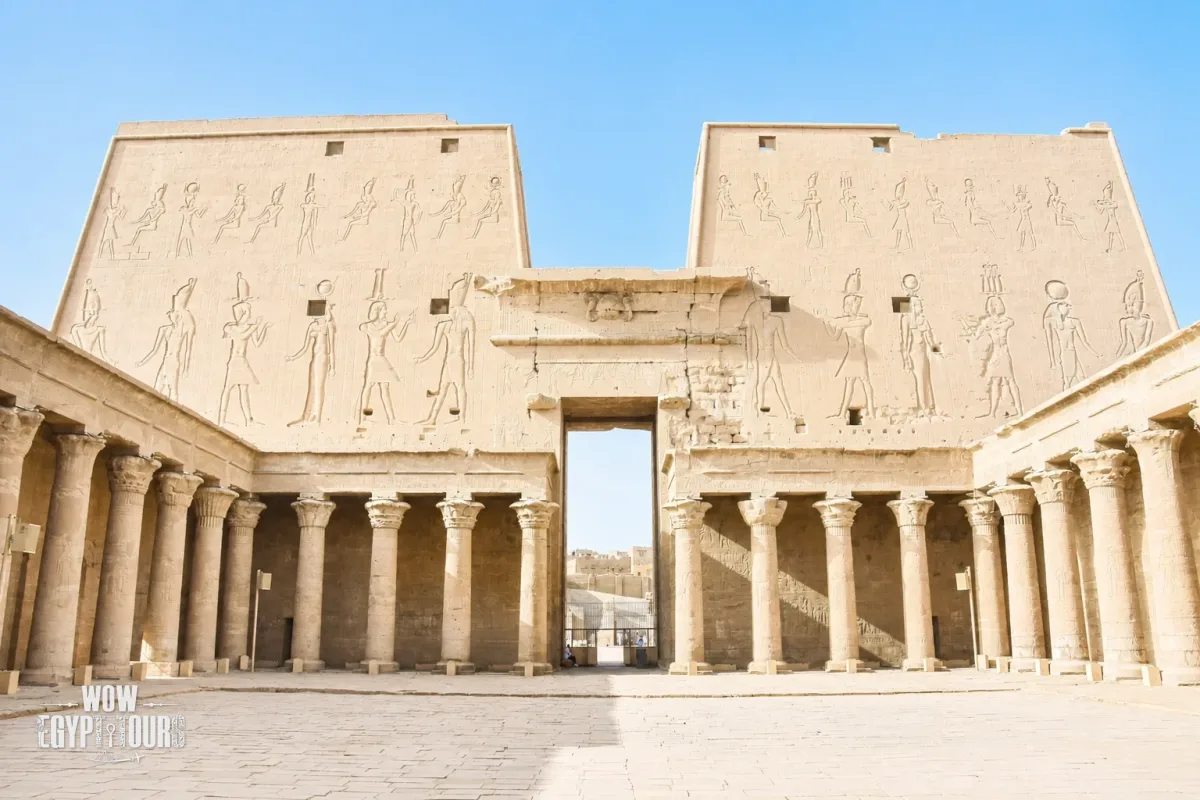
The entrance to the Temple of Horus at Edfu is through one of the most imposing and best-preserved ancient Egyptian entrance pylons in existence. The pylon stands approximately 36 meters high and 79 meters wide, making it the tallest pylon in any surviving ancient Egyptian temple, and its two towers are decorated on their outer faces with enormous carved reliefs showing Ptolemy XII in the act of smiting his enemies before the god Horus, a standard image of royal power and divine protection that appears on temple pylons throughout the history of ancient Egyptian architecture. The four deep vertical grooves cut into the pylon facade were designed to hold tall flagpoles from which colored pennants flew during religious festivals, and their presence on the facade of the Edfu pylon gives visitors a vivid impression of how the entrance to a great ancient Egyptian temple would have appeared during the great ritual celebrations of the sacred calendar.
The Outer Courtyard And Colonnade
Passing through the entrance gateway in the pylon leads into the great outer courtyard of the Temple of Horus at Edfu, a vast open space enclosed on three sides by a colonnade of 32 columns with composite floral capitals. The courtyard was the most public space in the temple complex, accessible to ordinary worshippers who would have been denied entry to the more sacred inner areas, and its scale and grandeur were designed to create an impression of overwhelming divine presence even before the inner temple was reached. On the south face of the colonnade, framing the entrance to the inner temple, stand two magnificent black granite falcon statues representing Horus in his form as the solar falcon, one of the most celebrated ancient Egyptian sculptures of the Ptolemaic period. A third granite falcon, smaller and wearing the double crown, stands at the entrance to the pronaos.
The Pronaos Or Outer Hypostyle Hall
The pronaos, or outer hypostyle hall, is the first enclosed interior space of the Temple of Horus at Edfu and one of the most architecturally magnificent ancient spaces in Egypt. Its ceiling is supported by twelve enormous columns arranged in two rows, with elaborately carved composite capitals combining lotus buds, palm fronds, and papyrus blossoms in a variety of designs. The walls of the pronaos are covered with carved relief scenes of exceptional quality showing the Ptolemaic rulers performing offerings and rituals before Horus, and the entrance wall preserves important inscriptions including the decrees of the various Ptolemaic rulers who contributed to the temple's construction. The ceiling of the pronaos bears astronomical reliefs depicting the sky goddess Nut stretched across the vault of heaven, with the solar and lunar barques and the stars of the Egyptian calendar arrayed across her body.
The Inner Hypostyle Hall
The inner hypostyle hall, accessed through the pronaos, is a narrower and more intimate space supported by twelve columns and lit by clerestory windows cut into the upper portions of its side walls. The walls of the inner hypostyle hall are decorated with scenes of particular theological significance, including the famous texts relating to the foundation and consecration of the temple, the inventory of its sacred equipment, and the long theological hymn to Horus that is one of the most extensive surviving examples of ancient Egyptian divine praise literature. On both sides of the inner hypostyle hall, small rooms open off the main axis serving specific ritual functions including a room for the preparation of sacred unguents, a library for the storage of sacred texts, and a room for the robing of the divine statue before ritual processions.
The Vestibules And Inner Sanctuary
Beyond the inner hypostyle hall, the Temple of Horus at Edfu continues through a first vestibule, a second vestibule or Hall of Offerings, and finally the innermost sanctuary of Horus, the most sacred space in the entire temple complex. The sanctuary walls are decorated with scenes showing the daily ritual programme of the Horus cult, including the opening of the sanctuary doors, the presentation of offerings to the divine statue, the clothing and anointing of the statue, and the closing of the doors at the end of the daily ritual cycle. At the center of the sanctuary stands the polished black granite naos of Nectanebo I, dating from the 30th Dynasty and predating the current Ptolemaic temple, which still occupies its original position and retains its original altar. In front of the naos stands a gilded wooden barque shrine, a replica of the sacred barque of Horus that would have been carried in procession during the great festivals of the Horus cult.
The Outer Ambulatory Corridor And The Myth Of The Winged Disk
Running completely around the exterior of the main temple building between the outer walls of the sanctuary and the inner face of the outer enclosure wall is a broad ambulatory corridor that constitutes one of the most historically significant inscribed spaces in ancient Egyptian religion. The walls of this outer corridor are covered with an almost continuous text known as the Myth of the Winged Disk or the Triumph of Horus over Seth, the most complete surviving version of the great cosmic battle narrative in which Horus defeats the evil god Seth and his followers in a series of engagements on both land and water, ultimately establishing divine order and cosmic harmony over the world. This text, running to more than one hundred columns of hieroglyphic inscription accompanied by vivid illustration scenes, is the primary ancient Egyptian source for the full narrative of the conflict between Horus and Seth and is one of the most important single religious documents in the entire corpus of ancient Egyptian sacred literature. The outer ambulatory corridor also provides access to the sacred lake and to the well within the temple precinct.
The Birth House Or Mammisi
To the south of the main temple building, within the outer enclosure wall, stands a well-preserved mammisi or birth house, a small subsidiary chapel in which the miraculous divine birth of the divine child was celebrated annually in ancient Egyptian temple religion from the New Kingdom period onwards. At Edfu, the mammisi was dedicated to the birth of Harsomtus, the divine child born to Horus and Hathor at the culmination of the Beautiful Feast of Meeting, the great annual festival during which the cult statue of Hathor from Dendera Temple traveled south by river to Edfu for a divine marriage with Horus. The birth house at Edfu is one of the most completely preserved examples of its type in Egypt, with a colonnaded exterior walkway featuring the distinctive Bes figures on its column capitals, and interior walls decorated with reliefs of the divine birth sequence that are among the finest examples of late Ptolemaic decorative carving.
Why Is The Temple Of Horus At Edfu Important?
The Temple of Horus at Edfu is important for a combination of architectural, religious, and historical reasons that make it one of the most significant ancient monuments in Egypt. Architecturally, it is the largest and most completely preserved ancient Egyptian temple in the world, the definitive surviving example of the standard ancient Egyptian temple plan at full scale, and the monument that allows modern visitors to experience the interior of a complete ancient Egyptian religious building in a way that no other surviving structure can provide. The roof intact, the pylon standing to nearly its original height, the original naos in place, the original decorative programme on virtually every wall: the Temple of Horus at Edfu is the ancient Egyptian temple as the ancient Egyptians actually built and experienced it, rather than a ruin through which such an experience must be imaginatively reconstructed.
Historically, the Edfu Temple walls preserve an extraordinary body of religious, ritual, and mythological text that is unmatched in completeness by any other single ancient Egyptian monument. The complete text of the Myth of the Winged Disk, the foundation and construction records, the detailed inventory of sacred equipment, the daily ritual texts, the astronomical ceiling records, and the theological hymns to Horus together constitute the most comprehensive surviving record of a single ancient Egyptian divine cult in existence. WOW Egypt Tours includes the Temple of Horus at Edfu as a featured stop on all Nile River Cruise itineraries, Aswan and Luxor Day Tours, Egypt Tours Packages, and Safaga Shore Excursions.
What Are Some Interesting Facts About The Temple Of Horus At Edfu?
The Most Complete Ancient Egyptian Temple In The World
The extraordinary state of preservation of the Temple of Horus at Edfu is the result of one of the most paradoxical preservation stories in the history of archaeology. The temple was not preserved by careful ancient or medieval stewardship but by the complete opposite: by the gradual burial of the entire building under many meters of sand, silt, and the accumulated debris of the medieval and modern town of Edfu, which built directly on top of the ancient ruins over many centuries until the temple was completely invisible and entirely forgotten. When Auguste Mariette excavated the buried structure between 1860 and 1868, he found the main temple building in a condition of almost miraculous completeness, with the roof intact, the original door sockets and pivots still in place, and large areas of the original painted decoration surviving on the protected interior walls. The building had been hermetically sealed by its burial and preserved in near-perfect condition for more than a thousand years.
The Festival Of The Beautiful Meeting
The most important annual festival at the Temple of Horus at Edfu was the Festival of the Beautiful Meeting, known in ancient Egyptian as the Beautiful Feast of the Meeting, which celebrated the annual divine marriage between Horus of Edfu and Hathor of Dendera. The festival began each year when the cult statue of Hathor, housed in her great temple at Dendera approximately 225 kilometers to the north, was placed in the sacred barque and carried in procession to the Nile, where it was loaded onto a ritual vessel and sailed south to Edfu. The journey from Dendera to Edfu took approximately two weeks, with the barque stopping at sacred sites along the way. Upon the arrival of Hathor at Edfu, a great ceremonial reunion took place at the Temple of Horus, with the two divine statues spending fourteen days together in the company of the other as the mythological divine marriage was enacted through elaborate ritual. The walls of the outer ambulatory corridor at Edfu preserve detailed reliefs depicting the arrival of Hathor's barque and the ceremonies of the Festival of the Beautiful Meeting, providing one of the most complete visual records of an ancient Egyptian festival programme in existence.
The Sacred Black Granite Naos
The polished black granite naos that stands in the innermost sanctuary of the Temple of Horus at Edfu is one of the finest surviving examples of ancient Egyptian lapidary craftsmanship and one of the most historically significant objects in the temple. Dating from the reign of Nectanebo I of the 30th Dynasty, approximately 360 BCE, the naos predates the current Ptolemaic temple by more than a century and represents the sacred cabinet from the earlier temple on the same site that was carefully preserved and incorporated into the new building as a living link with the ancient sacred tradition of Edfu. The naos stands more than three meters high and is carved from a single block of black granite, polished to a mirror finish on its exterior surfaces and inscribed with dedicatory inscriptions of Nectanebo I. Its presence in the Ptolemaic temple of Edfu, still standing in its original position in the innermost sanctuary after more than 2,300 years, is a powerful testimony to the continuity of sacred tradition that was one of the defining characteristics of ancient Egyptian religious culture.
What Is So Special About The Temple Of Horus At Edfu?
The Experience Of A Complete Ancient Temple
What makes the Temple of Horus at Edfu uniquely special among all the ancient temples of Egypt is the quality of architectural completeness that it alone among all surviving ancient Egyptian temples can provide. At Karnak Temple, the visitor moves through an accumulation of buildings from different periods, some standing to full height, others reduced to foundation level, the original spatial sequence interrupted by centuries of additions and modifications. At the great temples of Luxor, Abydos, and Dendera, significant portions of the original structure are missing or ruined. At the Temple of Horus at Edfu, the visitor enters a complete ancient Egyptian temple from the bottom to the top, walking through the full architectural sequence from the forecourt to the innermost sanctuary with the original roof overhead, the original walls on all sides, and the original decoration on virtually every surface. The experience of moving through the progressively narrowing and darkening sequence of spaces from the bright outer courtyard through the hypostyle halls to the dimly lit inner vestibules and finally to the near-total darkness of the innermost sanctuary, with the massive stone walls pressing in on all sides and the carved reliefs covering every available surface, is the closest any modern visitor can come to actually experiencing an ancient Egyptian sacred space as it was designed to be experienced.
The Falcon God In His Own House
The Temple of Horus at Edfu gives the visitor a uniquely direct and powerful encounter with the divine presence of Horus himself, represented not only in the carved images on the temple walls but in the two monumental black granite falcon statues that guard the entrance to the pronaos and in the extraordinary polished naos in the innermost sanctuary that once contained the golden statue of the god. Standing between the two great falcons at the entrance to the hypostyle hall, looking through the progressive sequence of doorways to the dark sanctuary beyond, visitors can understand in a visceral and immediate way what the ancient Egyptians meant when they said that their gods literally inhabited their temples. The Temple of Horus at Edfu is one of the very few ancient monuments anywhere in the world that communicates the presence of its divine resident with sufficient completeness and architectural integrity to produce a genuinely numinous experience.
Edfu Temple Through The Ages: From Ancient Egypt To The Present
The history of the Temple of Horus at Edfu after its completion around 57 BCE is a story of gradual transformation from a functioning divine cult institution to a buried archaeological monument and ultimately to one of the most visited ancient sites in Egypt. During the Roman Period, the temple continued to function as an active religious institution, with Roman emperors adding their names to the decoration in the traditional Egyptian style and the daily ritual programme of the Horus cult continuing to be performed by its priesthood. A Roman birth house was added to the south of the main temple during this period, and the town of Apollonopolis Magna continued to thrive as one of the most important religious and administrative centers of Upper Egypt.
During the early Christian era, the temple was closed and converted to Christian use, with crosses carved on many of the ancient relief figures to neutralize their pagan power and a Coptic settlement established within the outer enclosure. The gradual accumulation of sand and debris from the annual Nile flood over the subsequent centuries, combined with the growth of the medieval town of Edfu directly over the ancient structure, resulted in the progressive burial of the temple under many meters of deposit until the great entrance pylon was the only portion of the building visible above ground. The definitive excavation by Auguste Mariette between 1860 and 1868 transformed the Temple of Horus at Edfu from a largely buried ruin into the most completely preserved ancient Egyptian temple in the world, and established it immediately as one of the supreme destinations of Egyptian cultural tourism. Today the Edfu Temple receives hundreds of thousands of visitors per year from every country in the world and continues to serve as the definitive example of the ancient Egyptian temple in its complete form for visitors and scholars alike.
Edfu Temple UNESCO World Heritage Site
The Temple of Horus at Edfu is part of the broader landscape of Upper Egyptian Nile Valley heritage recognized by UNESCO as among the most outstanding cultural heritage concentrations in the world. The Nile River Valley between Luxor and Aswan, encompassing the great Ptolemaic temples at Edfu, Kom Ombo, and Esna together with the monuments of the ancient cities of Luxor and Aswan, represents one of the most concentrated assemblages of ancient monumental architecture in the world. The Edfu Temple is recognized internationally as the finest surviving example of ancient Egyptian temple architecture and as one of the most important individual ancient monuments in the entire world heritage zone of the Upper Egyptian Nile Valley.
Best Time To Visit The Temple Of Horus At Edfu
The best time to visit the Temple of Horus at Edfu is during the cooler months from October through April, when temperatures in Upper Egypt are moderate and both the outdoor approach to the temple and the enclosed interior spaces are comfortable for extended exploration. The summer months from May to September are intensely hot in this part of Upper Egypt, but the largely enclosed interior of the temple, with its thick stone walls and largely intact roof, is significantly cooler than the outdoor temperature, making the Edfu Temple one of the more manageable summer visits among the major ancient sites of Upper Egypt. If visiting in summer, plan to arrive at the temple before 9:00 AM when the exterior approach and the outer courtyard are still in shade. WOW Egypt Tours plans all day tour and Nile cruise visits to the Temple of Horus at Edfu at the optimal time of day for the season and for the specific itinerary.
Edfu Temple Opening Hours
The Temple of Horus at Edfu is open to visitors every day of the week, including public holidays. The temple opens at 6:00 AM and closes at 5:00 PM from October to April, and from 6:00 AM to 6:00 PM from May to September. Visitors who prefer the most peaceful and uncrowded experience should arrive as early as possible in the morning, before the main Nile cruise groups arrive from their ships, typically between 9:00 AM and 11:00 AM.
Edfu Temple Entrance Fees
Adults: EGP 550
Students: EGP 275
Keep your ticket safe throughout your visit. Entrance fees to the Temple of Horus at Edfu are included in all Edfu Temple Tours, Aswan Day Tours, Luxor Day Tours, Egypt Tours Packages, and Safaga Shore Excursions booked through WOW Egypt Tours.
How To Get To The Temple Of Horus At Edfu
Edfu is located approximately 105 kilometers south of Luxor and 65 kilometers north of Aswan on the west bank of the Nile. From Aswan, the Temple of Horus at Edfu is reached by private car or minibus along the main Nile Valley highway in approximately one hour to one hour and fifteen minutes. From Luxor, the journey south to Edfu by private vehicle takes approximately one and a half to two hours, often combined with a stop at the Khnum Temple at Esna approximately 55 kilometers south of Luxor along the way. Nile cruise ships traveling between Luxor and Aswan dock at the Edfu waterfront, from which a short taxi or horse-drawn carriage ride takes visitors to the temple entrance. From Safaga Port on the Red Sea coast, the Temple of Horus at Edfu is reached via the Eastern Desert road in approximately 2.5 to 3 hours by private vehicle.
All Aswan Day Tours, Luxor Day Tours, and Safaga Shore Excursions with WOW Egypt Tours include private air-conditioned transportation directly to and from the Temple of Horus at Edfu. All Nile River Cruise itineraries include a guided shore excursion to the temple as a standard stop.
How Long To Spend At The Temple Of Horus At Edfu
Most visitors spend between one and two hours at the Temple of Horus at Edfu, which is sufficient time to walk through the complete architectural sequence from the entrance pylon to the inner sanctuary, examine the great granite naos and the barque shrine, view the two black granite falcon statues, read the major inscriptions in the pronaos and the Myth of the Winged Disk in the outer ambulatory corridor, and visit the birth house. Visitors with a particular interest in the theological content of the decoration, the architectural history of the building, or the Festival of the Beautiful Meeting reliefs may wish to allow two to two and a half hours. The Temple of Horus at Edfu is ideally combined on the same day with the Temple of Kom Ombo to the south and optionally the Khnum Temple at Esna to the north for a comprehensive experience of the great Ptolemaic temples of the Upper Nile Valley.
Tips For Visiting The Temple Of Horus At Edfu
Arrive early in the morning before the main Nile cruise groups arrive to experience the temple in relative calm and quiet. Take time to walk the complete outer ambulatory corridor around the exterior of the main temple building, which contains the Myth of the Winged Disk inscription and some of the finest relief carving at the site but is frequently overlooked by visitors who focus exclusively on the main internal spaces. Do not miss the birth house to the south of the main temple, which is one of the best-preserved examples of its type in Egypt. Stand between the two great granite falcon statues at the entrance to the pronaos and look through the sequence of doorways to the distant sanctuary to appreciate the theatrical spatial depth of the temple's interior design. A licensed Egyptologist guide from WOW Egypt Tours is essential: the theological content of the Edfu Temple is extraordinarily rich and requires expert explanation to be fully appreciated. Do not touch any carved or painted surfaces anywhere in the temple.
What To Wear At The Temple Of Horus At Edfu
The Temple of Horus at Edfu combines a large outdoor courtyard and the open approach from the town entrance with substantially enclosed interior spaces under a largely intact roof. Lightweight, breathable clothing covering the shoulders and knees is recommended for both comfort and respect. A wide-brimmed hat and sunscreen are necessary for the outdoor courtyard and the approach to the temple. Comfortable, closed-toe walking shoes are essential for the uneven stone floors throughout the temple. Visitors entering the inner hypostyle hall and the sanctuary rooms should be prepared for a transition from relatively bright outer spaces to increasingly dim interior lighting as they move deeper into the temple, and eyes should be given time to adjust before examining the carved wall reliefs.
Photography At The Temple Of Horus At Edfu
The Temple of Horus at Edfu is one of the most rewarding photography destinations in Upper Egypt, offering the unique opportunity to photograph the interior of a complete ancient Egyptian temple with the roof intact, creating a combination of natural light through doorways and clerestory windows with deep shadow on the carved relief walls that produces photographs of extraordinary drama and depth. Photography with a standard camera or smartphone is permitted throughout most areas of the temple. Flash photography is strictly prohibited near all carved and painted surfaces. For interior photography in the hypostyle halls and sanctuary rooms, a camera with good low-light performance is essential. The most dramatic exterior photographs are taken from the outer courtyard looking back toward the entrance pylon, or from outside the entrance looking through the pylon gateway to the falcon statues beyond. Professional photography or filming requires a separate permit from Egypt's Ministry of Tourism and Antiquities.
Edfu Temple Tours
Single Attraction Visit: Edfu Temple Tour
This tour covers the Temple of Horus at Edfu as a standalone visit. It is suitable for travelers with a particular interest in Ptolemaic temple architecture, the mythology and cult of Horus, or the experience of a complete ancient Egyptian sacred space, as well as Nile cruise passengers who wish to spend extended time at the temple beyond the standard shore excursion programme.
What Is Covered
Full guided visit of the Temple of Horus at Edfu including the entrance pylon, the outer courtyard with the granite falcon statues, the pronaos, the inner hypostyle hall, the vestibules, the innermost sanctuary with the black granite naos and the gilded barque shrine, the outer ambulatory corridor with the Myth of the Winged Disk, and the birth house.
Duration
1.5 to 2 hours inside the temple complex.
Includes
Private transportation, private licensed Egyptologist guide, and entrance fees. Available for morning and afternoon departures. Morning visits are strongly recommended to avoid the crowds from Nile cruise ships.
Day Tour To Edfu Temple From Luxor Combined With Esna And Kom Ombo
This full-day tour from Luxor travels south along the Nile Valley road to visit three of the most impressive Ptolemaic temples in Egypt in a single day: the Khnum Temple at Esna, the Temple of Horus at Edfu, and the Temple of Kom Ombo. It is the most comprehensive single-day temple experience available on the Upper Egyptian Nile.
What Is Covered
The Khnum Temple at Esna, approximately 55 kilometers south of Luxor, with a guided visit of the remarkably preserved hypostyle hall and its astronomical ceiling. The Temple of Horus at Edfu with a full guided visit of the complete temple programme. The Temple of Sobek and Haroeris at Kom Ombo with a guided visit of the unique double temple, the medical instruments relief, the Nilometer, and the Crocodile Museum.
Duration
Full day from Luxor, approximately 1 to 2 hours at each temple, with travel time between sites included in the day programme.
Includes
Private air-conditioned transportation from Luxor, private licensed Egyptologist guide, and entrance fees to all three temples. Available for early morning departures to maximize time at each site.
Day Tour To Edfu Temple And Kom Ombo From Aswan
This full-day tour from Aswan travels north to visit the two finest Ptolemaic temples on the Upper Nile in a single comprehensive day excursion.
What Is Covered
The Temple of Sobek and Haroeris at Kom Ombo, approximately 45 kilometers north of Aswan, with a guided visit of the double temple, the Crocodile Museum, and the Nilometer. The Temple of Horus at Edfu with a full guided visit of the complete temple programme from the entrance pylon to the inner sanctuary.
Duration
Full day from Aswan, approximately 1 to 1.5 hours at Kom Ombo and 1.5 to 2 hours at Edfu.
Includes
Private air-conditioned transportation from Aswan, private licensed Egyptologist guide, and entrance fees to both temples. Available for morning departures.
Day Tour To Edfu Temple From Aswan
This half-day tour visits the Temple of Horus at Edfu as a dedicated excursion from Aswan, allowing travelers staying in Aswan to experience the most completely preserved ancient Egyptian temple in the world without the longer journey required from Luxor.
What Is Covered
Full guided visit of the Temple of Horus at Edfu including the complete architectural programme from the entrance pylon to the innermost sanctuary, the two black granite falcon statues, the sacred naos, the gilded barque shrine, the Myth of the Winged Disk in the outer ambulatory corridor, and the birth house.
Duration
Half day from Aswan, approximately 1.5 to 2 hours at the temple plus approximately 1 hour each way by private vehicle.
Includes
Private air-conditioned transportation from Aswan, private licensed Egyptologist guide, and entrance fees. Available for morning departures.
Safaga Shore Excursions Combined With The Temple Of Horus At Edfu
Safaga Port is located on the Red Sea coast, approximately 230 kilometers from Edfu via the Eastern Desert road. Due to this distance, a visit to the Temple of Horus at Edfu requires a full day of travel from Safaga and back, leaving limited time at the temple itself when combined with other sites. WOW Egypt Tours therefore strongly recommends the overnight Safaga Shore Excursion programme to ensure a comfortable and complete visit to the Edfu Temple along with the other great Upper Nile monuments.
Overnight Safaga Shore Excursion Via Luxor To Edfu And Kom Ombo
Day 1: Depart Safaga Port by private air-conditioned vehicle. Travel to Luxor via the Eastern Desert highway, approximately 3 hours. Full guided visit of the major Luxor West Bank sites: Valley of the Kings, Temple of Hatshepsut, and Colossi of Memnon. Evening guided visit of Luxor Temple and optional Karnak Sound and Light Show. Overnight in Luxor at a selected hotel.
Day 2: Morning guided visit of Karnak Temple. Travel south from Luxor to the Temple of Horus at Edfu, approximately 1.5 to 2 hours. Full guided visit of the Edfu Temple including the entrance pylon, the outer courtyard with the granite falcon statues, the pronaos, the inner hypostyle hall, the sanctuary with the naos and barque shrine, and the outer ambulatory corridor with the Myth of the Winged Disk. Optional continuation south to the Temple of Kom Ombo, approximately 65 kilometers further south, subject to available time. Return to Safaga Port via the Eastern Desert road. Return to ship.
Includes
Private air-conditioned vehicle throughout, private licensed Egyptologist guide, one night accommodation in Luxor, entrance fees to all included sites, and return transfer to the ship. All overnight Safaga Shore Excursions are coordinated with each ship's schedule to confirm departure and return timings in advance.
Dahabiya Nile River Cruise
A Dahabiya Nile River Cruise is a small-vessel sailing experience on the Nile between Luxor and Aswan aboard a traditional wooden dahabiya. WOW Egypt Tours operates dahabiya cruises with private cabins, all meals, a private licensed Egyptologist guide on board, and guided shore excursions at every stop. The Temple of Horus at Edfu is a featured stop on all Dahabiya itineraries in both directions.
4 Days 3 Nights Dahabiya Nile River Cruise From Aswan To Luxor
Route: Aswan to Luxor, sailing north.
Itinerary
Day 1: Embarkation in Aswan. Visit to Philae Temple and the Unfinished Obelisk. Sail north to Kom Ombo. Guided visit to Kom Ombo Temple and Crocodile Museum. Continue to Gebel el Silsila. Overnight on board.
Day 2: Guided visit to Gebel el Silsila. Sail to the Village of Basaw. Guided visit to Village of Basaw. Continue to Edfu. Guided visit to the Temple of Horus at Edfu. Overnight on board.
Day 3: Sail to El Kab. Guided visit to El Kab Tombs. Sail to El Hagaz Island. Swimming stop. Overnight on board.
Day 4: Sail to Esna. Visit Khnum Temple at Esna. Disembarkation in Esna. Transfer to Luxor, approximately 55 kilometers (35 miles).
Includes
Private cabin, all meals on board, private licensed Egyptologist guide, entrance fees to all temple visits including the Temple of Horus at Edfu, and private transfers.
5 Days 4 Nights Dahabiya Nile River Cruise From Luxor To Aswan
Route: Luxor to Aswan, sailing south.
Itinerary
Day 1: Embarkation in Luxor. Transfer to Esna, approximately 55 kilometers (35 miles). Visit Khnum Temple at Esna. Sail to El Hagaz Island. Overnight on board.
Day 2: Sail to El Kab. Guided visit to El Kab Tombs. Continue to Edfu. Guided visit to the Temple of Horus at Edfu. Sail to the Village of Basaw. Guided visit to Village of Basaw. Overnight on board.
Day 3: Sail to Gebel el Silsila. Guided visit to Gebel el Silsila. Sail south to Kom Ombo. Guided visit to Kom Ombo Temple and Crocodile Museum. Sail to Daraw Village. Overnight on board.
Day 4: Guided visit to Daraw Village. Sail to Herbiab Island. Swimming stop. Philae Sound and Light Show. Overnight on board.
Day 5: Optional Abu Simbel visit available by air or road. Guided visits to Philae Temple, the High Dam, and the Unfinished Obelisk. Disembarkation in Aswan.
Includes
Private cabin, all meals on board, private licensed Egyptologist guide, entrance fees to all temple visits including the Temple of Horus at Edfu, and private transfers.
8 Days 7 Nights Dahabiya Nile River Cruise Round Trip From Luxor (Via Aswan)
Route: Luxor and Aswan, sailing north and south.
Itinerary
Day 1: Embarkation in Luxor. Transfer to Esna, approximately 55 kilometers (35 miles). Visit Khnum Temple at Esna. Sail to El Hagaz Island. Overnight on board.
Day 2: Sail to El Kab. Continue to Edfu. Guided visit to the Temple of Horus at Edfu. Sail to the Village of Basaw. Guided visit to Village of Basaw. Overnight on board.
Day 3: Sail to Gebel el Silsila. Sail south to Kom Ombo. Guided visit to Kom Ombo Temple and Crocodile Museum. Sail to Daraw Village. Overnight on board.
Day 4: Guided visit to Daraw Village. Sail to Herbiab Island. Swimming stop. Philae Sound and Light Show. Overnight on board.
Day 5: Optional Abu Simbel visit available by air or road. Guided visits to Philae Temple, the High Dam, and the Unfinished Obelisk. Sail north to Kom Ombo. Continue to Gebel el Silsila. Overnight on board.
Day 6: Guided visit to Gebel el Silsila. Sail to the Village of Basaw. Continue to Edfu. Guided visit to the Temple of Horus at Edfu. Overnight on board.
Day 7: Sail to El Kab. Guided visit to El Kab Tombs. Sail to El Hagaz Island. Swimming stop. Overnight on board.
Day 8: Disembarkation in Esna. Transfer to Luxor, approximately 55 kilometers (35 miles).
Includes
Private cabin, all meals on board, private licensed Egyptologist guide, entrance fees to all temple visits including the Temple of Horus at Edfu, and private transfers.
8 Days 7 Nights Dahabiya Nile River Cruise Round Trip From Aswan (Via Luxor)
Route: Luxor and Aswan, sailing north and south.
Itinerary
Day 1: Embarkation in Aswan. Visit to Philae Temple and the Unfinished Obelisk. Sail north to Kom Ombo. Guided visit to Kom Ombo Temple and Crocodile Museum. Continue to Gebel el Silsila. Overnight on board.
Day 2: Guided visit to Gebel el Silsila. Sail to the Village of Basaw. Continue to Edfu. Guided visit to the Temple of Horus at Edfu. Overnight on board.
Day 3: Sail to El Kab. Guided visit to El Kab Tombs. Sail to El Hagaz Island. Swimming stop. Overnight on board.
Day 4: Sail to Esna. Visit Khnum Temple at Esna. Sail to El Hagaz Island. Overnight on board.
Day 5: Sail to El Kab. Continue to Edfu. Guided visit to the Temple of Horus at Edfu. Sail to the Village of Basaw. Guided visit to Village of Basaw. Overnight on board.
Day 6: Sail to Gebel el Silsila. Sail south to Kom Ombo. Guided visit to Kom Ombo Temple and Crocodile Museum. Sail to Daraw Village. Overnight on board.
Day 7: Guided visit to Daraw Village. Sail to Herbiab Island. Swimming stop. Philae Sound and Light Show. Overnight on board.
Day 8: Disembarkation in Aswan.
Includes
Private cabin, all meals on board, private licensed Egyptologist guide, entrance fees to all temple visits including the Temple of Horus at Edfu, and private transfers.
Luxor And Aswan Nile River Cruise
The Luxor and Aswan Nile River Cruise is a standard Nile cruise product operated aboard a full-size cruise ship between Luxor and Aswan. WOW Egypt Tours operates this cruise in both directions with private licensed Egyptologist guides, all meals included, private cabins, and guided shore excursions at every port of call. The Temple of Horus at Edfu is a featured guided stop on all Luxor and Aswan Nile River Cruise itineraries in both directions.
4 Days 3 Nights Luxor And Aswan Nile River Cruise From Aswan To Luxor
Route: Aswan to Luxor, sailing north.
Itinerary
Day 1: Embarkation in Aswan. Guided visits to Philae Temple, the High Dam, and the Unfinished Obelisk. Overnight on board in Aswan.
Day 2: Sail north to Kom Ombo. Guided visit to Kom Ombo Temple and Crocodile Museum. Continue to Edfu. Overnight on board.
Day 3: Guided visit to the Temple of Horus at Edfu. Continue north toward Luxor. Guided visit to Luxor Temple and Karnak Temple. Overnight on board in Luxor.
Day 4: Optional Sunrise Hot Air Balloon available. Guided visits to Valley of the Kings, Queen Hatshepsut Temple, and Colossi of Memnon. Disembarkation in Luxor.
Includes
Private cabin, all meals on board, private licensed Egyptologist guide, entrance fees to all temple visits including the Temple of Horus at Edfu, and private transfers.
5 Days 4 Nights Luxor And Aswan Nile River Cruise From Luxor To Aswan
Route: Luxor to Aswan, sailing south.
Itinerary
Day 1: Embarkation in Luxor. Guided visits to Luxor Temple and Karnak Temple. Overnight on board in Luxor.
Day 2: Optional Sunrise Hot Air Balloon available. Guided visits to Valley of the Kings, Queen Hatshepsut Temple, and Colossi of Memnon. Pass through the Esna locks. Sail south to Edfu. Overnight on board.
Day 3: Guided visit to the Temple of Horus at Edfu. Continue to Kom Ombo. Guided visit to Kom Ombo Temple and Crocodile Museum. Overnight on board.
Day 4: Continue south toward Aswan. Guided visits to Philae Temple, the High Dam, and the Unfinished Obelisk. Overnight on board in Aswan.
Day 5: Optional Abu Simbel visit available by air or road. Disembarkation in Aswan.
Includes
Private cabin, all meals on board, private licensed Egyptologist guide, entrance fees to all temple visits including the Temple of Horus at Edfu, and private transfers.
8 Days 7 Nights Luxor And Aswan Nile River Cruise Round Trip From Luxor (Via Aswan)
Route: Luxor and Aswan, sailing north and south.
Itinerary
Day 1: Embarkation in Luxor. Guided visits to Luxor Temple and Karnak Temple. Overnight on board in Luxor.
Day 2: Guided visits to Luxor Museum. Pass through the Esna locks. Sail south to Edfu. Overnight on board.
Day 3: Guided visit to the Temple of Horus at Edfu. Continue to Kom Ombo. Guided visit to Kom Ombo Temple and Crocodile Museum. Overnight on board.
Day 4: Continue south toward Aswan. Guided visits to Philae Temple, the High Dam, and the Unfinished Obelisk. Overnight on board in Aswan.
Day 5: Abu Simbel visit available by road. Sound and Light Show at Philae Temple. Overnight on board in Aswan.
Day 6: Guided visits to Nubian Village. Sail north to Kom Ombo. Guided visit to Kom Ombo Temple. Continue north. Overnight on board.
Day 7: Guided visits to Valley of the Kings, Queen Hatshepsut Temple, and Colossi of Memnon. Pass through the Esna locks. Sail south to Edfu. Overnight on board.
Day 8: Optional Sunrise Hot Air Balloon available. Disembarkation in Luxor.
Includes
Private cabin, all meals on board, private licensed Egyptologist guide, entrance fees to all temple visits including the Temple of Horus at Edfu, and private transfers.
8 Days 7 Nights Luxor And Aswan Nile River Cruise Round Trip From Aswan (Via Luxor)
Route: Luxor and Aswan, sailing north and south.
Itinerary
Day 1: Embarkation in Aswan. Guided visits to Philae Temple, the High Dam, and the Unfinished Obelisk. Overnight on board in Aswan.
Day 2: Sail north to Kom Ombo. Guided visit to Nubian Village and Kom Ombo Temple and Crocodile Museum. Continue to Edfu. Overnight on board.
Day 3: Continue north toward Luxor. Guided visit to Luxor Museum and Karnak Sound and Light Show. Overnight on board in Luxor.
Day 4: Guided visits to Luxor Temple and Karnak Temple. Overnight on board in Luxor.
Day 5: Optional Sunrise Hot Air Balloon available. Guided visits to Valley of the Kings, Queen Hatshepsut Temple, and Colossi of Memnon. Pass through the Esna locks. Sail south to Edfu. Overnight on board.
Day 6: Guided visit to the Temple of Horus at Edfu. Continue to Kom Ombo. Guided visit to Kom Ombo Temple. Overnight on board.
Day 7: Sound and Light Show at Philae Temple. Overnight on board in Aswan.
Day 8: Abu Simbel visit available by road. Disembarkation in Aswan.
Includes
Private cabin, all meals on board, private licensed Egyptologist guide, entrance fees to all temple visits including the Temple of Horus at Edfu, and private transfers.
Combine The Temple Of Horus At Edfu With Your Egypt Tours Package
The Temple of Horus at Edfu is included as a featured stop across the full range of WOW Egypt Tours travel products. Browse the options below to find the Egypt experience that is right for you.
Egypt Tour Packages: Multi-day guided Egypt tours organized by duration, including 2 Days Egypt Packages, 3 Days Egypt Packages, 4 Days Egypt Packages, 5 Days Egypt Packages, 6 Days Egypt Packages, 7 Days Egypt Packages, 8 Days Egypt Packages, 10 Days Egypt Packages, and longer itineraries. All packages include private air-conditioned transportation, private licensed Egyptologist guide, accommodations, entrance fees to all included sites including the Temple of Horus at Edfu, and private transfers throughout Egypt.
Egypt Travel Packages: Themed Egypt travel packages designed around specific travel styles and interests, including Egypt Honeymoon Travel Packages, Egypt Budget Travel Packages, Egypt Family Travel Packages, Egypt Luxury Travel Packages, Egypt Adventure Travel Packages, Egypt Cultural Travel Packages, and Egypt Christmas and New Year Travel Packages. All packages include private air-conditioned transportation, private licensed Egyptologist guide, accommodations, meals, entrance fees to all included sites, and private transfers.
Egypt Nile Cruise Packages: Complete Egypt travel packages combining Cairo sightseeing with a fully guided Nile cruise between Luxor and Aswan, available as Cairo and Nile Cruise Packages, Egypt and Nile Cruise Packages, and Nile Cruise and Red Sea Packages. All packages include private cabin on board, all meals, private licensed Egyptologist guide, entrance fees to all temple visits including the Temple of Horus at Edfu, and private transfers.
Nile River Cruises: All WOW Egypt Tours Nile cruise options between Luxor and Aswan, available across four ship categories — Standard, Deluxe, Ultra Deluxe, and Luxury — as well as private Dahabiya sailing vessels. The Temple of Horus at Edfu is a featured stop on all Nile River Cruise itineraries in both directions. All cruises include private cabin on board, all meals, private licensed Egyptologist guide, entrance fees to all temple visits, and private transfers.
Luxor Aswan Nile Cruises: The classic Upper Egypt Nile cruise route between Luxor and Aswan, available in both directions and in durations of 4 Days 3 Nights, 5 Days 4 Nights, and 8 Days 7 Nights round trip. The Temple of Horus at Edfu is a guided stop on all itineraries. All cruises include private cabin on board, all meals, private licensed Egyptologist guide, entrance fees to all sites, and private transfers.
Standard Nile Cruises: Comfortable standard-category cruise ships sailing between Luxor and Aswan, available in 4 Days 3 Nights, 5 Days 4 Nights, and 8 Days 7 Nights itineraries in both directions. Includes standard cabin on board, all meals, private licensed Egyptologist guide, entrance fees to all temple visits including Edfu Temple, and private transfers.
Deluxe Nile Cruises: Deluxe-category cruise ships with enhanced cabin comfort and upgraded dining, sailing between Luxor and Aswan in 4 Days 3 Nights, 5 Days 4 Nights, and 8 Days 7 Nights itineraries in both directions. Includes deluxe cabin on board, all meals, private licensed Egyptologist guide, entrance fees to all temple visits, and private transfers.
Ultra Deluxe Nile Cruises: Ultra deluxe-category cruise ships offering superior cabins, premium dining, and an elevated onboard experience, sailing between Luxor and Aswan in 4 Days 3 Nights, 5 Days 4 Nights, and 8 Days 7 Nights itineraries in both directions. Includes ultra deluxe cabin on board, all meals, private licensed Egyptologist guide, entrance fees to all temple visits, and private transfers.
Luxury Nile Cruises: Luxury-category cruise ships with the finest cabins, exceptional cuisine, and premium onboard facilities, sailing between Luxor and Aswan in 4 Days 3 Nights, 5 Days 4 Nights, and 8 Days 7 Nights itineraries in both directions. Includes luxury cabin on board, all meals, private licensed Egyptologist guide, entrance fees to all temple visits, and private transfers.
Dahabiya Nile Cruises: Private small-vessel sailing experience aboard a traditional wooden dahabiya between Luxor and Aswan, available in four itineraries: 4 Days 3 Nights Dahabiya From Aswan To Luxor, 5 Days 4 Nights Dahabiya From Luxor To Aswan, 8 Days 7 Nights Dahabiya Round Trip From Luxor via Aswan, and 8 Days 7 Nights Dahabiya Round Trip From Aswan via Luxor. Includes private cabin on board, all meals, private licensed Egyptologist guide, entrance fees to all temple visits including the Temple of Horus at Edfu, and private transfers.
Luxor Tours: Day tours from Luxor covering the major sites of Upper Egypt, including full-day tours from Luxor to the Temple of Horus at Edfu combined with the Temple of Kom Ombo and the Khnum Temple at Esna. All tours include private air-conditioned transportation, private licensed Egyptologist guide, entrance fees to all included sites, and private transfers.
Nearby Attractions To The Temple Of Horus At Edfu
The Temple of Horus at Edfu sits at a central point on the Upper Egyptian Nile between Luxor and Aswan, within easy reach of a remarkable concentration of ancient monuments in both directions. Approximately 65 kilometers to the south, the Temple of Sobek and Haroeris at Kom Ombo is the most dramatically situated Ptolemaic temple on the Nile, perched on a promontory directly above the river and celebrated for its unique double-temple design, its Crocodile Museum, and the ancient medical instruments relief in its outer ambulatory corridor. Approximately 45 kilometers south of Kom Ombo, the city of Aswan offers Philae Temple, the Unfinished Obelisk, the High Dam and Lake Nasser, the Nubian Museum, and the granite quarry landscapes of the Aswan area.
Between Edfu and Kom Ombo, the ancient sandstone quarries of Gebel el-Silsila are one of the most atmospheric and least visited ancient sites on the Nile, with rock-cut shrines, stele, and the great quarry faces where the stone for many of Egypt's most celebrated temples was cut directly from the riverbank cliffs. Approximately 50 kilometers north of Edfu, the ancient rock tombs and enclosure walls of El Kab preserve some of the earliest decorated private tombs in Egypt and one of the finest surviving examples of an ancient Egyptian town enclosure wall. Further north, the Khnum Temple at Esna is one of the most beautifully preserved Ptolemaic and Roman temples in the Nile Valley, celebrated for its extraordinary astronomical ceiling and its remarkably complete hypostyle hall still partly embedded in the modern town of Esna. The ancient cities of Luxor, approximately 105 kilometers to the north, represent the culminating heritage destination of the Upper Egyptian Nile Valley itinerary. All these sites are accessible through the Nile cruise itineraries, day tours, Egypt Tours Packages, and Safaga Shore Excursions offered by WOW Egypt Tours.
Frequently Asked Questions About The Temple Of Horus At Edfu
What is the Temple of Horus at Edfu?
The Temple of Horus at Edfu, also known as the Edfu Temple, is the largest and most completely preserved ancient Egyptian temple in the world, built by the Ptolemaic rulers of Egypt between 237 BCE and 57 BCE and dedicated to the falcon god Horus. It is a featured stop on all Nile River Cruise itineraries, Aswan and Luxor Day Tours, Egypt Tours Packages, and Safaga Shore Excursions offered by WOW Egypt Tours.
Why is the Temple of Horus at Edfu the most complete ancient Egyptian temple?
The extraordinary state of preservation of the Edfu Temple is the result of its gradual burial under many meters of sand and debris over the centuries following its closure, which preserved the main building including the roof in near-perfect condition. When archaeologist Auguste Mariette excavated the buried structure between 1860 and 1868, he found the building with its roof largely intact, its original door hardware in place, and its complete decoration surviving on virtually every wall surface.
Who was Horus and why was he worshipped at Edfu?
Horus was the falcon-headed sky god, son of Osiris and Isis, who avenged the murder of his father Osiris by the evil god Seth and became the divine embodiment of legitimate royal power. Every living pharaoh was identified as Horus on the throne of the living. Edfu was one of the oldest and most important centers of the Horus cult in Egypt, traditionally identified as the site of the great cosmic battle between Horus and Seth, giving it supreme theological significance as the place where divine order was established over the world.
Who built the Temple of Horus at Edfu?
The Edfu Temple was built by the Ptolemaic rulers of Egypt over a period of approximately 180 years. Construction began under Ptolemy III Euergetes I on the 23rd of August 237 BCE and was completed by Ptolemy XII Auletes around 57 BCE, with contributions from seven successive Ptolemaic rulers in between.
What is the black granite naos at Edfu Temple?
The naos is the innermost sacred cabinet that once contained the golden cult statue of Horus. The naos at Edfu is a polished black granite cabinet dating from the reign of Nectanebo I of the 30th Dynasty, approximately 360 BCE, predating the current Ptolemaic temple. Standing more than three meters high and inscribed with dedicatory texts of Nectanebo I, it still stands in its original position in the innermost sanctuary of the temple and is one of the finest surviving examples of ancient Egyptian lapidary craftsmanship.
What is the Myth of the Winged Disk?
The Myth of the Winged Disk is the most complete surviving version of the great cosmic battle narrative between Horus and Seth, inscribed in more than one hundred columns of hieroglyphic text on the walls of the outer ambulatory corridor of the Temple of Horus at Edfu. It is the primary ancient Egyptian source for the full narrative of how Horus defeated Seth and established divine order over the world, and is one of the most important single religious documents in the entire corpus of ancient Egyptian sacred literature.
What is the Festival of the Beautiful Meeting?
The Festival of the Beautiful Meeting was the most important annual religious celebration at the Temple of Horus at Edfu, during which the cult statue of the goddess Hathor traveled by sacred barque from her temple at Dendera, approximately 225 kilometers to the north, to Edfu for a divine marriage with Horus. The festival lasted approximately fourteen days and is depicted in detail on the outer ambulatory corridor of the temple.
What are the opening hours of the Temple of Horus at Edfu?
The Temple of Horus at Edfu is open daily from 6:00 AM to 5:00 PM from October to April, and from 6:00 AM to 6:00 PM from May to September, including public holidays.
How much does it cost to enter the Temple of Horus at Edfu?
The entrance fee is EGP 550 for adults and EGP 275 for students. Entrance fees are included in all Edfu Temple Tours, Aswan Day Tours, Luxor Day Tours, Egypt Tours Packages, and Safaga Shore Excursions booked through WOW Egypt Tours.
How long does it take to visit the Temple of Horus at Edfu?
Most visitors spend between one and two hours at the Edfu Temple for a complete visit including all major spaces and the birth house. Those with a deeper interest in the theological content and the historical inscriptions may wish to allow two to two and a half hours.
What is the best time of year to visit the Temple of Horus at Edfu?
October to April is the most comfortable period. Because much of the temple interior is enclosed under an intact roof, it is significantly cooler than outdoor sites in summer and is manageable year-round with early morning planning.
How do I get to the Temple of Horus at Edfu?
Edfu is located approximately 105 kilometers south of Luxor and 65 kilometers north of Aswan on the west bank of the Nile. All Day Tours, Nile River Cruises, and Safaga Shore Excursions with WOW Egypt Tours include private transportation to and from the Temple of Horus at Edfu.
Can I visit the Temple of Horus at Edfu as a day trip from Luxor?
Yes. The Edfu Temple is accessible as a full-day excursion from Luxor, most productively combined with the Khnum Temple at Esna and the Temple of Kom Ombo to experience three of the finest Ptolemaic temples on the Upper Nile in a single day.
Can I visit the Temple of Horus at Edfu as a day trip from Aswan?
Yes. The Edfu Temple is accessible as a full-day excursion from Aswan, approximately one hour to one hour and fifteen minutes by private vehicle, and is most productively combined with the Temple of Kom Ombo along the way for a comprehensive two-temple Upper Nile day excursion.
Is a guide necessary at the Temple of Horus at Edfu?
A guide is not required to enter but is strongly recommended. The theological content of the Myth of the Winged Disk, the significance of the naos and the barque shrine, the architectural programme of the double hypostyle hall, and the history of the Festival of the Beautiful Meeting are all greatly enriched by expert explanation. WOW Egypt Tours provides licensed Egyptologist guides on all Edfu Temple Tours, Day Tours, and Nile Cruises.
Can I take photographs at the Temple of Horus at Edfu?
Photography with a standard camera or smartphone is permitted throughout most of the temple. Flash photography is strictly prohibited near all carved and painted surfaces. For interior photography in the hypostyle halls and sanctuary rooms, a camera with good low-light performance is recommended. Professional filming requires a separate permit.
What should I wear to visit the Temple of Horus at Edfu?
Lightweight clothing covering the shoulders and knees, a wide-brimmed hat, sunscreen, and comfortable closed-toe walking shoes. The enclosed interior is significantly cooler than the outside, which is a welcome relief in summer months.
What is the difference between the Temple of Horus at Edfu and Kom Ombo Temple?
The Temple of Horus at Edfu is the largest and most completely preserved Ptolemaic temple in the world, dedicated solely to Horus with a single-axis plan, and is remarkable for its exceptional state of completeness including an intact roof and original naos. The Temple of Sobek and Haroeris at Kom Ombo is smaller but architecturally unique as the only double temple in Egypt, with a dramatic Nile riverside setting, the Crocodile Museum, and the fascinating medical instruments relief. Both are essential visits and complement rather than duplicate each other.
What Nile cruise options include the Temple of Horus at Edfu?
All WOW Egypt Tours Nile River Cruises, including both Luxor Aswan Nile River Cruises and Dahabiya Nile River Cruises, include a guided visit to the Temple of Horus at Edfu as a standard stop on all itineraries in both directions. All cruises are available as part of WOW Egypt Tours Egypt Tours Packages and Egypt Travel Packages.
Can I visit the Temple of Horus at Edfu as part of a Safaga Shore Excursion?
Yes, though WOW Egypt Tours strongly recommends an overnight excursion programme to ensure a comfortable and complete visit to the Temple of Horus at Edfu from Safaga Port. The overnight Safaga Shore Excursion combines Luxor sightseeing on the first day with a visit to the Edfu Temple on the second day, with an optional extension to the Temple of Kom Ombo further south, before returning to Safaga in the evening. Our team handles all transportation, accommodation, guiding, entrance fees, and logistics.
How do I book an Edfu Temple Tour with WOW Egypt Tours?
You can book any Edfu Temple Day Tour from Luxor, Edfu Temple Day Tour from Aswan, combined Edfu and Kom Ombo Tour, Dahabiya Nile River Cruise, Luxor Aswan Nile River Cruise, Egypt Tours Package, Egypt Travel Package, or Safaga Shore Excursion directly through WOW Egypt Tours. Our team of travel specialists will arrange everything from private transportation and licensed Egyptologist guides to hotel pick-up and entrance fees, ensuring a seamless and unforgettable experience of the Temple of Horus at Edfu and all the wonders of the Upper Egyptian Nile Valley.