
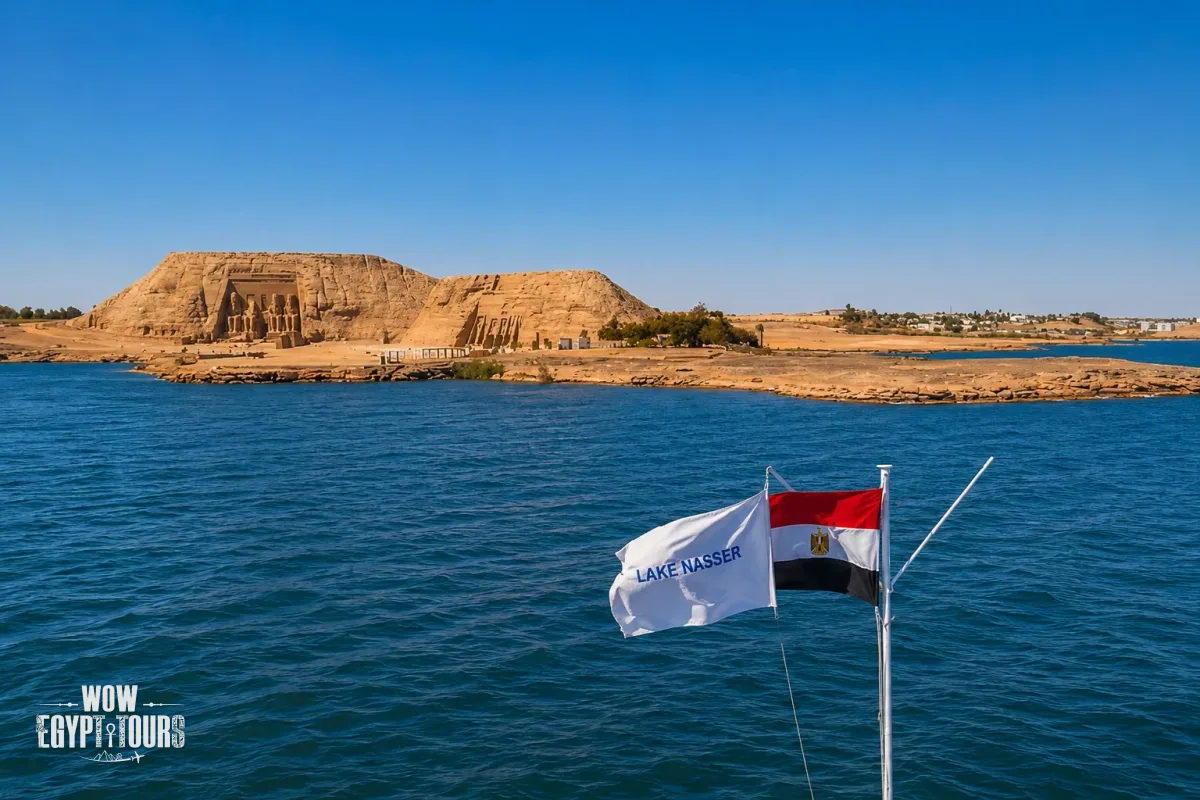

Lake Nasser is one of the most extraordinary artificial landscapes in the world, a vast inland sea stretching approximately 550 kilometers through the ancient heartland of Nubia from the Aswan High Dam in the north to the Sudan border in the south, whose creation submerged one of the most historically rich and most culturally significant corridors of the ancient Nile Valley and whose shores now preserve the most remarkable collection of rescued ancient Nubian monuments available anywhere in Africa. Created by the construction of the Aswan High Dam between 1960 and 1970, Lake Nasser is simultaneously one of the most consequential environmental transformations in the modern history of the Nile Valley and one of the most concentrated and most exclusively accessible ancient heritage landscapes in the entire world, a destination that combines the dramatic natural beauty of the largest artificial lake in Africa with the incomparable cultural richness of the ancient Nubian civilization whose physical remains line both its shores in a succession of extraordinary ancient monuments visible only to travelers who undertake the complete Lake Nasser Cruise experience. This extraordinary destination sits at the heart of Egypt's most exclusively immersive heritage travel experience, and WOW Egypt Tours proudly operates Lake Nasser Cruises that encompass the complete range of Lake Nasser ancient monuments as part of Egypt Tours Packages and Egypt Travel Packages for travelers from around the world.
The Lake Nasser heritage landscape encompasses five major ancient monument complexes of outstanding international significance, each representing a different period and a different cultural tradition of the ancient Nubian Nile Valley, from the supreme rock-cut temples of Ramesses II at Abu Simbel at the southern end of the Egyptian lake to the great Roman-period sanctuary of the Nubian god Mandulis at the Temple of Kalabsha near the Aswan High Dam in the north, with the three-temple complex of Wadi El Seboua, the oldest and most beautifully painted Temple of Amada, and the remarkable natural fortress of Kasr Ibrim completing the heritage sequence between them. All these monuments were rescued from the rising waters of Lake Nasser during the UNESCO International Campaign to Save the Monuments of Nubia between 1960 and 1980, one of the most ambitious and most historically consequential international heritage conservation efforts ever undertaken, and are now preserved on elevated lake shore platforms accessible exclusively by the luxury cruise vessels that make the Lake Nasser Cruise the most remote and the most exclusively accessed ancient heritage experience available anywhere in Egypt. The Lake Nasser Cruise is not simply a heritage tour; it is a journey through the complete chronological arc of ancient Nubian civilization in one of the most dramatically beautiful and most physically isolated natural landscapes in the African world, an experience whose combination of ancient grandeur, natural splendor, and physical remoteness gives it a quality of profound encounter with the ancient world that is simply unavailable at any other heritage destination in Egypt.

What Is Lake Nasser?
Lake Nasser is the vast artificial reservoir created by the construction of the Aswan High Dam across the Nile River at Aswan in Upper Egypt, completed in 1970. The lake stretches approximately 550 kilometers from the dam southward through the ancient landscape of Nubia to well beyond the Egyptian-Sudanese border, with the Egyptian portion of the lake covering approximately 480 kilometers and the Sudanese portion, known as Lake Nubia, covering the remaining 70 kilometers or more to the south. The lake has a surface area of approximately 5,250 square kilometers and a maximum water volume of approximately 132 cubic kilometers, making it the third largest artificial lake in the world by volume and one of the largest by surface area. The maximum width of the lake in the Egyptian section is approximately 35 kilometers, though the average width is considerably less, with the lake occupying the ancient valley bottom between the desert cliffs and plateaus of the Nubian landscape in a sinuous course that broadly follows the original course of the Nile but is expanded by the rising water to inundate the former river flood plain and the lower desert margins on both banks.
The creation of Lake Nasser involved the permanent submersion of the entire ancient Nubian homeland in the Egyptian section of the Nile Valley south of Aswan, a landscape that had been continuously inhabited since at least the Paleolithic period and that had served as the cultural heartland of successive Nubian civilizations for more than five thousand years. The submersion of this landscape, and the forced displacement of approximately 90,000 Egyptian Nubian people from their traditional villages on both banks of the Nile, was the most devastating cultural and social disruption experienced by the Nubian community in the modern era, and its consequences for Nubian cultural identity, community cohesion, and historical memory continue to shape the social and political life of the Nubian diaspora in Egypt today.
Who Created Lake Nasser?
Lake Nasser was created by the Egyptian government under President Gamal Abdel Nasser, whose name the lake bears, through the construction of the Aswan High Dam between 1960 and 1970 with the technical expertise and financial support of the Soviet Union. The decision to build the High Dam and create the reservoir was made in the context of Egypt's post-revolutionary modernization programme, in which the dam was conceived as the central symbol of Egyptian national development, providing year-round irrigation water for Egyptian agriculture and generating the electricity for Egypt's industrial expansion. The diplomatic and political consequences of the decision to build the dam, including the nationalization of the Suez Canal in 1956 that triggered the Suez Crisis, the subsequent Cold War alignment between Egypt and the Soviet Union, and the displacement of the Nubian community, are among the most significant political events in the modern history of the Nile Valley.
The lake itself was the direct and inevitable consequence of the dam's closure, as the impounded Nile waters rose progressively behind the dam structure from 1964 onwards, submerging first the lower Nubian villages and then the higher ground of the ancient archaeological sites, the temples and tombs, and ultimately the entire inhabited landscape of the Egyptian Nubian Nile Valley to a maximum depth of approximately 100 meters above the original river level at the dam site. The rising waters made necessary the most ambitious international cultural heritage rescue operation in history, the UNESCO International Campaign to Save the Monuments of Nubia, whose rescue of the Abu Simbel temples, the Philae temples, the Kalabsha temple, the Amada temple, the Wadi El Seboua temples, and numerous other monuments between 1960 and 1980 preserved the most significant ancient Nubian monuments from permanent submersion and established the precedent for all subsequent international heritage conservation efforts.
The Key Historical Significance Of The Lake Nasser Region
The region now covered by Lake Nasser was, before its submersion, one of the most historically significant and most archaeologically rich stretches of the ancient Nile Valley in all of Africa, the heartland of the ancient Nubian civilizations whose cultural achievements and historical importance have been systematically undervalued in the mainstream narrative of ancient world history and whose extraordinary contributions to the development of civilization in the Nile Valley are only now beginning to receive the scholarly and public recognition they deserve. The ancient Nubian kingdoms of Kerma, Kush, Napata, and Meroe, which flourished in the Nile Valley between approximately 2500 BCE and 400 CE in the landscape now covered by the waters of Lake Nasser, were sophisticated, politically powerful, and artistically accomplished civilizations that at various periods rivaled and in one extraordinary chapter, the 25th Dynasty of Egypt from approximately 747 to 656 BCE, actually ruled the entire Egyptian state as the Black Pharaohs of ancient Egyptian history.
The ancient monuments preserved along the shores of Lake Nasser, rescued from the rising waters of the reservoir by the UNESCO International Campaign, are the primary surviving physical evidence for the extraordinary cultural history of this submerged landscape. The Abu Simbel Temples of Ramesses II document the height of the New Kingdom Egyptian imperial presence in the ancient Nubian province. The Temple of Amada documents the beginnings of that imperial presence under the great pharaohs of the early 18th Dynasty. The Temples of Wadi El Seboua document the complex cultural interactions between the Meroitic Nubian kingdom, the Ptolemaic Egyptian state, and the Roman imperial administration at a single sacred site across more than a thousand years. The Temple of Kalabsha documents the Roman-period synthesis of Egyptian and indigenous Nubian religious traditions in the finest surviving free-standing Roman-period temple in Nubia. Together these monuments, preserved on the shores of the lake that submerged the landscape from which they came, constitute the most comprehensive and the most accessible collection of ancient Nubian heritage available anywhere in the world.
Lake Nasser Location In Egypt
Lake Nasser extends from the Aswan High Dam, located approximately 13 kilometers south of the city of Aswan in Upper Egypt, southward through the Nubian desert landscape for approximately 550 kilometers to and beyond the Egyptian-Sudanese border at approximately 22 degrees north latitude. The lake lies in the extreme south of Egypt, in the Aswan Governorate, and is bounded on both sides by the Nubian desert plateau whose ancient sandstone and granite bedrock rises from the lake shore in the characteristically spectacular landscape of the First and Second Cataract region. The nearest major city to the northern end of the lake is Aswan, approximately 13 kilometers from the Aswan High Dam, which serves as the primary embarkation and disembarkation point for all Lake Nasser Cruise itineraries. The nearest major town to the southern end of the Egyptian lake is Abu Simbel, a small settlement that has grown up around the famous temple complex and which serves as the alternative embarkation or disembarkation point for Lake Nasser Cruise itineraries beginning or ending at the southern end of the lake. WOW Egypt Tours arranges all transportation to and from both Aswan and Abu Simbel for all Lake Nasser Cruise itineraries.
Lake Nasser Fun Facts
Lake Nasser is the largest artificial lake in Africa and the third largest by volume in the world, with a surface area of approximately 5,250 square kilometers and a water volume of approximately 132 cubic kilometers at maximum capacity. The lake is approximately 550 kilometers long from the Aswan High Dam to the Sudan border, with the Egyptian portion measuring approximately 480 kilometers and the Sudanese portion, known as Lake Nubia, covering the remainder. The maximum depth of the lake reaches approximately 100 meters near the Aswan High Dam, where the original riverbed lies deepest beneath the accumulated water, and the maximum width reaches approximately 35 kilometers at its broadest points in the former river valley where the ancient Nubian settlement was most densely concentrated.
The creation of Lake Nasser required the relocation of approximately 90,000 Egyptian Nubian people from their traditional villages on both banks of the Nile between 1963 and 1966, and the additional relocation of approximately 50,000 Sudanese Nubian people from the Sudanese portion of the lake area. The UNESCO International Campaign to Save the Monuments of Nubia, launched in 1960 in response to the Lake Nasser threat, was the most expensive and most technically ambitious heritage rescue operation in history, involving contributions from 52 countries and ultimately saving 14 temples and countless smaller monuments from permanent submersion. The two most celebrated operations of the campaign, the rescue of the Abu Simbel temples between 1964 and 1968 and the rescue of the Philae Temple between 1972 and 1980, together involved the dismantling and reassembly of more than 46,000 individually numbered stone blocks in two separate relocation operations of extraordinary technical complexity and logistical scale.
Lake Nasser is one of the finest freshwater fishing lakes in Africa, with populations of Nile perch, tiger fish, and several other species that attract sport fishing enthusiasts from around the world. The lake also supports significant populations of Nile crocodiles, one of the largest crocodile populations in Africa, whose presence in the lake waters is a reminder of the ancient and continuous connection between the Nile Valley and the great sacred crocodile tradition of the Nubian religious world documented in the Temple of Sobek at Kom Ombo to the north and in the sacred crocodiles of the ancient Kalabsha sanctuary.
Why Is Lake Nasser Called By This Name?
Lake Nasser is named after Gamal Abdel Nasser, the President of Egypt from 1956 to 1970 whose government conceived, planned, and executed the construction of the Aswan High Dam, and in whose presidency the dam was built and the reservoir began to fill. Nasser, whose full name was Gamal Abdel Nasser Hussein, was one of the most influential political figures in the modern history of the Arab world, the leader of the Free Officers' Revolution that overthrew the Egyptian monarchy in 1952 and the most prominent advocate of pan-Arab nationalism and Egyptian independence from colonial influence in the 20th century. The decision to name the lake after him was made by the Egyptian government at the time of the dam's completion in 1970, the same year in which Nasser died of a heart attack at the age of 52, as a permanent memorial to the political leader under whose presidency the most transformative infrastructure project in the modern history of Egypt was conceived and constructed.
The Sudanese portion of the lake, which covers the ancient Nubian landscape of northern Sudan between the Egyptian border and the Sudanese town of Wadi Halfa, is known as Lake Nubia rather than Lake Nasser, reflecting the Sudanese government's preference for a name that honors the indigenous Nubian people whose homeland the lake submerged rather than the Egyptian political leader whose government created the lake.
Lake Nasser History
The history of the Lake Nasser region encompasses the complete arc of ancient Nubian civilization from its prehistoric origins to the modern submersion of the ancient landscape and its subsequent transformation into the heritage landscape of the lake shore. The ancient Nubian Nile Valley now covered by Lake Nasser was inhabited from at least the Paleolithic period onwards, with the earliest archaeological evidence for human occupation of the region dating to more than 100,000 years ago in the form of stone tool assemblages recovered from sites along what was then the Nile flood plain. The Paleolithic and Neolithic communities of the ancient Nubian Nile Valley were among the earliest agriculturalists and pastoralists of the African continent, developing sophisticated sedentary lifestyles and elaborate material cultures in the fertile river valley environment before the emergence of the first complex state societies in both Egypt and Nubia around 3500 to 3000 BCE.
The Kerma civilization, which flourished in the Nile Valley south of the Second Cataract between approximately 2500 and 1500 BCE, was the first major Nubian state society and the primary political and cultural rival of the Egyptian Old and Middle Kingdom states to the north. The Kerma kingdom, centered on the ancient city of Kerma near the Third Cataract in modern Sudan, extended its influence northward through the region now covered by Lake Nasser and established a sophisticated culture of royal burial, elaborate craft production, and long-distance trade that is documented in the archaeological record of the ancient Nubian Nile Valley. The subsequent New Kingdom Egyptian colonization of Nubia between approximately 1550 and 1070 BCE brought Egyptian administrative control, Egyptian religious institutions, and Egyptian artistic traditions to the Nubian Nile Valley, creating the hybrid cultural landscape of Egyptian-influenced Nubian civilization that is most dramatically documented in the royal temples of Ramesses II including those at Abu Simbel. The Napatan and Meroitic Nubian kingdoms that emerged after the end of the Egyptian New Kingdom created the most powerful and the most culturally sophisticated post-pharaonic civilizations in the ancient Nile Valley, and the Meroitic royal cemetery complex at Meroe in modern Sudan, the most important surviving monument of this civilization, is one of the great ancient heritage sites of Africa.
In the modern period, the history of the Lake Nasser region is the history of the dam, the displacement, and the rescue campaign. The construction of the Aswan Low Dam in 1902 and its subsequent raisings caused increasing annual flooding of the lower Nubian Nile Valley, providing an early warning of the threat that the more ambitious High Dam project would eventually pose. The announcement of the High Dam project in the late 1950s, the subsequent UNESCO campaign, the displacement of the Nubian community between 1963 and 1966, and the progressive filling of the lake between 1964 and 1970 constitute the defining events in the modern history of the Lake Nasser region, whose consequences for the Nubian people, for the ancient heritage of the Nile Valley, and for the international heritage conservation movement continue to shape cultural and political discourse about the relationship between development, heritage, and human rights in the 21st century.
The Story Of Lake Nasser And The UNESCO Campaign
The story of Lake Nasser and the UNESCO International Campaign to Save the Monuments of Nubia is the most dramatic and the most historically consequential story in the entire history of international cultural heritage conservation, a narrative in which the imminent threat of irreversible cultural loss motivated an unprecedented international response that demonstrated what the international community can achieve when it decides that something is too important to be lost and too significant to be sacrificed to any single nation's development imperatives. The UNESCO campaign, launched in 1960 with an appeal to the international community to contribute financially and technically to the rescue of the Nubian monuments threatened by the rising waters of Lake Nasser, attracted contributions from 52 countries and ultimately rescued 14 complete ancient temples and countless smaller monuments from permanent submersion, in operations ranging from the physically spectacular dismantling and relocation of the Abu Simbel colossi to the technically innovative sliding rescue of the painted Temple of Amada.
The campaign's most celebrated achievement, the rescue of the two Abu Simbel temples between 1964 and 1968, involved the cutting of both temples into 1,036 individually numbered blocks, the transportation of each block up the cliff face, and the precise reassembly of the complete temples in their exact original architectural arrangement on an artificial hill 65 meters above the rising lake. The campaign's most innovative achievement, the rescue of the painted Temple of Amada in 1975, involved sliding the entire temple as a single monolithic structure across the desert on steel rails to preserve its fragile painted decoration from the damage that disassembly would have caused. The campaign also relocated the Temple of Kalabsha near the Aswan High Dam in 1962 to 1963, the three temples of Wadi El Seboua in 1961 to 1965, and numerous other smaller monuments to safety above the lake waterline. The success of the Nubian campaign directly inspired the drafting of the UNESCO World Heritage Convention in 1972, which established the permanent international framework for the protection of outstanding cultural and natural heritage sites throughout the world that now encompasses more than 1,100 designated sites in every region of the globe. Every UNESCO World Heritage Site in existence today owes something to the precedent set by the Nubian monuments rescue campaign, making Lake Nasser not only a great natural landmark and a great heritage landscape but the birthplace of the modern international system of cultural heritage protection.
The Major Monuments Of Lake Nasser
The Temple Of Kalabsha
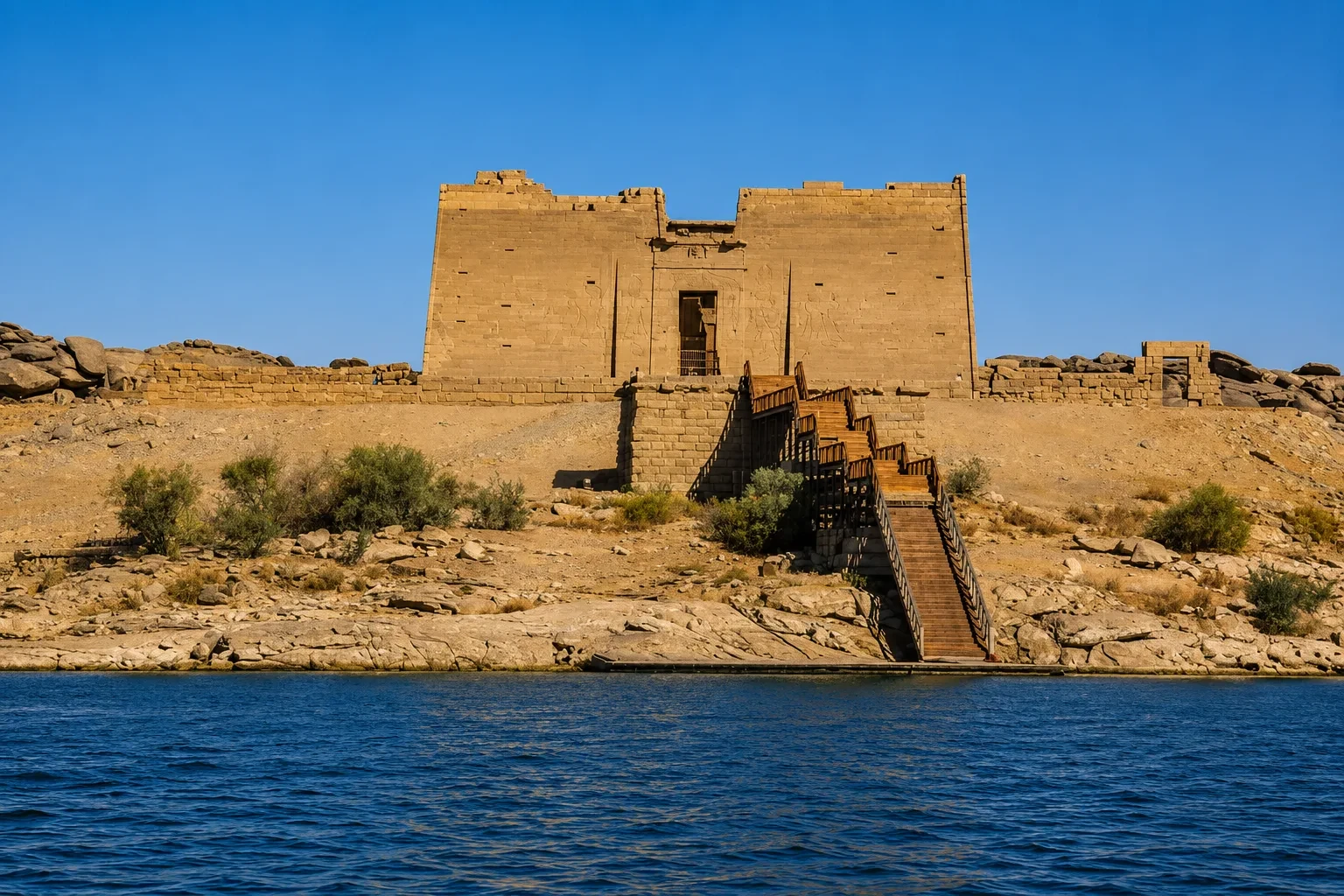
The Temple of Kalabsha is the largest and most completely preserved free-standing ancient temple in all of Nubia, a magnificent Roman-period sanctuary dedicated to the indigenous Nubian solar deity Mandulis and built primarily by the emperor Augustus in the first decades of the 1st century CE. The temple complex includes not only the great Kalabsha temple of Mandulis with its impressive entrance pylon, columned forecourt, and inner sanctuary, but also the Beit el-Wali, a rock-cut hemispeos temple of Ramesses II from approximately 1290 BCE with vivid painted New Kingdom military reliefs, and the elegant Kertassi kiosk, a Roman-period colonnaded pavilion with distinctive Hathor-headed column capitals. The Kalabsha complex is located approximately 50 kilometers south of Aswan near the Aswan High Dam, making it the most accessible and the most conveniently visited of all the Lake Nasser heritage temples, reachable both as a day excursion from Aswan and as the opening or closing monument of the complete Lake Nasser Cruise programme. The temple was rescued by a West German engineering team in 1962 and 1963 as Germany's primary contribution to the UNESCO Nubian campaign, in the first major temple relocation operation of the entire rescue effort.
The Temples Of Wadi El Seboua
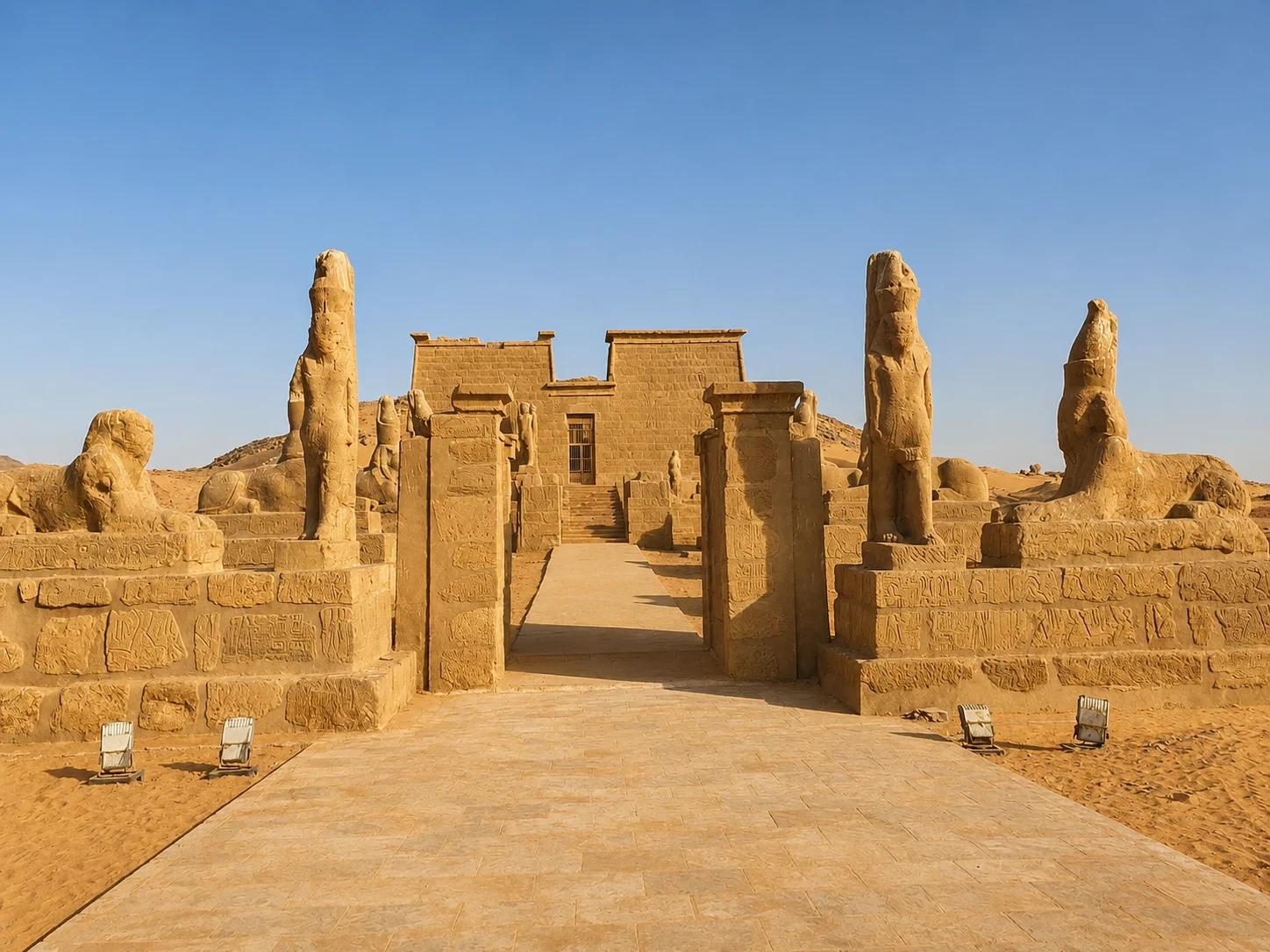
The Temples of Wadi El Seboua, the Valley of the Lions, are a remarkable cluster of three distinct ancient temple complexes from three entirely different periods of Nubian history, located approximately 150 kilometers south of the Aswan High Dam on the western shore of Lake Nasser. The three temples are the Ramesside Temple of Ramesses II with its famous sphinx-lined processional avenue, the Ptolemaic and Meroitic Temple of Dakka dedicated to the god Thoth, and the unfinished Roman-period Temple of Maharraka with its unique spiral staircase, the only spiral staircase in any ancient Egyptian temple. The most celebrated feature of the Wadi El Seboua complex is the extraordinary visual palimpsest in the inner sanctuary of the Ramesside temple, where a Byzantine-period Christian community plastered over the ancient pharaonic reliefs and painted Coptic images of Saints Peter and Paul over the ancient divine recipients of the pharaoh's offerings, creating the remarkable composition in which the deified Ramesses II appears to be presenting offerings to the Christian apostles.
The Temple Of Amada
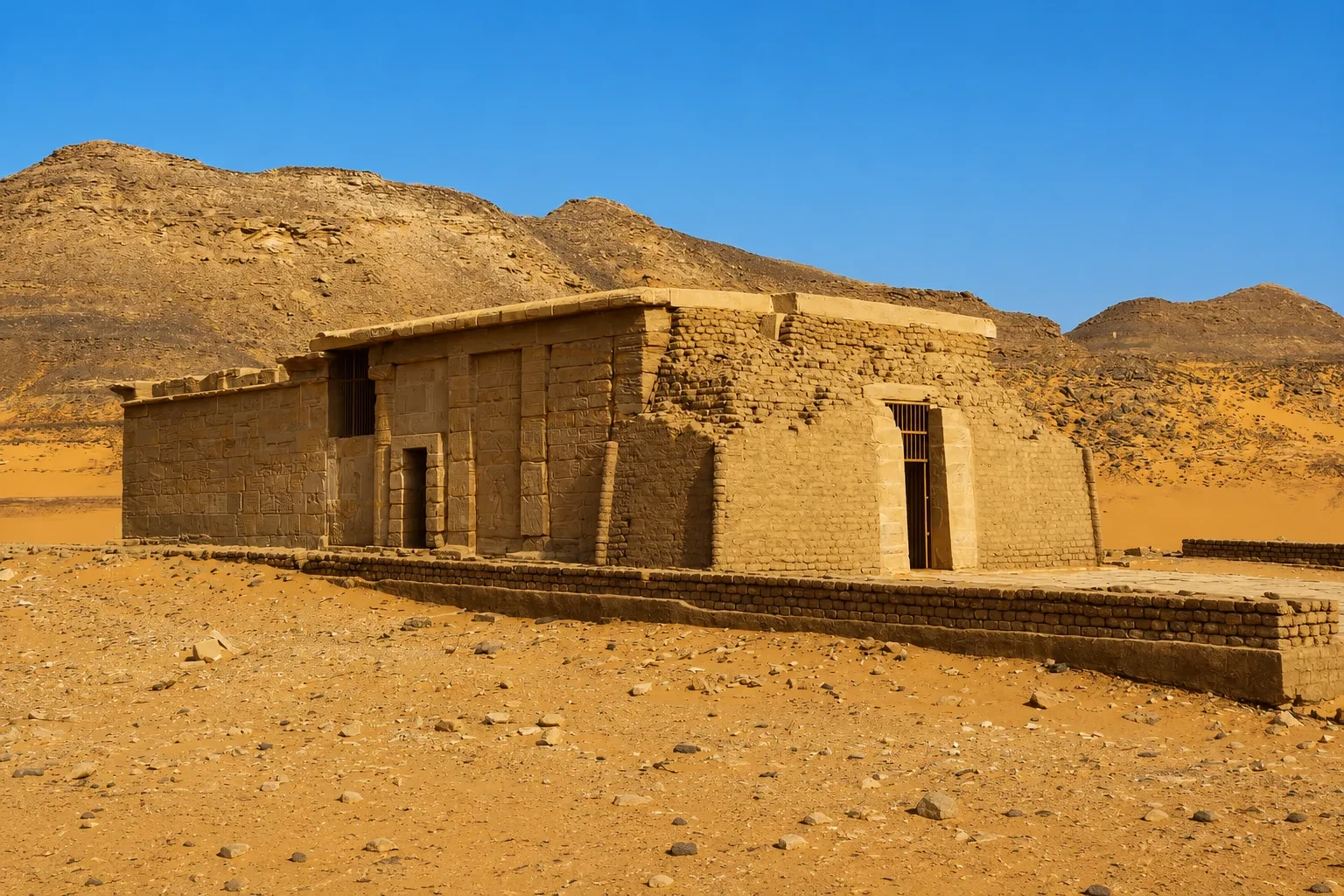
The Temple of Amada is the oldest surviving ancient Egyptian temple on the shores of Lake Nasser and the most beautifully painted ancient monument in the entire Lake Nasser heritage zone, built by the pharaohs Thutmose III, Amenhotep II, and Thutmose IV of the 18th Dynasty beginning around 1460 BCE. The temple preserves the finest surviving painted relief decoration of any ancient Egyptian temple south of Luxor, in a state of color preservation that approaches the freshness of newly applied pigment, and two historical stelae of Amenhotep II that are primary documents for the early 18th Dynasty royal history. The Temple of Amada was rescued from the rising waters of Lake Nasser in 1975 by the most technically innovative operation of the entire UNESCO campaign, moved intact as a single monolithic structure of approximately 800 tonnes on a specially constructed concrete slab sliding on steel rails lubricated with sand and grease, covering approximately 2.5 kilometers from its original position to its new elevated site without the disassembly that would have destroyed its fragile painted surfaces.
Kasr Ibrim
Kasr Ibrim is the only ancient Nubian site that was not relocated during the UNESCO International Campaign and that remains in its original location above the Lake Nasser waterline, a remarkable medieval fortified settlement on an island promontory in the middle of the lake approximately 40 kilometers north of Abu Simbel whose preservation in situ was possible because its elevated position above the ancient Nile flood plain kept it above the level of the rising Lake Nasser water. Kasr Ibrim was a significant administrative, religious, and military center in the ancient Nubian world from approximately the New Kingdom period through the medieval Islamic era, with phases of construction and occupation spanning more than two thousand years documented in the substantial mud-brick and stone remains that are visible from the passing cruise ship deck. Because Kasr Ibrim is an active archaeological excavation site under the management of the Egypt Exploration Society, it is not open to visitors for independent access but is viewed from the passing cruise ship as the vessel sails between the Wadi El Seboua area and Abu Simbel, providing a dramatic and historically atmospheric encounter with the one ancient Nubian site that was not moved by the UNESCO campaign.
The Abu Simbel Temples
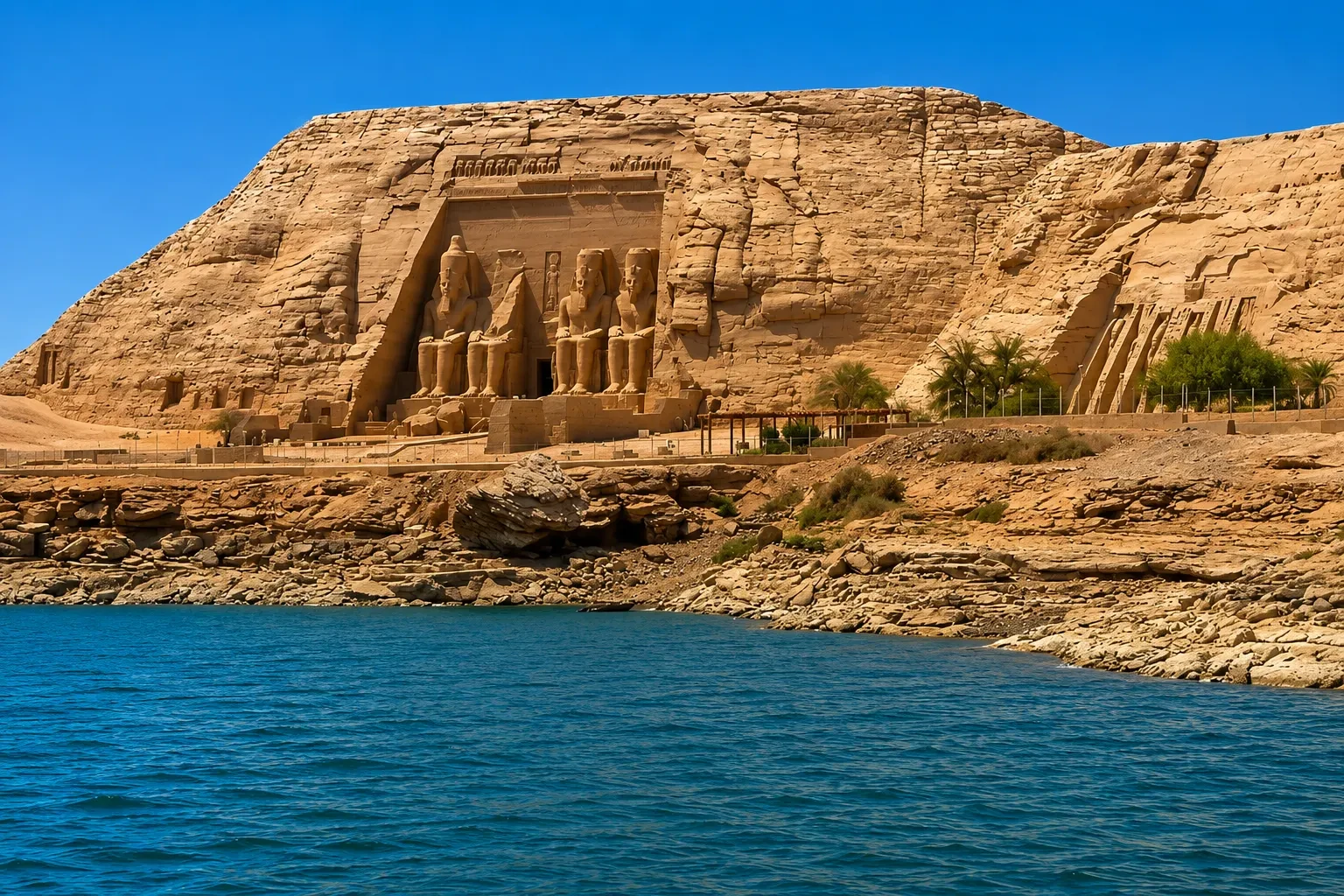
The Abu Simbel Temples are the most magnificent, the most awe-inspiring, and the most universally celebrated of all the ancient Nubian monuments rescued by the UNESCO campaign, two extraordinary rock-cut temple complexes carved into the sandstone cliffs by Ramesses II in the 13th century BCE and relocated 65 meters above their original position between 1964 and 1968 in the most celebrated and most technically spectacular heritage rescue operation in history. The Great Temple of Ramesses II, with its four colossal 21-meter seated statues of the pharaoh and the famous solar alignment phenomenon that illuminates the inner sanctuary statues on 22 February and 22 October each year, is one of the most immediately overwhelming ancient facades in the entire world. The Small Temple of Nefertari and Hathor, dedicated to the goddess Hathor and to Queen Nefertari, is the first temple in ancient Egyptian history built by a pharaoh in honor of his living queen. The Abu Simbel temples are located approximately 280 kilometers south of Aswan near the border with Sudan and are the supreme destination of every Lake Nasser Cruise itinerary.
Why Is Lake Nasser Important?
Lake Nasser is important in ways that span hydrology, ecology, economics, cultural heritage, and the history of international conservation. Hydrologically, it is the world's largest controlled reservoir of fresh water in an otherwise completely arid region, providing the year-round irrigation water that supports the agricultural productivity of the Nile Valley in Egypt and the hydroelectric power that supplies a significant proportion of Egypt's electricity. Ecologically, it has created an entirely new aquatic and riparian ecosystem in the Nubian desert, with thriving fish populations, significant bird life including migrating species on the African-Eurasian flyway, and large populations of Nile crocodiles and hippopotami in the southern sections of the lake. Economically, it has been fundamental to the development of Egyptian agriculture and industry in the second half of the 20th century, though its long-term effects on the ecology of the Nile Delta and the fertility of the agricultural land have been more complex and more problematic than originally anticipated.
For heritage and cultural tourism, Lake Nasser is important as the setting of the most concentrated and the most exclusively accessible collection of rescued ancient Nubian monuments in the world, a heritage landscape that is available only to travelers who undertake the complete Lake Nasser Cruise experience and that therefore retains a quality of discovery and exclusivity that no other ancient heritage destination in Egypt can match. WOW Egypt Tours operates Lake Nasser Cruises that provide the most comprehensive and the most expertly guided access to the complete Lake Nasser heritage landscape available to international travelers.
What Are Some Interesting Facts About Lake Nasser?
The Lake That Inspired The World Heritage Convention
The most historically significant fact about Lake Nasser, in terms of its global impact on cultural heritage preservation, is that its creation directly inspired the drafting and adoption of the UNESCO World Heritage Convention in 1972, the most widely ratified international cultural convention in history and the legal framework under which more than 1,100 outstanding cultural and natural heritage sites are now protected throughout the world. The UNESCO International Campaign to Save the Monuments of Nubia, launched in 1960 in response to the Lake Nasser threat, demonstrated for the first time that the international community could mobilize sufficient resources and expertise to save monuments of outstanding universal value from apparently inevitable destruction, and that the protection of significant ancient heritage was a legitimate concern of the international community as a whole rather than simply of the individual nations whose territory contained the monuments. The World Heritage Convention, drafted two years after the conclusion of the most critical phase of the Nubian monuments rescue campaign, directly incorporated the lessons and the principles of the Nubian experience into a permanent international legal framework whose global impact on the protection of the world's outstanding cultural and natural heritage has been incalculable.
The Most Exclusive Heritage Landscape In Egypt
One of the most distinctive and most appealing characteristics of Lake Nasser as a heritage tourism destination is the absolute exclusivity of the access it provides to its ancient monuments. While the great ancient sites of Luxor and Aswan attract hundreds of thousands of visitors each year and are accessible by road, river, and air to any traveler in Egypt, the monuments of Lake Nasser are accessible only to the relatively small number of travelers who commit to the complete Lake Nasser Cruise experience, the only practical means of visiting the Wadi El Seboua temples, the Temple of Amada, and Kasr Ibrim at any time of year. This exclusivity of access gives the Lake Nasser heritage landscape a quality of discovery and personal encounter with ancient monuments in a setting of near-complete natural isolation that is simply unavailable at any other heritage destination in Egypt, and that makes the Lake Nasser Cruise one of the most personally rewarding and most memorably special heritage travel experiences available anywhere in the world.
The Drowned World Beneath The Lake
Perhaps the most haunting and the most historically evocative dimension of the Lake Nasser landscape is the knowledge that beneath the blue water of the lake, approximately 100 meters below the surface near the dam and at various depths throughout the length of the lake, lies the entire ancient Nubian homeland that was submerged when the waters rose: the villages, the churches, the mosques, the palm groves, the agricultural fields, the ancient settlement mounds, and the countless smaller ancient monuments that could not be rescued by the UNESCO campaign or that were not identified as significant enough for rescue priority during the compressed and resource-limited campaign period. The drowned Nubian homeland beneath Lake Nasser is the most dramatic underwater ancient heritage landscape in Africa, and its existence gives every Lake Nasser Cruise a poignant dimension of historical awareness that is unlike anything available at any other heritage destination in the Egyptian Nile Valley.
What Is So Special About Lake Nasser?
The Last Great Heritage Frontier In Egypt
What makes Lake Nasser uniquely special among all the heritage and cultural destinations of Egypt is its quality as the last great heritage frontier, the final section of the ancient Nile Valley heritage landscape that remains largely inaccessible to the mass tourism that has transformed the experience of visiting the monuments of Luxor and Aswan over the past half century. The Lake Nasser monuments, preserved in a setting of extraordinary natural isolation in one of the most remote desert lake environments in Africa, retain a quality of genuine discovery and personal encounter with the ancient world that the more accessible and more heavily visited monuments of the Egyptian Nile Valley heritage circuit cannot provide. Travelers who undertake the Lake Nasser Cruise consistently describe it as the most revelatory and the most personally moving heritage experience of their entire Egypt journey, not because the monuments of Lake Nasser surpass those of Luxor and Aswan in every dimension, but because they are encountered in a context of physical isolation, natural grandeur, and complete exclusivity that gives the ancient experience a depth and a resonance impossible to achieve in the more crowded and more commercially mediated environment of the standard Egypt heritage circuit.
Ancient Heritage And Natural Beauty In Perfect Union
Lake Nasser is also uniquely special for the quality of its combination of ancient heritage with natural beauty, a combination in which the two elements are so perfectly matched in scale and in character that neither can be fully appreciated in isolation from the other. The great colossi of Abu Simbel would be impressive in any setting, but they are most completely experienced when approached by motorboat across the desert-bordered blue expanse of the lake from the cruise ship anchorage, with the sun illuminating the cliff face from which the colossi are carved and the vast Nubian sky providing the backdrop for the most dramatic ancient temple facade in the world. The sphinx avenue of Wadi El Seboua would be remarkable in any context, but it achieves its fullest atmospheric impact when seen across the lake shore in the golden light of a late afternoon, with the ancient processional approach visible from the water and the desert landscape framing it in a visual composition of such natural and historical power that no indoor heritage experience can approximate. The meeting of ancient human achievement with the most dramatically beautiful natural setting available in the Nubian world is the defining quality of the Lake Nasser heritage experience, and the reason why every traveler who has made the complete Lake Nasser Cruise describes it as one of the great heritage journeys of their lives.
Lake Nasser Through The Ages: From Ancient Nubia To The Present
The complete history of the Lake Nasser region from the earliest human occupation of the ancient Nubian Nile Valley to the present encompasses one of the most richly layered and most dramatically eventful cultural narratives in the entire history of the Nile Valley. The ancient period, spanning more than five thousand years from the earliest Predynastic communities through the great Nubian kingdoms and the Egyptian New Kingdom colonization to the Ptolemaic, Roman, and early Christian eras, is documented in the monuments preserved along the lake shores and in the archaeological record of the submerged ancient settlements and tombs that lie beneath the water. The medieval Islamic period, during which the Nubian Nile Valley was gradually integrated into the broader Islamic world while maintaining distinctively Nubian cultural and community traditions, transformed the social and linguistic character of the lake region while leaving the ancient physical heritage largely intact under the protective desert sand. The modern period, from the construction of the Aswan Low Dam in 1902 through the progressive flooding of the Nubian homeland and the construction of the High Dam and Lake Nasser between 1960 and 1970, to the UNESCO rescue campaign and the establishment of the Lake Nasser Cruise tourism infrastructure in the decades following the dam's completion, constitutes the most recently completed chapter in the Lake Nasser story.
Today Lake Nasser supports a modest but growing tourism economy based primarily on the Lake Nasser Cruise, a sport fishing industry that attracts international fishing enthusiasts to the lake's rich Nile perch and tiger fish populations, and the small service communities at both Aswan and Abu Simbel that cater to the cruise and day tour visitors who constitute the primary international audience for the lake's ancient monuments. The broader cultural and political story of Lake Nasser, including the ongoing Nubian community advocacy for the right of return to the lake shores and the continuing scholarly and public debate about the long-term environmental consequences of the lake for the Nile Delta and the Egyptian agricultural land, ensures that the Lake Nasser story remains a living political and cultural narrative rather than simply a completed episode in the history of modern Egyptian development.
Lake Nasser UNESCO World Heritage Status
The ancient monuments of Lake Nasser are inscribed as part of the Nubian Monuments from Abu Simbel to Philae UNESCO World Heritage Site, designated in 1979 as one of the first ten entries on the UNESCO World Heritage List. The World Heritage designation encompasses the complete collection of ancient Nubian monuments rescued from the rising waters of Lake Nasser during the UNESCO International Campaign, including the Abu Simbel temples, the Kalabsha temple complex, the Wadi El Seboua temples, the Temple of Amada, and the Philae Temple at the northern end of the heritage zone. The World Heritage designation recognizes both the outstanding universal value of the ancient monuments themselves, as supreme examples of ancient Egyptian and Nubian royal religious architecture from multiple periods spanning more than fifteen hundred years, and the unique significance of their rescue as the founding achievement of the modern international heritage protection movement. The Lake Nasser UNESCO World Heritage landscape is one of the most extensive and most internationally recognized ancient heritage zones in all of Africa, and its continued protection and management by the Egyptian Ministry of Tourism and Antiquities in partnership with UNESCO and with international scholarly institutions ensures that the monuments preserved above the lake waterline are maintained for the benefit of future generations throughout the world.
Best Time To Visit Lake Nasser
The best time to visit Lake Nasser and undertake the Lake Nasser Cruise is during the cooler months from October through April, when temperatures throughout the lake region are moderate and comfortable for outdoor exploration of the monument platforms, the ancient temple courts, and the open deck spaces of the cruise ship. The Lake Nasser region is one of the hottest and most arid areas in Egypt, with summer temperatures regularly exceeding 45 degrees Celsius from May to September, making the outdoor portions of the heritage visits extremely challenging during these months, though the air-conditioned temple interiors and the cruise ship facilities provide comfortable refuges from the outdoor heat. The late autumn and early spring months of October to November and March to April offer excellent conditions, with moderate temperatures, minimal visitor numbers, and the spectacularly beautiful desert light that creates the finest photography conditions of any season on the lake. December, January, and February are the most popular months for the Lake Nasser Cruise, with the most comfortable temperatures and the largest concentration of dedicated heritage travelers sharing the experience of the most exclusive ancient heritage landscape in Egypt. WOW Egypt Tours operates Lake Nasser Cruises throughout the year and provides expert guidance on the optimal seasonal timing for the complete cruise programme.
Getting To Lake Nasser
The Lake Nasser Cruise begins and ends at either Aswan or Abu Simbel, the two primary access points for the lake. Aswan, the northern embarkation and disembarkation point for most Lake Nasser Cruise itineraries, is accessible from Cairo by daily flights (approximately 1 hour 15 minutes), by overnight sleeper train (approximately 12 to 14 hours), or as the terminus of a Nile cruise from Luxor (four to eight days). Abu Simbel, the southern embarkation or disembarkation point for Lake Nasser Cruise itineraries beginning or ending at the southern end of the lake, is accessible from Aswan by domestic flight (approximately 45 minutes) or by road along the Lake Nasser desert highway (approximately 3 to 3.5 hours). WOW Egypt Tours arranges all flights, road transfers, and airport and port transfers for all Lake Nasser Cruise guests, ensuring a completely seamless journey from arrival in Egypt to embarkation and from disembarkation to onward travel.
How Long To Spend On Lake Nasser
The minimum recommended time for a meaningful and complete experience of the Lake Nasser heritage landscape is four days including the cruise programme, which encompasses both the 4 Days 3 Nights cruise from Abu Simbel to Aswan and the 5 Days 4 Nights cruise from Aswan to Abu Simbel. These two itineraries cover the complete range of Lake Nasser ancient monuments including the Kalabsha temples, the Wadi El Seboua temples, the Temple of Amada, Kasr Ibrim, and the Abu Simbel temples, all with guided shore excursions from the cruise ship and expert Egyptologist commentary at every stop. Travelers who add an Aswan programme of two or more days at either the beginning or the end of the Lake Nasser Cruise, visiting the Aswan highlights of the Temple of Isis at Philae, the Aswan High Dam, the Unfinished Obelisk, the Nubian Museum, and the Nubian Village, will have the most comprehensive and the most contextually complete Lake Nasser and Aswan heritage experience available. WOW Egypt Tours designs customized Lake Nasser and Aswan itineraries of any duration for individual travelers, couples, families, and groups.
Tips For Visiting Lake Nasser
Book your Lake Nasser Cruise as far in advance as possible, as the limited number of quality cruise vessels on the lake means that cabin availability is restricted, particularly during the peak winter months of December, January, and February. Visit the Nubian Museum in Aswan before embarking on your Lake Nasser Cruise, as the comprehensive presentation of the complete chronological and cultural history of the Nubian civilization from prehistoric times to the present day provides the essential intellectual preparation for the full appreciation of all the Lake Nasser monuments. Allow genuine quiet time on the cruise ship deck between monument visits to absorb the extraordinary natural beauty of the lake landscape, the desert cliffs, and the open African sky, as the experience of the Lake Nasser Cruise is as much about the journey between monuments as it is about the monuments themselves. Attend the Abu Simbel Sound and Light Show on the evening before your dawn visit to the temples, as the illuminated colossi reflected in Lake Nasser in the darkness of the Nubian night is one of the most dramatically atmospheric heritage experiences in Egypt. A licensed Egyptologist guide from WOW Egypt Tours on board throughout the cruise is essential for the fullest appreciation of every monument in the Lake Nasser heritage programme. Bring water, sunscreen, and a hat for all shore excursions, and a warm layer for evenings on the open deck in winter.
What To Wear On Lake Nasser
The Lake Nasser Cruise combines air-conditioned cruise ship spaces with open deck areas and outdoor shore excursions at ancient monument sites in an extreme desert environment, requiring a practical and versatile wardrobe for the complete experience. Lightweight, breathable clothing covering the shoulders and knees is recommended for all shore excursions as both protection from the desert sun and respect for the sacred ancient spaces. A wide-brimmed hat and very generous sunscreen are absolutely essential for all outdoor activities on the lake shore and the temple platforms. Comfortable, flat walking shoes are adequate for the well-maintained temple platform paths and interior floor surfaces. Flat non-slip footwear is required for the motorboat transfers between the cruise ship and the temple landings. For evenings on the cruise ship deck, a warm layer is recommended in the winter months when the desert temperature drops quickly after sunset. A light rain layer is useful for occasional windy conditions on the open lake, though actual rain is extremely rare in the Nubian desert.
Photography On Lake Nasser
Lake Nasser is one of the most extraordinarily beautiful and most photographically rewarding travel environments in all of Egypt, offering a combination of natural landscape, ancient monument, desert light, and water reflection that is available nowhere else in the Nile Valley. The photography opportunities on Lake Nasser span the complete range of heritage and natural photography: the colossal facade of Abu Simbel at sunrise, the sphinx avenue of Wadi El Seboua in golden afternoon light, the painted walls of the Temple of Amada in soft interior light, the Kertassi kiosk silhouetted against the desert sky, the Nubian sunset reflected in the flat surface of the lake, and the starfield of the Nubian night sky from the cruise ship deck are all images of exceptional beauty and emotional power that reward photographic attention with compositions of extraordinary quality. Photography rules at each monument site apply as described in the individual monument guides: flash photography is prohibited in all temple interiors; photography permits may be required for some sites. The open deck of the cruise ship and the lake waterscape are entirely photographable without restriction at all times. Professional photography or filming requires advance permits from Egypt's Ministry of Tourism and Antiquities.
Lake Nasser Cruise
A Lake Nasser Cruise is the only practical and the most completely rewarding way to experience the full range of ancient monuments along the shores of Lake Nasser, providing access to the Wadi El Seboua temples, the Temple of Amada, and Kasr Ibrim that are not accessible by any other means of transport, while also including the Temple of Kalabsha near Aswan, the Aswan highlights programme, and the supreme Abu Simbel temples at the southern end of the lake. WOW Egypt Tours operates Lake Nasser Cruises with private cabins, all meals, a private licensed Egyptologist guide on board throughout the cruise, and guided shore excursions with motorboat transfers at every monument stop. The Lake Nasser Cruise is available in two primary itineraries that together cover the complete heritage programme of the Egyptian section of the lake.
5 Days 4 Nights Lake Nasser Cruise From Aswan To Abu Simbel
Route: Aswan to Abu Simbel, sailing south on Lake Nasser.
Itinerary
Day 1: Embarkation in Aswan. Guided visits to the Aswan High Dam, the Unfinished Obelisk, and Philae Temple. Embarkation and sail south on Lake Nasser. Overnight on board.
Day 2: Sail south to Kalabsha. Guided visit to the Temple of Kalabsha, the largest free-standing ancient temple in Nubia, including the main temple of Mandulis, the Beit el-Wali rock-cut temple of Ramesses II with its vivid painted military reliefs, and the Kertassi kiosk with its graceful Hathor column capitals. Continue sailing south toward Wadi El Seboua. Overnight on board.
Day 3: Guided visit to the Temples of Wadi El Seboua, including the sphinx processional avenue of the Ramesside temple, the famous Christian palimpsest sanctuary, the Ptolemaic and Meroitic Temple of Dakka, and the Roman Temple of Maharraka with its unique spiral staircase. Guided visit to the Temple of Amada, the oldest and most beautifully painted ancient Egyptian temple on Lake Nasser, with its extraordinary 18th Dynasty painted decoration and the historical stelae of Amenhotep II. Continue south. Overnight on board.
Day 4: Sail to Kasr Ibrim. Guided viewing of Kasr Ibrim from the ship deck, the only ancient Nubian site remaining in its original above-water location on Lake Nasser. Continue south to Abu Simbel. First guided visit to the Abu Simbel Temples, the two extraordinary rock-cut temples of Ramesses II and Queen Nefertari. Optional Abu Simbel Sound and Light Show in the evening. Overnight on board at Abu Simbel.
Day 5: Second guided visit to the Abu Simbel Temples at sunrise for the most spectacular dawn lighting of the four colossal facade statues. Farewell breakfast on board. Disembarkation at Abu Simbel. Transfer by air or road back to Aswan.
Includes
Private cabin, all meals on board, private licensed Egyptologist guide throughout the cruise, entrance fees to all temple visits including the Kalabsha complex, Wadi El Seboua temples, Temple of Amada, and both Abu Simbel Temples on both visits, motorboat transfers at all shore excursion stops, motorboat transfer to Philae Island on embarkation day, and all private transfers between the hotels, airports, and cruise ship embarkation and disembarkation points.
4 Days 3 Nights Lake Nasser Cruise From Abu Simbel To Aswan
Route: Abu Simbel to Aswan, sailing north on Lake Nasser.
Itinerary
Day 1: Arrival at Abu Simbel by domestic flight or road transfer from Aswan. Embarkation at Abu Simbel. Full guided afternoon visit to the Abu Simbel Temples, the two extraordinary rock-cut temples of Ramesses II and Queen Nefertari, with a comprehensive guided programme covering the Great Temple facade and colossi, the complete interior including the hypostyle hall, the Battle of Kadesh reliefs, and the inner sanctuary with the solar alignment explanation, and the Small Temple of Nefertari with its exceptional painted decoration. Optional Abu Simbel Sound and Light Show in the evening. Overnight on board at Abu Simbel.
Day 2: Second guided visit to the Abu Simbel Temples at dawn in the golden light of the Nubian sunrise, for the most spectacular possible encounter with the four colossal seated statues of Ramesses II. Sail north on Lake Nasser. Guided viewing of Kasr Ibrim from the ship deck as the vessel passes this remarkable in-situ ancient Nubian fortress site. Guided visit to the Temple of Amada, the oldest and most beautifully painted ancient Egyptian temple on Lake Nasser, with complete guided exploration of the extraordinary 18th Dynasty painted decoration, the two historical stelae of Amenhotep II, and the evidence of the Atenist erasure and restoration in the wall surfaces. Guided visit to the Temples of Wadi El Seboua, including the sphinx avenue, the Christian palimpsest sanctuary, the Temple of Dakka, and the Temple of Maharraka. Overnight on board.
Day 3: Continue north to Kalabsha. Guided visit to the Temple of Kalabsha and associated monuments. Continue north toward Aswan. Guided visits to the Aswan High Dam, the Unfinished Obelisk, and Philae Temple. Overnight on board in Aswan.
Day 4: Guided visits to the Nubian Museum and Nubian Village. Optional visits to Elephantine Island and the Aswan Botanical Garden on Kitchener's Island. Farewell breakfast on board. Disembarkation in Aswan.
Includes
Private cabin, all meals on board, private licensed Egyptologist guide throughout the cruise, entrance fees to all temple visits including both Abu Simbel Temples on both visits, all Lake Nasser temple entrances, Philae Temple, and Nubian Museum, motorboat transfers at all shore excursion stops and to Philae Island, and all private transfers between hotels, airports, and cruise ship embarkation and disembarkation points.
Combine Lake Nasser With Your Egypt Tours Package
The Lake Nasser Cruise is featured across the full range of WOW Egypt Tours travel products as the supreme Nubian heritage experience and the most exclusively immersive ancient monument journey available in all of Egypt. Browse the options below to find the Egypt experience that includes Lake Nasser.
Egypt Tour Packages: Multi-day guided Egypt tours organized by duration, including 2 Days Egypt Packages, 3 Days Egypt Packages, 4 Days Egypt Packages, 5 Days Egypt Packages, 6 Days Egypt Packages, 7 Days Egypt Packages, 8 Days Egypt Packages, 10 Days Egypt Packages, and longer itineraries. All packages that include a Lake Nasser Cruise component feature the complete Lake Nasser heritage programme as the supreme Nubian heritage experience of the itinerary. All packages include private air-conditioned transportation, private licensed Egyptologist guide, accommodations, entrance fees to all included sites, and private transfers throughout Egypt.
Egypt Travel Packages: Themed Egypt travel packages designed around specific travel styles and interests, including Egypt Honeymoon Travel Packages, Egypt Budget Travel Packages, Egypt Family Travel Packages, Egypt Luxury Travel Packages, Egypt Adventure Travel Packages, Egypt Cultural Travel Packages, and Egypt Christmas and New Year Travel Packages. The Lake Nasser Cruise is featured in Cultural, Luxury, and Adventure themed packages as the most exclusively immersive and the most personally rewarding heritage travel experience available in the complete range of Egypt travel products. All packages include private transportation, licensed guide, accommodations, meals, and private transfers.
Egypt Nile Cruise Packages: Complete Egypt travel packages combining Cairo sightseeing with a fully guided Nile cruise. The Lake Nasser Cruise can be added as an extension from Aswan to any Egypt Nile Cruise Package, creating the most comprehensive possible Egypt itinerary encompassing the Nile Valley monuments from Cairo through Luxor to Aswan and the complete Nubian heritage programme of Lake Nasser. All packages include private cabin, all meals, licensed guide, and private transfers.
Nile River Cruises: All WOW Egypt Tours Nile cruise options, encompassing both the standard Nile River Cruise between Luxor and Aswan and the Lake Nasser Cruise between Aswan and Abu Simbel. The Lake Nasser Cruise is the most exclusively accessed and the most personally immersive of all the WOW Egypt Tours Nile cruise products, providing access to ancient monuments that are available by no other means of transport.
Lake Nasser Cruises: The dedicated luxury cruising programme on Lake Nasser between Aswan and Abu Simbel, encompassing the complete range of Lake Nasser ancient monuments in two itinerary directions and durations: 5 Days 4 Nights from Aswan to Abu Simbel and 4 Days 3 Nights from Abu Simbel to Aswan. Each itinerary visits the Temple of Kalabsha, the Temples of Wadi El Seboua, the Temple of Amada, Kasr Ibrim, and the Abu Simbel Temples (twice, including once at dawn), in addition to the Aswan highlights programme at the northern end of the lake. Includes private cabin, all meals, private licensed Egyptologist guide, entrance fees to all temple visits, motorboat transfers at every monument stop, and all private transfers.
All Lake Nasser Attractions
The major attractions of the Lake Nasser heritage landscape covered in this guide are listed below from north to south. Each is the subject of a comprehensive individual visitor's guide on the WOW Egypt Tours website, and all are accessible through the Lake Nasser Cruise and other programmes offered by WOW Egypt Tours.
The Temple of Kalabsha, the largest free-standing ancient temple in all of Nubia, dedicated to the indigenous Nubian solar deity Mandulis and built primarily by the Roman emperor Augustus, together with the Beit el-Wali rock-cut temple of Ramesses II and the Kertassi kiosk, located approximately 50 kilometers south of Aswan near the Aswan High Dam and accessible both as a day excursion from Aswan and as the opening or closing monument of the Lake Nasser Cruise.
The Temples of Wadi El Seboua, the Valley of the Lions, a remarkable cluster of three distinct ancient temples from three different historical periods including the Ramesside sphinx avenue temple of Ramesses II with its extraordinary Christian palimpsest sanctuary, the Ptolemaic and Meroitic Temple of Dakka dedicated to the god Thoth, and the unfinished Roman Temple of Maharraka with its unique spiral staircase, located approximately 150 kilometers south of the Aswan High Dam on the western shore of Lake Nasser and accessible exclusively by Lake Nasser Cruise.
The Temple of Amada, the oldest surviving ancient Egyptian temple on the shores of Lake Nasser and the most beautifully painted ancient monument in the entire Lake Nasser heritage zone, built by Thutmose III, Amenhotep II, and Thutmose IV of the 18th Dynasty beginning around 1460 BCE and rescued in 1975 by the most technically innovative UNESCO rescue operation of the entire Nubian campaign, located approximately 180 kilometers south of Aswan and accessible exclusively by Lake Nasser Cruise.
Kasr Ibrim, the only ancient Nubian site remaining in its original location above the Lake Nasser waterline, a medieval fortified settlement with origins in the New Kingdom period preserving more than two thousand years of ancient Nubian occupation history in its mud-brick and stone remains, viewed from the passing cruise ship deck approximately 40 kilometers north of Abu Simbel.
The Abu Simbel Temples, the most magnificent, the most celebrated, and the most universally recognized of all the ancient Nubian monuments rescued by the UNESCO campaign, two extraordinary rock-cut temple complexes of Ramesses II and Queen Nefertari carved into the sandstone cliffs approximately 280 kilometers south of Aswan and relocated 65 meters above their original position in the most spectacular heritage rescue operation in history, accessible by air or road from Aswan as a day excursion or as the supreme climactic destination of the complete Lake Nasser Cruise itinerary.
Frequently Asked Questions About Lake Nasser
What is Lake Nasser?
Lake Nasser is the vast artificial reservoir created by the construction of the Aswan High Dam across the Nile River at Aswan, completed in 1970. Stretching approximately 550 kilometers from the Aswan High Dam south to the Sudan border and beyond, it is the largest artificial lake in Africa and the third largest by volume in the world. Its shores preserve the most concentrated collection of rescued ancient Nubian monuments available anywhere in the world, accessible exclusively by Lake Nasser Cruise operated by WOW Egypt Tours.
Why is Lake Nasser named after Nasser?
Lake Nasser is named after Gamal Abdel Nasser, the President of Egypt from 1956 to 1970 under whose government the Aswan High Dam was constructed and under whose presidency the dam was completed. The lake was named after him at the time of its completion, the same year he died. The Sudanese portion of the lake is called Lake Nubia, named for the Nubian people whose homeland the lake submerged.
What ancient monuments are on the shores of Lake Nasser?
The major ancient monuments on the shores of Lake Nasser include the Temple of Kalabsha (the largest free-standing ancient temple in Nubia), the Temples of Wadi El Seboua (three temples from three different historical periods), the Temple of Amada (the oldest and most beautifully painted temple on the lake), Kasr Ibrim (the only ancient site in its original location), and the Abu Simbel Temples (the two rock-cut temples of Ramesses II and Nefertari, the most celebrated Nubian monuments in the world).
What was submerged by Lake Nasser?
Lake Nasser permanently submerged the entire ancient Nubian homeland in the Egyptian Nile Valley south of Aswan, including the traditional villages of approximately 90,000 Egyptian Nubian people, hundreds of ancient archaeological sites, smaller ancient temples and monuments that could not be rescued, the tombs and cemeteries of the ancient Nubian kingdoms, ancient rock inscriptions and graffiti along the former Nile bank, and the complete agricultural and cultural landscape of the ancient Nubian civilization that had been continuously inhabited for more than five thousand years.
Why was the UNESCO campaign to save the Nubian monuments important?
The UNESCO International Campaign to Save the Monuments of Nubia (1960 to 1980) was the most expensive and most technically ambitious heritage rescue operation in history, directly inspiring the drafting of the UNESCO World Heritage Convention in 1972 and establishing the permanent international framework for cultural heritage protection that now safeguards more than 1,100 outstanding sites throughout the world. Its most celebrated achievements were the rescue of the Abu Simbel temples (1964 to 1968) and the Philae temples (1972 to 1980), involving the dismantling and reassembly of more than 46,000 individually numbered stone blocks in two separate operations of extraordinary technical complexity.
How do I visit the monuments on Lake Nasser?
The monuments of Lake Nasser are accessible exclusively by Lake Nasser Cruise, with the exception of the Temple of Kalabsha which can also be visited as a day excursion from Aswan. All other Lake Nasser monuments including the Wadi El Seboua temples, the Temple of Amada, and Kasr Ibrim have no practical road access and can only be visited from a cruise ship by motorboat transfer to the temple landing. WOW Egypt Tours operates Lake Nasser Cruises in both directions between Aswan and Abu Simbel.
What is the Lake Nasser Cruise?
The Lake Nasser Cruise is a luxury cruising experience on Lake Nasser between Aswan and Abu Simbel, visiting all the major ancient Nubian monuments along the lake shores with guided shore excursions and motorboat transfers at every monument stop. It is available in two itinerary formats: 5 Days 4 Nights from Aswan to Abu Simbel and 4 Days 3 Nights from Abu Simbel to Aswan. All itineraries include private cabin, all meals, a private licensed Egyptologist guide, and entrance fees to all temples.
What is the best time of year to cruise Lake Nasser?
October through April is the most comfortable period, with moderate temperatures ideal for outdoor monument exploration. December, January, and February are the most popular months. Summer cruises are feasible with careful early morning timing for outdoor visits and the air-conditioned cruise ship and temple interiors providing relief from the heat.
How long is the Lake Nasser Cruise?
The Lake Nasser Cruise is available in two formats: 5 Days 4 Nights from Aswan to Abu Simbel and 4 Days 3 Nights from Abu Simbel to Aswan. The shorter northbound itinerary is possible because Day 2 covers both the Abu Simbel dawn visit and the Amada and Wadi El Seboua visits in a single long day of sailing and shore excursions.
What animals live in Lake Nasser?
Lake Nasser supports significant populations of Nile perch, tiger fish, and other freshwater species that attract sport fishing enthusiasts. The lake also has one of the largest Nile crocodile populations in Africa, as well as populations of hippopotami in the southern sections. Migratory birds using the African-Eurasian flyway stop at the lake shores, making it a rewarding birdwatching destination particularly in autumn and spring.
Is Lake Nasser suitable for swimming?
Swimming in Lake Nasser is not recommended due to the presence of Nile crocodiles in the lake waters, particularly in the southern sections near Abu Simbel, and due to the strong currents and variable water conditions in the open lake. Cruise ship passengers should follow the guidance of the cruise operator regarding water activities.
What is Kasr Ibrim?
Kasr Ibrim is the only ancient Nubian site that remains in its original location above the Lake Nasser waterline, a medieval fortified settlement on an island promontory in the middle of the lake with origins in the New Kingdom period and phases of occupation spanning more than two thousand years. It is currently an active archaeological excavation site managed by the Egypt Exploration Society and is not accessible for visitor landings; it is viewed from the passing cruise ship deck.
Can I visit Abu Simbel without a Lake Nasser Cruise?
Yes. The Abu Simbel Temples can be visited as a day excursion from Aswan by domestic flight (approximately 45 minutes each way) or by road (approximately 3 to 3.5 hours each way) without undertaking the full Lake Nasser Cruise itinerary. However, the other Lake Nasser monuments including Wadi El Seboua, the Temple of Amada, and Kasr Ibrim are only accessible by Lake Nasser Cruise.
Does WOW Egypt Tours operate the Lake Nasser Cruise?
Yes. WOW Egypt Tours operates Lake Nasser Cruises in both directions between Aswan and Abu Simbel, with private cabins, all meals, a private licensed Egyptologist guide on board throughout the cruise, guided shore excursions with motorboat transfers at every monument stop, and all private transfers between hotels, airports, and the cruise ship. Both the 5 Days 4 Nights from Aswan to Abu Simbel and the 4 Days 3 Nights from Abu Simbel to Aswan itineraries are available as standalone cruises or as components of comprehensive Egypt Tours Packages and Egypt Travel Packages.
Where does the Lake Nasser Cruise start and end?
The Lake Nasser Cruise can start and end at either Aswan in the north or Abu Simbel in the south. The 5 Days 4 Nights itinerary begins in Aswan and ends at Abu Simbel, from where guests transfer by air or road back to Aswan. The 4 Days 3 Nights itinerary begins at Abu Simbel, reached by air or road from Aswan, and ends in Aswan. WOW Egypt Tours arranges all flight and road transfers to and from both embarkation and disembarkation points.
How do I book a Lake Nasser Cruise with WOW Egypt Tours?
You can book the Lake Nasser Cruise as a standalone experience or as part of any Egypt Tours Package or Egypt Travel Package directly through WOW Egypt Tours. Our team of travel specialists will arrange everything from cruise cabin selection and flight bookings to the licensed Egyptologist guide, entrance fees to all Lake Nasser temples, motorboat transfers at every monument stop, and all the logistics of the complete Lake Nasser heritage journey, ensuring the most seamless and the most unforgettable possible encounter with the extraordinary ancient Nubian civilization preserved along the shores of the world's most historically significant artificial lake.