
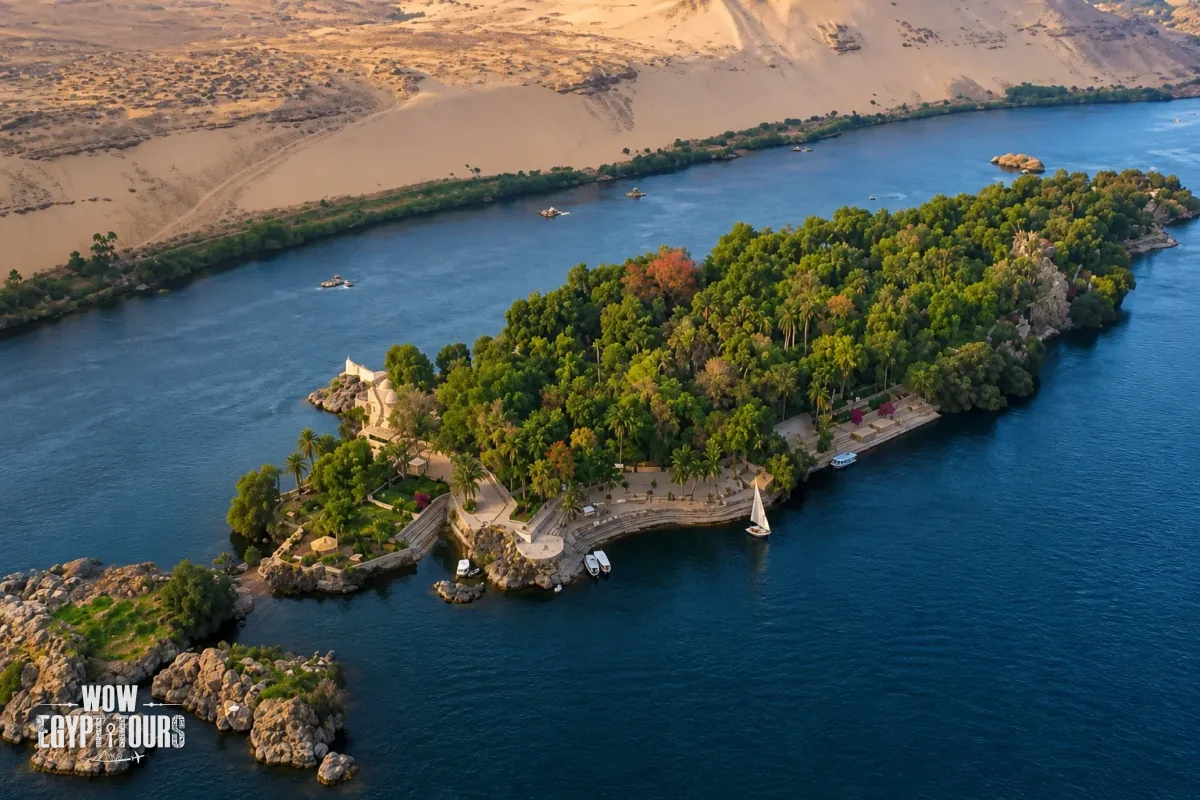

Elephantine Island is the most historically layered, most archaeologically significant, and most captivating island in the entire Egyptian Nile, a small granite island in the center of the Nile River at Aswan that has been continuously inhabited for more than five thousand years and that served as the most important frontier post, religious sanctuary, and commercial gateway between Egypt and the lands of Nubia throughout the entire pharaonic period. Located in the center of the Nile at the First Cataract, directly opposite the modern city of Aswan and surrounded by the spectacular black granite boulders and blue water of the most dramatic section of the Upper Egyptian Nile, Elephantine Island combines an extraordinary depth of ancient archaeological heritage with a living community of Nubian families whose village life today continues a tradition of human habitation that stretches back to the very beginning of Egyptian civilization. This remarkable destination sits at the heart of some of Egypt's most rewarding travel experiences, including Aswan Day Tours, Elephantine Island Tours, Dahabiya Nile River Cruises, Luxor Aswan Nile River Cruises, and Lake Nasser Cruises, all of which WOW Egypt Tours proudly offers to travelers from around the world. Elephantine Island is also a highlight of Egypt Tours Packages and Egypt Travel Packages, making it one of the most richly layered and most archaeologically rewarding destinations in all of Aswan.
The ancient site of Elephantine Island Egypt is celebrated above all for its extraordinary time depth, encompassing within the boundaries of a single small island the complete chronological arc of ancient Egyptian civilization from its earliest Predynastic origins through the Old Kingdom, Middle Kingdom, New Kingdom, Late Period, Ptolemaic Period, and Roman Period to the early Christian era, all in continuous stratigraphic sequence that has been systematically excavated by the German Archaeological Institute since 1969 in one of the longest-running and most productive archaeological research programmes in Egypt. The island is home to the ancient Temple of Khnum, the great ram-headed creator god of the Nile flood who was believed to control the annual inundation from his caverns beneath the First Cataract; the famous Nilometer of Elephantine, one of the best-preserved ancient Nilometers in Egypt, where the annual Nile flood level was measured and the agricultural and fiscal future of the country calculated; the Aswan Museum, which houses the most important collection of ancient artifacts from the Aswan region; and the remains of multiple other temples, shrines, and ancient installations spanning five thousand years of religious and administrative activity at this uniquely important border island. Visiting Elephantine Island is not simply a visit to an ancient site; it is an immersion in the complete story of ancient Egyptian civilization at the gateway to Africa, experienced on the actual ground where that story was lived for more than fifty centuries.

Who Built On Elephantine Island In Egypt?
The history of building on Elephantine Island spans the complete range of ancient Egyptian civilization, from the earliest Predynastic settlements of the 4th millennium BCE through the Roman Period, making the island one of the most comprehensively documented ancient settlement sites in the entire Nile Valley. The earliest significant monuments on the island date to the Early Dynastic Period around 3000 BCE, when Elephantine was already established as the administrative center of the southernmost nome of Upper Egypt and the primary gateway between Egypt proper and the lands of Nubia to the south. Old Kingdom pharaohs built temples and administrative buildings on the island, establishing Elephantine as the base for the trading expeditions to Nubia that brought gold, ivory, ebony, and exotic animals to the Egyptian court.
The principal ancient temple on Elephantine Island, the Temple of Khnum, was built and rebuilt multiple times over more than two thousand years, with significant construction phases during the New Kingdom, the Late Period, and the Ptolemaic Period. The most recently excavated and most clearly visible temple remains on the island date primarily to the 30th Dynasty and the Ptolemaic Period, though the site of the Khnum temple preserves the accumulated building history of all the earlier periods in its stratified remains. A second ancient temple, the Temple of Satet, the goddess of the First Cataract and consort of Khnum, preserves significant remains from the Old Kingdom through the Ptolemaic Period and is one of the oldest continuously rebuilt sacred sites on the island. The German Archaeological Institute excavations have also revealed the remains of multiple smaller shrines, chapels, administrative buildings, and private houses spanning the complete chronological range of occupation, making the Elephantine archaeological record one of the most complete urban stratigraphic sequences in Egypt.
Who Were Khnum And Satet?
The two principal divine residents of Elephantine Island, Khnum and Satet, were among the most ancient and most important deities in the religious tradition of the First Cataract region, and their cults at Elephantine formed part of a divine family that also included the goddess Anuket, the goddess of the cataracts, who rounded out the Elephantine triad of divine guardians of the sacred boundary between Egypt and Nubia.
Khnum, the ram-headed creator god, was venerated at Elephantine as the guardian of the sacred caverns beneath the First Cataract from which the annual Nile flood was believed to emerge. In his Elephantine form, Khnum was primarily a god of the inundation, controlling the divine sluice gates that released the life-giving floodwaters into the Nile Valley each year, and his role as the creator who fashioned human beings on his potter's wheel was closely connected at Elephantine with this life-giving power of the flood. The famous Famine Stela at Aswan, carved on the rocks of the nearby island of Sehel, records a dream of the pharaoh Djoser in which Khnum appeared and promised to end a seven-year famine by releasing the Nile flood from the caverns at Elephantine, a narrative that illustrates the paramount importance of the Khnum cult at Elephantine in the religious imagination of ancient Egypt.
Satet, the goddess of the First Cataract and of the annual inundation, was depicted wearing the white crown of Upper Egypt adorned with antelope horns, and was venerated as a protective goddess of the southern border and as the divine embodiment of the Nile flood at its source. Her temple on the southern tip of Elephantine Island is one of the oldest sacred sites on the island, with origins in the earliest periods of Egyptian religious history and with building phases traceable from the late Predynastic Period through the Ptolemaic era. Together Khnum and Satet embodied the dual creative power of the First Cataract landscape: the primordial creative force of the underground Nile caverns and the fertilizing power of the annual flood released from them.
Elephantine Island Location In Egypt
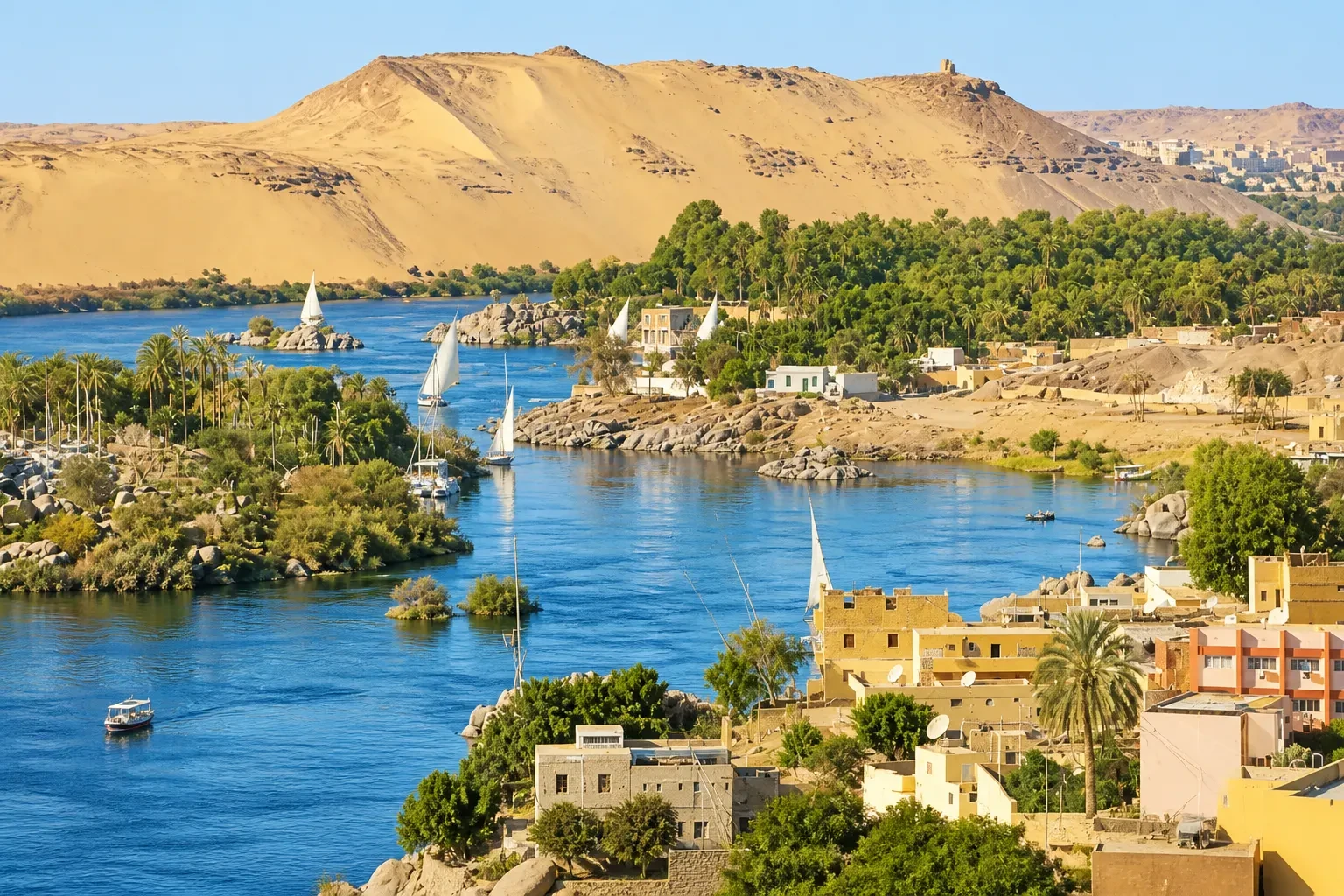
Elephantine Island is located in the center of the Nile River at the city of Aswan in Upper Egypt, approximately 550 kilometers south of Cairo, sitting directly opposite the Aswan Corniche waterfront and separated from the city by a narrow channel of the Nile that is crossed by regular public ferries operating throughout the day. The island measures approximately 1,200 meters from north to south and approximately 400 meters from east to west at its widest point, giving it an elongated oval shape that fits neatly between the east bank of the Nile where the modern city of Aswan stands and the west bank of the Nile where the Nubian villages and the desert begin. The archaeological site occupies the southern portion of the island, where the remains of the ancient settlement, the temples, and the Nilometer are concentrated, while the northern portion of the island is occupied by the Movenpick Aswan Hotel and its gardens. The southern portion of the island also has a small living Nubian community whose village streets, painted houses, and gardens create one of the most intimate and most atmospheric cultural landscapes available anywhere in the Aswan area. WOW Egypt Tours provides private ferry and motorboat transfers to Elephantine Island on all Aswan Day Tours, Egypt Tours Packages, and Nile River Cruise programmes that include the island.
Elephantine Island Fun Facts
Elephantine Island has the distinction of being one of the longest continuously inhabited sites in the Nile Valley, with an unbroken sequence of human occupation traceable from approximately 3500 BCE to the present day, a period of more than five thousand years during which the island has never been completely abandoned. The German Archaeological Institute excavations, ongoing since 1969, have revealed a stratigraphic sequence of archaeological deposits more than six meters deep in the central part of the island, encompassing the material remains of every major period of ancient Egyptian civilization from the Predynastic through the Roman era, making Elephantine one of the most comprehensively documented ancient urban sites in Africa.
The island takes its name, Elephantine, from the ancient Greek word for elephant, a reference either to the rounded black granite boulders in the Nile around the island that resemble the gray-brown skin of elephants, or to the island's ancient role as the primary entrepot for the ivory trade between sub-Saharan Africa and the Mediterranean world, with elephant tusks being among the most prized commodities that the Nubian trading expeditions brought north through the First Cataract gateway at Elephantine. The ancient Egyptian name for the island was Abu, meaning elephant, confirming the antiquity of the elephant association, and this name is still used in the modern Arabic toponym for the locality as Jazirat Abu, the Island of Abu or the Elephant Island.
The Elephantine Papyri, a collection of ancient Aramaic documents discovered on the island in the early 20th century and now distributed among several major international museums, constitute one of the most important documentary archives from the Persian Period in Egypt, dating to the 5th century BCE and providing extraordinary historical evidence for the life of a Jewish military colony stationed on Elephantine Island under the Persian administration, including letters, legal documents, and a remarkable correspondence about the local temple of the Jewish god Yahu that gives an intimate picture of religious life in the ancient multi-ethnic community of this remarkable island.
Why Is Elephantine Island Called By This Name In Egypt?
The name Elephantine is the ancient Greek form of the ancient Egyptian name Abu, meaning elephant. The identification of the island with the elephant goes back to the earliest periods of Egyptian history and may reflect two different but complementary realities of the island's ancient character. The most visually immediate explanation is the appearance of the black granite boulders that rise from the Nile around the island, particularly on the southern end where the First Cataract creates a landscape of smoothly rounded grey-black granite rocks polished by millennia of flowing water, which bear a striking visual resemblance to the rounded gray forms of elephants wading or bathing in a river. The second explanation connects the elephant name with the island's ancient commercial function as the primary transit point for the ivory trade, with elephant tusks being among the most prized and most commercially significant commodities that ancient Egyptian trading expeditions brought north from the land of Nubia through the First Cataract gateway, making the island literally the place where the elephant commodity entered the Egyptian economy.
Elephantine Island History
The history of Elephantine Island is essentially the history of the First Cataract as a sacred and strategic location in the geography of ancient Egypt, spanning more than five thousand years from the earliest Predynastic settlements to the living communities of today. The island's fundamental importance derived from its position at the First Cataract, the southernmost natural boundary of Egypt proper, where the Nile passes over a series of granite outcrops creating a series of rapids that were impassable for loaded river transport and that therefore constituted the practical southern limit of direct Egyptian administrative control. Everything south of the First Cataract, from the cataracts to the distant lands of equatorial Africa, was the domain of Nubia and the African interior, and everything north was Egypt. Elephantine Island, sitting directly at this boundary, was simultaneously the last Egyptian outpost before the frontier and the first point of contact for the trading caravans and diplomatic missions arriving from the south, making it the most strategically and commercially important point on the entire southern border of the Egyptian state.
During the Old Kingdom period, Elephantine was governed by a hereditary line of nomarchs, the Governors of Upper Egypt, whose tombs are cut into the western desert cliffs above the modern city of Aswan and who served as the primary conduits of the lucrative trade between Egypt and Nubia. These governors organized and led the trading expeditions south, negotiated with the Nubian chiefs, and reported directly to the pharaoh on conditions in the southern borderlands. Their biographical inscriptions, some of the most vivid and most informative official texts from the Old Kingdom period, record expeditions to mines and quarries, diplomatic encounters with Nubian rulers, and the acquisition of exotic trade goods including gold, ivory, ebony, incense, and live animals for the royal menagerie. During the Middle Kingdom, Elephantine was the base for the military campaigns to colonize Nubia, with a series of powerful mud-brick fortresses built south of the island to control the cataracts and the trade routes. During the New Kingdom, when Egypt colonized Nubia directly and established a network of temples and administrative centers throughout the Nubian Nile Valley, Elephantine retained its importance as the administrative capital of the southernmost Egyptian province and the religious center of the First Cataract cult of Khnum and Satet. The island was occupied and developed continuously through the Late Period, the Ptolemaic Period, and the Roman Period, with successive rulers adding to the existing religious and administrative infrastructure.
The Story Of The Jewish Community At Elephantine
One of the most remarkable and most unexpected chapters in the history of Elephantine Island is the story of the Jewish military colony that was stationed on the island during the Persian Period in Egypt, approximately 525 BCE to 404 BCE. This colony, known from the extraordinary documentary evidence of the Elephantine Papyri, consisted of Jewish soldiers and their families who served in the Persian army as a garrison at the First Cataract frontier. The community had its own temple dedicated to the Jewish god Yahu (Yahweh), built on the island before the Persian conquest, which coexisted with the ancient Egyptian temples of Khnum and Satet in a remarkable example of religious pluralism at the most sacred point of the Egyptian southern border.
The Elephantine Papyri, written in Aramaic, the administrative language of the Persian empire, include letters, legal contracts, marriage documents, and most remarkably a series of letters sent by the Jewish community to the Persian governor of Judah asking for help in rebuilding their temple after it was destroyed by Egyptian priests who resented the presence of a non-Egyptian religious institution on the sacred island of Elephantine. These letters, and the responses they received, give one of the most intimate and most immediate pictures of daily life, religious practice, and inter-communal relations in the ancient multi-ethnic society of the Persian-period Nile Valley available from any ancient documentary source. The Elephantine Jewish community was eventually dispersed or assimilated after the end of Persian rule, but their papyri, scattered to museums in Berlin, Brooklyn, Cairo, and elsewhere after their discovery in the early 20th century, remain one of the most important and most humanly immediate documentary archives from the ancient world.
Elephantine Island Architecture And Key Features
The Nilometer
The most celebrated and most important single ancient monument on Elephantine Island is the Nilometer, one of the two most famous ancient Nilometers in Egypt (the other being the Nilometer on Rhoda Island in Cairo), and the one whose measurements were of the most direct practical significance for the management of the Egyptian agricultural economy throughout the entire pharaonic, Islamic, and early modern periods. The Elephantine Nilometer consists of a rectangular pit cut down through the bedrock to the level of the Nile, with a central staircase descending the full depth of the pit and with the walls marked by graduated measurement scales in ancient Egyptian cubits and in later Arabic measurements. The current structure, while incorporating the ancient measurement shaft, was substantially rebuilt and redecorated during the Mamluk and Ottoman periods, and the Arabic inscriptions on its walls record the flood measurements of successive years from the Islamic period alongside the much older ancient Egyptian markings. The Nilometer descends approximately nine meters below the modern ground surface to the Nile water level, and visitors descend the staircase to examine the measurement scales on the walls and to appreciate the direct connection between this ancient measuring device and the practical management of the most important natural resource in Egyptian civilization.
The Temple Of Khnum
The ancient Temple of Khnum, the most important religious institution on Elephantine Island throughout the pharaonic period, occupies the central portion of the southern archaeological zone of the island. The temple was rebuilt multiple times over more than two thousand years, with the most recent ancient construction phase dating to the 30th Dynasty pharaoh Nectanebo I and to subsequent Ptolemaic additions, though these later structures themselves rest on the foundations of much earlier temples going back to the Old Kingdom and Middle Kingdom periods. The surviving remains of the Khnum temple, while less spectacularly preserved than the great Ptolemaic temples of Edfu or Dendera, include significant decorated architectural elements, column capitals, carved relief blocks, inscriptions, and foundation remains that document the building history of the temple across multiple periods and provide a uniquely layered record of the evolution of an ancient Egyptian sacred site from its earliest origins through its final ancient form.
The Temple Of Satet
On the southern tip of Elephantine Island, the ancient Temple of Satet occupies one of the most dramatically situated sacred sites in the entire Nile Valley, perched on the southernmost point of the island directly above the First Cataract rapids with the black granite boulders of the Nile visible in every direction. The Satet temple has a building history that is among the longest of any ancient Egyptian sacred site, with the earliest cult installations at this location dating to the late Predynastic Period around 3200 BCE and with significant building phases from virtually every major period of Egyptian history through the Ptolemaic era. The current visible remains include elements from multiple periods, including a beautiful small Ptolemaic chapel with decorated walls that is one of the most well-preserved ancient structures on the island, and the remains of earlier sanctuary buildings of the Old Kingdom, Middle Kingdom, and New Kingdom that have been excavated and analyzed by the German Archaeological Institute team.
The Aswan Museum
The Aswan Museum, located on the northern portion of the southern archaeological zone of Elephantine Island, houses the most important collection of ancient artifacts from the Aswan region, including finds from the excavations at Elephantine Island itself and from other archaeological sites in the First Cataract area. The museum collection spans the complete range of ancient Egyptian material culture from the Predynastic through the Ptolemaic Period, including pottery, stone vessels, sculpture, jewelry, shabtis and funerary equipment, inscribed objects, architectural elements, and the remarkable range of domestic and commercial artifacts recovered from the German Archaeological Institute excavations at the ancient settlement site. The museum building itself, a former British colonial administration building dating from the early 20th century, provides a pleasantly atmospheric setting for the collection, with views across the Nile to the Aswan waterfront from its garden terrace. The museum was partially closed for renovation in recent years and visitors should confirm current opening status through WOW Egypt Tours at the time of planning their visit.
The German Archaeological Institute Excavations
The ongoing German Archaeological Institute excavations at Elephantine Island, continuously active since 1969, constitute one of the longest-running and most productive archaeological research programmes in Egypt and one of the most significant contributions to the understanding of ancient Egyptian urban history and material culture. The excavations have revealed the complete ancient settlement sequence of the island, from its earliest Predynastic origins through the Roman Period, in a stratigraphic record of extraordinary completeness and detail. Recent excavation campaigns have focused particularly on the Old Kingdom and earlier periods, recovering architectural remains and material culture of a quality and completeness that is rarely available at comparable ancient sites. Visitors to the archaeological zone of Elephantine Island can observe the excavation areas and the exposed ancient remains of the settlement, giving a direct and immediate sense of the archaeological work in progress that is one of the most distinctive and most educationally enriching aspects of the Elephantine Island visit experience.
The Ancient Quarry And Granite Landscape
The southern end of Elephantine Island and the surrounding Nile channel are dominated by the spectacular landscape of the First Cataract, with the black and grey granite boulders that characterize the Aswan region rising from the water in every direction around the island. These granite boulders, the same geological formation that provided the raw material for the obelisks, sarcophagi, colossal statues, and architectural elements of ancient Egyptian monumental culture, bear on many of their surfaces the ancient quarrymen's marks and inscriptions that document the millennia of stone-working activity at the First Cataract. Walking through the granite boulder landscape of the southern island, visitors experience directly the geological foundation of the ancient Egyptian building tradition, the actual bedrock from which the stone of civilization was cut, in a natural setting of great visual drama and historical resonance that complements the archaeological excavations and the ancient temple remains in making the Elephantine Island visit one of the most multidimensional heritage experiences in the Aswan area.
The Living Nubian Community
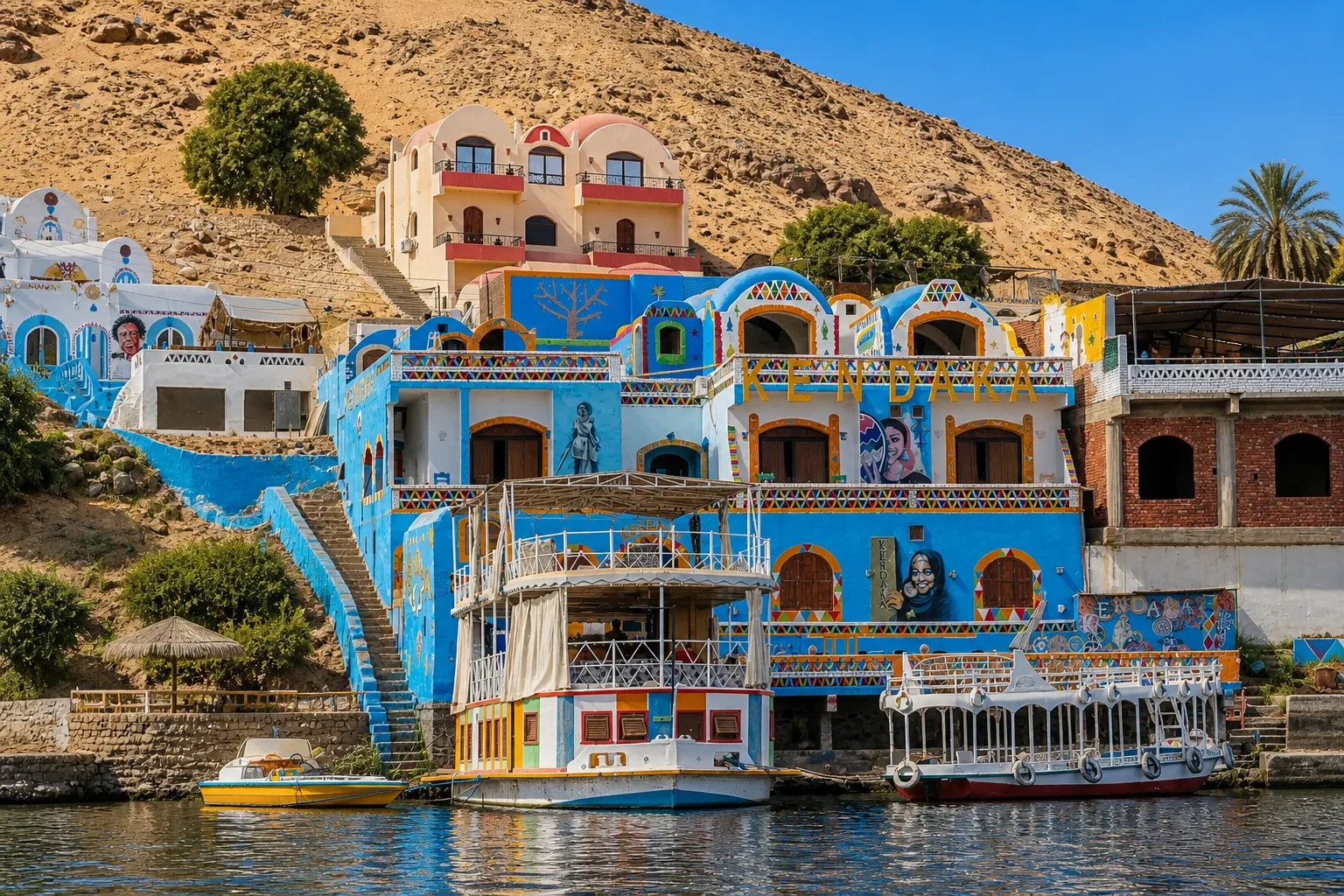
The southern portion of Elephantine Island is not only an archaeological site but also a living community, with a small Nubian village occupying part of the island's southern end alongside the ancient temples and the Nilometer. The Nubian families of Elephantine Island have lived on the island for generations and maintain the characteristic painted house architecture, the traditional hospitality, and the community life of the broader Nubian Village culture of the Aswan area in an island setting of unique intimacy and beauty. The combination of the ancient archaeological landscape with the living Nubian community gives Elephantine Island a quality of time depth and human continuity that is unlike anything at any other ancient site in Egypt, a place where the five-thousand-year story of human settlement at the First Cataract is experienced not as a sequence of discrete historical episodes but as a single continuous human presence that stretches from the earliest Egyptian civilization to the present day.
Why Is Elephantine Island Important?
Elephantine Island is important for reasons that span archaeological, historical, religious, and cultural dimensions in a combination that is unique among all the ancient sites of the Aswan area. Archaeologically, it is the most comprehensively excavated ancient urban site in Upper Egypt, with a stratigraphic sequence spanning more than five thousand years that provides the most complete available record of the material culture, religious life, and administrative organization of an ancient Egyptian border community from the earliest periods of civilization. Historically, it was the most strategically important point on the southern frontier of the ancient Egyptian state for more than two thousand years, the gateway through which all trade with Nubia and sub-Saharan Africa passed and the base from which the Egyptian colonial administration of Nubia was organized. Religiously, it was the primary sacred site of the First Cataract cult of Khnum and Satet, the divine guardians of the Nile flood whose annual management was the most important religious and economic concern of the Egyptian state. The Nilometer of Elephantine was the primary instrument through which the Egyptian administration monitored and predicted the agricultural future of the country throughout the pharaonic period.
The Elephantine Papyri make the island uniquely important as the source of one of the most important documentary archives from the ancient world, providing evidence not only for the political and administrative history of the Persian Period in Egypt but for the social, religious, and domestic life of the multi-ethnic community that occupied the island at one of the most politically complex moments in Egyptian history. WOW Egypt Tours includes Elephantine Island as a featured destination on extended Aswan Day Tours, full Aswan programme itineraries, Nile River Cruise overnight programmes, and Lake Nasser Cruise embarkation and disembarkation day programmes.
What Are Some Interesting Facts About Elephantine Island?
The Island That Measured The Future Of Egypt
The practical importance of the Elephantine Nilometer for the ancient Egyptian state can hardly be overstated. Each year, as the annual Nile flood began its rise in June and July, the chief responsibility of the administrators of Elephantine was to monitor the flood level at the Nilometer and report the measurements to the central government in Memphis or Thebes. The flood level measured at Elephantine in the early weeks of the inundation determined not only the expected harvest of the coming agricultural year but the entire fiscal and administrative planning of the state, since Egyptian taxation was calibrated to the flood level, with higher floods generally meaning more productive agricultural land and therefore higher tax assessments, and lower floods meaning the prospect of reduced harvests and the potential for famine. The Elephantine Nilometer was therefore not merely an interesting ancient measuring device but the most important instrument of economic and administrative intelligence in the entire Egyptian state, and the island that housed it was in a real sense the information center of the Egyptian economy.
Five Thousand Years In A Single Archaeological Profile
The German Archaeological Institute excavations at Elephantine Island have produced what is arguably the most complete stratigraphic profile of ancient Egyptian urban history available anywhere in the Nile Valley. In a single excavation area on the southern portion of the island, the archaeological sequence descends from Roman Period levels at the surface through Ptolemaic, Late Period, New Kingdom, Middle Kingdom, Old Kingdom, Early Dynastic, and ultimately Predynastic deposits at the base, in an unbroken stratigraphic column that documents more than five thousand years of continuous human occupation in the same location. The pottery sequences, architectural remains, and material culture assemblages recovered from each level provide an extraordinarily detailed record of how ancient Egyptian daily life, religious practice, architectural technology, and commercial activity evolved over five millennia at this single critical point in the geography of the Nile Valley.
The Island At The Edge Of The Ancient World
Elephantine Island occupied a unique position in the ancient Egyptian understanding of the world as the southernmost point of Egypt proper, the last outpost of the ordered, civilized, Nile-fed world before the wild and dangerous landscape of the Nubian cataracts began. For the ancient Egyptians, who understood their country as the uniquely blessed land watered by the divine Nile and protected by the divine pharaoh, the First Cataract at Elephantine represented the edge of the known and ordered world, beyond which the Nile became unnavigable, the land became increasingly wild and foreign, and the peoples of the south, however commercially valuable their gold and ivory, were fundamentally different from the inhabitants of the Nile Valley. Standing on the southern tip of Elephantine Island and looking south across the First Cataract rapids to the landscape of the ancient Nubian frontier, visitors can feel something of the psychological and cultural significance of this ancient boundary, the edge of Egypt and the beginning of Africa, that gave Elephantine its extraordinary importance and its extraordinary richness of ancient heritage.
What Is So Special About Elephantine Island?
The Most Time-Dense Ancient Site In Upper Egypt
What makes Elephantine Island uniquely special among all the ancient sites of the Aswan area is the extraordinary density of historical time that it concentrates within the boundaries of a single small island in the Nile. In the space of a walk of perhaps 30 minutes from one end to the other, visitors pass through more than five thousand years of continuous human occupation, from the Predynastic settlement remains of the earliest Egyptians at the base of the archaeological sequence to the living Nubian community on the island's southern waterfront today. At no other point in Egypt, including even the great ancient cities of Luxor and Memphis, can the complete arc of Egyptian civilization from its earliest origins to the present day be experienced in such physical proximity and such geographic intimacy as on the small island of Elephantine at the First Cataract of the Nile.
An Island Alive With Past And Present
Elephantine Island is also uniquely special because it is simultaneously an active archaeological site, an ancient heritage destination, and a living community, three dimensions that are rarely found in such immediate combination at any other ancient site in Egypt. The German Archaeological Institute excavations continue to reveal new aspects of the island's ancient past in one part of the site while Nubian families go about their daily lives in another part and tourists explore the Nilometer and the museum in a third. This quality of layered contemporaneity, ancient archaeology, heritage tourism, and living community all occupying the same small island in peaceful coexistence, gives Elephantine Island a unique vitality and a unique sense of continuous human presence that makes it unlike any other heritage destination in the Nile Valley.
Elephantine Island Through The Ages: From Ancient Egypt To The Present
The history of Elephantine Island after the ancient period is one of continuous occupation and gradual archaeological accumulation, with the medieval Arabic town built directly on top of the ancient remains and with the island's strategic importance at the First Cataract gateway maintaining its significance through the Islamic period and beyond. During the early Christian era, the ancient temples of Khnum and Satet were converted or abandoned, with a Coptic Christian church established on the island and the temple buildings gradually quarried for building material or buried under the accumulating debris of the medieval town. The Arab conquest of Egypt in 641 CE brought a new administrative and cultural framework to the island, and Elephantine continued to be inhabited as an important river crossing point and trading center throughout the medieval period.
The British colonial period brought the first systematic modern documentation of the ancient remains, with European travelers and scholars recording the temples, the Nilometer, and the inscriptions on the island from the early 19th century onwards. The discovery of the Elephantine Papyri in the early 20th century, sold by local treasure hunters to various European dealers and eventually acquired by museums in Berlin, Brooklyn, and Cairo, brought the island to international scholarly attention. The German Archaeological Institute excavations, beginning in 1969 and continuing to the present day, have been the defining modern development for the island, producing the systematic archaeological knowledge that has transformed Elephantine from a partially documented ancient site into one of the most comprehensively understood ancient urban sequences in all of Egypt. Today the island is managed as a combined heritage and living community site by the Egyptian Ministry of Tourism and Antiquities in cooperation with the German Archaeological Institute, receiving visitors from around the world who come to explore the Nilometer, the museum, the ancient temple remains, the ongoing excavations, and the living Nubian community that inhabits the island alongside its ancient past.
Elephantine Island UNESCO World Heritage Status
Elephantine Island is part of the broader concentration of ancient heritage in the Aswan area that is associated with the Nubian Monuments from Abu Simbel to Philae UNESCO World Heritage Site, inscribed in 1979. The ancient settlement sequence at Elephantine, spanning more than five thousand years from the Predynastic Period through the Roman era, is recognized internationally as one of the most important and most comprehensively documented ancient urban sites in Africa and as an essential component of the understanding of ancient Egyptian civilization at its southern frontier. The ongoing German Archaeological Institute research programme at Elephantine is supported by the Egyptian Ministry of Tourism and Antiquities and is recognized as one of the most significant contributions to the scientific understanding of ancient Egyptian urban history and material culture available from any currently active archaeological project in Egypt.
Best Time To Visit Elephantine Island
The best time to visit Elephantine Island is during the cooler months from October through April, when temperatures in the Aswan area are moderate and exploration of the outdoor archaeological site, the granite boulder landscape, and the Nubian village streets is comfortable throughout the day. The Aswan area can be intensely hot in summer, with temperatures regularly exceeding 40 degrees Celsius from May to September, and the open archaeological landscape of the southern island with its granite surfaces reflecting and amplifying the solar heat can be particularly challenging in the midday heat of summer months. If visiting in summer, plan your Elephantine Island visit for the early morning when the island is at its most cool and when the light on the ancient temple remains and the Nile landscape is at its most beautiful. WOW Egypt Tours plans all Elephantine Island visits at the optimal time of day for the season and the specific itinerary.
Elephantine Island Opening Hours
The Elephantine Island archaeological site and Nilometer are open to visitors every day of the week, including public holidays. The site opens at 8:00 AM and closes at 4:00 PM from October to April, and from 8:00 AM to 5:00 PM from May to September. The Aswan Museum on the island is subject to its own opening hours and renovation schedule, and visitors should confirm current status through WOW Egypt Tours at the time of planning their visit. Public ferries to the island operate throughout the day from the Aswan Corniche, with the last ferry typically running in the early evening. The most peaceful time to visit is in the morning before the main tourist groups arrive.
Elephantine Island Entrance Fees
Adults: EGP 200
Students: EGP 100
The entrance fee covers access to the archaeological site including the Nilometer, the Temple of Khnum remains, the Temple of Satet, the excavation areas, and the island pathways. The Aswan Museum has a separate admission fee when open. The public ferry to and from the island is charged separately at a nominal fare. All entrance fees and ferry transfers to Elephantine Island are included in all Aswan Day Tours, Egypt Tours Packages, and Nile River Cruise programmes that include the island visit, booked through WOW Egypt Tours.
How To Get To Elephantine Island
Elephantine Island is accessible from the Aswan Corniche waterfront by regular public ferry service operating throughout the day, a crossing of approximately 5 minutes across the narrow Nile channel that separates the island from the city. The public ferry landing on the island is on the eastern side of the island directly opposite the city ferry terminal. Private motorboats are also available for hire from the Aswan waterfront for a slightly faster and more private crossing. All transportation including ferry or motorboat transfers to and from Elephantine Island is included in all Aswan Day Tours, Egypt Tours Packages, and Nile River Cruise programmes that include the island visit, booked through WOW Egypt Tours.
How Long To Spend At Elephantine Island
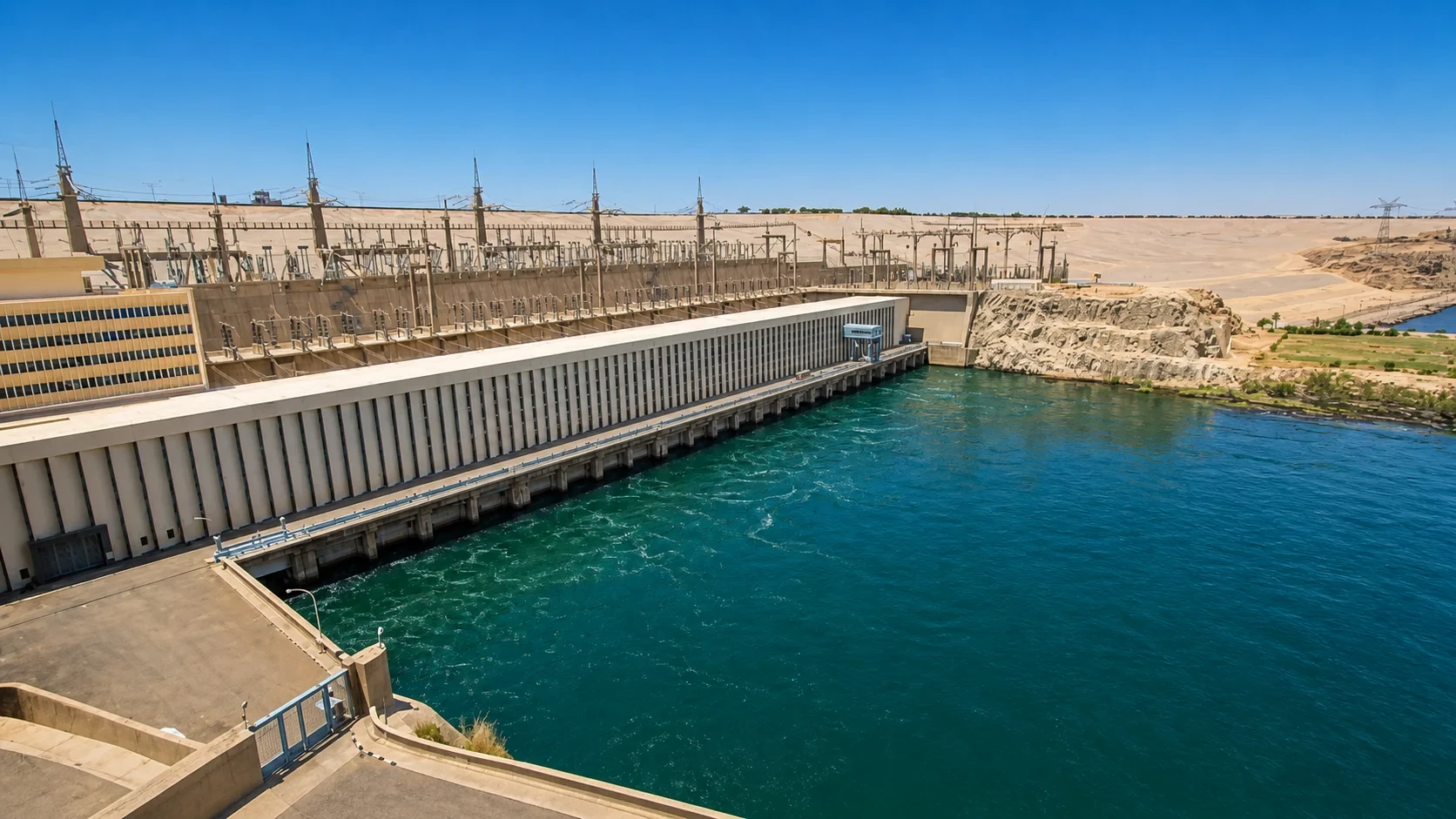
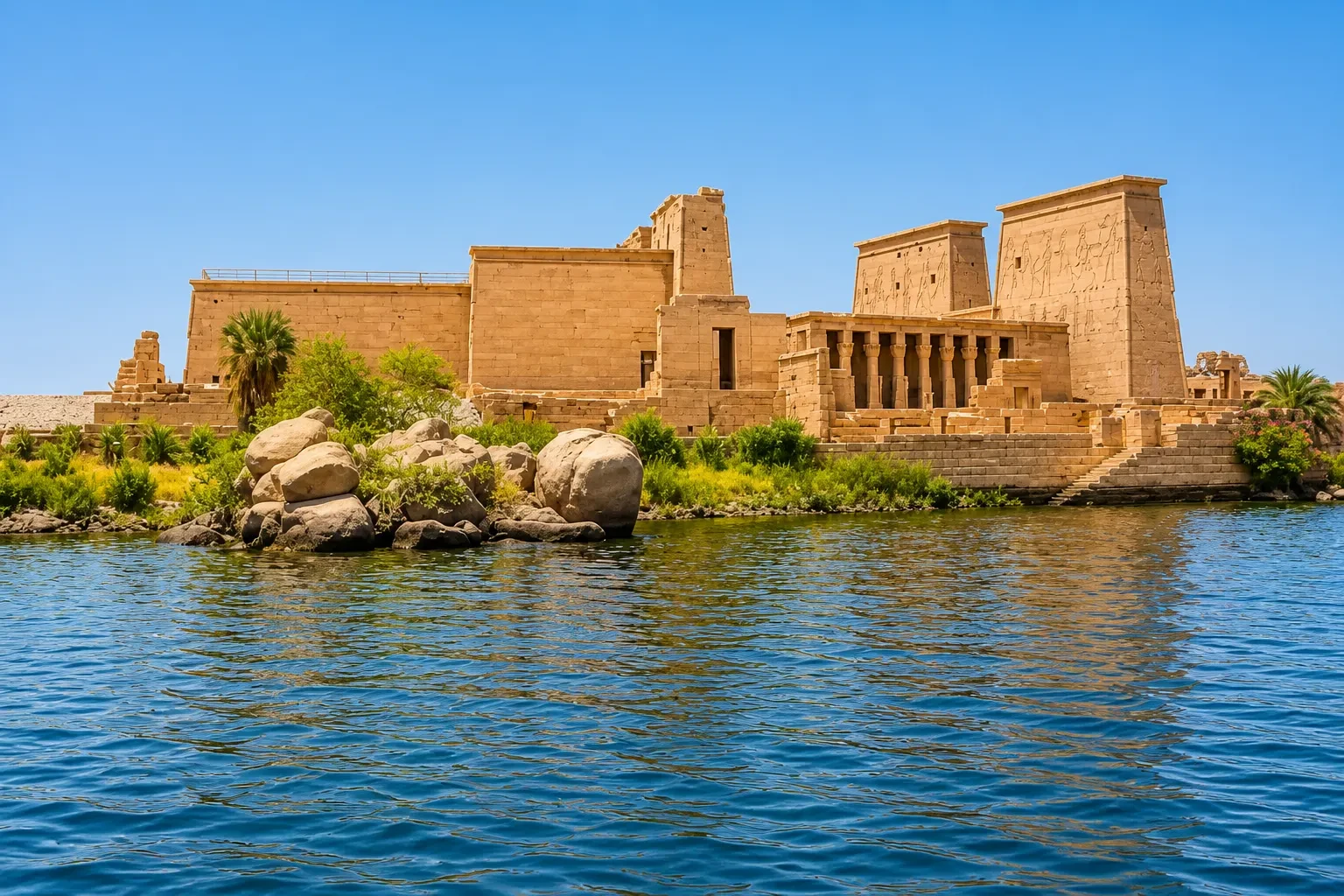
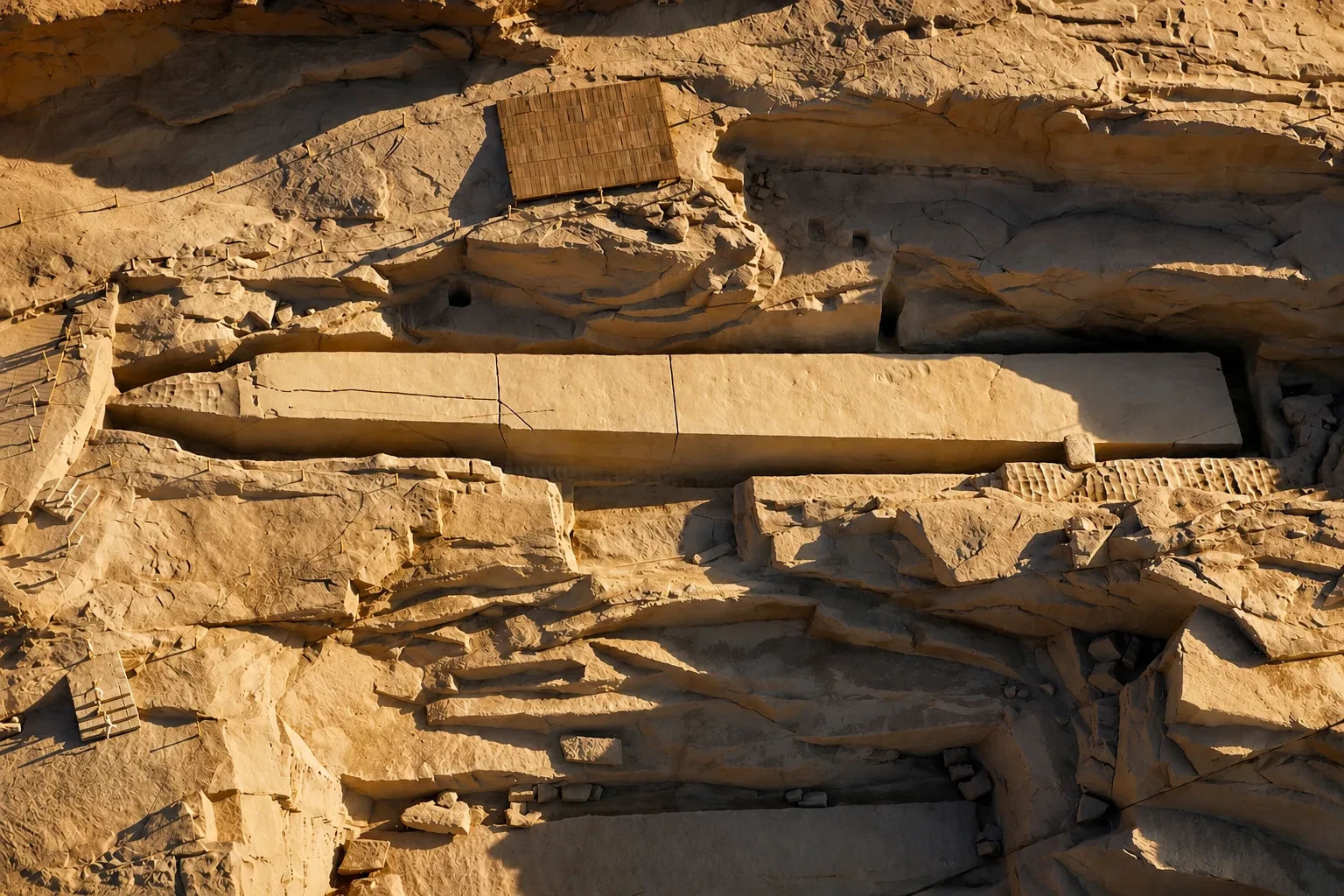
Most visitors spend between one and two hours on Elephantine Island, which is sufficient time to descend the Nilometer with a guided explanation of its significance, walk through the main archaeological zone with the Khnum and Satet temple remains, visit the Aswan Museum if open, see the German Archaeological Institute excavation areas, walk through the living Nubian village streets on the southern portion of the island, and appreciate the extraordinary granite boulder landscape of the First Cataract from the island's southern waterfront. Visitors with a particular interest in the archaeological history, the Jewish community papyri, or the detailed architecture of the ancient temples may wish to allow two hours. Elephantine Island is most commonly combined in Aswan with the Temple of Isis at Philae, the Aswan High Dam, the Unfinished Obelisk, and the Nubian Village for the most complete Aswan day experience.
Tips For Visiting Elephantine Island
Ask your guide to explain the measurement system of the Nilometer before descending, as understanding the ancient cubit scale and the significance of different flood levels for Egyptian agriculture and taxation transforms the experience of examining the Nilometer from a passive appreciation of an ancient measuring device into a genuine understanding of the most important instrument of ancient Egyptian economic administration. Allow time to walk the complete archaeological zone from north to south, as the progression from the Khnum temple remains through the Satet temple to the southern tip with its First Cataract granite landscape creates a coherent narrative experience of the island's sacred geography that is lost if visits are confined to the Nilometer alone. Look for the ongoing German Archaeological Institute excavation areas and ask your guide to explain what the excavators are currently investigating, as a direct encounter with active archaeological research in progress is one of the most intellectually stimulating aspects of the Elephantine Island visit. Spend time in the Nubian village streets on the southern portion of the island, where the living community provides the most intimate and most immediate encounter with the tradition of human habitation at the First Cataract that is the defining characteristic of Elephantine. A licensed Egyptologist guide from WOW Egypt Tours is essential for the full appreciation of the island's extraordinary archaeological complexity. Do not touch any ancient surfaces anywhere on the site.
What To Wear At Elephantine Island
Elephantine Island is an open-air site with the archaeological zone exposed to direct sun for much of the day, and with paths that cross both paved areas and natural granite rock surfaces. Lightweight, breathable clothing covering the shoulders and knees is recommended for both comfort and as a mark of respect when passing through the living Nubian community on the island. A wide-brimmed hat and generous sunscreen are essential for visits in the warmer months, as the granite surfaces of the First Cataract landscape reflect and amplify the heat significantly. Comfortable, closed-toe walking shoes with good grip are necessary for the uneven granite rock surfaces, the steps down to the Nilometer, and the sandy paths through the archaeological zone. Bring water, as there are limited refreshment facilities on the island outside the hotel on the northern portion. A light layer is useful in the early morning or in winter, as the island waterfront can be noticeably cool before the sun reaches full strength.
Photography At Elephantine Island
Elephantine Island is a rewarding and varied photography destination, offering a combination of ancient archaeological remains, the dramatic Nilometer pit with its staircase and measurement scales, the spectacular granite boulder landscape of the First Cataract, the painted facades of the Nubian village houses, and the panoramic views across the Nile to the Aswan waterfront and the desert horizon. Photography with a standard camera or smartphone is permitted throughout the archaeological site. Flash photography is strictly prohibited inside the Nilometer and near any carved, painted, or inscribed ancient surfaces. For photography of the Nilometer interior, a camera with good low-light performance is recommended as the pit receives very limited natural light in its lower sections. The most dramatic photography of the island setting is obtained from the southern waterfront looking south across the First Cataract granite boulders, or from the Nile looking back at the island from a boat on the western or eastern water channels. Photography in the Nubian village streets should follow the standard etiquette of asking permission before photographing people. Professional photography or filming requires a separate permit from Egypt's Ministry of Tourism and Antiquities.
Elephantine Island Tours
Single Attraction Visit: Elephantine Island Tour From Aswan
This dedicated tour visits Elephantine Island as a standalone archaeological and cultural excursion from Aswan, suitable for travelers with a particular interest in ancient Egyptian history, the First Cataract cult of Khnum and Satet, the Nilometer and its significance for ancient Egyptian administration, or the active German Archaeological Institute excavations.
What Is Covered
Ferry transfer to Elephantine Island. Full guided walk of the archaeological zone including the Nilometer with a descent to examine the measurement scales, the Temple of Khnum remains, the Temple of Satet on the southern tip, the German Archaeological Institute excavation areas, and the Aswan Museum if open. Walk through the living Nubian village streets on the island's southern portion. Appreciation of the First Cataract granite boulder landscape from the island waterfront. Return ferry to Aswan.
Duration
1 to 2 hours on the island, plus ferry transfer time from the Aswan Corniche.
Includes
Private vehicle from Aswan hotel to the Corniche, ferry transfer to and from the island, private licensed Egyptologist guide, and entrance fees. Available for morning and afternoon departures.
Full Aswan Day Tour: Elephantine Island, Philae Temple, High Dam, Unfinished Obelisk, And Nubian Village
This comprehensive full-day tour from Aswan covers the complete range of Aswan highlights, combining the archaeological depth of Elephantine Island with the sacred beauty of the Temple of Isis at Philae, the engineering drama of the Aswan High Dam, the industrial revelation of the Unfinished Obelisk, and the living cultural warmth of the Nubian Village.
What Is Covered
Elephantine Island with a guided visit of the Nilometer, the temple remains, the excavation areas, and the Nubian community. The Aswan High Dam. The Unfinished Obelisk. The Temple of Isis at Philae with motorboat transfer and full guided island visit. A traditional Nubian Village on the west bank. Optional: the Aswan Botanical Garden on Kitchener's Island, easily combined with the Elephantine Island visit as a single island excursion programme.
Duration
Full day from Aswan with appropriate time at each site.
Includes
Private air-conditioned transportation from Aswan hotel, ferry transfer to Elephantine Island, motorboat transfers for Philae and Nubian Village, private licensed Egyptologist guide, and entrance fees to all included sites. Available for morning departures.
Elephantine Island And Aswan Botanical Garden Combined Visit
This half-day tour combines a visit to the archaeological and cultural heritage of Elephantine Island with the natural beauty of the Aswan Botanical Garden on the neighboring Kitchener's Island, creating the most complete experience of the Aswan island landscape available in a single half-day programme.
What Is Covered
Elephantine Island with a guided visit of the Nilometer, the ancient temple remains, the excavation areas, and the living Nubian village. The Aswan Botanical Garden on Kitchener's Island with a guided walk through the collection of tropical plants from Africa, Asia, and the Americas.
Duration
Half day from Aswan, approximately 1 to 1.5 hours at Elephantine Island and 1 hour at the Botanical Garden.
Includes
Private vehicle from Aswan hotel, motorboat transfers between the islands, private licensed guide, and entrance fees. Available for morning departures.
Dahabiya Nile River Cruise
A Dahabiya Nile River Cruise is a small-vessel sailing experience on the Nile between Luxor and Aswan aboard a traditional wooden dahabiya. WOW Egypt Tours operates dahabiya cruises with private cabins, all meals, a private licensed Egyptologist guide on board, and guided shore excursions at every stop. Elephantine Island is available as an optional addition to all Dahabiya itineraries at the Aswan embarkation or disembarkation end of the journey, as part of an extended Aswan programme.
4 Days 3 Nights Dahabiya Nile River Cruise From Aswan To Luxor
Route: Aswan to Luxor, sailing north.
Itinerary
Day 1: Embarkation in Aswan. Guided visits to Philae Temple, the Aswan High Dam, and the Unfinished Obelisk. Optional Elephantine Island visit as an additional morning activity. Sail north to Kom Ombo. Guided visit to Kom Ombo Temple and Crocodile Museum. Continue to Gebel el Silsila. Overnight on board.
Day 2: Guided visit to Gebel el Silsila. Sail to the Village of Basaw. Guided visit to Village of Basaw. Continue to Edfu. Guided visit to the Temple of Horus at Edfu. Overnight on board.
Day 3: Sail to El Kab. Guided visit to El Kab Tombs. Sail to El Hagaz Island. Swimming stop. Overnight on board.
Day 4: Sail to Esna. Visit Khnum Temple at Esna. Disembarkation in Esna. Transfer to Luxor, approximately 55 kilometers (35 miles).
Includes
Private cabin, all meals on board, private licensed Egyptologist guide, entrance fees to all site visits, and private transfers. Elephantine Island visit available as an optional addition on embarkation day.
5 Days 4 Nights Dahabiya Nile River Cruise From Luxor To Aswan
Route: Luxor to Aswan, sailing south.
Itinerary
Day 1: Embarkation in Luxor. Transfer to Esna, approximately 55 kilometers (35 miles). Visit Khnum Temple at Esna. Sail to El Hagaz Island. Overnight on board.
Day 2: Sail to El Kab. Guided visit to El Kab Tombs. Continue to Edfu. Guided visit to the Temple of Horus at Edfu. Sail to the Village of Basaw. Guided visit to Village of Basaw. Overnight on board.
Day 3: Sail to Gebel el Silsila. Guided visit to Gebel el Silsila. Sail south to Kom Ombo. Guided visit to Kom Ombo Temple and Crocodile Museum. Sail to Daraw Village. Overnight on board.
Day 4: Guided visit to Daraw Village. Sail to Herbiab Island. Swimming stop. Philae Sound and Light Show. Overnight on board.
Day 5: Guided visits to Philae Temple, the Aswan High Dam, and the Unfinished Obelisk. Optional Elephantine Island visit. Disembarkation in Aswan.
Includes
Private cabin, all meals on board, private licensed Egyptologist guide, entrance fees to all site visits, and private transfers. Elephantine Island visit available as an optional addition on disembarkation day.
8 Days 7 Nights Dahabiya Nile River Cruise Round Trip From Luxor (Via Aswan)
Route: Luxor and Aswan, sailing north and south.
Itinerary
Day 1: Embarkation in Luxor. Transfer to Esna, approximately 55 kilometers (35 miles). Visit Khnum Temple at Esna. Sail to El Hagaz Island. Overnight on board.
Day 2: Sail to El Kab. Continue to Edfu. Guided visit to the Temple of Horus at Edfu. Sail to the Village of Basaw. Guided visit to Village of Basaw. Overnight on board.
Day 3: Sail to Gebel el Silsila. Sail south to Kom Ombo. Guided visit to Kom Ombo Temple and Crocodile Museum. Sail to Daraw Village. Overnight on board.
Day 4: Guided visit to Daraw Village. Sail to Herbiab Island. Swimming stop. Philae Sound and Light Show. Overnight on board.
Day 5: Guided visits to Philae Temple, the Aswan High Dam, and the Unfinished Obelisk. Optional Elephantine Island visit. Sail north to Kom Ombo. Continue to Gebel el Silsila. Overnight on board.
Day 6: Guided visit to Gebel el Silsila. Sail to the Village of Basaw. Continue to Edfu. Guided visit to the Temple of Horus at Edfu. Overnight on board.
Day 7: Sail to El Kab. Guided visit to El Kab Tombs. Sail to El Hagaz Island. Swimming stop. Overnight on board.
Day 8: Disembarkation in Esna. Transfer to Luxor, approximately 55 kilometers (35 miles).
Includes
Private cabin, all meals on board, private licensed Egyptologist guide, entrance fees to all site visits, and private transfers. Elephantine Island visit available as an optional addition.
8 Days 7 Nights Dahabiya Nile River Cruise Round Trip From Aswan (Via Luxor)
Route: Luxor and Aswan, sailing north and south.
Itinerary
Day 1: Embarkation in Aswan. Guided visits to Philae Temple, the Aswan High Dam, and the Unfinished Obelisk. Optional Elephantine Island visit. Sail north to Kom Ombo. Guided visit to Kom Ombo Temple and Crocodile Museum. Continue to Gebel el Silsila. Overnight on board.
Day 2: Guided visit to Gebel el Silsila. Sail to the Village of Basaw. Continue to Edfu. Guided visit to the Temple of Horus at Edfu. Overnight on board.
Day 3: Sail to El Kab. Guided visit to El Kab Tombs. Sail to El Hagaz Island. Swimming stop. Overnight on board.
Day 4: Sail to Esna. Visit Khnum Temple at Esna. Sail to El Hagaz Island. Overnight on board.
Day 5: Sail to El Kab. Continue to Edfu. Guided visit to the Temple of Horus at Edfu. Sail to the Village of Basaw. Guided visit to Village of Basaw. Overnight on board.
Day 6: Sail to Gebel el Silsila. Sail south to Kom Ombo. Guided visit to Kom Ombo Temple and Crocodile Museum. Sail to Daraw Village. Overnight on board.
Day 7: Guided visit to Daraw Village. Sail to Herbiab Island. Swimming stop. Philae Sound and Light Show. Overnight on board.
Day 8: Guided visits to Philae Temple, the Aswan High Dam, and the Unfinished Obelisk. Optional Elephantine Island visit. Disembarkation in Aswan.
Includes
Private cabin, all meals on board, private licensed Egyptologist guide, entrance fees to all site visits, and private transfers. Elephantine Island visit available as an optional addition.
Lake Nasser Cruise
A Lake Nasser Cruise is a luxury cruising experience on the waters of Lake Nasser, the vast reservoir created by the Aswan High Dam. WOW Egypt Tours operates Lake Nasser Cruises visiting the rescued Nubian temples along the lake shores. Elephantine Island is available as an optional addition to all Lake Nasser Cruise itineraries on the embarkation or disembarkation day in Aswan, most naturally combined with the other standard Aswan highlights of Philae Temple, the High Dam, and the Unfinished Obelisk.
5 Days 4 Nights Lake Nasser Cruise From Aswan To Abu Simbel
Route: Aswan to Abu Simbel, sailing south on Lake Nasser.
Itinerary
Day 1: Embarkation in Aswan. Guided visits to the Aswan High Dam, the Unfinished Obelisk, and Philae Temple. Optional Elephantine Island visit. Embarkation and sail south on Lake Nasser. Overnight on board.
Day 2: Sail south to Kalabsha. Guided visit to the Temple of Kalabsha and associated temples. Continue sailing south to Wadi el-Seboua. Overnight on board.
Day 3: Guided visit to the Temples of Wadi el-Seboua. Guided visit to the Temple of Amada. Continue south. Overnight on board.
Day 4: Sail to Kasr Ibrim. Guided visit to Kasr Ibrim. Continue south to Abu Simbel. Guided visit to the Abu Simbel Temples. Optional Sound and Light Show. Overnight on board at Abu Simbel.
Day 5: Second visit to Abu Simbel at sunrise. Farewell breakfast. Disembarkation at Abu Simbel. Transfer by air or road back to Aswan.
Includes
Private cabin, all meals on board, private licensed Egyptologist guide, entrance fees to all temple visits including Philae Temple and Abu Simbel Temples, motorboat transfer to Philae Island, and private transfers. Elephantine Island visit available as an optional addition on embarkation day.
4 Days 3 Nights Lake Nasser Cruise From Abu Simbel To Aswan
Route: Abu Simbel to Aswan, sailing north on Lake Nasser.
Itinerary
Day 1: Arrival at Abu Simbel. Embarkation. Full guided visit to the Abu Simbel Temples. Optional Sound and Light Show. Overnight on board at Abu Simbel.
Day 2: Sail north. Guided visit to Kasr Ibrim. Guided visit to the Temple of Amada. Guided visit to the Temples of Wadi el-Seboua. Overnight on board.
Day 3: Continue north to Kalabsha. Guided visit to the Temple of Kalabsha and associated temples. Continue north toward Aswan. Guided visits to the Aswan High Dam, the Unfinished Obelisk, and Philae Temple. Overnight on board in Aswan.
Day 4: Guided visit to Elephantine Island including the Nilometer, the ancient temple remains, and the living Nubian community. Optional Nubian Village visit on the west bank. Farewell breakfast on board. Disembarkation in Aswan.
Includes
Private cabin, all meals on board, private licensed Egyptologist guide, entrance fees to all temple visits including Elephantine Island, Philae Temple and Abu Simbel Temples, motorboat transfers, and private transfers.
Luxor And Aswan Nile River Cruise
The Luxor and Aswan Nile River Cruise is a standard Nile cruise product operated aboard a full-size cruise ship between Luxor and Aswan. WOW Egypt Tours operates this cruise in both directions with private licensed Egyptologist guides, all meals included, private cabins, and guided shore excursions at every port of call. Elephantine Island is available as an optional addition to all cruise itineraries on the Aswan overnight day, alongside or in addition to the standard Aswan highlights programme.
4 Days 3 Nights Luxor And Aswan Nile River Cruise From Aswan To Luxor
Route: Aswan to Luxor, sailing north.
Itinerary
Day 1: Embarkation in Aswan. Guided visits to Philae Temple, the Aswan High Dam, and the Unfinished Obelisk. Optional Elephantine Island visit. Overnight on board in Aswan.
Day 2: Sail north to Kom Ombo. Guided visit to Kom Ombo Temple and Crocodile Museum. Continue to Edfu. Overnight on board.
Day 3: Guided visit to the Temple of Horus at Edfu. Continue north toward Luxor. Pass through the Esna Lock. Optional visit to Khnum Temple at Esna. Guided visit to Luxor Temple and Karnak Temple. Overnight on board in Luxor.
Day 4: Optional Sunrise Hot Air Balloon available. Guided visits to Valley of the Kings, Queen Hatshepsut Temple, and Colossi of Memnon. Disembarkation in Luxor.
Includes
Private cabin, all meals on board, private licensed Egyptologist guide, entrance fees to all temple visits, motorboat transfer to Philae Island, and private transfers. Elephantine Island visit available as an optional addition.
5 Days 4 Nights Luxor And Aswan Nile River Cruise From Luxor To Aswan
Route: Luxor to Aswan, sailing south.
Itinerary
Day 1: Embarkation in Luxor. Guided visits to Luxor Temple and Karnak Temple. Overnight on board in Luxor.
Day 2: Optional Sunrise Hot Air Balloon available. Guided visits to Valley of the Kings, Queen Hatshepsut Temple, and Colossi of Memnon. Pass through the Esna Lock. Visit to Khnum Temple at Esna. Sail south to Edfu. Overnight on board.
Day 3: Guided visit to the Temple of Horus at Edfu. Continue to Kom Ombo. Guided visit to Kom Ombo Temple and Crocodile Museum. Overnight on board.
Day 4: Continue south toward Aswan. Guided visits to Philae Temple, the Aswan High Dam, and the Unfinished Obelisk. Elephantine Island visit. Overnight on board in Aswan.
Day 5: Optional Abu Simbel visit available by air or road. Disembarkation in Aswan.
Includes
Private cabin, all meals on board, private licensed Egyptologist guide, entrance fees to all temple visits including Elephantine Island, motorboat transfer to Philae Island, and private transfers.
8 Days 7 Nights Luxor And Aswan Nile River Cruise Round Trip From Luxor (Via Aswan)
Route: Luxor and Aswan, sailing north and south.
Itinerary
Day 1: Embarkation in Luxor. Guided visits to Luxor Temple and Karnak Temple. Overnight on board in Luxor.
Day 2: Guided visits to Luxor Museum. Pass through the Esna Lock. Visit to Khnum Temple at Esna. Sail south to Edfu. Overnight on board.
Day 3: Guided visit to the Temple of Horus at Edfu. Continue to Kom Ombo. Guided visit to Kom Ombo Temple and Crocodile Museum. Overnight on board.
Day 4: Continue south toward Aswan. Guided visits to Philae Temple, the Aswan High Dam, and the Unfinished Obelisk. Overnight on board in Aswan.
Day 5: Elephantine Island visit and optional Nubian Village visit. Abu Simbel visit available by road or air. Sound and Light Show at Philae Temple. Overnight on board in Aswan.
Day 6: Sail north to Kom Ombo. Guided visit to Kom Ombo Temple. Continue north. Overnight on board.
Day 7: Guided visits to Valley of the Kings, Queen Hatshepsut Temple, and Colossi of Memnon. Pass through the Esna Lock. Visit to Khnum Temple at Esna. Overnight on board in Luxor.
Day 8: Optional Sunrise Hot Air Balloon available. Disembarkation in Luxor.
Includes
Private cabin, all meals on board, private licensed Egyptologist guide, entrance fees to all temple visits including Elephantine Island, motorboat transfer to Philae Island, and private transfers.
8 Days 7 Nights Luxor And Aswan Nile River Cruise Round Trip From Aswan (Via Luxor)
Route: Luxor and Aswan, sailing north and south.
Itinerary
Day 1: Embarkation in Aswan. Guided visits to Philae Temple, the Aswan High Dam, and the Unfinished Obelisk. Elephantine Island visit. Overnight on board in Aswan.
Day 2: Sail north to Kom Ombo. Guided visit to Nubian Village and Kom Ombo Temple and Crocodile Museum. Continue to Edfu. Overnight on board.
Day 3: Continue north toward Luxor. Pass through the Esna Lock. Visit to Khnum Temple at Esna. Guided visit to Luxor Museum and Karnak Sound and Light Show. Overnight on board in Luxor.
Day 4: Guided visits to Luxor Temple and Karnak Temple. Overnight on board in Luxor.
Day 5: Optional Sunrise Hot Air Balloon available. Guided visits to Valley of the Kings, Queen Hatshepsut Temple, and Colossi of Memnon. Pass through the Esna Lock. Sail south to Edfu. Overnight on board.
Day 6: Guided visit to the Temple of Horus at Edfu. Continue to Kom Ombo. Guided visit to Kom Ombo Temple. Overnight on board.
Day 7: Sound and Light Show at Philae Temple. Overnight on board in Aswan.
Day 8: Abu Simbel visit available by road or air. Disembarkation in Aswan.
Includes
Private cabin, all meals on board, private licensed Egyptologist guide, entrance fees to all temple visits, motorboat transfer to Philae Island, and private transfers.
Combine Elephantine Island With Your Egypt Tours Package
Elephantine Island is included as a featured or optional visit across the full range of WOW Egypt Tours travel products that include an Aswan component. Browse the options below to find the Egypt experience that is right for you.
Egypt Tour Packages: Multi-day guided Egypt tours organized by duration, including 2 Days Egypt Packages, 3 Days Egypt Packages, 4 Days Egypt Packages, 5 Days Egypt Packages, 6 Days Egypt Packages, 7 Days Egypt Packages, 8 Days Egypt Packages, 10 Days Egypt Packages, and longer itineraries. All packages that include Aswan can feature Elephantine Island as a component of the Aswan programme. All packages include private air-conditioned transportation, private licensed Egyptologist guide, accommodations, entrance fees to all included sites, and private transfers throughout Egypt.
Egypt Travel Packages: Themed Egypt travel packages designed around specific travel styles and interests, including Egypt Honeymoon Travel Packages, Egypt Budget Travel Packages, Egypt Family Travel Packages, Egypt Luxury Travel Packages, Egypt Adventure Travel Packages, Egypt Cultural Travel Packages, and Egypt Christmas and New Year Travel Packages. Elephantine Island is particularly suited to Cultural and Adventure travel packages given its extraordinary archaeological richness and its island setting. All packages include private transportation, licensed guide, accommodations, meals, and private transfers.
Egypt Nile Cruise Packages: Complete Egypt travel packages combining Cairo sightseeing with a fully guided Nile cruise. Elephantine Island is available as an optional addition on the Aswan overnight day of all Nile cruise packages.
Nile River Cruises: All WOW Egypt Tours Nile cruise options. Elephantine Island is available as an optional addition at the Aswan end of all Nile River Cruise and Lake Nasser Cruise itineraries.
Luxor Aswan Nile Cruises: Available in both directions and in durations of 4 Days 3 Nights, 5 Days 4 Nights, and 8 Days 7 Nights round trip. Elephantine Island available as an optional addition at the Aswan overnight stop.
Standard Nile Cruises: Comfortable standard-category cruise ships. Elephantine Island available as an optional addition at Aswan.
Deluxe Nile Cruises: Deluxe-category cruise ships. Elephantine Island available as an optional addition at Aswan.
Ultra Deluxe Nile Cruises: Ultra deluxe-category cruise ships. Elephantine Island available as an optional addition at Aswan.
Luxury Nile Cruises: Luxury-category cruise ships. Elephantine Island available as an optional addition at Aswan.
Dahabiya Nile Cruises: Private small-vessel sailing experience between Luxor and Aswan. Elephantine Island is available as an optional addition at the Aswan embarkation or disembarkation end of all Dahabiya itineraries. Includes private cabin, all meals, licensed guide, entrance fees, and private transfers.
Lake Nasser Cruises: Luxury cruising on Lake Nasser between Aswan and Abu Simbel. Elephantine Island is a featured visit on the Lake Nasser Cruise disembarkation day programme in Aswan, providing the most complete possible archaeological context for the Lake Nasser heritage experience. Available in 5 Days 4 Nights from Aswan to Abu Simbel and 4 Days 3 Nights from Abu Simbel to Aswan.
Luxor Tours: Day tours from Luxor covering the major sites of Upper Egypt, including Aswan Day Tours that can incorporate Elephantine Island as part of the full Aswan programme. All tours include private air-conditioned transportation, private licensed Egyptologist guide, entrance fees, and private transfers.
Nearby Attractions To Elephantine Island
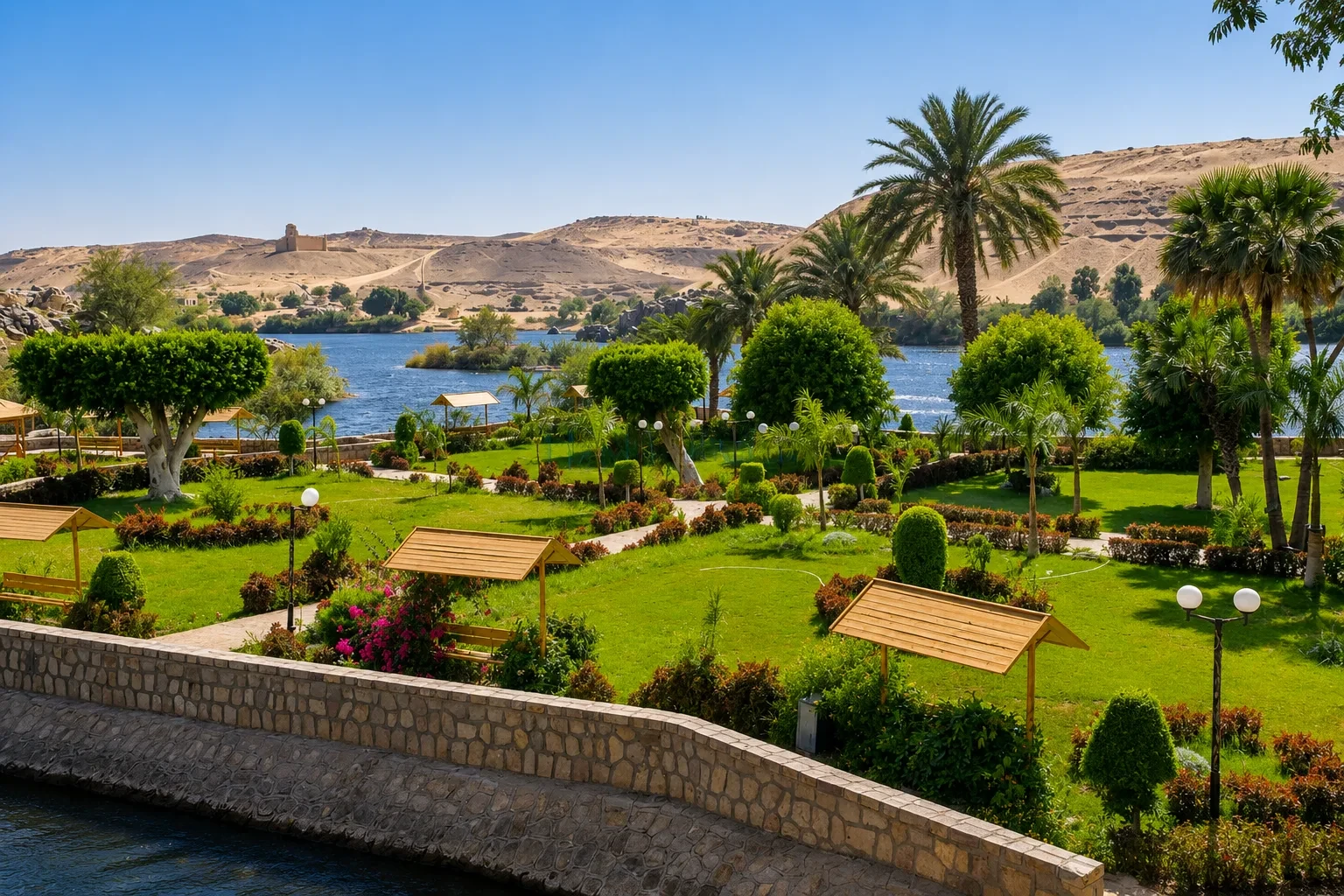
Elephantine Island sits in the center of the most culturally and archaeologically rich waterscape in all of Upper Egypt, surrounded by sites of extraordinary significance on all sides. Immediately adjacent on the northern part of the same island, the Movenpick Aswan Hotel gardens and facilities provide easy hospitality access for visitors who want to combine archaeological exploration with a comfortable island lunch or refreshment stop. On the neighboring island of Kitchener to the west, the Aswan Botanical Garden offers a beautifully maintained tropical plant collection in a tranquil island garden setting that provides a perfect natural complement to the archaeological intensity of the Elephantine visit and is easily combined with Elephantine in a single island excursion programme.
On the east bank of the Nile opposite Elephantine, the modern city of Aswan provides the full range of urban services and the Aswan waterfront with its characteristic felucca sailing boats and its panoramic views across the Nile to the island. On the west bank of the Nile, the Nubian Village communities provide the most authentic and most warmly hospitable living cultural experience in the Aswan area, most naturally combined with Elephantine in a day programme that encompasses both the ancient and the living dimensions of the First Cataract human heritage. The Temple of Isis at Philae, the Aswan High Dam, and the Unfinished Obelisk complete the essential Aswan heritage programme that every traveler should experience. For travelers looking south into the ancient Nubian homeland, the Lake Nasser Cruise provides access to the temples of Kalabsha, Wadi el-Seboua, Amada, and Abu Simbel. All these sites are accessible through the Aswan Day Tours, Nile cruise itineraries, Lake Nasser Cruises, and Egypt Tours Packages offered by WOW Egypt Tours.
Frequently Asked Questions About Elephantine Island
What is Elephantine Island?
Elephantine Island is a small granite island in the Nile River at Aswan, one of the most historically significant and most archaeologically rich ancient sites in Egypt, continuously inhabited for more than five thousand years and serving throughout the pharaonic period as the most important frontier post, religious sanctuary, and commercial gateway between Egypt and the lands of Nubia. It is home to the ancient Nilometer, the Temple of Khnum, the Temple of Satet, the Aswan Museum, ongoing German Archaeological Institute excavations, and a living Nubian community. Elephantine Island is featured on Aswan Day Tours, Nile River Cruises, Lake Nasser Cruises, and Egypt Tours Packages offered by WOW Egypt Tours.
Why is Elephantine Island called by that name?
The name Elephantine comes from the ancient Greek translation of the ancient Egyptian name Abu, meaning elephant. The association with the elephant may reflect either the appearance of the rounded black granite boulders around the island, which resemble elephants, or the island's role as the primary transit point for the ivory trade from sub-Saharan Africa into Egypt.
What is the Nilometer on Elephantine Island?
The Nilometer is an ancient measuring device consisting of a rectangular pit cut down to the Nile water level, with a central staircase and measurement scales on the walls calibrated in ancient cubits and later Arabic units. It was used to monitor the annual Nile flood level and thereby to calculate the expected agricultural yield and tax assessment for the coming year. The Elephantine Nilometer is one of the most important ancient Nilometers in Egypt and one of the primary instruments of ancient Egyptian economic administration.
What are the Elephantine Papyri?
The Elephantine Papyri are a collection of ancient Aramaic documents from the 5th century BCE, discovered on the island in the early 20th century and now distributed among several international museums. They were produced by a Jewish military colony stationed on the island during the Persian Period and include letters, legal documents, and correspondence about their local temple to the Jewish god Yahu, providing unique evidence for the multi-ethnic community life of the island during the Persian occupation of Egypt.
Who are Khnum and Satet?
Khnum is the ram-headed creator god venerated at Elephantine as the guardian of the sacred caverns beneath the First Cataract from which the annual Nile flood was believed to emerge, and as the divine craftsman who fashioned human beings on his potter's wheel. Satet is the goddess of the First Cataract and the annual inundation, depicted wearing the white crown of Upper Egypt with antelope horns, who was the protective goddess of the southern border. Together they were the principal divine residents of Elephantine Island and the guardians of the Nile flood at its source.
What are the German Archaeological Institute excavations?
The German Archaeological Institute has been conducting systematic excavation and research at Elephantine Island continuously since 1969, producing one of the most comprehensive ancient urban stratigraphic sequences available in Egypt. The excavations have revealed the complete occupation history of the island from the Predynastic Period through the Roman era and continue to produce significant new discoveries about the ancient settlement, its architecture, its religious institutions, and its material culture.
What are the opening hours of Elephantine Island?
The Elephantine Island archaeological site is open daily from 8:00 AM to 4:00 PM from October to April, and from 8:00 AM to 5:00 PM from May to September. The Aswan Museum opening hours should be confirmed at time of visit.
How much does it cost to enter Elephantine Island?
The entrance fee to the Elephantine Island archaeological site is EGP 200 for adults and EGP 100 for students. Entrance fees are included in all Aswan Day Tours, Egypt Tours Packages, and Nile River Cruise programmes booked through WOW Egypt Tours.
How long does it take to visit Elephantine Island?
Most visitors spend 1 to 2 hours for a complete visit including the Nilometer, the temple remains, the excavation areas, and the Nubian village streets.
What is the best time of year to visit Elephantine Island?
October to April is the most comfortable period. Summer visits are possible with early morning timing and adequate sun protection.
How do I get to Elephantine Island?
Elephantine Island is accessible by regular public ferry from the Aswan Corniche in approximately 5 minutes. All Aswan Day Tours and Nile River Cruise programmes with WOW Egypt Tours include ferry transfers to and from the island.
Is a guide necessary at Elephantine Island?
A guide is strongly recommended. The significance of the Nilometer measurement system, the building history of the Khnum and Satet temples, the history of the Jewish colony and the Elephantine Papyri, and the context of the German Archaeological Institute excavations all greatly benefit from expert explanation. WOW Egypt Tours provides licensed Egyptologist guides on all Elephantine Island tours.
Can I take photographs at Elephantine Island?
Photography with a standard camera or smartphone is permitted throughout the archaeological site. Flash photography is prohibited near ancient inscribed or decorated surfaces. A camera with good low-light capability is recommended for the Nilometer interior. Ask permission before photographing people in the living Nubian community.
What should I wear to visit Elephantine Island?
Lightweight, breathable clothing covering the shoulders and knees, a wide-brimmed hat and sunscreen, comfortable closed-toe walking shoes with good grip for the granite terrain, and adequate water. Dress modestly when passing through the living Nubian community on the southern portion of the island.
What other Aswan sites can I combine with Elephantine Island?
Elephantine Island is naturally combined with the Aswan Botanical Garden on neighboring Kitchener's Island, and as part of the full Aswan programme with the Temple of Isis at Philae, the Aswan High Dam, the Unfinished Obelisk, and the Nubian Village.
Does Elephantine Island have a living Nubian community?
Yes. The southern portion of Elephantine Island is home to a small living Nubian community whose painted houses, village streets, and warm hospitality create one of the most intimate and most atmospheric cultural encounters available on any Aswan island visit, combining the ancient archaeological landscape of the First Cataract with the living human tradition of Nubian community life.
What Nile cruise options include Elephantine Island?
Elephantine Island is available as an optional or featured addition on all WOW Egypt Tours Nile River Cruises, including Luxor Aswan Nile River Cruises, Dahabiya Nile River Cruises, and Lake Nasser Cruises at the Aswan end of the journey. All cruises are available as part of WOW Egypt Tours Egypt Tours Packages and Egypt Travel Packages.
How do I book an Elephantine Island tour with WOW Egypt Tours?
You can book any Elephantine Island tour as a standalone excursion, as part of a full Aswan Day Tour, as an addition to any Dahabiya Nile River Cruise, Luxor Aswan Nile River Cruise, Lake Nasser Cruise, Egypt Tours Package, or Egypt Travel Package directly through WOW Egypt Tours. Our team of travel specialists will arrange everything from ferry transfers and licensed Egyptologist guides to hotel pick-up and entrance fees, ensuring a seamless and unforgettable experience of Elephantine Island and all the wonders of ancient and modern Aswan.