

Al Azhar Mosque is simultaneously the most important, the most historically consequential, the most intellectually extraordinary, and the most personally affecting single Islamic institution in the complete world of Islam outside the two holy cities of Mecca and Medina, a mosque and university complex whose specific combination of religious authority, scholarly prestige, and cultural influence across the complete Islamic world from West Africa to Southeast Asia gives it a position in the global Islamic civilization that is genuinely without parallel at any other accessible Islamic heritage institution in the complete world heritage landscape, a position whose specific historical depth of more than a thousand years of continuous operation as the primary center of Sunni Islamic scholarship, the primary institution for the interpretation and transmission of the Islamic religious sciences, and the primary source of the religious authority whose pronouncements on matters of Islamic law and Islamic theology are recognized by hundreds of millions of Sunni Muslim believers worldwide as the most authoritative available expression of the living Sunni Islamic scholarly tradition makes Al Azhar not simply a mosque however magnificent and not simply a university however ancient but the most completely extraordinary and the most personally consequential single Islamic institution in the complete heritage record of the Sunni Islamic civilization across the entire span of its more than one thousand year existence. Founded in 970 CE by the Fatimid general Jawhar al-Siqilli within the year of the Fatimid founding of the city of Al-Qahira, Al Azhar is the world's second oldest continuously operating university, the oldest Islamic university in the complete world heritage record, and the primary center of Arabic language scholarship and Islamic religious sciences in the complete world of Islam, a foundation whose specific intellectual and institutional achievements across more than ten and a half centuries of continuous scholarly operation in the heart of the Islamic Cairo heritage district give it a quality of academic historical depth and cultural institutional significance that is simply without equal at any other accessible Islamic educational or religious institution in the complete world heritage landscape. This extraordinary monument is featured in Cairo Tours, Egypt Classic Tours, and Egypt Short Break Tours, all of which WOW Egypt Tours proudly offers to travelers from around the world as part of Egypt Tours Packages and Egypt Travel Packages that encompass the extraordinary Islamic and ancient heritage of Cairo and the complete Egyptian Nile Valley civilization.
Al Azhar Mosque Cairo is not simply a building of historical significance however extraordinary and not simply an institution of scholarly achievement however celebrated; it is the living intellectual and spiritual heart of the Sunni Islamic world, a functioning institution of the most complete and the most personally extraordinary religious and scholarly vitality whose ongoing daily programme of Islamic prayer, Quranic recitation, religious legal consultation, scholarly debate, and academic instruction gives every visitor who enters its extraordinary courtyard and its historic prayer halls the most direct and the most personally affecting encounter with the living Islamic intellectual tradition in its most historically ancient and its most institutionally authoritative contemporary expression available at any accessible heritage destination in the complete Egyptian capital. The specific quality of Al Azhar's institutional vitality, the continuous daily presence of students from across the Islamic world in the mosque's courtyards and prayer halls engaging in the most ancient and the most personally resonant forms of Islamic scholarly study, the formal seated circles of traditional Islamic learning in which a senior scholar transmits the complete Islamic religious sciences to his students in the most direct and the most humanly intimate educational format available in the complete Islamic scholarly tradition, gives the Al Azhar heritage experience a dimension of direct encounter with the living Islamic civilization in its most historically primary and its most institutionally complete form that no heritage museum display, no architectural monument however magnificently preserved, and no academic documentary programme however expertly produced can replicate in the same immediate and the same personally affecting manner. WOW Egypt Tours includes Al Azhar Mosque as an essential cultural heritage destination in all comprehensive Cairo Tours, Egypt Classic Tours, Egypt Short Break Tours, Egypt Family Tours, Egypt Budget Tours, and all Egypt Tour Packages that encompass the extraordinary Islamic heritage of the Egyptian capital.

What Is Al Azhar Mosque?
Al Azhar Mosque is a combined mosque and university complex in the heart of the historic Islamic Cairo district, founded in 970 CE by the Fatimid general Jawhar al-Siqilli following the Fatimid conquest of Egypt and the establishment of the new Islamic capital of Al-Qahira, whose institutional programme from its earliest years combined the specific religious functions of a congregational mosque of the most formal and the most complete Islamic liturgical type with the specific educational functions of the most ambitious Islamic higher educational institution founded anywhere in the complete early Islamic world in the specific form of the continuous residential scholarly programme whose organization of students from across the Islamic world into residential study circles under the guidance of appointed master scholars established the most complete and the most institutionally sophisticated model of higher Islamic education in the complete medieval Islamic world. The current Al Azhar complex encompasses the historic mosque whose multiple phases of architectural construction and expansion from the original Fatimid building of 970 CE through the successive Ayyubid, Mamluk, Ottoman, and modern additions give it the most chronologically layered and the most architecturally varied Islamic building fabric of any single mosque complex in the complete Egyptian Islamic heritage landscape, together with the extensive Al Azhar University campus whose modern university faculties, libraries, research institutions, and student residential facilities spread beyond the historic mosque building into the surrounding Islamic Cairo quarter in the most complete and the most institutionally substantial Islamic university infrastructure accessible at any heritage destination in the complete Egyptian capital.
Al Azhar's primary institutional identity is simultaneously religious and scholarly in the most completely inseparable combination that the Islamic tradition recognizes, whose specific understanding of religious knowledge as simultaneously the most practically important and the most personally sacred of all human intellectual pursuits gives the Al Azhar institutional programme its most fundamental and its most personally affecting character as the institution where the Islamic religious sciences of Quranic exegesis, prophetic tradition, Islamic jurisprudence, Islamic theology, Arabic language and literature, and the complete range of the classical Islamic intellectual disciplines are transmitted from each generation of master scholars to the next generation of students in the most direct and the most personally immediate educational format of the traditional Islamic scholarly circle whose specific intimacy of scholar-student relationship is the most ancient and the most institutionally consequential form of knowledge transmission in the complete Islamic educational heritage. Al Azhar's current student population of approximately 500,000 students from across the complete Islamic world, enrolled in programmes ranging from the traditional Islamic religious sciences of the historic mosque-based educational programme through the most contemporary academic disciplines of the modern Al Azhar University faculties, gives the institution a scale and a global reach of Islamic educational influence that is simply without parallel at any other Islamic educational institution in the complete world heritage record.
Who Founded Al Azhar Mosque?
Al Azhar Mosque was founded in 970 CE by the Fatimid general Jawhar al-Siqilli, the brilliant military commander of Sicilian origin who led the Fatimid conquest of Egypt in the same year and whose subsequent establishment of the new Fatimid capital of Al-Qahira immediately north of the existing Islamic city of Fustat was the most consequential single act of urban founding in the complete history of the Islamic Egyptian civilization since the original Arab Islamic establishment of Fustat by Amr Ibn Al-Ass in 641 CE. Jawhar al-Siqilli's founding of Al Azhar as the primary mosque of the new Fatimid capital within the same year of the city's foundation reflects the specific Fatimid Ismaili Shia theological understanding of the mosque as simultaneously the most important civic institution, the most authoritative religious institution, and the most essential educational institution of any properly organized Islamic urban community, giving Al Azhar from its founding moment in 970 CE the most completely integrated institutional programme of any mosque founded in the complete early Islamic period of Egyptian urban history. The specific identity of Jawhar al-Siqilli himself, a man of non-Arab origin from Sicily or possibly from the Byzantine world whose military genius and organizational brilliance gave the Fatimid Caliphate its most consequential military victory and its most enduring institutional legacy in the form of the new Egyptian capital and its primary mosque, gives the founding of Al Azhar a dimension of personal biographical extraordinariness entirely appropriate to the most extraordinary single Islamic founding event in the complete Egyptian Islamic heritage record.
The formal inauguration of Al Azhar as a center of higher Islamic learning, as distinct from its immediate function as the congregational mosque of the new Fatimid capital, is traditionally dated to 975 CE when the Fatimid Caliph al-Muizz li-Din Allah, whose name the adjacent El Moez Street carries as its official designation, authorized the first formal teaching circles in the mosque and established the institutional framework of the Al Azhar educational programme whose specific organization of resident scholars, residential student stipends, and systematic curriculum of Islamic religious sciences gave Al Azhar from its earliest educational phase the most complete and the most institutionally serious Islamic higher education programme founded anywhere in the Islamic world in the 10th century CE. The specific Fatimid Ismaili theological orientation of the original Al Azhar curriculum was subsequently transformed by the Ayyubid Sultan Saladin following his abolition of the Fatimid Caliphate in 1171 CE into the specifically Sunni Shafi'i orientation that has defined Al Azhar's primary theological and legal character from the Ayyubid period through the present day, making the transition from Fatimid Shia to Ayyubid and subsequently Mamluk Sunni the most consequential single theological institutional transformation in the complete history of Al Azhar's educational programme and giving the institution its most historically extraordinary dimension of theological adaptability and institutional resilience across the most dramatic possible change of its primary religious ideological orientation.
Al Azhar As The Heart Of The Sunni Islamic World
Al Azhar's position as the primary center of Sunni Islamic scholarship and the primary source of religious authority for the complete Sunni Islamic world, a position that has been continuously maintained and continuously reinforced across more than eight and a half centuries of Sunni Islamic institutional operation from the Ayyubid transformation of 1171 CE to the present day, gives the institution a quality of global Islamic cultural authority and global Islamic religious influence that is genuinely without parallel at any other accessible Islamic institution in the complete world heritage record. The specific mechanism of Al Azhar's global Islamic authority is the Islamic scholarly tradition's recognition of the Al Azhar graduates, the ulama or religious scholars trained in the complete Al Azhar curriculum of Islamic religious sciences, as the most authoritatively prepared and the most institutionally credentialed interpreters of the Islamic religious tradition available in the complete contemporary Islamic scholarly world, whose specific expertise in the classical Islamic sciences of Quranic exegesis, prophetic tradition, Islamic jurisprudence, and Islamic theology gives their religious pronouncements and their legal opinions a weight of scholarly authority recognized across the complete Sunni Islamic world from Morocco to Indonesia, from Nigeria to Kazakhstan, in the most globally comprehensive single institutional religious authority available in the complete contemporary world of the Sunni Islamic tradition.
The practical expression of Al Azhar's global Islamic cultural authority includes the institution's formal religious opinions on contemporary questions of Islamic law and Islamic ethics whose pronouncements are followed by hundreds of millions of Sunni Muslims worldwide, the institution's training of the Islamic religious leadership of dozens of Muslim-majority countries whose Al Azhar-educated religious scholars staff the most important mosques, Islamic educational institutions, and religious advisory bodies of the complete contemporary Islamic world, the institution's role in the promotion and preservation of the classical Arabic literary and linguistic tradition whose specific connection to the Quranic text gives Arabic language scholarship its most fundamental and its most personally sacred dimension in the complete Islamic intellectual tradition, and the institution's function as the primary venue for the most important international Islamic scholarly conferences and religious consultations whose specific deliberations on the most consequential contemporary issues of Islamic jurisprudence, Islamic theology, and Islamic social ethics are followed with the most careful attention by the complete global community of Sunni Islamic scholars, religious leaders, and Muslim believers who look to Al Azhar as the most authoritative available source of Islamic scholarly guidance on the questions that matter most for the practice of their faith in the contemporary world.
Al Azhar Mosque Location
Al Azhar Mosque is located in the heart of the historic Islamic Cairo district, in the Al-Gamaleya quarter of central Cairo, immediately adjacent to the Khan El Khalili bazaar on its western and northern boundaries and immediately accessible from the El Moez Street heritage corridor whose southern terminus at the Bab Zuweila gate and the Al-Ghuri Complex is separated from the Al Azhar Mosque complex by only a few hundred meters of the ancient historic quarter streets that connect the two primary Islamic Cairo heritage zones in the most naturally combined and the most personally extraordinary single Islamic Cairo heritage walk available at any accessible heritage destination in the complete Egyptian capital. The mosque's primary entrance on Al Azhar Street faces the large Al Azhar Square whose specific character as the primary public gathering space of the historic Islamic Cairo district gives the mosque approach its most impressive and its most personally affecting urban ceremonial dimension, the wide square providing the most spacious available foreground for the appreciation of the mosque's extraordinary multi-minaret facade in the most complete and the most personally overwhelming single Islamic architectural facade composition accessible from any publicly accessible viewpoint in the complete historic Islamic Cairo heritage landscape. The Al Azhar Mosque is accessible from central Cairo by private vehicle in approximately 15 to 20 minutes and by the Cairo Metro to Al-Azhar station and then a short walk through the adjacent historic quarter. WOW Egypt Tours provides private vehicle transportation from all Cairo hotels to Al Azhar Mosque and organizes the complete Islamic Cairo heritage programme as part of all Cairo Tours and Egypt Tour Packages.
Al Azhar Mosque Fun Facts
Al Azhar is the world's second oldest continuously operating university, having maintained its institutional educational programme without significant interruption since 975 CE, making it older than every European university including the University of Bologna (founded 1088 CE), Oxford University (first teaching circa 1096-1167 CE), and the University of Paris (founded circa 1150-1170 CE), and giving Al Azhar a specific claim to academic institutional priority over the complete European university tradition that is one of the most immediately personally striking and the most historically significant comparative facts available in the complete global history of higher education. The only institution with a stronger claim to educational institutional continuity is the University of al-Qarawiyyin in Fez, Morocco, whose foundation in 859 CE gives it a slight priority over Al Azhar's 970-975 CE educational beginning in the specific question of institutional precedence in the complete world history of continuously operating universities, a distinction that gives the complete Islamic university tradition an extraordinary historical priority over the European university system that is rarely appreciated in the Western educational and cultural tradition's understanding of the history of higher education.
Al Azhar's current student population of approximately 500,000 students enrolled across its complete programme of traditional Islamic education and modern university faculties makes it simultaneously one of the largest religious educational institutions and one of the largest universities in the complete world, a scale of educational operation that reflects the institution's specific position as the primary source of Islamic religious scholarly training for the complete Sunni Islamic world whose enormous geographical extent from West Africa to Southeast Asia and whose enormous total population of more than one billion Sunni Muslim believers creates a demand for Al Azhar-qualified Islamic religious scholars and Islamic educated professionals that requires precisely the most comprehensive and the most institutionally ambitious educational programme of any Islamic educational institution in the complete contemporary Islamic world. The specific diversity of Al Azhar's student population, drawn from the complete geographical range of the Sunni Islamic world with students from Indonesia, Nigeria, Pakistan, Malaysia, Senegal, Bangladesh, Turkey, and dozens of other Muslim-majority countries alongside the Egyptian students who constitute the largest single national group in the complete student body, gives Al Azhar's institutional environment a quality of global Islamic cultural diversity and personal cross-cultural Islamic encounter that is simply unavailable at any other single Islamic educational institution in the complete contemporary Islamic world.
The Sheikh of Al Azhar, the head of the institution and the most senior Islamic religious scholar in the complete Al Azhar hierarchy, is widely recognized as the most authoritative single voice in the complete contemporary Sunni Islamic world on matters of Islamic law, Islamic theology, and Islamic social ethics, a recognition whose specific institutional basis in the Al Azhar's more than a thousand years of continuous scholarly operation and its specific training and credentialing of the Islamic religious leadership of the complete Sunni Islamic world gives the Sheikh's religious authority a depth of scholarly legitimacy and a breadth of global religious recognition that is simply without parallel at the position of any other single Islamic religious authority in the complete contemporary Islamic world. The specific weight of the Sheikh of Al Azhar's religious pronouncements on contemporary questions of Islamic jurisprudence and Islamic social ethics, followed by hundreds of millions of Sunni Muslim believers worldwide as the most authoritative available expression of the Islamic scholarly consensus on the most important contemporary questions of religious practice and ethical behaviour, gives Al Azhar's institutional authority a practical impact on the daily religious life of the complete global Sunni Muslim community that makes it the single most consequential Islamic institution in the complete contemporary world of Sunni Islam.
Why Is It Called Al Azhar?
The name Al Azhar is an Arabic word meaning the most brilliant, the most resplendent, or the most flourishing in its primary dictionary meanings, a name whose specific application to the new Fatimid mosque of the 970 CE foundation has been given different explanatory origins in the various accounts of the Islamic historical tradition. The most commonly cited explanation connects the name to the Fatimid theological veneration of Fatima al-Zahra, the Prophet Muhammad's daughter and the wife of the Imam Ali ibn Abi Talib, whose specific honorific epithet al-Zahra, meaning the brilliant or the resplendent one, the Fatimid Ismaili theological tradition held in the most profound veneration as the mother of the Imams through whose divinely guided authority the Fatimid Caliphs claimed their specific legitimacy as the rightful leaders of the complete Islamic community. The naming of the primary mosque of the new Fatimid capital after the radiant epithet of the Prophet's daughter whose name the Fatimid dynasty itself carried in its dynastic designation, reflecting the Fatimid descent from Fatima al-Zahra through the Imam Ali, gives the name Al Azhar its most complete and its most historically specific Fatimid theological context as the most directly appropriate available designation for the institution that was specifically founded to serve as the primary religious and educational center of the new Fatimid Ismaili Shia Islamic capital in Egypt. The Arabic definite article al combined with the superlative adjective azhar gives the complete name Al Azhar the most elevated possible expression of the quality of brilliance and resplendence that the founding Fatimid patrons intended the new mosque to embody in both its physical architectural character and its institutional scholarly and religious programme, making the name simultaneously a theological reference to the Fatimid veneration of Fatima al-Zahra and an architectural and institutional aspiration toward the most brilliant and the most resplendent possible expression of the Islamic religious and educational ideal in the complete Egyptian Islamic heritage record.
Al Azhar Mosque History
The history of Al Azhar from its founding in 970 CE through the extraordinary thousand-year sequence of political, religious, and institutional transformations that have shaped its current character as the primary center of Sunni Islamic scholarship and the most globally influential Islamic institution in the complete Sunni Islamic world is one of the most extraordinary and the most personally consequential institutional biographies in the complete history of the world's major religious and educational institutions, a biography whose defining characteristic is the extraordinary capacity of Al Azhar to maintain its essential institutional identity and its specific institutional function as the primary center of Islamic religious learning through the most dramatic possible political and ideological transformations, from the Fatimid Ismaili Shia foundation of 970 CE through the Ayyubid Sunni transformation of 1171 CE, through the extraordinary Mamluk cultural flourishing of the 13th to 16th centuries, through the Ottoman conquest of 1517 and the subsequent Ottoman period, through the Napoleonic occupation of 1798 to 1801, through Muhammad Ali's 19th century modernization of Egypt, through the complete modern transformation of Egyptian society and the Egyptian state from the early 20th century to the present day, maintaining throughout each of these successive transformations its specific institutional function as the most important and the most personally consequential Islamic educational and religious authority in the complete Egyptian and global Islamic world.
The Fatimid period from 970 to 1171 CE established Al Azhar's original institutional character as the primary congregational mosque of the new Fatimid capital and the primary center of Ismaili Shia Islamic learning in the complete medieval Islamic world, whose specific theological and legal curriculum of the Fatimid Ismaili tradition gave Al Azhar its most distinctive and its most institutionally specific intellectual identity in the complete history of its more than thousand-year educational programme. The Ayyubid transformation of 1171 CE, when Saladin abolished the Fatimid Caliphate and converted Al Azhar from an Ismaili Shia to a Sunni Shafi'i institution by the simple and the most institutionally decisive act of directing the Friday prayer sermon toward the Abbasid Sunni Caliph of Baghdad rather than the Fatimid Ismaili Caliph of Cairo, represents the single most consequential institutional transformation in the complete history of Al Azhar's more than thousand-year educational programme, the moment when the institution that had been specifically founded as the primary center of Ismaili Shia Islamic learning became the institution that would subsequently develop into the primary center of Sunni Islamic learning, a transformation of such extraordinary institutional consequence for the subsequent history of the global Islamic religious tradition that its specific historical moment in 1171 CE deserves to be recognized as one of the most consequential single events in the complete history of the Islamic civilization's scholarly and educational development.
The Mamluk period from 1250 to 1517 CE was the most academically productive and the most institutionally consequential era in the complete history of Al Azhar's educational programme, the period in which the institution's specific character as the primary center of Sunni Islamic scholarship was most completely established and most personally consolidated through the most ambitious programme of scholarly recruitment, institutional endowment, and curriculum development in the complete history of Al Azhar's educational tradition, giving the Mamluk-era Al Azhar its most distinctive and its most personally influential institutional character as the global center of the Sunni Islamic scholarly tradition whose graduates staffed the most important Islamic educational and religious institutions of the complete medieval Islamic world from Morocco and West Africa through the Levant and Anatolia to Central Asia and the Indian subcontinent. Napoleon Bonaparte's extraordinary 1798 meeting with the Al Azhar scholars during the French occupation of Egypt, in which the French military commander sought and received the scholarly authorization of the Al Azhar ulama for his administrative reforms in a recognition of the institution's unparalleled religious authority in the Egyptian Muslim community, gives Al Azhar its most famous and the most personally extraordinary single episode of cross-cultural political encounter in the complete modern history of the Islamic Egyptian civilization, a meeting whose specific character of a Western military commander seeking Islamic scholarly authorization from the oldest university in Africa gives it a quality of personal historical drama and institutional significance entirely appropriate to the extraordinary institutional authority that Al Azhar represented in the Egyptian cultural and religious landscape of the late 18th century.
The Story Of The World's Most Influential Islamic Institution
The story of Al Azhar as the world's most influential Islamic institution is the story of how a mosque and university founded by a Fatimid military commander in the new Ismaili Shia capital of Egypt in 970 CE became, through the most extraordinary succession of institutional transformations, political challenges, and scholarly achievements in the complete history of any Islamic educational institution, the primary center of Sunni Islamic scholarship and the most globally authoritative Islamic religious institution in the complete Sunni Islamic world, serving the religious and educational needs of more than one billion Sunni Muslim believers across every continent of the inhabited world in the most personally consequential single Islamic institutional achievement of the complete Islamic civilization's more than fourteen-century history. The specific narrative of this transformation, from Ismaili Shia institution to Sunni Mamluk scholarly center to Ottoman period educational institution to modern Egyptian national university of global Islamic influence, is the most extraordinary story of institutional adaptability and institutional resilience in the complete history of any continuously operating educational or religious institution in the world, a story whose central theme is the extraordinary capacity of the Al Azhar institution to maintain its essential character as the most authoritative available center of Islamic religious learning through the most dramatic possible political and ideological changes in its external political environment while simultaneously evolving its institutional programme, its scholarly curriculum, and its educational methods to meet the changing needs of the global Islamic community it serves in each successive era of its more than thousand-year institutional existence.
Al Azhar Mosque Key Attractions And Features
The Multi-Minaret Facade And The Bab Al-Muzayyinin Gateway
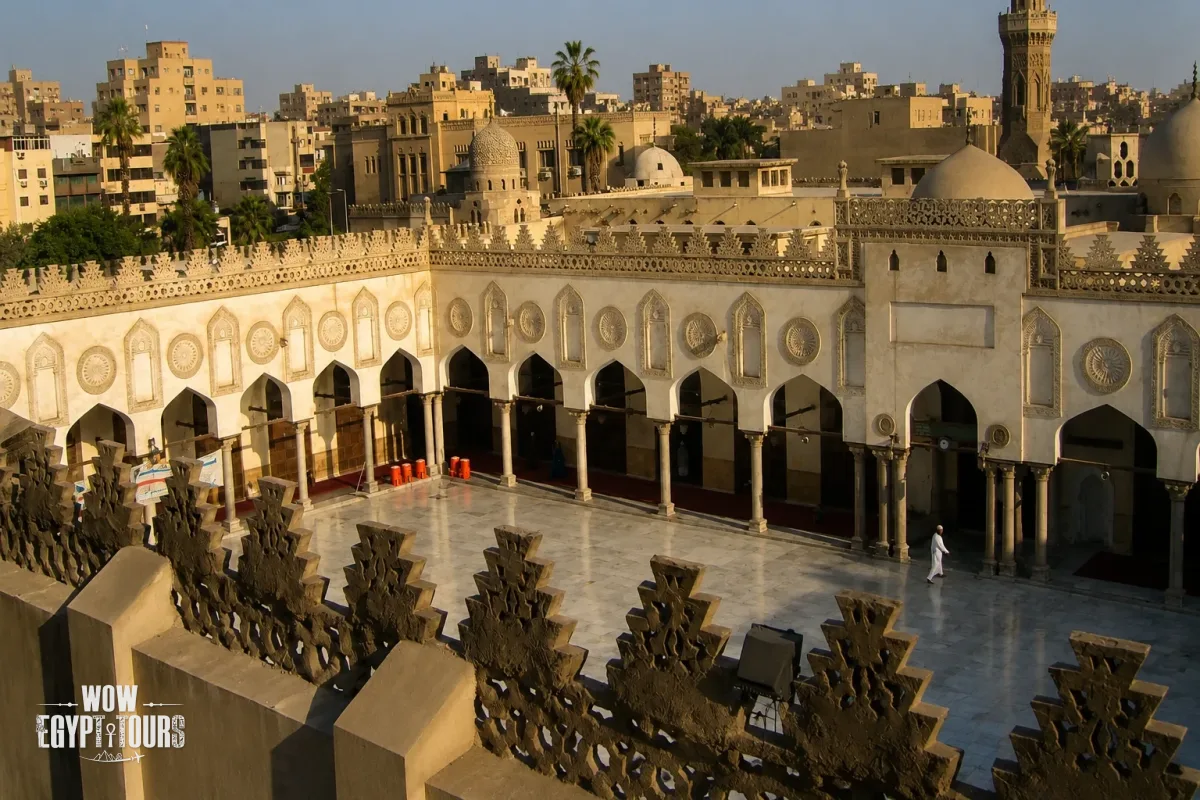
The extraordinary multi-minaret facade of Al Azhar Mosque, visible from the Al Azhar Square approach in the most dramatic and the most personally overwhelming single Islamic multi-minaret architectural composition accessible from any publicly accessible viewpoint in the complete historic Islamic Cairo heritage landscape, presents visitors with the most immediately extraordinary and the most completely architecturally distinctive exterior of any accessible mosque in the complete Egyptian Islamic heritage district, its five minarets of different periods, different heights, and different architectural styles rising from different positions along the mosque's extended urban facade in a composition whose specific variety of minaret form and minaret period gives it a quality of accumulated architectural layering and personal historical depth entirely different from the more architecturally unified minaret compositions of the great Mamluk mosques of the southern Islamic Cairo heritage district. The primary entrance to Al Azhar for visitors is through the Bab al-Muzayyinin, the Gate of the Barbers, a name that preserves the memory of the ancient tradition of student barbers who operated at the mosque gate offering their services to the residential student community of the Al Azhar educational programme in the most practically necessary and the most personally atmospheric of the ancient commercial traditions associated with the complete institutional life of the oldest university in Africa. The gateway's specific architectural character of carved stone decoration and pointed arch composition gives it a quality of medieval Islamic architectural refinement entirely appropriate to the primary entrance of the most historically significant Islamic educational institution in the complete world heritage landscape.
The Fatimid Courtyard
The Fatimid courtyard of Al Azhar, the primary open courtyard space of the mosque complex whose original Fatimid construction of 970 to 972 CE makes it the oldest surviving architectural fabric of the complete Al Azhar building in the most historically ancient and the most personally resonant interior space of any accessible part of the complete mosque complex, is the single most architecturally extraordinary and the most personally affecting space of the complete Al Azhar heritage visit, its open rectangular courtyard surrounded by the arcaded riwaq galleries on three sides and the primary prayer hall facade on the qibla side in the most completely realized expression of the classic Fatimid mosque courtyard organization available at any accessible Islamic heritage monument in the complete Egyptian Islamic architectural landscape. The courtyard's specific atmosphere of continuous scholarly and devotional activity, the presence of students reading and studying in the shade of the ancient arcaded galleries, worshippers performing their ablutions at the central courtyard fountain before prayer, scholars engaged in the traditional circular teaching sessions of the Al Azhar educational tradition under the galleries, and the general ambient activity of one of the most continuously active religious and educational institutions in the complete world heritage landscape, gives the Fatimid courtyard a quality of living institutional vitality and personal human immediacy that is simply unlike the experience of any other accessible Islamic courtyard monument in the complete Egyptian heritage district and that gives the Al Azhar visit its most distinctive and its most personally extraordinary heritage quality as the encounter with a living institution rather than a preserved monument.
The Prayer Hall And The Historic Columns
The prayer hall of Al Azhar Mosque, whose hypostyle interior of ancient marble and granite columns of considerable variety supporting the wooden roof structure of the prayer space reflects the accumulated architectural history of more than a thousand years of successive construction and expansion campaigns in the most directly legible and the most personally instructive architectural history available at any Islamic heritage monument interior in the complete Egyptian Islamic architectural landscape, provides the most personally extraordinary and the most historically resonant encounter with the Islamic hypostyle prayer hall tradition in its most ancient Egyptian institutional context, a forest of ancient columns of different periods, different materials, and different architectural characters whose specific variety gives the Al Azhar prayer hall interior a quality of accumulated material historical depth and personal architectural richness simply unavailable at the more architecturally unified and the more decoratively consistent prayer hall interiors of the great Mamluk mosque monuments of the southern Islamic Cairo heritage district. The ancient columns of the Al Azhar prayer hall, many of which are ancient Egyptian and Roman-period columns reused in the Fatimid construction of the mosque in the most direct and the most personally instructive possible demonstration of the Islamic architectural tradition's use of the abundant ancient material heritage of the Egyptian Nile Valley landscape as a practical building material for the most important early Islamic buildings in Egypt, give the prayer hall interior its most immediately extraordinary and its most personally affecting dimension of material historical depth, connecting the thousand-year-old Islamic institution of Al Azhar directly and physically to the ancient Egyptian and Roman-period architectural heritage that preceded it in the most ancient urban landscape in the complete Egyptian heritage record.
The Mamluk And Ottoman Additions
The successive Mamluk and Ottoman additions to the original Fatimid building fabric of Al Azhar, encompassing the extraordinary Mamluk ribat and madrasa additions of the 14th and 15th centuries CE, the Ottoman-period Taybarsiyya and Aqbughawiyya madrasas whose specific architectural character of the Ottoman educational building type gives the complete Al Azhar complex its most architecturally varied and its most chronologically comprehensive range of Islamic educational architecture available at any single accessible Islamic heritage site in the complete Egyptian capital, and the Ottoman-period minarets whose different profiles and different decorative programmes create the extraordinary multi-minaret facade visible from the Al Azhar Square approach, give the complete Al Azhar Mosque building complex its most characteristic and its most personally extraordinary architectural quality of accumulated historical layering, of successive generations of Muslim patrons each adding their own specific architectural contribution to the most important Islamic institution in the complete Egyptian Islamic heritage in a process of continuous institutional enrichment whose cumulative result is the most architecturally layered and the most historically complex single Islamic mosque complex accessible to visitors at any heritage site in the complete Egyptian capital. The specific quality of walking through the complete Al Azhar complex with the most complete expert historical guidance of the licensed Islamic Cairo guide provided by WOW Egypt Tours and reading the successive Fatimid, Ayyubid, Mamluk, and Ottoman architectural layers in the accumulated fabric of the building is the most personally instructive and the most completely satisfying single architectural heritage education available at any Islamic monument in the complete Egyptian heritage landscape.
The Traditional Islamic Scholarly Circles
The most personally extraordinary and the most completely unique dimension of the complete Al Azhar heritage experience that is unavailable at any other accessible Islamic heritage monument in the complete Egyptian capital or in the complete world heritage landscape is the direct observation of the traditional Islamic scholarly circles, the halaqat, that continue to be held in the Al Azhar Mosque's courtyard and prayer hall galleries in the most ancient and the most personally direct format of Islamic knowledge transmission, in which a senior scholar seated on the floor or on a modest raised platform is surrounded by a circle of students whose attentive engagement with the scholar's exposition of the classical Islamic religious texts creates the most immediately personal and the most historically resonant encounter with the living Islamic scholarly tradition in its most ancient and most institutionally authentic form available to any heritage visitor at any accessible Islamic heritage destination in the complete world heritage landscape. The specific sight of a traditional Islamic scholarly circle in progress in the Al Azhar courtyard galleries, the scholar's voice reciting and expounding the classical Islamic texts in the most ancient educational format of the complete Islamic intellectual tradition while his students follow the text and pose their questions in the most direct and the most personally intimate educational dialogue available in any university tradition in the complete world, gives every visitor who witnesses it the most direct and the most personally affecting encounter with the living Islamic intellectual heritage in its most historically primary and its most institutionally consequential contemporary form, an experience whose specific quality of direct observation of the oldest continuously operating university tradition in the complete African and Middle Eastern world is simply unlike anything available at any other accessible heritage destination in the complete Egyptian capital.
The Minarets Of Al Azhar
The five minarets of Al Azhar Mosque, representing the successive architectural contributions of the Fatimid, Mamluk, and Ottoman periods of the mosque's more than thousand-year construction history in the most chronologically diverse and the most architecturally varied collection of Islamic minaret forms available at any single accessible Islamic mosque complex in the complete Egyptian Islamic heritage landscape, give the Al Azhar facade its most immediately distinctive and its most personally extraordinary architectural character as the multi-period accumulation of successive Islamic architectural patronage whose specific variety of minaret height, minaret profile, and minaret decorative programme creates a facade composition of exceptional complexity and exceptional historical depth that is unlike anything available at any other accessible Islamic mosque facade in the complete Egyptian capital. The most celebrated of the Al Azhar minarets are the extraordinary double-headed minaret of Sultan Qaytbay whose specific late Mamluk architectural character of elaborate carved stone decoration and distinctive double-bulb finial gives it the most architecturally refined and the most personally extraordinary single minaret profile in the complete Al Azhar minaret collection, and the more recently constructed Mamluk and Ottoman minarets whose different profiles and different decorative programmes give the complete five-minaret facade its most personal character of accumulated architectural variety across the complete temporal span of the Islamic Egyptian civilization's patronage of the world's oldest Islamic university.
The Library And The Academic Heritage
The Al Azhar library, one of the most important collections of Islamic manuscripts and classical Islamic scholarly texts in the complete world, houses an extraordinary collection of ancient handwritten Arabic manuscripts, classical Islamic legal and theological texts, ancient Quranic manuscripts of exceptional age and exceptional scholarly significance, and the complete range of the classical Islamic intellectual tradition's written heritage in the most comprehensive and the most personally significant single collection of Islamic manuscript heritage available at any academic institution in the complete Egyptian capital. The specific scholarly importance of the Al Azhar manuscript collection, whose individual manuscripts document the most important chapters of the complete Islamic intellectual tradition from the earliest period of Islamic scholarly writing through the most distinguished Mamluk-era scholarly productions to the Ottoman period's continuation of the classical Islamic scholarly programme, gives Al Azhar its most directly personal and its most intellectually extraordinary heritage dimension for the most seriously Islamically educated and the most academically oriented heritage visitors whose specific interest in the written heritage of the classical Islamic intellectual tradition gives the library the most important and the most personally consequential dimension of their complete Al Azhar heritage experience.
Why Is Al Azhar Mosque Important?
Al Azhar is important for reasons spanning the complete history of the Islamic intellectual and religious tradition, the specific educational history of the world's oldest continuously operating university tradition, the global Islamic cultural authority whose religious pronouncements are followed by hundreds of millions of Sunni Muslim believers worldwide, the architectural historical significance of the complete mosque complex's accumulated Fatimid, Mamluk, and Ottoman building fabric, and the broader cultural significance of Al Azhar as the primary institution through which the Islamic intellectual and religious heritage has been transmitted from each generation of scholars to the next across more than a thousand years of continuous scholarly operation in the heart of the Islamic Cairo heritage district. As a religious and educational institution, Al Azhar is the single most consequential and the single most personally influential Islamic institution in the complete world heritage record of the Sunni Islamic civilization, whose specific authority as the primary source of Islamic religious scholarly qualification and the primary center of Islamic legal opinion has shaped the religious practice and the religious understanding of the complete Sunni Islamic world across more than eight centuries of continuous Sunni institutional operation from the Ayyubid period to the present day. WOW Egypt Tours includes Al Azhar Mosque as an essential destination in all comprehensive Cairo Tours, Egypt Classic Tours, and all Egypt Tour Packages encompassing the extraordinary Islamic heritage of the Egyptian capital.
What Are Some Interesting Facts About Al Azhar Mosque?
The World's Second Oldest Continuously Operating University
Al Azhar's specific historical priority as the world's second oldest continuously operating university, having maintained its institutional educational programme without significant interruption since 975 CE and thus predating every major European university by more than a century, is one of the most immediately personally striking and the most historically significant comparative facts available in the complete global history of higher education, a distinction whose specific implications for the understanding of the Islamic civilization's contribution to the world's educational heritage gives Al Azhar a position in the complete history of human intellectual development that is rarely fully appreciated in the Western educational tradition's conventional narrative of the origins and the development of the university as a specifically European educational institution. The specific comparison of Al Azhar's 975 CE educational founding with the University of Bologna's 1088 CE foundation, widely cited in the Western academic tradition as the world's oldest university, places Al Azhar more than a century earlier in the specific timeline of continuously operating university institutions and gives the Islamic educational tradition its most historically primary claim to the invention of the institutional form of organized residential higher education that the European university tradition subsequently developed into the modern university system.
Napoleon And The Al Azhar Scholars
The extraordinary historical episode of Napoleon Bonaparte's 1798 meeting with the Al Azhar scholars during the French military occupation of Egypt, in which the French commander sought the religious authorization of the most authoritative Islamic scholars in Egypt for his administrative programme and treated the Al Azhar ulama with the most personally respectful and the most institutionally appropriate recognition of their religious and intellectual authority, represents one of the most personally extraordinary and the most historically revealing single encounters between the European Enlightenment tradition and the Islamic scholarly tradition in the complete history of the modern era's cross-cultural intellectual encounters. Napoleon's specific recognition of Al Azhar's unparalleled authority in the Egyptian Muslim community, which led him to seek the mosque's scholarly endorsement for his administrative reforms in Egypt rather than imposing those reforms through purely military authority, gives the Al Azhar institution its most famous and its most personally affecting single episode of European recognition of Islamic scholarly authority in the complete modern history of the Islamic Egyptian civilization, a recognition whose specific character of a European military commander treating the Islamic scholarly institution with the most genuine respect for its religious and intellectual authority gives it a quality of cross-cultural historical significance entirely appropriate to the extraordinary institutional legacy that Al Azhar represents in the complete global heritage of higher educational and religious institutions.
The Fatimid Foundation Built On The New City
The extraordinary historical coincidence of Al Azhar's foundation in 970 CE within the same year as the founding of the new Fatimid capital of Al-Qahira gives the mosque a specific character of urban foundational primacy that is unlike anything available at any other accessible Islamic mosque in the complete Egyptian capital, the specific recognition that Al Azhar was built as the primary mosque of a completely new city in the same year that the city itself was established giving the institution its most complete and its most personally direct institutional connection to the foundational act of urban creation that established the Islamic Cairo that exists today as the most extraordinary and the most personally affecting Islamic urban heritage landscape in the complete African and Middle Eastern world. The naming of the mosque Al Azhar in reference to Fatima al-Zahra, the Prophet's daughter whose name and whose specific honorific epithet the Fatimid dynasty itself carried as the most direct expression of the Fatimid claim to the leadership of the complete Islamic community through descent from the Prophet's own family, gives the founding of Al Azhar its most directly personal connection to the most fundamental theological assertion of the Fatimid Ismaili Shia tradition whose complete institutional programme the new mosque was specifically designed to serve and to propagate in the most authoritative and the most publicly accessible institutional form available in the complete contemporary Islamic world.
What Is So Special About Al Azhar Mosque?
The Living Intellectual Heart Of The Islamic World
What makes Al Azhar uniquely and incomparably special in the complete Egyptian Islamic heritage landscape, and in the complete world heritage landscape of Islamic institutions, is the extraordinary combination of historical priority, institutional continuity, global religious authority, and living scholarly vitality that gives it a quality of total institutional achievement simply unavailable at any other accessible Islamic heritage monument or institution in the complete Egyptian capital or in the complete world heritage landscape. The specific quality of standing in the Al Azhar courtyard and simultaneously experiencing the most ancient Islamic institutional architecture of the Fatimid founding construction, the accumulated Mamluk and Ottoman architectural additions of successive centuries of devoted institutional patronage, the living scholarly activity of students and scholars engaged in the most ancient forms of Islamic knowledge transmission, the ongoing daily programme of Islamic prayer and Quranic recitation, and the awareness that this specific institution is recognized by more than one billion Sunni Muslim believers worldwide as the primary source of the most authoritative available Islamic religious scholarly guidance creates a quality of personal heritage impact and personal institutional grandeur that is simply unlike anything available at any other accessible heritage destination in the complete Egyptian capital and that gives Al Azhar its most fundamental and its most completely extraordinary identity as the place where the Islamic intellectual and religious tradition is most completely alive, most completely active, and most completely itself in the most personal and the most historically authentic form available to any heritage visitor at any accessible Islamic heritage institution in the complete world.
Where A Thousand Years Of Islamic Scholarship Lives
Al Azhar is also uniquely special for the specific quality of continuity it embodies, the specific recognition that the traditional scholarly circles in its courtyard galleries today are in direct institutional continuity with the scholarly circles that have been held in the same courtyard under the same arcaded galleries since the Fatimid scholars first organized the Al Azhar educational programme in 975 CE, giving every visitor who observes a traditional Al Azhar scholarly circle in progress the most direct and the most personally affecting possible encounter with the most ancient continuously operating university tradition in the African and Middle Eastern world, an encounter whose specific quality of direct observation of a living practice that has been continuous for more than a thousand years gives it a dimension of personal historical immediacy and personal institutional profundity that no heritage museum reconstruction, however technically perfect, and no heritage documentary, however expertly produced, can replicate in the same immediate and the same personally affecting manner as the direct experience of the living scholarly institution in its most ancient institutional form at the specific site where the tradition has been continuously maintained for more than a thousand years.
Al Azhar Mosque Through The Ages
The complete narrative of Al Azhar from the Fatimid founding of 970 CE through the extraordinary thousand-year sequence of Ayyubid, Mamluk, Ottoman, and modern transformations of its institutional character and its architectural fabric, through Napoleon's 1798 meeting with the Al Azhar scholars, through Muhammad Ali's 19th century educational reforms and their specific impact on the Al Azhar programme, through the 20th century's transformation of Al Azhar from a purely traditional Islamic educational institution into a modern university with contemporary academic faculties alongside the traditional religious sciences curriculum, and through the most recent decades of Al Azhar's engagement with the most pressing contemporary questions of Islamic jurisprudence, Islamic social ethics, and the relationship between the Islamic religious tradition and the challenges of the modern world, traces the most extraordinary and the most personally consequential single institutional biography in the complete history of any Islamic educational or religious institution in the world, a biography whose defining characteristic is the extraordinary capacity of Al Azhar to maintain its essential institutional identity and its specific global Islamic authority through the most dramatic possible transformations of its external political, social, and intellectual environment across more than a thousand years of continuous institutional operation in the heart of the Islamic Cairo heritage district.
Al Azhar Mosque And UNESCO
Al Azhar Mosque is protected as the most historically significant and the most globally consequential single Islamic institutional heritage component of the UNESCO World Heritage Site designated in 1979 as Historic Cairo, recognized as a heritage of outstanding universal value for the extraordinary concentration of Islamic heritage in the historic core of Cairo that includes Al Azhar as its primary and its most internationally recognized Islamic institutional monument alongside the architectural heritage of El Moez Street, the commercial heritage of the Khan El Khalili, and the complete surrounding historic quarter. The UNESCO Historic Cairo inscription specifically acknowledges Al Azhar as the embodiment of the outstanding universal value of the complete historic Islamic Cairo heritage zone in its most institutionally consequential and its most globally significant individual monument, the single institution whose specific combination of architectural historic significance and living institutional authority gives the complete Historic Cairo World Heritage designation its most personally compelling and its most internationally recognized justification of outstanding universal value. The Egyptian government and UNESCO are engaged in ongoing collaboration on the conservation management of the Al Azhar complex, addressing the specific challenges of conserving extraordinary medieval Islamic architectural fabric within the context of a continuously active and continuously expanding modern Islamic university of global institutional significance.
Best Time To Visit Al Azhar Mosque
Al Azhar Mosque is most naturally and most efficiently visited as part of the complete Islamic Cairo northern heritage programme combining the mosque with the adjacent Khan El Khalili bazaar and the El Moez Street heritage corridor in the most personally extraordinary and the most completely satisfying single Islamic Cairo heritage programme available from any Cairo hotel base. The morning hours from approximately 9:00 AM to noon are the most recommended visiting period for the most complete available programme in the most manageable visitor density conditions and the most atmospheric natural light quality in the Fatimid courtyard. The traditional scholarly circles are most likely to be observed during the morning academic hours before the midday prayer, making the morning visit the most personally extraordinary and the most institutionally revealing visit time for observers interested in the living Islamic scholarly tradition. The Friday mid-day congregational prayer from approximately 11:30 AM to 1:30 PM is the most important single weekly religious event of the Al Azhar institutional programme and represents the most personally extraordinary and the most atmospherically complete Islamic congregational prayer experience available at any accessible mosque in the complete Egyptian capital for visitors who wish to observe the complete Friday prayer as the primary weekly gathering of the world's oldest continuously active Islamic educational community. Visiting hours outside prayer times provide the most comfortable and the most practically accessible heritage visit. WOW Egypt Tours advises on optimal timing within the complete Islamic Cairo heritage programme.
Al Azhar Mosque Opening Hours
Al Azhar Mosque is open to visitors daily from 9:00 AM to 5:00 PM, with closure during the five daily prayer times whose specific schedule varies with the seasonal adjustment of Islamic prayer times throughout the year, and with the most significant closure for the Friday mid-day congregational prayer from approximately 11:30 AM to 1:30 PM when the mosque is closed to non-Muslim visitors. All visiting hours are subject to adjustment for Islamic religious observances and the specific schedule of Al Azhar University's academic calendar, and current access arrangements should be confirmed at time of booking with WOW Egypt Tours.
Al Azhar Mosque Entrance Fees
Al Azhar Mosque is accessible without an admission fee as an active place of Islamic worship and an active educational institution, making it the most historically significant and the most globally influential Islamic institution in the complete world that is freely accessible to all visitors of every religious background without charge. Non-Muslim visitors are specifically welcomed at Al Azhar with a tradition of Islamic scholarly hospitality that reflects the institution's specific understanding of its global educational role and its global cultural mission in the promotion of Islamic knowledge and Islamic culture for the complete international community. All logistics for the complete Islamic Cairo heritage programme including Al Azhar Mosque are organized by WOW Egypt Tours as part of all Cairo Tours and Egypt Tour Packages.
How To Get To Al Azhar Mosque
Al Azhar Mosque is located in the heart of the historic Islamic Cairo district, accessible from central Cairo by private vehicle in approximately 15 to 20 minutes, by the Cairo Metro to Al-Azhar station and then a short walk of approximately 5 minutes through the Al Azhar Street approach to the mosque square, or by taxi from any point in central Cairo. The mosque's Al Azhar Street location gives it the most conveniently positioned approach from the Khan El Khalili direction and the most naturally combined approach from the El Moez Street heritage walk through the Bab Zuweila end of the street and then a short walk through the Al-Ghuri area to the Al Azhar Square. The private vehicle organized by WOW Egypt Tours provides the most practically efficient approach and departure from the complete Islamic Cairo heritage programme combining Al Azhar Mosque with Khan El Khalili, El Moez Street, and all adjacent heritage destinations.
How Long To Spend At Al Azhar Mosque
A minimum of 45 minutes to one hour at Al Azhar Mosque is required for the most complete available programme encompassing the complete exterior facade approach through the Bab al-Muzayyinin gateway, the Fatimid courtyard exploration with the traditional scholarly circle observation if in progress, the prayer hall interior with the historic column programme and the mihrab, the Ottoman and Mamluk wing additions, and the complete guided historical narrative of the institution's more than thousand-year educational and religious heritage. A more completely satisfying Al Azhar programme of one and a half to two hours allows the most thorough engagement with all primary components of the mosque complex including the most complete architectural tour of the successive Fatimid, Mamluk, and Ottoman building phases, the most detailed engagement with the traditional scholarly circles in progress, and the most complete guided historical narrative of Al Azhar's extraordinary institutional biography from its Fatimid founding through the Ayyubid transformation to the modern global Islamic university. Al Azhar Mosque is most naturally and most efficiently combined with the Khan El Khalili bazaar and El Moez Street in the most comprehensive Islamic Cairo heritage day programme organized by WOW Egypt Tours.
Tips For Visiting Al Azhar Mosque
Ask your licensed guide from WOW Egypt Tours to provide the complete historical narrative of the Fatimid founding of Al Azhar, the Ayyubid theological transformation from Ismaili Shia to Sunni, and the Mamluk period's extraordinary scholarly flourishing before entering the mosque complex, as the combination of this complete institutional historical context with the direct physical encounter with the oldest Islamic university in Africa gives the Al Azhar visit its most personally extraordinary and the most completely affecting heritage experience. If traditional scholarly circles are in progress in the courtyard galleries on your visit, approach them with the most respectful observational distance and the most genuine sensitivity to the scholars and students whose academic activity you are observing, as the specific character of the traditional Islamic scholarly circle as a primarily devotional and academic rather than a performative or a tourist-oriented activity requires the most respectful and the most personally appropriate approach from heritage visitors who wish to observe the most ancient continuously operating university tradition in the complete African and Middle Eastern world without disturbing the scholarly and religious activity that gives Al Azhar its most fundamental and its most completely extraordinary living institutional heritage character. The Fatimid courtyard is the single most important space of the complete Al Azhar heritage visit and should receive the longest and the most contemplative time of any space in the complete mosque complex programme, its specific combination of ancient architectural fabric, living devotional and scholarly activity, and the most completely extraordinary institutional heritage atmosphere of any accessible Islamic heritage space in the complete Egyptian capital giving every minute spent in it a quality of personal heritage intensity and personal historical depth that the most hurried heritage schedule should resist reducing to less than 20 to 30 minutes of genuine contemplative engagement.
What To Wear At Al Azhar Mosque
Al Azhar is an active place of Islamic worship and the world's oldest Islamic university whose specific institutional character of the most formally organized and the most institutionally serious Islamic educational and religious programme in the complete Egyptian Islamic heritage requires the most respectful and the most culturally appropriate visiting clothing of any accessible Islamic monument in the complete Egyptian capital. Modest clothing covering the shoulders, arms, and knees is required for all visitors regardless of gender. Women must cover their hair completely before entering any part of the mosque complex interior and may be provided with an abaya and head covering at the mosque entrance for visitors who have not brought their own appropriate covering. Shoes must be removed before entering the prayer hall. Conservative, loose-fitting clothing that does not attract attention or create visual disturbance in the active scholarly and devotional environment of the mosque complex is the most appropriate and the most personally respectful choice for all visitors to the world's oldest Islamic university. The Al Azhar mosque administration is particularly attentive to the respectful visiting behaviour of international visitors and appreciates the most genuine expression of personal respect for the institution's religious and scholarly character that visiting clothing and visiting behaviour can provide.
Photography At Al Azhar Mosque
Photography for personal non-commercial purposes is generally permitted in the exterior and courtyard areas of Al Azhar Mosque, with the specific prayer hall interior photography subject to the permission of the mosque administration whose specific policies on interior photography may vary and should be confirmed with the mosque staff at the time of visit. Photography of the traditional Islamic scholarly circles in progress should be approached with the most sensitive and the most personally respectful observational practice, seeking permission from the presiding scholar before photographing the teaching circle and accepting any refusal with the most genuine courtesy and the most complete respect for the scholar's authority over the academic environment of his teaching circle. The most photographically extraordinary subjects of the complete Al Azhar heritage visit include the multi-minaret facade photographed from the Al Azhar Square approach in the most complete available morning light, the Fatimid courtyard in the most atmospheric natural light of the morning hours, and the historic columns of the prayer hall in the available interior lighting conditions. The specific heritage photography challenge of Al Azhar, combining ancient architecture with living devotional and academic activity in the most sensitive institutional context of any accessible Islamic heritage monument in the complete Egyptian capital, rewards the most patient and the most personally sensitive photographic approach with the most completely extraordinary and the most personally meaningful heritage photography available at any accessible Islamic heritage institution in the world.
Al Azhar Mosque Tours
Complete Islamic Cairo Heritage Day: Al Azhar, El Moez Street, And Khan El Khalili
This comprehensive Islamic Cairo heritage day programme combines the world's oldest Islamic university with the world's highest concentration of medieval Islamic architectural monuments on a single street and the most historically extraordinary medieval Islamic bazaar in Egypt in the most completely satisfying and the most personally extraordinary single-day Islamic Cairo heritage programme available from any Cairo hotel base, encompassing the complete range of the Islamic Cairo heritage from the most institutionally consequential to the most architecturally magnificent to the most commercially extraordinary.
What Is Covered
Private vehicle from Cairo hotel with morning departure. Al Azhar Mosque complete heritage programme: exterior facade and Bab al-Muzayyinin gateway approach, Fatimid courtyard with traditional scholarly circle observation, prayer hall interior with historic columns and mihrab, Mamluk and Ottoman wing additions, complete institutional historical narrative. El Moez Street complete heritage walk from Al-Ghuri complex to Bab al-Futuh with primary monument interior programme including Qalawun mausoleum and Bab Zuweila minaret ascent. Khan El Khalili complete market exploration with Fishawi's Café. Lunch in the historic quarter. Afternoon optional: Saladin Citadel and Muhammad Ali Mosque. Return to Cairo hotel.
Duration
Full day from Cairo hotel, approximately 8 to 9 hours.
Includes
Private vehicle, licensed Islamic Cairo guide, all monument entrance fees, lunch in the historic quarter, and all logistics. Through WOW Egypt Tours Cairo Tours.
Complete Cairo Multi-Faith Heritage: Islamic, Coptic, And Ancient
This extraordinary two-day Cairo multi-faith and multi-period heritage programme combines the supreme Islamic heritage of Al Azhar and the complete Islamic Cairo district with the extraordinary early Christian and Jewish heritage of Old Cairo and the ancient Egyptian heritage of the Giza Plateau in the most completely multi-dimensional and the most personally extraordinary single Cairo heritage programme available.
What Is Covered
Day 1: Giza Pyramids and Grand Egyptian Museum.
Day 2: Al Azhar Mosque, El Moez Street, Khan El Khalili. Afternoon: Old Cairo multi-faith heritage including Amr Ibn Al-Ass Mosque, Hanging Church, Coptic Museum, Ben Ezra Synagogue. Return to Cairo hotel.
Duration
2 Days from Cairo hotel.
Includes
Private vehicle both days, licensed guide, all entrance fees, lunch both days, all logistics. Through WOW Egypt Tours Cairo Tours.
Combine Al Azhar Mosque With Your Egypt Tours Package
Al Azhar Mosque is featured as an essential Islamic Cairo heritage destination across the full range of WOW Egypt Tours travel products. Browse the options below to find the Egypt experience that includes Al Azhar Mosque.
Egypt Tour Packages: Multi-day guided Egypt tours organized by duration, including 2 Days Egypt Packages, 3 Days Egypt Packages, 4 Days Egypt Packages, 5 Days Egypt Packages, 6 Days Egypt Packages, 7 Days Egypt Packages, 8 Days Egypt Packages, 10 Days Egypt Packages, and longer itineraries. Al Azhar Mosque is included in all Egypt Tour Packages of 4 days and above as the primary Islamic scholarly heritage destination of the Islamic Cairo northern heritage programme, most naturally combined with Khan El Khalili and El Moez Street. All packages include private vehicle, licensed guide, accommodation, all entrance fees, and all logistics.
Egypt Travel Packages: Themed Egypt travel packages including Egypt Honeymoon Travel Packages, Egypt Budget Travel Packages, Egypt Family Travel Packages, Egypt Luxury Travel Packages, Egypt Adventure Travel Packages, Egypt Cultural Travel Packages, and Egypt Christmas and New Year Travel Packages. Al Azhar is featured in every Egypt Travel Package category as the world's oldest Islamic university and the primary center of Sunni Islamic scholarly authority with the most extraordinary institutional heritage of any Islamic monument in the complete Egyptian capital.
Egypt Classic Tours: The most popular and the most comprehensively balanced Egypt travel programme, combining the complete Giza ancient heritage with Al Azhar Mosque, Khan El Khalili, El Moez Street, and the Saladin Citadel in Cairo, and the Nile Valley heritage of Luxor and Aswan, in the most complete and the most personally satisfying introduction to the complete Egyptian heritage available in any organized Egypt itinerary.
Egypt Short Break Tours: Focused short duration Egypt travel programmes for travelers with limited time. Al Azhar Mosque is included in Egypt Short Break Tours of 3 days and above as the primary Islamic scholarly heritage destination of the Islamic Cairo northern district, combined with Khan El Khalili and El Moez Street in the most efficiently organized and the most personally satisfying compact Islamic Cairo heritage programme.
Egypt Family Tours: Family-friendly Egypt travel programmes in which Al Azhar's extraordinary story as the world's second oldest university, the traditional scholarly circles, and the magnificent multi-minaret facade together provide one of the most educationally enriching and the most personally extraordinary heritage experiences for families with children and teenagers visiting the Islamic Cairo heritage district.
Egypt Budget Tours: Value-focused Egypt travel programmes providing access to the world's oldest Islamic university without any entrance fee as an active place of worship and scholarship, making Al Azhar the most historically significant and the most globally consequential free heritage destination in the complete Egyptian capital.
Egypt Nile Cruises: All-inclusive Nile River Cruise programmes combining the ancient pharaonic heritage of Luxor and Aswan with Cairo extensions that include Al Azhar Mosque as the primary Islamic scholarly heritage monument of the complete Islamic Cairo heritage programme.
Nile River Cruises: All WOW Egypt Tours Nile cruise options. Al Azhar Mosque is available as part of the Islamic Cairo heritage programme in the Cairo extension from the beginning or end of any Nile River Cruise itinerary.
Luxor Aswan Nile Cruises: Al Azhar combined with Khan El Khalili and El Moez Street is the primary Islamic Cairo heritage programme for any Luxor-Aswan Nile cruise Cairo extension, providing the most personally extraordinary medieval Islamic scholarly and architectural heritage complement to the ancient pharaonic monument heritage of the Nile Valley cruise.
Dahabiya Nile Cruises: Al Azhar Mosque available as part of the Islamic Cairo heritage programme for travelers combining the most intimate private Nile sailing experience with the world's oldest Islamic university and the supreme Islamic institutional heritage of the Egyptian capital.
Lake Nasser Cruises: Al Azhar Mosque available as part of the Cairo extension for travelers combining the extraordinary Nubian heritage of Lake Nasser with the world's oldest Islamic university and the most globally consequential Islamic institution in the complete Egyptian capital.
Cairo Tours: The complete range of guided day tour programmes available from Cairo hotels, including the complete Islamic Cairo heritage day combining Al Azhar with El Moez Street, Khan El Khalili, Saladin Citadel, Muhammad Ali Mosque, Sultan Hassan Mosque, Mosque of Ibn Tulun, and Amr Ibn Al-Ass Mosque, the multi-faith Cairo programme combining Al Azhar with the Coptic Cairo heritage of the Hanging Church, Coptic Museum, St George Church, St Virgin Mary Church, and Ben Ezra Synagogue, and the complete Cairo multi-period programme combining Al Azhar with the Giza Pyramids and Grand Egyptian Museum. All Cairo Tours include private vehicle, licensed guide, all entrance fees, and all logistics organized by WOW Egypt Tours.
Nearby Attractions To Al Azhar Mosque
Al Azhar Mosque is positioned at the center of the most extraordinary concentration of Islamic heritage in the complete Egyptian capital, immediately surrounded by the primary monuments and institutions of the historic Islamic Cairo northern heritage district in every direction. The most immediately proximate and the most naturally combined nearby heritage destinations are the primary monuments and commercial institutions of the complete historic Islamic Cairo quarter surrounding the mosque on all sides. The Khan El Khalili bazaar, immediately west and north of Al Azhar on the Khan El Khalili Square, is the most naturally combined commercial heritage complement to the mosque's scholarly and religious heritage, the most celebrated medieval Islamic bazaar in Egypt whose continuous operation since 1382 CE gives it a commercial institutional heritage of extraordinary depth and personal vitality entirely complementary to the scholarly and devotional character of the adjacent Al Azhar. El Moez Street, the world's highest concentration of medieval Islamic architectural monuments on a single street, is accessible from Al Azhar by a short walk through the Al-Ghuri area whose extraordinary late Mamluk architectural complex connects the two primary heritage zones of the Islamic Cairo northern district in the most naturally combined and the most personally extraordinary single Islamic Cairo heritage walk available.
The Saladin Citadel and the Muhammad Ali Mosque approximately 2 to 3 kilometers south provide the most spectacular elevated panoramic overview of the complete Islamic Cairo historic quarter including the Al Azhar multi-minaret facade visible from the Citadel terrace as part of the most dramatic available urban panorama of the historic Islamic Cairo district. The Sultan Hassan Mosque, the supreme masterpiece of medieval Islamic architecture in Egypt, the Mosque of Ibn Tulun, the oldest surviving mosque in Cairo, and the Amr Ibn Al-Ass Mosque, the oldest mosque in Africa, complete the most comprehensive Islamic Cairo heritage programme combining Al Azhar with the most important additional Islamic monuments of the complete historic Cairo heritage district. The Coptic Cairo quarter with the Hanging Church, the Coptic Museum, the St George Church, the St Virgin Mary Church, and the Ben Ezra Synagogue provides the most complete multi-faith heritage portrait of Cairo the Capital of Egypt organized by WOW Egypt Tours.
Frequently Asked Questions About Al Azhar Mosque
What is Al Azhar Mosque?
Al Azhar Mosque is a combined mosque and university complex in the heart of historic Islamic Cairo, founded in 970 CE by the Fatimid general Jawhar al-Siqilli and recognized as the world's second oldest continuously operating university, the oldest Islamic university in the world, and the primary center of Sunni Islamic scholarship and religious authority whose pronouncements are followed by more than one billion Sunni Muslims worldwide. With approximately 500,000 students from across the Islamic world, it is simultaneously the most historically ancient and the most globally influential Islamic educational institution in the complete world heritage record. It is featured in Cairo Tours, Egypt Classic Tours, and Egypt Short Break Tours offered by WOW Egypt Tours.
Is Al Azhar the world's oldest university?
Al Azhar is the world's second oldest continuously operating university, with its formal educational programme established in 975 CE, making it older than every major European university including the University of Bologna (1088 CE) and Oxford University (circa 1096-1167 CE). The only institution with a stronger claim to university institutional priority is the University of al-Qarawiyyin in Fez, Morocco, founded in 859 CE. Together, these two institutions give the Islamic educational tradition an extraordinary historical priority over the European university system that is rarely fully appreciated in the Western educational tradition's understanding of the global history of higher education.
Who founded Al Azhar Mosque?
Al Azhar Mosque was founded in 970 CE by Jawhar al-Siqilli, the Fatimid general of Sicilian origin who led the Fatimid conquest of Egypt in the same year and subsequently established the new Fatimid capital of Al-Qahira immediately north of the existing Islamic city of Fustat. The formal educational programme was inaugurated in 975 CE under the Fatimid Caliph al-Muizz li-Din Allah, establishing the institutional framework of the Al Azhar educational tradition whose more than thousand-year continuous operation gives it the most extraordinary institutional heritage of any Islamic educational institution in the complete world heritage record.
What is the significance of the name Al Azhar?
Al Azhar means the most brilliant or the most resplendent in Arabic, and is most commonly connected to the honorific epithet al-Zahra (the brilliant one) of Fatima, the Prophet Muhammad's daughter and the wife of the Imam Ali, whose veneration as the mother of the Imams was central to the Fatimid Ismaili Shia theological tradition. The naming of the primary mosque of the new Fatimid capital after the radiant epithet of the Prophet's daughter gives the name Al Azhar its most historically specific Fatimid theological context as the most appropriate designation for the primary religious and educational institution of the new Ismaili Shia Islamic capital of Egypt.
How did Al Azhar change from Shia to Sunni?
The transformation of Al Azhar from a Fatimid Ismaili Shia institution to a Sunni institution occurred in 1171 CE when Saladin, the founder of the Ayyubid dynasty, abolished the Fatimid Caliphate and converted Al Azhar to the Sunni Shafi'i orientation by the simple but institutionally decisive act of directing the Friday prayer sermon toward the Abbasid Sunni Caliph of Baghdad rather than the Fatimid Ismaili Caliph of Cairo. This single most consequential theological institutional transformation in Al Azhar's complete history redirected the institution from the primary center of Ismaili Shia learning to what would subsequently become the primary center of Sunni Islamic scholarship in the complete Islamic world.
What is the Sheikh of Al Azhar?
The Sheikh of Al Azhar is the head of the Al Azhar institution and the most senior Islamic religious scholar in the complete Al Azhar hierarchy, widely recognized as the most authoritative single voice in the complete contemporary Sunni Islamic world on matters of Islamic law, Islamic theology, and Islamic social ethics. The Sheikh's religious pronouncements on contemporary questions of Islamic jurisprudence are followed by hundreds of millions of Sunni Muslim believers worldwide, giving the position a practical impact on the daily religious life of the global Sunni Muslim community that makes it the single most consequential Islamic religious authority in the complete contemporary world of Sunni Islam.
What are the traditional scholarly circles at Al Azhar?
The traditional Islamic scholarly circles (halaqat) at Al Azhar are the most ancient continuously maintained form of Islamic knowledge transmission in the complete world, in which a senior scholar is surrounded by a circle of students for the direct transmission of the classical Islamic religious sciences of Quranic exegesis, prophetic tradition, Islamic jurisprudence, and Islamic theology in the most intimate and the most personally direct educational format available in any university tradition. These circles have been held in the Al Azhar courtyard and galleries since 975 CE and represent the most direct institutional continuity with the founding moment of the world's oldest Islamic university accessible to visitors at any heritage destination in the complete world heritage landscape.
Why did Napoleon visit Al Azhar?
During the French military occupation of Egypt from 1798 to 1801, Napoleon Bonaparte sought and received a meeting with the Al Azhar scholars in 1798 because he recognized the unparalleled religious authority of Al Azhar in the Egyptian Muslim community and sought the scholarly endorsement of the most authoritative Islamic institution in Egypt for his administrative programme, treating the Al Azhar ulama with the most respectful recognition of their religious and intellectual authority in one of the most personally extraordinary and the most historically revealing episodes of cross-cultural political encounter between the European Enlightenment tradition and the Islamic scholarly tradition in the complete history of the modern era.
How do I book an Al Azhar Mosque tour with WOW Egypt Tours?
You can book any Cairo Tours programme, Egypt Classic Tours package, Egypt Short Break Tours programme, Egypt Family Tours, Egypt Budget Tours, Egypt Tours Package, or Egypt Travel Package that includes Al Azhar Mosque directly through WOW Egypt Tours. Our team of travel specialists will arrange private vehicle, licensed Islamic Cairo guide, the complete Al Azhar heritage programme encompassing the Fatimid courtyard, the traditional scholarly circles, the historic prayer hall, and the complete institutional historical narrative of the world's oldest Islamic university, combined with the Khan El Khalili and El Moez Street in the most complete and the most personally extraordinary Islamic Cairo heritage programme available through any Egyptian heritage tour operator.