
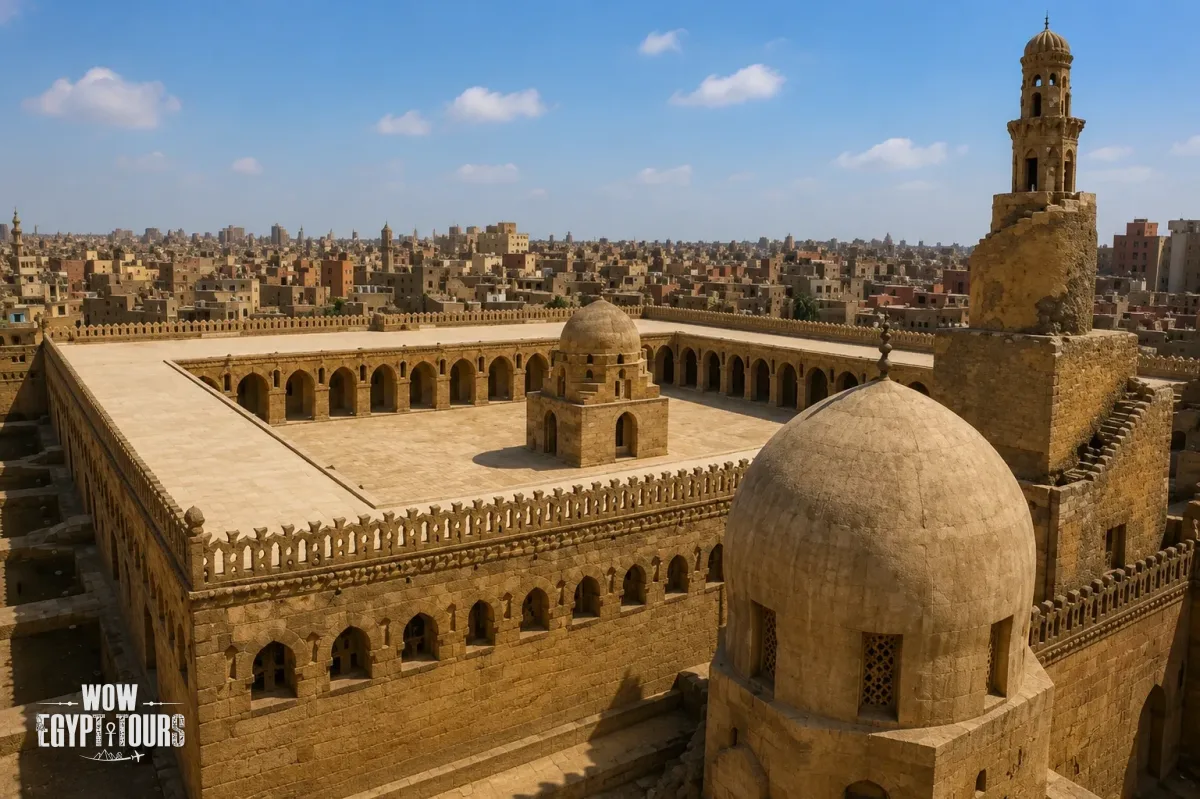

The Mosque of Ibn Tulun is the oldest mosque in Cairo to have survived in anything approaching its original architectural form, the largest mosque in Cairo by total area, and one of the most personally extraordinary, the most atmospherically complete, and the most architecturally unique Islamic monuments accessible at any heritage site in the complete Egyptian capital, a building of such completely extraordinary personal atmospheric power, such completely distinctive architectural character, and such completely extraordinary historical depth that it occupies a position in the Islamic architectural heritage of Cairo that is genuinely and irreplaceably its own, unlike any other accessible Islamic monument in the complete Egyptian capital in its specific combination of extreme architectural antiquity, architectural uniqueness, and personal atmospheric grandeur that gives every visitor who enters its vast courtyard the most immediately personal and the most completely affecting encounter with the earliest surviving Islamic architectural tradition in the complete Cairo heritage landscape. Built between 876 and 879 CE by Ahmad ibn Tulun, the ambitious and extraordinarily gifted Turkish-born governor of Egypt who established the semi-independent Tulunid dynasty and created his own capital city of Al-Qata'i whose complete urban fabric has since been consumed by the growth of Cairo leaving the mosque as the only surviving structure of the complete Tulunid capital and the most direct and the most personally affecting physical relic of the first period of independent political authority in the history of the Islamic Egyptian state, the Mosque of Ibn Tulun is the sole surviving monument of an entire medieval Islamic city, a building that stands not simply as a mosque of extraordinary heritage but as the entire physical legacy of one of the most personally fascinating and the most politically consequential rulers in the complete history of the Islamic Egyptian civilization. This extraordinary monument is featured in Cairo Tours, Egypt Classic Tours, and Egypt Short Break Tours, all of which WOW Egypt Tours proudly offers to travelers from around the world as part of Egypt Tours Packages and Egypt Travel Packages that encompass the extraordinary Islamic and ancient heritage of Cairo and the complete Egyptian Nile Valley civilization.
The Mosque of Ibn Tulun Cairo holds a position in the architectural heritage of the Islamic Cairo heritage district that no other accessible monument can share or replicate, the specific position of being simultaneously the oldest and the largest surviving mosque in the complete Cairo Islamic heritage landscape, the only surviving monument of an entire medieval Islamic capital city, and the most architecturally unique Islamic monument in the complete Egyptian heritage record in terms of the specific combination of its extraordinary spiral minaret, its vast open courtyard of unparalleled atmospheric quality, its complete brick construction in a building tradition entirely different from the limestone masonry of all subsequent Cairo mosque construction, and its remarkable sycamore wood frieze of extraordinary length running the complete interior perimeter of the courtyard arcades in the most completely personal and the most historically resonant decorative programme of any accessible early Islamic monument in the complete Egyptian heritage landscape. The specific quality of standing in the Ibn Tulun mosque courtyard, whose vast open space of approximately 92 meters by 92 meters is the largest open courtyard of any mosque accessible in the complete Cairo heritage district and whose specific atmosphere of monumental simplicity, of ancient brick arcades surrounding the enormous open sky of the courtyard in the most complete and the most personally affecting expression of the specifically early Islamic mosque architectural ideal of the vast communal prayer space unencumbered by visual complexity or decorative distraction, creates an experience of personal architectural encounter with the Islamic spatial ideal in its most historically primary and its most completely realized early Islamic form that is simply unavailable at any other accessible Islamic monument in the complete Egyptian heritage landscape. WOW Egypt Tours includes the Mosque of Ibn Tulun as an essential cultural heritage destination in all comprehensive Cairo Tours, Egypt Classic Tours, Egypt Short Break Tours, Egypt Family Tours, Egypt Budget Tours, and all Egypt Tour Packages that encompass the extraordinary Islamic heritage of the Egyptian capital.

What Is The Mosque Of Ibn Tulun?
The Mosque of Ibn Tulun is a congregational mosque built between 876 and 879 CE by Ahmad ibn Tulun, the Turkish-born governor of Egypt who founded the Tulunid dynasty and established the independent capital city of Al-Qata'i on a hill called Jabal Yashkur, the Hill of Thanksgiving, approximately 2.5 kilometers south of the earlier Arab Islamic capital of Fustat. The mosque is located on the same Jabal Yashkur site where Ahmad ibn Tulun built it more than eleven centuries ago, now within the Sayyida Zeinab district of Cairo's historic southern quarter, and covers a total area of approximately 6.5 acres including the surrounding outer enclosures known as the ziyada, making it the largest mosque in Cairo by total area and the most spatially generous single Islamic monument in the complete Egyptian capital. The mosque is distinguished from every other accessible Islamic monument in the complete Egyptian heritage landscape by its extraordinary combination of architectural characteristics that collectively give it an architectural identity utterly unlike any other mosque in Egypt: the specifically Iraqi architectural tradition of its construction that reflects Ahmad ibn Tulun's origins and his architectural reference to the Great Mosque of Samarra in Iraq, the complete use of brick as the primary building material in contrast to the limestone masonry of all subsequent major Cairo mosque construction, the unique spiral external minaret whose distinctive helical form is the only spiral Islamic minaret in the complete Egyptian architectural heritage, and the specific spatial character of its vast open courtyard surrounded by the stacked pointed arches of the arcaded porticos in the most completely extraordinary and the most personally affecting single mosque courtyard atmosphere accessible to visitors at any Islamic heritage monument in the complete Egyptian capital.
The mosque survives as the only remaining structure of Ahmad ibn Tulun's complete Tulunid capital city of Al-Qata'i, whose entire remaining urban fabric of palaces, administrative buildings, residential quarters, markets, and infrastructure was systematically demolished by the subsequent Abbasid governors of Egypt following the collapse of the Tulunid dynasty in 905 CE in one of the most consequential and the most personally dramatic acts of deliberate political urbicide in the complete history of the Islamic Egyptian civilization, an act whose specific scale and specific thoroughness, the complete demolition of an entire medieval Islamic capital city, gives the survival of the Ibn Tulun Mosque through this act of deliberate destruction a quality of personal historical extraordinariness entirely appropriate to the most atmospherically powerful and the most historically resonant ancient Islamic monument accessible at any heritage site in the complete Egyptian capital.
Who Built The Mosque Of Ibn Tulun?
The Mosque of Ibn Tulun was built by Ahmad ibn Tulun, born approximately 835 CE as the son of a Turkic slave named Tulun who had been presented as a gift to the Abbasid Caliph al-Ma'mun in Baghdad, whose specific personal biography of extraordinary social ascent from the slave origins of his father through the Abbasid court education that gave him his complete cultural formation to his appointment as governor of Egypt in 868 CE and his subsequent establishment of a virtually independent Tulunid dynasty that extended its political control over Syria as well as Egypt gives him one of the most personally fascinating and the most socially consequential individual biographies of any figure in the complete history of the Islamic Egyptian civilization. Ahmad ibn Tulun's appointment as governor of Egypt in 868 CE placed him in command of the most economically productive and the most strategically important single province of the complete Abbasid caliphate at a moment of considerable Abbasid political weakness, and his extraordinary personal gifts of political intelligence, military ambition, administrative efficiency, and cultural sophistication allowed him to transform what was intended as a temporary provincial governorship into the foundation of a virtually independent Tulunid state whose specific political achievement of retaining the formal diplomatic language of Abbasid caliphal authority while exercising all the practical powers of an independent sovereign gave the Tulunid political experiment its most characteristic quality of sophisticated political pragmatism combined with genuine personal ambition for the most complete available degree of practical political independence within the nominal framework of the Abbasid caliphal system.
Ahmad ibn Tulun's decision to build his new capital of Al-Qata'i on the Jabal Yashkur hill immediately north of Fustat, rather than establishing his administrative center within the existing urban fabric of the earlier Islamic Egyptian capitals, reflects both the specific practical requirements of housing the large Tulunid military force of Turkish and Greek slave soldiers in a dedicated military cantonment separate from the civilian population of Fustat and the specific personal ambition of a ruler who wished to give his independent political authority the most visible and the most personally impressive physical expression available in the form of an entirely new capital city built to his personal commission whose central mosque, the largest and the most architecturally distinctive Islamic building constructed in Egypt since the original founding of the first mosque in Africa by Amr Ibn Al-Ass in 641 CE, would give the Tulunid state its most personally extraordinary and its most institutionally consequential single monument of architectural prestige and religious authority in the complete Islamic Egyptian heritage record.
Ahmad Ibn Tulun: The Governor Who Built A City
Ahmad ibn Tulun's personal character, as preserved in the abundant Arabic historical literature that documents the Tulunid period of Egyptian history, is that of one of the most intellectually gifted, the most personally charismatic, and the most administratively extraordinary Islamic governors of Egypt in the complete history of the Islamic Egyptian state, a man whose specific combination of military genius, political sophistication, cultural ambition, architectural vision, and personal religious devotion gave his fourteen-year governorship of Egypt from 868 to 884 CE a quality of creative political and cultural achievement that has never been surpassed by any subsequent independent ruler of the Egyptian state until the modern era. The Arabic historical tradition presents Ahmad ibn Tulun as a man of extraordinary personal generosity combined with considerable personal ferocity, of deep personal religious commitment combined with considerable political ruthlessness in the management of those who challenged his authority, of extraordinary cultural sensitivity and architectural vision combined with the most practically efficient administrative approach to the management of the Egyptian provincial economy whose surpluses he systematically redirected from the Abbasid treasury in Baghdad to his own Tulunid capital building programme and military expansion in the most consequential single act of fiscal autonomy in the complete history of the provincial administration of the Islamic Egyptian state before the modern era.
The specific story of Ahmad ibn Tulun's commission of the spiral minaret of the Ibn Tulun Mosque, which the Arabic historical tradition preserves in the particularly charming anecdote of ibn Tulun inadvertently rolling a piece of paper around his finger during a meeting with his architect and then instructing the architect to build the minaret in exactly that rolled spiral form, gives the founding of the most architecturally unique single element of the complete Ibn Tulun Mosque its most personally accessible and its most humanly affecting foundational narrative, the specific recognition that the only spiral Islamic minaret in the complete Egyptian architectural heritage was created not by a deliberate architectural programme of innovative minaret design but by the most casual and the most accidentally creative act of physical fidgeting available in the complete history of Islamic architectural patronage, giving the Ibn Tulun minaret's extraordinary architectural distinction a quality of accidental genius and personal biographical charm that is simply unlike anything available at any other comparable architectural heritage narrative associated with any other accessible Islamic monument in the complete Egyptian capital.
Mosque Of Ibn Tulun Location
The Mosque of Ibn Tulun is located in the Sayyida Zeinab district of historic southern Cairo, on the Jabal Yashkur hill approximately 2.5 kilometers south of the Fatimid historic Islamic Cairo district of El Moez Street and the Khan El Khalili, approximately 1.5 kilometers west and north of the Sultan Hassan Mosque and the Saladin Citadel, and approximately 3 to 4 kilometers north of the Old Cairo Fustat district. The mosque's position on the Jabal Yashkur hill gives it an elevated character that is immediately perceptible to visitors approaching the building across the surrounding historic quarter, its massive brick facade visible from a considerable distance as one of the most imposing and the most personally extraordinary medieval Islamic building silhouettes accessible in the complete historic southern Cairo heritage district. The mosque is accessible from central Cairo by private vehicle in approximately 20 to 25 minutes, from the Sultan Hassan Mosque and the Saladin Citadel area by approximately 10 minutes by private vehicle, and from the El Moez Street and Khan El Khalili district by approximately 15 to 20 minutes by private vehicle. The mosque is most naturally combined in the complete Islamic Cairo southern heritage circuit with the Sultan Hassan Mosque, the Saladin Citadel, and the Muhammad Ali Mosque as part of the most comprehensive single-day Islamic Cairo southern heritage programme organized by WOW Egypt Tours.
Mosque Of Ibn Tulun Fun Facts
The Mosque of Ibn Tulun is the oldest mosque in Cairo to have survived in anything approaching its original form, a distinction that is sometimes confused with the claim of the Mosque of Amr Ibn Al-Ass to being the oldest mosque in Egypt and in Africa. The resolution of this apparent contradiction lies in the specific nature of each mosque's survival: while the Mosque of Amr Ibn Al-Ass has maintained its institutional existence continuously since 641 CE and therefore has the greater claim to institutional historical priority, its current physical building is primarily the product of successive rebuilding campaigns that have replaced the original construction multiple times, giving the current building very little original fabric from the earliest periods of its existence. The Mosque of Ibn Tulun, by contrast, retains the overwhelming majority of its original 876 to 879 CE architectural fabric in the most complete and the most archaeologically authentic surviving form of any mosque built in Cairo before the modern era, giving it the most extraordinary claim to architectural historical authenticity among all accessible Islamic monuments in the complete Cairo heritage landscape and the most direct and the most personally affecting physical encounter with the earliest Islamic architectural tradition of the Egyptian capital available at any accessible heritage site in the complete Cairo Islamic heritage district.
The spiral external minaret of the Mosque of Ibn Tulun is the only spiral minaret in the complete Egyptian Islamic architectural heritage record and one of only a handful of surviving spiral Islamic minarets in the complete world heritage landscape of medieval Islamic architecture, a distinction that gives the Ibn Tulun minaret an architectural uniqueness of the most completely extraordinary and the most personally extraordinary character in the complete Egyptian Islamic heritage record. The minaret's specific spiral form, in which an external staircase winds around the outside of the circular minaret shaft in a continuous helical ramp that rises from the minaret base to the caller's gallery at the summit in the most dramatically distinctive and the most personally extraordinary single minaret profile accessible at any heritage mosque in the complete Egyptian capital, was directly inspired by the extraordinary spiral minaret of the Great Mosque of Samarra in Iraq, the most celebrated and the most architecturally extraordinary Islamic minaret of the complete early Abbasid period whose specific form Ahmad ibn Tulun sought to reproduce in his new Egyptian capital as the most direct available architectural reference to his own Iraqi cultural formation and his own personal connection to the Abbasid imperial architectural tradition in which he had been educated and which he had personally encountered in the course of his career in the Abbasid administrative system before his appointment as governor of Egypt.
The Mosque of Ibn Tulun survived the systematic demolition of the complete Tulunid capital of Al-Qata'i by the subsequent Abbasid governors of Egypt because it was used as a hospital for pilgrims returning from Mecca, a practical humanitarian function that gave it a protected status even in the context of the most thoroughgoing program of deliberate political urbicide that any Islamic government has ever directed against the physical legacy of a predecessor dynasty in the complete history of the Islamic Egyptian state. The specific historical circumstance of the mosque's survival through its conversion to a hospital for returning pilgrims gives the Ibn Tulun Mosque its most personally extraordinary and its most completely affecting historical character as the sole survivor of an entire medieval Islamic city, the single building whose specific practical humanitarian function at a critical moment in the political history of the Tulunid dynasty gave it the most dramatic and the most personally resonant escape from the deliberate destruction that consumed every other physical component of Ahmad ibn Tulun's extraordinary architectural and urban legacy.
Why Is It Called The Mosque Of Ibn Tulun?
The Mosque of Ibn Tulun carries the name of its founder Ahmad ibn Tulun in the standard Islamic architectural naming convention that identifies mosque monuments with their royal or aristocratic patrons, with the specific form Ibn Tulun, meaning the son of Tulun, identifying the founder by his patronymic relationship to his father Tulun, the Turkic slave whose gifting to the Abbasid Caliph al-Ma'mun established the family's initial presence in the Abbasid imperial household and whose specific name, Tulun, an approximation of a Turkic personal name in the Arabic phonological system, gives the complete patronymic Ibn Tulun its most direct and its most personally informative biographical content as the most concise possible identification of Ahmad ibn Tulun's specific family origins within the Turkic slave military aristocracy of the Abbasid caliphate. The Arabic colloquial designation as Jami Ibn Tulun, the Congregational Mosque of Ibn Tulun, is the standard Egyptian popular and scholarly designation for the building in all contexts of Egyptian Arabic-language heritage discourse, reflecting both the building's specific institutional character as a jami or Friday congregational mosque of the most formal and the most complete Islamic liturgical type and the specific Islamic naming convention of attributing the building to its patron rather than to its function or its architectural character in the standard Islamic architectural toponym whose specific information content identifies both the building type (jami) and the patron (Ibn Tulun) in the most concise and the most immediately historically informative available Arabic designation for the oldest surviving mosque in the complete Cairo Islamic architectural heritage.
Mosque Of Ibn Tulun History
The history of the Mosque of Ibn Tulun from its construction between 876 and 879 CE through the collapse of the Tulunid dynasty and the demolition of Al-Qata'i in 905 CE, through the subsequent centuries of partial neglect and partial active use as the mosque's institutional fortunes fluctuated with the successive political authorities of the Islamic Egyptian state, through the extraordinary restoration of Sultan Lajin in 1296 CE that gave the mosque its central fountain pavilion and substantially repaired the building's fabric, through the Mamluk and Ottoman periods of continued active use, through the 19th century heritage conservation awakening and the subsequent conservation campaigns of the Comité de Conservation des Monuments de l'Art Arabe, through the modern era of systematic archaeological investigation and architectural conservation, traces a monument biography of extraordinary variety and extraordinary personal historical consequence whose most dramatic individual moments include the mosque's miraculous survival of the Al-Qata'i demolition through its function as a pilgrims' hospital, the extraordinary restoration of Sultan Lajin whose specific personal connection to the mosque has one of the most personally dramatic biographical narratives associated with any restoration patron in the complete history of the Islamic Egyptian built environment, and the ongoing modern conservation programme whose continuing investigation of the mosque's extraordinary fabric progressively reveals new dimensions of the building's architectural history and its material cultural heritage.
The most personally extraordinary biographical narrative associated with the restoration of the Mosque of Ibn Tulun is the story of Sultan Lajin, the Mamluk military commander who hid in the derelict and partially ruined mosque in 1294 CE after participating in the assassination of the Mamluk Sultan al-Ashraf Khalil, and who vowed during his period of refuge in the ancient mosque that if he survived to become sultan himself he would restore the Ibn Tulun Mosque to its original glory as an act of religious gratitude and personal piety. When Lajin did indeed become Sultan of Egypt in 1296 CE, he fulfilled his vow with the most comprehensive and the most personally invested restoration campaign in the complete history of the mosque's architectural conservation, rebuilding the minaret, adding the elegant fountain pavilion that now stands at the center of the courtyard, repairing the arcaded porticos, and restoring the mosque's complete institutional programme as an active Friday congregational mosque in the most complete and the most personally extraordinary act of architectural piety associated with any restoration patron in the complete history of the Islamic Egyptian built environment. The story of Lajin's refuge in the mosque and his subsequent restoration vow gives the Ibn Tulun Mosque its most personally affecting and its most dramatically biographical single historical narrative, a story of personal danger, divine providence, and religious gratitude whose specific combination of political drama, personal piety, and architectural consequence gives it a quality of individual historical resonance entirely appropriate to the most atmospherically powerful and the most historically resonant ancient Islamic monument accessible in the complete Cairo heritage landscape.
The Story Of The Last Monument Of A Lost City
The story of the Mosque of Ibn Tulun as the sole surviving monument of the entire Tulunid capital of Al-Qata'i is one of the most personally extraordinary and the most completely affecting single heritage narratives available in the complete history of any surviving ancient monument in the complete Egyptian heritage record, the story of how a single mosque survived when an entire city perished, of how the most deliberately constructed act of political destruction in the complete history of the Islamic Egyptian state was defied by the practical humanitarian function of a building whose specific use as a hospital for returning pilgrims gave it the protection that no amount of political or architectural prestige could have provided in the context of the Abbasid governors' determination to erase every physical trace of the Tulunid independent political authority from the Egyptian landscape. The complete city of Al-Qata'i, which at the height of its development under Ahmad ibn Tulun's rule encompassed a vast urban programme of palaces, administrative buildings, markets, residential quarters, gardens, a hippodrome, and the entire infrastructure of a major medieval Islamic capital city housing a population of hundreds of thousands of inhabitants, was systematically dismantled stone by stone and brick by brick by the Abbasid demolition programme of 905 CE whose specific motivation of erasing the physical legacy of Tulunid independent authority from the Egyptian landscape was carried out with a thoroughness that has left the Ibn Tulun Mosque as the only building standing from the complete fabric of the city that surrounded it more than eleven centuries ago, giving the mosque a quality of singular historical survival and solitary physical testimony to the complete Tulunid urban achievement whose specific character of being the only witness to an entire lost world gives it its most personally affecting and its most completely extraordinary heritage significance.
Mosque Of Ibn Tulun Key Attractions And Features
The Vast Courtyard And Its Atmospheric Quality
The courtyard of the Mosque of Ibn Tulun is the single most atmospherically extraordinary and the most personally affecting Islamic courtyard space accessible at any heritage mosque in the complete Cairo Islamic heritage district, a vast open rectangle of approximately 92 meters by 92 meters whose specific combination of enormous scale, simple brick construction, and the complete absence of the decorative complexity that characterizes the great Mamluk mosque interiors creates an experience of personal architectural encounter with the early Islamic spatial ideal in its most completely realized and its most personally overwhelming available form. The courtyard's specific atmosphere, which visitors consistently describe as the most powerful and the most personally unexpected single heritage encounter of the complete Cairo Islamic heritage experience, derives from the specific combination of the enormous open sky of the courtyard whose complete visibility from the ground level gives it a quality of vertical spatial freedom unlike anything available in the more enclosed and the more architecturally complex interiors of the great Mamluk mosques, the surrounding porticos of stacked pointed arches in ancient brick whose specific visual rhythm of the repeated pointed arch form creates the most perfectly regular and the most completely mesmerizing architectural boundary to the enormous open space, and the specific quality of ancient architectural silence that the complete absence of decorative complexity and the brick construction material of the courtyard walls gives the space in the most complete and the most personal expression of the early Islamic mosque's specific spatial character of the unadorned communal prayer space whose primary architectural quality is not decorative beauty but spatial grandeur and personal devotional simplicity. The courtyard of the Ibn Tulun Mosque is regularly described by visiting architects, architectural historians, and heritage travelers as one of the most personally extraordinary and the most completely unforgettable single interior architectural space encounters available at any accessible heritage monument in the complete Egyptian capital, a superlative that its specific combination of vast scale, ancient material, atmospheric simplicity, and personal spatial impact entirely justifies.
The Spiral Minaret
The spiral external minaret of the Mosque of Ibn Tulun, rising from the outer northwestern corner of the mosque's ziyada enclosure in a form entirely unlike any other accessible Islamic minaret in the complete Egyptian architectural heritage, is the single most architecturally distinctive and the most personally extraordinary single architectural element of the complete Ibn Tulun monument, a minaret whose external spiral staircase winds around the outside of its circular shaft in a continuous helical ramp whose specific visual character of the ascending spiral movement around the minaret's exterior gives it a silhouette of completely unique and completely immediately personally memorable visual identity in the complete Cairo Islamic heritage skyline. The minaret's specific form, inspired by the extraordinary spiral minaret of the Great Mosque of Samarra in Iraq that Ahmad ibn Tulun knew from his personal experience of the Abbasid imperial architectural tradition in which he was formed, represents the most direct and the most personally informative architectural reference in the complete Ibn Tulun Mosque to the founder's specific cultural origins in the Iraqi Abbasid world and his specific personal ambition to bring the most impressive and the most personally prestigious elements of the Abbasid imperial architectural tradition to his new Egyptian capital in the most complete and the most personally ambitious act of architectural cultural transfer available to a provincial governor building his first independent capital city. The ascent of the Ibn Tulun spiral minaret by visitors who make the physically manageable climb through the external staircase that winds around the minaret shaft provides the most completely extraordinary and the most personally affecting panoramic view of the historic southern Cairo heritage district available at any accessible elevated viewpoint in the complete area, encompassing the complete urban fabric of the historic quarter, the minaret and dome silhouettes of the surrounding Islamic monuments, the more distant profile of the Saladin Citadel and the Muhammad Ali Mosque on the Muqattam hill, and in the most complete visibility conditions the more distant desert skyline of the Giza Pyramids visible from the minaret gallery in the most extraordinary single panoramic heritage viewpoint of the complete Cairo southern heritage district.
The Pointed Arches And The Brick Arcades
The pointed arches of the Mosque of Ibn Tulun's courtyard arcades are among the earliest surviving examples of the pointed arch form in the complete architectural heritage of the Islamic world, a distinction whose specific historical importance for the understanding of the origins and the early development of the pointed arch as the most fundamental and the most personally consequential single architectural element in the complete medieval Islamic architectural tradition gives the Ibn Tulun arcades an architectural historical significance entirely beyond their purely visual quality as the most rhythmically regular and the most personally mesmerizing sequence of pointed arch openings accessible at any early Islamic heritage monument in the complete Egyptian capital. The specific form of the Ibn Tulun pointed arch, with its precise geometric relationship between the arch height and the arch span that creates the most elegant and the most structurally efficient pointed arch profile available in the complete early Islamic architectural heritage, anticipates in its specific geometric character the pointed arch forms of the complete subsequent Islamic architectural tradition from the Fatimid mosques of the 10th and 11th centuries through the extraordinary Mamluk portal compositions of the 13th to 16th centuries in the most direct and the most personally legible architectural historical lineage available at any accessible early Islamic heritage monument in the complete Egyptian heritage landscape. The arcades' specific construction material of brick, unique among major Cairo mosque buildings in substituting the Iraqi brick construction tradition of Ahmad ibn Tulun's cultural formation for the limestone masonry of the Egyptian architectural tradition, gives the Ibn Tulun arcades a material character completely unlike any other accessible Islamic arcade in the complete Cairo heritage district and gives the complete mosque its most immediately distinctive and its most personally memorable single architectural material quality in the complete spectrum of Islamic heritage materials accessible at heritage monuments throughout the Egyptian capital.
The Sycamore Wood Frieze
The extraordinary sycamore wood carved frieze that runs the complete interior perimeter of the Mosque of Ibn Tulun's courtyard arcades, a continuous band of intricately carved wood of remarkable length whose specific decorative programme of arabesque, geometric, and Quranic calligraphic carving in the most refined and the most technically demanding woodcarving tradition of the early Islamic Egyptian decorative arts gives the Ibn Tulun interior its most intimate and the most completely personal dimension of decorative achievement, is one of the most completely extraordinary and the most personally fascinating single decorative elements of any early Islamic monument accessible in the complete Egyptian heritage landscape, a decorative component whose specific combination of extreme length, extreme material delicacy, and extreme decorative refinement gives the Ibn Tulun Mosque an interior decorative dimension entirely complementary to and entirely contrasting with the monumental brick simplicity of the courtyard walls and arcades it decorates. The frieze's specific Quranic calligraphic content, whose carved Arabic text contains significant portions of the complete Quran in the most carefully and the most legibly executed early Islamic carved wood calligraphy accessible at any heritage monument in the complete Egyptian capital, gives the decorative programme its most specifically Islamic and its most personally devotionally significant character, making the complete sycamore wood frieze not simply one of the most extraordinary examples of early Islamic decorative woodcarving in the complete Egyptian heritage landscape but also one of the most complete and the most personally affecting single examples of the Quranic calligraphic decorative programme in the most ancient available form of the complete Egyptian Islamic architectural calligraphic tradition.
The Fountain Pavilion Of Sultan Lajin
The fountain pavilion at the center of the Mosque of Ibn Tulun's vast courtyard, added during the 1296 CE restoration campaign of Sultan Lajin as the most personally meaningful architectural addition of the Mamluk period to the original Tulunid building programme, is the single most visually distinctive and the most architecturally refined element of the courtyard's composition, a domed stone kiosk of elegant Mamluk architectural character whose specific design of a central domed chamber raised on columns with open arched sides and a central ablution basin creates the most personally charming and the most compositionally perfect focal point for the vast open courtyard space whose enormous uninterrupted floor expanse it anchors in the most elegantly proportioned and the most personally affecting single courtyard focal point element accessible at any Islamic heritage courtyard in the complete Cairo Islamic heritage district. The fountain pavilion's specific Mamluk architectural character, completely different in its material (stone rather than brick) and its decorative programme (carved stone arabesque and muqarnas rather than the brick simplicity of the original Tulunid construction) from the surrounding Tulunid fabric of the courtyard whose ancient brick texture it complements most beautifully in the most complete available contrast of architectural period and architectural material at any single point in the complete Ibn Tulun Mosque complex, gives the courtyard its most architecturally layered and its most historically resonant single element, the Mamluk fountain pavilion within the Tulunid courtyard creating the most completely personal and the most architecturally extraordinary single spatial composition of any accessible historic Islamic courtyard in the complete Cairo heritage landscape.
The Ziyada: The Outer Enclosures
The ziyada, the series of outer enclosure spaces that surround the mosque on three sides beyond the main prayer hall and the courtyard walls, is a specifically Iraqi architectural feature of the early Islamic mosque tradition whose specific function of creating a transitional zone of semi-sacred space between the completely sacred interior of the mosque and the completely secular exterior of the urban street gives the complete Ibn Tulun monument its most architecturally distinctive and its most spatially extraordinary external character as a vast compound of nested enclosures whose progressive progression from the outer ziyada walls through the inner ziyada spaces to the outer courtyard wall and finally into the sacred interior of the mosque creates the most completely organized and the most personally legible spatial hierarchy of sacred and secular space available at any accessible Islamic heritage monument in the complete Cairo Islamic heritage landscape. The ziyada's specific function of providing the mosque with a protected exterior approach zone and a spatial buffer against the noise and the activity of the adjacent urban fabric gives the Ibn Tulun Mosque its most powerful and its most atmospherically complete character of monumental isolation from the surrounding historic city, the vast compound of the ziyada enclosures creating a spatial domain of extraordinary scale and extraordinary personal serenity within the densely inhabited and intensely active urban fabric of the historic Sayyida Zeinab district that is unlike anything accessible at any other comparable Islamic heritage monument in the complete Cairo urban heritage landscape.
The 128 Stucco Windows
The Mosque of Ibn Tulun's extraordinary collection of 128 stucco window grilles, each individually designed in a different geometric pattern whose specific variety of geometric interlace, arabesque, and abstract decorative motifs gives the complete collection its most immediately extraordinary character of absolute individual uniqueness within a comprehensive decorative programme, is one of the most celebrated and the most personally fascinating single decorative achievements of the complete early Islamic Egyptian architectural heritage, a collection of individually conceived geometric decorative window designs whose specific variety is so complete and whose individual quality is so consistently refined that the complete set of 128 different geometric window patterns has been studied, documented, and celebrated by generations of scholars of the early Islamic decorative arts as the most complete and the most personally extraordinary single collection of early Islamic geometric window design available at any accessible heritage monument in the complete Egyptian Islamic architectural landscape. The specific claim that no two of the 128 stucco window grilles of the Ibn Tulun Mosque share the same geometric pattern, which the most careful scholarly examination of the complete window grille collection has largely confirmed, gives the mosque's window programme a quality of decorative inventiveness and personal creative ambition entirely appropriate to the extraordinary architectural patronage of a governor who commissioned the largest mosque in Cairo from an architectural tradition entirely different from the Egyptian mainstream in the most personally ambitious and the most creatively individual act of Islamic architectural patronage in the complete 9th century Egyptian heritage record.
The Gayer-Anderson Museum
Immediately adjacent to the Mosque of Ibn Tulun within its outer ziyada enclosure, the Gayer-Anderson Museum, also known as Beit al-Kiridliya, is one of the most personally extraordinary and the most completely atmospheric historic house museums accessible at any heritage site in the complete Cairo heritage landscape, a pair of connected 16th and 17th century Ottoman-period domestic buildings whose extraordinarily preserved interior spaces of carved wooden ceilings, painted tile walls, mashrabiyya screen galleries, formal reception halls, historic furniture collections, and the most completely personal and the most atmospherically extraordinary domestic heritage environment accessible at any historic house museum in the complete Egyptian capital were meticulously collected, furnished, and presented by Major R. Gayer-Anderson, a British military officer and passionate collector of Islamic art and Egyptian folk material culture who lived in the interconnected houses from 1935 to 1942 and whose extraordinary personal collection of Islamic ceramics, bronzework, carpets, textiles, and decorative objects from across the complete Islamic world gives the Gayer-Anderson Museum its most distinguished and its most internationally celebrated heritage collection identity in the complete Egyptian museum landscape. The specific adjacency of the Gayer-Anderson Museum to the Mosque of Ibn Tulun within the same enclosure compound makes the combined visit of the ancient mosque and the historic house museum the single most naturally organized and the most personally satisfying combined heritage programme available at the Ibn Tulun site, giving the complete visit a range of heritage experience from the most spatially overwhelming and the most historically primary to the most intimate and the most decoratively extraordinary that is simply unavailable at any other comparable combination of adjacent heritage monuments in the complete Cairo Islamic heritage landscape.
Why Is The Mosque Of Ibn Tulun Important?
The Mosque of Ibn Tulun is important for reasons spanning the architectural history of the early Islamic period in Egypt and the complete Islamic world, the personal royal biography of Ahmad ibn Tulun as the most consequential and the most personally extraordinary independent political figure in the complete history of the Islamic Egyptian state before the modern era, the archaeological significance of the Ibn Tulun Mosque as the sole surviving monument of an entire medieval Islamic capital city whose demolition gave the building its most extraordinary and its most personally affecting character of singular historical survival, the decorative arts significance of the complete sycamore wood frieze and the 128 unique stucco window grilles as the most important surviving examples of early Islamic decorative art accessible at any heritage monument in the complete Cairo Islamic heritage landscape, and the broader cultural significance of the mosque as the most atmospherically powerful and the most personally extraordinary single Islamic monument accessible in the complete historic southern Cairo heritage district. As an architectural monument, the Mosque of Ibn Tulun is uniquely important as the oldest surviving mosque in Cairo in its original architectural form and the most direct and the most personally affecting physical encounter with the early Islamic architectural tradition of the Egyptian capital available at any accessible heritage site in the complete Cairo Islamic heritage district. WOW Egypt Tours includes the Mosque of Ibn Tulun as an essential destination in all comprehensive Cairo Tours, Egypt Classic Tours, and all Egypt Tour Packages encompassing the extraordinary Islamic heritage of the Egyptian capital.
What Are Some Interesting Facts About The Mosque Of Ibn Tulun?
The Survivor Of A Demolished City
The Mosque of Ibn Tulun's survival as the sole remaining structure of the complete Tulunid capital of Al-Qata'i is the most personally extraordinary single fact associated with any accessible Islamic monument in the complete Cairo heritage landscape, a historical circumstance whose specific combination of deliberate political destruction and accidental humanitarian preservation gives the mosque a quality of personal historical survivorship that is genuinely without parallel at any other accessible medieval Islamic monument in the complete Egyptian capital. The specific fact that an entire medieval Islamic city was systematically demolished by the Abbasid governors of 905 CE leaving only this single mosque standing, that its survival was due entirely to its specific function as a hospital for returning pilgrims rather than to any recognition of its architectural significance or its historical heritage value, and that the building has therefore preserved for more than eleven centuries the only physical evidence of the complete Tulunid urban achievement whose extraordinary ambition and whose extraordinary cultural production Ahmad ibn Tulun organized across his fourteen-year governorship of Egypt gives the Ibn Tulun Mosque a quality of singular historical witness to a completely lost world whose specific character of being the only building in Cairo that was there when the Tulunid dynasty was at its height and that has watched every subsequent political transformation of the Egyptian state from the Abbasid restoration through the Fatimid founding through the complete Mamluk and Ottoman periods to the modern era gives it the most personally extraordinary temporal depth of any accessible monument in the complete Islamic Cairo heritage landscape.
The Accidentally Designed Spiral Minaret
The story of Ahmad ibn Tulun's accidental creation of the spiral minaret design by rolling a piece of paper around his finger during a planning meeting with his architect, who then dutifully reproduced the rolled paper's helical form as the design for the mosque's minaret, is one of the most personally charming and the most institutionally revealing architectural patronage anecdotes in the complete Islamic Egyptian historical tradition, a story whose specific quality of accidental genius and personal biographical humor gives the most architecturally unique single element of the complete Ibn Tulun Mosque its most immediately accessible and its most personally amusing foundational narrative. The specific architectural result of this accidental design moment, the only spiral minaret in the complete Egyptian Islamic architectural heritage and one of only a handful of surviving spiral minarets in the complete world heritage landscape of medieval Islamic architecture, gives the accidental patronage decision an architectural consequence of such completely extraordinary singularity and such completely personal architectural distinction that it transforms the most casual and the most accidentally creative act of physical fidgeting available in the complete history of Islamic architectural patronage into the founding moment of the most architecturally unique single element of the complete Cairo Islamic heritage skyline.
No Two Windows Are The Same
The extraordinary claim that no two of the 128 stucco window grilles of the Mosque of Ibn Tulun share the same geometric decorative pattern has been one of the most consistently repeated and the most personally fascinating facts associated with the mosque's decorative heritage in the complete Islamic art scholarship literature since the systematic documentation of the window grille collection began in the 19th century, a claim whose specific implication of the complete geometric decorative inventiveness of the early Islamic decorative artist who designed 128 individually different geometric window patterns for a single building programme gives the complete Ibn Tulun window collection a quality of creative achievement whose personal artistic ambition and whose technical decorative mastery is genuinely without parallel at any comparable decorative window programme accessible at any early Islamic heritage monument in the complete Egyptian Islamic architectural landscape. The specific geometric variety of the 128 different window grille patterns, encompassing the complete range of the early Islamic geometric decorative vocabulary from the simplest star and polygon compositions through the most complex multi-layered interlace patterns, gives the Ibn Tulun window collection its most complete and its most personally instructive single demonstration of the early Islamic geometric decorative tradition in its most inventive and its most comprehensively varied available form accessible at any single heritage monument in the complete Cairo Islamic heritage district.
What Is So Special About The Mosque Of Ibn Tulun?
The Most Atmospherically Powerful Islamic Space In Cairo
What makes the Mosque of Ibn Tulun uniquely and incomparably special in the complete Cairo Islamic heritage landscape is the extraordinary atmospheric quality of its vast courtyard, whose specific combination of enormous scale, ancient brick construction material, rhythmic pointed arch arcades, and the complete absence of decorative complexity creates the single most personally powerful and the most completely affecting Islamic spatial experience accessible at any heritage mosque in the complete Egyptian capital. Where the Sultan Hassan Mosque offers the most architecturally magnificent and the most decoratively extraordinary Islamic interior in Cairo, the Mosque of Ibn Tulun offers something entirely different and entirely complementary: the most atmospherically primordial and the most personally ancient Islamic spatial experience available at any accessible heritage mosque in the complete Egyptian capital, the specific quality of standing in its vast ancient brick courtyard and feeling the full weight of more than eleven centuries of Islamic prayer and devotion in the most unadorned and the most spatially generous communal sacred space that the early Islamic architectural tradition of Egypt created. This specific atmospheric quality, which experienced heritage travelers and experienced architects alike consistently identify as the single most powerful and the most personally unexpected heritage encounter of the complete Cairo Islamic heritage experience, is simply not replicable at any other accessible Islamic heritage monument in the complete Egyptian capital and gives the Mosque of Ibn Tulun its most fundamental and its most completely irreplaceable heritage significance in the complete Cairo Islamic architectural landscape.
The City That Only Lives In One Building
The Mosque of Ibn Tulun is also uniquely special for the specific quality of being the physical embodiment of an entire lost civilization, the sole surviving structure of the complete Tulunid capital of Al-Qata'i whose extraordinary urban ambition and whose extraordinary cultural achievement exist now only in the ancient brick walls, the spiral minaret, the vast courtyard, and the remarkable sycamore wood frieze of this single building. The specific awareness that every other physical component of the world that Ahmad ibn Tulun created, every palace, every street, every market, every garden, and every residential building of his extraordinary capital city, has been completely erased from the Egyptian landscape leaving only this mosque as the physical witness to the complete Tulunid urban achievement, gives every visit to the Mosque of Ibn Tulun a dimension of personal historical poignancy and personal historical wonder that is simply unavailable at any other accessible heritage monument in the complete Egyptian capital and that gives the building its most completely extraordinary and its most permanently affecting heritage significance as the physical embodiment of the most completely lost chapter in the complete architectural history of the Islamic Egyptian civilization.
The Mosque Of Ibn Tulun Through The Ages
The complete narrative of the Mosque of Ibn Tulun from Ahmad ibn Tulun's construction of 876 to 879 CE through the collapse of the Tulunid dynasty and the demolition of Al-Qata'i in 905 CE, through the mosque's survival as a pilgrims' hospital while the surrounding city was demolished, through the extraordinary centuries of partial neglect and partial active use during the Fatimid and Ayyubid periods, through Sultan Lajin's vow and his 1296 CE restoration campaign that saved the building from complete structural deterioration and gave it its present fountain pavilion, through the Mamluk and Ottoman periods of continued institutional use, through the 19th century's heritage conservation awakening under the Comité de Conservation des Monuments de l'Art Arabe, through Major Gayer-Anderson's occupation of the adjacent historic houses in 1935 to 1942 and his extraordinary contribution to the heritage of the complete site, and through the most recent modern programme of systematic architectural conservation and ongoing archaeological investigation of the complete building's extraordinary fabric, traces the most extraordinary and the most personally consequential single monument biography of any Islamic building in the complete Cairo heritage landscape, a biography whose most fundamental characteristic is the extraordinary personal and institutional resilience of a building that has survived every political upheaval, every natural disaster, every period of neglect, and every act of deliberate destruction directed at the heritage of the civilization that created it to remain as the most atmospherically powerful and the most historically extraordinary ancient Islamic monument accessible in the complete Egyptian capital.
The Mosque Of Ibn Tulun And UNESCO
The Mosque of Ibn Tulun is protected as one of the primary and most historically significant architectural heritage components of the UNESCO World Heritage Site designated in 1979 as Historic Cairo, recognized as a heritage of outstanding universal value for the extraordinary concentration of Islamic heritage in the historic core of Cairo that includes the Ibn Tulun Mosque as its most historically ancient surviving Islamic architectural monument alongside the architectural heritage of El Moez Street, the scholarly heritage of Al Azhar, and the complete surrounding historic quarter. The UNESCO Historic Cairo inscription specifically identifies the Mosque of Ibn Tulun as an exemplar of the outstanding universal value of the complete historic Islamic Cairo heritage zone, the single building whose specific combination of extreme architectural antiquity, architectural uniqueness, and atmospheric spatial quality gives the complete Historic Cairo World Heritage designation its most historically primary and its most architecturally distinctive individual monument of the early Islamic period. The Egyptian government and the UNESCO World Heritage Committee are engaged in ongoing collaboration on the conservation management of the Mosque of Ibn Tulun, addressing the specific challenges of conserving an extremely ancient brick building in the Cairo urban environment whose specific vulnerability to groundwater, air pollution, and vibration from adjacent urban traffic requires the most sophisticated and the most carefully organized conservation engineering approach of any early Islamic monument in the complete Egyptian heritage conservation landscape.
Best Time To Visit The Mosque Of Ibn Tulun
The best time to visit the Mosque of Ibn Tulun is during the cooler months from October through April when the Cairo climate provides the most comfortable conditions for the extended outdoor courtyard exploration, the spiral minaret ascent, and the complete circumnavigation of the outer ziyada enclosures. The morning hours from approximately 9:00 AM to noon provide the most extraordinary natural light quality in the courtyard, whose specific east-west orientation gives the morning eastern light the most dramatically beautiful and the most completely affecting illumination of the ancient brick arcade surfaces in the most warm and the most personally evocative natural light composition of any time in the complete daily visiting cycle. The late afternoon from approximately 4:00 PM is the second most recommended visiting period, when the low western sun illuminates the brick surfaces of the courtyard arcades in the most warm and the most architecturally revealing natural light available at any time of the afternoon, creating the most completely extraordinary photography conditions for the courtyard's ancient brick texture and the spiral minaret's external staircase profile against the late afternoon sky. Friday mid-day should be avoided during the congregational prayer period. WOW Egypt Tours advises on optimal timing within the complete Islamic Cairo southern heritage programme.
Mosque Of Ibn Tulun Opening Hours
The Mosque of Ibn Tulun is open to visitors daily from 8:00 AM to 5:00 PM, with the spiral minaret ascent accessible during visiting hours subject to its specific access conditions confirmed at the site at time of visit. The Gayer-Anderson Museum immediately adjacent is open daily from 9:00 AM to 4:00 PM. Both the mosque and the Gayer-Anderson Museum are subject to closure during Friday prayer from approximately 11:30 AM to 1:30 PM. All visiting hours are subject to adjustment for Islamic religious observances and should be confirmed at time of booking with WOW Egypt Tours.
Mosque Of Ibn Tulun Entrance Fees
Mosque of Ibn Tulun: EGP 100 for adults, EGP 50 for students. The Gayer-Anderson Museum immediately adjacent: EGP 100 for adults, EGP 50 for students, with a separate ticket from the mosque. The combined visit to both the mosque and the Gayer-Anderson Museum is the most naturally combined and the most personally satisfying heritage programme at the Ibn Tulun site and is organized by WOW Egypt Tours as part of the complete Islamic Cairo southern heritage day programme. All entrance fees are included in the Cairo Tours and Egypt Tour Packages organized by WOW Egypt Tours. Fees are subject to periodic adjustment and current rates should be confirmed at time of booking.
How To Get To The Mosque Of Ibn Tulun
The Mosque of Ibn Tulun is located in the Sayyida Zeinab district of historic southern Cairo, accessible from central Cairo by private vehicle in approximately 20 to 25 minutes, from the Sultan Hassan Mosque and the Saladin Citadel area by approximately 10 minutes by private vehicle, from the El Moez Street district by approximately 15 to 20 minutes by private vehicle, and from the Old Cairo multi-faith heritage district by approximately 15 minutes by private vehicle. The mosque is not conveniently accessible by public transport from central Cairo and the private vehicle organized by WOW Egypt Tours is the most practically efficient approach for all international visitors. The Ibn Tulun Mosque is most naturally positioned as an addition to the complete Islamic Cairo southern heritage programme whose primary destinations of the Sultan Hassan Mosque, the Saladin Citadel, and the Muhammad Ali Mosque are all accessible by private vehicle within a 10 to 15 minute range, giving the complete southern Islamic Cairo heritage day programme its most comprehensive and its most personally extraordinary coverage of the complete southern Islamic Cairo heritage district.
How Long To Spend At The Mosque Of Ibn Tulun
A minimum of one and a half hours at the Mosque of Ibn Tulun is required for a programme that covers the complete courtyard exploration with the full guided historical narrative and architectural analysis, the spiral minaret ascent and the panoramic view from the minaret gallery, the prayer hall interior with the sycamore wood frieze and the mihrab, the window grille survey of the most extraordinary individual designs of the 128 unique geometric patterns, and the fountain pavilion examination. Adding the Gayer-Anderson Museum visit extends the complete Ibn Tulun site programme by a minimum of 45 minutes to an hour for the most complete available survey of the museum's extraordinary historic interior rooms and decorative collection. A more completely satisfying Ibn Tulun and Gayer-Anderson combined visit of two and a half to three hours allows the most thorough and the most personally rewarding engagement with both institutions in the most unhurried and the most completely satisfying format. WOW Egypt Tours designs the Ibn Tulun and Gayer-Anderson combined visit within the most practically efficient and the most personally satisfying complete Islamic Cairo southern heritage day programme.
Tips For Visiting The Mosque Of Ibn Tulun
Stand at the center of the great courtyard before beginning the guided tour and allow yourself at least five minutes of silent personal contemplation of the vast brick arcaded space surrounding you on all four sides, resisting the immediate impulse to begin moving through the heritage programme, as the specific atmospheric quality of the Ibn Tulun courtyard whose most powerful and most personally affecting character is experienced most completely in the stillness of direct personal absorption rather than in the movement of active guided exploration requires this specific stillness to reveal itself fully to the visitor who brings to it the most genuine personal openness and the most complete personal receptivity. Ask your licensed guide from WOW Egypt Tours to tell the complete story of Ahmad ibn Tulun's personal biography, the founding of Al-Qata'i, the construction of the mosque, and the demolition of the entire city in 905 CE before entering the building, as the specific awareness of standing in the sole surviving monument of an entire destroyed medieval Islamic capital city is the single most personally affecting historical context available for the Ibn Tulun courtyard experience and gives the vast ancient space its most complete and its most personally extraordinary heritage significance. Do not miss the spiral minaret ascent, which requires confidence with heights but whose specific external staircase experience of ascending around the outside of the minaret shaft in the open air while the courtyard below progressively reveals its complete spatial composition provides the most completely extraordinary and the most personally affecting individual heritage experience of the complete Ibn Tulun monument programme. Walk the complete interior perimeter of the courtyard arcades specifically to examine the sycamore wood frieze at close range and to identify the most extraordinarily varied individual designs of the 128 unique stucco window grilles, asking your guide to identify the most personally extraordinary and the most geometrically complex individual designs of the complete window collection. Visit the Gayer-Anderson Museum after the mosque for the most complete and the most personally satisfying combined heritage programme at the Ibn Tulun site.
What To Wear At The Mosque Of Ibn Tulun
The Mosque of Ibn Tulun is an active place of Islamic worship requiring the most respectful visiting clothing appropriate for entering an active mosque in the Egyptian Islamic tradition. Modest clothing covering the shoulders, arms, and knees is required for all visitors regardless of gender. Women must cover their hair for entry into the prayer hall and may be provided with a head covering at the mosque entrance. Shoes must be removed before entering the prayer hall and comfortable socks are strongly recommended for the extensive courtyard walk whose ancient brick and stone floor surface is most comfortably navigated in socks than in bare feet. For the spiral minaret ascent, comfortable rubber-soled shoes that can be put on again after the prayer hall visit are strongly recommended as the external spiral staircase of the minaret requires firm foothold on the stone steps. The complete outdoor programme of the courtyard exploration, the ziyada circumnavigation, and the minaret ascent requires appropriate sun protection clothing and a hat for visits in the summer months. Carry adequate water as the mosque's refreshment facilities are limited and the outdoor programme creates significant hydration requirements in the warmer months.
Photography At The Mosque Of Ibn Tulun
The Mosque of Ibn Tulun provides the most atmospherically extraordinary and the most architecturally distinctive Islamic heritage photography of any accessible mosque in the complete Cairo heritage district, encompassing the vast courtyard's ancient brick arcade photography whose specific combination of the rhythmic pointed arch repetition, the ancient brick texture, and the open sky of the enormous courtyard creates the most completely extraordinary and the most personally evocative early Islamic architectural photography available at any accessible heritage monument in the complete Egyptian capital, the spiral minaret photography whose unique helical external staircase profile against the Cairo sky gives it the most architecturally distinctive and the most personally memorable single minaret photography subject of any accessible Islamic monument in the complete Egyptian heritage landscape, the sycamore wood frieze close-up photography whose ancient carved Arabic text and arabesque geometric decoration in the most intimate available material of the complete mosque decorative programme provides the most personally detailed and the most materially extraordinary decorative heritage photography of any early Islamic monument accessible in the complete Cairo Islamic heritage district, and the fountain pavilion photography at the center of the vast courtyard whose specific combination of the elegant Mamluk stone kiosk within the ancient Tulunid brick courtyard creates the most architecturally layered and the most historically resonant single courtyard composition available at any accessible Islamic heritage monument in the complete Egyptian capital. Photography for personal non-commercial purposes is permitted throughout the Mosque of Ibn Tulun including the prayer hall and the minaret ascent, with the standard respectful approach of avoiding photography during active prayer times as the most appropriate visiting practice.
Mosque Of Ibn Tulun Tours
Islamic Cairo Southern Heritage: Ibn Tulun, Sultan Hassan, And Saladin Citadel
This comprehensive Islamic Cairo southern heritage programme combines the oldest surviving mosque in Cairo in its original form with the most architecturally magnificent medieval Islamic monument in Egypt and the most extraordinary medieval Islamic fortification in the complete Egyptian capital in the most completely satisfying and the most chronologically comprehensive single-day Islamic Cairo southern heritage programme available from any Cairo hotel base.
What Is Covered
Private vehicle from Cairo hotel with morning departure. Mosque of Ibn Tulun complete heritage programme: courtyard atmospheric encounter, spiral minaret ascent with panoramic view, prayer hall interior with sycamore wood frieze and 128 unique stucco window grilles, fountain pavilion, sycamore wood frieze calligraphic programme, complete historical narrative of Ahmad ibn Tulun, the founding of Al-Qata'i, the demolition of the city, and the mosque's miraculous survival, the Sultan Lajin restoration story. Gayer-Anderson Museum: complete historic house interior programme. Sultan Hassan Mosque: complete cruciform courtyard, four iwan spaces, prayer hall, and mausoleum chamber programme. Al-Rifa'i Mosque. Lunch. Saladin Citadel and Muhammad Ali Mosque. Return to Cairo hotel.
Duration
Full day from Cairo hotel, approximately 8 to 9 hours.
Includes
Private vehicle, licensed Islamic Cairo guide, all monument entrance fees including Gayer-Anderson Museum, lunch, and all logistics. Through WOW Egypt Tours Cairo Tours.
Complete Islamic Cairo Heritage: Northern And Southern Districts
This comprehensive full-day Islamic Cairo heritage programme combines the northern district's extraordinary El Moez Street, Khan El Khalili, and Al Azhar Mosque programme with the southern district's Ibn Tulun Mosque, Sultan Hassan Mosque, and Saladin Citadel in the most completely multi-period and the most personally extraordinary single-day encounter with the complete spectrum of Islamic Cairo's architectural heritage from the oldest surviving mosque in Cairo to the supreme Mamluk masterpiece.
What Is Covered
Private vehicle from Cairo hotel. Morning: Al Azhar Mosque, El Moez Street highlights, Khan El Khalili and Fishawi's Café. Lunch. Afternoon: Mosque of Ibn Tulun and Gayer-Anderson Museum. Sultan Hassan Mosque. Saladin Citadel panoramic view and Muhammad Ali Mosque. Return to Cairo hotel.
Duration
Full day from Cairo hotel, approximately 9 to 10 hours.
Includes
Private vehicle, licensed Islamic Cairo guide, all monument entrance fees, lunch, and all logistics. Through WOW Egypt Tours Cairo Tours.
Combine The Mosque Of Ibn Tulun With Your Egypt Tours Package
The Mosque of Ibn Tulun is featured as an essential Islamic Cairo southern heritage destination across the full range of WOW Egypt Tours travel products. Browse the options below to find the Egypt experience that includes the Mosque of Ibn Tulun.
Egypt Tour Packages: Multi-day guided Egypt tours organized by duration, including 2 Days Egypt Packages, 3 Days Egypt Packages, 4 Days Egypt Packages, 5 Days Egypt Packages, 6 Days Egypt Packages, 7 Days Egypt Packages, 8 Days Egypt Packages, 10 Days Egypt Packages, and longer itineraries. The Mosque of Ibn Tulun is included in all Egypt Tour Packages of 5 days and above as part of the complete Islamic Cairo southern heritage programme combined with the Sultan Hassan Mosque and the Saladin Citadel. All packages include private vehicle, licensed guide, accommodation, all monument entrance fees, and all logistics.
Egypt Travel Packages: Themed Egypt travel packages including Egypt Honeymoon Travel Packages, Egypt Budget Travel Packages, Egypt Family Travel Packages, Egypt Luxury Travel Packages, Egypt Adventure Travel Packages, Egypt Cultural Travel Packages, and Egypt Christmas and New Year Travel Packages. The Mosque of Ibn Tulun is featured in Cultural, Luxury, and Classic themed packages as the oldest surviving mosque in Cairo in its original form, the sole surviving monument of a lost medieval Islamic city, and the most atmospherically powerful Islamic monument accessible in the complete Cairo heritage district.
Egypt Classic Tours: The most popular and the most comprehensively balanced Egypt travel programme, combining the complete Giza ancient heritage with the Ibn Tulun Mosque, Sultan Hassan Mosque, El Moez Street, Khan El Khalili, Al Azhar, and the Saladin Citadel in Cairo, and the Nile Valley heritage of Luxor and Aswan, in the most complete and the most personally satisfying introduction to the complete Egyptian heritage available in any organized Egypt itinerary.
Egypt Short Break Tours: Focused short duration Egypt travel programmes for travelers with limited time. The Mosque of Ibn Tulun is included in Egypt Short Break Tours of 4 days and above as the primary early Islamic architectural heritage destination of the southern Cairo heritage district, combined with the Sultan Hassan Mosque and Saladin Citadel in the most efficiently organized compact Islamic Cairo southern heritage programme.
Egypt Family Tours: Family-friendly Egypt travel programmes in which the Ibn Tulun spiral minaret ascent adventure, the extraordinary story of Ahmad ibn Tulun rolling paper into a spiral and creating a minaret, the lost city narrative, the 128 unique window grilles challenge, and the Gayer-Anderson Museum's extraordinary historic interior together provide one of the most varied and the most personally engaging heritage programmes for families with children of all ages.
Egypt Budget Tours: Value-focused Egypt travel programmes providing access to the Mosque of Ibn Tulun and the Gayer-Anderson Museum at very modest admission fees, making the oldest surviving mosque in Cairo and the most atmospherically powerful Islamic monument in the complete Egyptian capital accessible to travelers at every budget level.
Egypt Nile Cruises: All-inclusive Nile River Cruise programmes combining the ancient pharaonic heritage of Luxor and Aswan with Cairo extensions that include the Mosque of Ibn Tulun as part of the complete Islamic Cairo southern heritage programme.
Nile River Cruises: All WOW Egypt Tours Nile cruise options. The Mosque of Ibn Tulun is available as part of the Islamic Cairo southern heritage programme in the Cairo extension from the beginning or end of any Nile River Cruise itinerary.
Luxor Aswan Nile Cruises: The Mosque of Ibn Tulun combined with the Sultan Hassan Mosque and the Saladin Citadel is the primary Islamic Cairo southern heritage programme for any Luxor-Aswan Nile cruise Cairo extension, providing the most chronologically complete coverage of the Islamic Cairo architectural heritage from the earliest Tulunid mosque to the supreme Mamluk masterpiece and the medieval Ottoman fortification.
Dahabiya Nile Cruises: The Mosque of Ibn Tulun available as part of the Islamic Cairo southern heritage programme for travelers combining the most intimate private Nile sailing experience with the oldest surviving mosque in Cairo and the most atmospherically extraordinary Islamic architectural encounter in the complete Egyptian capital.
Lake Nasser Cruises: The Mosque of Ibn Tulun available as part of the Cairo extension for travelers combining the extraordinary Nubian heritage of Lake Nasser with the oldest surviving mosque in Cairo and the sole surviving monument of an entire lost medieval Islamic city.
Cairo Tours: The complete range of guided day tour programmes available from Cairo hotels, including the Islamic Cairo southern heritage day combining Ibn Tulun with the Gayer-Anderson Museum, Sultan Hassan Mosque, Saladin Citadel, and Muhammad Ali Mosque, the complete Islamic Cairo heritage day combining Ibn Tulun with the northern district programme of El Moez Street, Khan El Khalili, and Al Azhar Mosque, and the complete Cairo heritage circuit combining Ibn Tulun with the Coptic Cairo programme covering the Hanging Church, Coptic Museum, Amr Ibn Al-Ass Mosque, St George Church, St Virgin Mary Church, and Ben Ezra Synagogue. All Cairo Tours include private vehicle, licensed guide, all entrance fees, and all logistics organized by WOW Egypt Tours.
Nearby Attractions To The Mosque Of Ibn Tulun
The Mosque of Ibn Tulun is positioned in the historic Sayyida Zeinab district of southern Cairo surrounded by heritage destinations of the most extraordinary individual significance in the complete Islamic Cairo southern heritage landscape. The most immediately proximate and the most naturally combined nearby heritage destination is the Gayer-Anderson Museum immediately adjacent within the same ziyada enclosure compound, whose extraordinary historic house interior of the 16th and 17th century Islamic domestic architecture tradition provides the most personally intimate and the most decoratively extraordinary complement to the monumental spatial grandeur of the mosque's vast ancient courtyard. The Sultan Hassan Mosque, the supreme masterpiece of medieval Islamic architecture in Egypt, is approximately 10 minutes by private vehicle in the direction of the Saladin Citadel, and the natural programme combination of the Ibn Tulun Mosque and the Sultan Hassan Mosque in the same day gives the Islamic Cairo southern heritage programme its most complete and its most personally extraordinary chronological range from the earliest surviving Islamic architecture of Cairo to the greatest achievement of the complete Mamluk tradition, a temporal span of more than four and a half centuries of Islamic architectural achievement in the complete southern Cairo heritage district.
The Saladin Citadel and the Muhammad Ali Mosque on the Muqattam hill approximately 15 minutes from Ibn Tulun by private vehicle provide the most spectacular elevated panoramic overview of the complete historic southern Cairo quarter including the Ibn Tulun Mosque's spiral minaret and the Sultan Hassan Mosque's minarets visible from the Citadel terrace in the most extraordinary single panoramic view of the complete Islamic Cairo southern heritage district. The Amr Ibn Al-Ass Mosque in the Old Cairo Fustat district, the oldest mosque in Africa, is approximately 15 minutes south by private vehicle and provides the most historically primary and the most institutionally foundational complement to the Ibn Tulun Mosque's specific claim to being the oldest mosque in Cairo in its original architectural form in the most complete and the most personally instructive available comparison of the two earliest surviving Islamic monuments of the complete Egyptian capital. In the northern direction, the complete El Moez Street, Khan El Khalili, and Al Azhar Mosque programme of the northern Islamic Cairo district is accessible by approximately 15 to 20 minutes by private vehicle for the most comprehensive and the most personally extraordinary complete Islamic Cairo heritage day programme encompassing both the southern district's extraordinary early Islamic monuments and the northern district's supreme medieval Islamic commercial and architectural heritage, all organized by WOW Egypt Tours as part of comprehensive Cairo Tours and Egypt Tour Packages encompassing the extraordinary heritage of Cairo the Capital of Egypt.
Frequently Asked Questions About The Mosque Of Ibn Tulun
What is the Mosque of Ibn Tulun?
The Mosque of Ibn Tulun is the oldest mosque in Cairo to survive in anything approaching its original architectural form, built between 876 and 879 CE by Ahmad ibn Tulun, the Turkish-born governor who founded the Tulunid dynasty and established the independent capital of Al-Qata'i. It is the sole surviving monument of that entire medieval Islamic capital city, covers approximately 6.5 acres making it the largest mosque in Cairo by total area, and features the only spiral minaret in the complete Egyptian Islamic architectural heritage, 128 unique stucco window grilles, an extraordinary sycamore wood carved frieze, and the most atmospherically powerful courtyard of any mosque accessible in the complete Cairo Islamic heritage district. It is featured in Cairo Tours, Egypt Classic Tours, and Egypt Short Break Tours offered by WOW Egypt Tours.
Who was Ahmad ibn Tulun?
Ahmad ibn Tulun, born approximately 835 CE, was the son of a Turkic slave named Tulun who had been gifted to the Abbasid Caliph al-Ma'mun. Raised in the Abbasid court tradition and educated in Baghdad and Samarra, he was appointed governor of Egypt in 868 CE and transformed what was intended as a temporary provincial appointment into the foundation of the virtually independent Tulunid dynasty. He founded the capital city of Al-Qata'i, extending his authority over Syria as well as Egypt, and governed until his death in 884 CE, leaving the mosque that bears his name as the only physical survivor of his extraordinary urban and political achievement.
Why does the mosque have a spiral minaret?
The spiral external minaret of the Mosque of Ibn Tulun is inspired by the extraordinary spiral minaret of the Great Mosque of Samarra in Iraq, the most celebrated early Abbasid Islamic minaret whose specific form Ahmad ibn Tulun knew from his personal experience of the Abbasid imperial architectural tradition in Iraq. The Arabic historical tradition preserves the charming anecdote that ibn Tulun was rolling a piece of paper around his finger during a meeting with his architect, and when the architect asked what shape the minaret should take, ibn Tulun showed him the rolled paper and instructed him to build the minaret in exactly that helical form, creating the only spiral minaret in the complete Egyptian Islamic architectural heritage.
Why is the Ibn Tulun Mosque the only surviving building of Al-Qata'i?
When the Abbasid governors restored control of Egypt following the collapse of the Tulunid dynasty in 905 CE, they systematically demolished the entire Tulunid capital of Al-Qata'i as an act of deliberate political urbicide designed to erase every physical trace of the Tulunid independent political authority. The Mosque of Ibn Tulun survived because it was being used as a hospital for pilgrims returning from Mecca at the time of the demolition, a humanitarian function that gave it a protected status even within the most thoroughgoing program of political architectural destruction in the complete history of the Islamic Egyptian state.
What is the story of Sultan Lajin and the mosque?
In 1294 CE, the Mamluk military commander Lajin hid in the derelict and partially ruined Mosque of Ibn Tulun after participating in the assassination of the Mamluk Sultan al-Ashraf Khalil, and vowed during his period of refuge that if he survived to become sultan he would restore the ancient mosque to its original glory. When Lajin became Sultan of Egypt in 1296 CE, he fulfilled his vow with the most comprehensive restoration campaign in the complete history of the mosque, rebuilding the minaret, adding the elegant central fountain pavilion, repairing the arcaded porticos, and restoring the complete institutional programme of the oldest surviving mosque in Cairo.
What is the Gayer-Anderson Museum?
The Gayer-Anderson Museum, also known as Beit al-Kiridliya, is a pair of connected 16th and 17th century Ottoman-period domestic buildings immediately adjacent to the Mosque of Ibn Tulun within its outer ziyada enclosure, meticulously furnished and presented by Major R. Gayer-Anderson, a British military officer who lived in the houses from 1935 to 1942 and assembled an extraordinary collection of Islamic ceramics, bronzework, carpets, textiles, and decorative objects from across the complete Islamic world. Its extraordinarily preserved interior spaces of carved wooden ceilings, painted tile walls, mashrabiyya screen galleries, and historic furniture collections give it a quality of personal domestic Islamic architectural heritage entirely complementary to the monumental scale of the adjacent mosque.
Is it true no two window grilles are the same?
Yes, the claim that no two of the 128 stucco window grilles of the Mosque of Ibn Tulun share the same geometric decorative pattern has been largely confirmed by systematic scholarly examination of the complete window grille collection, giving the Ibn Tulun window programme a quality of complete geometric decorative inventiveness that is genuinely without parallel at any comparable decorative window programme accessible at any early Islamic heritage monument in the complete Egyptian Islamic architectural landscape.
Can I climb the spiral minaret?
Yes, the spiral minaret of the Mosque of Ibn Tulun is accessible to visitors via the external spiral staircase that winds around the outside of the minaret shaft, providing the most completely extraordinary elevated panoramic view of the historic southern Cairo heritage district available at any accessible viewpoint in the complete area. The minaret ascent requires comfort with heights as the external staircase has open sides, but the physical effort is manageable for most visitors in reasonable health. Access to the minaret should be confirmed at the site at time of visit as conditions may vary.
How is the Mosque of Ibn Tulun different from other Cairo mosques?
The Mosque of Ibn Tulun is categorically different from all other accessible Cairo mosques in several key dimensions: it is the oldest mosque in Cairo in its original architectural form (built 876-879 CE); it is built entirely of brick rather than the limestone masonry of all subsequent major Cairo mosque construction; it has the only spiral minaret in the complete Egyptian Islamic architectural heritage; it is the largest mosque in Cairo by total area at approximately 6.5 acres; it is the sole surviving monument of an entire medieval Islamic capital city; and it has the most atmospherically powerful and the most personally extraordinary open courtyard of any accessible mosque in the complete Cairo heritage district.
How do I book a Mosque of Ibn Tulun tour with WOW Egypt Tours?
You can book any Cairo Tours programme, Egypt Classic Tours package, Egypt Short Break Tours programme, Egypt Family Tours, Egypt Budget Tours, Egypt Tours Package, or Egypt Travel Package that includes the Mosque of Ibn Tulun directly through WOW Egypt Tours. Our team of travel specialists will arrange private vehicle, licensed Islamic Cairo guide, all entrance fees for the mosque and the Gayer-Anderson Museum, the complete courtyard atmospheric programme, the spiral minaret ascent, the sycamore wood frieze tour, the 128 unique window grille survey, and the complete historical narrative of Ahmad ibn Tulun, the founding and destruction of Al-Qata'i, and the extraordinary survival story of the most atmospherically powerful and the most historically extraordinary ancient Islamic monument in the complete Cairo heritage landscape available through any Egyptian heritage tour operator.