

The Small Pyramid of Giza, built for the pharaoh Menkaure of the Egyptian Old Kingdom 4th Dynasty and known in the Greek tradition as the Pyramid of Mykerinos, is the smallest, the most artistically refined, the most humanly intimate, and in many remarkable ways the most personally affecting of the three Great Pyramids of the Giza Pyramids Complex, a monument of modest scale compared to the overwhelming physical ambitions of the Great Pyramid of Khufu and the Middle Pyramid of Khafre but extraordinary in the quality and the variety of its artistic legacy, whose magnificent sculptural programme of royal portrait triads representing Menkaure with the goddess Hathor and the nome deities of the ancient Egyptian provinces, recovered from the monument's Valley Temple in the early 20th century and recognized by Egyptologists and art historians from every scholarly tradition as the finest group portrait sculptures of the complete ancient Egyptian Old Kingdom artistic tradition, gives the Menkaure pyramid complex an artistic significance and a personal heritage resonance entirely disproportionate to the pyramid's physical scale and entirely commensurate with the most ambitious artistic achievements of any civilization in the complete history of the ancient world. The Small Pyramid of Menkaure is also the most historically poignant of the three Giza pyramids, its construction left incomplete at the pharaoh's death and finished hastily by his successor Shepseskaf using mudbrick where the original programme called for the finest Aswan red granite, its incomparable basalt sarcophagus lost forever to the bottom of the Mediterranean Sea when the British ship carrying it to London sank off the coast of Spain in 1838, and its burial chamber containing when first explored in 1837 not only the beautiful ancient wooden coffin lid with a carved royal face but also the remains of a young woman whose identity and whose relationship to the monument's royal patron remain among the most poignant and the most unresolved mysteries in the complete Giza archaeological record. This extraordinary monument is the centerpiece of Cairo Tours, Egypt Classic Tours, and Egypt Short Break Tours, all of which WOW Egypt Tours proudly offers to travelers from around the world as part of Egypt Tours Packages and Egypt Travel Packages that encompass the extraordinary ancient heritage of Cairo and the complete Egyptian Nile Valley civilization.
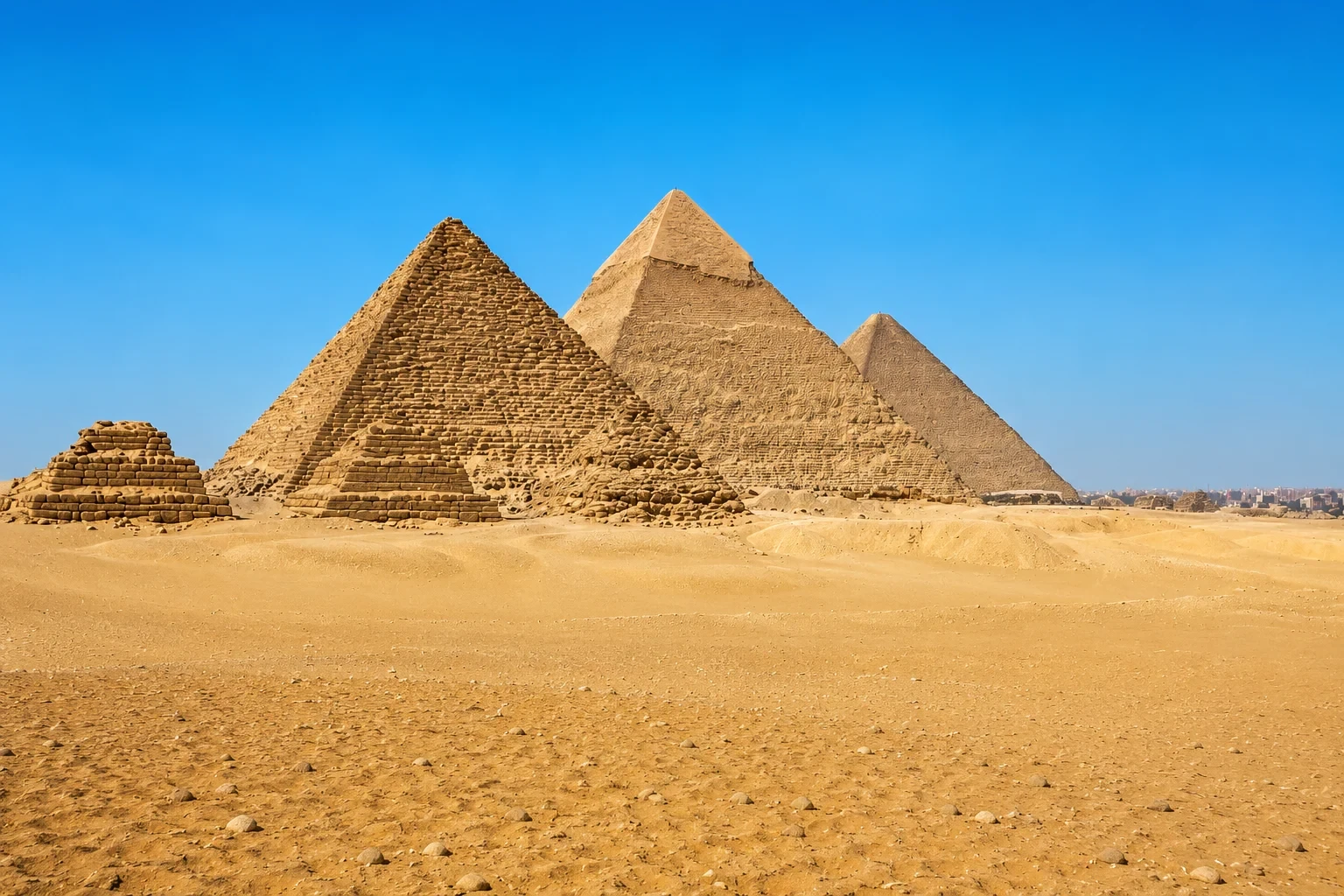
The Small Pyramid of Giza Menkaure Egypt stands at the southern end of the Giza Plateau diagonal alignment of three pyramids, its original height of approximately 65 meters making it less than half the height of the adjacent Khafre pyramid and less than half the height of the Great Pyramid, a scale reduction whose specific causes and specific meaning in the context of the 4th Dynasty royal pyramid building tradition have been the subject of sustained scholarly debate and a wide range of proposed explanations from the practical, a genuine reduction in the royal resources available for the pyramid building programme in the final phase of the 4th Dynasty, to the philosophical, a deliberate royal choice of quality over quantity in which the extraordinary sculptural programme of the Menkaure triads and the fine granite casing of the pyramid's lower courses express the same level of royal ambition and the same level of artistic investment as the physically larger monuments of Khufu and Khafre but in a different material and aesthetic register, and to the circumstantial, the simple fact that Menkaure died before his pyramid was complete and that whatever his original intentions for the monument's final scale and finish, the incomplete pyramid that his successor Shepseskaf was left to finish in the most expedient available manner may be significantly less ambitious in its final realized form than the programme that Menkaure himself had envisioned. WOW Egypt Tours includes the Small Pyramid of Menkaure as an essential destination in all comprehensive Cairo Tours, Egypt Classic Tours, Egypt Short Break Tours, Egypt Family Tours, Egypt Budget Tours, and all Egypt Tour Packages that encompass the extraordinary ancient heritage of the Egyptian capital.

What Is The Small Pyramid Of Giza Menkaure?
The Small Pyramid of Giza is the royal pyramid monument of the pharaoh Menkaure, sixth pharaoh of the Egyptian Old Kingdom 4th Dynasty who reigned approximately from 2532 to 2503 BCE as the son of Khafre and the grandson of Khufu, built on the southern section of the Giza Plateau at a position that completes the diagonal alignment of the three Great Pyramids and whose original height of approximately 65.5 meters, now reduced to approximately 61 meters after centuries of stone removal and erosion, makes it the smallest of the three Giza royal monuments by a considerable margin but still one of the largest and the most architecturally significant pyramid monuments of the complete ancient Egyptian pyramid building tradition outside the three Giza great pyramids themselves. The pyramid's base measures approximately 108 meters on each side, significantly smaller than the approximately 215-meter base of the Khafre pyramid and the approximately 230-meter base of the Khufu pyramid, and its volume is roughly one tenth that of the Great Pyramid of Khufu, a scale reduction that has consistently attracted scholarly attention as the most dramatic and the most consequential diminution in pyramid scale between successive pharaohs in the complete 4th Dynasty royal monument sequence.
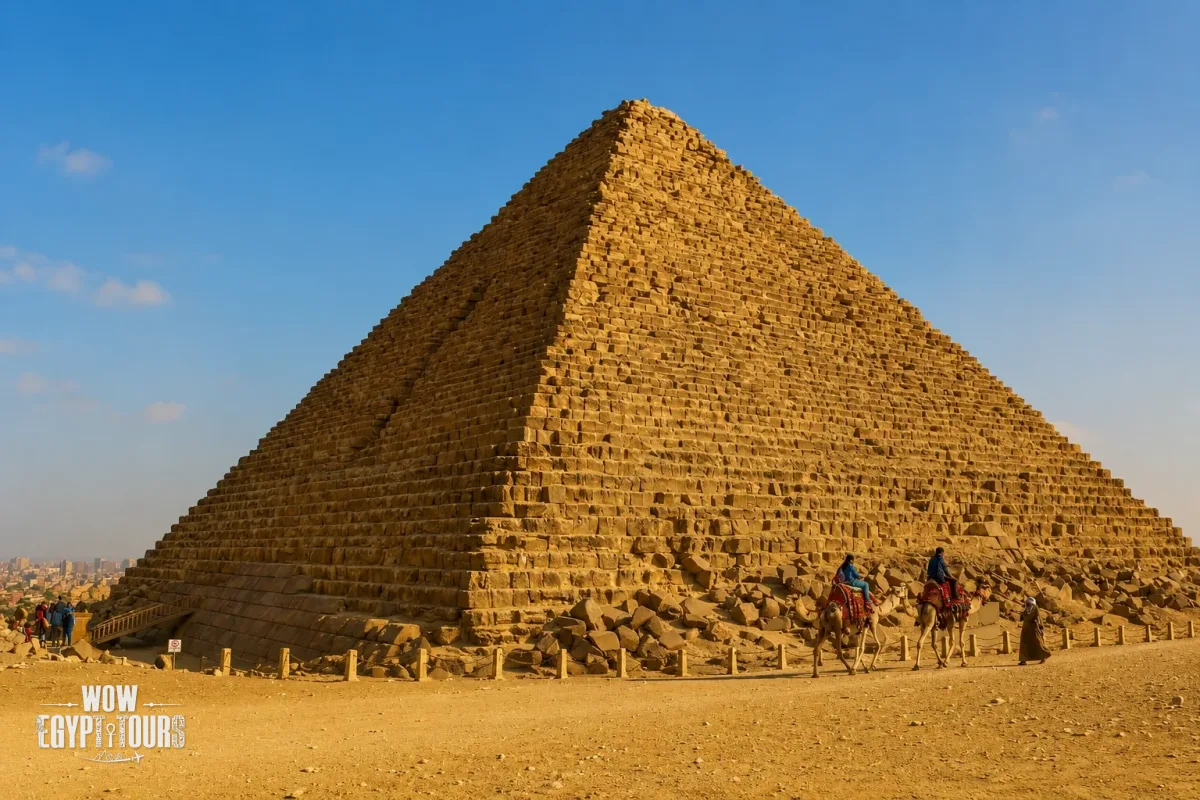
The most immediately distinctive visual feature of the Menkaure pyramid that sets it apart from its two larger Giza companions is the presence of red Aswan granite casing on the lower approximately 16 courses of the pyramid's exterior, whose dark reddish-brown stone contrasts dramatically with the rough grey limestone core above it and provides the most immediately visible evidence for the original exterior casing programme of the monument, a programme that was far more ambitious in its material specification than the white Tura limestone casing of the Khufu and Khafre pyramids, requiring the transport of the much heavier and the much more expensive Aswan red granite from the quarries at Aswan approximately 900 kilometers to the south for the complete lower casing of the monument that the pharaoh's death left unfinished and that his successor Shepseskaf completed only partially with rough mudbrick filling in the upper sections where the granite casing had not yet been placed. The combination of the red granite lower courses, the mudbrick filling sections above, and the original limestone casing that covers the uppermost portions of the monument creates an exterior surface of extraordinary visual complexity and extraordinary historical expressiveness, a physical record of the pyramid's incomplete construction history written directly in the contrasting colors and textures of the different materials that different phases of the construction programme used at different points of the monument's exterior surface.
Who Built The Small Pyramid Of Giza Menkaure?
The Small Pyramid of Giza was built by and for the pharaoh Menkaure, also known in the Greek tradition as Mykerinos or Mycerinus, sixth pharaoh of the Egyptian Old Kingdom 4th Dynasty who reigned approximately from 2532 to 2503 BCE as the son of Khafre and the grandson of Khufu in the most distinguished royal lineage of ancient Egyptian pyramid builders. The attribution of the Small Pyramid to Menkaure is established by multiple converging lines of ancient documentary and physical evidence including the ancient Egyptian administrative records that identify the monument as Menkaure's divine place, the name applied to the pyramid complex in the ancient Egyptian administrative and religious tradition, the inscriptions that identify Menkaure as the patron of the monument's construction programme, and the extraordinary sculptural programme of royal portrait triads recovered from the monument's Valley Temple area by the Boston Museum of Fine Arts excavations of George Reisner in the early 20th century whose royal iconography unambiguously identifies Menkaure as the subject and the patron of the most celebrated group portrait sculpture programme in the complete ancient Egyptian artistic heritage.
Menkaure himself is known to the ancient Egyptian and the classical Greek literary traditions as the most benevolent and the most just of the three Giza pyramid-building pharaohs, a characterization that may reflect genuine historical memory of a more moderate administrative regime or may simply represent the contrast that literary tradition has constructed between the three successive pyramid builders for narrative and moral purposes. The Greek historian Herodotus, who provides the most extended ancient literary account of all three Giza pharaohs in his Histories, describes Menkaure as a just and pious ruler who reopened the Egyptian temples that his father Khafre had closed, allowed the Egyptians to resume their religious practices, and was universally beloved by his people in a direct contrast to the despotic portraits of Khufu and Khafre that Herodotus constructs in the same narrative. Whether the Herodotean portrait of Menkaure's benevolence reflects genuine ancient Egyptian historical tradition or is a literary construction serving the moral purposes of Herodotus's historical narrative, it has given Menkaure a more personally sympathetic character in the Western cultural tradition's reception of the Giza pharaohs than his grandfather Khufu or his father Khafre and has contributed to the quality of personal human warmth and personal approachability that the Menkaure pyramid complex, with its smaller scale and its extraordinary sculptural legacy of genuinely warm and genuinely humanly compelling royal portraits, consistently communicates to visitors who engage with it in the most complete and the most informed way.
The Pharaoh Menkaure: The Most Human Of The Giza Pharaohs
Menkaure's approximately 29-year reign, during which the Giza Plateau's southern pyramid complex was conceived, partially constructed, and left unfinished at his death in a state whose completion by his successor Shepseskaf has preserved the most compelling evidence for the practical realities of the ancient Egyptian pyramid building programme's dependence on the sustained personal patronage of the living pharaoh, is in many ways the most historically nuanced and the most personally compelling of the three Giza pyramid-building reigns, presenting a royal biography of greater complexity and greater humanity than the overwhelming scale ambitions of Khufu and the comprehensive landscape planning achievements of Khafre allow for their respective historical portraits. The decision to case the lower portion of the Menkaure pyramid in red Aswan granite rather than the white Tura limestone used by Khufu and Khafre represents the most ambitious material specification of any Giza pyramid casing programme, the hardest and the most difficult stone to quarry, transport, and finish being applied to the exterior of the smallest of the three pyramids in a decision that speaks directly and powerfully to a royal aesthetic ambition whose measure is quality of material and quality of finish rather than quantity of stone and height of monument.
The extraordinary sculptural programme of the Menkaure triads, the series of group portrait sculptures representing the pharaoh standing or seated between the goddess Hathor and various nome deities of the ancient Egyptian provincial system, whose refinement of surface modelling, whose quality of compositional organization, and whose quality of direct human engagement in the royal portraiture are universally recognized by Egyptologists and art historians as the finest group portrait sculptures of the complete ancient Egyptian Old Kingdom tradition and among the most personally affecting works of ancient art in any medium accessible to visitors at any museum in the world, gives the Menkaure pyramid complex an artistic legacy whose quality is entirely commensurate with the most ambitious artistic achievements of any civilization in the complete history of ancient art and whose personal heritage impact on visitors who encounter the triads in the collection of the Egyptian Museum or the Boston Museum of Fine Arts is consistently described as one of the most genuinely moving and the most profoundly affecting encounters with ancient art available at any museum in the world. Menkaure is the ancient Egyptian pharaoh who proves most completely and most convincingly that the ambition of the ancient Egyptian royal programme was not exhausted by the construction of very large stone monuments but extended equally and simultaneously to the creation of very beautiful ancient art, that the same civilization capable of moving two and a half million multi-tonne stone blocks in the service of a single royal monument was simultaneously capable of carving the finest group portrait sculpture of the ancient world in the Valley Temple of the smallest of its three great pyramids.
Small Pyramid Of Giza Menkaure Location
The Small Pyramid of Giza Menkaure is located at the southern end of the Giza Plateau diagonal alignment in Giza Governorate, approximately 13 kilometers southwest of central Cairo, positioned immediately south of the Middle Pyramid of Khafre and at the southernmost point of the three-pyramid diagonal whose complete alignment is most dramatically visible from the famous panoramic desert viewpoint to the southwest. The Menkaure pyramid's position on the Giza Plateau is on naturally lower ground than the Khafre pyramid and on roughly comparable natural ground elevation to the Khufu pyramid at the northern end of the complex, giving the three-pyramid alignment a diagonal appearance when viewed from the east that reflects both the south-to-north topographic slope of the plateau and the deliberate ancient planning decision to align the three monuments in a southeast-to-northwest diagonal whose specific astronomical or geographical motivation remains a subject of scholarly discussion. The Valley Temple area of the Menkaure complex, whose excavation in the early 20th century by the Boston Museum of Fine Arts expedition under George Reisner produced the extraordinary sculptural discoveries of the Menkaure triads and the dyad portrait, is located at the eastern edge of the plateau approximately 350 meters east of the pyramid itself. WOW Egypt Tours provides all transportation and guide services for the complete Menkaure pyramid complex programme as part of all Cairo Tours and Egypt Tour Packages.
Small Pyramid Of Giza Menkaure Fun Facts
The most historically tragic and the most personally regrettable single event in the complete heritage biography of the Menkaure pyramid is the loss of the pharaoh's beautiful basalt sarcophagus to the bottom of the Mediterranean Sea in 1838, when the British ship HMS Beatrice that was transporting the sarcophagus from Alexandria to Britain sank in a storm off the coast of Cartagena in Spain with the loss of the sarcophagus along with the ship's other cargo. The sarcophagus, described by Colonel Howard Vyse who discovered it in the Menkaure burial chamber in 1837 as one of the most beautiful ancient Egyptian sarcophagi in existence, panelled in the most refined and the most precisely fitted dark grey basalt in the palace facade decorative scheme of the ancient Egyptian royal funerary tradition, has lain on the floor of the Mediterranean Sea west of Cartagena for more than 185 years in the most completely irreversible and the most personally regrettable heritage loss associated with any of the three Giza pyramid monuments, a loss whose specific circumstances, the sarcophagus surviving four and a half thousand years of sealed burial in the pyramid only to be lost to the ocean in the first year of its rediscovery by modern explorers, give it a quality of historical poignancy whose specific irony has been widely cited in the archaeological literature as one of the most painful single examples of the fragility of ancient heritage survival in the modern era of colonial-period archaeological extraction.
The Menkaure pyramid was the last of the three Giza pyramids to be completed, and its completion was left to Menkaure's successor Shepseskaf, the final pharaoh of the 4th Dynasty, who finished the monument in the most expedient manner available by substituting mudbrick for the unplaced red Aswan granite casing in the upper sections of all four faces, creating the most immediately visible evidence of a royal funerary monument left unfinished by its patron's death and completed by a successor who lacked the time, the resources, or the motivation to maintain the original programme's material specifications. The presence of mudbrick in the Menkaure pyramid's upper exterior sections is the most direct and the most physically readable evidence available at any Giza monument for the practical reality of pyramid building as an enterprise dependent on the continuous personal involvement and the continuous personal authority of the living pharaoh for whose benefit the construction programme exists, a reality that the seamless completed exteriors of the Khufu and Khafre monuments successfully conceal but that the Menkaure monument reveals with complete archaeological honesty in the most historically informative monument biography of the three Giza royal pyramids.
The three subsidiary pyramids associated with the Menkaure complex, located immediately south of the main pyramid and designated the Queens' Pyramids or the satellite pyramids of Menkaure in the Egyptological literature, include one pyramidal structure (G3-a) that appears to have been intended as a cult pyramid for the royal Ka soul rather than as a burial monument for a queen, and whose interior chamber system and its associated Mortuary Temple give it a functional character more closely related to the cult infrastructure of the main pyramid than to the funerary role of the queens' burial monuments at the Khufu and Khafre complexes. The three subsidiary pyramids of the Menkaure complex are among the most archaeologically productive of all the subsidiary monument structures at the Giza Plateau, their excavation in the early 20th century by George Reisner's Boston-Harvard Expedition having produced significant evidence for the royal funerary cult practices and the monument maintenance traditions of the late Old Kingdom period.
Why Is It Called The Small Pyramid Of Giza Menkaure?
The designation Small Pyramid is the most straightforward and the most practically descriptive of the three size-based names applied to the Giza royal pyramids in the modern heritage tourism and scholarly literature, identifying the Menkaure monument by its position at the smallest end of the dimensional hierarchy of the three Giza royal pyramids whose scale descends from north to south with the Great Pyramid of Khufu as the largest, the Middle Pyramid of Khafre as the second largest, and the Small Pyramid of Menkaure as the smallest. It is worth noting that the designation Small is relative only to its two Giza companions, both of which are themselves among the largest and the most technically extraordinary ancient buildings ever constructed, and that the Menkaure pyramid at approximately 65 meters in original height and approximately 108 meters base width is in absolute terms one of the most remarkable and the most ambitious ancient Egyptian pyramid monuments outside the three Giza pyramids themselves, exceeded in scale by only two other Egyptian pyramids, both built by Menkaure's grandfather Khufu's father Sneferu at Dahshur. The attribution to Menkaure and the Greek alternative Mykerinos or Mycerinus identify the specific royal patron of the monument in both the ancient Egyptian and the classical Greek scholarly traditions, with Menkaure being the standard Egyptological transliteration of the ancient Egyptian royal name and Mykerinos being the Greek tradition preserved in the historical accounts of Herodotus. The ancient Egyptian name of the Menkaure pyramid complex was Menkaure is Divine, a royal designation that identifies the pharaoh and expresses the ancient Egyptian assessment of the complete complex's sacred character in the most direct and the most theologically specific evaluative language available in the ancient Egyptian administrative and religious vocabulary.
Small Pyramid Of Giza Menkaure History
The history of the Small Pyramid of Menkaure begins with its initiation by Menkaure in approximately 2532 BCE and its incomplete state at his death approximately 29 years later in approximately 2503 BCE, a beginning whose specific circumstances, the unfinished pyramid left to an heir who lacked both the motivation and apparently the resources to complete it to the original material specifications, give the Menkaure pyramid a more complex and a more historically nuanced construction biography than either of its two completed Giza companions. The completion of the pyramid by Shepseskaf using mudbrick for the upper casing sections, a decision whose practical necessity reflects the specific realities of the late 4th Dynasty royal resource situation at the end of the most ambitious construction programme in the history of the ancient Egyptian state, created the monument in the specific incomplete and partially substituted form that subsequent generations of ancient Egyptians, medieval Arabic geographers, early modern European explorers, and modern archaeological investigators have encountered and studied.
The ancient Egyptian veneration tradition maintained the Menkaure pyramid complex as an active royal cult site throughout the Pharaonic period, with the mortuary priests of the Menkaure establishment continuing to perform the required daily ritual offerings for the royal soul of Menkaure in the pyramid's Mortuary Temple throughout the Old Kingdom and into the subsequent periods of Egyptian history, a continuity of religious service whose specific duration and specific organizational form is documented in the ancient Egyptian administrative papyri recovered from other Old Kingdom pyramid complexes and applied by analogy to the Menkaure establishment. The medieval Islamic period saw the Menkaure pyramid subjected to a serious and sustained attempt at deliberate demolition in approximately 1196 CE by the son of the great Saladin, al-Aziz Uthman, who began dismantling the pyramid from the outside with the intention of destroying the entire monument but discovered after eight months of effort that the work of demolition was nearly as expensive and nearly as physically demanding as the original work of construction and abandoned the project, leaving the distinctive gash visible on the pyramid's north face as the most direct physical evidence for the medieval demolition attempt and one of the most historically informative surface features of any of the three Giza pyramid monuments.
The first modern scientific exploration of the Menkaure pyramid was conducted by the British military engineer Colonel Howard Vyse and the engineer John Perring in 1837, who penetrated the pyramid's interior and discovered in the burial chamber the extraordinary dark basalt sarcophagus whose panelled surface decoration represented the finest ancient Egyptian royal funerary stone vessel carving of the complete Giza complex, the wooden anthropoid coffin lid with a carved royal face and inscribed with the name of Menkaure, and the bones of a young woman whose identity and relationship to the pyramid's patron remain among the most poignant and the most enduring mysteries of the complete Giza archaeological record. The discovery of the sarcophagus was followed by its removal from the pyramid for shipment to Britain, the disastrous maritime loss of the vessel carrying it off the Spanish coast, and the consequent permanent deprivation of the world's heritage of the finest ancient Egyptian royal stone sarcophagus from the Giza pyramid complex in what remains the single most consequential heritage loss associated with the early modern period of European exploration of the Egyptian ancient monuments. The most systematic and the most archaeologically productive modern investigation of the Menkaure pyramid complex was conducted by George Reisner's Boston-Harvard Expedition from 1906 to 1924, whose excavations of the Valley Temple area, the three subsidiary pyramids, and the mastaba tomb fields of the Menkaure complex produced the most important discoveries of the complete modern investigation of the Menkaure monument including the extraordinary triads and the royal dyad portrait whose recovery from the Valley Temple area transformed the understanding of the artistic achievements of the ancient Egyptian 4th Dynasty royal sculptural programme.
The Story Of The Lost Sarcophagus And The Unfinished Pyramid
The combined story of the Menkaure pyramid's unfinished state and the subsequent loss of its royal sarcophagus to the sea is the most dramatic and the most historically consequential narrative of loss and incompleteness in the complete biography of any Giza pyramid monument, a two-chapter story of the fragility of ancient royal heritage in the face of both the practical contingencies of the ancient world and the romantic adventurism of the 19th century European antiquarian tradition whose consequences for the completeness of the Giza archaeological record are permanent and irreversible in a way that the gradual erosion of pyramid casing stone or the deterioration of ancient painted surfaces is not. The first chapter of the story, the unfinished pyramid, begins with Menkaure's death in approximately 2503 BCE before the lower red granite casing of the monument had been completed and before the mudbrick filling of the upper exterior sections had been replaced with the proper stone casing of the original programme, leaving his successor Shepseskaf with an unfinished monument whose completion in the most practically available materials rather than the most ambitious materials of the original design preserved in the Menkaure pyramid's exterior the most directly readable account of an ancient Egyptian royal construction programme interrupted by its patron's death available at any pyramid monument in the complete Egyptian heritage landscape.
The second chapter of the story, the sarcophagus, begins with Howard Vyse's discovery of the extraordinary dark basalt sarcophagus in the Menkaure burial chamber in 1837, the most beautiful and the most materially refined ancient Egyptian royal stone sarcophagus from any of the three Giza pyramid complexes, whose panelled palace facade decoration in perfectly fitted polished dark basalt represents the highest expression of the ancient Egyptian royal stone vessel carving tradition in the 4th Dynasty. Vyse arranged for the sarcophagus to be removed from the pyramid and shipped to Britain for the British Museum's collection, an act of archaeological extraction entirely typical of the early 19th century European colonial engagement with ancient Egyptian heritage and entirely consistent with the practice of his contemporaries in removing ancient Egyptian objects to European collections. The sarcophagus was loaded onto the British merchant vessel HMS Beatrice at Alexandria and began its journey to Britain via the Mediterranean Sea route in 1838. The ship encountered a severe storm off the coast of Cartagena in southeastern Spain and sank with the loss of its cargo, consigning the most beautiful royal sarcophagus of the Giza complex to the floor of the Mediterranean Sea at a depth that has made its recovery impossible with any technology available in the 185 years since the sinking. The sarcophagus of Menkaure, which survived sealed in the burial chamber of his pyramid for more than four thousand five hundred years through every historical upheaval of the ancient and medieval Egyptian world, was lost to the ocean within a year of its rediscovery by modern explorers in one of the most complete and the most permanently consequential heritage losses in the entire history of ancient Egyptian archaeological investigation.
Small Pyramid Of Giza Menkaure Key Attractions And Features
The Red Granite Casing And The Unfinished Exterior
The most immediately distinctive and the most archaeologically informative visual feature of the Small Pyramid of Menkaure is the extraordinary combination of contrasting materials on its exterior surface, the polished red Aswan granite casing of the lowest approximately 16 courses of the pyramid face, the rough and unfinished limestone core above that, and the mudbrick sections visible in some areas where Shepseskaf's completion programme substituted expedient materials for the proper stone casing that the original construction programme had specified. The red granite casing of the lower courses is the most immediately visually extraordinary and the most materially ambitious exterior casing programme of any of the three Giza pyramids, requiring the transport of the heaviest and the most expensive casing material from the Aswan quarries approximately 900 kilometers to the south in a material specification whose ambition was never fully realized in the finished monument but whose surviving lower course evidence gives the Menkaure pyramid a quality of material magnificence in its lowest and most immediately accessible sections that the white Tura limestone casing of the Khufu and Khafre pyramids, however beautiful in its complete form, could not match in the specific richness and the specific visual drama of the polished red granite surface in the Egyptian desert light. The medieval demolition gash on the north face of the pyramid, the visible evidence of al-Aziz Uthman's abandoned eight-month attempt to demolish the monument in 1196 CE, adds a further layer of historical expressiveness to the pyramid's complex exterior, a wound in the stone that documents directly one of the most extraordinary and the most personally dramatic moments in the complete post-ancient history of the Giza monuments.
The Pyramid Interior: The Complex Chamber System
The interior of the Small Pyramid of Menkaure, accessible to visitors through the original ancient Egyptian entrance on the north face as part of the optional interior visit programme, contains the most architecturally complex and the most spatially varied internal chamber system of the three Giza royal pyramids, a passage and chamber sequence whose specific spatial organization and whose several distinct architectural elements reveal the most detailed available evidence for the specific construction programme modifications and functional planning decisions of the Menkaure pyramid building sequence. The internal programme includes the original entrance passage descending from the north face, a horizontal passage leading to an antechamber decorated with the palace facade panelled recesses that are the most architecturally refined interior decorative element of any of the three Giza pyramid chamber systems, a series of passages and rooms including a subsidiary chamber to the north of the main passage axis whose function remains a subject of scholarly interpretation, and the main burial chamber cut from the natural bedrock below the pyramid in the center of the monument whose floor bears the rectangular pit that received the basalt sarcophagus now lost to the sea. The palace facade panelling of the antechamber walls, whose precision-fitted limestone blocks are carved in the decorative scheme that evokes the facade of an ancient Egyptian royal palace or great tomb, is the most immediately beautiful and the most artistically refined interior architectural element accessible to visitors in the interior of any of the three Giza royal pyramids, its refined decorative programme giving the Menkaure interior a dimension of aesthetic ambition and aesthetic achievement entirely commensurate with the extraordinary quality of the external sculptural programme of the royal triads.
The Menkaure Triads: The Finest Sculpture Of The Old Kingdom
The most internationally celebrated and the most art-historically significant heritage discoveries associated with the Small Pyramid of Menkaure are the extraordinary group portrait sculptures known as the Menkaure triads, a series of schist (greywacke) group sculptures representing the pharaoh Menkaure standing or seated between the goddess Hathor on his right and a nome deity on his left, recovered from the Valley Temple area of the Menkaure complex by George Reisner's Boston-Harvard Expedition between 1908 and 1910 and recognized immediately upon their discovery as the finest group portrait sculptures of the complete ancient Egyptian Old Kingdom artistic tradition and among the most personally affecting and the most universally admired works of ancient art in any medium available at any museum in the world. The triads were originally part of a much larger series, with Reisner estimating that the complete sculptural programme may have included as many as 42 individual triads representing Menkaure with Hathor and each of the major nome deities of the ancient Egyptian provincial system, of which four complete or near-complete examples and several fragmentary examples survived to be recovered in the excavation of the Valley Temple area, giving scholars a sufficiently complete sample of the complete programme to understand its iconographic organization, its spatial distribution in the temple, and its extraordinary sculptural quality.
The specific quality of the Menkaure triads that has most consistently and most universally attracted the attention and the admiration of Egyptologists, art historians, and general visitors from every cultural background is the extraordinary directness and warmth of the royal portrait in the central Menkaure figure, whose face, despite the canonical idealization of ancient Egyptian royal portraiture, conveys a quality of individual human presence and individual personal authority that is more immediately and more completely legible as a portrait of a specific human being than the more formally distant royal expressions of most other ancient Egyptian royal portrait sculpture in the Old Kingdom tradition. The triads in the Egyptian Museum in Cairo, the four most completely preserved examples of the series, are among the most consistently admired and the most consistently photographed objects in the entire museum collection, objects whose combination of extraordinary sculptural quality, extraordinary preservation, and extraordinary personal human warmth give them a power of direct aesthetic impact on visitors of every cultural background and every level of prior artistic engagement that is matched by very few ancient sculptural works in any museum collection in the world.
The Menkaure Dyad: The King And His Queen
Among the most celebrated and the most personally affecting of all the ancient Egyptian royal portrait sculptures in the complete heritage of the 4th Dynasty artistic tradition is the extraordinary dyad, the pair statue, of Menkaure and his queen, also discovered by George Reisner's excavation of the Menkaure Valley Temple area and now one of the supreme masterpieces of the Egyptian Museum collection in Cairo. The dyad shows Menkaure and the queen in the canonical side-by-side standing pose of ancient Egyptian royal couple portrait sculpture, but with a quality of compositional warmth and a quality of individual characterization in both figures that gives the Menkaure dyad a dimension of personal and emotional engagement that is unique in the surviving ancient Egyptian royal couple portrait tradition and that has made it one of the most consistently cited and the most consistently reproduced examples of ancient Egyptian royal portraiture in the complete scholarly and popular literature of the ancient Egyptian artistic heritage. The queen's arm around the waist of the pharaoh, the forward posture of both figures giving the composition a quality of directed movement and engaged presence rather than the more static hieratic dignity of most ancient Egyptian royal couple portraits, and the extraordinary quality of the surface modelling of both faces in the rich dark green schist that gives the material its most complete and most immediately affecting quality of ancient presence, together give the Menkaure dyad a personal resonance and a human warmth that is unlike any other ancient Egyptian royal sculpture in the complete heritage record and that consistently produces in visitors who encounter it for the first time the most immediate and the most genuinely affecting response of personal recognition, the experience of seeing in an ancient stone carving of more than four thousand years ago a genuinely human couple in a genuinely human relationship of physical proximity and personal connection that transcends every cultural and temporal boundary to communicate something completely universal about the human condition.
The Three Subsidiary Pyramids
The three subsidiary pyramid structures associated with the Menkaure complex, positioned immediately south of the main pyramid and designated G3-a, G3-b, and G3-c in the Egyptological site plan notation, are among the most archaeologically informative of all the subsidiary monument structures associated with any of the three Giza royal pyramid complexes, their excavation by Reisner's expedition having produced significant evidence for the organizational structure, the personnel, and the material culture of the royal funerary cult establishment of the Menkaure complex in the Old Kingdom period. The largest of the three, G3-a, is distinguished from the other two by the presence of an internal chamber system and an associated Mortuary Temple that give it the character of a pyramid monument intended for the installation of a royal cult statue rather than simply as a burial monument for a queen, a functional distinction that has led some scholars to identify it as the cult pyramid of Menkaure's royal Ka soul rather than as a queens' burial monument in the conventional sense. The two smaller subsidiary pyramids, G3-b and G3-c, appear to be burial monuments for principal queens of Menkaure's royal family, with their simpler internal passage systems and their associated mortuary installations providing the standard queens' pyramid programme of the 4th Dynasty royal funerary landscape tradition. The complete subsidiary pyramid group of the Menkaure complex, when viewed from the panoramic desert viewpoint to the southwest, creates the most complex and the most architecturally varied skyline of any Giza pyramid complex, the main pyramid's three smaller companions arranged in a southward extension of the complex that gives the Menkaure portion of the Giza Plateau a more completely realized and a more densely organized monument landscape than its small main pyramid alone would suggest.
The Medieval Demolition Attempt
One of the most extraordinary and the most dramatically personal stories in the complete post-ancient history of the Giza pyramid monuments is the eight-month demolition attempt launched against the Small Pyramid of Menkaure in approximately 1196 CE by al-Aziz Uthman, the son of the great Saladin and the Sultan of Egypt at the time, who apparently wished to demonstrate that the ancient monuments could be demolished if sufficient human effort was applied to the task. Al-Aziz assembled a work force of engineers, soldiers, and laborers and set them to work on the systematic dismantling of the Menkaure pyramid from the outside, beginning with the north face where the demolition gash that remains visible today was created in the course of approximately eight months of sustained effort. The work proved so physically demanding, so expensive, and so discouragingly slow relative to the scale of the monument that even eight months of sustained effort with a large workforce produced only the visible surface gash on the north face and a modest quantity of stripped casing and core stones before the project was abandoned as impractical and the workers were released. The medieval chronicler Abd al-Latif al-Baghdadi, who visited Egypt at approximately the time of the demolition attempt, records in his Description of Egypt the account of the work and the reasons for its abandonment, providing the most direct ancient documentary evidence for one of the most extraordinary individual confrontations between a powerful ruler's will to destroy and the physical reality of an ancient monument's resistance to demolition that the complete heritage record of the Giza Plateau preserves. The demolition gash on the Menkaure pyramid's north face is therefore the most personally dramatic and the most historically informative surface feature of any of the three Giza pyramid monuments, a visible scar in the ancient stone that documents directly the failure of one of the most powerful rulers of medieval Islam to destroy what one of the most powerful rulers of the ancient world had built.
Why Is The Small Pyramid Of Giza Important?
The Small Pyramid of Giza Menkaure is important for reasons spanning ancient Egyptian artistic achievement, royal construction history, the practical biography of pyramid building as a royal enterprise dependent on the living pharaoh's sustained involvement, the medieval history of the Giza monuments' post-ancient treatment, and the history of modern archaeological exploration in Egypt with both its extraordinary discoveries and its most consequential losses. As an artistic heritage site, the Menkaure complex produced the finest group portrait sculptures of the complete ancient Egyptian Old Kingdom tradition in the Menkaure triads, works of such extraordinary sculptural quality and such extraordinary personal human warmth that they are universally recognized as among the most affecting and the most artistically accomplished ancient works of art in any medium accessible to visitors at any museum in the world. As a construction history document, the unfinished state of the pyramid's exterior, with its combination of polished red granite casing, rough limestone core, and mudbrick completion sections, provides the most directly readable physical evidence for the practical realities of ancient Egyptian pyramid construction as an enterprise dependent on the living pharaoh's personal authority and his continuous royal patronage. WOW Egypt Tours includes the Small Pyramid of Menkaure as an essential destination in all comprehensive Cairo Tours, Egypt Classic Tours, and all Egypt Tour Packages.
What Are Some Interesting Facts About The Small Pyramid Of Giza?
The Sarcophagus That Survived Four And A Half Thousand Years Only To Be Lost To The Sea
The story of Menkaure's basalt sarcophagus is one of the most completely extraordinary stories of heritage survival and heritage loss in the entire history of ancient Egyptian archaeology, a narrative of almost cosmic irony in which the most beautiful ancient Egyptian royal stone sarcophagus from any of the three Giza pyramid complexes survived sealed in the pyramid's burial chamber for more than 4,500 years through the fall of the Old Kingdom, the chaos of the First Intermediate Period, the political upheavals of the Middle and New Kingdom periods, the Ptolemaic and Roman reorganization of Egyptian society, the Islamic conquest of Egypt, the Crusades, the Mamluk and Ottoman periods, the Napoleonic invasion, and the beginning of the modern scientific investigation of ancient Egypt, only to be lost to the floor of the Mediterranean Sea less than twelve months after its rediscovery in 1837 by the very act of transportation that was intended to preserve and study it in the British Museum. The specific depth and the specific location off the coast of Cartagena in Spain where HMS Beatrice went down has been approximately established, and the sarcophagus may technically be findable at the bottom of the Mediterranean with sufficiently sophisticated underwater search technology, but no recovery attempt has been made and the sarcophagus remains on the sea floor as the most emotionally affecting and the most permanently consequential single heritage loss associated with the early modern European archaeological exploration of the Giza pyramid monuments.
The Pyramid That A Medieval Sultan Could Not Destroy
The eight-month failed demolition attempt of 1196 CE by al-Aziz Uthman against the Small Pyramid of Menkaure is the most dramatic individual post-ancient event in the complete biography of any of the three Giza pyramid monuments, a sustained confrontation between medieval Islamic political power and ancient Egyptian architectural permanence whose outcome, the medieval demolition project abandoned after eight months of intensive effort having produced only a surface gash and a quantity of stripped stone entirely negligible relative to the total volume of the monument, is one of the most powerful testimonies to the physical durability and the structural integrity of the ancient Egyptian limestone pyramid construction tradition available in the complete archaeological record of the Giza monuments. The story, recorded in medieval Arabic chronicles and visible in its physical consequence in the demolition gash on the Menkaure pyramid's north face, is the most personally dramatic ancient heritage survival story associated with any of the three Giza pyramids and gives the visit to the Menkaure pyramid a dimension of medieval historical engagement and personal wonder at the physical resilience of the ancient monument that is uniquely available at this specific point in the complete Giza Plateau visitor circuit.
The Woman In The Burial Chamber
Among the most poignant and the most persistently unresolved mysteries of the complete Giza archaeological record is the identity of the young woman whose remains were found in the burial chamber of the Menkaure pyramid by Howard Vyse in 1837, alongside the beautiful basalt sarcophagus of the pharaoh and the wooden coffin lid inscribed with Menkaure's name. The bones, described by Vyse as belonging to a young woman, were subsequently analyzed and carbon-dated in the 20th century, producing a radiocarbon date significantly later than the 4th Dynasty construction of the pyramid, suggesting that the remains may have been an intrusive burial placed in the chamber in a later period rather than the original ancient placement. However, the specific circumstances of the remains' position in relation to the sarcophagus and the coffin lid, and the possibility that the radiocarbon date was affected by the ancient Egyptian funerary practice of wrapping bodies in old linen, have made the definitive identification of the remains as either the original ancient burial or a later intrusion the most enduringly contested question in the specific archaeological biography of the Menkaure burial chamber, leaving the identity and the significance of the young woman's presence in the most private and the most sacred space of the pharaoh's eternal resting place permanently unresolved in one of the most humanly affecting mysteries of the complete Giza heritage record.
What Is So Special About The Small Pyramid Of Giza?
The Pyramid That Proves Quality Transcends Scale
What makes the Small Pyramid of Giza Menkaure uniquely special among all the Giza pyramid monuments is the extraordinary combination of the most artistically refined royal sculptural programme, the most archaeologically informative unfinished construction record, the most dramatically poignant heritage loss story, and the most personally human and most warmly approachable of the three Giza royal pyramid complexes that gives it a heritage significance and a personal impact entirely disproportionate to its physical scale and entirely commensurate with the most ambitious artistic, historical, and human dimensions of any single ancient royal monument in the complete Greater Cairo area. The Small Pyramid of Menkaure proves most completely and most convincingly the fundamental principle that the heritage significance of an ancient monument is not determined by its physical scale alone but by the completeness and the quality of the human story it embodies, and that a monument one tenth the volume of the largest building in the ancient world can carry a heritage biography of equal depth, equal complexity, and equal personal impact through the combination of its artistic legacy, its construction history, its post-ancient adventures, and its irreplaceable heritage losses that give it a uniqueness of character and a uniqueness of personal engagement available at no other monument on the Giza Plateau.
Where Ancient Art Reaches Its Most Human Expression
The Menkaure complex is also uniquely special for the quality of direct human engagement that its sculptural programme achieves, the extraordinary directness and warmth of the Menkaure triads and the dyad portrait giving the smallest of the Giza royal pyramid complexes a dimension of personal human connection between the ancient pharaoh and the modern visitor that the overwhelming physical scale of the Khufu and Khafre monuments, however personally impacting in their own specific ways, simply cannot provide. The visitor who stands in the Egyptian Museum before the Menkaure triads and the royal dyad, having visited the Menkaure pyramid itself on the Giza Plateau, understands in the most personal and the most directly experiential way possible that the ancient Egyptian 4th Dynasty royal programme was not simply the most ambitious architectural programme in the history of the ancient world but simultaneously the most accomplished and the most humanly warm royal portrait sculpture programme in the complete heritage of the ancient world, that the same pharaoh who commissioned the smallest of the three Giza great pyramids was also the patron of the finest group portrait sculptures ever created in ancient Egypt, and that the heritage of the Giza Plateau is not exhausted by the measurement of stone blocks and the calculation of construction logistics but extends to the most intimate and the most personally affecting dimension of ancient artistic vision available at any heritage site in the complete Greater Cairo area.
The Small Pyramid Of Giza Menkaure Through The Ages
The complete narrative of the Small Pyramid of Menkaure from its initiation by Menkaure approximately 2532 BCE through the unfinished state left at his death, the hasty mudbrick completion by Shepseskaf, the ancient Egyptian veneration tradition, the ancient Greek and Roman literary accounts of Mykerinos, the medieval Islamic demolition attempt and its dramatic failure, Howard Vyse's 1837 exploration and the discovery of the basalt sarcophagus and the young woman's remains, the subsequent loss of the sarcophagus to the Mediterranean Sea, the extraordinary archaeological discoveries of Reisner's Boston-Harvard Expedition between 1906 and 1924 that produced the Menkaure triads and the royal dyad, and the ongoing modern conservation and archaeological investigation of the complete complex traces one of the most richly varied, the most personally dramatic, and the most humanly affecting monument biographies in the complete heritage record of the Giza Plateau, a biography whose most significant moments span the complete arc of human engagement with the ancient monument from the most intimate ancient Egyptian royal personal investment in the finest sculptural programme of his complex to the most consequential modern heritage loss of the sarcophagus to the sea.
The Small Pyramid And UNESCO
The Small Pyramid of Giza Menkaure is protected as an essential component of the UNESCO World Heritage Site designated in 1979 as Memphis and its Necropolis: the Pyramid Fields from Giza to Dahshur, recognized as a heritage of outstanding universal value for the extraordinary concentration of ancient Egyptian funerary and royal monument heritage of the Old Kingdom pyramid building tradition. The UNESCO inscription encompasses the complete Giza Plateau monument complex including all three pyramids, the Great Sphinx, the Valley Temple of Khafre, and the connected pyramid fields of Saqqara and Dahshur. The Egyptian government and the UNESCO World Heritage Committee are engaged in ongoing collaboration on the conservation management of the Menkaure pyramid complex, including the preservation of the surviving red granite casing, the stabilization of the demolition gash on the north face, and the ongoing archaeological investigation of the Valley Temple area and subsidiary pyramid complex.
Best Time To Visit The Small Pyramid Of Giza Menkaure
The best time to visit the Small Pyramid of Menkaure is during the cooler months from October through April when the Cairo and Giza climate provides the most comfortable conditions for the outdoor pyramid complex exploration, the subsidiary pyramids circuit, and the panoramic desert viewpoint from which the complete Menkaure complex with its three subsidiary pyramids creates the most architecturally varied and the most compositionally rich portion of the complete Giza Plateau skyline. The winter months of December through February offer the most extraordinary quality of low-angle morning light that illuminates the red granite casing of the Menkaure pyramid's lower courses in the most dramatically beautiful contrast with the rough limestone core above and the most clearly defined revelation of the medieval demolition gash on the north face whose specific character is most clearly legible in the raking light of the early morning. For the pyramid interior visit, early morning arrival at the Giza complex opening is the most strongly recommended approach, as the Menkaure interior ticket is separately allocated in limited daily quantities. WOW Egypt Tours advises on optimal seasonal timing for all Giza heritage activities.
Small Pyramid Of Giza Menkaure Opening Hours
The Small Pyramid of Menkaure is accessible as part of the complete Giza Pyramids Complex, open daily from 8:00 AM to 5:00 PM in the winter season (October through April) and from 7:00 AM to 7:00 PM in the summer season (May through September). The Menkaure pyramid interior is open daily for a limited number of visitors with an additional ticket purchased at the complex entrance. The subsidiary pyramids of the Menkaure complex are accessible throughout the complex visiting hours as part of the general complex ticket. All visiting hours are subject to adjustment for Egyptian national holidays and should be confirmed at time of booking with WOW Egypt Tours.
Small Pyramid Of Giza Menkaure Entrance Fees
General Giza Pyramids Complex entrance: EGP 220 for adults, EGP 110 for students.
Menkaure Pyramid interior (additional fee beyond complex entrance): EGP 100 for adults, EGP 50 for students.
All Giza complex and Menkaure pyramid entrance fees are included in the Cairo Tours and Egypt Tour Packages organized by WOW Egypt Tours. The Menkaure triads and the royal dyad sculpture are viewed at the Egyptian Museum in Tahrir Square whose separate entrance fee is included in all complete Cairo heritage programmes organized by WOW Egypt Tours. Fees are subject to periodic adjustment.
How To Get To The Small Pyramid Of Giza Menkaure
The Small Pyramid of Menkaure is located at the southern end of the Giza Plateau approximately 13 kilometers southwest of central Cairo, accessible as part of the complete Giza Pyramids Complex visitor circuit. Private vehicle from Cairo hotel provided by WOW Egypt Tours is the most convenient approach, providing door-to-door transport from the hotel to the main Giza complex entrance and transportation between all sites within the plateau area and to the adjacent Grand Egyptian Museum, the Egyptian Museum, Saqqara, Memphis, and Dahshur. Within the Giza complex, the Menkaure pyramid is positioned at the southern end of the plateau approximately 700 meters south of the Great Pyramid of Khufu, accessible on foot from the main plateau visitor circuit.
How Long To Spend At The Small Pyramid Of Giza Menkaure
The Small Pyramid of Menkaure should be allocated a minimum of 45 minutes to one hour within the complete Giza Plateau programme for the exterior circuit including the red granite casing examination, the medieval demolition gash on the north face, the three subsidiary pyramids to the south, and the views from the Menkaure complex of the complete three-pyramid diagonal alignment from its southern end. The optional interior visit adds approximately 30 to 45 minutes for the palace facade antechamber and the burial chamber with its rectangular pit floor. A complete Egyptian Museum visit to see the Menkaure triads and the royal dyad, most naturally organized as the afternoon complement to the Giza morning programme, requires a minimum of one hour specifically for the Menkaure sculpture collection and two to three hours for the complete museum highlights programme in which the Menkaure sculptures are the most important 4th Dynasty royal portrait component. The complete Menkaure pyramid experience, combining the pyramid site visit with the Egyptian Museum sculpture collection visit, creates the most personally complete and the most artistically satisfying encounter with the Menkaure heritage available in any single-day Cairo programme.
Tips For Visiting The Small Pyramid Of Giza Menkaure
Ask your licensed Egyptology guide from WOW Egypt Tours to tell the complete story of the lost basalt sarcophagus, the discovery by Vyse in 1837, the shipment on HMS Beatrice, and the sinking off Cartagena in 1838, before approaching the pyramid's north face entrance where the burial chamber that held the sarcophagus can be visited, as the combination of the story's extraordinary irony with the direct physical encounter with the chamber space from which the sarcophagus was removed creates the single most personally affecting narrative heritage encounter available at any point in the complete Giza Plateau visitor circuit. Examine the medieval demolition gash on the north face carefully with your guide's assistance in identifying the specific character of the damage, as the contrast between the ancient construction that survived four and a half thousand years and the medieval demolition effort that eight months of work could only superficially affect gives the Menkaure pyramid the most dramatically readable physical testimony to the structural permanence of the ancient Egyptian limestone pyramid construction tradition available at any of the three Giza monuments. Walk the complete subsidiary pyramid circuit to the south of the main pyramid with sufficient time to identify the three subsidiary structures and to understand from your guide's explanation the specific functional distinctions between the cult pyramid of the royal Ka soul and the queens' burial monuments that give the Menkaure subsidiary pyramid group its most complex organizational character. Plan the Egyptian Museum visit for the same day as or the day following the Giza Plateau visit, specifically requesting the Menkaure sculpture galleries as the primary destination of the museum programme, as the combination of the pyramid site experience with the museum encounter with the triads and the dyad creates the most completely personal and the most artistically rewarding heritage experience available in any Cairo heritage programme.
What To Wear At The Small Pyramid Of Giza Menkaure
The Menkaure pyramid visit requires the same practical sun-protection clothing as the complete Giza Plateau programme: lightweight breathable long-sleeved clothing covering the arms and legs, a wide-brimmed hat, high-SPF sunscreen, and UV-protective sunglasses for the completely exposed plateau environment. For the pyramid interior visit, comfortable clothing allowing free movement in the descending and horizontal passage system to the burial chamber is required, with flat rubber-soled shoes providing the most secure footing on both the rough exterior limestone terrain and the smooth interior passage floors. The Menkaure interior passage system is more accessible and less physically demanding than the Great Pyramid's Ascending Passage and Grand Gallery climb, making the Menkaure interior the most practically accessible of the three Giza pyramid interior visits for visitors with moderate physical limitations. Modest clothing covering the shoulders and knees is appropriate throughout the Giza complex. Carry adequate water for the complete Giza Plateau programme.
Photography At The Small Pyramid Of Giza Menkaure
The Small Pyramid of Menkaure provides photography subjects of extraordinary variety and extraordinary historical specificity that are completely unique to this specific monument among the three Giza pyramids, encompassing the red granite casing photography whose warm reddish-brown surface in the Egyptian morning light creates the most dramatically beautiful and the most materially distinctive close-range pyramid face photography available at any of the three Giza monuments, the medieval demolition gash on the north face whose specific character as the scar of eight months of failed medieval destruction creates the most historically charged and the most narratively expressive single surface feature on any of the three Giza pyramids, the three subsidiary pyramids in their southern arrangement whose photographic composition captures the most complex and the most architecturally varied portion of the complete Giza plateau skyline, and the complete three-pyramid diagonal from the Menkaure position's southern end whose specific viewing angle from the southernmost member of the alignment gives the complete panorama its most dramatic compositional depth and its most clearly legible expression of the three monuments' spatial relationships across the plateau. The most dramatically beautiful single photograph associated with the Menkaure pyramid is not taken at the pyramid itself but in the Egyptian Museum, where the Menkaure triads photographed in the museum's natural light with the extraordinary surface quality of the dark green schist fully visible represent some of the finest ancient portrait sculpture photography available at any museum in the world.
Small Pyramid Of Giza Menkaure Tours
Complete Giza Pyramid Programme Including Menkaure Complex And Egyptian Museum Sculpture Collection
This comprehensive programme combines the complete Giza Plateau monument experience with a specific focus on the Menkaure complex's unique qualities, including the red granite casing, the medieval demolition gash, the subsidiary pyramids, and the optional interior visit, together with the Egyptian Museum's Menkaure sculpture galleries for the most completely personal and the most artistically rewarding encounter with the Small Pyramid's extraordinary artistic legacy available in any single Cairo heritage day programme.
What Is Covered
Private vehicle from Cairo hotel with early morning departure. Complete Giza Plateau programme including all three pyramids with specific Menkaure complex focus: red granite casing close examination, demolition gash narrative, three subsidiary pyramids circuit, optional Menkaure interior including the palace facade antechamber and the burial chamber pit, Menkaure Valley Temple area. Great Pyramid exterior and optional interior. Great Sphinx and Valley Temple of Khafre. Panoramic desert viewpoint. Lunch. Afternoon: Egyptian Museum with primary focus on the Menkaure sculpture galleries including the triads and the royal dyad, followed by the complete museum highlights including Tutankhamun. Return to Cairo hotel in the evening.
Duration
Full day from Cairo hotel, approximately 10 to 11 hours.
Includes
Private vehicle, licensed Egyptology guide, all site and museum entrance fees, optional Menkaure pyramid interior ticket, lunch, and all logistics. Through WOW Egypt Tours Cairo Tours.
Greater Cairo Pyramid Heritage Circuit: Giza, Saqqara, Memphis, And Dahshur
This comprehensive two-day Cairo ancient heritage programme covers the complete chronological sequence of ancient Egyptian pyramid development from the world's oldest monumental stone building at Saqqara through the experimental transitional pyramids of Menkaure's great-grandfather Sneferu at Dahshur to the complete three-pyramid programme of the Giza Plateau.
What Is Covered
Day 1: Complete Giza Plateau programme including all three pyramids with Menkaure complex specific programme, Great Sphinx, Valley Temple of Khafre, panoramic desert viewpoint. Afternoon: Grand Egyptian Museum including the complete Old Kingdom royal collection.
Day 2: Saqqara Step Pyramid Complex morning. Afternoon: Memphis and Dahshur Bent and Red Pyramids of Sneferu. Egyptian Museum for the Menkaure triads if not visited on Day 1.
Duration
2 Days from Cairo hotel.
Includes
Private vehicle both days, licensed Egyptology guide, all site entrance fees, lunch both days, and all logistics. Through WOW Egypt Tours Cairo Tours.
Combine The Small Pyramid Of Giza Menkaure With Your Egypt Tours Package
The Small Pyramid of Giza Menkaure is included as an essential destination in every Cairo heritage programme across the full range of WOW Egypt Tours travel products. Browse the options below to find the Egypt experience that includes the Menkaure Pyramid.
Egypt Tour Packages: Multi-day guided Egypt tours organized by duration, including 2 Days Egypt Packages, 3 Days Egypt Packages, 4 Days Egypt Packages, 5 Days Egypt Packages, 6 Days Egypt Packages, 7 Days Egypt Packages, 8 Days Egypt Packages, 10 Days Egypt Packages, and longer itineraries. The Menkaure pyramid is included in all Egypt Tour Packages as part of the complete Giza Plateau Cairo heritage programme. All packages include private vehicle, licensed Egyptology guide, accommodation, all site entrance fees, and all logistics.
Egypt Travel Packages: Themed Egypt travel packages including Egypt Honeymoon Travel Packages, Egypt Budget Travel Packages, Egypt Family Travel Packages, Egypt Luxury Travel Packages, Egypt Adventure Travel Packages, Egypt Cultural Travel Packages, and Egypt Christmas and New Year Travel Packages. The Menkaure pyramid complex is featured in every Egypt Travel Package category as an essential component of the complete Giza Plateau heritage programme, with the Egyptian Museum Menkaure sculpture collection as the most important artistic heritage complement to the pyramid site visit.
Egypt Classic Tours: The most popular and the most comprehensively balanced Egypt travel programme, combining the complete Giza Plateau programme including the Menkaure complex, the Egyptian Museum with the extraordinary Menkaure triads and dyad, and the Grand Egyptian Museum with the Nile Valley heritage of Luxor and Aswan in the most complete and the most personally satisfying introduction to the ancient Egyptian world available in any organized Egypt itinerary.
Egypt Short Break Tours: Focused short duration Egypt travel programmes for travelers with limited time. The complete Giza Plateau programme including the Menkaure complex and its specific narrative of the unfinished pyramid, the lost sarcophagus, and the extraordinary sculptural legacy is always included in every Egypt Short Break Tours itinerary as an essential component of the Cairo ancient heritage programme.
Egypt Family Tours: Family-friendly Egypt travel programmes in which the story of the lost sarcophagus, the failed medieval demolition attempt, the mystery of the young woman's remains, and the extraordinary Menkaure triads together provide the most narratively varied and the most personally engaging heritage stories for children and adults of all ages available at any of the three Giza pyramid monuments.
Egypt Budget Tours: Value-focused Egypt travel programmes providing access to the complete Giza Plateau including the Menkaure complex and the Egyptian Museum Menkaure sculpture collection at the most economical pricing available from any professional Egyptian tour operator.
Egypt Nile Cruises: All-inclusive Nile River Cruise programmes combining the ancient pharaonic heritage of Luxor and Aswan with Cairo extensions that include the complete Giza Plateau programme with the Menkaure complex as the most artistically refined ancient Egyptian royal monument component of any Cairo extension.
Nile River Cruises: All WOW Egypt Tours Nile cruise options. The Menkaure pyramid complex is available as part of the Cairo extension from the beginning or end of any Nile River Cruise itinerary.
Luxor Aswan Nile Cruises: The Menkaure pyramid complex with its extraordinary sculptural legacy is available as part of the complete Cairo extension for any Luxor-Aswan Nile cruise programme.
Dahabiya Nile Cruises: The Menkaure pyramid complex available as a Cairo extension for travelers combining the most intimate private Nile sailing experience with the complete Giza Plateau ancient heritage programme.
Lake Nasser Cruises: The Menkaure pyramid complex available as a Cairo extension for travelers combining the extraordinary Nubian heritage of Lake Nasser with the supreme ancient monuments of the Giza Plateau.
Cairo Tours: The complete range of guided day tour programmes available from Cairo hotels, including the complete Giza Plateau programme with the Menkaure complex as a primary heritage destination, the combined Giza and Egyptian Museum full-day programme with specific focus on the Menkaure triads and royal dyad as the most extraordinary ancient Egyptian royal group portrait sculptures accessible at any museum in Cairo, the combined Giza and Grand Egyptian Museum programme, the Greater Cairo pyramid circuit combining Giza with Saqqara, Memphis, and Dahshur, the Islamic Cairo programme covering the Khan El Khalili, El Moez Street, Saladin Citadel, and Muhammad Ali Mosque, and the Coptic Cairo programme covering the Hanging Church, Coptic Museum, and Ben Ezra Synagogue. All Cairo Tours include private vehicle, licensed Egyptology guide, all entrance fees, and all logistics organized by WOW Egypt Tours.
Nearby Attractions To The Small Pyramid Of Giza Menkaure
The Small Pyramid of Menkaure is the southernmost monument of the complete Giza Pyramids Complex, and its most immediately proximate and most naturally combined nearby heritage destinations are the other primary monuments of the same Giza Plateau complex. The Middle Pyramid of Khafre immediately to the north provides the most completely preserved ancient Egyptian royal funerary landscape at the Giza Plateau with its surviving original casing, extraordinary Valley Temple, preserved causeway, and its intimate association with the Great Sphinx. The Great Pyramid of Khufu at the northern end of the plateau diagonal provides the most overwhelming physical scale monument of the complete Giza complex. The panoramic desert viewpoint to the southwest of the Menkaure complex provides the most famous and the most compositionally complete view of all three pyramids in their diagonal alignment.
The Egyptian Museum in central Cairo is the single most important nearby heritage destination for the complete appreciation of the Menkaure pyramid's artistic legacy, housing the extraordinary Menkaure triads and the royal dyad portrait that are the finest group portrait sculptures of the complete ancient Egyptian Old Kingdom tradition and the primary artistic heritage produced by the Menkaure complex. The Grand Egyptian Museum approximately 2 kilometers north of the plateau is the most logistically convenient museum complement to the Giza morning programme. The complete Greater Cairo pyramid heritage circuit of Saqqara, Memphis, and Dahshur provides the most complete chronological context for the Menkaure pyramid's position at the culminating and most artistically refined moment of the complete 4th Dynasty royal pyramid building tradition. All these destinations are organized by WOW Egypt Tours as part of comprehensive Cairo Tours and Egypt Tour Packages encompassing the extraordinary heritage of Cairo the Capital of Egypt.
Frequently Asked Questions About The Small Pyramid Of Giza Menkaure
What is the Small Pyramid of Giza Menkaure?
The Small Pyramid of Giza is the royal pyramid monument of the pharaoh Menkaure, sixth pharaoh of the Egyptian Old Kingdom 4th Dynasty and son of Khafre, built approximately 2532 to 2503 BCE at the southern end of the Giza Plateau. It is the smallest of the three Great Pyramids at approximately 65 meters in original height, distinctive for its red Aswan granite casing on the lower courses, its incomplete mudbrick upper section, the medieval demolition gash on its north face, the loss of its beautiful basalt sarcophagus to the Mediterranean Sea in 1838, and the extraordinary Menkaure triads, the finest group portrait sculptures of the complete ancient Egyptian Old Kingdom tradition, recovered from its Valley Temple area. It is featured in Cairo Tours, Egypt Classic Tours, and Egypt Short Break Tours offered by WOW Egypt Tours.
What are the Menkaure triads?
The Menkaure triads are a series of extraordinary schist (greywacke) group portrait sculptures representing the pharaoh Menkaure standing or seated between the goddess Hathor and a nome deity, discovered in the Valley Temple area of the Menkaure complex by George Reisner's Boston-Harvard Expedition between 1908 and 1910. Recognized universally as the finest group portrait sculptures of the complete ancient Egyptian Old Kingdom tradition, the triads in the Egyptian Museum in Cairo are among the most consistently admired and the most universally affecting ancient artworks in any museum collection in the world, combining extraordinary sculptural quality with a quality of direct human warmth in the royal portraiture that is unlike any other ancient Egyptian royal sculpture of the Old Kingdom period.
Why is the Menkaure pyramid unfinished?
Menkaure died in approximately 2503 BCE before his pyramid's lower red granite casing programme was complete. His successor Shepseskaf, the final pharaoh of the 4th Dynasty, completed the monument in the most expedient manner available by substituting mudbrick for the unplaced granite casing in the upper sections of all four pyramid faces. The resulting combination of polished red granite at the base, rough limestone core in the middle, and mudbrick completion above is the most directly readable physical evidence for the practical reality of pyramid construction as an enterprise dependent on the living pharaoh's continuous personal patronage available at any Giza pyramid monument.
What happened to the Menkaure sarcophagus?
The beautiful dark basalt sarcophagus of Menkaure was discovered by Colonel Howard Vyse in the burial chamber of the pyramid in 1837 and removed for shipment to Britain. The ship carrying it, HMS Beatrice, sank in a storm off the coast of Cartagena, Spain in 1838, consigning the most beautiful ancient Egyptian royal stone sarcophagus from any of the three Giza pyramid complexes to the floor of the Mediterranean Sea where it has remained for more than 185 years, one of the most consequential and the most permanently irreversible heritage losses in the complete history of Egyptian archaeological investigation.
Why does the Menkaure pyramid have red granite casing?
Menkaure chose to case the lower portion of his pyramid in Aswan red granite rather than the white Tura limestone used by Khufu and Khafre, a material specification of greater ambition and greater cost than either of his predecessors' casing programmes, requiring the transport of the hardest, heaviest, and most expensive casing stone from Aswan approximately 900 kilometers to the south. The choice reflects a royal aesthetic programme that prioritized quality of material over quantity of stone, entirely consistent with the extraordinary quality of the Menkaure triads' sculptural programme.
What is the medieval demolition gash on the Menkaure pyramid?
The demolition gash on the Menkaure pyramid's north face is the physical evidence for an eight-month failed demolition attempt in approximately 1196 CE by al-Aziz Uthman, son of Saladin and Sultan of Egypt, who assembled a large workforce of engineers and laborers to demolish the pyramid and found after eight months of intensive effort that the work of demolition was nearly as expensive and physically demanding as the original construction, abandoning the project with only the surface gash as evidence of the attempt. The medieval Arabic chronicler Abd al-Latif al-Baghdadi records the account and the reasons for its abandonment.
Who was found in the Menkaure burial chamber?
Colonel Howard Vyse discovered in the Menkaure burial chamber in 1837 the basalt sarcophagus (subsequently lost at sea), a wooden anthropoid coffin lid inscribed with Menkaure's name, and the bones of a young woman. Subsequent radiocarbon dating of the bones produced a date significantly later than the 4th Dynasty, suggesting a possible later intrusive burial, though the possibility that the date was affected by ancient linen wrapping materials has kept the question of the woman's identity and the date of her burial among the most enduringly unresolved mysteries of the complete Giza archaeological record.
Where are the Menkaure triads displayed?
The four most completely preserved Menkaure triads are in the Egyptian Museum in Tahrir Square, Cairo, where they are among the most celebrated and the most consistently visited objects in the entire collection. The Boston Museum of Fine Arts holds additional fragments recovered by the Reisner expedition. The Egyptian Museum also holds the extraordinary Menkaure and queen dyad portrait, the most personally affecting royal couple sculpture in the complete ancient Egyptian Old Kingdom artistic heritage.
Is the Menkaure pyramid interior worth visiting?
Yes, particularly for the extraordinary palace facade panelling of the antechamber, the finest interior architectural decorative element accessible in any of the three Giza pyramid interiors, and for the burial chamber with its rectangular floor pit that received the lost basalt sarcophagus. The Menkaure interior is the least physically demanding of the three Giza pyramid interior visits and is accessible to a wider range of physical abilities than the Great Pyramid's Ascending Passage and Grand Gallery climb.
Why is the Menkaure pyramid the smallest of the three?
The specific reasons for the dramatic scale reduction from the Khafre pyramid to the Menkaure pyramid remain debated: possible explanations include genuine resource constraints in the late 4th Dynasty royal construction programme, a deliberate royal choice of quality over quantity consistent with the extraordinary sculptural programme of the triads, the fact that Menkaure died before his pyramid was complete leaving its final scale uncertain as a reflection of his original intentions, and broader shifts in the ancient Egyptian royal funerary ideology that reduced the primacy of the pyramid as the primary vehicle of royal immortality in the transition from the early to the late Old Kingdom period.
What other Giza monuments are associated with the Menkaure complex?
The Menkaure complex includes the main pyramid, three subsidiary pyramids (including one cult pyramid of the royal Ka soul and two queens' burial monuments), the Valley Temple area where the extraordinary triads and dyad were discovered, and the Mortuary Temple at the pyramid's east face. The complete Menkaure complex is located at the southern end of the Giza Plateau diagonal alignment and is most naturally visited as the southern component of the complete three-pyramid circuit that includes the Khafre complex and the Khufu pyramid.
How do I book a Menkaure pyramid tour with WOW Egypt Tours?
You can book any Cairo Tours programme, Egypt Classic Tours package, Egypt Short Break Tours programme, Egypt Family Tours, Egypt Budget Tours, Egypt Travel Package, or Egypt Tours Package that includes the Menkaure pyramid directly through WOW Egypt Tours. Our team of travel specialists will arrange private vehicle, licensed Egyptology guide, all site entrance fees, the complete Menkaure complex programme including the red granite casing examination, the demolition gash narrative, the lost sarcophagus story, the palace facade antechamber interior, and the Egyptian Museum visit for the extraordinary Menkaure triads and royal dyad that make the smallest of the three Giza pyramids the most artistically extraordinary and the most personally affecting monument in the complete Giza heritage programme.