
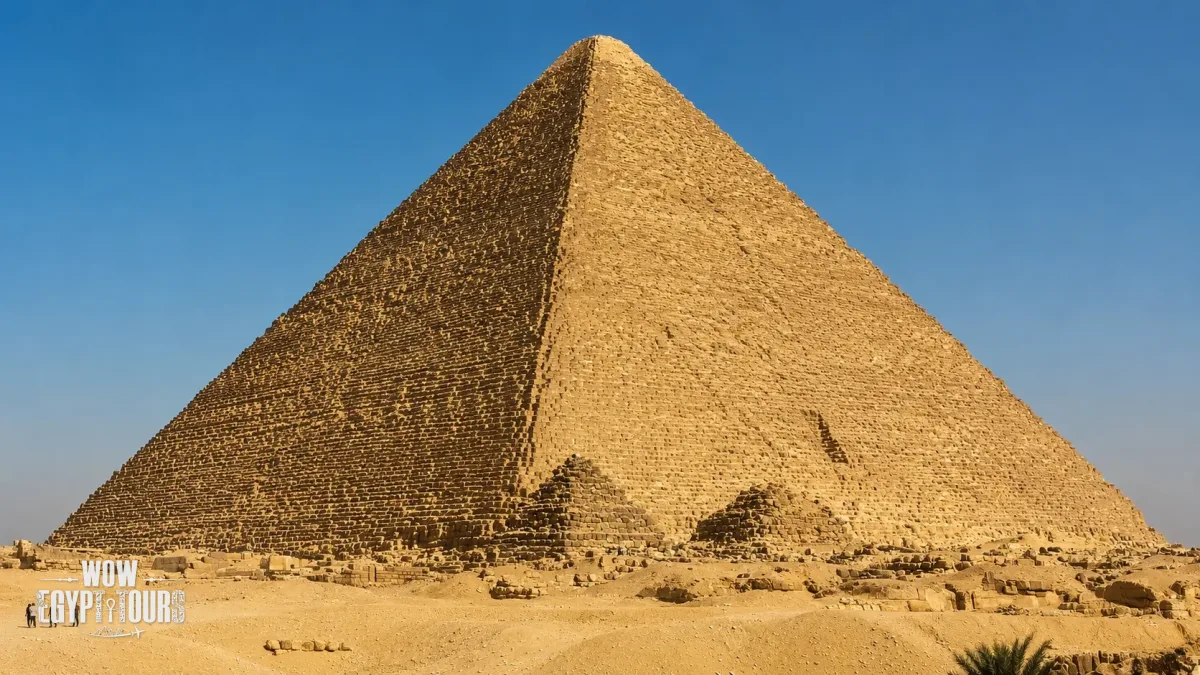

The Great Pyramid of Giza, built for the pharaoh Khufu of the Egyptian Old Kingdom 4th Dynasty and known in the Greek tradition as the Pyramid of Cheops, is the largest, the most precisely constructed, the most technically extraordinary, and the most historically significant ancient building in the entire history of human civilization, a monument of such overwhelming physical scale, such breathtaking mathematical precision, and such completely extraordinary ancient engineering achievement that it has commanded the astonishment, the veneration, the scholarly investigation, and the personal wonder of every civilization, every culture, and every individual who has encountered it from the ancient Egyptian farmers who lived in its shadow to the millions of international heritage travelers who make the journey to the Giza Plateau each year specifically to stand at its base and experience directly the most completely overwhelming physical reality available at any heritage site in the world. Standing originally at 146.5 meters in height and currently at 138.8 meters after the removal of its original smooth white limestone casing and its missing capstone in the medieval period, the Great Pyramid of Khufu was for approximately 3,800 years the tallest human-built structure in the entire world, surpassed only in approximately 1311 CE by the now-collapsed spire of Lincoln Cathedral in England, a record of architectural supremacy spanning the complete histories of the ancient Egyptian, Greek, Roman, Byzantine, early Islamic, and medieval European civilizations in an unbroken tenure of vertical pre-eminence whose duration no other human building has approached in the entire history of constructed architecture. This extraordinary monument is the centerpiece of Cairo Tours, Egypt Classic Tours, and Egypt Short Break Tours, all of which WOW Egypt Tours proudly offers to travelers from around the world as part of Egypt Tours Packages and Egypt Travel Packages that encompass the extraordinary ancient heritage of Cairo and the complete Egyptian Nile Valley civilization.
The Great Pyramid of Giza Khufu Egypt is the sole surviving member of the Seven Wonders of the Ancient World, the ancient monument that has outlasted every other building on the most celebrated list of human architectural achievement in the entire history of the ancient Mediterranean and Middle Eastern civilizations, and the most consequential proof available anywhere in the world that the capacity of the ancient human mind for organizational genius, technological innovation, and physical ambition has no necessary inferiority to the capacity of the modern mind, a proof whose physical reality at the Giza Plateau challenges every comfortable assumption about the necessary relationship between available technology and achievable result that the modern world tends to apply when considering the achievements of the ancient one. The Great Pyramid contains approximately 2.3 million individual stone blocks whose average weight is approximately 2.5 to 3 metric tonnes and whose largest individual examples in the internal granite chamber system weigh up to 80 metric tonnes each, moved from the Aswan quarries approximately 900 kilometers to the south by Nile boat, transferred from the river to the construction site by an ancient harbor and canal system whose physical evidence has been progressively revealed by modern archaeological investigation, and positioned with a precision of alignment and fit that the most sophisticated modern surveying and construction technologies can measure with complete accuracy but cannot fully account for in terms of the specific practical methods by which it was achieved using the organizational tools, the material resources, and the physical technology available to the ancient Egyptian 4th Dynasty construction programme. WOW Egypt Tours includes the Great Pyramid of Khufu as the primary and the most fundamental ancient monument destination in all comprehensive Cairo Tours, Egypt Classic Tours, Egypt Short Break Tours, Egypt Family Tours, Egypt Budget Tours, and all Egypt Tour Packages that encompass the extraordinary ancient heritage of the Egyptian capital.

What Is The Great Pyramid Of Giza Khufu?
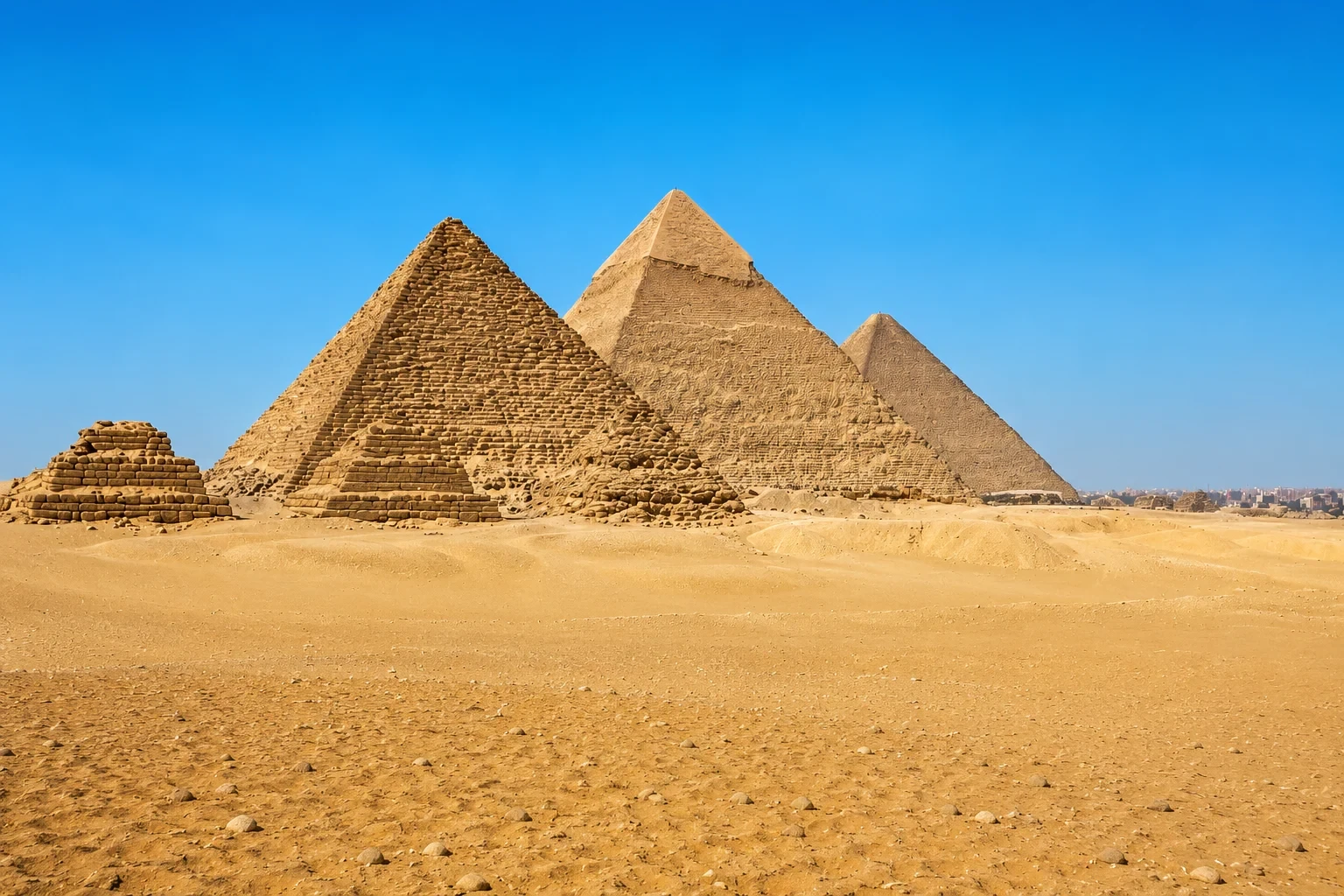
The Great Pyramid of Giza is the largest of the three royal pyramid monuments of the Giza Pyramids Complex and the primary royal tomb monument of the pharaoh Khufu, second pharaoh of the Egyptian Old Kingdom 4th Dynasty, built approximately from 2589 to 2566 BCE on the northern section of the Giza Plateau in Giza Governorate approximately 13 kilometers southwest of central Cairo. The pyramid is a true pyramid of square base plan with four triangular faces meeting at a single apex point, whose base measurements of approximately 230.4 meters on each of the four sides and whose original apex height of approximately 146.5 meters, now reduced to approximately 138.8 meters by the removal of the casing stone and the capstone, give it the proportions of an extremely steep-sided mountain of precisely geometric form whose visual impact on visitors approaching across the Giza Plateau from any direction is one of the most immediately and the most completely overwhelming ancient architectural encounters available at any heritage site in the world.
The pyramid's internal structure encompasses a complex system of passages and chambers whose design was modified at least twice during the construction process, incorporating the Descending Passage, the Subterranean Chamber cut into the bedrock below the pyramid, the Ascending Passage, the Queen's Chamber in the center of the pyramid body, the extraordinary Grand Gallery leading to the King's Chamber level, the King's Chamber of Aswan red granite housing the empty royal sarcophagus, and the series of five relieving chambers above the King's Chamber that distribute the enormous weight of the pyramid above the burial space in the most technically sophisticated structural engineering solution in the complete ancient Egyptian pyramid building tradition. The precise purpose of each component of this internal system, the reason for the apparent abandonment of the Subterranean Chamber and the Queen's Chamber in favor of the King's Chamber as the ultimate burial space, and the specific functions of the so-called air shafts that penetrate the pyramid body from both the Queen's Chamber and the King's Chamber in two directions, are among the most actively and the most productively debated questions in the complete scholarly literature of Egyptological pyramid study, generating new investigations, new surveys, and new interpretations with each generation of scholars who bring fresh analytical tools to the examination of the most extraordinary and the most inexhaustibly fascinating ancient building in the world.
Who Built The Great Pyramid Of Giza?
The Great Pyramid of Giza was built by and for the pharaoh Khufu, also known in the Greek tradition as Cheops, the second pharaoh of the Egyptian Old Kingdom 4th Dynasty who reigned approximately from 2589 to 2566 BCE and who is universally recognized in the mainstream Egyptological scholarship as the patron and the primary beneficiary of the most ambitious single construction project in the history of the ancient world. The attribution of the Great Pyramid to Khufu rests on multiple converging lines of ancient documentary and physical evidence, including the red ocher workmen's inscriptions discovered by the British engineer Howard Vyse in the relieving chambers above the King's Chamber in 1837 that include the royal name of Khufu (in the cartouche form that is the standard ancient Egyptian representation of the royal name), the ancient Egyptian administrative records that associate the Giza Plateau construction programme with the 4th Dynasty, the spatial and chronological logic of the Giza Plateau layout in which the Great Pyramid is the earliest of the three main monuments and is positioned to command the highest and the most northerly point of the plateau, and the extraordinary Diary of Merer, the ancient papyrus document discovered at the Red Sea port of Wadi el-Jarf in 2013 that provides direct eyewitness documentation of the transportation of Tura limestone casing blocks to the Giza construction site during the reign of Khufu.
Khufu himself remains one of the most historically elusive of all the great pharaohs of ancient Egypt, his personal character, his political achievements beyond the pyramid building programme, and the specific organizational genius that produced the Great Pyramid known to us primarily through the monument rather than through the abundant personal documentation that many subsequent pharaohs left in the form of royal inscriptions, historical texts, and biographical narratives. The only known three-dimensional portrait of Khufu is a small ivory statuette of approximately 7.5 centimeters in height discovered at the ancient Egyptian site of Abydos in the early 20th century by the Egyptian archaeologist Petrie, which currently resides in the collection of the Egyptian Museum in Cairo as one of the most celebrated paradoxes in the history of ancient Egyptian art: the builder of the largest building in the history of the world is represented in his only surviving three-dimensional portrait in the most miniature format available to the ancient Egyptian sculptor, a disproportion of building scale and personal portrait scale that has no parallel in the complete history of ancient royal portraiture in any culture or any period.
The Pharaoh Khufu: Builder Of Eternity
Khufu's reign of approximately 23 years, the period within which the entire Great Pyramid was apparently designed, constructed, and completed according to the ancient Egyptian administrative records and the modern archaeological estimation of the construction programme's logistics, is the most extraordinary single reign in the complete history of the ancient Egyptian construction tradition, a reign whose primary and most overwhelming legacy is the most ambitious and the most completely extraordinary building that any human civilization has ever conceived and executed. The ancient Egyptian sources about Khufu's reign are relatively sparse, with the most substantial ancient literary source being the account of the Greek historian Herodotus who visited Giza in the 5th century BCE approximately 2,000 years after Khufu's death and recorded in his Histories a portrait of the pharaoh as a cruel and despotic ruler who closed the Egyptian temples, forced the Egyptian people into the service of his pyramid building programme, and was so universally hated by the Egyptian population that his name was not spoken aloud for generations after his death. The Herodotean portrait of Khufu as a tyrant, however dramatically compelling and however convenient for the narrative purposes of a Greek historian seeking to explain the scale of the monument to a Greek audience whose cultural assumptions about the relationship between pharaonic power and popular consent were entirely different from the reality of the ancient Egyptian social contract, is comprehensively contradicted by the archaeological evidence for the pyramid building workforce recovered from the Giza Plateau by the most recent systematic excavation, which presents a picture not of coerced slave labor but of a well-organized, well-provisioned, and well-respected national workforce whose members were proud of their contribution to the most prestigious national enterprise of the most powerful state in the ancient world.
The discovery of the Diary of Merer at Wadi el-Jarf in 2013, the oldest papyrus document ever found in Egypt, gave Egyptologists for the first time a direct ancient documentary window into the organizational reality of Khufu's construction programme from the perspective of an actual participant, the inspector Merer whose team of approximately 40 men spent their working months transporting white Tura limestone casing blocks by boat from the Tura quarries across the Nile to the Giza construction site via the ancient harbor canal system. The Diary's extraordinary specificity, the daily records of journey times, cargo quantities, crew compositions, supply depots, and administrative supervisors, reveals an organizational system of extraordinary sophistication and extraordinary logistical capacity, a construction management programme that could plan and execute the simultaneous deployment of dozens of work crews on dozens of parallel construction tasks across an entire plateau and sustain the continuous output of a workforce of tens of thousands of workers for the two decades required to complete the monument, all without any of the communication and coordination technologies that modern construction management considers essential for projects of a fraction of this scale and complexity.
Great Pyramid Of Giza Khufu Location
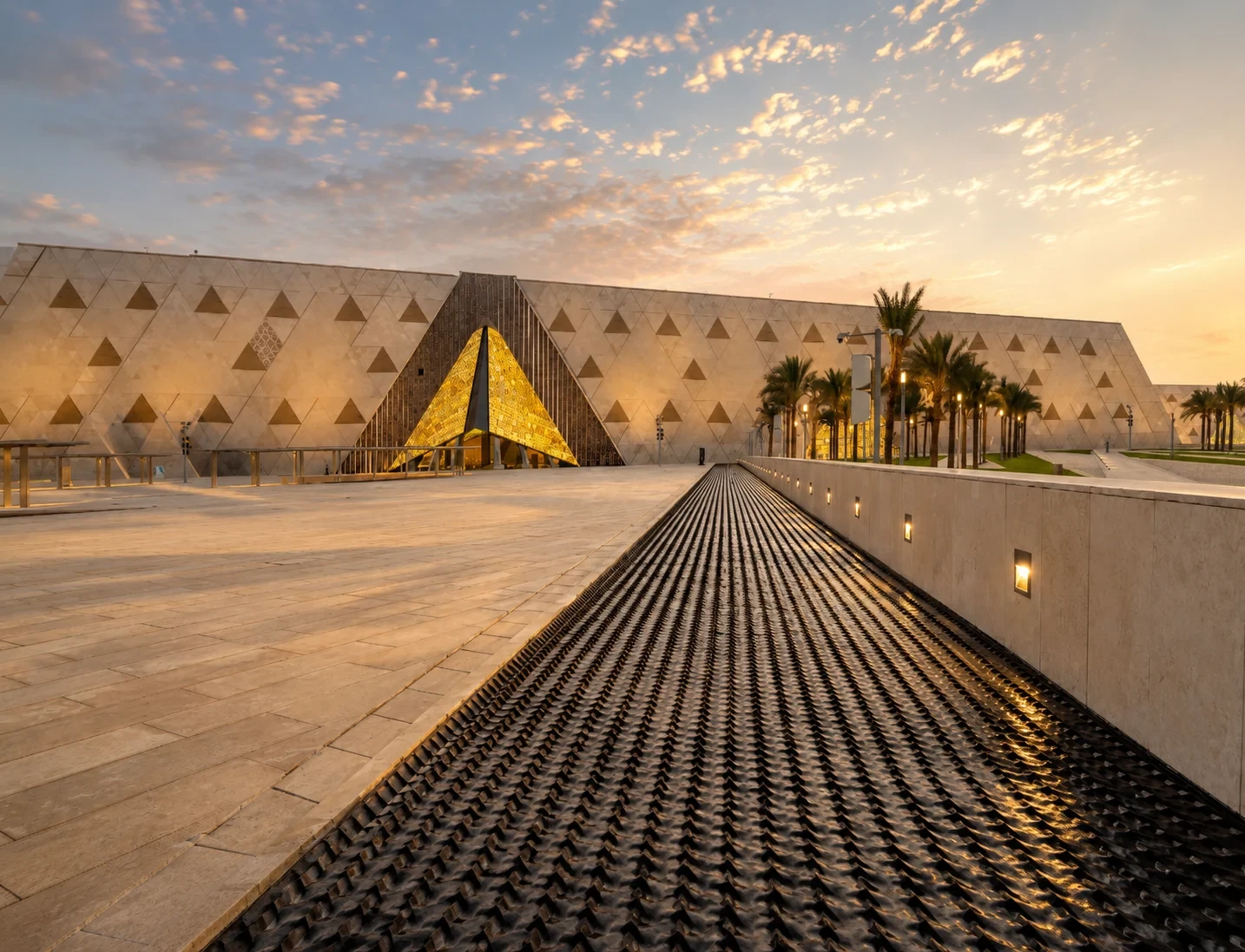
The Great Pyramid of Khufu is located on the Giza Plateau in Giza Governorate, approximately 13 kilometers southwest of central Cairo, in the northern section of the Giza Plateau at its highest elevation point, a position whose commanding visual dominance of the complete plateau and the surrounding desert landscape was clearly deliberate in the ancient planning of the monument's site. The pyramid's northeast corner is the primary orientation reference point for the complete Giza Plateau monument layout, with the alignments of the Middle Pyramid of Khafre and the Small Pyramid of Menkaure both referenced to the Great Pyramid's position in a spatial organization that gives the complete three-pyramid layout its most immediately coherent visual character when viewed from the panoramic desert viewpoint to the south and west. The main visitor entrance to the Great Pyramid is on the north face of the monument, with the modern visitor access tunnel that leads visitors from the original entrance downward through the Descending Passage junction and upward through the Ascending Passage and Grand Gallery to the King's Chamber level, providing access to the most significant interior spaces of the pyramid's chamber system. The Grand Egyptian Museum is located approximately 2 kilometers north of the Giza Plateau and the Khufu Boat Museum is located immediately south of the Great Pyramid. WOW Egypt Tours provides all transportation and guide services for all Great Pyramid and Giza Plateau visits.
Great Pyramid Of Giza Fun Facts
The base perimeter of the Great Pyramid, approximately 921.6 meters, is almost exactly equal to the circumference of a circle whose radius equals the pyramid's height, a mathematical relationship that produces a ratio very close to the mathematical constant pi (approximately 3.14159), a coincidence whose precise ancient intentionality remains a subject of scholarly debate but whose existence is an undeniable mathematical fact about the pyramid's proportions, documented with complete precision by the most careful modern survey measurements of the monument's dimensions. Whether the ancient Egyptian builders intentionally incorporated pi into the pyramid's design through a conscious understanding of the mathematical relationship between circumference and radius, or whether the pi relationship emerged as an unintentional consequence of the practical construction method of counting wheel rotations to determine dimensions (in which the natural result of rolling a wheel a specific number of rotations inherently produces a pi-based length relationship), the fact itself is one of the most extraordinary single mathematical properties of the Great Pyramid and one of the most persistently fascinating mathematical dimensions of the monument's proportional system.
The Great Pyramid's four sides are oriented to true north, south, east, and west with a precision of within 3 to 4 minutes of arc of the true cardinal directions, an astronomical accuracy achieved by the ancient Egyptian surveyors and astronomers of the 4th Dynasty using techniques whose specific details remain a subject of active scholarly investigation. The most currently favored explanation for the extraordinary orientation precision is the transit observation method, in which the ancient surveyors observed the point of a specific star's transit across the meridian in both the rising and setting directions and bisected the angle between those two observations to establish true north, a method whose theoretical accuracy is sufficient to account for the Great Pyramid's observed orientation precision if applied with the care and consistency that the monument's builders evidently brought to all dimensions of the construction programme. The north-pointing so-called air shaft of the King's Chamber, one of four narrow passages that penetrate the pyramid body from the two main chambers, was aligned in the ancient period of the pyramid's construction with the star Thuban in the constellation Draco, the Pole Star of Khufu's era before the precession of the Earth's axis shifted the apparent position of the celestial north pole from Thuban to the current Pole Star Polaris, while the southern shaft of the King's Chamber was aligned with the belt of the constellation Orion whose three stars the ancient Egyptians associated with the god Osiris in the most important astronomical-religious framework of the ancient Egyptian funerary tradition.
The Egyptian red granite sarcophagus in the King's Chamber of the Great Pyramid is too wide by several centimeters to pass through any of the passages leading to the chamber, a fact that has been definitively established by modern measurement of both the sarcophagus dimensions and the passage dimensions and that proves conclusively that the sarcophagus was placed in the King's Chamber during the construction of the pyramid rather than inserted after the pyramid was built, a construction sequencing fact of considerable logistical interest that reveals one of the most practically complex management challenges of the entire pyramid construction programme: the necessity of synchronizing the placement of the most important and the most irreplaceable single object in the entire pyramid interior, the royal burial vessel, at precisely the right moment in the construction sequence when the chamber was complete enough to receive the sarcophagus but the passage above it had not yet been closed in a way that would prevent the sarcophagus from being brought through. The sarcophagus was found empty when the pyramid's interior was first entered by Arab explorers in the medieval period, its royal contents long since removed by ancient tomb robbers in the period of political disorder that followed the end of the Old Kingdom, a loss of the royal burial equipment that is one of the most historically consequential and the most personally regrettable events in the complete heritage biography of the Great Pyramid.
Why Is It Called The Great Pyramid Of Giza?
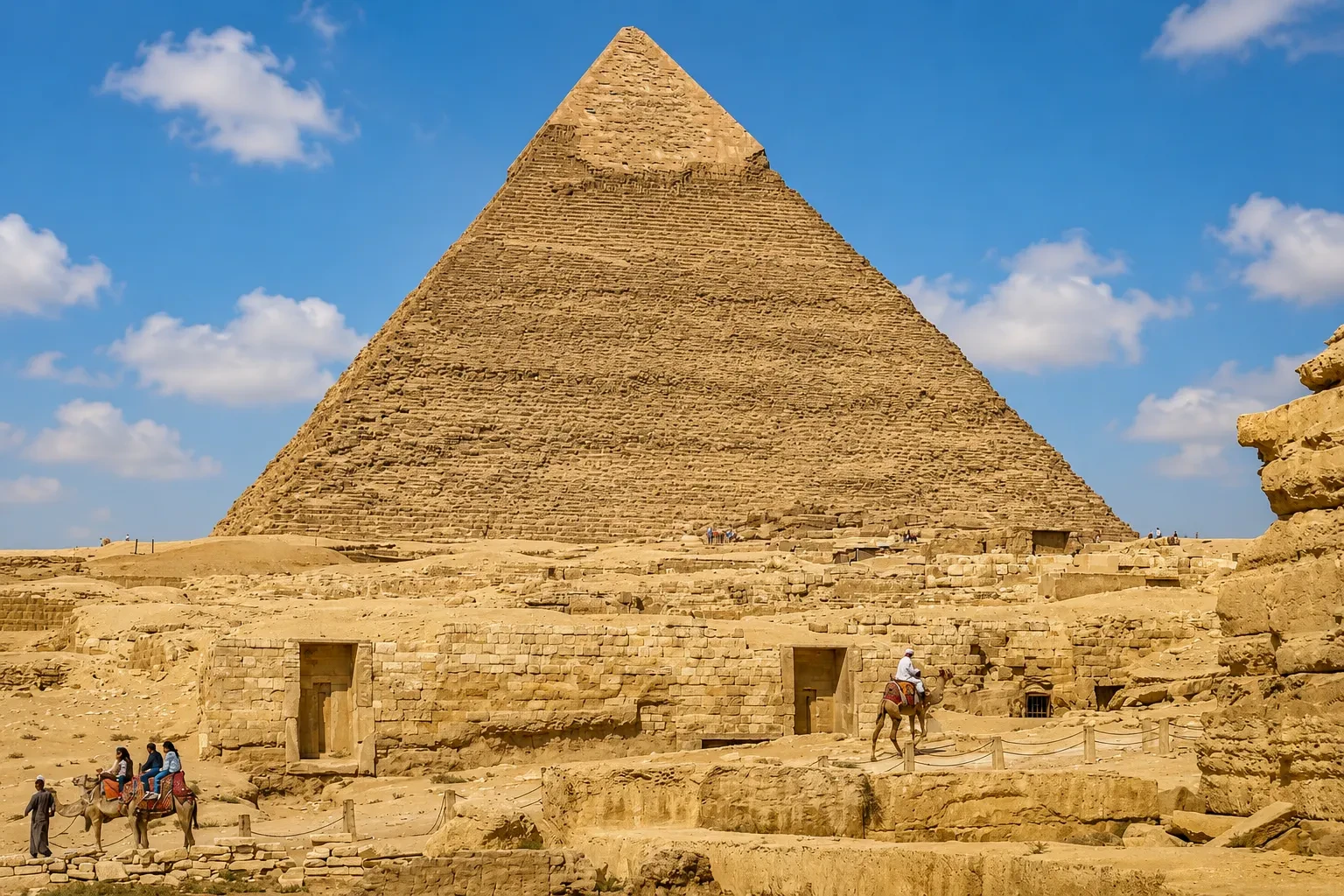
The designation Great Pyramid, as opposed to the Middle Pyramid of Khafre and the Small Pyramid of Menkaure that accompany it on the Giza Plateau, is a straightforward reference to the monument's superiority in scale over its two companion pyramids, a scale superiority that was even more pronounced in the ancient period before the removal of the original casing stone reduced the height differential between the Great Pyramid and the Middle Pyramid that has been made more apparent in the modern era by the Middle Pyramid's retention of a section of its original casing near the apex. The epithet Great is applied to the pyramid in the ancient Greek and Roman literary tradition from Herodotus onwards, and has been the universal designation for the monument in the Western scholarly and popular tradition since the beginning of systematic European engagement with the Giza monuments in the 18th and 19th centuries, distinguishing it from the many other royal pyramids of the ancient Egyptian tradition in a designation of such complete simplicity and such complete accuracy that no alternative or supplement has ever been felt necessary. The attribution to Giza places it in its correct geographical context as the largest of the pyramids of the Giza Plateau, distinguishing it from the pyramid of Khufu's predecessor Sneferu at Dahshur and from the other royal pyramid monuments of the complete Memphite necropolis zone whose designation as belonging to Giza specifically identifies the most northern and most famous of the three pyramid fields included in the UNESCO World Heritage designation of Memphis and its Necropolis. The additional designation Khufu (or Cheops in the Greek tradition) identifies the specific pharaoh of the monument's construction and distinguishes the pyramid from the other major Giza monuments with which it is inevitably discussed in any complete Giza heritage context.
Great Pyramid Of Giza Khufu History
The history of the Great Pyramid from the completion of its construction in approximately 2560 BCE through the ancient Egyptian veneration period, the ancient Greek and Roman scientific and literary engagement, the medieval Islamic period of stripping and exploration, the early modern European scholarly investigation, and the modern era of systematic archaeological, conservation, and scientific investigation traces the most completely documented and the most continuously significant monument biography in the entire world heritage record. The ancient Egyptian state maintained the Great Pyramid's mortuary cult throughout the Pharaonic period, with later pharaohs restoring the associated mortuary temples and causeways, appointing priests to perform the regular funerary offerings for the royal soul of Khufu, and venerating the monument itself as a sacred presence in the ancient Egyptian landscape of the dead. The ancient Greek intellectual tradition treated the Great Pyramid as one of the seven supreme achievements of human construction from at least the 4th century BCE, establishing it in the Western cultural tradition as the defining example of a human building achievement of such extraordinary scale and such extraordinary technical quality that it demands comparison with the most ambitious monuments of any civilization at any period of history.
The medieval Islamic period saw the Great Pyramid stripped of most of its original white Tura limestone casing blocks in a systematic quarrying operation that provided building material for the construction of mosques, bridges, and defensive walls of medieval Cairo, transforming the monument's external appearance from the smooth-sided, gleaming white precision surface of the ancient period into the stepped and rough-surfaced grey limestone core that modern visitors experience, a transformation that paradoxically preserved the most fundamental architectural achievement of the pyramid, its internal geometry and its massive structural integrity, while removing the most immediately beautiful and the most astronomically significant surface layer of the monument's original appearance. The first documented interior exploration of the Great Pyramid in the modern era was the forced entry by the Caliph Al-Ma'mun's workers in approximately 820 CE, who excavated a tunnel through the pyramid's limestone core in search of the legendary treasure that medieval Arab traditions associated with the monument, eventually intersecting the original passage system and discovering the King's Chamber with its empty sarcophagus, a discovery that established the primary framework of the pyramid's interior exploration tradition for all subsequent investigators from the medieval Arab geographers through the 19th century European Egyptologists to the modern scientific survey teams whose non-invasive scanning programmes continue to generate new knowledge about the pyramid's internal architecture.
The modern era of systematic scientific investigation began with Napoleon's Egyptian campaign of 1798 to 1801 and the subsequent publication of the Description de l'Egypte whose comprehensive survey drawings and measurements established the first scientifically organized baseline documentation of the pyramid's dimensions and architecture. The 19th century investigations of Colonel Howard Vyse, who discovered the workmen's inscriptions bearing Khufu's name in the relieving chambers above the King's Chamber in 1837, and of Sir William Flinders Petrie, whose extraordinarily precise survey of the complete Giza plateau monuments in the 1880s established the dimensional baseline that all subsequent precision surveys have refined rather than fundamentally revised, together laid the foundational framework for the modern scholarly understanding of the pyramid's architecture and construction that subsequent generations of investigators have progressively elaborated and deepened. The most recent and the most publicly celebrated contribution to the scholarly understanding of the Great Pyramid is the ScanPyramids project's cosmic ray muon detection survey of 2016 to 2017, which identified a previously unknown large void structure above the Grand Gallery of the pyramid in a position and with dimensions suggesting a significant internal space whose architectural purpose and construction context remain under active investigation by the international research team that conducted the survey.
The Story Of Building The Great Pyramid
The story of how the Great Pyramid was built is the most extraordinary and the most persistently fascinating engineering narrative in the complete intellectual history of archaeology, a story whose central question, how did a Bronze Age society without iron tools, without wheeled transport, without cranes, without mechanized lifting systems, and without any of the power-assisted construction technologies that modern civil engineering considers prerequisite for work at the scale and precision of the Great Pyramid succeed in creating the most precisely built and the most physically overwhelming ancient building in the history of the world, has attracted the most brilliant and the most creative engineers, mathematicians, archaeologists, and historians of the modern era to the most productive and the most intellectually rewarding scholarly investigation of any single construction project in human history. The current scholarly consensus on the pyramid construction process, assembled from the convergent evidence of experimental archaeology, ancient administrative document analysis, computer modeling of construction logistics, and the physical evidence of the quarrying and transport infrastructure recovered from the Giza Plateau and the surrounding landscape, involves a combination of systematic quarrying of the Giza Plateau's own bedrock limestone for the core masonry, long-distance water transport of the white Tura casing limestone from the Tura quarries across the Nile Valley by boat, Nile transport of the Aswan red granite for the internal chamber construction, and the movement of all stone from the Nile to the construction site by an ancient harbor and canal system whose physical evidence the current archaeological investigation of the plateau has progressively revealed.
The quarry to pyramid stone movement used sledges drawn on wet clay or wooden tracks whose lubrication significantly reduced the friction forces required to move multi-tonne stone blocks across the plateau terrain. Construction ramps of various geometries, whose specific design remains the most actively debated unresolved question in the complete pyramid construction scholarly literature, provided the inclined surfaces along which the stone blocks were moved from ground level to their final positions in the rising pyramid body. The Diary of Merer, the extraordinary ancient papyrus document that provides the most direct available eyewitness evidence for the construction logistics, records with daily precision the operations of a single transportation crew whose activities illuminate the organizational complexity and the operational efficiency of the complete construction system at the level of individual crew management, daily scheduling, and supply chain coordination. The total workforce required for the complete pyramid construction programme is now estimated by the most authoritative modern scholars at approximately 20,000 to 30,000 men at any one time, organized in rotating work teams of several months' duration that allowed the same individual workers to cycle between pyramid construction duty and their normal agricultural lives in the Nile Valley, providing the most sustainable and the most socially integrated workforce management system for a construction programme of this duration and this scale that the ancient Egyptian state's organizational capacity and the Egyptian agricultural calendar could simultaneously support.
Great Pyramid Of Giza Key Attractions And Features
The Exterior And The Original Casing
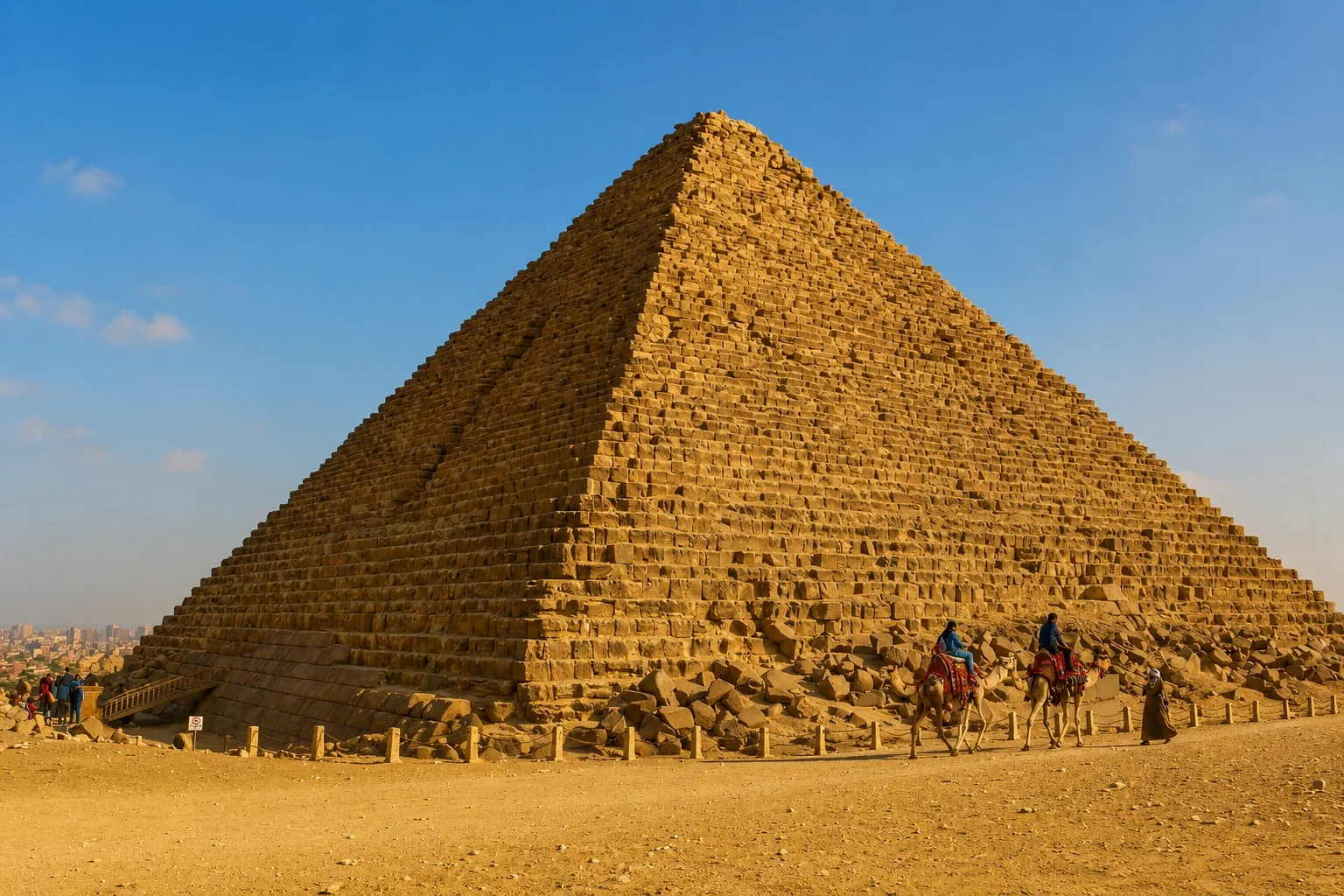
The exterior of the Great Pyramid as visitors encounter it today is the rough limestone core of the monument whose original smooth white casing of Tura limestone has been almost entirely removed, leaving the stepped and textured surface of the internal core blocks whose irregular courses of varying height create the climbing surface that visitors who make the (now prohibited) ascent of the pyramid's exterior have historically used to reach the pyramid's summit. The original exterior appearance of the Great Pyramid, reconstructed from the few remaining sections of original casing visible at the pyramid's base on the north face and from the complete casing surviving on the upper portion of the adjacent Khafre Pyramid, was a perfectly smooth-sided white surface of gleaming polished limestone that reflected the Egyptian sun in a display of brilliant white light visible from many kilometers across the ancient landscape, an effect whose visual impact in the ancient period would have been dramatically more powerful and more immediately overwhelming than the textured grey stone surface of the current monument. The most complete section of original casing visible at the Great Pyramid is the few remaining casing stones at the base of the north face, whose smooth angled surface gives the most direct physical evidence for the original appearance of the complete casing and whose material quality demonstrates the extraordinary precision of the casing stone work whose joints fit so tightly that a piece of paper cannot be inserted between adjacent blocks.
The Original Entrance And Al-Ma'mun's Tunnel
The Great Pyramid has three known entrance passages in its north face: the original ancient Egyptian entrance approximately 17 meters above the base of the north face and slightly east of the pyramid's center line, which leads directly to the Descending Passage and was used for all official ancient access to the pyramid interior; the forced entry tunnel excavated by the Caliph Al-Ma'mun's workers in approximately 820 CE approximately 7 meters below and 10 meters west of the original entrance, which intersects the Ascending Passage junction and provides the primary visitor access route used for all modern pyramid interior visits; and a small exploratory tunnel discovered in the 20th century that provides limited additional archaeological access to specific sections of the pyramid's internal structure. Modern visitors to the Great Pyramid interior enter through Al-Ma'mun's forced tunnel, proceeding inward along the forced tunnel section until it intersects the original Descending Passage at the point where the ascending passage diverges upward, then following the ascending route through the Ascending Passage, the Grand Gallery, and the antechamber to the King's Chamber, in a journey through the pyramid's interior that takes them from the modern entry point through the medieval exploration tunnel and then through the ancient Egyptian passage system in a historically layered underground experience of extraordinary personal impact and extraordinary historical depth.
The Descending Passage And The Subterranean Chamber
The Descending Passage, the original ancient Egyptian entrance passage of the Great Pyramid, descends from the original north face entrance at an angle of approximately 26 degrees below horizontal for approximately 105 meters through the pyramid's core limestone and then through the natural bedrock of the Giza Plateau to a depth of approximately 30 meters below the base of the pyramid, where it reaches the Subterranean Chamber, an unfinished underground room cut from the natural bedrock whose purpose and its apparent abandonment before completion are among the most discussed questions in the scholarly literature of Great Pyramid internal architecture. The Subterranean Chamber's unfinished character, with its rough ceiling, partially excavated floor, and dead-end passages extending from its walls, suggests that the construction plan was changed during the pyramid's building sequence, with the intended burial location shifted from the subterranean bedrock chamber (a tradition well established in earlier pyramid designs) to the internal body of the pyramid itself, where both the Queen's Chamber and ultimately the King's Chamber were subsequently built in a sequence of design modifications whose specific motivations remain a subject of scholarly interpretation. The Descending Passage is not part of the standard modern visitor access route to the pyramid interior, which uses Al-Ma'mun's tunnel to bypass the lower section of the passage system and proceed directly to the ascending route, but its existence and its relationship to the complete passage system are explained by the licensed Egyptology guide as part of the comprehensive architectural introduction to the pyramid interior that every visitor receives before entering the monument.
The Ascending Passage And The Grand Gallery
The Ascending Passage of the Great Pyramid, running upward from its junction with the Descending Passage at an angle of approximately 26 degrees above horizontal for approximately 39 meters, leads visitors from the lower passage system to the horizontal passage giving access to the Queen's Chamber and to the base of the most extraordinary single architectural space in the complete ancient Egyptian pyramid tradition, the Grand Gallery. The Grand Gallery is a corbelled limestone passage approximately 47 meters long, 2 meters wide at the floor level, and rising in seven corbelled steps on each side to a maximum ceiling height of approximately 8.5 meters at the apex of the corbelling, whose structural engineering of the corbelled limestone vault distributing the enormous weight of the pyramid above the passage space represents the most technically sophisticated and the most architecturally ambitious single interior space in any ancient Egyptian pyramid and one of the most extraordinary engineering achievements of the complete ancient Egyptian architectural tradition. The Grand Gallery's walls are of finely dressed white limestone whose precision of fitting and quality of surface treatment give the passage an atmosphere of extraordinary material refinement and extraordinary spatial drama in the contrast between the narrow 2-meter floor width and the soaring 8.5-meter ceiling height of the corbelled vault above, creating a tunnel of vertical space within the pyramid body that is unlike any other architectural experience available at any ancient monument site in the world and whose direct physical encounter, climbing upward through the gallery along the central ramp with the corbelled walls rising on both sides and the summit of the pyramid somewhere above in the darkness, is one of the most personally extraordinary and the most completely unforgettable moments of any Great Pyramid interior visit.
The Queen's Chamber
The Queen's Chamber, located in the center of the pyramid body at the junction of the horizontal passage extending from the base of the Grand Gallery and named by medieval Arab explorers whose convention of designating pointed-ceiling rooms as intended for women has been applied to this chamber despite having no connection to any actual historical queen's burial at this location, is a finely built limestone chamber of approximately 5.7 meters east to west, 5.2 meters north to south, and 6.3 meters in height to the apex of its pointed gabbled ceiling, whose specific function in the pyramid's internal programme remains one of the most debated questions in the complete scholarly literature of Khufu's pyramid. The chamber contains a large empty niche in the east wall whose proportions and whose position have been interpreted by some scholars as the location for a cult statue of Khufu, by others as the intended burial space of the pharaoh in an original plan that was subsequently changed in favor of the King's Chamber location, and by yet others as a component of the specific religious and symbolic programme of the pyramid's interior whose full meaning in the context of the ancient Egyptian funerary theology cannot be completely recovered from the physical evidence alone. Two narrow shaft passages of approximately 20 centimeters square cross-section extend from the Queen's Chamber northward and southward into the pyramid body, their upper ends blocked by small stone slabs with copper handles discovered by the Upuaut robot probe in 1993 and subsequently investigated by the Djedi robot probe in 2011, revealing behind the first blocking slab a small chamber whose further exploration by non-invasive scanning technologies continues to generate scholarly excitement and public interest as one of the most fascinating unresolved questions in the current Great Pyramid investigation programme.
The King's Chamber And The Royal Sarcophagus
The King's Chamber, the primary burial space and the architectural climax of the complete Great Pyramid interior experience, is a masterpiece of ancient engineering in Aswan red granite of approximately 10.5 meters east to west, 5.2 meters north to south, and 5.8 meters in height, whose nine massive granite ceiling beams of approximately 25 to 40 tonnes each span the complete chamber width in a structural programme of extraordinary engineering efficiency and extraordinary material quality that gives the room its most immediately overwhelming physical character. The perfectly fitted granite walls and ceiling of the King's Chamber, whose assembly from blocks of up to 80 tonnes quarried in Aswan and transported more than 900 kilometers by Nile boat to the Giza construction site represents the most technically demanding single component of the complete pyramid construction programme, create an interior of extraordinary material presence and extraordinary acoustic properties whose specific resonant frequencies have been the subject of scientific investigation by acoustic researchers who have documented the chamber's capacity to amplify specific tonal frequencies in ways that may have been deliberately exploited in the ancient funerary ritual programme conducted in the chamber before the pyramid was sealed. The empty red granite sarcophagus in the western end of the chamber, the only surviving original furniture of the complete King's Chamber interior, is both the most immediately historically significant and the most immediately personally affecting object in the complete Great Pyramid interior, a magnificent vessel of polished red granite whose dimensions, slightly wider than the access passages leading to the chamber, prove conclusively that it was placed in the King's Chamber during the pyramid's construction rather than inserted after the building was complete.
The Relieving Chambers
Above the King's Chamber ceiling, accessible to researchers only through the small openings cut by Howard Vyse in 1837 and not open to the general visitor public, are five consecutive spaces known as the relieving chambers or construction chambers, whose function is to distribute the enormous weight of the approximately 2 million stone blocks in the pyramid above the King's Chamber away from the chamber ceiling through a system of progressively relieving flat granite ceiling beams and a final pointed gabbled roof of massive limestone blocks whose apex directs the weight outward and downward into the pyramid body on either side of the chamber. The highest of the five relieving chambers, Vyse's Chamber named for its discoverer, contains the quarry marks painted in red ochre on the rough granite surfaces by the ancient Egyptian work gangs who participated in the construction of this section of the pyramid, including the most important and the most historically significant of all the ancient Egyptian ancient pyramid construction inscriptions: the work gang name that includes the royal cartouche of Khufu himself, the direct physical evidence in the pyramid's own construction for the identification of the monument with its royal patron that gives the mainstream Egyptological attribution of the Great Pyramid to Khufu its most immediate and most authoritative physical proof.
The ScanPyramids Void Discovery
The most extraordinary and the most internationally celebrated recent discovery in the complete modern investigation of the Great Pyramid is the identification by the ScanPyramids project in 2017 of a previously unknown large void structure above the Grand Gallery of the pyramid, detected using cosmic ray muon particle detectors whose capacity to identify density variations in large stone structures by measuring the differential attenuation of cosmic muon particles passing through them provides the most powerful and the most completely non-invasive tool available for the detection of unknown cavities and void spaces within massive ancient stone buildings. The void, designated the Big Void by the ScanPyramids team in their Nature journal publication of November 2017, is estimated from the muon detection data to be at least 30 meters in length and appears to be oriented roughly horizontally above the Grand Gallery's ceiling, in a position that corresponds to no previously known architectural feature of the pyramid's internal programme and whose relationship to the known passage and chamber system of the pyramid cannot be fully determined from the muon detection data alone. The precise nature of the Big Void, whether it represents an undiscovered chamber of architectural significance, a construction gap required by the structural engineering of the Grand Gallery's corbelled vault system, or some other architectural feature whose purpose in the pyramid's construction programme cannot be determined without direct physical investigation, remains the most exciting and the most consequential unresolved question in the current Great Pyramid scholarly investigation and the subject of continued non-invasive scanning programmes using improved muon detection equipment and complementary ground-penetrating radar and infrared thermography surveys that together are progressively narrowing the range of possible interpretations for the extraordinary discovery.
The Khufu Boat Museum
Immediately south of the Great Pyramid, housed in the purpose-built Khufu Boat Museum that was constructed specifically to preserve and display the extraordinary ancient wooden vessel recovered from the sealed boat pit adjacent to the pyramid's south face in 1954, the reconstructed Solar Boat of Khufu is the most completely extraordinary ancient Egyptian wooden object in the world and the most remarkable single material artifact associated with the Great Pyramid accessible to visitors at any point in the complete Giza Plateau heritage programme. The boat, assembled from 1,224 individual planks of Lebanese cedar wood and ropes of halfa grass found folded in their original storage positions in the sealed pit, measures approximately 43.4 meters in length when fully assembled and represents the most complete and the most perfectly preserved ancient Egyptian wooden vessel in the world, a boat of extraordinary craftsmanship whose plank-sewn construction using no metal fasteners of any kind relies entirely on the swelling of the cedar wood planks in water to create the watertight hull whose structural integrity after more than 4,500 years of sealed storage in the pit is one of the most extraordinary testimonies to the quality of the ancient Egyptian woodworking tradition at the peak of the Old Kingdom period. Whether the boat was used in Khufu's lifetime as the royal river vessel that transported the pharaoh along the Nile, whether it was built specifically for the funerary programme to carry the royal body from the Nile Valley to the pyramid site, or whether it was intended to serve as the divine solar barque for the pharaoh's celestial journey after death, are questions whose answers remain a subject of scholarly debate while the extraordinary physical reality of the boat itself is available for direct and completely astonishing personal encounter by every visitor to the Khufu Boat Museum.
Why Is The Great Pyramid Of Giza Important?
The Great Pyramid of Giza is important for reasons that span the entirety of human intellectual life from the most immediate and the most personal response to physical overwhelming scale to the most abstract and the most technically demanding questions of ancient engineering, mathematical precision, astronomical alignment, organizational management, and social history that the monument's extraordinary construction raises for every discipline of modern scholarly investigation that has engaged with it. As the sole surviving Wonder of the Ancient World, the Great Pyramid is the physical proof that the most ambitious ancient building achievement the ancient imagination could conceive was actually built and has endured essentially intact for more than four and a half thousand years, a fact of heritage significance whose uniqueness in the history of the world's ancient monuments gives the Great Pyramid a claim on every person's attention and respect that is simply unavailable at any other ancient building in the entire global heritage inventory. As an ongoing source of new knowledge, the Great Pyramid continues to generate scholarly discoveries of extraordinary importance, from the Diary of Merer's 2013 revelation of construction logistics details to the ScanPyramids void discovery of 2017, that demonstrate the monument's capacity to surprise and to transform even the most established scholarly understanding of ancient Egyptian civilization at its most ambitious expression. WOW Egypt Tours includes the Great Pyramid of Khufu as the most fundamental and the most universally important ancient heritage destination in all comprehensive Cairo Tours, Egypt Classic Tours, and all Egypt Tour Packages.
What Are Some Interesting Facts About The Great Pyramid Of Giza?
The Diary That Changed Everything
The discovery of the Diary of Merer at the ancient Red Sea port of Wadi el-Jarf in 2013 by the French-Egyptian archaeological team led by Pierre Tallet is the single most consequential documentary discovery in the complete modern history of Great Pyramid scholarly investigation, not because it resolved the most fundamental question of how the pyramid was built but because it provided for the first time a direct ancient eyewitness perspective on the construction logistics from the point of view of an actual participant whose daily record of his team's activities gives the abstract engineering question of pyramid construction the most immediately personal and the most humanly vivid ancient documentary context it has ever had. The Diary reveals in extraordinary detail the daily operations of an elite transportation crew, their journey times between the Tura quarries and the Giza construction site, their provisioning arrangements at supply depots along the route, the quantities of casing stone they delivered on each trip, and the administrative oversight structure within which their work was organized, together painting a picture of an ancient construction management system of extraordinary sophistication and extraordinary operational efficiency that gives the Great Pyramid's achievement the most completely grounded and the most personally convincing ancient human explanation that any ancient building of comparable scale and comparable complexity has ever received from a primary historical source.
The Hidden Void Above The Grand Gallery
The ScanPyramids void discovery of 2017 is the most extraordinary and the most personally exciting recent development in the 200-year history of modern Great Pyramid investigation, a discovery of sufficient archaeological significance to be published in the most prestigious scientific journal in the world, Nature, and of sufficient public interest to generate international media coverage of an intensity normally reserved for the discovery of a new royal tomb. The void, at least 30 meters in length and appearing to be horizontally oriented above the Grand Gallery's ceiling in a position that corresponds to no previously known feature of the pyramid's internal programme, remains the most important unresolved architectural question in the complete Great Pyramid scholarly literature, a potential undiscovered chamber or construction space whose nature and significance can only be determined by the most careful and the most technologically sophisticated non-invasive investigation programme that the most advanced scientific tools available to the 21st century archaeological research community can bring to bear on the most extraordinary ancient building in the world.
The Star-Aligned Shafts
The four narrow shaft passages of approximately 20 centimeters square cross-section that extend from the Queen's Chamber and the King's Chamber in both the northward and southward directions through the pyramid body are among the most discussed and the most variously interpreted features of the complete Great Pyramid interior, their specific functions in the pyramid's architectural and theological programme being the subject of scholarly proposals ranging from the practical (ventilation for the workers during construction, now widely rejected as physically impractical in the specific shaft geometry) to the astronomical (stellar alignment passages designed to transmit the light of specific stars to the interior chambers) to the theological (passages for the royal soul's journey from the burial chamber to the celestial realm associated with specific star configurations). The most secure and the most widely accepted astronomical observation about the pyramid shafts is the alignment of the King's Chamber southern shaft with the constellation Orion's belt, specifically the star Al Nitak, in the epoch of approximately 2500 BCE when the pyramid was built, and the alignment of the King's Chamber northern shaft with the star Thuban in the constellation Draco, the Pole Star of the Old Kingdom period, together suggesting that the King's Chamber was oriented to facilitate the royal soul's access to the two most important stellar destinations in the ancient Egyptian funerary astronomical theology, the circumpolar stars associated with immortality and the Orion stars associated with the god Osiris whose resurrection mythology provided the fundamental theological framework for the royal funerary tradition.
What Is So Special About The Great Pyramid Of Giza?
The Building That Changed The Definition Of Possible
What makes the Great Pyramid of Giza uniquely special among all the ancient monuments of the world is not simply its physical scale, though its scale is the most overwhelming of any ancient building, nor its mathematical precision, though its precision is the most extraordinary of any ancient structure, nor its historical age, though its age of more than four and a half thousand years gives it the most profound temporal perspective of any continuously standing human building, but the combination of all these qualities in a single monument together with the continuing capacity of that monument to generate new knowledge, new questions, and new personal astonishment in every successive generation of scholars and visitors who encounter it, a combination that gives the Great Pyramid a quality of heritage inexhaustibility and intellectual vitality that is simply unavailable at any other ancient monument in the world. The monument that was the most extraordinary building in the world when it was completed in approximately 2560 BCE remains the most extraordinary building in the world in 2025, not because no subsequent civilization has produced buildings of comparable ambition or comparable technical achievement in its own cultural and technological context, but because the combination of scale, precision, age, and continuing mystery that the Great Pyramid embodies gives it a claim on the imagination and the wonder of every human being who encounters it that transcends every cultural and every historical context.
Where Ancient Ambition And Modern Wonder Converge
The Great Pyramid is also uniquely special for the quality of direct personal encounter it provides, the experience of standing at the base of the northeast corner and looking upward at 138 meters of ascending limestone courses receding to the summit in the most completely physically overwhelming perspective available at any ancient building, or descending through the internal passage system to the King's Chamber and standing in the granite-walled burial space at the center of the most extraordinary building in the world, or stepping back to the desert panoramic viewpoint and watching the complete three-pyramid skyline of the Giza Plateau resolve into its most perfectly composed visual statement of ancient human ambition and ancient human achievement against the desert sky. None of these experiences can be adequately prepared for by any amount of prior reading, film viewing, or image study, because the specific quality of personal scale relationship between the human body and the Great Pyramid's mass and volume is something that only the direct physical encounter can create, and it is this quality of unavoidable physical reality that makes the Great Pyramid the most consistently extraordinary and the most consistently personally transformative heritage encounter available to any traveler at any heritage site in the world.
The Great Pyramid Of Giza Through The Ages
The complete narrative of the Great Pyramid's history from the completion of its construction in approximately 2560 BCE through the ancient Egyptian veneration, the Herodotean wonder tradition, the medieval Islamic stripping and Al-Ma'mun's tunnel exploration, the early modern European survey tradition of the Napoleonic expedition and Petrie's precision survey, the Victorian era of Vyse's relieving chamber discoveries and their workmen's inscriptions, the 20th century discoveries of the solar boat pit and the Khufu Boat, and the 21st century revolutionary discoveries of the Diary of Merer and the ScanPyramids void together constitute the most extensively documented and the most intellectually productive ancient monument biography in the complete world heritage record, a biography whose most recent chapters are among the most extraordinary and the most consequential for the scholarly understanding of the monument and whose future chapters, whatever new discoveries and new technologies they bring to the investigation of the world's most extraordinary ancient building, are certain to continue the tradition of generating astonishment and transforming understanding that has characterized every previous generation of serious engagement with this most inexhaustible of the world's ancient heritage monuments.
The Great Pyramid And UNESCO
The Great Pyramid of Khufu is protected as the primary monument within the UNESCO World Heritage Site designated in 1979 as Memphis and its Necropolis: the Pyramid Fields from Giza to Dahshur, recognized as a heritage of outstanding universal value for the extraordinary concentration of ancient Egyptian funerary and royal monument heritage of the Old Kingdom pyramid building tradition. The UNESCO inscription encompasses the complete Giza Plateau monument complex including the Great Pyramid, the Great Sphinx, the Middle Pyramid of Khafre, the Small Pyramid of Menkaure, and the connected pyramid fields of Saqqara and Dahshur. The Egyptian government and the UNESCO World Heritage Committee are engaged in continuous collaboration on the conservation management of the Great Pyramid and its associated monuments, addressing the growing threats of urban encroachment, atmospheric pollution, visitor impact management, and the structural conservation of a monument whose age, scale, and material complexity make it one of the most demanding conservation management challenges in the complete world heritage portfolio.
Best Time To Visit The Great Pyramid Of Giza
The best time to visit the Great Pyramid of Khufu is during the cooler months from October through April, when the Cairo and Giza climate provides the most comfortable conditions for the extended outdoor exploration of the pyramid's exterior, the base circuit walk, the Khufu Boat Museum visit, and the desert panoramic viewpoint programme. The winter months of December through February offer the most pleasant daytime temperatures of 15 to 22 degrees Celsius and the most extraordinary low-angle morning light that illuminates the pyramid's north and east faces in the most dramatically beautiful photography conditions available at any season. For the Great Pyramid interior visit, early morning arrival at the complex opening is the most strongly recommended strategy, as the daily visitor quota for the pyramid interior is controlled and the combination of the queue build-up and the increasing interior heat through the morning makes the earliest possible interior visit by far the most comfortable and the most rewarding experience. The summer months of June through August bring very hot temperatures regularly exceeding 35 to 40 degrees Celsius that make the interior visit particularly warm and the exterior exploration most comfortable only in the early morning hours. WOW Egypt Tours organizes Great Pyramid programmes throughout the year and advises on optimal seasonal timing.
Great Pyramid Of Giza Opening Hours
The Great Pyramid of Khufu is accessible as part of the complete Giza Pyramids Complex, open daily from 8:00 AM to 5:00 PM in the winter season (October through April) and 7:00 AM to 7:00 PM in the summer season (May through September). The Great Pyramid interior is open daily for a limited number of visitors in two sessions: morning from complex opening until 12:00 PM, and afternoon from 1:00 PM until closing. The number of visitors permitted inside per session is strictly controlled and advance booking of the interior ticket through WOW Egypt Tours is strongly recommended to guarantee access. The Khufu Boat Museum is open daily from 9:00 AM to 5:00 PM with a separate admission fee. All hours are subject to adjustment for Egyptian national holidays and should be confirmed at time of booking.
Great Pyramid Of Giza Entrance Fees
General Giza Pyramids Complex entrance: EGP 220 for adults, EGP 110 for students.
Great Pyramid interior (additional fee beyond complex entrance): EGP 400 for adults, EGP 200 for students.
Khufu Boat Museum (additional fee): EGP 100 for adults, EGP 50 for students.
All entrance fees are included in the Cairo Tours and Egypt Tour Packages organized by WOW Egypt Tours. Fees are subject to periodic adjustment and current rates should be confirmed at time of booking. The Great Pyramid interior ticket is sold in limited daily quantities and early purchase is recommended.
How To Get To The Great Pyramid Of Giza
The Great Pyramid of Khufu is located on the Giza Plateau approximately 13 kilometers southwest of central Cairo, accessible from the city center by private vehicle in approximately 30 to 45 minutes depending on traffic. The most convenient approach for international visitors is the private vehicle from the Cairo hotel provided by WOW Egypt Tours as part of the complete Cairo heritage programme, providing door-to-door transport from the hotel to the main Giza complex entrance and seamless transportation between all sites within the Giza Plateau area and to the adjacent Grand Egyptian Museum, the Egyptian Museum, Saqqara, Memphis, and Dahshur as part of the complete Greater Cairo ancient heritage circuit.
How Long To Spend At The Great Pyramid Of Giza
The Great Pyramid alone requires a minimum of two to three hours for a programme that includes the exterior base circuit, the interior visit to the King's Chamber via Al-Ma'mun's tunnel and the Grand Gallery, and the Khufu Boat Museum. A more complete Great Pyramid programme of three to four hours allows the interior visit, the Khufu Boat Museum, the complete exterior circuit including the boat pits, the subsidiary Queens' Pyramids, and the Mortuary Temple remains on the east face, in the most unhurried and the most personally rewarding format. The Great Pyramid is most naturally and most efficiently visited as part of the complete Giza Plateau programme that includes all three main pyramids, the Great Sphinx, the Valley Temple of Khafre, and the panoramic desert viewpoint in a full-day programme of five to six hours. The Grand Egyptian Museum is the most naturally combined afternoon complement to the Giza morning programme. WOW Egypt Tours designs all Giza and Greater Cairo pyramid programmes in the most efficient and the most personally satisfying sequence.
Tips For Visiting The Great Pyramid Of Giza
Arrive at the Giza complex entrance at opening time and purchase the Great Pyramid interior ticket before any other activity if the interior visit is planned, as the daily quota fills quickly and the morning session provides the most comfortable interior temperatures and the most manageable visitor density inside the pyramid passages. Prepare physically for the interior visit by understanding its specific demands: the access through Al-Ma'mun's tunnel requires stooping for the first section, the Ascending Passage ascent is steep and can be physically demanding for those with mobility or respiratory limitations, and the Grand Gallery climb is steep and confined with a handrail that requires confident physical engagement. The interior of the pyramid is warm and humid at all times of year, and the combination of physical exertion and enclosed space makes loose, breathable clothing and adequate prior hydration essential. Do not attempt to enter the pyramid if you have claustrophobia, severe mobility limitations, or respiratory conditions that are exacerbated by physical exertion in warm confined spaces. Visit the Khufu Boat Museum immediately after the pyramid interior, while the impression of the ancient construction programme is freshest, as the boat's extraordinary material presence as the finest surviving ancient Egyptian wooden object in the world provides the most humanly immediate and the most personally affecting complement to the pyramid's overwhelming architectural experience. Ask your licensed Egyptology guide from WOW Egypt Tours to describe the Diary of Merer and the specific transportation and construction operations it documents before entering the pyramid, as this ancient eyewitness account gives the physical experience of the pyramid interior its most complete and its most personally resonant historical context.
What To Wear At The Great Pyramid Of Giza
The Great Pyramid visit requires practical clothing suitable for both the outdoor pyramid exterior programme and the physically demanding pyramid interior visit. For the exterior, lightweight breathable clothing covering the arms and legs, a wide-brimmed hat, high-SPF sunscreen, and UV-protective sunglasses are essential for the exposed limestone plateau environment. For the interior visit, loose comfortable clothing that allows free movement in stooped and climbing positions is strongly recommended, as the passage access requires physical flexibility in confined spaces. Flat, rubber-soled shoes with good grip are essential for both the rough exterior limestone terrain and the smooth polished surfaces of the internal passage floors. Do not wear sandals or open-toed shoes for the interior visit. The interior temperature is consistently warm throughout the year regardless of the exterior season, and the physical exertion of the interior access makes water essential: drink adequately before entering and carry water for the post-interior recovery period. Modest clothing covering the shoulders and knees is appropriate throughout the Giza complex in the Egyptian cultural context.
Photography At The Great Pyramid Of Giza
The Great Pyramid provides the most celebrated and the most visually extraordinary exterior architectural photography subjects available at any ancient building in the world, combined with the unique interior photography opportunity of the Grand Gallery and the King's Chamber that gives the pyramid a dimension of architectural photography depth simply unavailable at any other ancient monument. The most dramatic exterior photography of the Great Pyramid is achieved from the northeast corner of the pyramid base where a low-angle upward shot communicates the overwhelming vertical scale of the ascending limestone courses most directly, from the panoramic desert viewpoint to the southwest where all three pyramids appear together in the most universally recognized ancient heritage landscape composition, and from the base of the east face where the Mortuary Temple remains and the subsidiary Queens' Pyramids provide foreground interest for the main pyramid. The interior photography is challenging due to the low light and the warm atmosphere of the passage system, requiring a camera with strong low-light capability and preferably a wide-angle lens for the Grand Gallery and King's Chamber compositions that best capture the extraordinary architectural character of these spaces. Photography is freely permitted in all accessible areas of the pyramid interior and exterior. The Khufu Boat Museum provides extraordinary close-range photography of the most complete ancient Egyptian wooden vessel in the world in the controlled lighting of the climate-regulated museum environment.
Great Pyramid Of Giza Tours
Complete Great Pyramid Interior And Exterior Programme
This comprehensive Great Pyramid programme provides the most complete and the most expertly guided encounter with all dimensions of the world's most extraordinary ancient building, from the exterior base circuit and the boat museum to the complete interior visit through Al-Ma'mun's tunnel to the King's Chamber and the royal granite sarcophagus of Khufu.
What Is Covered
Private vehicle from Cairo hotel with early morning departure. Exterior guided programme of the complete Great Pyramid including base circuit, northeast corner close-up, Mortuary Temple remains on the east face, boat pits, Queens' Pyramids, and northwest corner viewing of the complete three-pyramid alignment. Great Pyramid interior visit via Al-Ma'mun's tunnel, Ascending Passage, Grand Gallery with complete architectural explanation of the corbelled vault engineering, Queen's Chamber with shaft explanation, King's Chamber with the royal sarcophagus and the Diary of Merer construction logistics narrative, and relieving chambers description. Khufu Boat Museum visit with complete explanation of the boat's extraordinary preservation and its possible functions. Return to Giza plateau circuit for the complete Sphinx, Valley Temple, and panoramic desert viewpoint programme. Return to Cairo hotel for lunch followed by afternoon Grand Egyptian Museum visit.
Duration
Full day from Cairo hotel, approximately 10 to 11 hours.
Includes
Private vehicle, licensed Egyptology guide, all site and interior entrance fees including Great Pyramid interior ticket and Khufu Boat Museum, lunch, and all logistics. Through WOW Egypt Tours Cairo Tours.
Greater Cairo Pyramid Heritage Circuit: Giza, Saqqara, Memphis, And Dahshur
This extraordinary two-day Cairo ancient heritage programme covers the complete chronological sequence of ancient Egyptian pyramid development, from the world's oldest monumental stone building at Saqqara through the experimental transitional pyramids of Dahshur to the supreme perfection of the Great Pyramid of Khufu at Giza, in the most comprehensively historical and the most personally complete pyramid programme available from any Cairo hotel base.
What Is Covered
Day 1: Complete Giza Plateau programme including Great Pyramid exterior and interior, Khufu Boat Museum, Great Sphinx, Valley Temple of Khafre, Khafre Pyramid, Menkaure Pyramid, and panoramic desert viewpoint. Afternoon: Grand Egyptian Museum.
Day 2: Saqqara Step Pyramid Complex morning. Afternoon: Memphis and Dahshur Bent and Red Pyramids.
Duration
2 Days from Cairo hotel.
Includes
Private vehicle both days, licensed Egyptology guide, all site entrance fees, lunch both days, and all logistics. Through WOW Egypt Tours Cairo Tours.
Combine The Great Pyramid With Your Egypt Tours Package
The Great Pyramid of Giza is the most fundamental and the most universally important ancient monument destination in the complete Egyptian heritage tourism landscape and is featured as the primary Cairo ancient heritage destination across the full range of WOW Egypt Tours travel products. Browse the options below to find the Egypt experience that includes the Great Pyramid.
Egypt Tour Packages: Multi-day guided Egypt tours organized by duration, including 2 Days Egypt Packages, 3 Days Egypt Packages, 4 Days Egypt Packages, 5 Days Egypt Packages, 6 Days Egypt Packages, 7 Days Egypt Packages, 8 Days Egypt Packages, 10 Days Egypt Packages, and longer itineraries. The Great Pyramid is included in all Egypt Tour Packages as the primary Cairo ancient heritage destination. All packages include private vehicle, licensed Egyptology guide, accommodation, all entrance fees, and all logistics.
Egypt Travel Packages: Themed Egypt travel packages including Egypt Honeymoon Travel Packages, Egypt Budget Travel Packages, Egypt Family Travel Packages, Egypt Luxury Travel Packages, Egypt Adventure Travel Packages, Egypt Cultural Travel Packages, and Egypt Christmas and New Year Travel Packages. The Great Pyramid is featured in every Egypt Travel Package category as the single most important ancient heritage destination in Egypt.
Egypt Classic Tours: The most popular and the most comprehensively balanced Egypt travel programme, combining the supreme ancient heritage of Cairo including the Great Pyramid interior visit, the Khufu Boat Museum, the Grand Egyptian Museum, and the Egyptian Museum with the Nile Valley heritage of Luxor and Aswan in the most complete and the most personally satisfying introduction to the ancient Egyptian world available in any organized Egypt itinerary.
Egypt Short Break Tours: Focused short duration Egypt travel programmes of 3 to 5 days designed for travelers with limited time. The Great Pyramid and Giza Plateau are always the first and the most fundamental Cairo ancient heritage programme in every Egypt Short Break Tours itinerary, with the Great Pyramid interior visit as the single most personally important activity of any short Cairo programme.
Egypt Family Tours: Family-friendly Egypt travel programmes in which the Great Pyramid is the single most universally exciting ancient monument for children and adults of all ages. All Egypt Family Tours include the Great Pyramid exterior with the camel ride at the panoramic viewpoint, the Khufu Boat Museum, and for appropriate age groups the Great Pyramid interior visit with the Grand Gallery and the King's Chamber and sarcophagus as primary heritage highlights.
Egypt Budget Tours: Value-focused Egypt travel programmes providing access to the Great Pyramid and the complete Giza Plateau programme at the most economical pricing available from any professional Egyptian tour operator, ensuring that the most extraordinary ancient building in the world is accessible to travelers at every budget level.
Egypt Nile Cruises: All-inclusive Nile River Cruise programmes combining the ancient pharaonic heritage of Luxor and Aswan with Cairo extensions that include the Great Pyramid as the most important and the most universally significant ancient heritage component of any complete Egypt Nile Cruise programme.
Nile River Cruises: All WOW Egypt Tours Nile cruise options. The Great Pyramid is available as a Cairo extension from the beginning or end of any Nile River Cruise itinerary.
Luxor Aswan Nile Cruises: The Great Pyramid is the most naturally combined Cairo ancient heritage destination with the Luxor-Aswan Nile cruise, included in all programmes as a Cairo extension at the beginning or end of the river journey for the most complete available ancient Egyptian heritage programme combining the supreme Nile Valley monuments with the world's most extraordinary pyramid.
Dahabiya Nile Cruises: The Great Pyramid available as a Cairo extension for travelers combining the most intimate private Nile sailing experience with the most fundamental ancient heritage of the Giza Plateau.
Lake Nasser Cruises: The Great Pyramid available as a Cairo extension for travelers combining the extraordinary Nubian heritage of Lake Nasser with the supreme ancient monuments of the Giza Plateau.
Cairo Tours: The complete range of guided day tour programmes available from Cairo hotels, including the complete Great Pyramid interior and exterior programme, the combined Giza and Grand Egyptian Museum full-day programme, the Greater Cairo pyramid circuit combining Giza, Saqqara, Memphis, and Dahshur, the Islamic Cairo programme covering the Khan El Khalili, El Moez Street, Saladin Citadel, and Muhammad Ali Mosque, and the Coptic Cairo programme covering the Hanging Church, Coptic Museum, and Ben Ezra Synagogue. All Cairo Tours include private vehicle, licensed Egyptology guide, all entrance fees, and all logistics organized by WOW Egypt Tours.
Nearby Attractions To The Great Pyramid Of Giza
The Great Pyramid of Khufu is the largest and the most historically significant monument within the complete Giza Pyramids Complex, and its most immediately proximate and most naturally combined heritage destinations are the other extraordinary monuments of the same plateau. The Great Sphinx and the Valley Temple of Khafre at the eastern edge of the plateau provide the most dramatically powerful and the most architecturally refined complement to the pyramid visit within the same Giza Plateau circuit. The Middle Pyramid of Khafre and the Small Pyramid of Menkaure complete the three-pyramid programme of the complete Giza Plateau ancient heritage complex.
The Grand Egyptian Museum approximately 2 kilometers north is the most directly relevant institutional complement to the Great Pyramid visit, housing in its extraordinary new galleries the most important ancient Egyptian collection in the world including the Tutankhamun treasure and the Old Kingdom royal portraiture whose direct connection to the Giza pyramid-building programme gives the museum the most complete contextual relationship to the Great Pyramid of any museum collection in the world. The Egyptian Museum in central Cairo houses the only surviving three-dimensional portrait of Khufu, the 7.5cm ivory statuette discovered at Abydos, alongside the Menkaure triads and the diorite Khafre throne statue in the most important collection of ancient Egyptian 4th Dynasty royal art accessible at any museum in the world. The ancient city of Memphis, the Saqqara Step Pyramid Complex, and the Dahshur Pyramids of Sneferu complete the most important Greater Cairo pyramid heritage circuit, providing the chronological context for the Great Pyramid's achievement in the complete development sequence of the ancient Egyptian pyramid building tradition. All these destinations are organized by WOW Egypt Tours as part of comprehensive Cairo Tours and Egypt Tour Packages encompassing the extraordinary ancient heritage of Cairo the Capital of Egypt and its pharaonic legacy.
Frequently Asked Questions About The Great Pyramid Of Giza
What is the Great Pyramid of Giza?
The Great Pyramid of Giza is the largest and the most extraordinary ancient building in human history, built for the pharaoh Khufu of the Egyptian 4th Dynasty approximately 2589 to 2566 BCE, originally 146.5 meters in height and containing approximately 2.3 million stone blocks. It is the sole surviving member of the Seven Wonders of the Ancient World, the world's tallest building for 3,800 years, and the most precisely astronomically aligned ancient building in the world. It is the centerpiece of Cairo Tours, Egypt Classic Tours, and Egypt Short Break Tours offered by WOW Egypt Tours.
Can I go inside the Great Pyramid?
Yes. The Great Pyramid interior is open to visitors for a limited daily number in morning and afternoon sessions with an additional ticket beyond the general complex entrance. The visitor access route follows Al-Ma'mun's medieval tunnel to the junction with the original passage system, then the Ascending Passage and Grand Gallery to the King's Chamber housing the empty red granite sarcophagus of Khufu. The passage is warm and requires physical bending and climbing. Advance booking through WOW Egypt Tours is strongly recommended.
What is the Grand Gallery inside the Great Pyramid?
The Grand Gallery is the most extraordinary single interior architectural space in any ancient Egyptian pyramid, a corbelled limestone passage approximately 47 meters long rising in seven corbelled steps on each side to a maximum ceiling height of approximately 8.5 meters at the apex of the corbelling, while only approximately 2 meters wide at the floor. The combination of the narrow floor width and the soaring corbelled ceiling creates one of the most architecturally dramatic and the most personally extraordinary interior architectural experiences available at any ancient monument in the world.
What is the Diary of Merer?
The Diary of Merer is the oldest papyrus document ever discovered in Egypt, found at the ancient Red Sea port of Wadi el-Jarf in 2013 and dated to the reign of Khufu. It records in extraordinary daily detail the operations of an inspector named Merer and his team who transported white Tura limestone casing blocks by Nile boat from the quarries across the river to the Giza construction site, providing the first direct ancient eyewitness documentation of the Great Pyramid construction logistics from the perspective of an actual participant in the construction programme.
What is the ScanPyramids void discovery?
The ScanPyramids void, reported in the journal Nature in November 2017 following a non-invasive cosmic ray muon particle detection survey of the pyramid, is a previously unknown large void structure at least 30 meters in length detected above the Grand Gallery ceiling in a position corresponding to no previously known architectural feature of the pyramid's internal programme. Its precise nature, whether a chamber, a construction space, or another architectural feature, remains the most exciting unresolved question in current Great Pyramid research.
What is the Khufu Solar Boat?
The Solar Boat of Khufu is an ancient cedar wood vessel of approximately 43.4 meters in length, discovered in 1954 in a sealed pit adjacent to the Great Pyramid's south face and reconstructed from 1,224 individual planks. It is the most completely preserved ancient Egyptian wooden boat in the world, constructed without any metal fasteners using the swell of the cedar planks in water to create a watertight hull, and is displayed in the Khufu Boat Museum immediately south of the Great Pyramid.
Why is the Great Pyramid's sarcophagus empty?
The red granite sarcophagus in the King's Chamber was found empty when the pyramid's interior was first entered by Arab explorers in approximately 820 CE. The royal contents, the royal mummy, the burial equipment, and all the funerary objects that would originally have accompanied Khufu's burial, were removed by tomb robbers in the period of political disorder that followed the end of the Old Kingdom, a theft that is one of the most historically consequential losses in the complete ancient Egyptian heritage record.
Why was the Great Pyramid the tallest building for 3,800 years?
The Great Pyramid's original height of approximately 146.5 meters was not surpassed by any other human-built structure until the completion of the Lincoln Cathedral spire in England in approximately 1311 CE, approximately 3,800 years after the pyramid's completion. This extraordinary record reflects both the extraordinary scale of the ancient Egyptian construction programme's achievement and the absence of any comparable motivation or capacity for vertical construction on this scale in any subsequent civilization until the era of cathedral building in medieval Europe.
Is the Great Pyramid interior visit suitable for everyone?
No. The interior visit requires physical ability to stoop, climb, and move through narrow warm passages over an extended period. It is not recommended for visitors with claustrophobia, significant mobility limitations, severe respiratory conditions, or heart conditions that are exacerbated by physical exertion in warm confined spaces. Children below approximately 10 years of age may find the physical demands and the confined warmth challenging. Consult WOW Egypt Tours at time of booking for the most complete and the most current guidance on the interior visit's specific physical requirements.
What other Cairo monuments can I combine with the Great Pyramid?
The Grand Egyptian Museum is the most directly relevant and most logistically convenient afternoon complement to the Great Pyramid morning programme. The Great Sphinx and Valley Temple of Khafre are within the same Giza Plateau site. The Saqqara, Memphis, and Dahshur pyramid circuit provides the most complete chronological context for the Great Pyramid as part of a two-day Cairo pyramid heritage programme.
How do I book a Great Pyramid tour with WOW Egypt Tours?
You can book any Cairo Tours programme, Egypt Classic Tours package, Egypt Short Break Tours programme, Egypt Family Tours, Egypt Budget Tours, Egypt Tours Package, or Egypt Travel Package that includes the Great Pyramid directly through WOW Egypt Tours. Our team of travel specialists will arrange private vehicle, licensed Egyptology guide, guaranteed Great Pyramid interior tickets, Khufu Boat Museum, all site entrance fees, and the most complete and the most personally extraordinary guided encounter with the most extraordinary ancient building in the history of the world available through any Egyptian heritage tour operator.