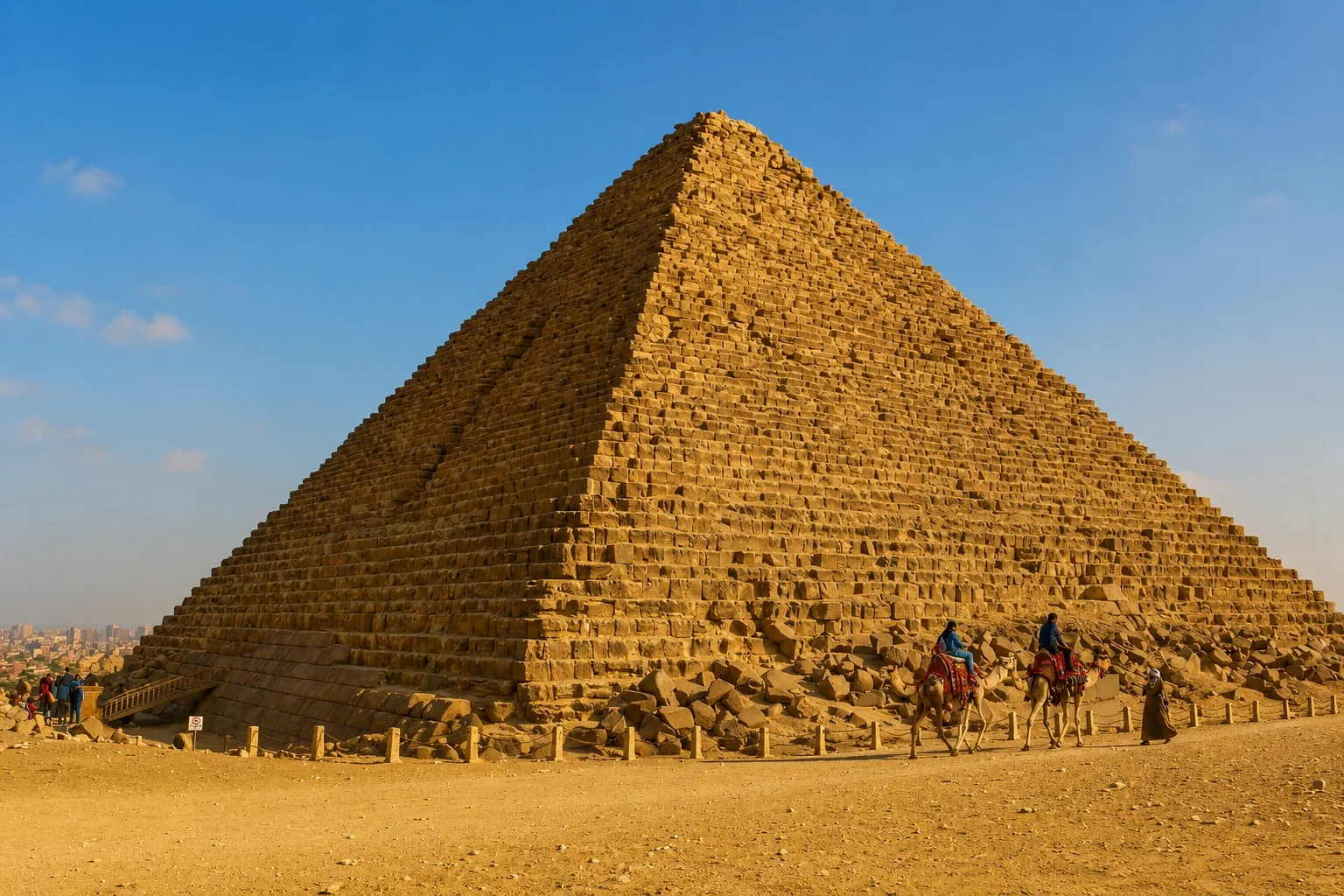


The Valley Temple of Khafre is the most completely preserved, the most architecturally magnificent, and the most personally overwhelming ancient Egyptian Old Kingdom temple interior accessible to visitors at any heritage site in the Greater Cairo area, a monumental sacred structure of extraordinary material quality built from massive monolithic blocks of Aswan red granite in the core construction and originally clad in white Tura limestone on the exterior, whose extraordinary state of preservation, whose incomparable spatial atmosphere of ancient divine authority, and whose direct and immediate physical connection to the Great Sphinx of Giza immediately to its north and to the complete royal funerary landscape of the Middle Pyramid of Khafre above give it a heritage significance and a personal impact entirely commensurate with the most extraordinary ancient architectural achievements of the complete Egyptian Old Kingdom tradition and entirely worthy of its position as the primary ritual gateway of the most completely preserved royal funerary landscape in the Giza Pyramids Complex. The Valley Temple of Khafre is the building in which the most celebrated and the most universally admired ancient Egyptian royal sculpture in the complete heritage of the Old Kingdom period, the magnificent diorite throne statue of Khafre now recognized as the supreme masterpiece of ancient Egyptian royal portraiture in the collection of the Egyptian Museum in Cairo, was discovered by Auguste Mariette in 1860 in the sealed pit of the temple's central hall, a discovery of such extraordinary artistic significance and such completely unexpected sculptural quality that it transformed in a single moment the understanding of the artistic achievements of the ancient Egyptian 4th Dynasty royal programme and gave the Valley Temple of Khafre its most important and its most personally resonant single chapter in the complete biography of the ancient building. This extraordinary monument is featured in Cairo Tours, Egypt Classic Tours, and Egypt Short Break Tours, all of which WOW Egypt Tours proudly offers to travelers from around the world as part of Egypt Tours Packages and Egypt Travel Packages that encompass the extraordinary ancient heritage of Cairo and the complete Egyptian Nile Valley civilization.
The Valley Temple of Khafre Egypt stands at the eastern edge of the Giza Plateau where the desert limestone escarpment meets the ancient Nile Valley landscape below, at the precise boundary between the world of the living and the world of the dead in the ancient Egyptian funerary geography of the Giza necropolis, in a position whose specific architectural and theological character as the primary threshold and purification space of the complete Khafre royal funerary landscape system gives it a significance in the ancient Egyptian ritual programme of royal death and divine resurrection that cannot be adequately appreciated by simply standing at its entrance and admiring its massive stone facade, but requires the most complete and the most scholarly informed guided encounter with its spatial organization, its material quality, its sculptural programme, and its specific functional role in the ancient Egyptian royal funerary tradition that the licensed Egyptology guides of WOW Egypt Tours provide in all comprehensive Cairo Tours, Egypt Classic Tours, and Egypt Short Break Tours programmes that include the complete Giza Plateau heritage experience. The Valley Temple is not simply the finest surviving ancient Egyptian Old Kingdom temple in the Greater Cairo area; it is also the building most directly and most personally associated with the Great Sphinx of Giza whose enclosure is immediately adjacent to the temple's northern face, and the building whose own ancient causeway connects it directly to the Mortuary Temple at the base of the Middle Pyramid of Khafre above in the most completely preserved and the most spatially legible ancient Egyptian royal funerary processional landscape accessible at any heritage site in the Greater Cairo area. WOW Egypt Tours includes the Valley Temple of Khafre as an essential destination in all comprehensive Cairo Tours, Egypt Classic Tours, Egypt Short Break Tours, Egypt Family Tours, Egypt Budget Tours, and all Egypt Tour Packages that encompass the extraordinary ancient heritage of the Egyptian capital.

What Is The Valley Temple Of Khafre?
The Valley Temple of Khafre is an ancient Egyptian Old Kingdom royal funerary temple of the 4th Dynasty, built approximately 2558 to 2532 BCE during the reign of the pharaoh Khafre as the primary entrance, reception, and purification facility of the complete Khafre royal pyramid complex at the Giza Plateau, positioned at the eastern edge of the plateau at the base of the desert escarpment where the ancient Nile Valley flood zone met the desert margin in the ritual geography of the ancient Egyptian funerary landscape that identified the eastern, Nile-side approach to the necropolis as the entry point for the royal funeral cortege traveling from the world of the living to the world of the dead. The temple is constructed from massive monolithic blocks of Aswan red granite in both the interior wall surfaces and the core structural elements, with the limestone backing and paving completing the internal floor and selected transition surfaces, creating a building of such completely extraordinary material quality, such completely extraordinary structural boldness, and such completely extraordinary spatial atmosphere that it stands as the most impressive and the most personally overwhelming interior architectural space of the complete ancient Egyptian Old Kingdom period accessible to visitors at any heritage site within the Greater Cairo area.
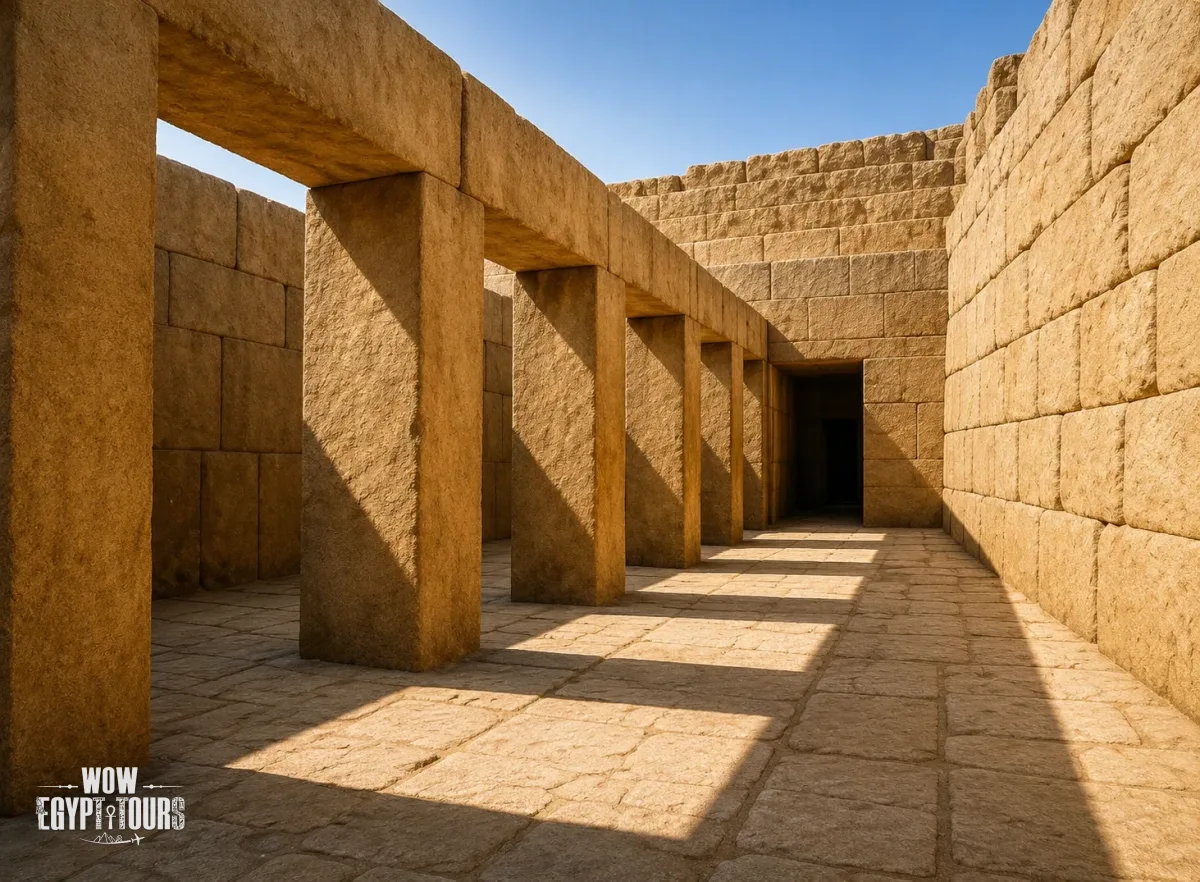
The temple's plan is organized around a T-shaped interior hall whose central axis is oriented to provide the most dramatic and the most architecturally framed possible approach from the entrance portal on the eastern face of the building toward the inner sanctuary spaces and toward the causeway gateway on the western face that connects the temple to the causeway ascending to the Mortuary Temple and the pyramid above. The hall's sixteen monolithic granite pillars, arranged in two rows supporting the massive granite ceiling beams, create the primary spatial armature of the temple interior, the most immediately and the most completely overwhelming architectural experience available within any accessible ancient Egyptian Old Kingdom temple building in the Greater Cairo area, a forest of polished granite rising from the alabaster floor in the most refined and the most materially magnificent expression of the ancient Egyptian monumental architectural tradition at its most ambitious and its most completely realized peak of achievement in the 4th Dynasty royal monument programme.
Who Built The Valley Temple Of Khafre?
The Valley Temple of Khafre was built by and for the pharaoh Khafre, fourth pharaoh of the Egyptian Old Kingdom 4th Dynasty who reigned approximately from 2558 to 2532 BCE as the son of Khufu and the builder of the Middle Pyramid of the Giza complex. The attribution of the Valley Temple to Khafre is established by the architectural relationship of the temple to the complete Khafre pyramid complex of which it is the primary entrance facility, by the inscriptions and sculptural programme that identify Khafre as the patron of the complete complex, and most directly by the discovery in 1860 of the magnificent diorite throne statue of Khafre in the sealed pit of the temple's central hall, the most unambiguously pharaoh-specific royal portrait sculpture in the complete ancient Egyptian Old Kingdom archaeological record from the Giza Plateau. The Valley Temple was one of two primary temple structures of the Khafre pyramid complex, the other being the Mortuary Temple at the pyramid's eastern base, and its specific functional role as the entrance and purification facility of the complete funerary landscape system gave it the most direct connection to the world of the living at the Nile Valley edge and the most immediate ritual significance as the building in which the royal body entered the sacred funerary precinct from the external world for the first time in the processional sequence of the ancient Egyptian royal funeral.
Khafre's choice of Aswan red granite as the primary building material for the Valley Temple's interior construction, the most expensive, the most physically demanding to quarry and transport, and the most technically difficult to work of all the stone materials used in the complete Giza pyramid building programme, reflects a level of royal material ambition in the Valley Temple's construction that is entirely commensurate with the extraordinary scale ambition of the pyramid above it and that gives the temple interior a quality of physical magnificence and material permanence that the white limestone of most other ancient Egyptian temple constructions, however beautifully carved and however magnificently decorated, simply cannot match in the specific qualities of hardness, density, colour, and surface polish that the red granite provides in the most refined and the most materially extraordinary interior architectural environment accessible to visitors in any ancient Egyptian monument in the greater Cairo area.
The Diorite Statue Of Khafre: A Discovery That Changed Everything
The most celebrated and the most historically consequential single event in the complete modern biography of the Valley Temple of Khafre is the discovery on 26 February 1860 by the French Egyptologist Auguste Mariette of the magnificent diorite throne statue of Khafre in the sealed circular pit in the center of the temple's main hall, a moment of archaeological discovery so completely extraordinary in its artistic significance, so completely unexpected in the quality and the completeness of the ancient sculpture it revealed, and so immediately transformative in its impact on the scholarly understanding of ancient Egyptian 4th Dynasty royal art that it stands as one of the most celebrated and the most personally consequential individual discovery moments in the complete history of Egyptological investigation. Mariette, who had been conducting systematic excavations at the Giza Plateau as part of his broader programme of Egyptian archaeological investigation that would eventually lead to his founding of the Egyptian Antiquities Service and the Egyptian Museum in Cairo, had cleared the accumulated debris of millennia from the Valley Temple's interior and was investigating the temple floor when his workers discovered the sealed pit in the hall's pavement and extracted from it the most extraordinary ancient Egyptian royal sculpture that had been found at any Egyptian site up to that point in the history of Egyptological research.
The statue shows Khafre seated on his royal throne in the canonical frontal posture of ancient Egyptian royal sculpture, his hands resting on his thighs in the standard royal seated pose, his head covered by the royal nemes headdress, and the divine falcon god Horus spreading his wings in a protective embrace around the back of the royal head in the most intimate and the most iconographically precise expression of divine royal protection available in the complete ancient Egyptian royal sculptural tradition. The material of the statue, the intensely dark green diorite whose extreme hardness and whose resistance to carving tools made it the most technically demanding sculptural medium available to the ancient Egyptian sculptor and whose polished surface achieves the most complete and the most visually extraordinary quality of ancient material presence available in any ancient Egyptian royal portrait sculpture in any stone, together with the extraordinary quality of the facial modelling whose idealized royal physiognomy carries a quality of individual authority and individual human presence that transcends the formal conventions of the royal portrait tradition to create the most personally affecting and the most artistically convincing royal portrait in the complete Old Kingdom sculptural heritage, gives the Khafre diorite statue a claim to the title of the supreme masterpiece of ancient Egyptian royal portraiture that has been universally endorsed by every Egyptologist, every art historian, and every museum visitor who has encountered the work since its extraordinary discovery in the Valley Temple floor in 1860. The statue is currently one of the most celebrated and the most consistently admired objects in the collection of the Egyptian Museum in Cairo, where its position in the museum's permanent collection provides the most direct and the most personally rewarding complementary encounter with the artistic legacy of the Valley Temple for every visitor who combines the physical temple site visit on the Giza Plateau with the museum sculpture gallery visit in central Cairo.
Valley Temple Of Khafre Location
The Valley Temple of Khafre is located at the eastern edge of the Giza Plateau in Giza Governorate, approximately 13 kilometers southwest of central Cairo, positioned immediately south of the Great Sphinx enclosure and at the foot of the causeway that ascends westward up the plateau to the Mortuary Temple at the eastern base of the Middle Pyramid of Khafre. The temple's eastern facade with its original entrance portals faces toward the ancient Nile Valley floodplain below the plateau escarpment, in the direction from which the royal funeral cortege approached the Giza necropolis in the ancient period across the cultivated and populated landscape of the Nile Valley. The temple is accessible from the main Giza complex visitor circuit by descending from the plateau surface to the Sphinx enclosure level where the Valley Temple entrance is immediately adjacent to the southern end of the Sphinx enclosure wall, and is most naturally combined with the Great Sphinx visit and the causeway walk as the three primary components of the most completely preserved ancient Egyptian royal funerary landscape accessible at any heritage site in the Greater Cairo area. The Grand Egyptian Museum is located approximately 2 kilometers north of the Giza Plateau. WOW Egypt Tours provides all transportation and guide services for the complete Valley Temple and Giza Plateau heritage programme.
Valley Temple Of Khafre Fun Facts
The Valley Temple of Khafre is constructed from some of the largest individual stone blocks used in any ancient Egyptian temple building, with certain of the interior granite wall blocks weighing an estimated 100 to 150 metric tonnes each and measuring up to 5 to 6 meters in length in the most massive single stone elements of any accessible ancient Egyptian temple interior in the Greater Cairo area. The scale of these individual building blocks, whose weight and whose dimensions challenge the explanatory capacity of modern civil engineering to fully account for in terms of the specific quarrying, transportation, and placement logistics available to the ancient Egyptian 4th Dynasty construction programme without mechanical lifting equipment of any kind, gives the Valley Temple interior a quality of structural boldness and material grandeur that is entirely without precedent in the accessible ancient Egyptian architectural heritage of the Greater Cairo area and that gives the direct physical encounter with the temple's massive granite walls and massive granite ceiling beams a personal quality of structural astonishment entirely comparable in its specific character to the personal quality of scale astonishment produced by the direct physical encounter with the exterior of the adjacent Great Pyramid of Khufu.
The Valley Temple of Khafre was discovered in its substantial entirety by Auguste Mariette whose excavation of 1853 to 1858 first cleared the accumulated desert sand from the temple's exterior and revealed the most completely preserved ancient Egyptian Old Kingdom temple plan available at any accessible heritage site in the Greater Cairo area. Mariette's excavation of the Valley Temple was one of the most consequential single archaeological projects in the history of Egyptian archaeology, revealing not only the extraordinary physical character of the building itself but also the most important ancient Egyptian royal sculpture discovered in any 19th century excavation at the Giza Plateau, the magnificent diorite throne statue of Khafre, and the complete plan of the first ancient Egyptian valley temple ever scientifically excavated and documented in the modern archaeological record of the complete Giza complex. The Valley Temple's extraordinary state of preservation, which Mariette described in superlatives in his excavation report comparing the quality and completeness of the ancient structure to the finest surviving Nile Valley temples of more completely documented historical periods, gave the scientific world of 1860 its first direct and comprehensive view of the architectural character of an ancient Egyptian Old Kingdom royal valley temple in a completeness that no subsequent excavation at any other site has fully replicated.
The twenty-three statue bases discovered in the Valley Temple's main hall and inner chambers by Mariette, all found empty of the statues they once supported, document a royal sculptural programme of extraordinary ambition and extraordinary variety that would have made the Valley Temple one of the most densely and the most magnificently decorated royal cult spaces in the complete ancient Egyptian Old Kingdom archaeological record. The single surviving statue from the temple's complete original programme, the diorite Khafre throne statue found in the sealed circular pit beneath the hall floor, provides the most direct available evidence for the extraordinary quality that all twenty-three of the temple's original statues presumably shared, and whose loss to the robbing and destruction of the post-Old Kingdom period is one of the most personally regrettable dimensions of the complete Valley Temple heritage biography, depriving the modern heritage visitor of what would have been the most magnificent and the most completely extraordinary royal sculptural programme of the complete ancient Egyptian Old Kingdom period accessible at any single heritage site in the world.
Why Is It Called The Valley Temple Of Khafre?
The name Valley Temple, applied to the Khafre monument and to the equivalent structures in all ancient Egyptian royal pyramid complexes of the Old Kingdom period, is the standard Egyptological designation for the type of temple built at the lowest elevation point of the ancient Egyptian royal funerary landscape system, at the boundary between the Nile Valley flood zone and the desert escarpment where the pyramid complex was located, in contrast to the Mortuary Temple built at the higher elevation immediately adjacent to the pyramid's eastern face and connected to the Valley Temple by the ancient causeway that ascended the intervening slope of the desert plateau. The term Valley reflects the ancient Egyptian topographic and theological organization of the royal funerary landscape in which the low-lying Nile Valley, the world of the living, the world of agriculture, fertility, and the annual inundation, was contrasted with the high desert plateau, the world of the dead, the world of the pyramid and the eternal royal soul, and the temple at the boundary between these two worlds served as the threshold, the purification space, and the entrance portal for the transition between them. The attribution to Khafre identifies the specific pharaoh of the monument's construction and distinguishes this specific valley temple from the comparable structures of the Khufu and Menkaure complexes whose substantially less preserved or substantially less accessible remains on the Giza Plateau give the Khafre Valley Temple a uniqueness of preservation quality and visitor accessibility that no other valley temple structure at the Giza complex can match.
Valley Temple Of Khafre History
The history of the Valley Temple of Khafre from its construction in the 4th Dynasty through the ancient Egyptian veneration tradition, the medieval Islamic period's progressive sand burial that protected the monument while concealing it from modern view, Mariette's extraordinary excavation of 1853 to 1860 that revealed both the temple and the diorite statue, the subsequent systematic archaeological investigation of the complete temple plan, and the modern conservation and visitor management programme traces a monument biography of extraordinary complexity and extraordinary scholarly significance whose most consequential moments are separated by more than four thousand years of time and whose combined narrative encompasses the most ambitious royal construction achievement of the ancient Egyptian 4th Dynasty, the most dramatic single sculptural discovery in the history of 19th century Egyptian archaeology, and the ongoing modern challenge of maintaining the most completely preserved ancient Egyptian Old Kingdom temple interior in the Greater Cairo area in the best possible physical condition for all future generations of visitors and scholars.
The ancient Egyptian use of the Valley Temple in the active royal funerary programme of the Khafre pyramid complex encompassed the complete sequence of ancient Egyptian royal funerary ritual whose specific stages at the Valley Temple included the reception of the royal body from the Nile boat that had transported it from the royal palace in Memphis to the Giza funerary harbor, the performance of the embalming and purification rites that prepared the royal body for its burial in the pyramid's burial chamber, and the installation of the divine royal statue programme in the temple's halls as the primary medium through which the eternal soul of the pharaoh would inhabit and be venerated in the temple's cult after the royal burial. The ancient Egyptian administrative records from other Old Kingdom pyramid complexes, applied by analogy to the Khafre Valley Temple's programme, suggest that the daily ritual service of the Valley Temple cult included the presentation of bread, beer, meat, and linen to the royal statues in the hall, the burning of incense before the divine royal images, and the recitation of the sacred funerary texts whose power sustained the eternal life of the royal soul in the world beyond death. This daily ritual service, performed by a specialized priesthood appointed and endowed by the royal funerary foundation established at the pharaoh's death, continued throughout the Old Kingdom period and into the subsequent periods of Egyptian history until the declining resources and the changing political circumstances of the First Intermediate Period eventually brought the active cult of the Khafre Valley Temple to an end.
The most consequential post-ancient event in the Valley Temple's history is the gradual burial of the monument under the accumulating desert sand of the millennia following the end of active ancient Egyptian use, a process that simultaneously protected the granite walls from the surface wind erosion that has degraded the limestone monuments of the same period and concealed the temple from the medieval Islamic period that saw the systematic quarrying of ancient stone from accessible surfaces throughout the Giza Plateau. The sand burial effectively preserved the Valley Temple's extraordinary granite interior in the most complete possible condition for the Mariette excavation of the 19th century, giving the modern world the most completely preserved ancient Egyptian Old Kingdom temple interior available at any accessible heritage site in the Greater Cairo area and providing the most direct and the most personally affecting ancient architectural experience of the complete 4th Dynasty royal monument programme at its most refined and most materially magnificent expression.
The Story Of The Ancient Egyptian Royal Funerary Landscape
The Valley Temple of Khafre is the most important and the most completely preserved surviving component of the ancient Egyptian royal funerary landscape system that organized the complete Khafre pyramid complex and that gave the royal funerary programme its most physically realized and its most spatially complete ancient Egyptian architectural expression in the entire Giza Plateau monument record. The ancient Egyptian royal funerary landscape of the Old Kingdom period was not a collection of individual buildings placed in proximity to each other for practical convenience but a carefully planned sacred geography organized around the fundamental theological narrative of royal death, divine transformation, and eternal solar resurrection, in which each physical component of the landscape system corresponded to a specific stage of the royal funerary theological programme and whose spatial sequence from the Nile Valley boundary at the Valley Temple through the transitional causeway to the pyramid above embodied the complete journey of the royal soul from the world of the living through the threshold of death to the eternal world of the divine.
In this complete landscape system, the Valley Temple occupied the most theologically charged and the most ritually significant position of any single building, standing at the precise threshold between the world of the living and the world of the dead in the ancient Egyptian geographical imagination, receiving the royal body at its most vulnerable moment of transition, performing the purification rites that prepared the royal person for the sacred journey ahead, and providing the primary installation space for the divine royal statue programme through which the eternal aspect of the pharaoh's soul would inhabit the physical world of the ancient Egyptian landscape long after the royal body had been sealed in the pyramid above. The Valley Temple therefore combined in a single extraordinary building the practical functions of a purification and embalmment facility, the ritual functions of a divine royal cult space, and the theological functions of a sacred threshold between the two fundamental realms of the ancient Egyptian cosmological geography, giving it a complexity of meaning and a density of sacred significance that no other single building of the complete Giza Plateau monument landscape could match in its specific combination of practical, ritual, and theological dimensions.
Valley Temple Of Khafre Key Attractions And Features
The Granite Hall And Sixteen Pillars
The T-shaped interior hall of the Valley Temple of Khafre, whose sixteen massive monolithic granite pillars support the equally massive granite ceiling beams and frame the most extraordinary and the most materially magnificent interior architectural space accessible at any ancient Egyptian Old Kingdom heritage site in the complete Greater Cairo area, is the single most immediately personal and the single most completely overwhelming architectural experience of the complete Valley Temple visit, the moment when the visitor steps from the exterior approach into the granite-walled and granite-pillared interior of the ancient temple and understands directly and physically what it means to inhabit a space built from the hardest and the most refined stone in the ancient Egyptian material vocabulary at the most ambitious scale and with the most complete material consistency of any comparable ancient Egyptian building in the accessible heritage record. The sixteen pillars, each carved from a single granite monolith of extraordinary size and carefully finished to the square cross-section profile and the precisely leveled capital surface of the ancient Egyptian royal architectural tradition, are arranged in two parallel rows along the central axis of the T-shaped hall, their combined visual weight and their material presence creating an atmosphere of ancient authority and ancient divine power that is unlike anything available in the white limestone temple interiors of most other accessible ancient Egyptian heritage sites and that gives every visitor who stands between the granite pillars in the extraordinary quality of the Egyptian desert light entering through the temple's carefully positioned lighting slots an encounter with the physical reality of the ancient Egyptian royal religious world at its most uncompromising and its most materially magnificent expression.
The Alabaster Floor
The floor of the Valley Temple's main hall, paved in alabaster whose warm translucent golden-white surface and whose precisely fitted joints create the most refined floor surface available in any accessible ancient Egyptian Old Kingdom temple interior in the Greater Cairo area, provides the most complete and the most immediately affecting contrast with the dark polished granite of the walls and the pillars that together create the most extraordinary interior material composition of any accessible ancient Egyptian temple in the complete heritage landscape of the Giza Plateau. The alabaster's specific optical quality of translucency, whose warm luminosity in the Egyptian light entering through the temple's overhead lighting slots creates a floor surface that appears to glow from within in the most dramatically beautiful play of light and material available in any ancient Egyptian temple interior, gives the Valley Temple hall a quality of interior atmospheric beauty that the more straightforward opaque stone floors of most other ancient Egyptian temples cannot match and that gives the complete granite-alabaster interior composition of the Khafre Valley Temple a quality of material refinement and interior architectural beauty that is genuinely unique in the accessible ancient Egyptian architectural heritage of the complete Greater Cairo area.
The Statue Bases And The Sealed Pit
The twenty-three empty statue bases discovered in the Valley Temple's main hall and inner chambers by Mariette's excavation are the most direct physical evidence for the extraordinary royal sculptural programme that originally furnished the temple interior and whose loss to ancient robbing deprives the modern heritage visitor of what would have been the most magnificent collection of ancient Egyptian royal portrait sculpture available at any single heritage site in the complete Giza Plateau monument landscape. Each of the twenty-three empty bases represents a royal portrait statue of Khafre in one of the divine manifestations that the complete royal portrait programme expressed: seated and standing, in different scales and different stone materials, in different iconographic combinations of royal headdress, divine attribute, and symbolic posture that together constituted the most complete and the most varied royal divine portrait programme of any Old Kingdom valley temple. The sealed circular pit discovered by Mariette in the center of the hall floor, from which the extraordinary diorite throne statue of Khafre was extracted in 1860 and which is still visible in the floor surface, is the single most archaeologically significant and the single most personally affecting feature of the complete Valley Temple interior, the point where the most celebrated sculptural discovery in the complete history of 19th century Egyptian archaeology took place and the point where the direct physical encounter with the ancient archaeological biography of the building is most immediately and most completely available.
The Lighting Slots And The Ancient Atmosphere
One of the most extraordinarily beautiful and the most architecturally sophisticated design features of the Valley Temple's interior is the system of carefully angled lighting slots cut into the granite ceiling and upper walls of the T-shaped hall that admit controlled natural light to the interior in precisely calculated angles and at precisely calculated positions, creating the most dramatically beautiful interior lighting effects available in any ancient Egyptian Old Kingdom temple interior and providing the most direct surviving evidence for the ancient Egyptian temple architect's sophisticated understanding of the use of natural light as an architectural material in the service of divine atmospheric creation. The lighting slots cast precisely angled shafts of natural light across the alabaster floor and the granite pillar surfaces at specific times of day and at specific seasons of the year in compositions of extraordinary beauty whose specific astronomical meaning has been the subject of scholarly investigation, with some researchers proposing that the lighting was calculated to create specific solar illumination effects at significant moments of the ancient Egyptian calendar that had specific ritual significance in the funerary cult programme of the Khafre Valley Temple. The quality of the light in the Valley Temple at different times of day, particularly in the early morning when the low eastern sun enters the temple through the carefully positioned lighting slots to create the most dramatically beautiful and the most personally overwhelming light quality of any time of day in the complete temple interior, is one of the most consistently reported and the most enthusiastically described heritage experiences of any visitor to the Giza Plateau in the accounts of experienced heritage travelers who have visited the Valley Temple at multiple times of day and in multiple seasons of the year.
The Relationship With The Great Sphinx
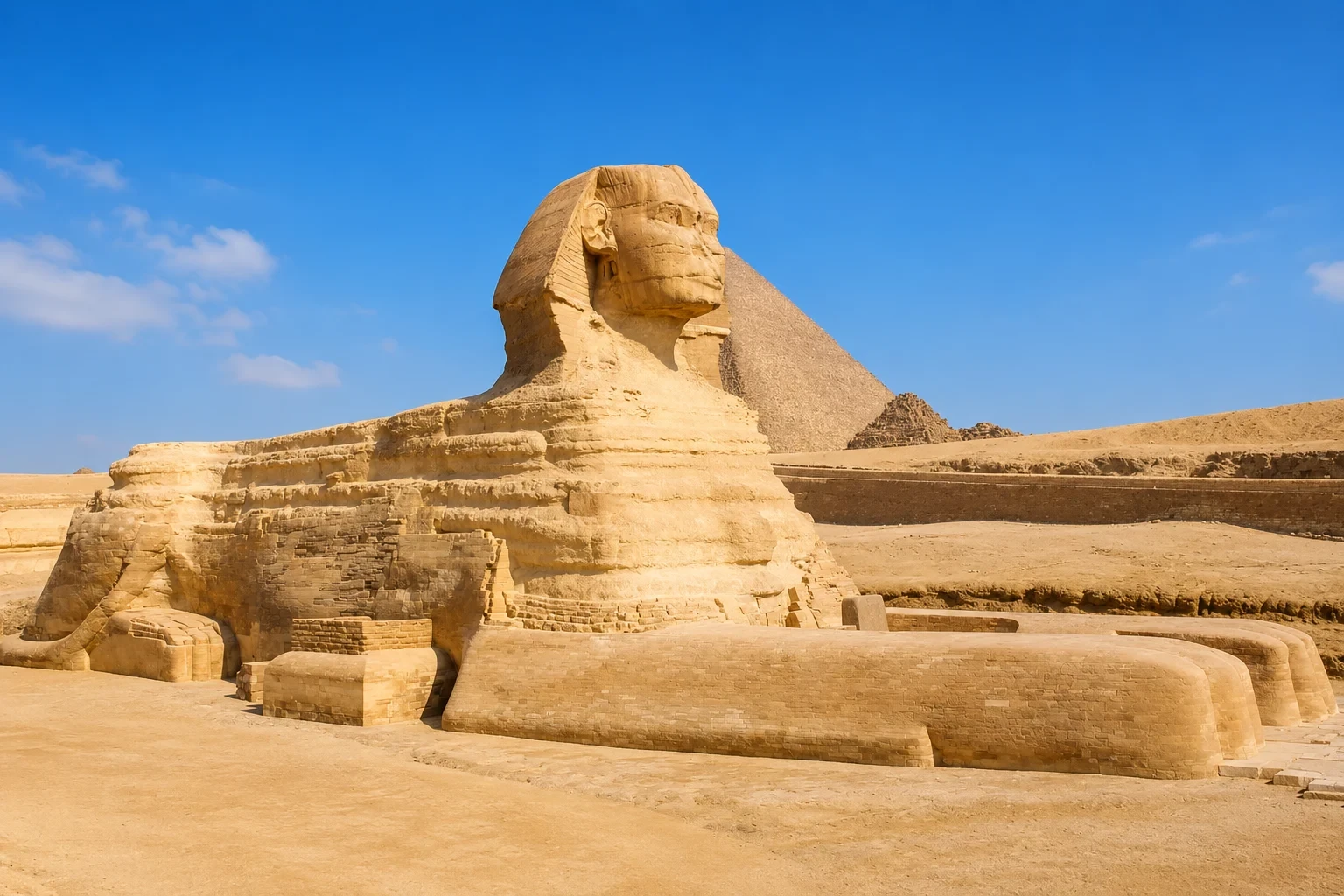
The most immediately extraordinary and the most spatially dramatic dimension of the complete Valley Temple of Khafre heritage experience is the direct physical proximity of the temple to the Great Sphinx of Giza, whose massive recumbent form crouches immediately north of the temple's northern face in a spatial relationship of such complete visual and architectural intimacy that the two monuments, the world's largest monolithic sculpture and the most completely preserved ancient Egyptian Old Kingdom temple interior, are inseparable components of the single most extraordinary ancient heritage landscape composition accessible at any point in the complete Giza Plateau visitor circuit. The Valley Temple's northern entrance portal, opening directly toward the southern wall of the Sphinx enclosure, creates the most direct available architectural connection between the temple and the Sphinx in the ancient Giza Plateau spatial programme, a connection that reflects the shared divine identity of both monuments as expressions of Horemakhet, Horus of the Horizon, the solar divine manifestation embodied by the Sphinx and venerated in the Valley Temple as the primary cult identity of the Khafre royal funerary establishment. The combination of the Valley Temple visit with the Great Sphinx enclosure visit in a single comprehensive programme of the Khafre complex's eastern zone creates the most personally extraordinary and the most archaeologically complete heritage experience available at any single combined site visit in the complete Giza Plateau monument landscape.
The Causeway Connection
The western gateway of the Valley Temple, where the preserved causeway that connects the eastern approach temple with the Mortuary Temple at the base of the Khafre pyramid approximately 494 meters to the northwest begins its roofed corridor ascent up the gentle gradient of the plateau surface, provides the most spatially immediate and the most personally legible connection between the Valley Temple and the complete Khafre royal funerary landscape system of which it is the primary entrance component. The causeway, the most substantially preserved pyramid causeway on the complete Giza Plateau, originally formed a completely enclosed roofed passage decorated with relief carvings of the royal divine narrative programme, and its preserved sections communicate most directly the ancient architectural logic of the complete funerary landscape system whose spatial sequence from the Valley Temple to the Mortuary Temple to the pyramid embodies the most complete surviving ancient Egyptian royal funerary processional route in the complete archaeological record of the Old Kingdom pyramid building tradition. Walking the causeway route from the Valley Temple to the Mortuary Temple area with a licensed Egyptology guide from WOW Egypt Tours is one of the most spatially immediate and the most personally affecting heritage experiences available at the complete Giza Plateau, the physical act of walking the ancient royal processional route in the actual ancient landscape of the most completely preserved royal funerary complex on the plateau creating a quality of direct archaeological connection with the ancient programme that no amount of scholarly description or museum object encounter can quite replicate.
The Exterior And The Ancient Harbor
The exterior of the Valley Temple of Khafre, whose original casing of white Tura limestone has been almost entirely removed in the medieval period leaving the massive dark granite core blocks of the interior construction exposed on the exterior faces, creates a building exterior of extraordinary visual power and extraordinary archaeological expressiveness whose rough granite core masonry provides the most direct and the most personally affecting visual evidence for the construction process of the ancient Egyptian granite building tradition at its most ambitious Old Kingdom expression. The ancient harbor whose evidence has been identified by modern archaeological investigation in the low-lying terrain immediately east of the Valley Temple, including the preserved traces of a boat landing, a quay structure, and water management features whose identification and interpretation have been progressively advanced by the archaeological investigation of the broader Giza Plateau landscape by the Giza Plateau Mapping Project, is the most important and the most completely extraordinary recently identified component of the complete Valley Temple heritage programme, providing the first direct physical evidence for the ancient waterway system that connected the Valley Temple to the Nile Valley and that was the primary transport route for both the royal funeral cortege and the massive construction materials of the complete Giza pyramid building programme in the 4th Dynasty period of maximum ancient Egyptian national construction ambition.
Why Is The Valley Temple Of Khafre Important?
The Valley Temple of Khafre is important for reasons spanning ancient Egyptian architectural history, the history of 19th century Egyptological discovery, the understanding of the ancient Egyptian royal funerary landscape system, the specific archaeological biography of the Giza Plateau's most completely preserved primary ritual facility, and the broader cultural significance of the building as the physical context of the most celebrated ancient Egyptian royal sculptural discovery of the modern era. As an architectural monument, the Valley Temple of Khafre is the most completely preserved and the most architecturally magnificent ancient Egyptian Old Kingdom temple interior accessible to visitors at any heritage site in the Greater Cairo area, providing the most direct available encounter with the material ambitions, the spatial sophistication, and the architectural achievement of the 4th Dynasty royal temple building programme at its most ambitious and most fully realized expression. As an archaeological discovery site, the Valley Temple is the building in which the diorite throne statue of Khafre, the supreme masterpiece of ancient Egyptian Old Kingdom royal portraiture now in the Egyptian Museum, was discovered by Mariette in 1860 in one of the most celebrated and the most personally consequential archaeological discovery moments in the complete history of Egyptological investigation. WOW Egypt Tours includes the Valley Temple of Khafre as an essential destination in all comprehensive Cairo Tours, Egypt Classic Tours, and all Egypt Tour Packages.
What Are Some Interesting Facts About The Valley Temple Of Khafre?
The Largest Stone Blocks In Any Egyptian Temple
The Valley Temple of Khafre contains some of the largest individual stone blocks used in the construction of any ancient Egyptian temple building accessible to visitors at any heritage site in the greater Cairo area, with certain of the massive granite core blocks of the interior walls estimated by Egyptologists and structural engineers who have investigated the building to weigh between 100 and 150 metric tonnes each and measuring up to 5 or 6 meters in length in the most enormous single stone elements of any temple interior in the complete accessible Egyptian architectural heritage. The physical reality of being surrounded by walls built from stones of this scale, each one individually quarried at Aswan approximately 900 kilometers to the south, transported by Nile boat to the Giza area, moved from the river to the construction site by the ancient harbor and transport system whose evidence has been progressively identified by modern archaeological investigation, and positioned with the precision of fit that the temple's current structural integrity demonstrates, creates the most complete and the most personally overwhelming single experience of ancient Egyptian construction ambition and ancient Egyptian construction capacity available in any interior architectural space in the complete Greater Cairo heritage landscape.
Preserved By The Desert Sand For Four Thousand Years
The extraordinary state of preservation of the Valley Temple of Khafre's granite interior, whose polished wall surfaces, precisely fitted stone joints, and overall structural integrity represent a quality of ancient architectural preservation simply unavailable at any comparable ancient Egyptian Old Kingdom heritage site in the Greater Cairo area, is directly attributable to the progressive burial of the complete temple under accumulating desert sand in the centuries following the end of active ancient use, a process of sand accumulation that simultaneously concealed the building from the medieval stone quarrying operations that removed the casing stone from the adjacent pyramid monuments and provided the most completely effective natural conservation environment available for the preservation of the ancient granite surfaces in the most complete and the most personally affecting condition accessible to modern visitors. The practical implication of this extraordinary preservation circumstance for the modern visitor is that the Valley Temple of Khafre provides the most direct and the most completely authentic encounter with the physical reality of an ancient Egyptian 4th Dynasty royal temple interior that is available at any accessible heritage site in the complete Greater Cairo area, an encounter whose quality of ancient material presence, ancient spatial atmosphere, and ancient architectural completeness is simply not available at any other comparable ancient monument in the entire Egyptian heritage landscape within practical day-trip distance of Cairo.
Where Mariette Found The Greatest Statue In Egypt
The Valley Temple of Khafre's position as the building in which the most celebrated and the most universally admired ancient Egyptian royal sculpture in the complete heritage of the Old Kingdom period was discovered in 1860 gives it a specific artistic heritage significance and a specific personal historical resonance that is available at no other ancient building in the complete Giza Plateau monument landscape. Standing in the Valley Temple's main hall on the alabaster floor above the circular pit from which Mariette's workers extracted the diorite throne statue on 26 February 1860, knowing that the supreme masterpiece of ancient Egyptian royal portraiture, the sculpture now displayed in the Egyptian Museum in Cairo as the most celebrated and the most consistently admired object in its entire extraordinary collection, was buried beneath this specific spot in the floor of this specific ancient building for more than four thousand years before that specific moment of extraction, creates one of the most personally extraordinary and the most completely affecting encounters with the archaeology of ancient artistic discovery available anywhere in the complete heritage world of the Greater Cairo area, a moment of direct connection between the physical space of the ancient building and the supreme artistic object that the ancient building once contained that gives the Valley Temple visit a dimension of personal artistic and archaeological significance that no other accessible ancient Egyptian monument in the Greater Cairo area can provide in quite the same form.
What Is So Special About The Valley Temple Of Khafre?
The Most Magnificent Ancient Egyptian Interior In Greater Cairo
What makes the Valley Temple of Khafre uniquely special among all the ancient Egyptian monuments accessible to visitors in the Greater Cairo heritage area is the extraordinary combination of material magnificence, architectural scale, ancient preservation quality, and specific historical significance that gives it a heritage experience of complete and immediate personal impact that is available in this specific combination at no other accessible ancient Egyptian monument in the complete Cairo heritage landscape. The encounter with the Valley Temple's interior of polished red granite, massive monolithic pillars, and alabaster floor in the extraordinary quality of Egyptian desert light entering through the temple's precisely positioned lighting slots is the single most completely and the most immediately overwhelming ancient interior architectural experience available to visitors at any heritage site in the complete Greater Cairo area, an experience whose material quality, whose spatial drama, and whose ancient atmospheric character are uniquely available at this specific building among all accessible ancient Egyptian monuments in the region and that gives the Valley Temple a primacy of architectural experience in the complete Giza Plateau heritage programme that is not diminished by the overwhelming physical scale of the adjacent pyramid monuments but that exists in a completely different and completely complementary register of heritage impact whose interior, intimate, and materially refined character contrasts with the exterior, monumental, and physically overwhelming character of the pyramid monuments in the most complete and the most personally satisfying possible heritage programme balance.
Where Three Extraordinary Monuments Meet
The Valley Temple of Khafre is also uniquely special for the extraordinary spatial convergence of three of the most celebrated and the most personally overwhelming ancient monuments in the complete world heritage record that its immediate landscape context creates, the Valley Temple itself as the most magnificent ancient Egyptian Old Kingdom temple interior in the Greater Cairo area, the Great Sphinx immediately to its north as the world's largest monolithic sculpture and the most universally recognized ancient portrait in the history of human art, and the Middle Pyramid of Khafre rising above and behind the temple as the second largest ancient building in the world. No other single accessible heritage site in the complete world heritage landscape brings the visitor into such immediate physical proximity with three ancient monuments of such individually extraordinary significance and such completely remarkable personal impact as the Valley Temple's position at the base of the Giza Plateau escarpment where the complete Khafre royal funerary landscape presents itself in the most concentrated and the most dramatically powerful spatial composition of ancient heritage available at any accessible point in the complete Egyptian heritage world.
The Valley Temple Of Khafre Through The Ages
The complete narrative of the Valley Temple of Khafre from its construction and its active royal funerary use in the 4th Dynasty through the ancient Egyptian priestly maintenance tradition, the gradual post-Old Kingdom sand burial that preserved the ancient granite interior for four thousand years, the extraordinary Mariette excavation of 1853 to 1860 that revealed the temple and the diorite statue, the subsequent systematic Egyptological investigation and documentation, and the ongoing modern conservation and visitor management programme traces a monument biography of such extraordinary variety and such extraordinary consequence that it gives the Valley Temple a heritage narrative of as great a depth and as great a personal impact as any of the more physically overwhelming pyramid monuments that surround it on the Giza Plateau. The most recent and the most archaeologically productive contributions to the scholarly understanding of the Valley Temple have come from the investigation of the ancient harbor and waterway system immediately east of the building, whose identification and progressive documentation by the Giza Plateau Mapping Project have transformed the understanding of the complete ancient functional landscape of the Khafre complex's eastern zone and given the Valley Temple the most direct available physical connection to the ancient Nile Valley transport system that served both the royal funerary programme and the construction logistics of the complete Giza pyramid building enterprise.
The Valley Temple And UNESCO
The Valley Temple of Khafre is protected as a primary component of the UNESCO World Heritage Site designated in 1979 as Memphis and its Necropolis: the Pyramid Fields from Giza to Dahshur, recognized as a heritage of outstanding universal value for the extraordinary concentration of ancient Egyptian funerary and royal monument heritage of the Old Kingdom pyramid building tradition. The UNESCO inscription encompasses the complete Giza Plateau monument complex including all three pyramids, the Great Sphinx, the Valley Temple of Khafre, and the connected pyramid fields of Saqqara and Dahshur. The Egyptian government and the UNESCO World Heritage Committee are engaged in ongoing collaboration on the conservation management of the Valley Temple's extraordinary granite interior, including the monitoring of the structural integrity of the massive monolithic granite blocks, the conservation of the alabaster floor surfaces, and the management of visitor access to maintain the extraordinary physical quality of the ancient building for all future generations of heritage visitors and scholarly investigators.
Best Time To Visit The Valley Temple Of Khafre
The best time to visit the Valley Temple of Khafre is during the cooler months from October through April when the Egyptian climate provides the most comfortable conditions for the outdoor movement between the Sphinx enclosure, the Valley Temple entrance, and the causeway walk, and when the extraordinary quality of the winter light entering the temple's precision-positioned lighting slots in the early morning hours creates the most dramatically beautiful interior atmospheric conditions available at any time of the complete annual cycle. The early morning visit immediately after the Giza complex opening at 8:00 AM provides the most extraordinary interior lighting quality of any time of day, with the low eastern sun casting the most dramatically beautiful natural light shafts across the alabaster floor and the granite pillar surfaces in a play of ancient architectural atmospheric beauty that the higher-angle light of the midday and afternoon hours cannot replicate. The summer months are comfortable for the covered interior of the Valley Temple even in the heat of the Egyptian afternoon, making the temple one of the most naturally comfortable heritage visit environments at the Giza Plateau in the summer season. WOW Egypt Tours advises on optimal seasonal and daily timing for the Valley Temple visit as part of all comprehensive Giza Plateau heritage programmes.
Valley Temple Of Khafre Opening Hours
The Valley Temple of Khafre is accessible as part of the complete Giza Pyramids Complex, open daily from 8:00 AM to 5:00 PM in the winter season (October through April) and from 7:00 AM to 7:00 PM in the summer season (May through September). Access to the Valley Temple interior is included in the general Giza Pyramids Complex admission ticket without any additional separate entrance fee. The temple is most naturally visited in combination with the Great Sphinx enclosure immediately to the north and the causeway walk toward the Khafre pyramid complex above, both of which are accessible without additional separate fees as part of the general complex admission. All visiting hours are subject to adjustment for Egyptian national holidays and should be confirmed at time of booking with WOW Egypt Tours.
Valley Temple Of Khafre Entrance Fees
Valley Temple of Khafre entrance: included in the general Giza Pyramids Complex admission ticket of EGP 220 for adults and EGP 110 for students. No additional fee is charged for Valley Temple interior access beyond the general complex admission. All Giza complex entrance fees are included in the Cairo Tours and Egypt Tour Packages organized by WOW Egypt Tours. The diorite Khafre throne statue discovered in the Valley Temple is viewed in the Egyptian Museum in Cairo whose separate entrance fee is included in all comprehensive Cairo heritage programmes. Fees are subject to periodic adjustment and should be confirmed at time of booking.
How To Get To The Valley Temple Of Khafre
The Valley Temple of Khafre is located at the eastern edge of the Giza Plateau approximately 13 kilometers southwest of central Cairo, accessible from the main Giza complex entrance by the visitor path descending from the plateau surface to the Sphinx enclosure level where the Valley Temple entrance is immediately adjacent to the southern end of the Sphinx enclosure wall. Private vehicle from Cairo hotel provided by WOW Egypt Tours as part of the complete Cairo heritage programme is the most convenient approach, providing door-to-door transport from the hotel to the main Giza complex entrance and organized movement between all the primary sites within the plateau area. The Valley Temple is most efficiently visited as part of the complete Khafre complex eastern zone programme that combines the Valley Temple interior with the Great Sphinx enclosure and the causeway walk in a single comprehensive visit of approximately two hours that covers the most completely preserved ancient Egyptian royal funerary landscape accessible at any heritage site in the Greater Cairo area.
How Long To Spend At The Valley Temple Of Khafre
The Valley Temple of Khafre interior visit should be allocated a minimum of 30 to 45 minutes for the complete guided tour of the T-shaped hall, the sixteen granite pillars, the alabaster floor, the twenty-three empty statue bases, the sealed circular pit of the Khafre statue discovery, the lighting slots and their atmospheric effects, and the causeway gateway that connects the temple to the Mortuary Temple above. A more completely satisfying Valley Temple visit of 45 to 60 minutes allows the most thorough guided explanation of the temple's ancient functional programme, the specific significance of the Mariette statue discovery, the relationship between the temple and the adjacent Sphinx, and the complete spatial logic of the Khafre funerary landscape system. The Valley Temple is most naturally and most effectively combined with the Great Sphinx enclosure visit of 30 to 45 minutes immediately adjacent to the north and the causeway walk of approximately 494 meters to the Mortuary Temple above in a complete Khafre complex eastern zone programme of approximately two hours that provides the most comprehensive and the most personally satisfying encounter with the most completely preserved ancient Egyptian royal funerary landscape at the Giza Plateau. The Egyptian Museum visit for the Khafre diorite statue, most naturally organized as the afternoon complement to the Giza morning programme, adds approximately two to three hours for the complete Egyptian Museum highlights programme in which the Khafre statue is the most important 4th Dynasty royal portrait object.
Tips For Visiting The Valley Temple Of Khafre
Time the Valley Temple interior visit for the early morning immediately after the Giza complex opening when the low eastern sun creates the most dramatically beautiful natural light quality in the temple interior through the precision-positioned lighting slots, the moment when the interaction of the morning light with the polished granite surfaces and the alabaster floor creates the most completely extraordinary atmospheric experience of any time of day in the complete Valley Temple interior. Ask your licensed Egyptology guide from WOW Egypt Tours to stand at the precise location of the Mariette statue discovery pit in the center of the hall floor and to describe in complete detail the circumstances of the 26 February 1860 discovery, because the combination of the specific physical location, the guide's expert narrative of the discovery moment, and the knowledge that the supreme masterpiece of ancient Egyptian royal portraiture was buried in this specific spot for more than four thousand years before Mariette's workers extracted it creates the single most personally extraordinary moment of archaeological imagination available at any accessible point in the complete Valley Temple visit. Allow sufficient time after the Valley Temple interior to walk the complete causeway route from the western gateway of the temple to the Mortuary Temple at the Khafre pyramid base, as the causeway walk is the most spatially immediate and the most personally affecting experience of the complete ancient Egyptian royal funerary processional sequence that the Khafre complex embodies and whose approximately 494-meter length from the Valley Temple to the Mortuary Temple gives the ancient spatial programme its most direct and its most completely physical expression in the complete Giza heritage landscape. Combine the Valley Temple visit on the same day with the Egyptian Museum visit specifically to see the diorite Khafre throne statue, planning the morning for the Giza Plateau and the afternoon for the Egyptian Museum, as the combination of the building where the statue was discovered with the direct encounter with the statue itself in the museum collection creates the most completely satisfying and the most personally resonant heritage experience of any combined programme available in a single day of Cairo heritage engagement.
What To Wear At The Valley Temple Of Khafre
The Valley Temple of Khafre visit encompasses both the covered interior of the ancient temple, where the polished granite walls and the large stone masses maintain a relatively cool and stable temperature even in the most extreme Egyptian summer heat, and the outdoor movement between the Valley Temple, the Sphinx enclosure, and the causeway walk that requires standard sun-protection clothing for the exposed Giza Plateau environment. For the outdoor components of the complete Khafre complex eastern zone programme, lightweight breathable clothing covering the arms and legs, a wide-brimmed hat, high-SPF sunscreen, and UV-protective sunglasses are essential. For the Valley Temple interior, comfortable casual clothing is appropriate and the stable granite interior temperature makes the temple one of the more comfortable enclosed spaces at the Giza Plateau in any season. Flat rubber-soled shoes with good grip are recommended for the Valley Temple's alabaster floor surfaces whose polished finish can be slippery in certain lighting and humidity conditions. Modest clothing covering the shoulders and knees is appropriate throughout the Giza complex. Carry adequate water for the complete Giza Plateau programme.
Photography At The Valley Temple Of Khafre
The Valley Temple of Khafre provides the most extraordinary and the most materially distinctive interior architectural photography subjects available at any ancient Egyptian heritage site in the complete Greater Cairo area, encompassing the sixteen monolithic granite pillars in their two rows with the early morning light shafts falling across the alabaster floor, the massive granite wall surfaces with their extraordinary polished finish and their precise stone joint work, the Mariette discovery pit in the center of the hall floor, and the causeway gateway that frames the view toward the ascending processional route to the Khafre pyramid above. The most dramatically beautiful single interior photograph of the complete Valley Temple programme is the early morning wide-angle composition from the eastern entrance of the main hall looking westward along the complete T-shaped axis of the sixteen pillars toward the causeway gateway with the light shafts from the overhead lighting slots crossing the alabaster floor in the most extraordinary natural light architectural photography subject available at any enclosed ancient Egyptian heritage site in the complete Greater Cairo area. Photography is freely permitted throughout the accessible interior of the Valley Temple. The exterior of the building, whose dark rough granite core masonry contrasts dramatically with the smooth polished interior, provides architectural photography of extraordinary material character and ancient building process expressiveness from the exterior approach path. The combination of the Valley Temple exterior with the adjacent Sphinx enclosure in a single wide-angle composition from the southeast viewing angle captures the most extraordinary and the most archaeologically informative spatial relationship available at any accessible point in the complete Khafre complex eastern zone programme.
Valley Temple Of Khafre Tours
Complete Khafre Eastern Zone Programme: Valley Temple, Sphinx, And Causeway
This comprehensive programme of the Khafre complex's eastern zone combines the most magnificent ancient Egyptian Old Kingdom temple interior, the world's largest monolithic sculpture, and the most completely preserved ancient royal funerary processional route in the complete Giza Plateau monument landscape in the most archaeologically complete and the most personally extraordinary single heritage programme available at any accessible point in the complete Greater Cairo area.
What Is Covered
Private vehicle from Cairo hotel with early morning departure timed to reach the Valley Temple at the complex opening. Guided Valley Temple interior programme: sixteen granite pillars, alabaster floor, lighting slots and atmospheric effects, twenty-three empty statue bases, Mariette discovery pit narrative, causeway gateway. Great Sphinx enclosure complete circuit including Dream Stele narrative and frontal face portrait approach. Causeway walk from the Valley Temple to the Mortuary Temple at the Khafre pyramid base with guided explanation of the ancient processional sequence and the complete funerary landscape spatial logic. Complete Giza Plateau programme adding the Great Pyramid exterior and optional interior, Khufu Boat Museum, Menkaure Pyramid, and panoramic desert viewpoint. Afternoon: Egyptian Museum with primary focus on the Khafre diorite throne statue discovered in the Valley Temple in 1860, viewed in the museum as the direct artistic complement to the building where it was found on the Giza Plateau in the morning. Return to Cairo hotel in the evening.
Duration
Full day from Cairo hotel, approximately 10 to 11 hours.
Includes
Private vehicle, licensed Egyptology guide, all Giza complex and Egyptian Museum entrance fees, lunch, and all logistics. Through WOW Egypt Tours Cairo Tours.
Greater Cairo Pyramid Heritage Circuit Including Valley Temple
This comprehensive two-day Cairo ancient heritage programme covers the complete ancient Egyptian pyramid complex heritage of the Greater Cairo area, with the Valley Temple of Khafre as the primary interior architectural heritage highlight of the complete programme.
What Is Covered
Day 1: Complete Giza Plateau programme including Valley Temple, Great Sphinx, causeway, all three pyramids, and panoramic desert viewpoint. Afternoon: Grand Egyptian Museum.
Day 2: Saqqara Step Pyramid Complex morning. Afternoon: Memphis and Dahshur Bent and Red Pyramids. Evening: Egyptian Museum for the Khafre diorite throne statue.
Duration
2 Days from Cairo hotel.
Includes
Private vehicle both days, licensed Egyptology guide, all site entrance fees, lunch both days, and all logistics. Through WOW Egypt Tours Cairo Tours.
Combine The Valley Temple Of Khafre With Your Egypt Tours Package
The Valley Temple of Khafre is included as an essential destination in every Giza heritage programme across the full range of WOW Egypt Tours travel products. Browse the options below to find the Egypt experience that includes the Valley Temple of Khafre.
Egypt Tour Packages: Multi-day guided Egypt tours organized by duration, including 2 Days Egypt Packages, 3 Days Egypt Packages, 4 Days Egypt Packages, 5 Days Egypt Packages, 6 Days Egypt Packages, 7 Days Egypt Packages, 8 Days Egypt Packages, 10 Days Egypt Packages, and longer itineraries. The Valley Temple of Khafre is included in all Egypt Tour Packages as part of the complete Giza Plateau programme. All packages include private vehicle, licensed Egyptology guide, accommodation, all entrance fees, and all logistics.
Egypt Travel Packages: Themed Egypt travel packages including Egypt Honeymoon Travel Packages, Egypt Budget Travel Packages, Egypt Family Travel Packages, Egypt Luxury Travel Packages, Egypt Adventure Travel Packages, Egypt Cultural Travel Packages, and Egypt Christmas and New Year Travel Packages. The Valley Temple of Khafre is featured in every Egypt Travel Package category as the most magnificent ancient Egyptian Old Kingdom temple interior accessible to visitors at any Greater Cairo heritage site.
Egypt Classic Tours: The most popular and the most comprehensively balanced Egypt travel programme, combining the complete Giza Plateau programme including the Valley Temple, Great Sphinx, and all three pyramids with the Egyptian Museum for the Khafre diorite throne statue and the Nile Valley heritage of Luxor and Aswan in the most complete and the most personally satisfying introduction to the ancient Egyptian world available in any organized Egypt itinerary.
Egypt Short Break Tours: Focused short duration Egypt travel programmes for travelers with limited time. The Valley Temple of Khafre combined with the Great Sphinx is always included in the Giza Plateau programme of every Egypt Short Break Tours itinerary as the most architecturally extraordinary and the most atmospheric interior heritage experience of the complete Giza visit.
Egypt Family Tours: Family-friendly Egypt travel programmes in which the Valley Temple's extraordinary granite interior, the Mariette discovery story, and the combination with the Great Sphinx create one of the most varied and the most personally engaging heritage programmes for families with children of all ages visiting the Giza Plateau.
Egypt Budget Tours: Value-focused Egypt travel programmes providing access to the Valley Temple of Khafre as part of the complete Giza Plateau programme at the most economical pricing available from any professional Egyptian tour operator, as the Valley Temple interior is included in the general Giza complex admission without any additional fee.
Egypt Nile Cruises: All-inclusive Nile River Cruise programmes combining the ancient pharaonic heritage of Luxor and Aswan with Cairo extensions that include the Valley Temple of Khafre as part of the complete Giza Plateau programme.
Nile River Cruises: All WOW Egypt Tours Nile cruise options. The Valley Temple is available as part of the complete Giza Plateau Cairo extension from the beginning or end of any Nile River Cruise itinerary.
Luxor Aswan Nile Cruises: The Valley Temple of Khafre is the most magnificent ancient Egyptian interior architectural heritage destination in any Cairo extension for the Luxor-Aswan Nile cruise programme.
Dahabiya Nile Cruises: The Valley Temple available as part of the complete Giza Plateau Cairo extension for travelers combining the most intimate private Nile sailing experience with the most magnificent ancient Egyptian Old Kingdom temple interior in the Greater Cairo area.
Lake Nasser Cruises: The Valley Temple available as part of the Cairo extension for travelers combining the extraordinary Nubian heritage of Lake Nasser with the supreme ancient monuments of the Giza Plateau.
Cairo Tours: The complete range of guided day tour programmes available from Cairo hotels, including the complete Khafre eastern zone programme combining the Valley Temple, Great Sphinx, and causeway walk, the combined Giza and Egyptian Museum full-day programme with specific focus on the Valley Temple and the Khafre diorite throne statue, the combined Giza and Grand Egyptian Museum programme, the Greater Cairo pyramid circuit combining Giza with Saqqara, Memphis, and Dahshur, the Islamic Cairo programme covering the Khan El Khalili, El Moez Street, Saladin Citadel, and Muhammad Ali Mosque, and the Coptic Cairo programme covering the Hanging Church, Coptic Museum, and Ben Ezra Synagogue. All Cairo Tours include private vehicle, licensed Egyptology guide, all entrance fees, and all logistics organized by WOW Egypt Tours.
Nearby Attractions To The Valley Temple Of Khafre
The Valley Temple of Khafre is positioned at the most heritage-dense convergence point of the complete Giza Plateau monument landscape, where the most celebrated ancient monument, the most magnificent ancient temple interior, and the most completely preserved ancient royal funerary landscape meet in the most extraordinary spatial concentration of ancient heritage accessible at any single point in the complete Greater Cairo area. The Great Sphinx of Giza immediately to the north is the most universally recognized ancient portrait in the history of human art and the most directly adjacent monument to the Valley Temple in the complete Giza Plateau heritage landscape, inseparable from the Valley Temple visit as the defining spatial companion of the Khafre complex's eastern zone. The Middle Pyramid of Khafre, connected to the Valley Temple by the approximately 494-meter preserved causeway, is the primary monument of the complete Khafre funerary landscape whose visual dominance of the complete Giza Plateau skyline is most dramatically experienced from the Valley Temple's position at the base of the plateau escarpment. The Great Pyramid of Khufu and the Small Pyramid of Menkaure complete the three-pyramid programme of the complete Giza Pyramids Complex.
The Egyptian Museum in central Cairo is the single most important nearby heritage destination for the complete appreciation of the Valley Temple's artistic legacy, housing the extraordinary diorite throne statue of Khafre discovered in the Valley Temple floor in 1860 and now universally recognized as the supreme masterpiece of ancient Egyptian Old Kingdom royal portraiture. The Grand Egyptian Museum approximately 2 kilometers north of the plateau is the most logistically convenient museum complement to the Giza morning programme. The ancient city of Memphis, the Saqqara Step Pyramid, and the Dahshur Pyramids complete the most comprehensive Greater Cairo ancient pyramid heritage circuit for the most historically complete encounter with the complete development sequence of the ancient Egyptian pyramid building tradition. All these destinations are organized by WOW Egypt Tours as part of comprehensive Cairo Tours and Egypt Tour Packages encompassing the extraordinary heritage of Cairo the Capital of Egypt.
Frequently Asked Questions About The Valley Temple Of Khafre
What is the Valley Temple of Khafre?
The Valley Temple of Khafre is the most completely preserved and the most architecturally magnificent ancient Egyptian Old Kingdom temple interior accessible to visitors in the Greater Cairo area, built approximately 2558 to 2532 BCE from massive monolithic blocks of Aswan red granite as the primary entrance, reception, and purification facility of the Khafre royal pyramid complex at the eastern edge of the Giza Plateau. It is the building where the supreme masterpiece of ancient Egyptian Old Kingdom royal portraiture, the diorite throne statue of Khafre now in the Egyptian Museum, was discovered by Auguste Mariette in 1860. It is featured in Cairo Tours, Egypt Classic Tours, and Egypt Short Break Tours offered by WOW Egypt Tours.
What was the Valley Temple used for in ancient Egypt?
The Valley Temple served as the primary entrance, reception, and purification facility of the Khafre royal funerary landscape system, receiving the royal body from the Nile boat at the ancient harbor immediately east of the building, performing the embalming and purification rites that prepared the royal person for burial, and providing the primary installation space for the royal divine statue programme of twenty-three royal portrait sculptures through which the eternal soul of Khafre would inhabit and be venerated in the temple's cult after the royal burial in the pyramid above.
What was discovered in the Valley Temple in 1860?
On 26 February 1860, the French Egyptologist Auguste Mariette discovered the magnificent diorite throne statue of Khafre in a sealed circular pit beneath the floor of the temple's main hall. The statue, carved from intensely dark green diorite whose extreme hardness made it the most technically demanding sculptural medium available to the ancient Egyptian sculptor, shows Khafre seated on his royal throne with the falcon god Horus spreading his wings protectively behind the royal head. It is now universally recognized as the supreme masterpiece of ancient Egyptian Old Kingdom royal portraiture and is one of the most celebrated objects in the Egyptian Museum collection in Cairo.
What is the Valley Temple made of?
The Valley Temple of Khafre is constructed primarily from massive monolithic blocks of Aswan red granite in both the interior wall surfaces and the core structural elements, with white Tura limestone originally on the exterior casing (now largely removed) and alabaster paving the interior floor of the main hall. The combination of polished red granite walls and pillars with the warm translucent alabaster floor creates the most materially magnificent and the most atmospherically extraordinary ancient Egyptian temple interior accessible to visitors in the complete Greater Cairo area.
How large are the stone blocks in the Valley Temple?
The Valley Temple of Khafre contains some of the largest individual stone blocks used in any ancient Egyptian temple building, with certain of the interior granite wall blocks estimated to weigh between 100 and 150 metric tonnes each and measuring up to 5 to 6 meters in length. These are among the largest single stone elements in any accessible ancient Egyptian architectural heritage in the Greater Cairo area and give the Valley Temple interior a quality of structural boldness and material grandeur entirely without precedent in the accessible ancient Egyptian architectural heritage.
Is the Valley Temple near the Great Sphinx?
Yes. The Valley Temple of Khafre is immediately adjacent to the Great Sphinx, with the temple's northern face positioned directly alongside the southern end of the Sphinx enclosure wall. The two monuments are the most directly adjacent and the most spatially intimate ancient heritage sites in the complete Giza Plateau monument landscape, sharing the Khafre complex's eastern zone in the most concentrated and the most archaeologically extraordinary spatial convergence of ancient heritage accessible at any single point in the Greater Cairo area.
Does the Valley Temple have an additional entrance fee?
No. Access to the Valley Temple interior is included in the general Giza Pyramids Complex admission ticket without any additional separate entrance fee, making it one of the most remarkable heritage value propositions available at any Giza Plateau monument, the most completely preserved and the most architecturally magnificent ancient Egyptian Old Kingdom temple interior in the Greater Cairo area accessible without any cost beyond the general complex admission.
What is the causeway connected to the Valley Temple?
The causeway is an approximately 494-meter roofed limestone corridor that connects the Valley Temple's western gateway to the Mortuary Temple at the eastern base of the Khafre pyramid above, ascending the gentle gradient of the plateau surface in a completely enclosed transitional passage that originally bore carved and painted relief decoration of the royal divine narrative programme. It is the most substantially preserved pyramid causeway on the complete Giza Plateau and the most spatially immediate expression of the ancient Egyptian royal funerary processional route connecting the world of the living at the Valley Temple to the world of the dead at the pyramid base.
What is the best time to visit the Valley Temple?
The early morning immediately after the Giza complex opening (8:00 AM in winter) is the most strongly recommended time, when the low eastern sun creates the most dramatically beautiful natural light quality in the temple interior through the precision-positioned lighting slots, with warm light shafts crossing the alabaster floor and illuminating the polished granite pillar surfaces in the most extraordinary atmospheric lighting effects available at any time of day in the complete Valley Temple interior.
Can I see the Khafre statue in the Valley Temple?
No. The diorite throne statue of Khafre discovered in the Valley Temple in 1860 was removed to the Egyptian Museum in Cairo where it is currently displayed as one of the most celebrated objects in the museum's collection. The sealed circular pit from which the statue was extracted by Mariette is still visible in the Valley Temple floor, and the guided explanation of the discovery story at this specific location is one of the most personally extraordinary moments of the complete Valley Temple visit. The Egyptian Museum visit for the statue itself is the most important artistic complement to the Valley Temple site visit.
Is the Valley Temple suitable for families with children?
Yes. The Valley Temple's extraordinary granite interior, the Mariette treasure discovery story in the sealed pit, and the immediate proximity to the Great Sphinx together make the Valley Temple one of the most varied and the most engaging heritage experiences for families with children at the Giza Plateau. The covered granite interior provides a welcome shade and coolness in the summer months that makes the Valley Temple one of the most comfortable enclosed ancient heritage environments for families with young children during the hottest parts of the Egyptian day.
How do I book a Valley Temple of Khafre tour with WOW Egypt Tours?
You can book any Cairo Tours programme, Egypt Classic Tours package, Egypt Short Break Tours programme, Egypt Family Tours, Egypt Budget Tours, Egypt Tours Package, or Egypt Travel Package that includes the Giza Plateau directly through WOW Egypt Tours. The Valley Temple of Khafre is included in all Giza Plateau heritage programmes. Our team of travel specialists will arrange private vehicle, licensed Egyptology guide, all entrance fees, the complete Khafre eastern zone programme encompassing the Valley Temple interior, the Great Sphinx enclosure, and the causeway walk, combined with the Egyptian Museum visit for the extraordinary Khafre diorite throne statue discovered in the Valley Temple floor in 1860, ensuring the most complete and the most personally extraordinary encounter with the most magnificent ancient Egyptian Old Kingdom temple interior and the supreme masterpiece of ancient Egyptian royal portraiture accessible at any heritage site in the complete Greater Cairo area.