
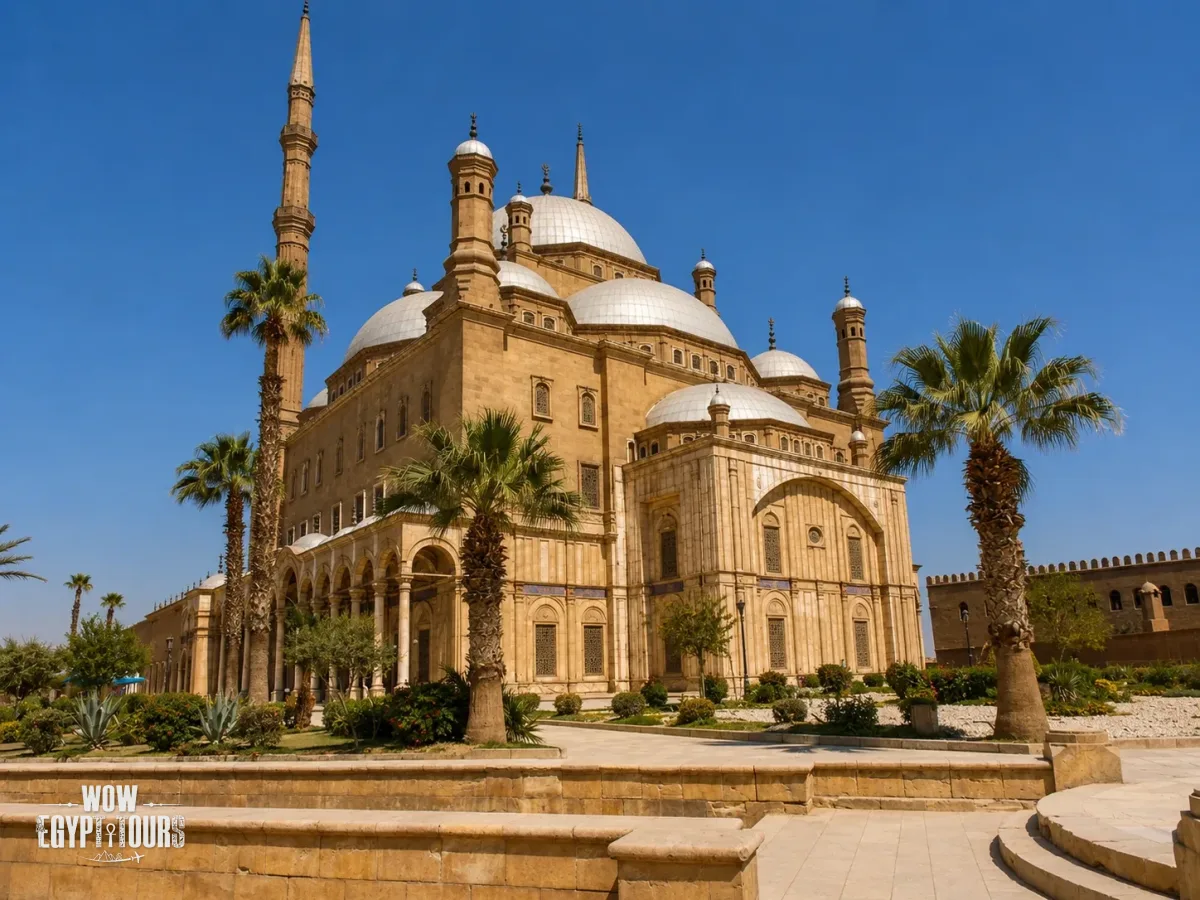

The Muhammad Ali Mosque, also known as the Alabaster Mosque for the extraordinary pale Egyptian alabaster that lines its lower interior walls and gives its exterior a quality of luminous pale stone beauty in the most dramatically revealing morning and afternoon light conditions available at any accessible Islamic monument in the complete Cairo heritage landscape, is the most visually dominant, the most immediately personally recognizable, and the most universally celebrated single building in the complete Cairo urban skyline, a mosque of such completely extraordinary visual presence, such completely overwhelming architectural drama, and such completely personal biographical richness in its connection to the most consequential single ruler of the modern Egyptian state that it occupies a position in the Islamic architectural heritage of Cairo entirely its own, simultaneously the largest Ottoman-style mosque in Egypt, the most completely realized expression of the specifically Ottoman architectural tradition accessible at any heritage mosque in the complete African and Middle Eastern world outside the Ottoman heartland of Turkey itself, and the most personally extraordinary elevated Islamic building accessible at any heritage site in the complete Egyptian capital by virtue of its specific position at the highest point of the Saladin Citadel's Muqattam spur whose commanding elevation above the complete Cairo urban landscape gives the mosque's twin pencil minarets and its soaring central dome the most dramatically extraordinary and the most personally affecting single building skyline presence of any building accessible in the complete Egyptian capital, visible from virtually every point in the greater Cairo metropolitan area as the most immediately recognizable and the most personally extraordinary elevated Islamic monument on the complete Cairo horizon. Built between 1830 and 1848 CE by Muhammad Ali Pasha, the Albanian-born Ottoman military commander who founded the dynasty that governed Egypt from 1805 to 1952 and who through the most remarkable individual exercise of political will and institutional creativity in the complete modern history of the Egyptian state transformed Egypt from an impoverished Ottoman province into an ambitious modernizing regional power whose military strength, administrative sophistication, agricultural productivity, and cultural ambition gave the Egyptian state under his personal leadership the most consequential and the most personally extraordinary political transformation of any Islamic state in the complete 19th century world, the Muhammad Ali Mosque is simultaneously the primary monument of the complete Muhammad Ali-era architectural heritage, the most visually extraordinary building of the complete Saladin Citadel complex, and the most personally affecting single testimony to the extraordinary individual ambition and the extraordinary personal cultural vision of the man who created modern Egypt. This extraordinary monument is featured in Cairo Tours, Egypt Classic Tours, and Egypt Short Break Tours, all of which WOW Egypt Tours proudly offers to travelers from around the world as part of Egypt Tours Packages and Egypt Travel Packages that encompass the extraordinary Islamic and ancient heritage of Cairo and the complete Egyptian Nile Valley civilization.
The Muhammad Ali Mosque Cairo holds a position in the architectural heritage of the Egyptian capital that is simultaneously the most visually prominent and the most institutionally consequential of any accessible Islamic monument in the complete Cairo Islamic heritage landscape, a position whose specific character of dominating the complete Cairo urban skyline from the highest point of the Muqattam spur in the most dramatic and the most personally overwhelming single building elevated presence available at any accessible heritage monument in the complete Egyptian capital gives it an immediate personal visual impact that no description however eloquent and no photograph however perfectly composed can fully prepare the first-time visitor for in the specific quality of its complete visual dominance of the Cairo landscape as experienced from the multiple directions and multiple distances from which the twin minarets and the central dome are visible across the complete metropolitan area. The mosque's interior, whose soaring central dome of approximately 21 meters in diameter surrounded by the four great semi-domes of the specifically Ottoman spatial system creates the single most spacious and the most spatially extraordinary single prayer hall interior accessible at any Islamic heritage mosque in the complete Egyptian capital, gives every visitor who enters it the most immediately personally overwhelming and the most completely affecting single interior spatial experience of the complete Cairo Islamic heritage visit, a spatial experience whose specific quality of total immersion in a single unified domed space of extraordinary scale and extraordinary luminous quality gives it a character of personal spiritual and aesthetic impact entirely unlike the more architecturally complex and more decoratively elaborate interiors of the great Mamluk mosques of the historic Cairo district. WOW Egypt Tours includes the Muhammad Ali Mosque as an essential cultural heritage destination in all comprehensive Cairo Tours, Egypt Classic Tours, Egypt Short Break Tours, Egypt Family Tours, Egypt Budget Tours, and all Egypt Tour Packages that encompass the extraordinary Islamic heritage of the Egyptian capital.

What Is The Muhammad Ali Mosque?
The Muhammad Ali Mosque is a large Ottoman-style congregational mosque built within the Saladin Citadel enclosure between 1830 and 1848 CE by Muhammad Ali Pasha, the founder of modern Egypt and the first ruler of the dynasty that governed Egypt continuously from 1805 to 1952, on the highest point of the Citadel's Muqattam spur in the most visually commanding and the most architecturally prestigious position available within the complete Citadel complex. The mosque is the largest Ottoman-style mosque built in Egypt and one of the most completely and the most personally extraordinarily realized examples of the specifically Ottoman mosque architectural tradition accessible at any heritage site in the complete African and Middle Eastern world outside the Ottoman imperial heartland of Turkey, whose specific architectural programme of the central dome surrounded by four great semi-domes in the most completely unified and the most spatially generous single-space mosque interior tradition available in the complete Islamic architectural heritage gives the Muhammad Ali Mosque a quality of interior spatial grandeur and personal atmospheric impact that is unlike anything accessible at any earlier Egyptian Islamic mosque tradition whose architectural language is so completely different from the specifically Ottoman spatial synthesis that the Muhammad Ali Mosque represents in the Egyptian architectural heritage record.
The mosque is also known as the Alabaster Mosque, a designation that refers to the extraordinary pale Egyptian alabaster used for the complete cladding of the lower interior walls and for significant elements of the exterior stone programme, whose specific material quality of translucent pale calcite with its warm honey-colored veining gives the interior walls a luminous beauty entirely different from the darker limestone of most Egyptian mosque construction and whose specific reference to the ancient Egyptian building material tradition of using alabaster for the most sacred and the most aesthetically demanding architectural applications connects the Muhammad Ali Mosque's decorative programme to the most ancient Egyptian heritage of the specifically Egyptian architectural material culture in the most directly personal and the most materially extraordinary available link between the modern Islamic building tradition of the 19th century Ottoman-style mosque and the ancient pharaonic building tradition whose alabaster quarries in Middle Egypt supplied the material for both the ancient pharaonic sacred monuments and Muhammad Ali's modern Ottoman-style mosque in the most extraordinary material cultural continuity available at any accessible Islamic heritage monument in the complete Egyptian capital.
Who Built The Muhammad Ali Mosque?
The Muhammad Ali Mosque was commissioned and built by Muhammad Ali Pasha ibn Ibrahim Agha al-Qawala, born in 1769 CE in the small town of Kavala in what is now northern Greece, then part of the Ottoman Empire, as the son of a local Albanian tobacco and shipping merchant whose specific social origins in the modest provincial commercial class of the Ottoman Balkan world give the founder of modern Egypt one of the most extraordinary stories of social ascent in the complete history of the Islamic Egyptian civilization. Muhammad Ali's arrival in Egypt in 1801 CE as the commander of an Albanian mercenary contingent in the Ottoman military force sent to recover Egypt from the French occupation following Napoleon Bonaparte's extraordinary 1798 campaign gave him his first direct encounter with the Egyptian political landscape whose specific combination of Ottoman imperial weakness, Mamluk military aristocracy, and Egyptian popular volatility he would subsequently exploit with a genius of political improvisation and personal strategic vision entirely unprecedented in the complete history of the provincial Ottoman administration of Egypt. Muhammad Ali's rise to become the de facto ruler of Egypt by 1805 CE, his recognition as governor of Egypt by the Ottoman Sultan in 1806 following his elimination of several rival political factions, his 1811 Massacre of the Mamluk leaders in the Saladin Citadel that gave him the most complete political authority of any Egyptian ruler since the Mamluk sultanate's establishment in 1250 CE, and his subsequent programme of military modernization, agricultural reform, industrial development, and educational transformation that gave Egypt the most completely extraordinary state modernization of any Islamic country in the complete 19th century world, constitute together one of the most personally extraordinary and the most institutionally consequential political biographies of any single ruler in the complete modern history of the Egyptian state.
The Muhammad Ali Mosque was designed by the Greek architect Youssef Boushnaq, whose specific professional formation in the Ottoman architectural tradition of Constantinople gave him the most complete and the most personally expert command of the Ottoman mosque architectural vocabulary available to any architect working in early 19th century Egypt, and whose specific design for Muhammad Ali's Citadel mosque took as its primary architectural inspiration the extraordinary Sultan Ahmed Mosque in Istanbul, the famous Blue Mosque of the early 17th century whose specific architectural programme of the central dome surrounded by four great semi-domes created the most completely realized single-space mosque interior of the complete Ottoman architectural tradition and whose specific influence on the Muhammad Ali Mosque gives the Cairo building its most direct and its most personally informative architectural connection to the supreme achievements of the Ottoman imperial mosque tradition in the city whose architectural culture Muhammad Ali most directly aspired to emulate in his programme of Egyptian state modernization. Muhammad Ali began the mosque's construction in 1830 CE on the site of earlier Mamluk-era buildings within the Citadel complex that he had demolished to make way for the new mosque, the demolition of the Mamluk heritage at this specific location representing the most consequential and the most personally deliberate act of architectural replacement in the complete Muhammad Ali-era transformation of the Cairo heritage landscape whose specific motivation of replacing the physical monuments of the Mamluk political tradition that he had destroyed in the 1811 massacre with the monumental expression of his own new Egyptian political and cultural vision gives the Muhammad Ali Mosque its most personally extraordinary and its most completely historically resonant political architectural context.
Muhammad Ali Pasha: The Founder Of Modern Egypt
Muhammad Ali Pasha's personal biography is the most completely extraordinary and the most personally consequential individual political narrative available in the complete modern history of the Egyptian state, a biography whose central achievement of transforming Egypt from an impoverished and politically unstable Ottoman province into the most powerful and the most institutionally sophisticated regional state in the complete 19th century Middle Eastern world through the most remarkable single exercise of individual political will and institutional creativity available in the complete modern Islamic political tradition gives him an uncontested position as the founder of modern Egypt in the Egyptian historical and cultural tradition that is celebrated in the Egyptian popular memory, the Egyptian educational curriculum, and the Egyptian national heritage narrative with a depth of institutional recognition and personal popular appreciation entirely appropriate to the most consequential single ruler of the complete modern Egyptian state. Muhammad Ali's specific institutional achievements encompassed the complete reorganization of the Egyptian military along European lines, whose specific programme of military modernization through the recruitment of French military advisers, the establishment of modern military academies, and the systematic adoption of European military technology and military organizational methods gave Egypt the most effective modern military force of any Islamic state in the complete 1820s and 1830s Middle Eastern world, the transformation of Egyptian agriculture through the introduction of long-staple cotton cultivation whose specific commercial success in the European textile markets gave Egypt the most valuable single agricultural export commodity of any country in the complete 19th century world and provided the financial foundation for Muhammad Ali's complete programme of state modernization, the establishment of the first modern Egyptian school system including the famous School of Medicine at Qasr al-Aini and the school of languages and translation that would become the primary institutional vehicle for Egypt's engagement with the European intellectual tradition, and the extraordinary industrial development programme whose specific ambition of establishing Egyptian textile manufacturing, armaments production, and chemical industries gave Muhammad Ali the most completely realized vision of industrial state-building of any Islamic ruler in the complete 19th century world.
The personal charisma and the personal vision of Muhammad Ali Pasha, who was illiterate for much of his early adult life but who compensated for his lack of formal education with a quality of personal intellectual energy, personal curiosity, and personal strategic vision that gave him the most completely extraordinary combination of practical military and political genius with personal cultural ambition available in the complete roster of Egyptian rulers across the complete Islamic period, gives the Muhammad Ali Mosque's specific combination of the most visually extraordinary external profile in the complete Cairo skyline with the most personally ambitious and the most completely realized Ottoman interior in the Egyptian architectural heritage a quality of personal biographical appropriateness entirely commensurate with the most ambitious and the most personally extraordinary political vision of any single ruler of the complete modern Egyptian state. The recognition of Muhammad Ali Pasha's extraordinary legacy in the Egyptian cultural tradition, whose specific assessment of his political achievement as the founding act of the modern Egyptian state is celebrated in the most directly personal terms as the achievement of a man of no formal education and no inherited privilege who created through the most completely personal exercise of political genius the institutional foundations of the most modern and the most militarily powerful regional state of the complete 19th century Middle Eastern world, gives the Muhammad Ali Mosque a heritage significance entirely beyond its extraordinary architectural character as the most spectacular Ottoman mosque accessible in the complete Egyptian capital.
Muhammad Ali Mosque Location
The Muhammad Ali Mosque is located within the Saladin Citadel enclosure on the highest point of the Muqattam spur in the historic southern Cairo district, accessible as the primary architectural monument of the complete Citadel heritage complex whose general entrance and internal circulation give visitors access to the mosque as the most visually dominant and the most personally extraordinary single building of the entire Citadel site. The mosque's position at the highest point of the Citadel's Muqattam spur, elevated approximately 70 to 80 meters above the surrounding historic Cairo quarter, gives it the most commanding elevated position of any Islamic building in the complete Cairo heritage landscape and makes its twin minarets and central dome visible from virtually every point in the complete Cairo metropolitan area in the most immediately recognizable and the most personally extraordinary single building landmark horizon presence accessible in the complete Egyptian capital. The mosque is accessible from central Cairo by private vehicle in approximately 20 to 25 minutes, from the Sultan Hassan Mosque immediately below by approximately 5 minutes ascending the Citadel hill road, and from the Mosque of Ibn Tulun by approximately 10 minutes by private vehicle. The mosque is most naturally visited as the primary building of the complete Saladin Citadel heritage programme organized by WOW Egypt Tours as part of all Cairo Tours and Egypt Tour Packages.
Muhammad Ali Mosque Fun Facts
The Muhammad Ali Mosque's twin pencil-form minarets, rising to approximately 82 meters above the Citadel's already elevated position on the Muqattam spur, are the tallest mosque minarets in the complete Cairo Islamic heritage landscape and among the tallest Islamic minarets in the complete Egyptian heritage record, giving the mosque a total elevated presence above the surrounding Cairo urban landscape of such completely extraordinary personal visual dominance that it can be seen from distances exceeding 30 kilometers in the clearest atmospheric conditions, making it the single most immediately personally recognizable building on the complete Cairo horizon for approaching travelers from virtually every direction of approach to the Egyptian capital. The specific pencil-form profile of the twin minarets, the slender cylindrical minaret form with its characteristic Ottoman conical finial, is unlike any other accessible minaret form in the complete Egyptian Islamic heritage landscape and gives the Muhammad Ali Mosque its most immediately distinctive and its most personally memorable single architectural feature in the complete Cairo skyline, the two identical pencil minarets flanking the central dome in the most perfectly symmetrical and the most completely realized Ottoman mosque facade composition accessible at any Islamic heritage monument in the complete Egyptian capital.
The extraordinary courtyard of the Muhammad Ali Mosque contains a remarkable artifact of the complex diplomatic relationship between Muhammad Ali Pasha and the European powers of the early 19th century: a ceremonial clock tower presented to Muhammad Ali by the French King Louis Philippe as a diplomatic gift in exchange for Muhammad Ali's gift to France of one of the ancient obelisks that then stood before the great Luxor Temple in Luxor, the specific Luxor obelisk that now stands at the center of the Place de la Concorde in Paris as the most visited single ancient monument in the complete French capital. The specific diplomatic exchange between Muhammad Ali's gift of an ancient Egyptian royal monument to France and France's gift of a decorative clock tower to Egypt has been a source of considerable popular Egyptian commentary on the relative merits of the diplomatic exchange, with the near-universal popular Egyptian assessment that the exchange of one of the most extraordinary ancient Egyptian royal monuments in the complete heritage record of the pharaonic civilization for a decorative clock tower of no particular architectural distinction represents the most lopsided diplomatic exchange of any significant cultural heritage object in the complete modern history of Egyptian-European diplomatic cultural relations. The clock tower's own specific heritage fate, which has never reliably kept accurate time since its installation in the Muhammad Ali Mosque courtyard and which remains as much a source of popular Egyptian amusement at the futility of the diplomatic exchange as of genuine practical utility, gives the courtyard's most immediately incongruous single element its most charming and its most personally historically resonant popular cultural dimension in the complete Muhammad Ali Mosque heritage experience.
Muhammad Ali Pasha himself died in 1849 CE, approximately one year after the Muhammad Ali Mosque's official completion in 1848 CE, and was buried in the extraordinary marble mausoleum chamber within the mosque that he had specifically commissioned as his own funerary monument in the most personal and the most directly autobiographical architectural programme of any accessible Islamic funerary monument in the complete Cairo Islamic heritage landscape. The specific circumstances of Muhammad Ali's burial in the mosque that bears his name, in the mausoleum chamber that was specifically designed and built to receive his own remains, give the Muhammad Ali Mosque its most personally affecting and its most directly biographical heritage dimension for every visitor who enters the mausoleum and understands the specific human biographical connection between the building and its patron that the interment of Muhammad Ali's remains in his own Citadel mosque represents in the most complete and the most personally immediate form available at any Islamic mausoleum accessible in the complete Cairo Islamic heritage landscape.
Why Is It Called The Muhammad Ali Mosque?
The Muhammad Ali Mosque carries the name of its founding patron Muhammad Ali Pasha in the standard Islamic architectural naming convention that attributes mosque monuments to their founding patrons rather than to their architects, their builders, or their specific institutional functions, giving the complete name Muhammad Ali Mosque the most direct and the most historically accurate possible designation for the primary religious monument of the founder of modern Egypt and the most visually extraordinary single building of his complete architectural legacy in the Egyptian capital. The alternative designation as the Alabaster Mosque, derived from the extraordinary pale Egyptian alabaster whose specific use for the complete interior lower wall cladding and for significant exterior stone elements gives the mosque a distinctive material character unlike any other accessible Islamic mosque in the complete Egyptian capital, is the most immediately materially informative of the available alternative designations for the building and the most commonly used alternative name in the international heritage tourism literature whose specific descriptive character of the building's most immediately striking material quality gives it a commercial tourism-oriented clarity of identification that complements the biographically more informative primary designation of the Muhammad Ali Mosque in the most practically accessible available combination of alternative mosque names. The Arabic designation as Jami Muhammad Ali, the Congregational Mosque of Muhammad Ali, is the standard Egyptian Arabic reference in the formal heritage scholarship and in the popular colloquial tradition of the Egyptian capital, reflecting the mosque's specific institutional character as a jami or Friday congregational mosque of the most completely formal and the most institutionally complete Islamic liturgical type.
Muhammad Ali Mosque History
The history of the Muhammad Ali Mosque begins with Muhammad Ali Pasha's decision in the late 1820s to build a new mosque within the Saladin Citadel enclosure on the site of earlier Mamluk buildings that he demolished to make way for the new construction, a decision whose specific timing in the context of Muhammad Ali's complete programme of Egyptian state modernization reflects both his personal religious piety and his specific political ambition to establish a monumental religious legacy within the Citadel compound that would give his dynasty's primary seat of power the most visually extraordinary and the most personally prestigious Islamic religious monument available at any hilltop royal residence in the complete Egyptian Islamic heritage record. Construction began in 1830 CE under the direction of the Greek architect Youssef Boushnaq, whose specific expertise in the Ottoman architectural tradition gave the project its most completely authoritative professional direction, and proceeded over the following eighteen years through the various construction phases of the foundations, the wall construction, the dome and semi-dome structural programme, the minaret construction, the interior decoration programme including the extraordinary alabaster cladding of the lower walls, and the courtyard programme including the ceremonial gate and the French clock tower, reaching its formal completion in 1848 CE, one year before Muhammad Ali's death in 1849 CE.
The building's subsequent history encompasses the interment of Muhammad Ali Pasha in his mausoleum chamber within the mosque in 1849 CE, the continued use of the mosque as the primary royal congregational mosque of the Muhammad Ali dynasty throughout the complete period of the dynasty's governance of Egypt from 1849 to 1952, the progressive accumulation of various restorations and conservation interventions whose specific history is documented in the Egyptian heritage conservation records from the 19th century Comité de Conservation des Monuments de l'Art Arabe through the modern Egyptian Supreme Council of Antiquities whose ongoing conservation management of the mosque addresses the specific structural and decorative conservation challenges of a large domed building in the specific environmental conditions of the elevated Citadel site, and the modern transformation of the mosque into one of the most visited and the most personally extraordinary heritage mosque destinations accessible to international visitors at any Islamic heritage monument in the complete Egyptian capital. The mosque remains an active place of Islamic worship as well as a primary international heritage monument, giving every visitor the most complete combination of active devotional atmosphere and extraordinary architectural heritage experience available at any accessible Islamic mosque in the complete Egyptian capital.
The Story Of The Mosque That Defines The Cairo Skyline
The story of the Muhammad Ali Mosque as the building that defines the Cairo skyline is inseparable from the story of Muhammad Ali Pasha's complete programme of Egyptian state transformation whose most visually permanent and the most personally enduring monument in the complete physical heritage of the Egyptian capital is precisely this mosque on the highest point of the Citadel spur whose twin pencil minarets and central dome have dominated the Cairo horizon since the mosque's completion in 1848 CE in the most continuously extraordinary and the most personally affecting single building skyline presence of any building in the complete modern history of the Egyptian capital. The specific decision to build the mosque at the highest point of the Citadel's Muqattam spur, replacing earlier Mamluk buildings at the site to give the new mosque the most dramatically commanding possible position within the complete Citadel complex, reflects Muhammad Ali's specific personal understanding of architecture as the most publicly permanent and the most visually inescapable expression of political authority and personal legacy available to a ruler whose programme of state modernization required the most dramatic possible demonstration of new political identity and new cultural ambition to replace the visual legacy of the Mamluk tradition that his 1811 Citadel Massacre had politically eliminated but whose architectural monuments throughout the Cairo heritage landscape continued to assert the physical presence of the tradition he had destroyed. The Muhammad Ali Mosque's specific position as the most visually dominant building in the complete Cairo skyline is therefore not simply an architectural achievement however extraordinary but a specifically political architectural statement of the most personal and the most deliberately calculated kind, the deliberate placing of the most visually overwhelming building of the complete Cairo Islamic heritage at the highest available point of the most politically significant hilltop fortress in the Egyptian capital in the most complete and the most personally extraordinary single act of architectural political self-assertion in the complete modern history of the Egyptian architectural heritage.
Muhammad Ali Mosque Key Attractions And Features
The Soaring Interior: Dome And Semi-Domes
The interior of the Muhammad Ali Mosque is the single most spatially extraordinary and the most personally overwhelming Islamic interior space accessible at any heritage mosque in the complete Egyptian capital, a vast unified prayer space whose central dome of approximately 21 meters in diameter at approximately 52 meters above the prayer hall floor is surrounded by four great semi-domes whose specific structural integration with the central dome creates the most completely unified and the most spatially generous single-space mosque interior of the Ottoman architectural tradition in the most completely realized expression of the specifically Ottoman spatial synthesis accessible at any heritage mosque in the complete Egyptian capital. The specific spatial character of the Muhammad Ali Mosque interior, in which the central dome and the surrounding semi-domes create a seamless unified overhead spatial canopy of extraordinary scale whose complete coverage of the prayer hall floor area below creates the most complete and the most personally overwhelming sense of sheltered grandeur within a single uninterrupted interior space available at any accessible Islamic mosque in the complete Egyptian capital, gives the mosque its most immediately personally affecting and its most completely extraordinary single heritage quality as the building in which the specifically Ottoman understanding of the mosque interior as a unified domed space of maximum spatial generosity is most completely realized in the Egyptian architectural heritage record. The dome's specific illumination system, in which the windows of the drum below the dome allow natural light to enter the interior in a diffused and softened quality whose specific effect on the alabaster-clad walls below creates the most extraordinary natural interior luminosity of any accessible Islamic mosque interior in the complete Egyptian capital, gives the Muhammad Ali Mosque's interior a quality of sacred architectural light whose specific character is entirely unlike the natural light quality of any other mosque interior accessible in the complete Cairo heritage district and whose specific combination of the overhead dome illumination with the alabaster-filtered wall illumination creates the most personally affecting and the most completely extraordinary sacred interior light environment of any accessible Islamic monument in the complete Egyptian capital.
The Alabaster Walls: The Material That Names The Mosque
The extraordinary pale Egyptian alabaster, the warm honey-colored translucent calcite whose specific geological character of slight natural translucency gives it a luminous quality unlike any other building material accessible in the complete Egyptian architectural heritage, covers the complete lower interior wall surfaces of the Muhammad Ali Mosque from the floor level to the height of the arcade zone above the mosque's main structural arches in a cladding programme of such completely extraordinary material quality and such completely extraordinary decorative refinement that it gives the Muhammad Ali Mosque its most immediately personally distinctive and its most universally celebrated single decorative heritage identity in the complete Cairo Islamic architectural landscape. The specific quality of the alabaster in the Muhammad Ali Mosque's interior, whose warm honey-colored surface with its characteristic natural veining pattern creates a decorative wall texture of genuine material beauty whose specific luminous quality in the natural light entering from the dome's drum windows gives the interior its most extraordinarily beautiful and its most personally affecting single decorative material experience, is unlike anything available at any other accessible Islamic mosque interior in the complete Egyptian capital and gives the Alabaster Mosque its most materially distinctive and its most directly sensory heritage quality in the complete range of Islamic architectural material experiences available at accessible heritage monuments throughout the Egyptian heritage landscape. The specific connection of the Muhammad Ali Mosque's alabaster cladding material to the ancient Egyptian architectural tradition of using alabaster for the most sacred and the most aesthetically demanding building applications, from the alabaster floors of ancient temples to the alabaster canopic jars and funerary objects of the royal tombs, gives the material a dimension of historical depth and personal cultural continuity that connects the most modern of the accessible Cairo Islamic heritage mosques directly and materially to the most ancient of the Egyptian architectural and sacred material traditions in the most unexpectedly personal and the most completely extraordinary material link between the 19th century Ottoman mosque and the 3,000-year-old pharaonic heritage of the Egyptian building tradition.
The Twin Minarets And The Dome Exterior
The exterior of the Muhammad Ali Mosque, viewed from the Saladin Citadel's panoramic terrace or from the Rumayla Square below or from the most distant available viewpoints across the complete Cairo metropolitan area, presents the most dramatic and the most personally extraordinary single building exterior composition available at any accessible heritage monument in the complete Egyptian capital, its twin pencil-form minarets of approximately 82 meters height flanking the central dome in the most perfectly symmetrical and the most completely realized Ottoman mosque exterior facade composition accessible at any Islamic heritage monument in the complete Egyptian heritage landscape. The specific pencil-form minaret profile, the slender cylindrical minaret shaft with its characteristic Ottoman conical finial rising from the stacked galleries of the traditional Ottoman minaret body, is unlike any other accessible minaret form in the complete Egyptian Islamic heritage record and gives the Muhammad Ali Mosque its most immediately distinctive and its most personally memorable single architectural element in the complete Cairo skyline, the two identical pencil minarets visible from virtually every point in the complete Cairo metropolitan area in the most universally personally recognized single building horizon presence of the complete Egyptian capital. The central dome's exterior, whose lead-covered surface creates the most immediately distinguished and the most personally extraordinary single dome profile on the complete Citadel complex's elevated skyline, is most dramatically visible from the northern panoramic terrace of the Citadel itself where the full scale of the dome's exterior profile above the Citadel's massive walls creates the most completely extraordinary and the most personally affecting single building close-range elevated exterior composition accessible at any heritage mosque in the complete Cairo heritage landscape.
The Courtyard And The Clock Tower
The courtyard of the Muhammad Ali Mosque, a large open square courtyard surrounded by covered arcades on all four sides and entered through the mosque's elaborate ceremonial gate from the main Citadel plaza, provides the most completely organized and the most personally atmospheric approach to the mosque's interior of any accessible Islamic mosque courtyard in the complete Citadel heritage complex, its open square space with the central ablution fountain kiosk and the extraordinary French clock tower creating the most personally memorable and the most historically resonant single outdoor heritage space of the complete Muhammad Ali Mosque visit programme. The French clock tower, a circular cast-iron and stone structure of late European Baroque architectural character whose specific design reflects the fashionable European decorative arts vocabulary of the early 19th century rather than any specifically Islamic or specifically Egyptian architectural tradition, represents the most immediately visually incongruous element of the complete Muhammad Ali Mosque heritage programme and the most personally fascinating single object in the complete courtyard, whose specific history as the diplomatic gift of King Louis Philippe of France to Muhammad Ali Pasha in exchange for Muhammad Ali's gift of the Luxor obelisk that now stands at the center of the Place de la Concorde in Paris gives it a dimension of diplomatic historical irony and personal popular Egyptian cultural commentary that is simply unavailable at any other single object in the complete Cairo Islamic heritage landscape. The central ablution fountain kiosk at the center of the courtyard, whose elegant domed structure provides the primary ritual purification facility for the mosque's active worshipping community in the most directly functional and the most personally useful of the courtyard's architectural elements, creates the most traditionally Islamic and the most personally appropriate focal point of the courtyard space in the most complete possible contrast to the incongruous European clock tower whose specific presence in the same courtyard gives the Muhammad Ali Mosque's outdoor heritage programme its most personally amusing and its most historically revealing single moment of cross-cultural architectural encounter.
The Mausoleum Of Muhammad Ali Pasha
The mausoleum chamber of Muhammad Ali Pasha, located within the southeastern section of the mosque complex and containing the tomb of the founder of modern Egypt beneath an extraordinary marble cenotaph of considerable personal elegance and considerable decorative refinement, is the most personally affecting and the most directly biographically resonant single interior space of the complete Muhammad Ali Mosque heritage programme, the specific place where the most consequential single ruler of the modern Egyptian state has rested since his burial there in 1849 CE in the mausoleum chamber that he specifically commissioned for his own funerary interment as the most personally appropriate and the most institutionally consequential final resting place available to the founder of the Egyptian dynasty that would govern the country for the following 103 years of the most dramatic and the most personally extraordinary transformation of the Egyptian state from an Ottoman province into a modern nation. The mausoleum chamber's specific decorative programme of the most refined Egyptian white marble combined with the most elegantly carved stone of the Ottoman funerary architectural tradition gives the tomb of Muhammad Ali Pasha a quality of personal funerary elegance and personal material refinement whose specific character of Ottoman-tradition marble craftsmanship is entirely appropriate to the most personally ambitious and the most institutionally extraordinary ruler of the complete modern Egyptian political tradition whose marble mausoleum chamber in his own Citadel mosque gives the complete Muhammad Ali Mosque heritage visit its most directly human and its most personally historically affecting single moment of encounter with the physical memory of the founder of modern Egypt.
The Interior Decoration And The Ottoman Heritage Programme
The complete interior decoration programme of the Muhammad Ali Mosque, encompassing the alabaster lower wall cladding, the painted medallions and arabesque decorative programme of the dome's interior surface, the extraordinary Turkish Ottoman-style tiles and decorative ceramics of selected interior wall and niche surfaces, the gilded inscription bands of the Quranic calligraphy that runs the complete interior perimeter of the prayer hall above the arcade zone, and the extraordinary hanging lamp candelabra whose hundreds of glass oil lamps and suspended globe elements create the most dramatic and the most personally extraordinary artificial interior illumination programme of any accessible Islamic mosque in the complete Cairo heritage landscape, gives the Muhammad Ali Mosque interior its most completely extraordinary and its most personally overwhelming decorative programme of any accessible mosque interior in the complete Egyptian capital, a programme whose specific combination of Ottoman architectural decoration in the most completely realized and the most personally satisfying available expression of the 19th century Ottoman mosque decorative tradition with the specifically Egyptian alabaster material of the lower wall cladding gives the complete interior a quality of cultural synthesis between the Ottoman and the specifically Egyptian that is entirely appropriate to the mosque of a ruler whose own personal cultural identity encompassed the most extraordinary combination of Ottoman imperial formation and Egyptian political ambition available in the complete modern history of the Egyptian political tradition.
The View From The Mosque's Elevated Position
The specific elevation of the Muhammad Ali Mosque's position at the highest point of the Saladin Citadel's Muqattam spur gives the mosque's external terraces and the panoramic terrace immediately adjacent to the mosque building the most completely extraordinary and the most personally affecting single elevated heritage view available at any accessible Islamic monument in the complete Egyptian capital, encompassing the complete historic Cairo Islamic quarter spread below the Citadel with the extraordinary skyline of medieval minarets and Mamluk domes in the most personally overwhelming and the most historically resonant single urban heritage panorama available at any elevated viewpoint in the complete Egyptian capital, the Sultan Hassan Mosque's massive walls and minarets immediately below the Citadel walls in the most dramatically extraordinary close-range elevated architectural photography subject available at any viewpoint in the complete Cairo heritage landscape, the Al Azhar Mosque's multi-minaret facade in the middle distance, the complete El Moez Street Fatimid and Mamluk monument corridor extending through the historic Islamic quarter to the north, and in the clearest atmospheric conditions the three Great Pyramids of the Giza Pyramids Complex visible on the desert horizon to the southwest in one of the most personally extraordinary and the most historically resonant single panoramic compositions accessible at any heritage monument in the complete Egyptian capital.
Why Is The Muhammad Ali Mosque Important?
The Muhammad Ali Mosque is important for reasons spanning the architectural history of the Ottoman mosque tradition in Egypt, the specific personal biography of Muhammad Ali Pasha as the founder of modern Egypt and the most consequential single ruler of the complete modern Egyptian political tradition, the decorative arts significance of the complete interior programme's extraordinary alabaster cladding as the most completely extraordinary and the most personally distinctive use of the Egyptian alabaster material in any accessible Islamic monument in the complete Egyptian heritage landscape, the panoramic heritage landscape significance of the mosque's elevated position as the single most visually dominant building in the complete Cairo skyline, and the broader cultural significance of the mosque as the primary monument of the Muhammad Ali dynasty's 147-year governance of Egypt from 1805 to 1952 whose specific cultural legacy in the Egyptian national heritage tradition is most completely and most personally expressed in the extraordinary mosque that the dynasty's founder built on the highest point of the Citadel in his own name. As an architectural monument, the Muhammad Ali Mosque is the most completely realized and the most personally affecting expression of the Ottoman mosque architectural tradition accessible at any heritage monument in the complete Egyptian capital, whose specific combination of the soaring domed interior, the extraordinary alabaster decoration, the twin pencil minarets, and the commanding elevated position gives it a quality of total architectural achievement simply unavailable at any other accessible Ottoman-style Islamic monument in the complete Egyptian capital. WOW Egypt Tours includes the Muhammad Ali Mosque as an essential destination in all comprehensive Cairo Tours, Egypt Classic Tours, and all Egypt Tour Packages encompassing the extraordinary Islamic heritage of the Egyptian capital.
What Are Some Interesting Facts About The Muhammad Ali Mosque?
The Clock For An Obelisk
The diplomatic exchange of 1830 CE in which Muhammad Ali Pasha gifted the French King Louis Philippe one of the two ancient obelisks that then stood before the great Luxor Temple in exchange for the French gift of the decorative clock tower that now stands incongruously in the Muhammad Ali Mosque's courtyard is one of the most personally extraordinary and the most popularly celebrated diplomatic cultural heritage exchanges in the complete modern history of Egyptian-European cultural relations, a transaction whose specific asymmetry of value, one of the most extraordinary surviving ancient Egyptian royal monuments of the complete New Kingdom period in exchange for a decorative cast-iron clock tower of modest artistic merit, has been a source of popular Egyptian cultural commentary and national heritage reflection since the specific terms of the exchange became widely known in the Egyptian popular consciousness. The Luxor obelisk that Muhammad Ali gifted to France, one of a pair that had stood before the first pylon of the Luxor Temple for more than 3,200 years since its erection by Ramesses II in the 13th century BCE, was transported to France in 1833 and erected at the center of the Place de la Concorde in Paris in 1836 where it remains as the most visited ancient Egyptian monument in the complete French capital and one of the most personally recognizable and the most universally beloved Egyptian heritage monuments in the complete European heritage landscape. The French clock tower in the Muhammad Ali Mosque courtyard, by contrast, has never reliably kept accurate time since its installation and has been the subject of considerably more popular Egyptian amusement at the futility of the diplomatic exchange than admiration for its specific aesthetic qualities.
Inspired By The Blue Mosque Of Istanbul
The primary architectural inspiration for the Muhammad Ali Mosque's specific spatial programme of the central dome surrounded by four great semi-domes was the Sultan Ahmed Mosque in Istanbul, the famous Blue Mosque of the early 17th century whose specific architectural achievement of the most completely unified single-space mosque interior in the complete Ottoman imperial mosque tradition provided the most prestigious and the most personally consequential architectural model available to the Greek architect Youssef Boushnaq for Muhammad Ali's ambitious Citadel mosque commission. The specific choice of the Sultan Ahmed Mosque as the primary architectural reference for the Muhammad Ali Mosque reflects Muhammad Ali Pasha's specific personal understanding of the Ottoman architectural tradition's supreme achievements and his personal ambition to bring the most prestigious expression of that tradition to his own Egyptian capital in the most complete and the most personally extraordinary act of Ottoman imperial mosque architectural emulation available to a provincial ruler of Muhammad Ali's specific cultural formation and personal architectural ambition. The specific architectural resemblance between the Muhammad Ali Mosque and the Sultan Ahmed Mosque in Istanbul, recognizable to any visitor who has experienced both buildings, gives the Cairo mosque its most direct and its most personally informative architectural genealogy in the complete Ottoman imperial mosque tradition and gives every visitor who knows the Istanbul building's extraordinary heritage the most immediately personally resonant comparative architectural context for appreciating the specific quality of the Muhammad Ali Mosque's spatial and decorative achievement in the most completely Ottoman of any accessible Islamic heritage mosque in the complete Egyptian capital.
Muhammad Ali Was Illiterate For Most Of His Life
Among the most personally extraordinary biographical facts available in the complete heritage record of any Islamic ruler who commissioned a monument of this architectural significance and this cultural ambition is the specific biographical fact that Muhammad Ali Pasha, the founder of modern Egypt and the patron of the most visually dominant building in the complete Cairo skyline, was illiterate for the majority of his adult life, having received no formal education in his modest Albanian provincial origins and only learning to read and write in his later years as governor of Egypt. The specific combination of complete functional illiteracy with the most completely extraordinary personal intelligence, the most remarkable political strategic vision, and the most personally ambitious cultural programme of any ruler in the complete modern Egyptian political tradition gives Muhammad Ali's specific patronage of the most visually spectacular Islamic monument built in 19th century Egypt a quality of personal biographical extraordinariness entirely appropriate to the most personally extraordinary and the most institutionally consequential political leader of the complete modern Egyptian state, whose specific achievement of creating the most modern and the most militarily powerful regional state of the complete 19th century Middle Eastern world from the base of an impoverished Ottoman province without the benefit of any formal education or any inherited privilege gives him the most completely personal and the most deeply human claim to the title of the founder of modern Egypt.
What Is So Special About The Muhammad Ali Mosque?
The Building That Defines Cairo
What makes the Muhammad Ali Mosque uniquely and incomparably special in the complete Cairo Islamic heritage landscape is the extraordinary combination of visual dominance, interior spatial grandeur, material decorative quality, personal biographical significance, and elevated landscape presence that gives it a quality of total architectural and personal heritage achievement simply unavailable at any other accessible Islamic monument in the complete Egyptian capital. The specific quality of the Muhammad Ali Mosque's heritage significance is most completely and most personally expressed in the specific moment of first visual encounter with its twin minarets and central dome rising above the Citadel walls from the approach through the Rumayla Square below, a visual experience of such completely extraordinary personal impact and such completely immediate architectural overwhelm that it consistently transforms the personal relationship of every visitor with the Egyptian capital's most visually extraordinary Islamic building horizon into one of the most permanently memorable architectural encounter experiences of their complete travel life. No other building in the complete Cairo heritage landscape creates this specific quality of total visual dominance combined with total interior spatial grandeur combined with total personal biographical resonance in the specific form available at the Muhammad Ali Mosque, giving it a position in the complete Egyptian Islamic heritage experience that is uniquely its own and that gives the complete Cairo heritage programme its most visually extraordinary and its most personally unforgettable single building encounter.
The Ottoman Tradition's Greatest Expression In Egypt
The Muhammad Ali Mosque is also uniquely special for the specific quality of the architectural tradition it represents in the Egyptian heritage landscape, giving Cairo visitors the most complete and the most personally extraordinary encounter with the specifically Ottoman mosque architectural tradition accessible at any heritage monument in the complete Egyptian capital, whose specific spatial language of the unified domed interior, the semi-dome system, and the pencil minarets is so completely and so completely personally different from the Mamluk and Fatimid architectural traditions of the historic Cairo Islamic quarter's primary monuments that the Muhammad Ali Mosque gives the complete Cairo Islamic heritage programme its most essential architectural variety and its most important single demonstration of the complete range of the Islamic architectural tradition's diverse spatial and constructional vocabularies across the span of the Islamic Egyptian civilization's architectural heritage from the 9th century Tulunid brick mosque through the 14th century Mamluk stone masterpieces to the 19th century Ottoman mosque of Muhammad Ali Pasha.
The Muhammad Ali Mosque Through The Ages
The complete narrative of the Muhammad Ali Mosque from its founding decision in the late 1820s and its construction between 1830 and 1848 CE through Muhammad Ali's death and burial in the mosque's mausoleum in 1849, through the continuous use of the mosque as the primary royal congregational mosque of the Muhammad Ali dynasty across the complete 103-year span of the dynasty's governance of Egypt from 1849 to 1952, through the progressive restoration and conservation interventions of the 19th century Comité de Conservation des Monuments de l'Art Arabe and the subsequent modern conservation programme, to the contemporary mosque's function as both an active place of Islamic worship and the most visited and the most personally extraordinary single Islamic heritage monument in the complete Saladin Citadel complex, traces a monument biography of extraordinary personal biographical richness and extraordinary institutional significance whose most fundamental characteristic is the continuous connection between the building's physical presence on the highest point of the Cairo skyline and the personal political legacy of the extraordinary individual whose name it carries and whose remains it houses in the mausoleum chamber that he specifically built for his own funerary interment.
The Muhammad Ali Mosque And UNESCO
The Muhammad Ali Mosque is protected as a primary architectural heritage component of the UNESCO World Heritage Site designated in 1979 as Historic Cairo, recognized as a heritage of outstanding universal value for the extraordinary concentration of Islamic heritage in the historic core of Cairo that includes the Muhammad Ali Mosque as the most visually dominant and the most architecturally distinctive single building of the complete Cairo Islamic heritage skyline alongside the Saladin Citadel in which it is located, the Sultan Hassan Mosque, and the complete surrounding historic Islamic Cairo quarter. The UNESCO Historic Cairo inscription identifies the Muhammad Ali Mosque as an essential component of the outstanding universal value of the complete historic Islamic Cairo heritage zone, the single building whose specific visual dominance of the complete Cairo skyline most immediately and most personally communicates the extraordinary concentration of Islamic heritage in the historic core of the Egyptian capital to the approaching visitor from any direction of approach to the complete Cairo metropolitan area. The Egyptian government and the UNESCO World Heritage Committee are engaged in ongoing collaboration on the conservation management of the Muhammad Ali Mosque, addressing the specific conservation challenges of the dome's structural fabric, the alabaster wall cladding's long-term preservation requirements, and the exterior stone programme's specific vulnerability to weathering in the elevated and exposed Citadel position.
Best Time To Visit The Muhammad Ali Mosque
The best time to visit the Muhammad Ali Mosque is during the cooler months from October through April when the Cairo climate provides the most comfortable conditions for the complete Citadel heritage programme of which the Muhammad Ali Mosque is the primary building, encompassing the approach from the Rumayla Square, the Citadel plaza, and the mosque courtyard. The morning hours from approximately 9:00 AM to noon provide the most extraordinary natural light quality for the mosque's exterior, whose alabaster stone surfaces in the morning eastern light create the most luminously beautiful and the most personally extraordinary exterior stone quality of any time in the complete daily visiting cycle. For the interior, the midday light from the dome's drum windows creates the most completely extraordinary natural interior illumination of the alabaster lower wall cladding in the most dramatically beautiful and the most personally affecting natural light composition available in the complete interior programme. The late afternoon from approximately 4:00 PM gives the exterior alabaster walls the most warm and the most dramatically beautiful amber natural light conditions, creating the most extraordinary exterior photography conditions of any time in the complete daily cycle. The Friday mid-day congregational prayer from approximately 11:30 AM to 1:30 PM sees the mosque closed to non-Muslim visitors. WOW Egypt Tours advises on optimal timing within the complete Islamic Cairo southern heritage programme.
Muhammad Ali Mosque Opening Hours
The Muhammad Ali Mosque is open to visitors daily from 8:00 AM to 5:00 PM as part of the complete Saladin Citadel visiting hours, with closure during the five daily Islamic prayer times including the Friday mid-day congregational prayer from approximately 11:30 AM to 1:30 PM when the mosque is closed to non-Muslim visitors. The mausoleum chamber of Muhammad Ali Pasha is accessible during mosque visiting hours. All visiting hours are subject to adjustment for Islamic religious observances and should be confirmed at time of booking with WOW Egypt Tours. The Muhammad Ali Mosque is accessible as part of the Saladin Citadel general admission without a separate individual entrance fee.
Muhammad Ali Mosque Entrance Fees
The Muhammad Ali Mosque is included in the Saladin Citadel general admission: EGP 180 for adults, EGP 90 for students. There is no separate individual admission fee for the Muhammad Ali Mosque beyond the general Citadel admission. All Saladin Citadel and Muhammad Ali Mosque entrance fees are included in the Cairo Tours and Egypt Tour Packages organized by WOW Egypt Tours. Fees are subject to periodic adjustment and current rates should be confirmed at time of booking.
How To Get To The Muhammad Ali Mosque
The Muhammad Ali Mosque is located within the Saladin Citadel enclosure on the Muqattam spur in historic southern Cairo, accessible from central Cairo by private vehicle in approximately 20 to 25 minutes and from the Sultan Hassan Mosque immediately below by approximately 5 minutes ascending the Citadel hill road. The mosque is reached through the Saladin Citadel's main entrance gate on the Citadel's eastern approach road and then through the Citadel's internal plaza to the mosque's ceremonial gate. The private vehicle organized by WOW Egypt Tours provides the most practically efficient approach within the complete Islamic Cairo southern heritage programme combining the Muhammad Ali Mosque with the Sultan Hassan Mosque immediately below and the Mosque of Ibn Tulun in the most thoroughly organized and the most personally satisfying southern heritage day programme.
How Long To Spend At The Muhammad Ali Mosque
A minimum of 45 minutes to one hour at the Muhammad Ali Mosque itself is required for the complete available programme encompassing the courtyard approach with the French clock tower examination, the interior visit with the guided explanation of the dome and semi-dome spatial system, the alabaster wall cladding, the hanging lamp illumination programme, and the complete calligraphic and decorative programme, and the mausoleum chamber visit with the complete historical narrative of Muhammad Ali Pasha's extraordinary biography. The mosque is most naturally and most efficiently visited as the primary building of the complete Saladin Citadel heritage programme whose total duration of two to three hours covers the Muhammad Ali Mosque, the panoramic northern terrace view, the Mosque of al-Nasir Muhammad, the Well of the Spiral, the al-Gawhara Palace, and the Military Museum highlights in the most completely satisfying and the most institutionally comprehensive single heritage programme of the complete Citadel complex. WOW Egypt Tours designs the Muhammad Ali Mosque visit as the primary monument of the complete Citadel heritage programme in the most practically efficient and the most personally satisfying format.
Tips For Visiting The Muhammad Ali Mosque
Approach the Muhammad Ali Mosque through the Citadel's main plaza from the entrance gate and take the most complete available panoramic view of the mosque's exterior from the plaza before entering through the ceremonial courtyard gate, as the full-scale exterior encounter with the twin minarets and the central dome at close range from the Citadel plaza creates the most complete and the most personally overwhelming single building exterior experience available at the closest approach distance to the mosque's facade, a visual experience whose specific combination of scale, symmetry, and commanding elevated position gives the close-range exterior encounter with the Muhammad Ali Mosque a quality of personal architectural overwhelm that no amount of distant photography or documentary preview can fully prepare the first-time visitor for. Ask your licensed guide from WOW Egypt Tours to explain the complete story of the French clock tower and the Luxor obelisk exchange before entering the courtyard, as the specific diplomatic history of this most incongruous of courtyard furnishings gives the courtyard visit its most personally amusing and its most historically revealing single moment of cultural heritage commentary. Stand at the center of the prayer hall floor and look directly upward at the central dome's apex for the most complete and the most personally extraordinary single architectural spatial experience of the complete mosque interior programme, the specific combination of the dome's extraordinary height above the prayer hall floor, the complete spatial unity of the dome and semi-dome overhead canopy, and the natural light entering from the dome's drum windows in the most diffused and the most completely beautiful interior illumination of any accessible Islamic mosque in the complete Egyptian capital creating the most personally extraordinary and the most completely affecting single interior spatial experience of the complete Cairo Islamic heritage visit. Visit the mausoleum of Muhammad Ali Pasha with the most complete available historical narrative of his extraordinary biography from the licensed guide before approaching the tomb, as the specific combination of the remarkable life story with the direct encounter with the physical memorial of the most consequential single ruler of the complete modern Egyptian state gives the mausoleum visit its most personally affecting and its most completely historically resonant heritage experience.
What To Wear At The Muhammad Ali Mosque
The Muhammad Ali Mosque is an active Islamic place of worship requiring the most respectful visiting clothing appropriate for any active mosque in the Egyptian Islamic tradition. Modest clothing covering the shoulders, arms, and knees is required for all visitors regardless of gender. Women must cover their hair completely for entry into the mosque interior, including the courtyard as well as the prayer hall and mausoleum chamber, and may be provided with an abaya and head covering at the mosque's ceremonial courtyard gate for visitors who have not brought their own appropriate covering. Shoes must be removed before entering the prayer hall and the mausoleum chamber. Comfortable socks are strongly recommended as the prayer hall and mausoleum floor surfaces are most comfortably navigated in socks rather than bare feet. The mosque's active institutional character as a place of Islamic worship maintained by the Egyptian Ministry of Religious Endowments makes the most genuinely respectful and the most personally appropriate visiting behaviour in terms of clothing, comportment, and noise level the most important single practical requirement for the most complete and the most personally satisfying Muhammad Ali Mosque heritage experience.
Photography At The Muhammad Ali Mosque
The Muhammad Ali Mosque provides the most varied and the most photographically extraordinary range of Islamic heritage photography subjects of any accessible single mosque in the complete Cairo heritage landscape, encompassing the exterior facade photography from the Citadel plaza whose most complete and the most personally revealing compositions capture the twin minarets and the central dome in their most dramatic and their most completely symmetrical frontal profile in the morning light, the interior dome photography whose specific challenge of capturing the extraordinary scale and the complete spatial unity of the central dome and surrounding semi-domes in the available natural light from the drum windows rewards careful exposure management with the most completely extraordinary and the most personally evocative Ottoman mosque interior photography available at any accessible heritage mosque in the complete Egyptian capital, the alabaster wall cladding close-up photography whose warm honey-colored material texture in the natural light creates the most beautiful and the most materially distinctive heritage photography of any Islamic monument wall surface in the complete Egyptian capital, the courtyard photography encompassing the French clock tower and the central ablution fountain kiosk in the most completely personally amusing and the most historically resonant single courtyard composition of the complete Cairo Islamic heritage experience, and the panoramic view photography from the Citadel terrace adjacent to the mosque whose complete Cairo heritage landscape compositions including the Sultan Hassan Mosque immediately below and the distant Giza Pyramid horizon create the most personally extraordinary and the most permanently memorable heritage photography available at any elevated Islamic heritage viewpoint in the complete Egyptian capital. Photography for personal non-commercial purposes is permitted throughout the Muhammad Ali Mosque including the interior prayer hall, the mausoleum chamber, and the courtyard, with the respectful practice of avoiding photography during active prayer times as the most culturally appropriate visiting approach.
Muhammad Ali Mosque Tours
Complete Islamic Cairo Southern Heritage: Muhammad Ali Mosque, Sultan Hassan, And Citadel
This comprehensive Islamic Cairo southern heritage programme combines the most visually dominant single building in the complete Cairo skyline with the supreme masterpiece of medieval Islamic architecture in Egypt and the most historically consequential medieval Islamic fortification in the complete Egyptian capital in the most completely satisfying and the most personally extraordinary single-day Islamic Cairo southern heritage programme available from any Cairo hotel base.
What Is Covered
Private vehicle from Cairo hotel with morning departure. Sultan Hassan Mosque complete interior programme. Al-Rifa'i Mosque. Ascent to the Saladin Citadel: Muhammad Ali Mosque complete interior including courtyard with clock tower narrative, prayer hall dome and alabaster walls, mausoleum of Muhammad Ali Pasha with complete biographical historical narrative. Panoramic northern terrace view with complete Cairo heritage landscape orientation. Mosque of al-Nasir Muhammad. Well of the Spiral Bir Yusuf. al-Gawhara Palace. Military Museum highlights. Return to Cairo hotel or onward transport to northern Islamic heritage district.
Duration
Full day from Cairo hotel, approximately 8 to 9 hours.
Includes
Private vehicle, licensed Islamic Cairo guide, all monument and museum entrance fees, lunch, and all logistics. Through WOW Egypt Tours Cairo Tours.
Complete Cairo Multi-Period Heritage: Ancient, Islamic, And Panoramic
This extraordinary Cairo heritage programme combines the ancient Egyptian heritage of the Giza Plateau with the supreme medieval Islamic architecture of the Sultan Hassan Mosque and the most visually extraordinary modern Islamic monument of the Muhammad Ali Mosque and Saladin Citadel in the most completely multi-period and the most personally comprehensive single Cairo heritage programme available.
What Is Covered
Day 1: Giza Pyramids and Grand Egyptian Museum.
Day 2: El Moez Street and Khan El Khalili morning programme. Afternoon: Sultan Hassan Mosque. Saladin Citadel and Muhammad Ali Mosque panoramic heritage programme. Return to Cairo hotel.
Duration
2 Days from Cairo hotel.
Includes
Private vehicle both days, licensed guide, all entrance fees, lunch both days, and all logistics. Through WOW Egypt Tours Cairo Tours.
Combine The Muhammad Ali Mosque With Your Egypt Tours Package
The Muhammad Ali Mosque is featured as an essential Islamic Cairo heritage destination across the full range of WOW Egypt Tours travel products. Browse the options below to find the Egypt experience that includes the Muhammad Ali Mosque.
Egypt Tour Packages: Multi-day guided Egypt tours organized by duration, including 2 Days Egypt Packages, 3 Days Egypt Packages, 4 Days Egypt Packages, 5 Days Egypt Packages, 6 Days Egypt Packages, 7 Days Egypt Packages, 8 Days Egypt Packages, 10 Days Egypt Packages, and longer itineraries. The Muhammad Ali Mosque is included in all Egypt Tour Packages of 4 days and above as a primary Islamic Cairo southern heritage destination within the complete Saladin Citadel programme. All packages include private vehicle, licensed guide, accommodation, all monument entrance fees, and all logistics.
Egypt Travel Packages: Themed Egypt travel packages including Egypt Honeymoon Travel Packages, Egypt Budget Travel Packages, Egypt Family Travel Packages, Egypt Luxury Travel Packages, Egypt Adventure Travel Packages, Egypt Cultural Travel Packages, and Egypt Christmas and New Year Travel Packages. The Muhammad Ali Mosque is featured in every Egypt Travel Package category as the most visually dominant single building in the complete Cairo skyline, the most completely realized Ottoman mosque in the Egyptian heritage landscape, and the primary monument of the founder of modern Egypt.
Egypt Classic Tours: The most popular and the most comprehensively balanced Egypt travel programme, combining the complete Giza ancient heritage with the Muhammad Ali Mosque, Saladin Citadel, Sultan Hassan Mosque, El Moez Street, Khan El Khalili, and Al Azhar in Cairo, and the Nile Valley heritage of Luxor and Aswan, in the most complete and the most personally satisfying introduction to the complete Egyptian heritage available in any organized Egypt itinerary.
Egypt Short Break Tours: Focused short duration Egypt travel programmes for travelers with limited time. The Muhammad Ali Mosque is included in Egypt Short Break Tours of 3 days and above as the primary Islamic Cairo panoramic and architectural heritage destination within the Saladin Citadel programme, providing the most immediately visually extraordinary and the most personally overwhelming single Islamic building encounter available in the complete Cairo heritage landscape.
Egypt Family Tours: Family-friendly Egypt travel programmes in which the Muhammad Ali Mosque's soaring dome interior, the extraordinary story of the clock-for-obelisk diplomatic exchange, the panoramic Cairo view, and the biography of Muhammad Ali's extraordinary rise from provincial Albanian merchant's son to founder of modern Egypt together provide one of the most varied and the most personally engaging heritage programmes for families with children of all ages.
Egypt Budget Tours: Value-focused Egypt travel programmes providing access to the Muhammad Ali Mosque's extraordinary Ottoman interior, the most visually dominant building in the Cairo skyline, and the panoramic Cairo heritage landscape view within the Saladin Citadel general admission at the most economical pricing available from any professional Egyptian tour operator.
Egypt Nile Cruises: All-inclusive Nile River Cruise programmes combining the ancient pharaonic heritage of Luxor and Aswan with Cairo extensions that include the Muhammad Ali Mosque as the primary visual landmark and the most architecturally extraordinary Islamic monument of the complete Saladin Citadel heritage programme.
Nile River Cruises: All WOW Egypt Tours Nile cruise options. The Muhammad Ali Mosque is available as part of the Saladin Citadel heritage programme in the Cairo extension from the beginning or end of any Nile River Cruise itinerary.
Luxor Aswan Nile Cruises: The Muhammad Ali Mosque within the Saladin Citadel combined with the Sultan Hassan Mosque is the primary Islamic Cairo southern heritage programme for any Luxor-Aswan Nile cruise Cairo extension, providing the most visually extraordinary and the most personally overwhelming Islamic architectural heritage complement to the ancient pharaonic monument heritage of the Nile Valley cruise.
Dahabiya Nile Cruises: The Muhammad Ali Mosque available as part of the Saladin Citadel programme for travelers combining the most intimate private Nile sailing experience with the most visually dominant single building in the complete Cairo skyline and the most completely realized Ottoman mosque accessible in the Egyptian heritage landscape.
Lake Nasser Cruises: The Muhammad Ali Mosque available as part of the Cairo extension for travelers combining the extraordinary Nubian heritage of Lake Nasser with the primary monument of the founder of modern Egypt and the most visually extraordinary Islamic building in the complete Egyptian capital.
Cairo Tours: The complete range of guided day tour programmes available from Cairo hotels, including the complete Islamic Cairo southern heritage day combining the Muhammad Ali Mosque with the Saladin Citadel, Sultan Hassan Mosque, and Mosque of Ibn Tulun, the complete Islamic Cairo heritage day combining the southern and northern heritage districts including El Moez Street, Khan El Khalili, and Al Azhar Mosque, the complete Cairo multi-period heritage programme combining the Muhammad Ali Mosque with the Giza Pyramids and Grand Egyptian Museum, and the complete Cairo multi-faith heritage programme combining the Muhammad Ali Mosque with the Coptic Cairo quarter including the Hanging Church, Coptic Museum, Amr Ibn Al-Ass Mosque, St George Church, St Virgin Mary Church, and Ben Ezra Synagogue. All Cairo Tours include private vehicle, licensed guide, all entrance fees, and all logistics organized by WOW Egypt Tours.
Nearby Attractions To The Muhammad Ali Mosque
The Muhammad Ali Mosque is located within the Saladin Citadel complex and its most immediately proximate and the most naturally combined nearby heritage destinations are the other primary monuments within the Citadel's own enclosure and the heritage sites immediately surrounding the Citadel in the historic southern Cairo district. Within the Citadel complex itself, the Mosque of al-Nasir Muhammad, the Well of the Spiral Bir Yusuf, the al-Gawhara Palace, and the Military Museum together constitute the most complete and the most institutionally comprehensive combined heritage programme with the Muhammad Ali Mosque, giving the complete Citadel visit its most varied and the most personally extraordinary range of heritage encounters within the single most historically consequential heritage complex in the complete Islamic Cairo southern heritage district. The panoramic northern terrace of the Citadel, immediately adjacent to the Muhammad Ali Mosque building, provides the single most spectacular urban heritage panorama accessible at any elevated viewpoint in the complete Egyptian capital and is the single most important individual heritage experience of the complete Citadel programme that no visitor should miss regardless of the brevity of their complete Citadel visit.
Immediately below the Citadel hill in the Rumayla Square, the Sultan Hassan Mosque and the adjacent al-Rifa'i Mosque provide the most naturally combined and the most architecturally extraordinary nearby heritage destinations accessible within the complete Islamic Cairo southern heritage district, the view of the Sultan Hassan Mosque from the Muhammad Ali Mosque panoramic terrace above creating the most dramatically extraordinary close-range elevated architectural heritage composition available at any elevated viewpoint in the complete Egyptian heritage landscape. The Mosque of Ibn Tulun approximately 10 to 15 minutes by private vehicle to the northwest provides the most historically primary and the most architecturally distinctive Islamic heritage complement to the Muhammad Ali Mosque's most completely realized Ottoman architectural achievement in the complete southern Cairo heritage circuit. In the northern direction, the complete El Moez Street, Khan El Khalili, and Al Azhar Mosque programme of the northern Islamic Cairo district is accessible from the Citadel by approximately 15 to 20 minutes by private vehicle. The Old Cairo multi-faith heritage district encompassing the Amr Ibn Al-Ass Mosque, the Hanging Church, and the Coptic Museum is approximately 15 minutes by private vehicle, completing the most comprehensive multi-faith heritage portrait of Cairo the Capital of Egypt organized by WOW Egypt Tours.
Frequently Asked Questions About The Muhammad Ali Mosque
What is the Muhammad Ali Mosque?
The Muhammad Ali Mosque, also known as the Alabaster Mosque, is the most visually dominant single building in the complete Cairo skyline, an Ottoman-style congregational mosque built within the Saladin Citadel between 1830 and 1848 CE by Muhammad Ali Pasha, the founder of modern Egypt, on the highest point of the Muqattam spur. It features twin pencil minarets of approximately 82 meters, a soaring central dome surrounded by four semi-domes creating Egypt's most completely realized Ottoman mosque interior, and extraordinary alabaster wall cladding that gives the interior its most distinctive and its most luminously beautiful material character. It is featured in Cairo Tours, Egypt Classic Tours, and Egypt Short Break Tours offered by WOW Egypt Tours.
Who was Muhammad Ali Pasha?
Muhammad Ali Pasha (1769 to 1849 CE) was an Albanian-born Ottoman military commander who rose to become the de facto ruler and then formally recognized governor of Egypt from 1805 CE. He eliminated the Mamluk political aristocracy in the 1811 Citadel Massacre, modernized the Egyptian military along European lines, transformed Egyptian agriculture through the introduction of long-staple cotton cultivation, established the first modern Egyptian school system, and created the most powerful regional state of the complete 19th century Middle Eastern world from the base of an impoverished Ottoman province, earning his recognition in the Egyptian historical and cultural tradition as the founder of modern Egypt and the progenitor of the dynasty that governed Egypt until 1952 CE.
Why is it called the Alabaster Mosque?
The Muhammad Ali Mosque is called the Alabaster Mosque because of the extraordinary pale Egyptian alabaster (calcite) used for the complete cladding of the lower interior walls from floor level to the height of the arcade zone, whose specific material quality of warm honey-colored translucency with its characteristic natural veining creates a luminous wall surface unlike any other building material in the complete Egyptian Islamic architectural heritage. The alabaster also connects the mosque to the most ancient Egyptian architectural tradition of using this material for the most sacred and most aesthetically demanding applications.
What is the story of the French clock tower in the courtyard?
In 1830 CE, Muhammad Ali Pasha gifted the French King Louis Philippe one of the ancient obelisks that then stood before the Luxor Temple as a diplomatic exchange. Louis Philippe reciprocated by gifting the decorative clock tower now standing in the Muhammad Ali Mosque courtyard. The Luxor obelisk was erected at the Place de la Concorde in Paris in 1836 where it remains today. The French clock tower in the Citadel courtyard has never reliably kept accurate time since its installation, making the exchange a source of considerable popular Egyptian commentary on the asymmetry of exchanging one of the most extraordinary ancient royal monuments of the pharaonic civilization for a decorative clock of limited utility.
Is Muhammad Ali buried in the mosque?
Yes. Muhammad Ali Pasha is buried in a marble mausoleum chamber within the mosque that he specifically commissioned for his own funerary interment. He died in 1849 CE, approximately one year after the mosque's official completion in 1848 CE, and was interred in the mausoleum chamber that gives the Muhammad Ali Mosque its most personally biographical and its most directly affecting heritage dimension as the funerary monument of the founder of modern Egypt.
What mosque inspired the Muhammad Ali Mosque's design?
The Muhammad Ali Mosque's spatial programme of the central dome surrounded by four great semi-domes was directly inspired by the Sultan Ahmed Mosque (the Blue Mosque) in Istanbul, the most celebrated early 17th century Ottoman mosque whose specific architectural achievement of the most completely unified single-space mosque interior in the complete Ottoman imperial tradition provided the primary architectural reference for the Greek architect Youssef Boushnaq's design of Muhammad Ali's Citadel mosque.
Can I see the Cairo panorama from the Muhammad Ali Mosque?
Yes. The panoramic northern terrace of the Saladin Citadel immediately adjacent to the Muhammad Ali Mosque provides the single most spectacular urban heritage panorama accessible at any elevated viewpoint in the complete Egyptian capital, encompassing the complete historic Islamic Cairo skyline of medieval minarets and Mamluk domes, the Sultan Hassan Mosque immediately below, the Al Azhar multi-minaret facade in the middle distance, and in clear conditions the Giza Pyramids on the desert horizon to the southwest. The view of Cairo from beside the Muhammad Ali Mosque is considered one of the most impressive urban heritage vistas available at any elevated viewpoint in the world.
Was Muhammad Ali literate?
Muhammad Ali Pasha was illiterate for the majority of his adult life, having received no formal education in his modest Albanian provincial origins, and only learned to read and write in his later years as governor of Egypt. This specific biographical fact gives his remarkable achievement of creating the most modern and the most institutionally sophisticated regional state of the complete 19th century Middle Eastern world from a base of complete functional illiteracy one of the most personally extraordinary qualities of any political biography in the complete modern Islamic political tradition.
What other monuments are near the Muhammad Ali Mosque?
Within the Saladin Citadel enclosure: the Mosque of al-Nasir Muhammad (the most important surviving Mamluk mosque within the Citadel), the Well of the Spiral Bir Yusuf (an 87-meter deep Ayyubid hydraulic engineering marvel), the al-Gawhara Palace (19th century palatial interior of the Muhammad Ali dynasty), and the Military Museum. Immediately below the Citadel: the Sultan Hassan Mosque (the supreme masterpiece of medieval Islamic architecture in Egypt) and the al-Rifa'i Mosque.
How do I book a Muhammad Ali Mosque tour with WOW Egypt Tours?
You can book any Cairo Tours programme, Egypt Classic Tours package, Egypt Short Break Tours programme, Egypt Family Tours, Egypt Budget Tours, Egypt Tours Package, or Egypt Travel Package that includes the Muhammad Ali Mosque directly through WOW Egypt Tours. Our team of travel specialists will arrange private vehicle, licensed Islamic Cairo guide, the complete Saladin Citadel general admission including the Muhammad Ali Mosque, and the most complete and the most personally extraordinary guided encounter with the most visually dominant building in the complete Cairo skyline, the most completely realized Ottoman mosque in the Egyptian heritage landscape, the most personally affecting alabaster-clad sacred interior of any accessible Islamic monument in the complete Egyptian capital, and the extraordinary panoramic Cairo heritage landscape view from the highest accessible Islamic building in the Egyptian capital available through any Egyptian heritage tour operator.