
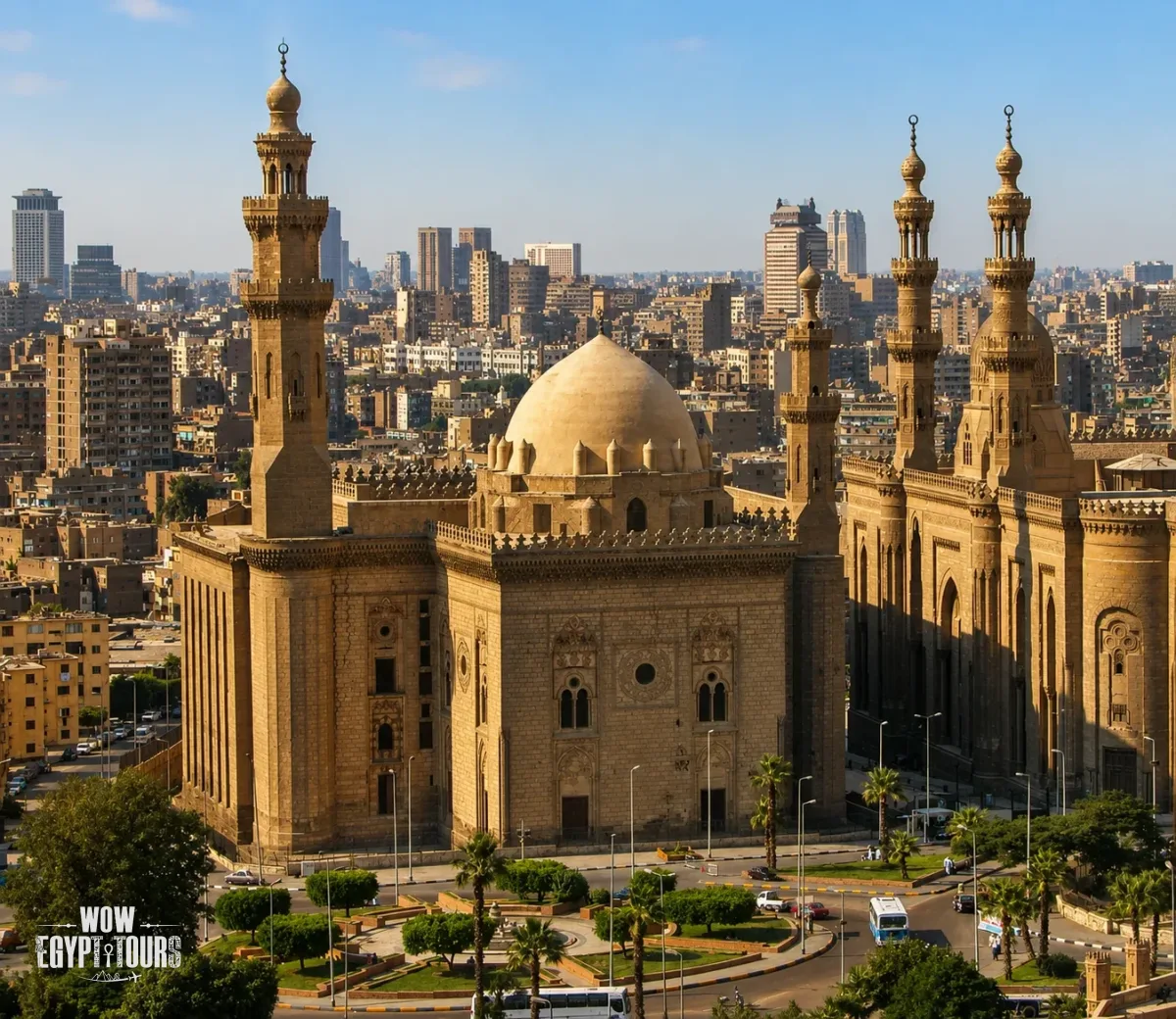

The Mosque and Madrasa of Sultan Hassan is the most magnificent, the most architecturally extraordinary, and by universal critical agreement the most sublime masterpiece of medieval Islamic architecture in Egypt and one of the greatest buildings of the medieval Islamic world, a monument of such completely overwhelming physical scale, such completely extraordinary spatial drama, and such completely unparalleled quality of architectural conception and architectural execution that it stands in the complete heritage record of the Islamic architectural tradition in the same position of supreme individual achievement that the Great Pyramid of Khufu occupies in the complete heritage record of the ancient Egyptian architectural tradition, the building that every serious student of Islamic architecture must encounter directly to understand what the Islamic architectural tradition at its most ambitious and its most completely realized is capable of achieving. Built between 1356 and 1363 CE under the patronage of the Mamluk Sultan Hassan ibn Muhammad ibn Qalawun in a location immediately below the Saladin Citadel on the slope of the Muqattam hill overlooking the complete historic Islamic Cairo quarter, the Sultan Hassan Mosque combines in a single building of approximately 7,900 square meters of total floor area the most ambitious spatial programme, the most dramatic structural engineering, the most refined decorative achievement, and the most complete expression of the specifically Mamluk architectural synthesis of earlier Islamic architectural traditions that any single medieval Islamic building in Egypt or in the complete African and Middle Eastern world has ever achieved in the combined force of a single monument whose individual qualities each represent the supreme expression of their specific category in the complete medieval Egyptian Islamic building tradition. This extraordinary monument is featured in Cairo Tours, Egypt Classic Tours, and Egypt Short Break Tours, all of which WOW Egypt Tours proudly offers to travelers from around the world as part of Egypt Tours Packages and Egypt Travel Packages that encompass the extraordinary Islamic and ancient heritage of Cairo and the complete Egyptian Nile Valley civilization.
The Sultan Hassan Mosque Cairo occupies a position in the architectural heritage of medieval Islam that is genuinely without parallel in the complete Egyptian Islamic building tradition, a position whose specific character of supreme architectural achievement is not a matter of subjective aesthetic preference but of objective scholarly consensus across more than six centuries of critical engagement with the monument from the earliest medieval Islamic architectural writers who visited and described it in terms of unstinting admiration through the modern generations of architectural historians, Islamic art scholars, and heritage professionals whose sustained scholarly investigation of the monument has only deepened and enriched the understanding of the specific architectural qualities that give the Sultan Hassan Mosque its most fundamental and its most personally affecting character as the building in which the Mamluk architectural tradition reached its absolute apex of spatial ambition, structural boldness, decorative refinement, and architectural synthesis in the most completely realized and the most personally overwhelming single monument available at any accessible Islamic heritage site in the complete Egyptian architectural landscape. The specific combination of the monumental facade, the extraordinary entrance portal, the cruciform interior courtyard, the four colossal iwans, the soaring domes of the four madrasa wings, the extraordinary marble and stucco decorative programme, and the position of the building in immediate visual relationship with the Citadel above and the complete Cairo Islamic heritage district below gives the Sultan Hassan Mosque a quality of architectural grandeur and personal architectural impact that is simply unavailable at any other accessible Islamic heritage monument in the complete Egyptian capital. WOW Egypt Tours includes the Sultan Hassan Mosque as an essential cultural heritage destination in all comprehensive Cairo Tours, Egypt Classic Tours, Egypt Short Break Tours, Egypt Family Tours, Egypt Budget Tours, and all Egypt Tour Packages that encompass the extraordinary Islamic heritage of the Egyptian capital.

What Is The Sultan Hassan Mosque?
The Mosque and Madrasa of Sultan Hassan is a combined congregational mosque and multi-school religious educational complex of the specifically Mamluk architectural institution type known as the sultan complex, built between 1356 and 1363 CE in the Rumayla Square district at the foot of the Muqattam hill immediately below the Saladin Citadel in the most strategically significant and the most architecturally commanding location available to any single building project in the complete medieval Islamic Cairo urban landscape. The building's total floor area of approximately 7,900 square meters on a plot of approximately 150 meters by 68 meters makes it the largest religious building in the complete Mamluk Cairo architectural heritage and one of the largest medieval Islamic religious buildings accessible to visitors at any heritage site in the complete African and Middle Eastern world, its specific scale exceeding any comparable Mamluk religious building in Cairo and giving its spatial programme a quality of physical grandeur and personal architectural overwhelm that is simply unavailable at any other accessible medieval Islamic monument in the complete Egyptian capital.
The Sultan Hassan complex combines in a single architectural programme four madrasas for the four schools of Sunni Islamic jurisprudence, the Hanafi, Maliki, Shafi'i, and Hanbali schools whose simultaneous institutional presence within a single building complex makes the Sultan Hassan the most institutionally complete and the most intellectually comprehensive Islamic educational establishment erected in the complete Mamluk period of Egyptian Islamic history, together with a congregational mosque of extraordinary scale and extraordinary spatial quality whose cruciform courtyard with four colossal iwans represents the most ambitious and the most completely realized expression of the specifically Mamluk cruciform mosque plan in its most perfectly resolved and most personally affecting architectural form, a mausoleum for the Sultan himself located behind the qibla wall of the mosque in the most sacred and the most architecturally privileged position available within the complete building programme, and a complete range of service and residential facilities for the educational and religious institutional programme including student residential cells, academic libraries, service facilities, a hospital, and the complete administrative infrastructure required to support the most ambitious single Islamic educational institution established by any Mamluk patron in the complete history of the Mamluk sultanate.
Who Built The Sultan Hassan Mosque?
The Sultan Hassan Mosque was built by and for the Mamluk Sultan Hassan ibn Muhammad ibn Qalawun, the ninth sultan of the Bahri Mamluk line and the son of the extraordinary Sultan Muhammad ibn Qalawun whose three-part sultanate of extraordinary political complexity and extraordinary cultural productivity gave the mid-Mamluk period its most celebrated and its most personally compelling royal biography. Sultan Hassan reigned in two separate periods, first from 1347 to 1351 CE and then again from 1354 to 1361 CE, both reigns characterized by the extraordinary personal political vulnerability of a young sultan surrounded by the most powerful and the most factionally ambitious Mamluk military aristocracy in the complete history of the Mamluk sultanate, whose specific political instability gave Hassan's two reigns a character of remarkable personal drama and remarkable personal danger that makes the extraordinary architectural achievement of the Sultan Hassan Mosque all the more personally extraordinary when understood in the context of the specific political conditions under which its patron commissioned and oversaw its construction. The Sultan Hassan Mosque was begun in 1356 CE at the beginning of Hassan's second reign and was not quite complete at the time of Hassan's assassination in 1361 CE, its mausoleum dome and certain finishing details of the decorative programme remaining incomplete when the young sultan was killed by his own Mamluk military commanders in one of the most violent and the most personally dramatic political assassinations in the complete history of the Mamluk sultanate, giving the Sultan Hassan Mosque its most poignant single biographical narrative: the most magnificent building in the complete medieval Egyptian Islamic architectural heritage was built by a young sultan who never saw it completed and who was buried in his own mausoleum within the building, his body placed in the tomb chamber that was specifically designed to receive it but whose completion was left to the sultanate that had already killed him.
The specific identity of the architect who designed the Sultan Hassan Mosque is not definitively established in the available documentary record of the complete Mamluk architectural heritage, a lacuna in the historical record that is common to most major medieval Islamic architectural achievements whose specific attribution to named individual architects is complicated by the Islamic architectural tradition's tendency to attribute buildings to their royal patrons rather than their professional designers. The most commonly cited candidate for the Sultan Hassan Mosque's primary architect is a figure named Muhammad ibn Balik al-Mihmandar, identified in some medieval sources as the master architect responsible for the Sultan Hassan complex, but the specific documentary basis for this attribution is not sufficiently complete or sufficiently unambiguous to allow a confident assertion of individual architectural authorship of the quality that the monument's supreme architectural achievement would most naturally inspire one to seek.
Sultan Hassan: The Patron And The Political Drama
Sultan Hassan's personal biography is one of the most dramatically compelling and the most personally extraordinary royal narratives in the complete history of the Mamluk sultanate, a biography whose central paradox of supreme architectural achievement combined with political weakness and ultimately political assassination gives the Sultan Hassan Mosque its most humanly affecting and its most personally resonant historical dimension, the specific quality of an extraordinary monument built by a sultan whose personal power was limited, whose political position was precarious, and whose ultimate fate was violent death at the hands of the military commanders whose institutional authority consistently exceeded his own in the specific political dynamics of the Mamluk sultanate system. Hassan came to the throne for the first time in 1347 CE at the age of approximately thirteen, a young prince thrust into the most demanding political position in the complete Mamluk system whose specific institutional requirement of commanding the loyalty of the most independently powerful and the most personally ambitious military aristocracy in the medieval Islamic world was simply beyond the capacity of a child sultan whose personal authority and personal experience were inadequate to the institutional demands of the sultanate he nominally headed.
Hassan's commission of the Sultan Hassan Mosque at the beginning of his second reign in 1356 CE, when he was approximately twenty-two years old and had already survived the deposal and the reinstallation that gave his sultanate its extraordinarily complex two-part structure, represents the most extraordinary single act of architectural patronage in the complete Mamluk sultanate's history, a commission whose specific scale and specific ambition exceeded any comparable royal architectural commission in the complete medieval Islamic Cairo heritage record and whose specific combination of spiritual, educational, and funerary programme gave the building its most complete and its most personally meaningful institutional identity as simultaneously a monument to the glory of Islam, a comprehensive educational institution for the most complete available expression of the Sunni Islamic scholarly tradition, and the Sultan's own eternal funerary monument, all combined in the single most architecturally extraordinary building that any Mamluk sultan would ever commission in the complete history of the sultanate. The specific political motivation for commissioning a building of such completely extraordinary scale and such completely unprecedented ambition from a position of relative political weakness has been variously interpreted by scholars of the Mamluk period as an assertion of royal prestige and royal authority against the institutional power of the Mamluk military commanders, as an act of personal piety and personal religious commitment by a sultan whose specific Islamic theological orientation gave his cultural patronage its most deeply religious character, and as a political strategy of resource expenditure that directed the vast revenue accumulation of the Mamluk treasury toward architectural achievement rather than military investment in a moment when the specific political dynamics of the sultanate made military investment a less immediately productive assertion of royal authority than architectural magnificence.
Sultan Hassan Mosque Location
The Sultan Hassan Mosque is located in the Rumayla Square district at the foot of the Muqattam hill in the historic Islamic Cairo area, immediately below the massive walls of the Saladin Citadel whose imposing medieval fortification walls rise directly above the mosque's northern facade and whose specific visual relationship with the Sultan Hassan building creates the single most spectacular urban architectural composition of any two adjacent buildings in the complete Cairo Islamic heritage landscape, the extraordinary height of the mosque's minarets and its massive stone walls mediating the dramatic visual transition between the medieval fortification of the Citadel above and the complete historic Islamic Cairo quarter spreading below. The mosque is accessible from the El Moez Street and Khan El Khalili heritage district by approximately 15 to 20 minutes by private vehicle or taxi, from central Cairo by approximately 20 to 25 minutes by private vehicle, and is most naturally visited in combination with the immediately adjacent al-Rifa'i Mosque, the Saladin Citadel above, and the Muhammad Ali Mosque within the Citadel in the most comprehensive and the most personally satisfying single-day Islamic Cairo southern heritage programme organized by WOW Egypt Tours.
Sultan Hassan Mosque Fun Facts
The Sultan Hassan Mosque's minarets, two of which survive from the original construction programme with a third partially restored, are the tallest medieval Islamic minarets in the complete Egyptian architectural heritage, with the surviving southern minaret rising to approximately 68 meters above the ground level, a height that exceeds the contemporary height of all other medieval Islamic minarets in the complete Cairo Islamic heritage district and that gave the Sultan Hassan Mosque's original four-minaret silhouette the most dramatic and the most immediately personally overwhelming medieval Islamic skyline presence of any single building in the complete medieval Cairo urban landscape. The specific structural feat of raising four minarets of this height on the corners of a building of the Sultan Hassan's enormous scale, in the specific geological and geotechnical conditions of the Mamluk-era Rumayla district's filled terrain immediately below the Citadel's Muqattam hill, represents one of the most extraordinary structural engineering achievements of the complete medieval Islamic architectural tradition in Egypt and one whose specific technical difficulty gives the Mamluk architects responsible for its realization their most compelling and their most permanently impressive claim to structural engineering mastery of the highest available medieval Islamic standard.
The resources that funded the construction of the Sultan Hassan Mosque included the vast treasury of the estates confiscated from plague victims who died during the Black Death pandemic of 1348 CE, the most devastating epidemic in the complete medieval Islamic world whose specific mortality in Egypt eliminated between one third and one half of the total Egyptian population in a single epidemic episode and whose specific economic consequence of the mass intestate death of property owners and merchants throughout the Egyptian economy deposited unprecedented quantities of confiscated estate value into the Egyptian royal treasury whose subsequent availability for royal expenditure made the specifically extraordinary financial scale of the Sultan Hassan construction programme economically possible in a way that the normal operating revenues of the Mamluk sultanate would not have been sufficient to support. The specific connection between the Black Death's catastrophic human mortality and the extraordinary architectural achievement of the Sultan Hassan Mosque gives the monument a dimension of historical tragic irony of the most personally affecting character: the most magnificent medieval Islamic building in Egypt was made financially possible by the most devastating pandemic in medieval Islamic history, the deaths of hundreds of thousands of Egyptians providing through the confiscation of their intestate estates the specific financial resources that funded the architectural achievement whose extraordinary quality has astonished and inspired every generation of heritage visitors since its completion in approximately 1363 CE.
The Sultan Hassan Mosque's entrance portal, whose total height of approximately 38 meters from the ground level to the apex of its carved stone stalactite muqarnas canopy makes it the tallest single portal in the complete medieval Islamic architectural heritage of Egypt and one of the tallest medieval Islamic entrance portals accessible at any heritage site in the complete African and Middle Eastern world, is the most immediately and the most personally overwhelming single architectural element of the complete Sultan Hassan building's exterior programme, a carved stone doorway composition of such completely extraordinary scale, such completely extraordinary decorative refinement, and such completely extraordinary spatial drama that its direct encounter by the approaching visitor creates one of the most personally extraordinary and the most completely unforgettable single architectural approach experiences available at any heritage monument in the complete Egyptian Islamic heritage landscape.
Why Is It Called The Sultan Hassan Mosque?
The Sultan Hassan Mosque carries the name of its royal patron, the Mamluk Sultan Hassan ibn Muhammad ibn Qalawun, in the standard Islamic architectural naming convention that attributed the monument to its royal patron as the primary historical actor whose political authority and financial resources made the architectural achievement possible, rather than to the architect whose professional genius conceived and realized the architectural programme or to the building's primary institutional function in the standard Western architectural naming convention that tends to identify religious buildings by their primary liturgical use rather than their patronage context. The designation Mosque is the primary institutional identifier in the standard English-language heritage tourism vocabulary, though the building's complete institutional programme as a combined mosque and four-school madrasa complex makes the fuller designation Mosque and Madrasa of Sultan Hassan both institutionally more accurate and architecturally more informative in the specific scholarly and heritage contexts where the precise institutional character of the building requires the most complete available descriptive identification. In Egyptian Arabic colloquial usage the building is most commonly referred to simply as Jami Sultan Hassan, literally the Congregational Mosque of Sultan Hassan, whose specific designation as a jami rather than a masjid reflects the building's institutional character as a Friday congregational mosque of the most formally complete and the most spatially comprehensive type in the Islamic mosque architectural tradition, whose specific liturgical requirements for a fully enclosed courtyard, a large prayer hall, a formal minbar for the Friday sermon, and a mausoleum for the building's patron give the Sultan Hassan Mosque its most specific and its most institutionally complete architectural programme of any single medieval Islamic religious building in the complete Mamluk Cairo architectural heritage.
Sultan Hassan Mosque History
The history of the Sultan Hassan Mosque from its construction between 1356 and 1363 CE through the extraordinary political dramas of the Mamluk period, the Ottoman conquest of Egypt in 1517, the Napoleonic occupation of 1798 to 1801 and its specific military exploitation of the building's commanding strategic position, the 19th century heritage conservation awakening under the Comité de Conservation des Monuments de l'Art Arabe, and the modern era of systematic archaeological investigation and architectural conservation gives the monument an institutional biography of extraordinary variety and extraordinary personal historical consequence whose most dramatic individual moments include the assassination of Sultan Hassan himself in 1361 CE before the building's completion, the specific use of the building as a military fortification by successive political factions in the violent political struggles of the late Mamluk and early Ottoman periods, and the extraordinary incident of Napoleon's troops firing artillery shells at the Citadel from the Sultan Hassan roof during the Egyptian campaign of 1798 whose specific military exploitation of the building's commanding position overlooking the Citadel gives the mosque its most directly personal connection to the history of the French military occupation of Egypt and its most specifically non-Islamic historical chapter in the complete biography of a building whose primary institutional character is the most completely Islamic educational and religious monument in the complete medieval Cairo architectural heritage. The 1992 Cairo earthquake caused significant structural damage to certain elements of the building's fabric, initiating a comprehensive structural conservation and restoration programme whose ongoing implementation by the Egyptian Supreme Council of Antiquities in collaboration with international conservation science institutions represents the most important and the most consequential single heritage conservation investment directed at the Sultan Hassan Mosque in the complete modern history of Islamic Cairo heritage conservation.
The Story Of The Greatest Islamic Building In Egypt
The story of the Sultan Hassan Mosque as the greatest Islamic building in Egypt is simultaneously the story of the Mamluk architectural tradition at its absolute peak of achievement and the story of a young sultan's extraordinary personal ambition to create a monument that would outlast his own political vulnerability and his own inevitable personal mortality in the most permanently impressive and the most universally admired architectural form that the complete medieval Islamic building tradition could provide. Sultan Hassan's specific architectural vision, articulated in the building programme of a combined mosque, four-school madrasa, and royal mausoleum of unprecedented scale and unprecedented spatial ambition, represents the most complete and the most personally consequential expression of the Mamluk understanding of architecture as the primary vehicle of political legitimacy, religious authority, educational prestige, and personal immortality available in the complete medieval Islamic Egyptian cultural vocabulary, a building programme whose specific combination of functional completeness, spatial grandeur, and decorative excellence gave the Sultan Hassan Mosque from the moment of its completion in 1363 CE the quality of recognized supreme achievement that no subsequent Islamic architectural patron in the complete Egyptian architectural heritage has ever surpassed or equaled in the specific dimension of combined spatial, structural, and decorative excellence that gives the Sultan Hassan Mosque its most fundamental and its most enduring architectural reputation as the supreme masterpiece of the medieval Islamic architectural tradition in Egypt.
Sultan Hassan Mosque Key Attractions And Features
The Monumental Facade And The City Context
The exterior facade of the Sultan Hassan Mosque, whose massive limestone walls rise to approximately 36 meters at the highest point of the building's stone-built external envelope in the most imposing and the most personally overwhelming single medieval Islamic building facade accessible at any heritage site in the complete Egyptian Islamic architectural landscape, creates the most immediately dramatic and the most personally affecting first encounter with the building's extraordinary architectural presence that the complete historic Cairo Citadel area can offer, a wall of such completely extraordinary scale, such completely extraordinary quality of cut stone masonry, and such completely extraordinary visual dominance of the complete Rumayla Square urban space below the Citadel that every visitor who approaches it from the square in front of the building experiences the most immediate and the most completely direct encounter with the specifically Mamluk tradition of architectural monumentality at its most ambitious and its most completely realized physical expression. The facade's specific composition of the massive unornamented limestone wall surface interrupted by the extraordinary carved stone entrance portal and the surviving southern minaret creates an architectural language of dramatic contrast between the plain and the elaborately decorated, between the vast and the precisely detailed, that gives the Sultan Hassan facade its most distinctive and its most personally affecting visual character in the complete sequence of medieval Islamic building facades accessible to visitors at any heritage destination in the complete Egyptian Islamic architectural landscape.
The Entrance Portal
The entrance portal of the Sultan Hassan Mosque, rising to approximately 38 meters from the ground level at the apex of its extraordinary carved stone stalactite muqarnas canopy, is the most immediately and the most completely overwhelming single architectural element of the building's complete exterior programme and the single most spectacular medieval Islamic architectural portal accessible at any heritage monument in the complete Egyptian Islamic architectural heritage, a doorway composition of such completely extraordinary scale, such completely extraordinary decorative ambition, and such completely extraordinary quality of execution in the most refined and the most technically demanding medium of carved stone muqarnas work that its direct approach and its direct encounter by the visitor constitute one of the most personally extraordinary and the most completely unforgettable single architectural experiences available at any accessible heritage monument in the complete Egyptian capital. The portal's specific architectural composition, a deeply recessed pointed arched niche of approximately 25 to 30 meters in depth framed by the massive limestone wall of the facade on both sides and surmounted by the extraordinary stalactite muqarnas canopy whose individual carved stone elements are assembled in the most complex and the most completely realized decorative architectural programme of any single element of the complete Sultan Hassan building, gives the entrance portal a quality of spatial and decorative achievement that is genuinely without parallel at any accessible medieval Islamic monument in the complete Egyptian architectural heritage and that gives every visitor who passes beneath it into the building's interior the most immediate and the most completely affecting transition experience from the exterior monumentality of the building's massive stone walls to the extraordinary interior spatial programme of the cruciform courtyard and the four colossal iwans that constitute the building's primary interior architecture.
The Vestibule And The Transitional Space
The extraordinary vestibule space between the main entrance portal and the cruciform courtyard of the Sultan Hassan interior, a transitional zone of remarkable architectural sophistication whose specific spatial character of progressive dimensional compression and progressive change of direction from the street approach to the building interior creates the most carefully orchestrated architectural promenade sequence of any accessible medieval Islamic building interior in the complete Egyptian Islamic heritage landscape, gives the complete interior experience its most carefully staged and its most personally affecting architectural introduction, preparing the visitor through a controlled sequence of spatial compression and directional change for the most complete and the most personally overwhelming spatial revelation that the complete Sultan Hassan interior can provide, the moment of entry into the cruciform courtyard whose extraordinary scale, whose soaring iwan vaults, and whose overwhelming quality of spatial grandeur create the most personally extraordinary and the most completely unforgettable single interior spatial experience available at any accessible medieval Islamic monument in the complete Egyptian capital. The vestibule's architectural character of deliberate spatial staging, in which the visitor's approach to the extraordinary interior is organized through a sequence of transitional spaces that progressively heighten the anticipation and the perceptual readiness for the interior spatial revelation, represents the most sophisticated and the most personally effective application of the Islamic architectural promenade principle to the approach to a major mosque interior available at any accessible medieval Islamic monument in the complete Egyptian Islamic architectural heritage.
The Cruciform Courtyard And The Four Iwans
The cruciform courtyard of the Sultan Hassan Mosque, the building's primary interior space whose organization around a central open courtyard with a marble-lined ablution fountain at its center and four colossal pointed-arch iwan openings on each of its four sides in the most completely and the most perfectly realized example of the cruciform mosque plan in the complete Mamluk architectural heritage, is the most extraordinary and the most personally overwhelming medieval Islamic interior architectural space accessible at any heritage monument in the complete Egyptian Islamic architectural landscape, a space of such completely extraordinary scale, such completely extraordinary spatial drama, and such completely extraordinary quality of architectural conception and architectural execution that its encounter by the visitor who enters from the vestibule after the carefully staged approach produces one of the most genuinely astonishing and the most completely personally overwhelming single architectural spatial experiences available at any accessible heritage monument in the complete African and Middle Eastern world. The four iwans, the great vaulted halls opening off each side of the central courtyard whose colossal pointed arch opening height of approximately 22 meters creates the most immediately and the most completely personally overwhelming vertical dimension of any accessible medieval Islamic interior in the complete Egyptian heritage landscape, achieve in their specific combination of scale, structural boldness, and spatial drama the most complete and the most personally affecting expression of the specifically Mamluk architectural tradition's ambition to create interior spaces of genuinely overwhelming vertical grandeur whose specific architectural effect on the individual visitor is that of total immersion in a spatial environment whose scale exceeds the comfortable cognitive grasp of the individual human body in the most complete and the most personally affecting way available at any accessible heritage monument interior in the complete Egyptian Islamic architectural heritage.
The Qibla Iwan And The Prayer Hall
The qibla iwan of the Sultan Hassan Mosque, the largest of the four cruciform courtyard iwans whose specific orientation toward Mecca gives it its primary liturgical function as the prayer hall of the building's congregational mosque programme, is the most spatially imposing and the most decoratively elaborated of the four iwan spaces, its colossal pointed arch of approximately 22 meters in height opening onto an interior prayer space of extraordinary depth and extraordinary decorative richness whose specific combination of the coloured marble revetment panels of the qibla wall, the extraordinary carved and gilded stucco medallions of the ceiling and the upper wall decoration, the beautiful mihrab niche of coloured marble with its extraordinary geometric and arabesque relief carving programme, the magnificent carved marble minbar pulpit with its extraordinarily refined joinery detail, and the complete range of the building's most concentrated and the most elaborate decorative programme in the space that the Friday preacher addresses and that the community of worshippers faces in prayer creates the single most completely and the most personally affecting medieval Islamic liturgical interior space accessible at any heritage monument in the complete Egyptian Islamic architectural landscape. The qibla iwan's decorative programme, concentrated with the greatest density and the greatest variety of the Sultan Hassan building's extraordinary decorative achievement in the most liturgically significant space of the complete building programme, gives the prayer hall a quality of sacred interior atmospheric beauty and personal spiritual aesthetic impact whose specific combination of scale, material richness, and decorative refinement is simply unmatched at any comparable medieval Islamic prayer hall interior accessible to visitors at any heritage monument in the complete Egyptian capital.
The Mausoleum Of Sultan Hassan
The mausoleum of Sultan Hassan, located in the most sacred and the most architecturally privileged position of the complete building programme immediately behind the qibla wall of the prayer hall, is accessible from the exterior of the building through a separate entrance on the building's eastern face and provides the most dramatically intimate and the most personally affecting single interior space experience of the complete Sultan Hassan building programme, a domed chamber of extraordinary spatial quality and extraordinary decorative richness whose soaring dome of approximately 21 meters in diameter, raised on its drum above the carved stucco zone of transition in the most completely realized Mamluk dome architecture of the complete building, and whose interior decorative programme of coloured marble revetment and carved stucco of exceptional refinement and exceptional completeness gives the mausoleum chamber a quality of sacred architectural beauty and personal atmospheric impact whose specific combination of the dome's soaring height, the chamber's intimate human-scale proportions, and the extraordinary decorative richness of the marble and stucco surfaces creates the most completely extraordinary and the most personally affecting single sacred interior space available at any accessible medieval Islamic mausoleum monument in the complete Egyptian Islamic heritage landscape. The specific historical poignancy of the mausoleum as the chamber specifically built to receive the Sultan Hassan's own burial while the building remained unfinished at his assassination in 1361 CE gives the space its most personally resonant and its most directly humanly affecting heritage dimension, the specific awareness that the extraordinary architectural environment of the mausoleum chamber was experienced by its patron only in the form of its partial construction and was brought to its full completed condition only after the patron's violent death gave the completed programme its most poignant personal significance.
The Four Madrasa Wings
The four madrasa wings of the Sultan Hassan complex, one for each of the four schools of Sunni Islamic jurisprudence, are arranged around the four corners of the cruciform courtyard in a spatial organization whose specific architectural ingenuity of fitting four complete madrasa programmes of student residential cells, teaching spaces, and service facilities into the four triangular zones between the four iwan projections of the cruciform plan represents the most architecturally sophisticated and the most spatially efficient single solution to the challenge of combining four complete institutional programmes within a single unified building complex that any medieval Islamic architect in the complete Egyptian architectural heritage achieved. The student residential cells of each madrasa wing, arranged in multiple stories around the perimeter of each wing's private courtyard above the ground-floor teaching spaces, whose specific number of approximately 160 total residential cells accommodating the complete student population of all four madrasa schools gives the Sultan Hassan complex the most comprehensive single-site residential educational programme of any Mamluk educational institution in the complete Cairo Islamic heritage landscape, create the most intimate and the most personally engaging dimension of the complete building's institutional programme, the specific architectural scale of the individual student cell whose modest human proportions contrast most directly and most personally with the overwhelming scale of the cruciform courtyard and the four colossal iwans giving every visitor who explores the madrasa wings the most complete and the most personally affecting understanding of the specific human scale at which the ancient educational institution's daily life was actually lived within the extraordinary architectural setting of the Sultan Hassan complex.
The Decorative Programme: Marble, Stucco, And Bronze
The complete decorative programme of the Sultan Hassan Mosque, encompassing the coloured marble revetment of the qibla wall and the mausoleum chamber in the most refined and the most completely realized geometric and organic pattern programme of any Mamluk marble decoration accessible at any heritage monument in the complete Cairo Islamic heritage landscape, the carved and gilded stucco medallions and arabesques of the ceiling and upper wall decoration in the most elaborate and the most technically demanding stucco decorative programme of any accessible medieval Islamic monument in Egypt, the extraordinary bronze entrance doors with their extraordinary keel-arch frame whose specific technical mastery of the Mamluk decorative metalwork tradition gives the Sultan Hassan Mosque its most distinguished and its most internationally celebrated single decorative object in the complete heritage record of the medieval Islamic decorative arts, and the complete range of calligraphic bands and geometric ornamental programmes that integrate the diverse decorative media of the building into the most completely unified and the most personally overwhelming single decorative achievement of any accessible medieval Islamic monument in the complete Egyptian Islamic architectural heritage, represents the most comprehensive and the most completely extraordinary decorative programme realized in a single medieval Islamic building in Egypt and one of the most completely extraordinary decorative achievements of the complete medieval Islamic decorative arts tradition accessible at any heritage monument in the complete African and Middle Eastern world.
Why Is The Sultan Hassan Mosque Important?
The Sultan Hassan Mosque is important for reasons spanning the architectural history of the medieval Islamic tradition in Egypt and the broader Islamic world, the specific royal biography of Sultan Hassan and the extraordinary political context of its commission, the structural engineering achievement of the medieval Islamic master builders whose specific technical accomplishment in constructing the building's extraordinary spatial programme without any modern engineering tools or computational design methods represents one of the most extraordinary feats of structural intuition and structural mastery in the complete history of medieval construction, the decorative arts achievement of the complete building's marble, stucco, and metalwork programme, and the broader cultural significance of the building as the supreme surviving monument of the Mamluk architectural tradition whose extraordinary 267-year contribution to the Islamic architectural heritage of Egypt is most completely and most personally accessible at this single extraordinary building. As an architectural monument, the Sultan Hassan Mosque is universally recognized by every scholarly tradition of architectural history that has engaged with it as the supreme masterpiece of the medieval Islamic architectural tradition in Egypt, a distinction whose specific basis in the objective qualities of the building's spatial programme, structural achievement, and decorative excellence gives it a scholarly authority and a scholarly consensus of critical recognition that is simply unavailable to any other claim of architectural supremacy in the complete Egyptian Islamic heritage landscape. WOW Egypt Tours includes the Sultan Hassan Mosque as an essential destination in all comprehensive Cairo Tours, Egypt Classic Tours, and all Egypt Tour Packages encompassing the extraordinary Islamic heritage of the Egyptian capital.
What Are Some Interesting Facts About The Sultan Hassan Mosque?
Built From Black Death Money
The extraordinary financial resources that made the Sultan Hassan Mosque's unprecedented construction programme economically possible came primarily from the confiscated estates of the hundreds of thousands of Egyptians who died intestate during the Black Death pandemic of 1348 CE, the most catastrophic epidemic in the complete medieval Islamic history of Egypt whose specific mortality of between one third and one half of the total Egyptian population in a single epidemic episode deposited unprecedented quantities of confiscated estate revenue into the royal treasury whose availability for royal expenditure made the specific financial scale of the Sultan Hassan construction programme economically feasible. The specific connection between the medieval pandemic's human tragedy and the architectural masterpiece of the following decade gives the Sultan Hassan Mosque its most sobering and its most personally affecting historical dimension, the specific knowledge that the building's extraordinary architectural achievement was funded by the deaths of hundreds of thousands of people whose intestate estates provided the financial resources for the most magnificent building in the complete medieval Egyptian Islamic architectural heritage, giving the monument a dimension of human historical tragedy and architectural redemption whose specific poignancy is unlike anything available at any other accessible medieval Islamic building in the complete Egyptian heritage landscape.
The Patron Never Saw It Finished
Sultan Hassan was assassinated by his own Mamluk military commanders in 1361 CE, approximately two years before the building's completion in approximately 1363 CE, making the Sultan Hassan Mosque the most personally poignant architectural masterpiece in the complete Egyptian Islamic heritage record: the most magnificent building in the complete medieval Egyptian Islamic architectural heritage was built by a young sultan whose political weakness made his assassination inevitable and who was buried in his own mausoleum within the building whose completion he never witnessed. The specific historical irony of the situation, in which the extraordinary architectural monument that was specifically designed to celebrate and to commemorate the Sultan's power, piety, and cultural magnificence was completed only after the Sultan's violent death made his personal cultural magnificence politically irrelevant, gives the Sultan Hassan Mosque a dimension of personal historical tragedy and personal historical grandeur that is simply unavailable at any other accessible medieval Islamic monument in the complete Egyptian capital and that gives every visitor who knows this specific historical context the most personally affecting and the most completely humanly extraordinary engagement with the building's heritage significance available at any accessible medieval Islamic monument in the complete Egyptian Islamic architectural landscape.
Napoleon Fired Artillery From Its Roof
During the French military occupation of Egypt from 1798 to 1801, Napoleon's military engineers recognized the extraordinary strategic value of the Sultan Hassan Mosque's commanding position immediately below the Saladin Citadel and used the building's massive roof as a military artillery platform from which French troops fired cannon balls at the Citadel's fortifications during the military operations of the Egyptian campaign. The specific use of the most magnificent medieval Islamic building in Egypt as a military artillery platform by the Napoleonic army represents one of the most extraordinary and the most personally dramatic episodes of inappropriate military exploitation of a heritage monument in the complete modern history of the Egyptian Islamic built environment, and the cannon balls fired from the Sultan Hassan roof at the Citadel walls left physical traces in the Citadel fabric that are still visible to the attentive visitor at the specific impact points on the Citadel wall surface that face the Sultan Hassan Mosque position, creating the most direct and the most physically immediately legible historical connection between the Sultan Hassan Mosque and the Napoleonic period of Egyptian history available at any accessible point in the complete Islamic Cairo heritage landscape.
What Is So Special About The Sultan Hassan Mosque?
The Supreme Masterpiece Of Medieval Islamic Architecture In Egypt
What makes the Sultan Hassan Mosque uniquely and incomparably special in the complete Egyptian Islamic heritage landscape is the extraordinary combination of spatial grandeur, structural boldness, decorative excellence, institutional completeness, and personal historical drama that gives it a quality of total architectural achievement simply unavailable at any other accessible medieval Islamic monument in the complete Egyptian capital. The specific quality of standing in the cruciform courtyard of the Sultan Hassan Mosque and experiencing directly the overwhelming vertical scale of the four colossal iwan vaults rising approximately 22 meters above the courtyard floor, the complete spatial enclosure of the four iwan walls creating the most perfectly realized sense of sheltered interior grandeur within an open sky courtyard, the extraordinary decorative richness of the surrounding marble and stucco surfaces in the most refined and the most completely realized medieval Islamic decorative programme accessible at any monument interior in the complete Egyptian heritage landscape, and the specific historical awareness of being in the building that every scholarly tradition of architectural history has recognized as the supreme masterpiece of the medieval Islamic tradition in Egypt, together create a quality of personal architectural overwhelm and personal heritage impact that is genuinely without parallel at any other accessible heritage destination in the complete Egyptian capital.
Where Medieval Islamic Architecture Reached Its Egyptian Apex
The Sultan Hassan Mosque is also uniquely special for the specific historical position it occupies in the complete narrative of Islamic architectural history, the building in which the Mamluk architectural tradition of Egypt reached its absolute apex of architectural achievement in the single most concentrated and the most personally powerful expression of everything that the medieval Islamic Egyptian building tradition had learned, developed, and refined across the two centuries of Mamluk patronage from the earliest Mamluk buildings of the mid-13th century to the extraordinary mid-14th century moment of the Sultan Hassan commission whose specific combination of spatial ambition, structural mastery, and decorative excellence exceeded everything that had been attempted before it in the complete Egyptian Islamic architectural heritage and defined the standard against which every subsequent medieval and early modern Islamic building in Egypt would be measured and found wanting in at least one of the specific dimensions of architectural excellence in which the Sultan Hassan is simply without peer in the complete heritage record of the Egyptian Islamic architectural tradition.
The Sultan Hassan Mosque Through The Ages
The complete narrative of the Sultan Hassan Mosque from Sultan Hassan's commission in 1356 CE and the building's construction over seven years through the Sultan's assassination in 1361 CE before completion, the building's completion by the subsequent Mamluk administration, the Ottoman conquest of 1517 and the Ottoman period's use and maintenance of the building as the most important Friday mosque of the southern Cairo historic district, the Napoleonic military exploitation of 1798 to 1801, the 19th century heritage conservation awakening under the Comité de Conservation des Monuments de l'Art Arabe, the 1992 earthquake damage and the subsequent conservation programme, and the ongoing modern archaeological investigation and architectural conservation of the complete building traces a monument biography of extraordinary variety and extraordinary personal historical consequence whose most dramatic and most personally affecting moments encompass the complete spectrum of human engagement with one of the world's greatest buildings from the most violent political assassination of its patron to the most sophisticated modern scientific conservation programme directed at preserving its extraordinary architectural fabric for all future generations of heritage visitors and scholars.
The Sultan Hassan Mosque And UNESCO
The Sultan Hassan Mosque is protected as the primary single-building heritage component of the UNESCO World Heritage Site designated in 1979 as Historic Cairo, recognized as a heritage of outstanding universal value for the extraordinary concentration of Islamic heritage in the historic core of Cairo that includes the Sultan Hassan Mosque as its most architecturally significant and its most universally admired individual medieval Islamic building. The UNESCO inscription specifically identifies the Sultan Hassan Mosque as an exemplar of the outstanding universal value of the complete historic Islamic Cairo heritage zone, the single building whose specific quality of architectural achievement most completely and most personally embodies the claimed heritage significance of the complete Historic Cairo World Heritage designation. The Egyptian government and the UNESCO World Heritage Committee are engaged in ongoing collaboration on the conservation management of the Sultan Hassan Mosque, addressing the specific conservation challenges of a massive medieval limestone building whose structural fabric requires the most sophisticated and the most carefully managed conservation engineering intervention programme of any individual Islamic monument in the complete Egyptian heritage conservation landscape.
Best Time To Visit The Sultan Hassan Mosque
The best time to visit the Sultan Hassan Mosque is during the cooler months from October through April when the Cairo climate provides the most comfortable conditions for the complete exterior circumnavigation, the approach to the monumental facade, and the extended interior exploration of the cruciform courtyard, the four iwan spaces, and the mausoleum chamber. The morning hours from approximately 9:00 AM to noon provide the most extraordinary natural light quality in the cruciform courtyard, whose specific orientation and whose specific skylight opening through the courtyard's open ceiling gives the morning eastern sunlight entry into the courtyard's eastern iwan in the most dramatically beautiful and the most personally affecting natural light composition of any time of the complete daily visiting cycle, illuminating the marble and stucco surfaces of the eastern iwan with a quality of directional natural light whose specific character of warm morning illumination across the polished stone surfaces creates the most completely extraordinary and the most personally affecting single interior natural light experience available at any accessible medieval Islamic monument in the complete Egyptian capital. The Friday mid-day visit from approximately 11:30 AM to 1:30 PM should be avoided during the Friday prayer period when the building is closed to non-Muslim visitors for the congregational prayer. WOW Egypt Tours advises on optimal timing within the complete Islamic Cairo southern heritage programme.
Sultan Hassan Mosque Opening Hours
The Sultan Hassan Mosque is open to visitors daily from 9:00 AM to 5:00 PM, with closure during Friday prayer from approximately 11:30 AM to 1:30 PM. The mausoleum chamber is accessible from the separate eastern entrance during regular visiting hours. All visiting hours are subject to adjustment for Islamic religious observances and special events, and current access arrangements should be confirmed at time of booking with WOW Egypt Tours.
Sultan Hassan Mosque Entrance Fees
Sultan Hassan Mosque: EGP 100 for adults, EGP 50 for students. The adjacent al-Rifa'i Mosque, whose combined visit with Sultan Hassan is the most naturally and the most practically organized combined heritage programme in the Rumayla Square area, has a separate admission fee of EGP 100 for adults, EGP 50 for students. All Sultan Hassan Mosque and adjacent monument entrance fees are included in the Cairo Tours and Egypt Tour Packages organized by WOW Egypt Tours. Fees are subject to periodic adjustment and current rates should be confirmed at time of booking.
How To Get To The Sultan Hassan Mosque
The Sultan Hassan Mosque is located in the Rumayla Square district at the foot of the Citadel hill, accessible from central Cairo by private vehicle in approximately 20 to 25 minutes, from the El Moez Street and Khan El Khalili heritage district by approximately 15 to 20 minutes by private vehicle, and from the Saladin Citadel above by descending the Citadel hill road in approximately 5 minutes by private vehicle. The private vehicle organized by WOW Egypt Tours provides the most practically efficient approach within the complete Islamic Cairo southern heritage programme combining the Sultan Hassan Mosque with the adjacent al-Rifa'i Mosque and the Saladin Citadel in the most completely satisfying and the most personally extraordinary single-site Islamic Cairo heritage day programme.
How Long To Spend At The Sultan Hassan Mosque
A minimum of one and a half to two hours at the Sultan Hassan Mosque is required for a programme that covers the complete exterior facade approach including the portal, the cruciform courtyard with the four iwan spaces, the prayer hall interior with the mihrab and minbar, the madrasa wing residential cell sections, and the mausoleum chamber, in the most complete and the most personally satisfying format available within a focused heritage monument visit. A more completely satisfying Sultan Hassan programme of two to two and a half hours allows the most unhurried and the most personally contemplative engagement with all the primary spaces of the building, the most complete guided explanation of the architectural programme including the specific spatial and decorative achievements of each component, and the most complete photographic coverage of the building's extraordinary interior in the most careful natural light conditions of any time of the morning visiting period. The Sultan Hassan Mosque is most naturally and most efficiently combined with the immediately adjacent al-Rifa'i Mosque and the Saladin Citadel above in the most comprehensive and the most personally extraordinary Islamic Cairo southern heritage day programme organized by WOW Egypt Tours.
Tips For Visiting The Sultan Hassan Mosque
Approach the Sultan Hassan Mosque from the Rumayla Square side for the most dramatic and the most completely personally affecting first encounter with the building's monumental facade, walking toward the building from the maximum available viewing distance in the square to experience the most complete and the most gradually overwhelming approach to the extraordinary carved stone portal whose specific visual impact builds most dramatically and most personally over the complete distance of the approach from the square. Ask your licensed guide from WOW Egypt Tours to tell the complete story of Sultan Hassan's political biography, his two reigns, his commission of the mosque from a position of relative weakness, and his assassination two years before the building's completion before entering the building, as the combination of the specific historical narrative with the direct physical encounter with the extraordinary building creates the most personal and the most completely affecting heritage experience of any accessible Islamic monument in the complete Egyptian capital. Stand at the center of the cruciform courtyard and look upward through the open sky to experience the most complete available sense of the extraordinary spatial programme whose combination of the open courtyard sky, the four iwan vaults rising to approximately 22 meters on all four sides, and the complete enclosure of the surrounding building walls creates the most completely extraordinary and the most personally affecting single interior spatial experience accessible at any medieval Islamic monument in the complete Egyptian capital. Visit the mausoleum chamber through its separate eastern entrance both before and after the main building interior visit, as the approach to the mausoleum from the exterior gives the chamber's extraordinary domed interior a quality of isolated sacred spatial beauty that complements the overwhelming architectural grandeur of the cruciform courtyard interior in the most complete and the most personally satisfying possible range of spatial experience available at the complete Sultan Hassan monument programme.
What To Wear At The Sultan Hassan Mosque
The Sultan Hassan Mosque is an active place of Islamic worship and the most important medieval congregational mosque in the complete Islamic Cairo southern heritage district, requiring modest clothing that covers the shoulders, arms, and knees for all visitors regardless of gender throughout the complete building visit. Women are required to cover their hair for entry into the mosque's interior spaces and may be provided with a head covering at the entrance if not bringing their own. Shoes must be removed before entering the main prayer hall and the mausoleum chamber, and comfortable socks or foot coverings that can be easily removed and replaced are strongly recommended as the most practically convenient approach to the multiple shoe removal requirements of a visit that encompasses both the prayer hall and the mausoleum chamber as separate entrance experiences. The building's interior spaces are not air-conditioned and can be warm in the summer months, making lightweight, breathable modest clothing the most practically comfortable choice for the summer visiting period. Comfortable walking shoes are recommended for the exterior approach and the complete circumnavigation of the building's exterior before entering through the monumental portal.
Photography At The Sultan Hassan Mosque
The Sultan Hassan Mosque provides the most architecturally extraordinary and the most personally distinctive Islamic heritage photography subjects of any accessible medieval Islamic monument in the complete Egyptian capital, encompassing the exterior approach and facade photography whose specific challenge of capturing the monumental scale of the building and the extraordinary detail of the entrance portal in a single composition gives the Sultan Hassan's exterior the most demanding and the most rewarding architectural photography challenge of any accessible Islamic monument facade in the complete Egyptian Islamic heritage landscape, the courtyard interior photography whose specific challenge of capturing the overwhelming vertical scale of the four iwan vaults and the open sky courtyard in the most dramatically beautiful available natural light conditions rewards the most careful attention to time of day and light direction with the most completely extraordinary medieval Islamic interior architectural photography available at any accessible heritage monument in the complete Egyptian capital, and the mausoleum chamber photography whose extraordinary domed interior provides the most atmospheric and the most intimate sacred interior photography subject of any accessible Mamluk royal mausoleum chamber in the complete Egyptian Islamic heritage landscape. Photography for personal non-commercial purposes is permitted throughout the Sultan Hassan Mosque including the interior prayer hall and the mausoleum chamber, with the respectful approach of avoiding photography during active prayer and seeking permission before photographing worshippers the most culturally appropriate practice throughout the visit.
Sultan Hassan Mosque Tours
Islamic Cairo Southern Heritage: Sultan Hassan, Al-Rifa'i, And Saladin Citadel
This comprehensive Islamic Cairo southern heritage programme combines the most architecturally magnificent medieval Islamic monument in Egypt with the adjacent al-Rifa'i Mosque and the extraordinary Saladin Citadel above in the most completely satisfying and the most personally extraordinary single-location Islamic Cairo heritage programme available from any Cairo hotel base, encompassing the full chronological range of Islamic Egyptian architectural achievement from the 14th century Mamluk supreme masterpiece through the 19th century royal funerary monument of the al-Rifa'i Mosque to the complete medieval Islamic fortification of the Citadel and the 19th century Muhammad Ali Mosque within it.
What Is Covered
Private vehicle from Cairo hotel. Sultan Hassan Mosque complete heritage programme: exterior facade and portal approach, cruciform courtyard and four iwan spaces with complete architectural and historical guided programme, qibla iwan prayer hall with mihrab, minbar, and decorative programme, madrasa wing residential cell sections, mausoleum chamber. Adjacent al-Rifa'i Mosque including the royal funerary chambers of the Egyptian royal family and the Shah of Iran. Ascent to the Saladin Citadel: complete Citadel heritage programme including the Muhammad Ali Mosque, the panoramic Cairo view from the Citadel terrace, and the Citadel military and historical museums. Return to Cairo hotel or onward transport to the Khan El Khalili and El Moez Street Islamic Cairo northern heritage district for the afternoon programme.
Duration
Full day from Cairo hotel, approximately 7 to 8 hours including the Citadel programme.
Includes
Private vehicle, licensed Islamic Cairo guide, all monument entrance fees for Sultan Hassan, al-Rifa'i, and Saladin Citadel, and all logistics. Through WOW Egypt Tours Cairo Tours.
Complete Islamic Cairo Heritage Day: Northern And Southern Districts
This comprehensive full-day Islamic Cairo heritage programme combines the northern Islamic Cairo district's extraordinary El Moez Street and Khan El Khalili programme with the southern district's supreme architectural achievement of the Sultan Hassan Mosque and Saladin Citadel in the most completely satisfying and the most personally extraordinary single-day encounter with the complete spectrum of Islamic Cairo's medieval architectural heritage available from any Cairo hotel base.
What Is Covered
Private vehicle from Cairo hotel. Morning: El Moez Street heritage walk and Khan El Khalili bazaar including Al Azhar Mosque. Lunch. Afternoon: Sultan Hassan Mosque complete interior programme. Al-Rifa'i Mosque. Saladin Citadel and Muhammad Ali Mosque. Return to Cairo hotel.
Duration
Full day from Cairo hotel, approximately 9 to 10 hours.
Includes
Private vehicle, licensed Islamic Cairo guide, all monument entrance fees, lunch, and all logistics. Through WOW Egypt Tours Cairo Tours.
Combine The Sultan Hassan Mosque With Your Egypt Tours Package
The Sultan Hassan Mosque is featured as an essential Islamic Cairo heritage destination across the full range of WOW Egypt Tours travel products. Browse the options below to find the Egypt experience that includes the Sultan Hassan Mosque.
Egypt Tour Packages: Multi-day guided Egypt tours organized by duration, including 2 Days Egypt Packages, 3 Days Egypt Packages, 4 Days Egypt Packages, 5 Days Egypt Packages, 6 Days Egypt Packages, 7 Days Egypt Packages, 8 Days Egypt Packages, 10 Days Egypt Packages, and longer itineraries. The Sultan Hassan Mosque is included in all Egypt Tour Packages of 4 days and above as a primary Islamic Cairo heritage destination, most naturally combined with the Saladin Citadel, Muhammad Ali Mosque, and the Khan El Khalili. All packages include private vehicle, licensed guide, accommodation, all monument entrance fees, and all logistics.
Egypt Travel Packages: Themed Egypt travel packages including Egypt Honeymoon Travel Packages, Egypt Budget Travel Packages, Egypt Family Travel Packages, Egypt Luxury Travel Packages, Egypt Adventure Travel Packages, Egypt Cultural Travel Packages, and Egypt Christmas and New Year Travel Packages. The Sultan Hassan Mosque is featured in every Egypt Travel Package category as the supreme masterpiece of the medieval Islamic architectural tradition in Egypt and the single most architecturally extraordinary Islamic monument accessible at any heritage site in the complete Egyptian capital.
Egypt Classic Tours: The most popular and the most comprehensively balanced Egypt travel programme, combining the complete Giza ancient heritage with the Sultan Hassan Mosque, Saladin Citadel, El Moez Street, and Khan El Khalili in Cairo, and the Nile Valley heritage of Luxor and Aswan, in the most complete and the most personally satisfying introduction to the complete Egyptian heritage available in any organized Egypt itinerary.
Egypt Short Break Tours: Focused short duration Egypt travel programmes for travelers with limited time. The Sultan Hassan Mosque is included in Egypt Short Break Tours of 3 days and above as the primary Islamic Cairo architectural heritage destination, its extraordinary cruciform courtyard and four colossal iwans providing the most architecturally extraordinary and the most personally overwhelming medieval Islamic heritage encounter available in the complete Cairo heritage landscape.
Egypt Family Tours: Family-friendly Egypt travel programmes in which the Sultan Hassan Mosque's overwhelming scale, the dramatic portal approach, the extraordinary courtyard spatial experience, and the complete historical narrative of the Black Death funding and the sultan's assassination together provide one of the most varied and the most personally engaging architectural heritage experiences for families with older children and teenagers visiting the Islamic Cairo heritage district.
Egypt Budget Tours: Value-focused Egypt travel programmes providing access to the Sultan Hassan Mosque's supreme medieval Islamic architectural heritage at the most economical pricing available from any professional Egyptian tour operator, ensuring that the greatest Islamic building in Egypt is accessible to travelers at every budget level.
Egypt Nile Cruises: All-inclusive Nile River Cruise programmes combining the ancient pharaonic heritage of Luxor and Aswan with Cairo extensions that include the Sultan Hassan Mosque as the supreme Islamic architectural monument of the Cairo heritage programme.
Nile River Cruises: All WOW Egypt Tours Nile cruise options. The Sultan Hassan Mosque is available as part of the Islamic Cairo heritage programme in the Cairo extension from the beginning or end of any Nile River Cruise itinerary.
Luxor Aswan Nile Cruises: The Sultan Hassan Mosque combined with the Saladin Citadel and El Moez Street is the primary Islamic Cairo architectural heritage programme for any Luxor-Aswan Nile cruise Cairo extension.
Dahabiya Nile Cruises: The Sultan Hassan Mosque available as part of the Islamic Cairo heritage programme for travelers combining the most intimate private Nile sailing experience with the supreme medieval Islamic architectural achievement of the Egyptian capital.
Lake Nasser Cruises: The Sultan Hassan Mosque available as part of the Cairo extension for travelers combining the extraordinary Nubian heritage of Lake Nasser with the supreme medieval Islamic architectural masterpiece of the Egyptian capital.
Cairo Tours: The complete range of guided day tour programmes available from Cairo hotels, including the Islamic Cairo southern heritage day combining Sultan Hassan with the al-Rifa'i Mosque and the Saladin Citadel and Muhammad Ali Mosque, the complete Islamic Cairo heritage day combining the southern district Sultan Hassan programme with the northern district El Moez Street and Khan El Khalili programme and the Al Azhar Mosque, Amr Ibn Al-Ass Mosque, and Mosque of Ibn Tulun, and the complete Cairo heritage circuit combining the Islamic monuments with the Coptic Cairo programme covering the Hanging Church, Coptic Museum, St George Church, St Virgin Mary Church, and Ben Ezra Synagogue. All Cairo Tours include private vehicle, licensed guide, all entrance fees, and all logistics organized by WOW Egypt Tours.
Nearby Attractions To The Sultan Hassan Mosque
The Sultan Hassan Mosque is positioned in the Rumayla Square district at the foot of the Citadel hill in one of the most heritage-dense locations of the complete Islamic Cairo historic district, surrounded by monuments of the most extraordinary individual significance in every direction within the accessible Islamic Cairo heritage landscape. The most immediately proximate and the most naturally combined nearby heritage destination is the al-Rifa'i Mosque immediately adjacent to the Sultan Hassan's eastern face, a 19th century royal mosque of the Khedivial era that houses the funerary chambers of the Egyptian royal family of the Muhammad Ali dynasty including King Farouk and his predecessors, and whose specific historical significance as the burial place of the last Shah of Iran Muhammad Reza Pahlavi who was buried there in 1980 gives it an international biographical heritage significance that connects the medieval Islamic architecture of the Sultan Hassan's neighbourhood to the most dramatic political events of the 20th century Middle Eastern world.
Immediately above the Sultan Hassan Mosque on the Muqattam hill, the Saladin Citadel and the Muhammad Ali Mosque within it provide the most naturally combined architectural heritage complement to the Sultan Hassan visit, their specific visual relationship with the Sultan Hassan building below creating the most spectacular urban architectural composition available at any pair of adjacent Islamic buildings in the complete Cairo heritage landscape. The Mosque of Ibn Tulun, approximately 1.5 kilometers west of the Sultan Hassan in the historic Sayyida Zeinab district, is the oldest surviving mosque in Cairo and the third oldest in the complete Egyptian Islamic architectural heritage, providing the most historically significant architectural complement to the Sultan Hassan's supreme Mamluk achievement in the most complete chronological range of Islamic Egyptian architectural history accessible in the same general area of the southern Islamic Cairo heritage district. In the northern direction, the complete El Moez Street and Khan El Khalili heritage programme of the northern Islamic Cairo district is accessible by approximately 15 to 20 minutes by private vehicle for the most comprehensive and the most personally extraordinary complete Islamic Cairo heritage day programme encompassing both the southern district's supreme Mamluk architectural masterpiece and the northern district's extraordinary medieval Islamic commercial and architectural heritage, all organized by WOW Egypt Tours as part of comprehensive Cairo Tours and Egypt Tour Packages encompassing the extraordinary heritage of Cairo the Capital of Egypt.
Frequently Asked Questions About The Sultan Hassan Mosque
What is the Sultan Hassan Mosque?
The Mosque and Madrasa of Sultan Hassan is universally recognized as the supreme masterpiece of medieval Islamic architecture in Egypt, built between 1356 and 1363 CE by the Mamluk Sultan Hassan ibn Muhammad ibn Qalawun in the Rumayla Square district below the Saladin Citadel. It combines a congregational mosque, four madrasas for the four schools of Sunni jurisprudence, a royal mausoleum, and complete educational facilities in a single building of approximately 7,900 square meters whose cruciform courtyard with four colossal iwans of approximately 22 meters in height, 38-meter entrance portal, and extraordinary decorative programme of marble and carved stucco give it the most completely extraordinary spatial and architectural achievement of any accessible medieval Islamic monument in the complete Egyptian capital. It is featured in Cairo Tours, Egypt Classic Tours, and Egypt Short Break Tours offered by WOW Egypt Tours.
Why was the Sultan Hassan Mosque funded by Black Death money?
The Black Death pandemic of 1348 CE killed between one third and one half of Egypt's total population, leaving hundreds of thousands of intestate estates whose value was confiscated by the royal treasury. This unprecedented accumulation of confiscated wealth gave Sultan Hassan extraordinary financial resources to commission the most ambitious single Islamic building project in medieval Egyptian architectural history, creating the historical irony that the most magnificent medieval Islamic monument in Egypt was funded by the deaths of the pandemic's Egyptian victims.
What happened to Sultan Hassan?
Sultan Hassan was assassinated by his own Mamluk military commanders in 1361 CE, approximately two years before his extraordinary mosque complex was completed in approximately 1363 CE. He was subsequently buried in the mausoleum chamber of the building he never saw finished, giving the Sultan Hassan Mosque its most poignant biographical narrative as the most magnificent building in medieval Egyptian Islamic architectural heritage built by a patron who was killed before its completion and buried in its unfinished tomb.
What is a cruciform mosque plan?
A cruciform mosque plan organizes the building around a central open courtyard with four iwan halls opening off each of the four sides in the form of a cross, creating a spatial organization that simultaneously serves as the primary mosque prayer space in the largest iwan (oriented toward Mecca) and as the central organizing axis for the complete educational programme of the madrasa wings located in the four triangular spaces between the four iwans. The Sultan Hassan Mosque represents the most completely and the most personally extraordinary realization of this plan in the complete Mamluk architectural heritage, with its four iwan vaults rising to approximately 22 meters in the most imposing and the most personally overwhelming vertical dimension of any accessible medieval Islamic mosque interior in the complete Egyptian heritage landscape.
How tall are the Sultan Hassan Mosque's minarets?
The surviving southern minaret of the Sultan Hassan Mosque rises to approximately 68 meters above ground level, making it the tallest medieval Islamic minaret in the complete Egyptian architectural heritage. The original building programme included four minarets on the four corners of the complex, of which two survive in their medieval form, giving the Sultan Hassan Mosque the most dramatic and the most completely overwhelming medieval Islamic minaret programme of any accessible building in the complete Egyptian Islamic heritage landscape.
What was the Sultan Hassan Mosque's mausoleum built for?
The mausoleum chamber immediately behind the qibla wall of the prayer hall was specifically built to receive the burial of Sultan Hassan himself as the royal patron of the complete complex, providing the most sacred and the most architecturally privileged funerary installation of any Mamluk sultan who chose to be buried within his own mosque complex. Sultan Hassan was indeed buried in his mausoleum following his assassination in 1361 CE, though one historical account suggests that his body may have been subsequently removed during a later political dispute, giving the mausoleum an additional layer of historical uncertainty and biographical drama beyond the already extraordinary story of the sultan who was assassinated before his own tomb was completed.
What are the four madrasas in the Sultan Hassan complex?
The four madrasa wings of the Sultan Hassan complex were each dedicated to one of the four schools of Sunni Islamic jurisprudence: the Hanafi, Maliki, Shafi'i, and Hanbali schools, making the Sultan Hassan the most institutionally complete Islamic educational establishment of the Mamluk period whose simultaneous provision of teaching space, residential cells for students, and service facilities for all four major legal schools of the Sunni Islamic tradition within a single architecturally unified complex gave it a comprehensiveness of Islamic educational provision unmatched by any comparable Mamluk educational institution in the complete Cairo Islamic heritage landscape.
How does Sultan Hassan Mosque compare to other Cairo mosques?
The Sultan Hassan Mosque is universally recognized by every tradition of Islamic architectural scholarship as the greatest individual mosque monument in the complete Egyptian Islamic architectural heritage, exceeding every other Cairo mosque in the combined quality of its spatial programme, structural achievement, and decorative excellence. The Muhammad Ali Mosque in the Citadel is larger in certain dimensions but belongs to the Ottoman architectural tradition rather than the specifically Mamluk tradition that the Sultan Hassan most completely embodies. The Mosque of Ibn Tulun is older and equally significant in architectural historical terms but represents an earlier and a different architectural tradition. The Sultan Hassan's specific combination of scale, spatial drama, and decorative excellence at the Mamluk peak gives it an architectural achievement that is genuinely without peer in the complete Egyptian Islamic heritage record.
How do I book a Sultan Hassan Mosque tour with WOW Egypt Tours?
You can book any Cairo Tours programme, Egypt Classic Tours package, Egypt Short Break Tours programme, Egypt Family Tours, Egypt Budget Tours, Egypt Tours Package, or Egypt Travel Package that includes the Sultan Hassan Mosque directly through WOW Egypt Tours. Our team of travel specialists will arrange private vehicle, licensed Islamic Cairo guide, all monument entrance fees, and the most complete and the most personally extraordinary guided encounter with the supreme masterpiece of the medieval Islamic architectural tradition in Egypt, the building whose extraordinary spatial programme, structural boldness, and decorative excellence give it its most fundamental and its most enduring architectural reputation as the greatest Islamic building in the complete Egyptian heritage landscape available through any Egyptian heritage tour operator.