

The Mosque of Amr Ibn Al-Ass is the oldest mosque in Egypt, the oldest mosque in Africa, and one of the oldest mosques in the entire Islamic world, a monument of such extraordinary historical significance, such completely foundational importance to the history of Islam in Egypt and in the entire African continent, and such extraordinary personal resonance for every visitor who understands the specific historical events associated with its founding that it occupies a position in the heritage of the Islamic Egyptian civilization comparable in its foundational character to the position of the Saqqara Step Pyramid in the heritage of the ancient Egyptian civilization, the building where the tradition began, the physical location of the most consequential single religious and cultural act in the complete history of the Islamic Egyptian world, the founding of the first mosque in Africa in 641 CE by the Arab general Amr Ibn Al-Ass immediately following the Islamic conquest of Egypt in the most historically consequential military and religious campaign in the complete history of the African continent's encounter with the religion of Islam. Located in the ancient Coptic Cairo district of Old Cairo known as Fustat, the site of the first Arab capital of Islamic Egypt whose establishment immediately adjacent to the ancient Roman fortress of Babylon gave the new Islamic city of the Nile Valley its most strategically appropriate and its most historically resonant urban foundation on the western bank of the Nile approximately 5 kilometers south of the modern city center of Cairo, the Mosque of Amr Ibn Al-Ass is the physical embodiment of the moment when the Egyptian civilization first encountered and first embraced the religion of Islam in the most consequential single religious transformation in the complete history of the Egyptian people since the ancient Egyptian polytheistic civilization's encounter with Christianity more than six centuries earlier. This extraordinary monument is featured in Cairo Tours, Egypt Classic Tours, and Egypt Short Break Tours, all of which WOW Egypt Tours proudly offers to travelers from around the world as part of Egypt Tours Packages and Egypt Travel Packages that encompass the extraordinary Islamic, Coptic, and ancient heritage of Cairo and the complete Egyptian Nile Valley civilization.
The Mosque of Amr Ibn Al-Ass Cairo holds the most historically foundational position of any Islamic monument in the complete African heritage record, the specific distinction of being the first mosque ever built on the entire African continent in a historical episode whose importance for the subsequent religious history of the African continent, where Islam is today the primary religion of the majority of the population across the complete northern and sub-Saharan African world, is genuinely without parallel in the complete record of religious cultural transformation in the African heritage. The current building that visitors encounter today is not the original 641 CE structure whose modest reed and mud-brick construction was replaced, rebuilt, and substantially enlarged in successive renovation campaigns over the fourteen centuries since Amr Ibn Al-Ass's first mosque was established, but the accumulated product of a continuous rebuilding and expansion tradition that has maintained the mosque's institutional continuity and its specific site-identity as the oldest mosque in Africa across the complete span of the Islamic Egyptian civilization from the first Arab conquest of 641 CE through the Umayyad, Abbasid, Fatimid, Ayyubid, Mamluk, Ottoman, and modern periods of Egyptian Islamic history to the present day. WOW Egypt Tours includes the Mosque of Amr Ibn Al-Ass as an essential cultural heritage destination in all comprehensive Cairo Tours, Egypt Classic Tours, Egypt Short Break Tours, Egypt Family Tours, Egypt Budget Tours, and all Egypt Tour Packages that encompass the extraordinary multi-faith heritage of the Egyptian capital.

What Is The Mosque Of Amr Ibn Al-Ass?
The Mosque of Amr Ibn Al-Ass is the oldest mosque in Egypt, the oldest mosque in Africa, and the first mosque ever built on the African continent, established in 641 CE by the Arab general and Islamic commander Amr Ibn Al-Ass immediately following the successful Islamic conquest of Egypt and the fall of the Byzantine stronghold of the Babylon Fortress in the Coptic Cairo area. The mosque was originally a simple structure of reed walls and a palm-leaf roof of extremely modest dimensions, roughly 17 meters by 15 meters in the first construction, whose specific architectural simplicity reflected both the practical constraints of a military encampment mosque established in the immediate aftermath of a military campaign and the specifically Islamic theological tradition of the early Muslim community's preference for simple and unadorned places of prayer whose functional adequacy for the performance of the five daily prayers was more important than any architectural elaboration or decorative ambition that the earliest Islamic mosque building tradition in the Arabian Peninsula had consistently prioritized in the service of the most unmediated possible direct relationship between the worshipper and the divine. The mosque has been rebuilt, enlarged, and renovated in multiple phases over the fourteen centuries of its institutional existence, with the most significant historical expansions occurring in the Umayyad period under the governors Abd Allah ibn Said and Maslama ibn Mukhallad, in the Abbasid period, and in multiple subsequent phases of Ottoman and modern renovation that have given the current building the specific architectural character of a large courtyard mosque of considerable spatial generosity and considerable atmospheric charm whose specific combination of ancient institutional significance and relatively modest architectural character gives it a quality of personal heritage encounter entirely different from the architectural overwhelm of the great Mamluk mosque monuments of the Islamic Cairo district.
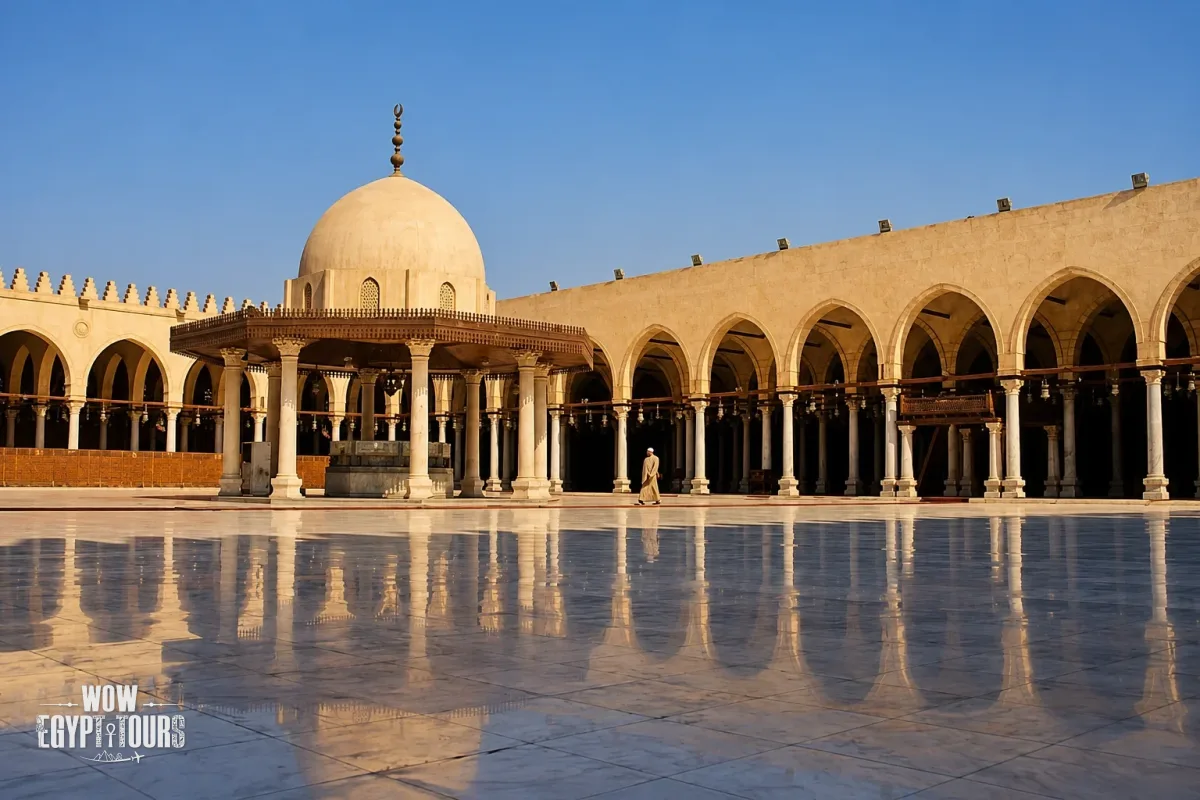
The current building, whose most recent comprehensive renovation campaign in the 20th century gave it the substantially enlarged and substantially modernized physical form that most contemporary visitors encounter, encompasses a large hypostyle prayer hall of multiple rows of columns supporting the wooden roof structure of the prayer space, a central open courtyard with an ablution fountain, the historic qibla wall with its mihrab niche, and the surrounding residential and administrative facilities of the mosque's institutional programme, in a spatial organization of considerable practical completeness and considerable atmospheric simplicity whose specific aesthetic of unpretentious devotional utility rather than architectural grandeur gives the Mosque of Amr Ibn Al-Ass its most distinctive and its most personally affecting character as the oldest Islamic monument in Africa whose most fundamental importance rests not in the architectural quality of its current built fabric but in the extraordinary historical significance of its founding moment and the extraordinary institutional continuity of its fourteen-century existence as the primary Islamic place of worship at the site of the first Arab Islamic settlement on the African continent.
Who Built The Mosque Of Amr Ibn Al-Ass?
The Mosque of Amr Ibn Al-Ass was founded and built by the Arab general Amr ibn Al-Ass ibn Wail al-Sahmi, one of the most brilliant and most personally extraordinary military commanders of the early Islamic period whose extraordinary military career encompassed the conquest of Palestine, the conquest of Egypt, and the subsequent governance of the Egyptian province under both the Caliph Umar ibn al-Khattab and the Caliph Uthman ibn Affan in a political and military biography of remarkable complexity and remarkable personal achievement that gives him the most consequential and the most personally fascinating individual biography of any figure associated with the early Islamic history of Egypt in the complete Islamic Egyptian heritage record. Amr Ibn Al-Ass entered Egypt with an Islamic Arab army of approximately 4,000 men in late 639 CE or early 640 CE, crossed the Sinai Peninsula from Palestine in a military campaign of extraordinary speed and extraordinary tactical sophistication, and within approximately a year and a half of the campaign's beginning had achieved the decisive military victory and the successful negotiation of the surrender of the Byzantine Babylon Fortress that established Islamic Arab political authority over Egypt for the first time in the history of the Nile Valley civilization. The founding of the mosque in 641 CE immediately following the fall of the Babylon Fortress represents the most symbolically significant and the most personally consequential single act of Amr Ibn Al-Ass's complete Egyptian career, the establishment of the physical institution through which the religious life of the new Arab Islamic community in Egypt would be organized and from whose single founding building the entire subsequent tradition of Islamic mosque building in Egypt and across the African continent would progressively develop over the fourteen centuries that followed.
Amr Ibn Al-Ass's personal character, as preserved in the abundant Arabic historical literature that documents the early Islamic period of Egyptian history, is that of one of the most intellectually gifted and the most personally charming of the early Islamic military commanders, a man of considerable political sophistication, considerable diplomatic skill, and considerable personal wit whose specific combination of military genius, administrative efficiency, and human charisma gave him the most naturally compelling personal authority of any of the early Islamic governors of Egypt and whose specific legacy of religious and institutional founding at the Fustat site gave the complete Islamic Egyptian civilization its most foundational and its most personally resonant individual patron figure. The Islamic historical tradition consistently presents Amr Ibn Al-Ass as a man of genuine personal piety combined with considerable worldly pragmatism, a combination of religious commitment and political realism that gave his governance of Egypt both its most specifically Islamic character of religious institutional foundation and its most practically effective character of administrative efficiency and institutional organization in the management of the most important province of the early Islamic caliphate outside the Arabian Peninsula itself.
The Islamic Conquest Of Egypt And The Founding Of Fustat
The Islamic conquest of Egypt between 639 and 642 CE is one of the most historically consequential and the most personally extraordinary military campaigns in the complete history of the ancient and medieval world, a campaign whose specific outcome, the replacement of six centuries of Christian Byzantine rule in Egypt with the Arab Islamic governance that has defined the primary religious and cultural identity of the Egyptian people from the 7th century to the present day, represents the single most consequential political and religious transformation in the complete history of Egypt since the ancient pharaonic tradition's encounter with the successive imperial powers of Persia, Greece, and Rome. Amr Ibn Al-Ass's specific military achievement of conquering the most populous and the most economically productive province of the Byzantine Empire with a force of initially approximately 4,000 men, subsequently reinforced by additional Arab troops sent by the Caliph Umar, against the resistance of the Byzantine military garrison and the fortification system of the Babylon Fortress at the apex of the Nile Delta, represents one of the most remarkable military feats in the complete history of the early Islamic period and one whose specific combination of tactical brilliance, logistical efficiency, and political diplomacy in the treatment of the conquered population has been celebrated in the Islamic historical tradition as the most complete and the most personally impressive expression of the early Islamic military genius in the complete conquest history of the Arab Islamic expansion.
The establishment of the new Arab Islamic capital of Fustat immediately adjacent to the captured Babylon Fortress in 641 CE, the layout of the new city according to the tribal organization of the Arab Islamic military force whose different tribal contingents were assigned their own residential quarters in the new settlement, and the founding of the Mosque of Amr Ibn Al-Ass as the central religious and social institution of the new Arab Islamic community at the apex of the Nile Delta gave the complete Islamic Egyptian civilization its most fundamental physical and institutional foundation in a single concentrated episode of urban and religious founding whose specific historical importance for the subsequent fourteen centuries of Islamic Egyptian civilization is simply without parallel in the complete history of any comparable city founding event in the complete African heritage record. The city of Fustat, whose full name was Fustat Misr, meaning the Tent of Egypt in the most commonly accepted etymology of the Arabic name, grew rapidly in the decades following its foundation into the most important and the most commercially active urban center in the complete early Islamic world outside the Arabian Peninsula and the newly conquered territories of the Levant, providing the organizational and economic foundation for the extraordinary prosperity of the early Islamic Egyptian province whose agricultural wealth, commercial position, and strategic importance as the primary grain supply of the early Islamic caliphate gave Egypt its most fundamental significance in the complete early Islamic political geography.
Amr Ibn Al-Ass Mosque Location
The Mosque of Amr Ibn Al-Ass is located in the Fustat district of Old Cairo, on the western bank of the Nile approximately 5 kilometers south of the modern Cairo city center and immediately adjacent to the ancient Coptic Cairo district whose extraordinary concentration of early Christian churches, monasteries, and the Coptic Museum gives the Old Cairo heritage area its most complete and its most personally extraordinary multi-faith heritage character as the location where the ancient Egyptian heritage of the Roman fortress of Babylon, the early Christian heritage of the Coptic Egyptian church, and the early Islamic heritage of the first Arab mosque in Africa are all accessible within walking distance of each other in the most concentrated and the most personally extraordinary single-area multi-period heritage experience available anywhere in the complete Egyptian capital. The mosque is accessible from central Cairo by taxi or private vehicle in approximately 20 to 25 minutes, and is most naturally and most efficiently visited in combination with the adjacent Coptic Cairo heritage programme encompassing the Hanging Church, the Coptic Museum, the Ben Ezra Synagogue, the St George Church, and the St Virgin Mary Church in the most completely organized and the most personally extraordinary multi-faith heritage day programme available from any Cairo hotel base. WOW Egypt Tours provides private vehicle transportation from all Cairo hotels to the Amr Ibn Al-Ass Mosque and organizes the complete Old Cairo multi-faith heritage programme as part of all Cairo Tours and Egypt Tour Packages.
Amr Ibn Al-Ass Mosque Fun Facts
The Mosque of Amr Ibn Al-Ass holds the extraordinary historical distinction of being the first mosque ever built on the entire African continent, a distinction whose specific temporal priority of approximately 1,384 years of existence as the oldest Islamic place of worship in Africa gives it a foundational importance for the subsequent religious history of the African continent that is genuinely without parallel in the complete heritage record of any comparable religious founding event at any accessible heritage site in the complete Egyptian religious heritage landscape. The specific historical fact that the religion of Islam, whose more than 550 million African adherents today make it the primary religion of the majority of the northern and sub-Saharan African world, first established its earliest physical institutional presence on the African continent at precisely the site of the Mosque of Amr Ibn Al-Ass in 641 CE gives the Fustat mosque a foundational religious heritage significance for the complete African Islamic world that is comparable in its continental scope and its historical depth to the foundational significance of any of the most important individual religious buildings in the complete world heritage record of the major world religions.
The original 641 CE mosque building founded by Amr Ibn Al-Ass was a structure of extraordinary modesty, measuring approximately 17 meters by 15 meters in its first construction with walls of reed and a roof of palm branches, a building of such complete architectural simplicity that its entire floor area was smaller than many of the individual residential rooms of the great Mamluk palatial complexes of the subsequent medieval Islamic Cairo that the same religious tradition would produce more than seven centuries later. This extraordinary contrast between the complete architectural modesty of the founding moment and the extraordinary architectural ambition of the later Mamluk tradition gives the Mosque of Amr Ibn Al-Ass its most personally instructive dimension as a heritage monument, the recognition that the most elaborate and the most architecturally extraordinary Islamic architectural tradition in the complete African and Middle Eastern world, the tradition that produced the extraordinary Sultan Hassan Mosque and the complete heritage of El Moez Street, began at this specific spot in the Fustat district with a building no larger than a modest modern apartment whose architectural simplicity was the most direct possible architectural expression of the most fundamental Islamic theological principle of the equality of all believers before God in the most unadorned and the most functionally minimal sacred space that the early Islamic community's theological priorities could conceive and realize.
A famous story associated with the construction of the Mosque of Amr Ibn Al-Ass recounts that when Amr Ibn Al-Ass was about to demolish the previous structure to begin the enlargement of the mosque, a dove was found to have nested in the tent of the mosque's prayer space and was nesting on eggs. According to the story, Amr Ibn Al-Ass refused to disturb the nesting dove and instructed that the entire structure be left undisturbed until the eggs had hatched and the chicks had fledged, a story whose specific combination of military commander's personal gentleness, Islamic theological respect for God's creatures, and practical administrative decision to preserve the established mosque structure gives it a quality of personal biographical charm and personal religious character that has made it one of the most consistently told and the most personally beloved anecdotes in the complete popular Islamic heritage tradition associated with the founding of the oldest mosque in Africa, a story whose specific character of mercy and natural piety gives the founding general of the oldest mosque in Africa his most humanly appealing and his most personally sympathetic biographical portrait in the complete Islamic Egyptian historical tradition.
Why Is It Called The Mosque Of Amr Ibn Al-Ass?
The Mosque of Amr Ibn Al-Ass carries the name of its founder, the Arab general Amr ibn Al-Ass ibn Wail al-Sahmi, in the most direct and the most historically appropriate possible designation for the oldest mosque in Africa, identifying the building with the specific individual whose military achievement, religious commitment, and personal authority made its founding possible in the most consequential single religious institutional act in the complete history of the Islamic Egyptian civilization. The Arabic name Jami Amr ibn al-As, meaning the Congregational Mosque of Amr ibn al-As, is the standard designation in the Islamic heritage scholarship and the Islamic Egyptian religious tradition for the oldest mosque in Africa, whose specifically congregational character as the primary Friday prayer mosque of the early Islamic Fustat community is captured in the jami designation that distinguishes it from the more modest individual neighbourhood mosques of the Islamic urban tradition. The alternative designations that the mosque carries in various historical sources and various Islamic geographical and architectural literature include Taj al-Jawami, meaning the Crown of Mosques, a honorific designation that reflects the mosque's extraordinary historical significance as the first and the most foundational Islamic religious institution in the complete African heritage and that gives the building its most elevated and its most personally reverential title in the complete Islamic Egyptian heritage vocabulary. The English-language international heritage tourism designation as the Mosque of Amr Ibn Al-Ass is a direct transliteration of the Arabic name whose specific phonological character of the hamza in Ibn Al-Ass has produced the most commonly used English spelling Amr Ibn Al-Ass in the international tourism literature, though alternative transliterations including Amr ibn al-As, Amr ibn al-'As, and other variants of the same Arabic name are used in different scholarly and popular contexts throughout the international Arabic-language heritage scholarship and Islamic architectural history literature.
Amr Ibn Al-Ass Mosque History
The history of the Mosque of Amr Ibn Al-Ass from its founding in 641 CE through the complete sequence of subsequent rebuilding and expansion campaigns that have transformed the original modest reed-and-palm-branch structure into the current substantial mosque of considerable scale and considerable spatial quality traces the most extraordinary and the most personally consequential institutional heritage biography of any single Islamic monument in the complete Egyptian heritage record, a biography whose complete temporal span of more than 1,380 years encompasses the complete historical sequence of the Islamic Egyptian civilization from the founding moment of the Arab conquest through the complete Umayyad, Abbasid, Tulunid, Fatimid, Ayyubid, Mamluk, Ottoman, and modern periods of Egyptian Islamic history in a continuous institutional existence whose specific duration as the oldest continuously active mosque in Africa gives it a quality of institutional permanence and historical depth that is simply without equal at any other accessible Islamic monument in the complete Egyptian heritage landscape. The original 641 CE structure was first expanded in 673 CE by the governor Abd Allah ibn Said, who significantly increased the mosque's dimensions to accommodate the growing Muslim population of Fustat, and was subsequently expanded again in 698 CE by the governor Abd al-Aziz ibn Marwan who added minarets to the mosque in one of the earliest recorded instances of minaret construction in the complete Islamic architectural history of Egypt, establishing the architectural tradition that would subsequently produce the most extraordinary variety and the most complete chronological sequence of Islamic minaret forms available at any Islamic heritage site in the complete Egyptian architectural landscape.
The most consequential historical transformation of the Mosque of Amr Ibn Al-Ass occurred in the devastating burning of the Fustat district in 1168 CE, when the Fatimid vizier Shawar ordered the burning of the entire old city of Fustat to prevent it from being captured and used as a base by the advancing Crusader army under the command of King Amalric I of Jerusalem, an act of military scorched-earth policy of such completely extraordinary human consequence, the deliberate destruction of the oldest Islamic capital of Egypt and the burning of the homes of hundreds of thousands of inhabitants, that it stands as one of the most dramatic and the most personally affecting single events in the complete history of the Islamic Egyptian urban landscape. The Fustat fire destroyed or severely damaged large sections of the old city and its historic buildings, though the mosque survived in sufficient condition to be subsequently restored and to continue its institutional function as the primary Friday congregational mosque of the Old Cairo district through the Ayyubid and Mamluk periods whose successive renovation and expansion campaigns progressively rebuilt and enlarged the building to the substantial form that later Ottoman and modern renovation campaigns have further modified and expanded to produce the current building whose specific architectural character is a complex product of multiple successive phases of construction and renovation spanning more than a thousand years of institutional existence at the same Fustat site.
The most recent comprehensive renovation campaign, conducted in the 20th century, substantially enlarged the mosque to its current dimensions and gave the building the architectural character that modern visitors encounter, combining the ancient institutional site and the ancient spiritual significance of the oldest mosque in Africa with a built fabric whose specific architectural character is primarily a product of relatively recent renovation rather than a direct physical survival of the medieval and early Islamic construction phases whose historical significance gives the building its most fundamental heritage importance. The specific heritage character of the Mosque of Amr Ibn Al-Ass is therefore the most instructive available example of the Islamic architectural tradition's approach to religious buildings as primarily institutional rather than primarily architectural heritage, in which the continuous institutional existence of the mosque as the oldest Islamic religious institution in Africa is more fundamentally important than the material authenticity of any specific phase of its physical construction, and in which the successive renewal and expansion of the physical building in each generation's most appropriate architectural language is understood as the most authentic possible expression of the living Islamic community's ongoing commitment to the institutional continuity of the oldest mosque in Africa rather than as a dilution of the building's heritage significance through the replacement of its historic fabric with later construction.
The Story Of The First Mosque In Africa
The story of the founding of the Mosque of Amr Ibn Al-Ass in 641 CE is the story of the moment when the religion of Islam first established its physical institutional presence on the African continent, a moment of such completely extraordinary historical consequence for the subsequent religious history of Africa that its specific importance cannot be measured simply in the architectural terms of what was built at the Fustat site in 641 CE but must be understood in the broader historical framework of what the establishment of this specific mosque at this specific moment set in motion across the subsequent fourteen centuries of African Islamic history. The religion of Islam, which today claims the religious allegiance of more than 550 million Africans across the complete northern and sub-Saharan African world, spread across the African continent from this specific founding moment in the Fustat district of what would become Cairo in the most consequential single religious cultural diffusion in the complete history of the African continent, with the mosque that Amr Ibn Al-Ass founded in 641 CE serving as the institutional model, the spiritual inspiration, and in some cases the direct institutional ancestor of the thousands of subsequent mosques that were built across the African continent in the centuries following the initial Islamic conquest of Egypt and the subsequent spread of the Islamic faith across North Africa, sub-Saharan Africa, and the East African coast in the most geographically extensive religious cultural transformation in the complete history of the African religious heritage.
The specific modesty of the original building, a structure of reed walls and palm branches barely 17 meters by 15 meters in dimensions, gives the story of the first mosque in Africa its most personally affecting and its most theologically resonant character, the specific contrast between the extraordinary historical consequence of the founding moment and the complete architectural modesty of the founding building that most directly and most personally embodies the fundamental Islamic theological principle of the equality of all believers before God in the most unadorned and the most functionally minimal sacred space that the early Islamic community's most rigorous theological priorities could conceive. The story of the founding dove whose nest Amr Ibn Al-Ass refused to disturb, whatever its specific historical basis in actual events of the 641 CE founding moment, captures the essential human character of the founding moment in the most accessible and the most personally appealing narrative form available in the complete popular Islamic heritage tradition associated with the oldest mosque in Africa, giving the specific historical episode of the founding the most charming and the most humanly immediate biographical portrait of the founding general that the Islamic historical tradition has produced in the complete heritage record of the early Islamic conquest of Egypt.
Amr Ibn Al-Ass Mosque Key Attractions And Features
The Historical Site And The Founding Significance
The most immediately extraordinary and the most personally affecting heritage dimension of the Mosque of Amr Ibn Al-Ass is not any specific architectural feature of the current building but the simple awareness of being at the specific site where the Islamic religion first established its physical institutional presence on the African continent more than 1,380 years ago, the specific recognition that the ground beneath the current mosque's floor was the site of Amr Ibn Al-Ass's original reed-and-palm-branch structure of 641 CE and that the continued existence of an active Islamic mosque at this specific location for an uninterrupted period of more than thirteen centuries gives the site a quality of institutional continuity and religious historical depth that is simply without equal at any other accessible Islamic heritage destination in the complete Egyptian capital or indeed in the complete African Islamic heritage world. The specific character of this awareness, most fully achieved with the expert historical guidance of the licensed Islamic Cairo guide provided by WOW Egypt Tours whose complete narrative of the Islamic conquest of Egypt, the founding of Fustat, the establishment of the first mosque, and the subsequent fourteen centuries of institutional continuity gives the direct physical encounter with the mosque site its most complete and its most personally affecting historical depth, is the primary and the most fundamental heritage value of the Mosque of Amr Ibn Al-Ass for every visitor who approaches it with the most genuine interest in the complete religious and historical heritage of the Islamic Egyptian civilization.
The Hypostyle Prayer Hall
The current prayer hall of the Mosque of Amr Ibn Al-Ass, whose hypostyle organization of multiple rows of columns supporting the wooden roof structure of the prayer space in the most traditional and the most historically foundational form of the Islamic mosque interior architecture, provides the most directly accessible and the most personally affecting encounter with the Islamic hypostyle prayer hall tradition in its most historically significant institutional context available at any accessible heritage mosque in the complete Old Cairo heritage district. The hypostyle hall's specific architectural character, with its forest of columns creating the most democratically organized and the most completely undifferentiated prayer space of any traditional Islamic mosque interior form in terms of the visual equality of all positions within the complete prayer space, embodies in its specific spatial organization the most fundamental Islamic theological principle of the equality of all believers before God in the most directly architectural form available in the complete Islamic architectural tradition, giving the Mosque of Amr Ibn Al-Ass's interior a quality of devotional simplicity and theological directness that contrasts most clearly and most personally with the architectural grandeur and the decorative elaboration of the great Mamluk mosques of the northern Islamic Cairo heritage district and that gives the oldest mosque in Africa its most distinctive and its most personally appropriate architectural character as the building where the Islamic tradition of Egypt began in the most unadorned and the most functionally direct religious space that the founding moment of Islamic Egyptian civilization produced.
The Courtyard And The Ablution Fountain
The open courtyard of the Mosque of Amr Ibn Al-Ass, with its central ablution fountain for the ritual purification that precedes the Islamic prayer and its surrounding arcade whose shaded walkway provides the most comfortable atmospheric transition between the open sky of the courtyard and the shaded interior of the prayer hall, is one of the most personally atmospheric and the most historically resonant open courtyard spaces accessible at any Islamic heritage monument in the complete Old Cairo heritage district, a space of considerable practical completeness and considerable personal charm whose specific combination of the simple courtyard architecture, the cool water of the ablution fountain, and the specific quality of the filtered Egyptian light in the colonnaded arcade creates an atmosphere of devotional simplicity and personal calm that is entirely appropriate to the oldest mosque in Africa and entirely consistent with the most fundamental Islamic theological principle of the unadorned simplicity of the Islamic sacred space. The courtyard's specific atmosphere of unhurried religious life, enhanced by the presence of worshippers performing their ablutions and their prayers in the most natural and the most completely unselfconscious way that the Mosque of Amr Ibn Al-Ass's character as a primarily devotional rather than primarily tourist heritage destination gives it, provides the most directly personal and the most genuinely experiential encounter with the living Islamic devotional tradition available at any accessible heritage mosque in the complete Old Cairo heritage district.
The Mihrab And The Qibla Wall
The mihrab niche of the Mosque of Amr Ibn Al-Ass, the prayer niche in the qibla wall oriented toward Mecca that serves as the primary liturgical focal point of the prayer hall and the most architecturally significant single element of the mosque's interior decorative programme, is the most directly historically significant and the most personally emotionally resonant single architectural element of the complete mosque interior, the specific architectural point toward which more than 1,380 years of Islamic prayer in the oldest mosque in Africa have been directed in the most continuously performed act of Islamic devotion at any accessible Islamic heritage site in the complete African heritage record. The mihrab's specific architectural form, a rounded arch-framed niche whose relatively modest scale and relatively restrained decorative programme reflects the building's specific aesthetic of devotional simplicity rather than architectural grandeur, creates an interior focal point of considerable devotional power and considerable personal spiritual atmosphere whose specific character of direct, unadorned religious focus gives the Mosque of Amr Ibn Al-Ass's prayer hall its most immediately distinctive and its most personally appropriate sacred interior identity as the oldest mosque in Africa whose most fundamental heritage value lies in the simplicity and the directness of its Islamic devotional function rather than in the elaboration and the magnificence of its architectural programme.
The Fustat Archaeological Landscape
The Mosque of Amr Ibn Al-Ass is situated within the broader Fustat archaeological landscape of Old Cairo, whose extensive subsurface deposits of the original Arab Islamic capital of Egypt contain the most complete and the most archaeologically productive ancient Islamic urban fabric accessible at any heritage site in the complete Egyptian archaeological record, giving the complete Old Cairo heritage area a dimension of archaeological depth and historical richness that the visible surface heritage of the mosque itself can only partially represent to the visitor who encounters the site without the expert historical guidance that gives the complete Fustat heritage its most meaningful and its most personally extraordinary character. The Fustat archaeological excavations conducted by Egyptian and international teams since the mid-20th century have recovered an extraordinary range of ancient Islamic material culture including ceramics, glassware, metalwork, textiles, and architectural fragments from the complete sequence of early Islamic Egyptian occupation from the 7th to the 12th centuries CE, giving the Fustat site a material cultural heritage of extraordinary scholarly significance and extraordinary personal interest for the most history-focused and the most archaeologically minded of the heritage visitors who engage with the Old Cairo heritage area in the most complete and the most intellectually enriching format available through the expert historical guidance of WOW Egypt Tours.
The Multi-Faith Heritage Neighborhood
The most extraordinary and the most personally affecting dimension of the complete heritage experience centered on the Mosque of Amr Ibn Al-Ass is the extraordinary multi-faith heritage neighborhood of Old Cairo in which the oldest mosque in Africa is physically surrounded by the most complete and the most personally extraordinary concentration of early Christian Coptic Egyptian heritage accessible at any single location in the complete Egyptian capital, giving the complete Old Cairo heritage area a quality of multi-faith historical density and personal heritage variety that is simply unavailable at any comparable heritage district in the complete Egyptian urban landscape. The Hanging Church, whose extraordinary heritage as one of the oldest continuously active Christian churches in Egypt gives it the most historically resonant Coptic Christian heritage presence in the complete Old Cairo district, is accessible from the Mosque of Amr Ibn Al-Ass by a short walk through the ancient streets of the Coptic quarter whose specific character of narrow medieval lanes and ancient stone walls creates the most completely personal and the most atmospherically extraordinary heritage walk available at any multi-faith heritage destination in the complete Egyptian capital. The Ben Ezra Synagogue, the Coptic Museum, the St George Church, and the St Virgin Mary Church complete the most extraordinary and the most personally affecting multi-faith heritage programme available at any single urban heritage area in the complete Egyptian capital.
Why Is The Mosque Of Amr Ibn Al-Ass Important?
The Mosque of Amr Ibn Al-Ass is important for reasons spanning the complete religious history of the Islamic Egyptian civilization, the foundational significance of the 641 CE establishment of the first mosque in Africa for the subsequent religious history of the entire African continent, the specific institutional heritage of the oldest continuously active Islamic religious institution in the complete African heritage record, the archaeological significance of the Fustat site as the oldest Arab Islamic urban settlement in the complete African archaeological record, and the broader cultural significance of the Old Cairo multi-faith heritage district as the most extraordinary and the most personally affecting concentration of ancient Christian, Jewish, and Islamic religious heritage accessible at any single heritage area in the complete Egyptian capital. As a religious heritage monument, the Mosque of Amr Ibn Al-Ass is the most historically foundational and the most personally resonant Islamic heritage site in the complete Egyptian capital, the specific physical location where the Islamic religious tradition of Egypt began and from which the subsequent fourteen centuries of extraordinary Islamic cultural achievement that produced the Sultan Hassan Mosque, the El Moez Street heritage corridor, and the complete tradition of Islamic architectural achievement in Egypt progressively developed. WOW Egypt Tours includes the Mosque of Amr Ibn Al-Ass as an essential destination in all comprehensive Cairo Tours, Egypt Classic Tours, and all Egypt Tour Packages encompassing the extraordinary multi-faith heritage of the Egyptian capital.
What Are Some Interesting Facts About The Mosque Of Amr Ibn Al-Ass?
The First Mosque In Africa
The Mosque of Amr Ibn Al-Ass holds the most extraordinary historical distinction available to any Islamic monument on the African continent: the specific priority of being the first mosque ever built on the African continent in 641 CE, a distinction whose specific historical consequence for the subsequent religious history of Africa, where more than 550 million Muslims today practice the religion that entered the African continent through this specific building at this specific site, gives it a foundational religious heritage significance for the complete African Islamic world that is simply without parallel at any other accessible Islamic monument in the complete African heritage record. The specific temporal priority of the Mosque of Amr Ibn Al-Ass as the oldest Islamic monument in Africa, more than a thousand years older than the great Islamic monuments of West Africa, more than eight centuries older than the Islamic architectural heritage of sub-Saharan East Africa, and more than six centuries older than the Ottoman period Islamic architecture of North Africa that most casual observers associate with the historic character of the African Islamic architectural heritage, gives the Fustat mosque a position of supreme historical foundational importance in the complete narrative of African Islamic history that its relatively modest current architectural character does not immediately communicate to the uninformed visitor but that becomes the most personally extraordinary and the most completely overwhelming heritage quality of the building for every visitor who understands its specific historical significance in the most complete and the most personally resonant context available through the expert historical guidance of WOW Egypt Tours.
The Nesting Dove Of Amr Ibn Al-Ass
The famous story of Amr Ibn Al-Ass's refusal to disturb the nesting dove whose eggs were incubating in the tent mosque at the time of the planned expansion represents one of the most personally appealing and the most theologically resonant anecdotes in the complete popular Islamic heritage tradition associated with the founding of the oldest mosque in Africa, a story whose specific combination of the founding general's personal gentleness, Islamic theological respect for God's living creatures, and practical wisdom in preserving the established sacred space gives it a quality of human biographical charm and religious moral teaching that has made it one of the most consistently told and the most personally beloved anecdotes in the complete Egyptian Islamic popular heritage tradition from the early medieval period through the present day. Whether the specific story is historically accurate in its particular details or represents a later legendary elaboration of the founding narrative whose specific symbolic content was more important to the Islamic historical tradition's understanding of Amr Ibn Al-Ass's character than its literal factual accuracy, the specific quality of mercy and natural piety that the dove story attributes to the founding general of the oldest mosque in Africa gives him his most humanly appealing and his most personally sympathetic biographical portrait in the complete Islamic Egyptian historical tradition and gives the Mosque of Amr Ibn Al-Ass its most charming and its most immediately personally accessible founding narrative in the complete heritage record of any accessible Islamic monument in the complete Egyptian capital.
The Crown Of Mosques
The honorific designation of the Mosque of Amr Ibn Al-Ass as Taj al-Jawami, the Crown of Mosques, which appears in various historical and geographical sources of the medieval Islamic literary tradition as the most elevated and the most reverentially respectful available designation for the oldest mosque in Africa, gives the building a specific place in the hierarchy of Islamic sacred sites in the complete Egyptian Islamic heritage that is entirely appropriate to its extraordinary historical significance as the founding Islamic institution of the African continent and entirely consistent with the Islamic scholarly and religious tradition's recognition that the specific historical priority of the oldest mosque in Africa gives it a sacred and an institutional authority that no subsequent Islamic monument in the complete Egyptian or African Islamic heritage can claim in the same direct and the same personally foundational sense that the Taj al-Jawami designation captures in the most succinctly reverential available Arabic honorific vocabulary.
What Is So Special About The Mosque Of Amr Ibn Al-Ass?
Where The Islamic Heritage Of Africa Began
What makes the Mosque of Amr Ibn Al-Ass uniquely and incomparably special in the complete Egyptian Islamic heritage landscape is the extraordinary combination of historical priority and institutional continuity that gives it the most fundamental and the most personally foundational heritage significance of any Islamic monument in the complete African heritage record. The specific quality of standing in the courtyard of the oldest mosque in Africa and understanding that this specific site, this specific ground, this specific institutional location is where the Islamic religious tradition of Africa began in 641 CE and has been continuously maintained as an active place of Islamic worship for more than 1,380 years is the most personally extraordinary and the most completely affecting heritage awareness available at any accessible Islamic heritage monument in the complete Egyptian capital, a quality of historical priority and institutional continuity that the most architecturally magnificent Islamic monuments of the medieval Cairo heritage district, however extraordinary in their specific architectural achievements, simply cannot claim in the same direct and the same historically foundational sense that the Mosque of Amr Ibn Al-Ass embodies through its simple, unadorned, and continuously active institutional existence as the oldest Islamic monument in Africa.
The Heritage Of Simplicity And Devotion
The Mosque of Amr Ibn Al-Ass is also uniquely special for the specific quality of devotional simplicity and religious authenticity that its architectural character of unpretentious practical utility rather than architectural grandeur gives it in the complete spectrum of Islamic heritage experiences available at accessible Islamic monuments in the complete Egyptian capital. Where the Sultan Hassan Mosque and the great Mamluk monuments of El Moez Street provide the most architecturally overwhelming and the most decoratively extraordinary dimension of the complete Islamic Cairo heritage experience, the Mosque of Amr Ibn Al-Ass provides the most historically foundational and the most devotionally authentic dimension of the same experience, the specific encounter with the Islamic religious tradition in its most historically primary and its most theologically unadorned institutional form that gives the complete Islamic Cairo heritage programme its most important counterpoint to the architectural grandeur of the Mamluk tradition in the most complete and the most personally instructive possible range of Islamic heritage experience available through the Cairo Tours and Egypt Tour Packages organized by WOW Egypt Tours.
The Mosque Of Amr Ibn Al-Ass Through The Ages
The complete narrative of the Mosque of Amr Ibn Al-Ass from Amr's founding of the original reed-and-palm-branch structure in 641 CE through the successive Umayyad, Abbasid, Fatimid, Ayyubid, Mamluk, Ottoman, and modern expansion and renovation campaigns, through the devastating Fustat fire of 1168 CE and the subsequent rebuilding, through the Ottoman period's maintenance and further modification, through the 19th century heritage conservation awakening and the 20th century comprehensive renovation programme, to the current building's institutional existence as the oldest continuously active mosque in Africa traces the most extraordinary and the most institutionally consequential single heritage biography of any Islamic monument in the complete African heritage record, a biography whose most fundamental characteristic is the continuous institutional existence of the mosque at the same Fustat site through the most dramatic political, military, and cultural transformations in the complete history of the Islamic Egyptian civilization, giving the Mosque of Amr Ibn Al-Ass a quality of institutional resilience and historical persistence that is simply without parallel in the complete heritage record of any comparable Islamic religious institution in the complete African and Middle Eastern world.
The Mosque Of Amr Ibn Al-Ass And UNESCO
The Mosque of Amr Ibn Al-Ass is protected as an essential component of the UNESCO World Heritage Site designated in 1979 as Historic Cairo, recognized as a heritage of outstanding universal value for the extraordinary concentration of Islamic heritage in the historic core of Cairo that includes the Fustat district and the Mosque of Amr Ibn Al-Ass as its most historically foundational Islamic monument alongside the complete heritage of the medieval Islamic Cairo quarter. The UNESCO Historic Cairo inscription specifically acknowledges the extraordinary historical significance of the Mosque of Amr Ibn Al-Ass as the oldest mosque in Egypt and in Africa, identifying its foundational importance for the complete subsequent development of the Islamic architectural and religious heritage tradition in Egypt and across the African continent as a primary justification for the heritage significance of the complete Historic Cairo World Heritage designation of which it is the most historically ancient Islamic component. The Egyptian government and the UNESCO World Heritage Committee are engaged in ongoing collaboration on the conservation management of the complete Historic Cairo heritage zone including the Mosque of Amr Ibn Al-Ass and the complete Fustat archaeological landscape whose specific conservation challenges as an active religious site within a dense urban environment require the most carefully managed and the most sensitively organized heritage conservation approach of any comparable Islamic monument site in the complete Egyptian heritage landscape.
Best Time To Visit The Mosque Of Amr Ibn Al-Ass
The Mosque of Amr Ibn Al-Ass is most naturally and most efficiently visited as part of the complete Old Cairo multi-faith heritage programme combining the mosque with the adjacent Coptic heritage sites of the Hanging Church, the Coptic Museum, and the Ben Ezra Synagogue in the most personally extraordinary and the most completely satisfying multi-faith heritage day programme available from any Cairo hotel base. The morning hours from approximately 9:00 AM to noon are the most recommended visiting period, when the mosque's courtyard is most atmospherically beautiful in the morning light and the adjacent Coptic heritage sites are most accessible before the main midday visitor flow. The cooler months from October through April provide the most comfortable conditions for the outdoor courtyard and the walking programme between the adjacent Old Cairo multi-faith heritage sites. Friday mid-day should be avoided during the congregational prayer period when the mosque is closed to non-Muslim visitors. WOW Egypt Tours advises on optimal timing within the complete Old Cairo multi-faith heritage programme.
Mosque Of Amr Ibn Al-Ass Opening Hours
The Mosque of Amr Ibn Al-Ass is open to visitors daily from 9:00 AM to 5:00 PM, with closure during the five daily prayer times and during the Friday mid-day congregational prayer from approximately 11:30 AM to 1:30 PM. The mosque is an active place of Islamic worship and visiting arrangements must respect the prayer schedule and the requirements of the worshipping community. All visiting hours are subject to adjustment for Islamic religious observances and should be confirmed at time of booking with WOW Egypt Tours.
Mosque Of Amr Ibn Al-Ass Entrance Fees
The Mosque of Amr Ibn Al-Ass is accessible without an admission fee as an active place of Islamic worship. Non-Muslim visitors are welcome to enter and experience the mosque's historical heritage with appropriate respect for the building's religious character and the ongoing devotional activities of its Muslim community. All logistics for the complete Old Cairo multi-faith heritage programme including the Mosque of Amr Ibn Al-Ass are organized by WOW Egypt Tours as part of all Cairo Tours and Egypt Tour Packages.
How To Get To The Mosque Of Amr Ibn Al-Ass
The Mosque of Amr Ibn Al-Ass is located in the Fustat district of Old Cairo, approximately 5 kilometers south of the Cairo city center, accessible by private vehicle from central Cairo in approximately 20 to 25 minutes, by the Cairo Metro to Mar Girgis station on Line 1 and then a short walk of approximately 5 to 10 minutes through the Old Cairo heritage area, or by taxi from any point in central Cairo. The private vehicle organized by WOW Egypt Tours as part of the complete Old Cairo multi-faith heritage programme is the most practically efficient and the most personally organized approach for international visitors, providing door-to-door transport from the hotel and organized movement between the Mosque of Amr Ibn Al-Ass and all adjacent Coptic and Jewish heritage sites in the most efficiently timed and the most personally satisfying multi-faith heritage day programme available in the complete Cairo heritage landscape.
How Long To Spend At The Mosque Of Amr Ibn Al-Ass
The Mosque of Amr Ibn Al-Ass visit requires approximately 30 to 45 minutes for the most complete available programme encompassing the guided historical introduction to the founding of the first mosque in Africa, the courtyard and ablution fountain exploration, the prayer hall interior with the mihrab and the hypostyle column programme, and the complete historical narrative of the building's fourteen centuries of institutional continuity. The mosque is most naturally and most efficiently visited as part of the complete Old Cairo multi-faith heritage programme whose total duration of approximately three to four hours covers the Mosque of Amr Ibn Al-Ass, the Coptic Museum, the Hanging Church, the Ben Ezra Synagogue, and the other accessible Coptic and Jewish heritage sites of the Old Cairo district in the most completely satisfying and the most personally extraordinary multi-faith heritage day programme organized by WOW Egypt Tours.
Tips For Visiting The Mosque Of Amr Ibn Al-Ass
Ask your licensed guide from WOW Egypt Tours to provide the complete historical narrative of the Islamic conquest of Egypt, the founding of Fustat, and the establishment of the first mosque in Africa before entering the building, as the combination of this complete historical context with the direct physical encounter with the oldest mosque in Africa at the specific founding site creates the most personally extraordinary and the most completely affecting heritage experience of any accessible Islamic monument in the complete Old Cairo heritage district. The mosque is a place of active Islamic worship whose atmosphere of genuine devotional use gives the heritage visit a quality of direct encounter with the living Islamic religious tradition that the primarily tourist-oriented heritage monuments of the medieval Islamic Cairo district cannot provide in the same form, and approaching the mosque with the most genuine respect for its devotional character and the most genuine sensitivity to the worshippers who are present throughout the visiting hours will give the complete heritage experience its most authentic and its most personally rewarding dimension of direct cross-cultural religious encounter. Remove shoes before entering the prayer hall and carry them in hand or leave them at the shoe storage at the prayer hall entrance. Women should bring or be provided with a head covering for entry into the prayer hall. Visit in the morning from approximately 9:00 AM to 11:00 AM for the most atmospheric courtyard light and the most manageable visitor density before the approach of the midday prayer period.
What To Wear At The Mosque Of Amr Ibn Al-Ass
The Mosque of Amr Ibn Al-Ass is an active Islamic place of worship whose visiting requirements are the most respectful and the most culturally appropriate available for visiting an active mosque in the Egyptian Islamic tradition. Modest clothing covering the shoulders, arms, and knees is required for all visitors regardless of gender. Women must cover their hair for entry into the prayer hall and may be provided with a head covering at the mosque entrance. Shoes must be removed before entering the prayer hall and comfortable socks are strongly recommended. Conservative clothing that covers the complete body except the face and hands is the most culturally appropriate approach to the mosque visit for all visitors. Lightweight, breathable modest clothing is the most practically comfortable choice for the summer months when the mosque interior and courtyard can be warm.
Photography At The Mosque Of Amr Ibn Al-Ass
Photography for personal non-commercial purposes is generally permitted in the Mosque of Amr Ibn Al-Ass, with the courtyard and the prayer hall accessible for photography within the respectful approach of avoiding photography during active prayer times and seeking permission before photographing individual worshippers. The courtyard with its atmospheric colonnade and the hypostyle prayer hall columns provide the most architecturally distinctive photography subjects of the complete mosque visit. The most personally extraordinary photography opportunity at the Mosque of Amr Ibn Al-Ass is the morning light photography of the courtyard whose specific quality of filtered Egyptian morning sunlight creates the most atmospheric and the most personally affecting natural light heritage photography available at any accessible Islamic monument in the complete Old Cairo heritage district.
Amr Ibn Al-Ass Mosque Tours
Old Cairo Multi-Faith Heritage Day: Mosque, Coptic Churches, And Synagogue
This comprehensive Old Cairo multi-faith heritage programme combines the oldest mosque in Africa with the most extraordinary early Christian Coptic heritage in Egypt and one of the oldest synagogues in the country in the most personally extraordinary and the most completely historic multi-faith heritage day programme available from any Cairo hotel base, encompassing the complete range of the three Abrahamic religious heritage traditions in their most ancient and their most personally affecting Egyptian expression in a single heritage day of truly extraordinary historical depth and personal cultural richness.
What Is Covered
Private vehicle from Cairo hotel with morning departure. Mosque of Amr Ibn Al-Ass: complete historical introduction to the Islamic conquest of Egypt, the founding of Fustat, and the establishment of the first mosque in Africa, courtyard and prayer hall guided programme with the founding narrative and the fourteen-century institutional continuity story. Coptic Museum: the most comprehensive collection of Coptic Christian art and material culture in the world. Hanging Church: one of the oldest and most celebrated Coptic churches in Egypt. Ben Ezra Synagogue: the oldest synagogue in Egypt with extraordinary heritage. St George Church and St Virgin Mary Church. Return to Cairo hotel or onward transport to the Islamic Cairo northern heritage district.
Duration
Half day to full day from Cairo hotel, approximately 3 to 5 hours depending on programme scope.
Includes
Private vehicle, licensed multi-faith Cairo guide, all monument entrance fees, and all logistics. Through WOW Egypt Tours Cairo Tours.
Complete Cairo Multi-Period Heritage Day
This comprehensive Cairo heritage day programme combines the ancient Egyptian heritage of the Giza Pyramids, the Islamic heritage of El Moez Street and Khan El Khalili, and the multi-faith heritage of Old Cairo including the Mosque of Amr Ibn Al-Ass and the Coptic quarter in the most completely multi-dimensional and the most personally extraordinary Cairo heritage programme available from any hotel base in the Egyptian capital.
What Is Covered
2-day programme: Day 1: Giza Pyramids and Grand Egyptian Museum. Day 2: Old Cairo multi-faith programme including the Mosque of Amr Ibn Al-Ass, Coptic Museum, Hanging Church, Ben Ezra Synagogue. Afternoon: Islamic Cairo northern heritage with El Moez Street and Khan El Khalili. Return to Cairo hotel.
Duration
2 Days from Cairo hotel.
Includes
Private vehicle both days, licensed guide, all site and monument entrance fees, lunch both days, and all logistics. Through WOW Egypt Tours Cairo Tours.
Combine The Mosque Of Amr Ibn Al-Ass With Your Egypt Tours Package
The Mosque of Amr Ibn Al-Ass is featured as an essential multi-faith heritage destination across the full range of WOW Egypt Tours travel products. Browse the options below to find the Egypt experience that includes the Mosque of Amr Ibn Al-Ass.
Egypt Tour Packages: Multi-day guided Egypt tours organized by duration, including 2 Days Egypt Packages, 3 Days Egypt Packages, 4 Days Egypt Packages, 5 Days Egypt Packages, 6 Days Egypt Packages, 7 Days Egypt Packages, 8 Days Egypt Packages, 10 Days Egypt Packages, and longer itineraries. The Mosque of Amr Ibn Al-Ass is included in all Egypt Tour Packages of 4 days and above as part of the complete Old Cairo multi-faith heritage programme. All packages include private vehicle, licensed guide, accommodation, all monument entrance fees, and all logistics.
Egypt Travel Packages: Themed Egypt travel packages including Egypt Honeymoon Travel Packages, Egypt Budget Travel Packages, Egypt Family Travel Packages, Egypt Luxury Travel Packages, Egypt Adventure Travel Packages, Egypt Cultural Travel Packages, and Egypt Christmas and New Year Travel Packages. The Mosque of Amr Ibn Al-Ass is featured in every Egypt Travel Package category as the oldest mosque in Africa and the foundational Islamic monument of the complete Egyptian Islamic heritage.
Egypt Classic Tours: The most popular and the most comprehensively balanced Egypt travel programme, combining the ancient Egyptian heritage of Cairo with the complete multi-faith Islamic, Coptic, and Jewish heritage of Old Cairo including the Mosque of Amr Ibn Al-Ass, the medieval Islamic heritage of El Moez Street and the Saladin Citadel, and the Nile Valley heritage of Luxor and Aswan in the most complete and the most personally satisfying introduction to the complete Egyptian heritage available in any organized Egypt itinerary.
Egypt Short Break Tours: Focused short duration Egypt travel programmes for travelers with limited time. The Mosque of Amr Ibn Al-Ass is included in Egypt Short Break Tours of 3 days and above as part of the Old Cairo multi-faith heritage programme, combined with the Hanging Church, Coptic Museum, and Ben Ezra Synagogue in the most efficiently organized compact multi-faith heritage programme available from any Cairo hotel base.
Egypt Family Tours: Family-friendly Egypt travel programmes in which the extraordinary story of the first mosque in Africa, the nesting dove anecdote, and the multi-faith heritage neighbourhood of Old Cairo together provide one of the most varied and the most personally engaging religious and historical heritage programmes for families with children of all ages visiting the complete Cairo heritage landscape.
Egypt Budget Tours: Value-focused Egypt travel programmes providing access to the Mosque of Amr Ibn Al-Ass without any entrance fee as an active place of worship, making the oldest mosque in Africa the most economically accessible and the most historically significant free heritage destination in the complete Egyptian capital.
Egypt Nile Cruises: All-inclusive Nile River Cruise programmes combining the ancient pharaonic heritage of Luxor and Aswan with Cairo extensions that include the Mosque of Amr Ibn Al-Ass as part of the complete Old Cairo multi-faith heritage programme.
Nile River Cruises: All WOW Egypt Tours Nile cruise options. The Mosque of Amr Ibn Al-Ass is available as part of the Old Cairo multi-faith heritage programme in the Cairo extension from the beginning or end of any Nile River Cruise itinerary.
Luxor Aswan Nile Cruises: The Mosque of Amr Ibn Al-Ass combined with the Hanging Church, Coptic Museum, and Ben Ezra Synagogue is the primary Old Cairo multi-faith heritage programme for any Luxor-Aswan Nile cruise Cairo extension, providing the most personally extraordinary multi-faith heritage complement to the ancient pharaonic monument heritage of the Nile Valley cruise.
Dahabiya Nile Cruises: The Mosque of Amr Ibn Al-Ass available as part of the Old Cairo multi-faith heritage programme for travelers combining the most intimate private Nile sailing experience with the oldest mosque in Africa and the extraordinary multi-faith heritage of Old Cairo.
Lake Nasser Cruises: The Mosque of Amr Ibn Al-Ass available as part of the Cairo extension for travelers combining the extraordinary Nubian heritage of Lake Nasser with the foundational Islamic monument of the Egyptian capital and the complete multi-faith heritage of Old Cairo.
Cairo Tours: The complete range of guided day tour programmes available from Cairo hotels, including the Old Cairo multi-faith heritage day combining the Mosque of Amr Ibn Al-Ass with the Hanging Church, Coptic Museum, Ben Ezra Synagogue, St George Church, and St Virgin Mary Church, the complete Cairo Islamic and multi-faith heritage day combining the Mosque of Amr Ibn Al-Ass with El Moez Street, Khan El Khalili, Al Azhar Mosque, Saladin Citadel, Muhammad Ali Mosque, Sultan Hassan Mosque, and Mosque of Ibn Tulun. All Cairo Tours include private vehicle, licensed guide, all entrance fees, and all logistics organized by WOW Egypt Tours.
Nearby Attractions To The Mosque Of Amr Ibn Al-Ass
The Mosque of Amr Ibn Al-Ass is situated in the Old Cairo Fustat district at the center of the most extraordinary multi-faith heritage concentration in the complete Egyptian capital, immediately surrounded by the ancient Coptic Christian and Jewish heritage monuments of the historic Coptic Cairo quarter whose combination with the oldest mosque in Africa gives the complete Old Cairo heritage area its most personally extraordinary and its most completely multi-dimensional religious heritage character. The most immediately proximate and the most naturally combined nearby heritage destinations are the primary Coptic and Jewish monuments of the same Old Cairo heritage area whose walking-distance accessibility from the Mosque of Amr Ibn Al-Ass makes the complete multi-faith heritage programme of the Old Cairo district the most practically and the most personally convenient single-area multi-period heritage programme available in the complete Egyptian capital.
The Hanging Church, the most celebrated of all the ancient Coptic churches in the complete Old Cairo heritage district and one of the most historically significant Christian churches in the entire African continent, is accessible from the Mosque of Amr Ibn Al-Ass by a short walk through the ancient lanes of the Coptic quarter. The Coptic Museum, housing the most comprehensive and the most personally extraordinary collection of Coptic Christian art and material culture in the complete world, is immediately adjacent to the Hanging Church in the most naturally combined institutional heritage complex of the complete Old Cairo district. The Ben Ezra Synagogue, the oldest synagogue in Egypt and one of the most historically resonant Jewish heritage sites in the complete African continent, is accessible within the same Old Cairo heritage walking circuit. The St George Church and the St Virgin Mary Church complete the most extraordinary multi-faith heritage programme of the complete Old Cairo district. In the broader Cairo heritage area, the Mosque of Ibn Tulun approximately 2 kilometers north is the oldest surviving mosque in Cairo and provides the most architecturally significant Islamic monument complement to the Mosque of Amr Ibn Al-Ass in the broader historic Islamic Cairo southern heritage district. All these destinations are organized by WOW Egypt Tours as part of comprehensive Cairo Tours and Egypt Tour Packages encompassing the extraordinary multi-faith heritage of Cairo the Capital of Egypt.
Frequently Asked Questions About The Mosque Of Amr Ibn Al-Ass
What is the Mosque of Amr Ibn Al-Ass?
The Mosque of Amr Ibn Al-Ass is the oldest mosque in Egypt, the oldest mosque in Africa, and the first mosque ever built on the African continent, founded in 641 CE by the Arab general Amr ibn Al-Ass immediately following the Islamic conquest of Egypt in the Fustat district of Old Cairo. It is also known as Taj al-Jawami, the Crown of Mosques. The current building reflects successive rebuilding and expansion campaigns over fourteen centuries of continuous institutional existence as the primary Islamic place of worship at the site of the first Arab settlement in Africa. It is featured in Cairo Tours, Egypt Classic Tours, and Egypt Short Break Tours offered by WOW Egypt Tours.
Who was Amr Ibn Al-Ass?
Amr ibn Al-Ass ibn Wail al-Sahmi was the Arab general who led the Islamic conquest of Egypt between 639 and 642 CE, one of the most brilliant military commanders of the early Islamic period whose extraordinary campaign conquered the most populous and the most economically productive Byzantine province with a force of initially approximately 4,000 men. He subsequently served as the first governor of Islamic Egypt under the Caliphs Umar and Uthman, founded the first Arab capital of Egypt at Fustat, and established the first mosque in Africa whose institutional existence has been continuously maintained for more than 1,380 years.
What did the original mosque look like?
The original mosque founded by Amr Ibn Al-Ass in 641 CE was an extremely modest structure of approximately 17 meters by 15 meters in dimensions, with walls of reed and a roof of palm branches, a building of complete architectural simplicity reflecting both the practical constraints of a military encampment mosque and the early Islamic theological preference for unadorned places of prayer. The extraordinary contrast between this founding modesty and the subsequent fourteen centuries of architectural elaboration that produced the great Mamluk monuments of Islamic Cairo gives the Mosque of Amr Ibn Al-Ass its most personally instructive dimension as a foundational heritage monument.
What is the story of the nesting dove?
A beloved anecdote in the Islamic popular heritage tradition associated with the mosque recounts that when Amr Ibn Al-Ass was about to demolish the original tent mosque to build a larger structure, a dove was found to have nested in the prayer space and was incubating eggs. Amr Ibn Al-Ass refused to disturb the nesting dove, instructing that the entire structure remain undisturbed until the eggs had hatched and the chicks had fledged, a story that gives the founding general his most charming and his most personally sympathetic biographical portrait in the complete Islamic Egyptian historical tradition.
Why was Fustat established near the Babylon Fortress?
Amr Ibn Al-Ass established the Arab Islamic capital of Fustat immediately adjacent to the captured Byzantine Babylon Fortress in 641 CE for practical strategic reasons of logistical convenience and military security, positioning the new Arab settlement adjacent to the most significant pre-existing fortification in the area for defensive protection and adjacent to the apex of the Nile Delta for maximum commercial and administrative accessibility to both the Nile Valley and the Delta regions of the new Islamic Egyptian province.
What is the Fustat district?
Fustat was the first Arab Islamic capital of Egypt, established by Amr Ibn Al-Ass in 641 CE adjacent to the Roman fortress of Babylon in what is now the Old Cairo district. The name Fustat is most commonly translated as the Tent of Egypt, referring either to the large tent or pavilion that Amr Ibn Al-Ass erected at the founding of the settlement or to the general Arabic word for a pitched camp or city. Fustat grew rapidly into the most important urban center in the early Islamic world outside the Arabian Peninsula and the Levant before being burned by the Fatimid vizier Shawar in 1168 CE to prevent its capture by the Crusaders.
Is the Mosque of Amr Ibn Al-Ass near the Coptic churches?
Yes. The Mosque of Amr Ibn Al-Ass is located in the Fustat district immediately adjacent to the historic Coptic Cairo quarter where the most important early Christian heritage sites in Egypt are concentrated, including the Hanging Church, the Coptic Museum, the Ben Ezra Synagogue, and the other Coptic churches of the old quarter, giving Old Cairo its most extraordinary character as the location where the Islamic, Christian, and Jewish religious heritages of Egypt coexist in the most concentrated and the most personally extraordinary multi-faith heritage area in the complete Egyptian capital.
Can non-Muslims visit the Mosque of Amr Ibn Al-Ass?
Yes. Non-Muslim visitors are welcome to enter and experience the Mosque of Amr Ibn Al-Ass with appropriate respect for its character as an active Islamic place of worship. Modest clothing covering the shoulders, arms, and knees is required. Women must cover their hair. Shoes must be removed before entering the prayer hall. Photography is generally permitted with respectful practice. The mosque does not charge an admission fee. Visits should be organized around the prayer times and should avoid the Friday mid-day congregational prayer period.
What makes the Mosque of Amr Ibn Al-Ass different from other Cairo mosques?
The Mosque of Amr Ibn Al-Ass is categorically different from all other Cairo mosques in its specific historical priority as the oldest mosque in Egypt and in Africa, founded in 641 CE more than 240 years before the Mosque of Ibn Tulun (879 CE), more than 700 years before the Fatimid mosques of El Moez Street, and more than 700 years before the great Mamluk mosques including the Sultan Hassan Mosque. Its heritage significance rests primarily in its extraordinary historical priority and institutional continuity rather than in architectural grandeur.
How do I book a Mosque of Amr Ibn Al-Ass tour with WOW Egypt Tours?
You can book any Cairo Tours programme, Egypt Classic Tours package, Egypt Short Break Tours programme, Egypt Family Tours, Egypt Budget Tours, Egypt Tours Package, or Egypt Travel Package that includes the Mosque of Amr Ibn Al-Ass directly through WOW Egypt Tours. Our team of travel specialists will arrange private vehicle, licensed multi-faith Cairo guide, the complete Old Cairo multi-faith heritage programme encompassing the oldest mosque in Africa together with the most extraordinary early Christian and Jewish heritage of Coptic Cairo, and the most complete and the most personally extraordinary guided encounter with the foundational Islamic monument of the African continent available through any Egyptian heritage tour operator.