
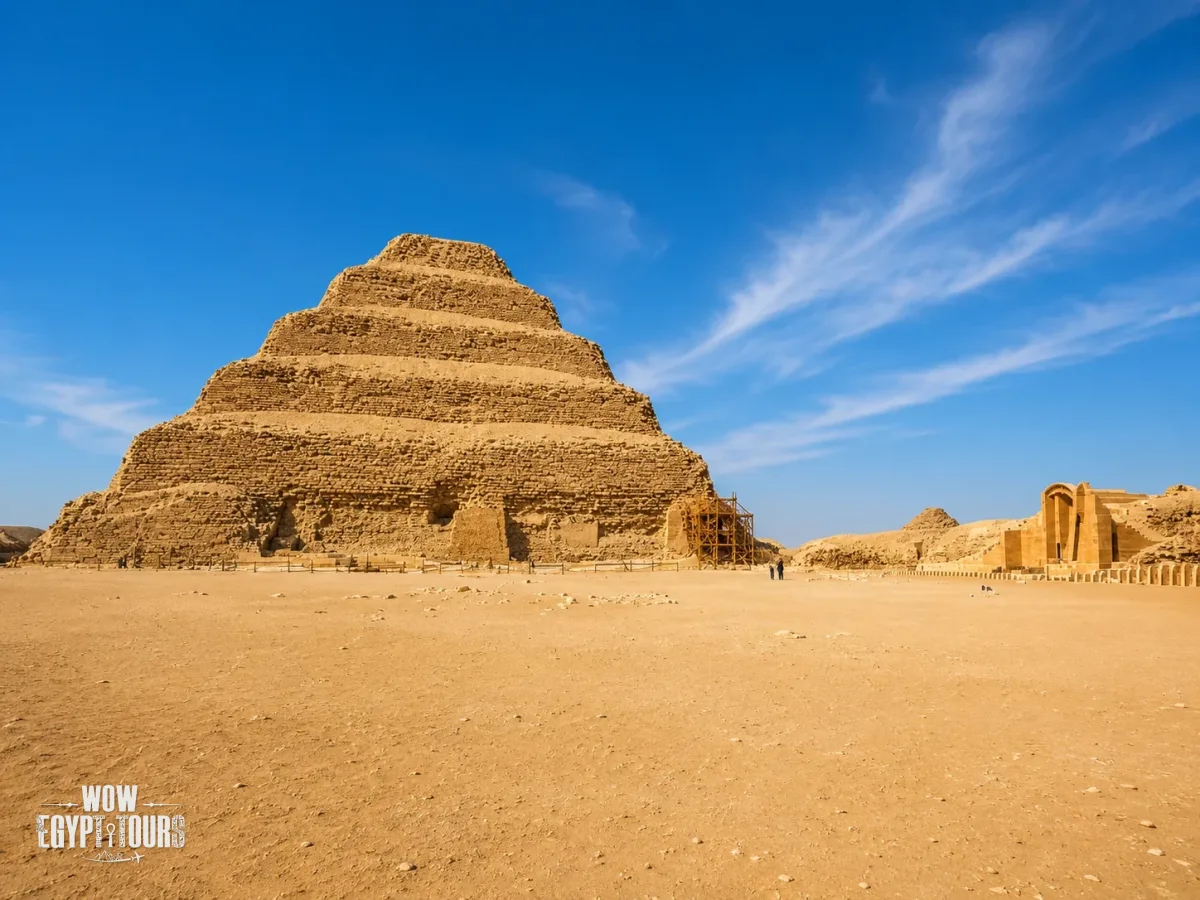

The Saqqara Step Pyramid is the most historically consequential, the most architecturally revolutionary, and the most personally extraordinary ancient building in the complete Egyptian heritage landscape after the Great Pyramids themselves, the world's oldest monumental stone building constructed approximately 2667 to 2648 BCE by the brilliant ancient Egyptian architect, physician, and statesman Imhotep for the pharaoh Djoser of the Egyptian Old Kingdom 3rd Dynasty, a monument whose creation represented the single most dramatic and the most completely consequential architectural leap forward in the history of the ancient world, the transformation of the ancient Egyptian royal funerary tradition from the flat-topped rectangular mudbrick mastaba tomb of the Early Dynastic period into the soaring six-stepped limestone pyramid of 60 meters in height that stands on the Saqqara desert plateau approximately 27 kilometers south of Cairo as the direct and the most immediately legible architectural ancestor of the supreme pyramid achievements of the Giza Pyramids Complex whose extraordinary smooth-sided perfection was reached only two generations later in the revolutionary sequence of architectural development that Imhotep's Step Pyramid inaugurated. The Saqqara Step Pyramid is not simply the world's oldest pyramid; it is the world's oldest monumental structure built entirely of cut stone, the first time in the complete history of human civilization that any builder or any civilization attempted to construct a building of this physical scale entirely from quarried and dressed stone rather than from the mudbrick, timber, and rubble fill that all previous ancient monumental construction had used, a first whose specific historical significance in the development of the complete human architectural tradition is greater than any comparable architectural innovation in any subsequent period of the history of construction. This extraordinary monument is featured in Cairo Tours, Egypt Classic Tours, and Egypt Short Break Tours, all of which WOW Egypt Tours proudly offers to travelers from around the world as part of Egypt Tours Packages and Egypt Travel Packages that encompass the extraordinary ancient heritage of Cairo and the complete Egyptian Nile Valley civilization.
The Saqqara Step Pyramid Egypt is situated within the most extensive and the most archaeologically productive ancient necropolis in the complete Egyptian heritage landscape, a desert plateau cemetery of extraordinary historical depth extending approximately 7 kilometers north to south along the western edge of the Nile Valley above the ancient capital of Memphis whose more than 4,000 years of continuous burial use from the 1st Dynasty rulers of the earliest pharaonic period through the Old, Middle, and New Kingdom elite burials to the Late Period animal cemeteries and the Coptic era monastic remains gives the Saqqara necropolis a temporal depth and a heritage variety that is simply unavailable at any comparable ancient Egyptian archaeological site in the complete Greater Cairo heritage landscape. Beyond the Step Pyramid itself and its extraordinary Djoser complex, the Saqqara plateau encompasses the extraordinary painted relief mastaba tombs of the Old Kingdom elite whose narrative scenes of ancient Egyptian daily life in all its extraordinary variety and human vitality represent the most completely realized and the most personally engaging documentary art of the ancient Egyptian cultural tradition in the form most directly and most accessibly available to the modern visitor, the extraordinary Pyramid Texts of the Unas Pyramid as the oldest surviving religious corpus in the complete world heritage record, and the underground Serapeum galleries whose enormous granite sarcophagi of the mummified sacred Apis bulls represent the most physically overwhelming and the most atmospherically extraordinary underground ancient heritage encounter accessible at any site in the complete Greater Cairo area. WOW Egypt Tours includes the Saqqara Step Pyramid and the complete Saqqara necropolis as an essential destination in all comprehensive Cairo Tours, Egypt Classic Tours, Egypt Short Break Tours, Egypt Family Tours, Egypt Budget Tours, and all Egypt Tour Packages that encompass the extraordinary ancient heritage of the Egyptian capital region.

What Is The Saqqara Step Pyramid?
The Saqqara Step Pyramid, officially designated the Pyramid of Djoser, is the world's oldest complete monumental stone building, constructed approximately 2667 to 2648 BCE during the reign of the pharaoh Djoser of the Egyptian Old Kingdom 3rd Dynasty on the Saqqara desert plateau approximately 27 kilometers south of modern Cairo and immediately west of the ancient capital of Memphis whose necropolis Saqqara served throughout the complete Old Kingdom period of ancient Egyptian civilization. The pyramid rises in six successively smaller steps from its rectangular base of approximately 125 meters by 109 meters to its surviving height of approximately 60 meters, whose specific six-stepped form documents in its physical reality the progressive architectural development through which the monument grew from an initial mastaba of massive masonry into the final six-stepped pyramid in a sequence of design revisions and construction phases that the most recent archaeological investigation of the monument's fabric has traced with considerable precision, revealing a building whose current form is the product of at least five distinct construction phases whose progressive enlargement and elaboration transformed the original mastaba conception into the unprecedented six-stepped monument whose revolutionary form established the Egyptian pyramid as the primary vehicle of royal funerary ambition for the complete Old Kingdom period and the direct architectural ancestor of the supreme smooth-sided pyramids of the Giza Plateau whose perfection was achieved only two generations after Imhotep's revolutionary innovation at Saqqara.
The Step Pyramid stands at the center of the most extensive and the most completely realized ancient Egyptian royal funerary complex accessible at any heritage site in the complete Greater Cairo area, the Djoser complex, whose massive limestone enclosure wall of approximately 10.5 meters in height surrounding a rectangular precinct of approximately 544 meters by 277 meters encompasses in its complete ancient spatial programme not only the pyramid itself but the full range of the subsidiary structures required by the ancient Egyptian royal funerary ideology of the early Old Kingdom period: the mortuary temple, the Heb-Sed court for the royal ritual renewal festival, the South Tomb, the North and South Houses representing the shrines of the Two Lands, the serdab with the famous statue of Djoser, and the complete range of ritual installations whose presence within the enclosure wall gives the complete Djoser complex its most comprehensive and its most archaeologically legible ancient royal funerary landscape character of any heritage site in the complete Greater Cairo area.
Who Built The Saqqara Step Pyramid?
The Saqqara Step Pyramid was built by and for the pharaoh Djoser, the second or third pharaoh of the Egyptian Old Kingdom 3rd Dynasty who reigned approximately from 2667 to 2648 BCE and whose decision to commission the construction of an entirely stone-built royal funerary monument of unprecedented scale and unprecedented architectural ambition represents the most consequential single royal construction decision in the complete history of the ancient Egyptian architectural tradition, a decision whose specific historical significance derives not from any personal biographical information about Djoser himself that the surviving ancient Egyptian historical record preserves but from the extraordinary physical consequence of his commission in the form of the revolutionary monument that his architect Imhotep created in response to the royal funerary programme requirements of the 3rd Dynasty Memphite royal court. Djoser's name in the ancient Egyptian historical tradition is most commonly associated not with the biographical narrative of his reign's specific political achievements but with the monument itself and the extraordinary genius of the architect who realized the royal funerary programme in the most completely revolutionary and the most historically consequential architectural form that any patron-architect relationship in the complete history of ancient Egyptian monumental construction ever produced.
The true builder of the Saqqara Step Pyramid in the fullest sense of the creative and intellectual authorship of the monument's revolutionary design is Imhotep, the ancient Egyptian royal official, architect, physician, scribe, and sage who served as the chancellor of Djoser's royal court and who conceived, designed, and oversaw the construction of the world's first monumental stone building in the most completely extraordinary demonstration of individual architectural genius available in the complete archaeological record of the ancient Egyptian construction tradition. Imhotep's specific intellectual achievement in the design of the Step Pyramid and the Djoser complex encompassed the revolutionary conceptual leap from mudbrick to stone construction at a monumental scale, the development of the entirely new quarrying, transportation, and construction technologies required to realize the stone pyramid programme in the specific material conditions of the Saqqara plateau, the complex architectural planning of the complete Djoser enclosure with its unprecedented range of functional structures organized around the new stone pyramid monument, and the extraordinary decorative programme of the underground chambers beneath the pyramid whose faience tile walls and relief carved panels represent the most refined and the most completely extraordinary decorative achievement of any underground chamber system in the complete ancient Egyptian Early Dynastic and Old Kingdom funerary heritage. Imhotep's extraordinary intellectual legacy was recognized in the ancient Egyptian tradition by the most exceptional honour available in the Egyptian moral and religious vocabulary: he was, in the centuries following his death, deified and worshipped as a god of wisdom and medicine, the patron deity of scribes, physicians, and architects whose divine cult was established throughout Egypt and whose temple at Memphis attracted pilgrims seeking healing and wisdom from the ancient sage who had demonstrated in the most completely extraordinary and the most permanently visible possible form that human intellectual genius could transform the limits of the possible in the service of the most ambitious royal programme in the history of the ancient world.
Imhotep: The Genius Behind The Step Pyramid
Imhotep is the most extraordinary and the most completely realized individual intellectual genius accessible in the complete biographical record of the ancient Egyptian civilization, a figure whose specific historical significance extends far beyond the specific achievement of designing the world's first monumental stone building to encompass the most complete range of intellectual accomplishment documented for any individual in the complete ancient Egyptian historical record, a man who was simultaneously the most distinguished physician, the most eminent architect, the most respected scribe, and the most celebrated sage of his generation whose extraordinary multiple intellectual mastery gives him a quality of Renaissance genius that has no parallel in the complete ancient Egyptian biographical tradition and that has made him the most personally fascinating and the most consistently celebrated of all the non-royal figures of the complete pharaonic heritage in the popular and scholarly culture of Egyptology since the systematic investigation of the ancient Egyptian historical record began in the modern era. The specific historical evidence for Imhotep's multiple intellectual roles comes from the ancient Egyptian inscriptions that identify him by a range of honorific titles including Chancellor of the King of Lower Egypt, First after the King of Upper Egypt, Administrator of the Great Palace, Hereditary Nobleman, High Priest of Heliopolis, Builder, Sculptor, and Maker of Stone Vessels, a list of official functions and honorary designations whose specific variety and whose specific combination of administrative, religious, architectural, and artistic roles is without parallel in the inscriptional record of any other ancient Egyptian official of the complete Old Kingdom period.
The Greek identification of Imhotep with Asclepius, the Greek god of medicine and healing, reflects the ancient Egyptian tradition of Imhotep's specific expertise as a physician and his specific reputation as a healer of extraordinary effectiveness whose medical knowledge was preserved in ancient Egyptian medical papyri that the later tradition attributed to his authorship. Whether or not the specific medical texts that the ancient Egyptian tradition associated with Imhotep's authorship were genuinely composed by him, the tradition of his medical expertise is sufficiently ancient and sufficiently consistent in the ancient Egyptian biographical record to establish his reputation as the most celebrated physician of the Old Kingdom period alongside his more immediately verifiable architectural achievement as the designer of the world's first monumental stone building. The deification of Imhotep in the New Kingdom period and his continued veneration as a healing deity through the Late Period and the Ptolemaic era, when his cult was particularly active and his temple at Memphis attracted pilgrims from throughout Egypt and the broader Mediterranean world seeking divine medical healing from the deified sage, gives Imhotep the most extraordinary post-mortem cultural career of any non-royal ancient Egyptian figure in the complete pharaonic tradition, a career whose specific trajectory from royal official to revered sage to deified god of wisdom and medicine across the more than two thousand years between his death and the Ptolemaic period is the most completely extraordinary and the most personally compelling ancient Egyptian biographical narrative available in the complete pharaonic historical record.
Saqqara Step Pyramid Location
The Saqqara Step Pyramid and the complete Saqqara necropolis are located on the desert plateau immediately west of the ancient city of Memphis in Giza Governorate, approximately 27 kilometers south of central Cairo, approximately 32 kilometers south of the Giza Pyramids Complex, and approximately 3 to 4 kilometers west of the Mit Rahina open-air museum of the ancient Memphis city site. The plateau site extends approximately 7 kilometers north to south and up to 1.5 kilometers east to west in the most extensive ancient Egyptian necropolis zone accessible to organized heritage visits in the complete Greater Cairo archaeological landscape, with the Step Pyramid and Djoser complex occupying the central position of the plateau whose most significant monuments extend in both directions from this primary ancient royal focus. The Saqqara site is accessible from Cairo by the desert road through Giza and south to the Memphis area from which a shorter plateau access road leads westward to the Saqqara visitor complex, with a total journey time from central Cairo of approximately 45 minutes to one hour by private vehicle. The most efficient and the most personally satisfying programme combines the Saqqara Step Pyramid with the Memphis open-air museum and the Dahshur Pyramids in the most completely realized Greater Cairo southern heritage circuit organized by WOW Egypt Tours.
Saqqara Step Pyramid Fun Facts
The Saqqara Step Pyramid holds the distinction of being both the world's oldest complete monumental stone building and the world's first pyramid, a combination of superlatives that gives it a position in the complete history of human architectural achievement that is simply unavailable to any other ancient building in the world heritage record and that makes the direct physical encounter with the Step Pyramid on the Saqqara plateau one of the most historically consequential and the most personally extraordinary heritage moments available to any traveler at any accessible ancient monument site in the world. The specific architectural significance of the Step Pyramid as the first stone building of its scale is so completely foundational to the complete subsequent history of monumental stone architecture in the ancient Egyptian tradition and so immediately consequential for the development of the extraordinary Giza pyramid achievements that followed within two generations of Imhotep's revolutionary innovation that the Saqqara plateau monument can be most accurately described not simply as a heritage destination however significant but as the physical location of the beginning of the entire pyramid building tradition whose supreme expression in the Giza Great Pyramids gives the Egyptian ancient heritage its most universally recognized and its most personally extraordinary identity in the complete world cultural imagination.
The French architect Jean-Philippe Lauer, who devoted more than 70 years of his professional life from 1926 until his death in 2001 to the systematic excavation, documentation, and architectural restoration of the Djoser complex and the complete Saqqara plateau heritage, is the most extraordinary example of individual scholarly dedication to a single ancient monument complex in the complete modern history of Egyptological investigation, a figure whose specific personal commitment to the Saqqara site across seven decades of continuous work, encompassing his initial arrival as a young architectural student assigned to assist the Djoser complex excavation and his continued presence on the site as the world's primary Djoser complex authority until his death at the age of 99, gave the modern scholarly understanding of the Step Pyramid's construction sequence, decorative programme, and architectural organization a depth and a precision that no other ancient Egyptian monument complex of comparable complexity has received from any single scholar's sustained individual investigative commitment in the complete modern history of the discipline.
The Pyramid Texts inscribed on the walls of the internal chambers of the Unas Pyramid at Saqqara, the last pharaoh of the 5th Dynasty who reigned approximately 2375 to 2345 BCE, are the oldest surviving corpus of religious literature in the complete world heritage record, a collection of 227 spells, incantations, hymns, and ritual instructions carved in hieroglyphic text on the limestone walls of the burial chamber, antechamber, and connecting passage of the Unas Pyramid interior whose specific purpose of facilitating the royal soul's safe passage through the dangers of the afterlife and its ultimate arrival in the eternal presence of the solar god Re gives them a theological significance and a literary quality that places the ancient Egyptian religious tradition in the most direct and the most personally affecting relationship with the complete history of human spiritual reflection on the nature of death and the possibility of eternal life available in any written heritage accessible to the modern visitor at any heritage site in the complete Greater Cairo area.
Why Is It Called The Saqqara Step Pyramid?
The name Saqqara, applied to the complete desert plateau necropolis site approximately 27 kilometers south of Cairo whose most celebrated monument is the Step Pyramid of Djoser, is an Arabic toponym of uncertain but probably ancient origin whose most commonly proposed etymology connects it to the ancient Egyptian funerary deity Sokar, one of the most important ancient Egyptian gods of the dead and the underworld whose sacred domain was specifically identified with the Memphite necropolis zone on the western desert plateau above the ancient city and whose name in the ancient Egyptian phonological system would have produced a place name whose approximate pronunciation in the Arabic linguistic tradition of the medieval and modern period would be rendered as Saqqara in the standard Arabic orthographic convention. The identification of Saqqara as the sacred domain of Sokar gives the site name a dimension of ancient theological appropriateness entirely in keeping with the site's character as the primary funerary landscape of the ancient Egyptian capital Memphis across more than four thousand years of continuous burial use from the earliest pharaonic period through the late antique era, an appropriateness that reflects either a genuine ancient connection between the site name and the deity whose sacred domain it designated or a medieval Arabic phonetic coincidence of considerable theological resonance. The designation Step Pyramid distinguishes the Djoser monument from the true smooth-sided pyramids of the subsequent 4th and later Dynasty royal tradition by identifying its most immediately distinctive visual characteristic, the six-stepped profile whose successive terraced stages give it a completely different and immediately recognizable silhouette from the smooth triangular profiles of the Giza Great Pyramids and the Dahshur true pyramids, a visual difference that accurately reflects and most directly communicates the specific historical position of the Saqqara monument as the architectural prototype that immediately preceded the development of the smooth-sided true pyramid form in the Egyptian royal funerary building tradition.
Saqqara Step Pyramid History
The history of the Saqqara Step Pyramid begins with Imhotep's extraordinary architectural innovation approximately 2667 BCE, when the commission to create a royal funerary monument for the pharaoh Djoser provided the specific stimulus for the most consequential single act of architectural creativity in the complete history of the ancient world, the conception and the realization of the world's first monumental stone building in the form of a six-stepped pyramid rising from a massive limestone enclosure complex on the Saqqara desert plateau above the ancient capital of Memphis. The construction of the Step Pyramid is now understood through the most recent archaeological investigation of the monument's fabric to have proceeded through at least five distinct phases of design revision and building enlargement, beginning with a mastaba of massive stone construction whose initial square plan was subsequently extended on all four sides to create an enlarged rectangular mastaba of approximately 71 meters by 79 meters, then raised vertically with the addition of a four-stepped pyramid on the rectangular mastaba platform, and ultimately enlarged laterally and extended to six steps in the most ambitious and the most completely realized phase of the construction sequence that produced the final monument form of approximately 125 meters by 109 meters base and 60 meters in height that visitors encounter on the Saqqara plateau today. The specific motivation for each successive phase of revision and enlargement in the Step Pyramid's construction sequence remains a subject of scholarly interpretation, though the progressive development from mastaba to six-stepped pyramid has been most persuasively explained as reflecting the progressive refinement of Imhotep's revolutionary architectural conception as the construction proceeded and the specific possibilities of the new stone building technology were progressively realized and exploited in each successive expansion phase.
The Saqqara plateau's history as an ancient burial site extends far beyond the Step Pyramid's 3rd Dynasty construction date to encompass the complete sequence of ancient Egyptian pharaonic and elite burial from the 1st Dynasty mastaba tombs of the earliest pharaonic period on the northern section of the plateau, whose massive mudbrick superstructures were for many decades considered by some Egyptologists as the primary royal tombs of the 1st Dynasty pharaohs before the Abydos royal tombs were accepted as the true primary royal burial site, through the extraordinary concentration of Old Kingdom pyramid monuments, elite mastaba tombs, and administrative personnel burial installations that make the central Saqqara plateau the most archaeologically dense and the most historically complex section of the complete Memphite necropolis zone. The most recent archaeological investigations of the Saqqara plateau by the Egyptian Supreme Council of Antiquities and international teams have continued to reveal new tomb complexes, new artifact assemblages, and new architectural features of extraordinary significance that demonstrate the extraordinary archaeological productivity of the Saqqara site remains unexhausted after more than 150 years of systematic Egyptological investigation, with new discoveries including extraordinary intact animal mummy caches, previously unknown official tomb complexes, and remarkable artifact assemblages continuing to be announced from successive excavation seasons in the most exciting period of active Saqqara archaeological discovery since the systematic 19th century excavations of Auguste Mariette.
The Story Of The World's First Architectural Revolution
The story of how Imhotep created the world's first monumental stone building is the most extraordinary story of individual architectural genius in the complete ancient world, a narrative whose central achievement, the transformation of the ancient Egyptian royal funerary tradition from a mudbrick mastaba whose essential material was unfired clay and straw to a six-stepped stone pyramid rising 60 meters above the Saqqara plateau, was accomplished without any precedent, without any example to follow, without any established body of technical knowledge about how to quarry, transport, dress, and position stone blocks of this size at this scale, and without any theoretical framework for calculating the structural loads and the material stresses of a limestone building of unprecedented height and unprecedented mass whose specific engineering challenges had never been encountered by any builder in the complete history of the ancient world to that point. The solution to each of these unprecedented challenges that Imhotep devised in the course of planning and executing the Step Pyramid construction, the specific quarrying methods developed for the relatively small stone blocks of the Step Pyramid's construction that are noticeably smaller and more manageable than the massive blocks of the subsequent Giza monuments, the specific ramp and sledge transport system whose traces have been identified in the archaeological landscape around the pyramid, the specific construction organization of work crews and supply chains whose logistics were managed from the Memphis administrative base, and the specific masonry techniques of the pyramid's core and casing whose details reveal the ancient builder's progressive mastery of the new stone construction technology as the work proceeded, together constitute the most completely extraordinary and the most historically consequential single collection of construction innovations in the complete history of the ancient world's building tradition.
The underground world beneath the Step Pyramid, whose approximately 5.7 kilometers of underground passages, chambers, and galleries beneath the pyramid and the adjacent South Tomb were excavated in the limestone bedrock of the Saqqara plateau to create the most extensive and the most architecturally complex underground funerary installation in any ancient Egyptian royal monument of the Old Kingdom period, reveals a dimension of Imhotep's architectural imagination and technical ambition that the above-ground monument, however extraordinary, does not fully prepare the visitor to expect. The underground galleries include the extraordinary faience-tiled chambers, whose walls are decorated with the most beautiful and the most technically refined decorative programme in any underground ancient Egyptian royal funerary installation, with thousands of individually made faience tiles of brilliant turquoise-blue glaze arranged in patterns that reproduce in the underground chamber environment the appearance of the reed mat hangings that decorated the interior walls of the ancient Egyptian royal palace above ground, giving the underground burial world of Djoser's pyramid the most direct and the most personally affecting material connection to the living royal world of the ancient Egyptian palace that any underground funerary installation in the complete Egyptian archaeological record achieves.
Saqqara Step Pyramid Key Attractions And Features
The Step Pyramid And The Djoser Complex
The Step Pyramid of Djoser, the world's oldest complete monumental stone building and the world's first pyramid, is the absolute primary monument of the Saqqara heritage programme and the most historically consequential and the most personally extraordinary ancient building accessible at any heritage site in the complete Greater Cairo area after the Great Pyramids of Giza themselves. The pyramid's six-stepped profile rising from the Saqqara plateau in the most immediately readable and the most personally instructive visual expression of the ancient Egyptian pyramid-building tradition at its earliest and most revolutionary historical moment gives every visitor who approaches it across the desert plateau the most direct possible encounter with the physical reality of the most consequential single architectural innovation in the history of the ancient world, the recognition that the building before them was the first of its kind in the complete history of human construction, that no builder before Imhotep had ever conceived or realized anything like it, and that every subsequent pyramid monument in the complete Egyptian heritage landscape, from the extraordinary Giza Great Pyramids to the more modest pyramid monuments of the Middle and New Kingdom traditions, exists in direct architectural lineage from this specific building on this specific plateau. The complete Djoser complex, encompassing the pyramid within its massive limestone enclosure wall of approximately 10.5 meters in height with its 14 false doorways and single real entrance of extraordinary architectural elaboration on the south-eastern corner, gives the complete monument its most comprehensive ancient spatial programme of any Old Kingdom pyramid complex accessible to organized visitor programmes in the complete Greater Cairo area.
The Enclosure Wall And The Colonnade Entrance
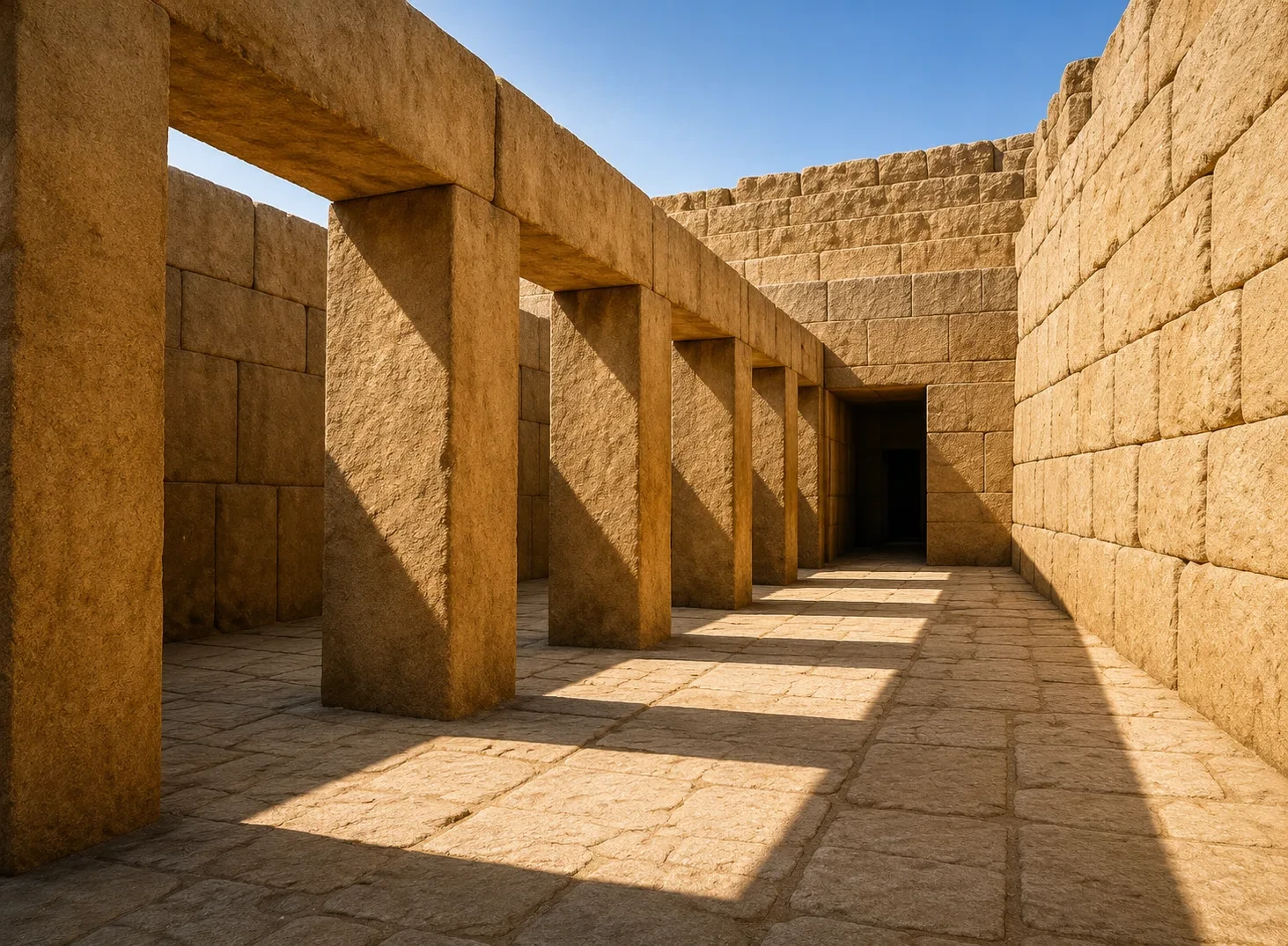
The massive limestone enclosure wall of the Djoser complex, restored by Jean-Philippe Lauer's extraordinary seven-decade programme of systematic architectural investigation and careful physical restoration to a substantial portion of its original 10.5-meter height in the most completely realized ancient Egyptian royal complex enclosure wall accessible to visitors at any heritage site in the complete Greater Cairo area, is one of the most immediately architecturally extraordinary and the most personally affecting features of the complete Djoser complex visit, a limestone screen of alternating projecting and receding panels whose characteristic palace facade niching pattern translates the ancient Egyptian royal architectural vocabulary of mudbrick palace construction into the entirely new material of limestone masonry in the most direct and the most architecturally informative possible demonstration of Imhotep's revolutionary translation of the complete ancient Egyptian royal architectural tradition from its original mudbrick material basis to the unprecedented stone construction medium of the Step Pyramid complex. The single real entrance to the complex in the south-eastern section of the enclosure wall leads into the extraordinary colonnade entrance passage, a roofed stone corridor whose ceiling of carefully shaped rounded stone logs reproduces in the permanent medium of limestone the appearance of the bundled papyrus-log roofing of ancient Egyptian mudbrick architecture, creating the most direct and the most architecturally legible possible demonstration of the ancient builder's strategy of translating the established visual vocabulary of mudbrick and organic material construction into the new stone medium of the Step Pyramid complex.
The Heb-Sed Court
The Heb-Sed court of the Djoser complex, a large open courtyard within the enclosure wall whose specific architectural programme of dummy chapel facades, stone sed-festival platforms, and ritual running track reflects the ancient Egyptian royal Heb-Sed renewal festival whose regular celebration by the pharaoh was the most important of all the ancient Egyptian royal ritual programmes for the renewal of royal power and the demonstration of royal vitality in the most complete and the most personally consequential royal religious ceremonial of the ancient Egyptian tradition, is the most archaeologically informative and the most personally engaging component of the Djoser complex beyond the pyramid itself, its specific architectural arrangements allowing the most complete reconstruction available at any ancient Egyptian heritage site of the specific spatial requirements of the ancient Egyptian royal renewal festival whose ritual choreography of royal running, royal sitting, and royal prostration before the assembled shrines of the Egyptian divine world was the most elaborate and the most symbolically consequential royal ceremonial in the complete ancient Egyptian religious tradition. The dummy chapel facades of the Heb-Sed court, built not as functional buildings but as architectural stage sets for the eternal ritual performance of the royal renewal festival in the afterlife, represent the most directly accessible and the most personally instructive available demonstration of the ancient Egyptian funerary ideology of providing in the built environment of the royal tomb complex all the spatial and architectural resources required for the eternal continuation of the royal ritual programme after death in the most complete and the most completely realized architectural expression of this ideology available at any accessible heritage site in the complete Greater Cairo area.
The Serdab And The Djoser Statue
The serdab of the Djoser complex, a sealed stone chamber positioned against the northern face of the pyramid's lower body whose specific architectural form of a completely closed stone box with two small circular eye-holes at the seated statue's eye level provides the most direct and the most personally affecting demonstration of the ancient Egyptian funerary concept of the serdab as the divine royal viewing point through which the enthroned royal soul could observe the ritual offerings performed in its honour in the adjacent offering space, is one of the most personally extraordinary and the most immediately historically legible architectural features of the complete Djoser complex programme, a building detail whose specific functional logic is so completely and so immediately communicable to the modern visitor through the direct experience of approaching the serdab and looking through the eye-holes to the interior where a plaster cast of the extraordinary painted limestone seated statue of Djoser reproduces the original ancient spatial experience of the divine royal gaze through the eye-holes of the sealed chamber in the most directly personal and the most completely affecting ancient funerary architectural encounter available at any accessible point in the complete Djoser complex visit. The original limestone seated statue of Djoser, recovered from the serdab by the early 20th century Saqqara excavations and currently housed in the Egyptian Museum in Cairo, is the oldest complete life-size painted royal portrait statue in the complete ancient Egyptian sculptural tradition, a limestone seated royal portrait of extraordinary historical significance and extraordinary personal immediacy whose specific antiquity of approximately 4,600 years gives it a quality of ancient historical presence in the Egyptian Museum collection that is surpassed in the complete ancient Egyptian sculptural heritage only by the prehistoric and Early Dynastic period objects of the Predynastic gallery.
The Unas Pyramid And The Pyramid Texts
The Pyramid of Unas, the last pharaoh of the 5th Dynasty who reigned approximately 2375 to 2345 BCE and whose pyramid stands at the southwestern edge of the Djoser complex enclosure wall on the Saqqara plateau, is the first ancient Egyptian royal pyramid monument to have its internal chambers inscribed with the religious texts that constitute the oldest surviving corpus of religious literature in the complete world heritage record. The Pyramid Texts of the Unas Pyramid, carved in hieroglyphic columns on the limestone walls of the burial chamber, antechamber, and connecting passage of the pyramid interior in a collection of 227 spells, hymns, and ritual incantations whose specific purpose is the protection and guidance of the royal soul through the dangers of the ancient Egyptian afterlife and its ultimate achievement of eternal union with the solar deity Re, represent the direct textual expression of the same royal funerary ideology that the architectural programme of the Step Pyramid complex expresses in its spatial and material form, giving the complete Saqqara heritage programme its most completely extraordinary combination of ancient architectural and ancient literary heritage in the form of the two most historically significant and the most personally extraordinary ancient monuments accessible at any single heritage site in the complete Greater Cairo area. The interior of the Unas Pyramid, accessible to visitors with a licensed Egyptology guide, provides the most direct and the most personally affecting encounter with the earliest surviving religious text in the complete world heritage record, the hieroglyphic columns of the Pyramid Texts in their original ancient architectural context giving the ancient words of the oldest religion a quality of material presence and personal immediacy that no museum display of the same texts however beautifully organized can quite replicate.
The Old Kingdom Mastaba Tombs: Mereruka, Ti, Kagemni, And Ptahhotep
The extraordinary collection of Old Kingdom elite mastaba tombs on the Saqqara plateau, whose painted limestone relief decoration representing every dimension of ancient Egyptian daily life in the Old Kingdom period constitutes the most completely realized, the most individually distinguished, and the most personally engaging documentary art of the ancient Egyptian cultural tradition accessible to visitors at any heritage site in the complete Greater Cairo area, gives the Saqqara heritage programme its most completely extraordinary and its most personally affecting dimension of ancient human cultural encounter beyond the pyramid monuments themselves, a dimension of direct documentary engagement with the ancient Egyptian daily world at its most vivid, its most humanly specific, and its most completely accessible that the monumental architectural heritage of the pyramid complex, however extraordinary, does not by itself provide. The mastaba tomb of Mereruka, the most extensive and the most complete of the accessible Old Kingdom mastaba tomb complexes on the Saqqara plateau, encompasses 32 individual decorated chambers whose extraordinary programme of painted and painted relief narrative scenes covers every aspect of the ancient Egyptian elite daily life from the most intimate personal activities of the tomb owner and his family to the most comprehensive documentary record of artisan activity, agricultural production, animal husbandry, and riverside commerce whose specific detail and human vitality give the Mereruka mastaba a quality of ancient documentary engagement with the living ancient Egyptian world that is simply the most complete and the most personally extraordinary of its kind accessible at any heritage site in the complete Egyptian archaeological landscape.
The mastaba tomb of Ti, one of the most celebrated and the most consistently admired painted relief tomb interiors in the complete Egyptian Old Kingdom heritage record, displays a narrative programme of extraordinary artistic quality and extraordinary documentary specificity whose scenes of hippopotamus hunting in the papyrus marshes, fishing from reed boats in the Nile, cattle herding across ancient Egyptian fields, and craftsmen at work in the ancient Egyptian workshop represent the most completely beautiful and the most most artistically sophisticated of all the documentary relief carving programmes in the accessible Old Kingdom mastaba tomb heritage of the Saqqara plateau. The mastaba of Kagemni, contemporary with the Mereruka tomb and similarly comprehensive in its documentary programme of the ancient Egyptian elite daily life, and the double mastaba of Ptahhotep and Akhethotep, whose extraordinary quality of fine line relief carving in the softest and the most technically demanding ancient Egyptian technique represents the highest available standard of Old Kingdom relief sculpture in the accessible mastaba tomb heritage of the complete Saqqara plateau, together give the complete Saqqara mastaba tomb programme a depth and a variety of ancient documentary art and ancient personal human presence that is simply unmatched at any other accessible heritage site in the complete Greater Cairo area and that gives the complete Saqqara heritage programme its most consistently extraordinary and its most personally unforgettable dimension beyond the pyramid monuments themselves.
The Serapeum: The Underground Gallery Of The Sacred Bulls
The Serapeum of Saqqara, the extraordinary underground gallery system discovered by Auguste Mariette in 1851 and used for the burial of the mummified sacred Apis bulls of the Memphis Ptah temple from the New Kingdom period of Amenhotep III through the Ptolemaic era of Ptolemy I in the most elaborate and the most completely extraordinary sacred animal burial tradition in the complete ancient Egyptian religious landscape, is one of the most personally overwhelming and the most atmospherically extraordinary underground ancient heritage encounters accessible at any heritage site in the complete Greater Cairo area, a vast network of underground corridors and side chambers cut from the Saqqara plateau bedrock whose massive granite sarcophagi of the mummified Apis bulls, each weighing between 60 and 80 tonnes of perfectly polished dark granite cut to dimensions of approximately 3.8 meters in length, 2.3 meters in width, and 2.3 meters in height, line the side chambers of the main gallery in the most physically overwhelming and the most personally extraordinary underground ancient Egyptian monument accessible to visitors at any heritage site in the complete Egyptian archaeological landscape. The sheer physical scale of the Serapeum experience, of descending into the underground gallery system by the original ancient entrance stairway and emerging into the vast underground corridor whose ceiling rises to approximately 5 meters above the gallery floor while the polished granite sarcophagi of the sacred bulls fill the side chambers in succession to left and right as far as the torchlight illuminates in each direction, creates the most immediately personal and the most completely extraordinary underground ancient heritage encounter available at any accessible site in the complete Greater Cairo area, an experience whose specific combination of geological drama, historical depth, and material scale has no parallel at any other underground ancient monument in the complete Egyptian heritage landscape.
The Imhotep Museum
The Imhotep Museum at Saqqara, established within the Saqqara site visitor complex to house and display the most significant objects discovered in successive generations of archaeological excavation at the Saqqara plateau, provides the most complete and the most expertly organized museum encounter with the material culture of the complete Saqqara necropolis accessible to visitors at any institutional facility within the site boundary, giving the complete Saqqara heritage visit a museum complement of considerable scholarly quality and considerable personal heritage significance whose specific collection of objects from the Djoser complex, the Old Kingdom mastaba tombs, the Serapeum, and the complete range of Saqqara archaeological contexts gives the visitor the most complete possible picture of the ancient material world of the Memphis necropolis in the most directly site-relevant museum display environment available at any ancient Egyptian necropolis site in the complete Greater Cairo heritage landscape. The museum's specific display of architectural fragments, sculptural elements, and decorative objects from the Djoser complex gives it an especially direct and especially personally enriching relationship with the primary monument of the Saqqara heritage programme, providing the most detailed and the most expertly interpreted collection context for the architectural innovations of Imhotep's revolutionary construction programme available at any museum institution in the complete Egyptian heritage landscape.
Why Is The Saqqara Step Pyramid Important?
The Saqqara Step Pyramid is important for reasons spanning the complete history of ancient architecture, the specific history of the ancient Egyptian pharaonic monument building tradition, the intellectual history of the human capacity for unprecedented architectural innovation, the religious history of the ancient Egyptian funerary theology in its most complete and most archaeologically legible Old Kingdom expression, and the broader cultural significance of the site as the UNESCO World Heritage-recognized primary location of the most historically consequential single architectural achievement in the history of the ancient world. As the world's oldest complete monumental stone building, the Step Pyramid establishes the foundational moment of the ancient Egyptian stone architecture tradition whose subsequent development produced the most extraordinary ancient building heritage in the complete world heritage record. As the work of Imhotep, the most completely extraordinary individual architectural genius in the ancient Egyptian historical tradition, the Step Pyramid gives the complete Saqqara heritage programme its most directly personal and most completely intellectually engaging dimension of individual human achievement and individual creative vision available at any ancient monument site in the complete Greater Cairo area. WOW Egypt Tours includes the Saqqara Step Pyramid as an essential destination in all comprehensive Cairo Tours, Egypt Classic Tours, and all Egypt Tour Packages encompassing the complete Greater Cairo ancient heritage circuit.
What Are Some Interesting Facts About The Saqqara Step Pyramid?
Imhotep: Architect, Physician, And God
The extraordinary trajectory of Imhotep's biographical legacy from the royal official whose specific architectural achievement of the Step Pyramid is documented in the inscriptions of the Djoser complex through the revered sage whose medical expertise attracted a tradition of attributed medical papyri in the centuries following his death to the deified god of wisdom and medicine whose cult was established throughout Egypt in the New Kingdom period and whose Ptolemaic era temple at Memphis attracted healing pilgrims from throughout the Mediterranean world is the most completely extraordinary individual post-mortem cultural career in the complete ancient Egyptian biographical tradition, a career whose specific trajectory from mortal official to immortal deity across more than two thousand years of ancient Egyptian cultural history is available to no other non-royal individual in the complete pharaonic historical record and whose specific recognition by the Greek medical tradition through the identification of Imhotep with Asclepius gives him the most direct and the most personally consequential cross-cultural legacy of any individual in the complete ancient Egyptian biographical tradition, connecting the specific genius of the Step Pyramid's architect to the origins of the Western medical tradition in the most extraordinary intellectual lineage available in the complete history of ancient Mediterranean civilization.
Mariette And The Serapeum Discovery Of 1851
The discovery of the Serapeum by Auguste Mariette in 1851 is one of the most celebrated and the most personally dramatic single archaeological discovery events in the complete history of 19th century Egyptological exploration, a discovery that began with Mariette's observation of a sphinx head protruding from the Saqqara desert sand near the ancient site of the Serapeum dromos, whose recognition as the remnant of the processional avenue of sphinxes leading to the Serapeum entrance led to the systematic clearance of the complete sphinx avenue and the identification of the Serapeum entrance stairway, and whose final dramatic culmination in the descent into the underground gallery system revealed the most physically overwhelming and the most personally extraordinary underground ancient Egyptian monument that any modern archaeological explorer had encountered to that point in the complete history of Egyptian archaeological investigation. Mariette's discovery of the Serapeum, which he described in his excavation reports in terms of the most astonished and the most personally overwhelmed superlatives available in the vocabulary of 19th century French Egyptological writing, established his reputation as the most consequential individual archaeological discoverer in Egypt of his generation and provided the most direct personal motivation for his subsequent campaign to establish the Egyptian Antiquities Service and the Egyptian national museum system as the institutional framework for the protection of the extraordinary ancient heritage whose most dramatic individual revelation his Serapeum discovery had provided.
Jean-Philippe Lauer's Seventy-Year Devotion
The extraordinary story of Jean-Philippe Lauer's more than seventy-year personal dedication to the archaeological investigation and architectural restoration of the Djoser complex and the complete Saqqara plateau heritage is the most remarkable example of individual scholarly commitment to a single ancient monument complex in the complete modern history of Egyptological investigation, a devotion that began in 1926 when the 23-year-old French architectural student arrived at Saqqara as the architect assigned to assist the Djoser complex excavation and that continued without significant interruption until Lauer's death in 2001 at the age of 99, encompassing a period of active scholarly engagement with the Saqqara site that spanned the complete middle decades of the 20th century and produced the most comprehensive and the most architecturally authoritative understanding of the Step Pyramid's construction history, its decorative programme, and its spatial organization that any comparable ancient monument in the complete Egyptian archaeological record has ever received from any single scholar's sustained individual investigative engagement. Lauer's restoration of the Djoser complex enclosure wall and the colonnade entrance to the most substantial section of their original physical character, carried out with meticulous archaeological precision and the most complete possible respect for the surviving ancient fabric, gave the modern visitor to the Saqqara site the most completely realized physical encounter with the ancient Djoser complex's spatial organization and architectural character that the monument's 4,600-year survival in the specific condition of the Saqqara desert environment makes practically possible, a gift of scholarly dedication to the heritage visiting public of every subsequent generation that deserves the most complete possible acknowledgment and the most genuine possible personal gratitude from every visitor who benefits from its extraordinary results.
What Is So Special About The Saqqara Step Pyramid?
The Building Where It All Began
What makes the Saqqara Step Pyramid uniquely and incomparably special in the complete ancient Egyptian heritage landscape is its position as the physical location of the single most historically consequential architectural innovation in the history of the ancient world, the point where the complete Egyptian pyramid building tradition began, the building whose creation by Imhotep's extraordinary individual genius established the architectural precedent and the technological foundation for all the subsequent pyramid monuments of the complete ancient Egyptian royal funerary tradition, from the experimental transitional pyramids of the Dahshur plateau to the supreme smooth-sided perfection of the Great Pyramid of Khufu at Giza. The specific quality of standing before the Step Pyramid on the Saqqara plateau and understanding that this is where it all began, that this specific building on this specific plateau is the oldest pyramid on earth and the oldest complete monumental stone building in the world, gives the Saqqara heritage visit a dimension of historical foundational significance and personal architectural wonder that is simply unavailable at any other ancient monument site in the complete Greater Cairo heritage landscape, not even at the more immediately overwhelming Giza Great Pyramids whose extraordinary physical scale makes the most visceral and the most immediately personally overwhelming impression but whose revolutionary architectural innovation was made possible by and is entirely dependent upon the earlier and the more intellectually extraordinary revolutionary achievement of Imhotep's Step Pyramid two generations before.
The Most Varied Ancient Heritage Landscape In Greater Cairo
The Saqqara plateau also offers the most varied and the most personally enriching complete heritage landscape programme of any accessible ancient Egyptian heritage site in the complete Greater Cairo area, a programme whose extraordinary range of heritage experiences, from the architectural revolutionary achievement of the Step Pyramid and the complete Djoser complex through the oldest religious text in the world in the Unas Pyramid's Pyramid Texts to the most personally extraordinary underground ancient monument of the Serapeum and the most completely beautiful and the most humanly engaging ancient documentary art of the painted mastaba tombs, gives every visitor to the complete Saqqara heritage programme the most genuinely comprehensive and the most personally extraordinary range of individual heritage encounters available in a single day's programme at any ancient Egyptian site in the complete Greater Cairo area.
The Saqqara Step Pyramid Through The Ages
The complete history of the Saqqara Step Pyramid from Imhotep's revolutionary construction in approximately 2667 BCE through the ancient Egyptian veneration of the monument as a sacred site throughout the pharaonic period, the progressive sand burial that protected the limestone fabric of the complex through the medieval and early modern period, the 19th century Egyptological investigations beginning with Karl Richard Lepsius's survey of 1843, the extraordinary Serapeum discovery of Mariette in 1851, the systematic early 20th century excavations of the Djoser complex by Cecil Firth and James Quibell, and the extraordinary seven-decade restoration and investigation programme of Jean-Philippe Lauer from 1926 to 2001, and continuing to the present generation of systematic excavations whose extraordinary new discoveries of intact animal cemeteries, previously unknown official tombs, and remarkable artifact assemblages give the Saqqara plateau one of the most exciting and the most consequential active archaeological investigation programmes in the complete Egyptian heritage landscape, traces the most continuously active and the most institutionally consequential ancient monument investigation biography of any single site in the complete Greater Cairo heritage area, a biography whose most recent chapters of extraordinary new discovery give the Saqqara heritage programme a quality of living archaeological excitement and continuing scholarly relevance entirely appropriate to the most historically consequential ancient monument site in the complete Egyptian pyramid building tradition.
The Saqqara Step Pyramid And UNESCO
The Saqqara Step Pyramid and the complete Saqqara necropolis are protected as primary components of the UNESCO World Heritage Site designated in 1979 as Memphis and its Necropolis: the Pyramid Fields from Giza to Dahshur, recognized as a heritage of outstanding universal value for the extraordinary concentration of ancient Egyptian pharaonic civilization heritage encompassing the world's oldest complete monumental stone building, the world's oldest surviving corpus of religious literature in the Pyramid Texts of the Unas Pyramid, the most extensive collection of Old Kingdom elite painted mastaba tomb heritage accessible at any heritage site in the complete Egyptian archaeological landscape, and the most physically overwhelming underground sacred animal burial installation in the complete ancient Egyptian religious heritage. The Egyptian government and the UNESCO World Heritage Committee are engaged in ongoing collaboration on the conservation management of the complete Saqqara heritage zone, addressing the specific challenges of a desert plateau site whose ongoing archaeological investigation continuously reveals new heritage elements requiring protection and management alongside the conservation of the already-identified monument fabric.
Best Time To Visit The Saqqara Step Pyramid
The best time to visit the Saqqara Step Pyramid and the complete Saqqara plateau heritage programme is during the cooler months from October through April when the desert plateau climate provides the most comfortable conditions for the extended outdoor walking programme of the Djoser complex, the Heb-Sed court exploration, the mastaba tomb circuit, and the movement between the various sites of the plateau whose considerable geographical extent and whose sand and limestone rock terrain require comfortable outdoor walking conditions for the most complete and the most personally satisfying heritage programme. The winter months of December through February offer the most extraordinary quality of low-angle morning light that illuminates the Step Pyramid's distinctive stepped profile in the most dramatically beautiful desert photography conditions of any time of the complete annual cycle. For the underground sites including the Unas Pyramid interior and the Serapeum, the consistent underground temperature makes these installations comfortable at any time of year, giving the summer visitor an important refuge from the extreme surface heat in the most dramatically atmospheric underground heritage encounters of the complete Saqqara programme. WOW Egypt Tours organizes Saqqara heritage programmes throughout the year and advises on optimal seasonal timing within the complete Greater Cairo southern heritage circuit.
Saqqara Step Pyramid Opening Hours
The Saqqara Step Pyramid and the complete Saqqara necropolis visitor complex are open daily from 8:00 AM to 5:00 PM in the winter season (October through April) and from 8:00 AM to 6:00 PM in the summer season (May through September). The underground sites including the Unas Pyramid interior and the Serapeum have access managed within the general visiting hours. The Imhotep Museum within the Saqqara visitor complex is open during site visiting hours. All visiting hours and specific underground site access are subject to adjustment for Egyptian national holidays and conservation management requirements, and current hours should be confirmed at time of booking with WOW Egypt Tours.
Saqqara Step Pyramid Entrance Fees
Saqqara general site admission (includes Step Pyramid and Djoser complex access): EGP 600 for adults, EGP 300 for students.
All Saqqara site entrance fees are included in the Cairo Tours and Egypt Tour Packages organized by WOW Egypt Tours. Fees are subject to periodic adjustment and current rates should be confirmed at time of booking.
How To Get To The Saqqara Step Pyramid
The Saqqara Step Pyramid is located approximately 27 kilometers south of central Cairo and approximately 3 to 4 kilometers west of the Memphis open-air museum, accessible by private vehicle from Cairo via the desert road through Giza and south to the Memphis area from which a shorter plateau access road leads westward to the Saqqara visitor complex, with a total journey time from central Cairo of approximately 45 minutes to one hour. The Saqqara site is not conveniently accessible by public transport from Cairo and the private vehicle organized by WOW Egypt Tours as part of the complete Greater Cairo southern heritage circuit is the most practical and the most personally efficient approach for all international visitors. The most naturally combined and the most geographically rational programme combines Saqqara with Memphis and Dahshur in the Greater Cairo southern heritage day circuit whose complete programme is organized and timed by WOW Egypt Tours to maximize the heritage engagement at each site within the available programme hours.
How Long To Spend At The Saqqara Step Pyramid
A minimum of three hours at Saqqara is required for a programme that covers the Step Pyramid and Djoser complex exterior including the enclosure wall, the colonnade entrance, the Heb-Sed court, and the serdab, the exterior of the Unas Pyramid, the Serapeum underground gallery, and one or two mastaba tomb interiors from the most celebrated and the most artistically distinguished of the accessible painted relief tomb programme. A more completely satisfying Saqqara programme of four to five hours allows the most thorough engagement with the complete Djoser complex, the Unas Pyramid interior with the Pyramid Texts, the complete Serapeum descent, at least three of the most important mastaba tombs including Mereruka, Ti, and either Kagemni or Ptahhotep, and a comprehensive visit to the Imhotep Museum, in the most unhurried and the most personally enriching complete Saqqara heritage programme format. The Saqqara plateau site is most naturally combined with Memphis and Dahshur in the complete Greater Cairo southern heritage day programme whose timing is organized by WOW Egypt Tours to allocate the appropriate programme time to each site in the most practically efficient and the most personally satisfying sequence. A dedicated full Saqqara day programme of six to seven hours is the most completely satisfying option for the most serious Egyptology-focused heritage traveler who wants the most comprehensive possible engagement with the complete plateau heritage programme across all its primary and secondary monument sites.
Tips For Visiting The Saqqara Step Pyramid
Begin the Saqqara programme with the Djoser complex entry through the colonnade entrance passage, asking your licensed Egyptology guide from WOW Egypt Tours to describe the specific architectural translation strategy that Imhotep used to reproduce the familiar ancient Egyptian mudbrick and organic material architectural vocabulary in the entirely new medium of limestone masonry, as the combination of the guide's expert explanation with the direct visual experience of the colonnade's rounded stone log ceiling and the enclosure wall's palace facade niching pattern creates the most complete and the most personally instructive architectural education in Imhotep's revolutionary construction programme available at any accessible point in the complete Saqqara heritage visit. Visit the Serapeum before the mastaba tombs in the programme sequence, as the underground gallery's extraordinary atmosphere of geological drama and historical depth, entering in the heat of the day from the desert surface and descending into the cool darkness of the ancient underground corridor with the massive granite sarcophagi of the sacred bulls illuminated in succession along the gallery walls, provides the single most atmospherically powerful and the most personally overwhelming heritage encounter of the complete Saqqara programme and deserves the freshest physical and emotional attention the visitor can bring to it. Allow at least 30 to 45 minutes in each of the most celebrated mastaba tombs and ask your guide to specifically identify and explain the most historically important and the most artistically extraordinary individual relief scenes in each tomb's complete decorative programme, as the cumulative understanding of the ancient Egyptian documentary art tradition that the progressive engagement with two or three mastaba tomb programmes provides is the most completely personally enriching and the most permanently memorable ancient documentary art encounter available at any heritage site in the complete Greater Cairo area.
What To Wear At The Saqqara Step Pyramid
The Saqqara plateau heritage visit is primarily an outdoor programme in the desert environment of the Nile Valley western plateau, requiring practical sun-protection clothing appropriate for extended outdoor exposure in the completely exposed desert terrain with very limited natural shade between monument sites. Lightweight breathable long-sleeved clothing covering the arms and legs, a wide-brimmed hat, high-SPF sunscreen, and UV-protective sunglasses are essential for comfortable outdoor exploration of the Djoser complex, the mastaba tomb exterior circuit, and the movement between the various plateau sites throughout the year. For the underground heritage sites including the Unas Pyramid interior and the Serapeum, a light sweater or jacket may be useful as the underground temperature is significantly cooler than the desert surface in the summer months when the temperature differential between the surface and the underground can be substantial. Sturdy walking shoes with good grip and ankle support are strongly recommended for the uneven limestone rock and desert sand terrain of the Saqqara plateau between monuments, which is significantly more demanding on footwear than the more accessible desert road surface of the Giza Plateau visitor circuit. Modest clothing covering the shoulders and knees is appropriate throughout the Saqqara site. Carry at least two liters of water per person for the complete Saqqara programme whose physical demands of outdoor walking in the desert environment require adequate hydration throughout the visit.
Photography At The Saqqara Step Pyramid
The Saqqara plateau provides the most photographically varied and the most individually extraordinary range of heritage photography subjects of any ancient Egyptian site in the complete Greater Cairo area, encompassing the exterior architecture photography of the Step Pyramid's six-stepped profile in the extraordinary desert light of the Saqqara plateau, the enclosure wall's palace facade niching photographed in the low morning light whose raking shadows most completely reveal the architectural relief of the ancient limestone masonry, the dramatic underground photography of the Serapeum gallery with its massive granite sarcophagi photographed in the available artificial lighting of the underground installation, the relief carving photography of the painted mastaba tomb interiors whose scenes of ancient Egyptian daily life provide the most completely extraordinary and the most individually distinguished subjects for ancient documentary art photography available at any heritage site in the complete Greater Cairo area, and the Unas Pyramid interior photography of the Pyramid Text inscriptions whose hieroglyphic columns in the cool blue-white painted chamber provide one of the most dramatically beautiful and the most historically resonant ancient text photography opportunities accessible at any heritage site in the Greater Cairo area. Photography is permitted throughout the accessible areas of the Saqqara site including the Serapeum and the Unas Pyramid interior, and photography in the mastaba tombs may require a specific photography permit whose availability and cost should be confirmed at the site entrance through the licensed Egyptology guide provided by WOW Egypt Tours.
Saqqara Step Pyramid Tours
Greater Cairo Southern Heritage Circuit: Saqqara, Memphis, And Dahshur
This comprehensive southern heritage day programme from Cairo combines the world's oldest complete monumental stone building and the most extraordinary painted mastaba tomb heritage at Saqqara with the ancient city remains and the magnificent Ramesses II colossus at Memphis and the experimental transitional pyramids at Dahshur in the most completely organized and the most personally enriching single-day ancient Egyptian heritage programme available in the complete Greater Cairo southern heritage area.
What Is Covered
Private vehicle from Cairo hotel with morning departure. Saqqara: Step Pyramid and Djoser complex with colonnade entrance and Heb-Sed court. Serdab and Djoser statue context. Unas Pyramid exterior and optional interior with Pyramid Texts. Serapeum underground gallery. Mastaba tombs of Mereruka and Ti with expert guided narrative of the relief carving documentary programme. Imhotep Museum. Memphis open-air museum: Ramesses II colossal statue and alabaster sphinx with embalming table programme. Lunch. Dahshur: Bent Pyramid of Sneferu and Red Pyramid of Sneferu with Valley Temple visit and optional Red Pyramid interior. Return to Cairo hotel in the late afternoon.
Duration
Full day from Cairo hotel, approximately 9 to 10 hours.
Includes
Private vehicle, licensed Egyptology guide, all site entrance fees for Saqqara, Memphis, and Dahshur including Serapeum and mastaba tomb fees, lunch, and all logistics. Through WOW Egypt Tours Cairo Tours.
Dedicated Saqqara Full Programme
For visitors whose specific cultural interest in the complete Saqqara plateau heritage warrants a dedicated full programme, this focused Saqqara visit provides the most completely satisfying and the most personally enriching engagement with all the primary monument programmes of the most historically extraordinary and the most archaeologically varied ancient Egyptian necropolis site in the complete Greater Cairo heritage landscape.
What Is Covered
Private vehicle from Cairo hotel. Complete Saqqara plateau programme: Step Pyramid and complete Djoser complex including enclosure wall, colonnade entrance, Heb-Sed court, North and South Houses, serdab. Unas Pyramid interior with complete Pyramid Texts guided programme. Serapeum underground gallery with expert guided historical and religious narrative. Four mastaba tombs: Mereruka, Ti, Kagemni, and Ptahhotep with expert guided analysis of the most important and the most artistically extraordinary individual relief scene programmes of each tomb. Imhotep Museum comprehensive collection visit. Return to Cairo hotel.
Duration
Full day dedicated to Saqqara, approximately 6 to 7 hours on site.
Includes
Private vehicle, licensed Egyptology guide, all Saqqara site entrance fees including all underground and mastaba tomb fees, and all logistics. Through WOW Egypt Tours Cairo Tours.
Combine The Saqqara Step Pyramid With Your Egypt Tours Package
The Saqqara Step Pyramid is included as an essential destination in the Greater Cairo southern heritage circuit across the full range of WOW Egypt Tours travel products. Browse the options below to find the Egypt experience that includes Saqqara.
Egypt Tour Packages: Multi-day guided Egypt tours organized by duration, including 2 Days Egypt Packages, 3 Days Egypt Packages, 4 Days Egypt Packages, 5 Days Egypt Packages, 6 Days Egypt Packages, 7 Days Egypt Packages, 8 Days Egypt Packages, 10 Days Egypt Packages, and longer itineraries. Saqqara is included in Egypt Tour Packages of 5 days and above as part of the complete Greater Cairo southern heritage circuit combining Saqqara with Memphis and Dahshur. All packages include private vehicle, licensed Egyptology guide, accommodation, all site entrance fees, and all logistics.
Egypt Travel Packages: Themed Egypt travel packages including Egypt Honeymoon Travel Packages, Egypt Budget Travel Packages, Egypt Family Travel Packages, Egypt Luxury Travel Packages, Egypt Adventure Travel Packages, Egypt Cultural Travel Packages, and Egypt Christmas and New Year Travel Packages. Saqqara is featured in Cultural and Classic themed packages as the location of the world's oldest complete monumental stone building, the world's oldest surviving religious literature, and the most extraordinary Old Kingdom painted mastaba tomb heritage in the complete Egyptian archaeological landscape.
Egypt Classic Tours: The most popular and the most comprehensively balanced Egypt travel programme, combining the complete Giza Plateau programme with the Greater Cairo southern heritage circuit of Saqqara, Memphis, and Dahshur, and the Nile Valley heritage of Luxor and Aswan, in the most complete and the most personally satisfying introduction to the ancient Egyptian world available in any organized Egypt itinerary. Saqqara is the primary destination of the southern heritage circuit that gives the Egypt Classic Tours programme its most complete archaeological and chronological coverage of the ancient Egyptian Memphite pyramid tradition.
Egypt Short Break Tours: Focused short duration Egypt travel programmes for travelers with limited time. Saqqara is included in Egypt Short Break Tours of 4 days and above as part of the Greater Cairo southern heritage circuit, with the Step Pyramid and Djoser complex combined with the Serapeum as the most efficiently organized compact Saqqara programme for the time-limited heritage visitor.
Egypt Family Tours: Family-friendly Egypt travel programmes in which the Step Pyramid as the world's oldest pyramid, the extraordinary underground atmosphere of the Serapeum with its massive granite bull sarcophagi, the animal mummy discoveries, and the vivid documentary narrative scenes of the mastaba tomb reliefs together provide one of the most varied and the most personally engaging heritage programmes for families with children of all ages visiting the Greater Cairo southern heritage circuit.
Egypt Budget Tours: Value-focused Egypt travel programmes providing access to the Saqqara Step Pyramid, the Serapeum, and the mastaba tomb programme at the most economical pricing available from any professional Egyptian tour operator, ensuring that the world's oldest pyramid is accessible to travelers at every budget level.
Egypt Nile Cruises: All-inclusive Nile River Cruise programmes combining the ancient pharaonic heritage of Luxor and Aswan with Cairo extensions that include Saqqara as part of the complete Greater Cairo southern heritage circuit for the most historically complete Cairo programme complement to the Nile Valley cruise experience.
Nile River Cruises: All WOW Egypt Tours Nile cruise options. Saqqara is available as part of the Greater Cairo southern heritage circuit Cairo extension from the beginning or end of any Nile River Cruise itinerary.
Luxor Aswan Nile Cruises: Saqqara combined with Memphis and Dahshur is the primary Greater Cairo southern heritage programme for any Luxor-Aswan Nile cruise Cairo extension, providing the most chronologically complete coverage of the complete ancient Egyptian pyramid building tradition from its revolutionary origin to its supreme Giza expression.
Dahabiya Nile Cruises: Saqqara available as part of the Greater Cairo southern heritage circuit for travelers combining the most intimate private Nile sailing experience with the world's oldest complete monumental stone building and the most extraordinary underground ancient heritage of the Serapeum.
Lake Nasser Cruises: Saqqara available as part of the Cairo extension for travelers combining the extraordinary Nubian heritage of Lake Nasser with the world's first pyramid and the most extraordinary painted mastaba tomb heritage in the complete Greater Cairo archaeological landscape.
Cairo Tours: The complete range of guided day tour programmes available from Cairo hotels, including the Greater Cairo southern heritage circuit combining Saqqara with Memphis and Dahshur, the dedicated Saqqara full day programme, the complete Greater Cairo pyramid circuit combining Saqqara, Dahshur, Memphis, and the Giza Plateau in a two-day programme, the Islamic Cairo programme covering the Khan El Khalili, El Moez Street, Saladin Citadel, and Muhammad Ali Mosque, and the Coptic Cairo programme covering the Hanging Church, Coptic Museum, and Ben Ezra Synagogue. All Cairo Tours include private vehicle, licensed Egyptology guide, all entrance fees, and all logistics organized by WOW Egypt Tours.
Nearby Attractions To The Saqqara Step Pyramid
The Saqqara Step Pyramid is situated at the center of the most extraordinary concentration of ancient Egyptian funerary heritage in the complete Greater Cairo southern heritage area, immediately adjacent to and most naturally combined with the ancient city of Memphis to the east and the Dahshur pyramid monuments to the south as the primary components of the Greater Cairo southern heritage circuit. The most immediately proximate and the most naturally combined nearby heritage destination within the Saqqara plateau itself is the complete range of the plateau's own monument sites, encompassing the Unas Pyramid with its extraordinary Pyramid Texts, the Serapeum underground gallery, the painted mastaba tombs of Mereruka, Ti, Kagemni, and Ptahhotep, the Imhotep Museum, and the additional pyramid monuments of the Old and Middle Kingdom periods whose presence on the plateau makes the complete Saqqara site the most archaeologically varied and the most heritage-rich single ancient Egyptian necropolis zone in the complete Greater Cairo area.
The Memphis open-air museum approximately 3 to 4 kilometers east of the Saqqara plateau is the most immediately proximate and the most historically relevant nearby heritage destination, its ancient city remains providing the most direct urban context for understanding the funerary landscape of the Saqqara necropolis as the cemetery of the ancient Egyptian capital city. The Dahshur Pyramids of Sneferu approximately 10 kilometers south of Saqqara, encompassing the extraordinary Bent Pyramid and the Red Pyramid whose experimental transitional forms most directly document the architectural development from the Saqqara Step Pyramid to the smooth-sided true pyramid of the Giza tradition, provide the most chronologically essential and the most architecturally immediate complement to the Saqqara heritage programme in the complete southern heritage circuit. The Giza Pyramids Complex approximately 32 kilometers north of Saqqara, with the Great Pyramid of Khufu, the Great Sphinx, and the Valley Temple of Khafre, provides the supreme architectural culmination of the pyramid building tradition whose revolutionary origin is at Saqqara. The Grand Egyptian Museum and the Egyptian Museum house the most important objects from the complete Saqqara excavation programme including the seated statue of Djoser and the Saqqara collection highlights, providing the most important institutional collection complement to the Saqqara site visit in the complete Greater Cairo heritage landscape. All these destinations are organized by WOW Egypt Tours as part of comprehensive Cairo Tours and Egypt Tour Packages encompassing the extraordinary heritage of Cairo the Capital of Egypt.
Frequently Asked Questions About The Saqqara Step Pyramid
What is the Saqqara Step Pyramid?
The Saqqara Step Pyramid, officially the Pyramid of Djoser, is the world's oldest complete monumental stone building and the world's first pyramid, built approximately 2667 to 2648 BCE by the architect Imhotep for the pharaoh Djoser of the Egyptian Old Kingdom 3rd Dynasty on the desert plateau above ancient Memphis, approximately 27 kilometers south of Cairo. It rises in six steps to approximately 60 meters and stands at the center of the most complete ancient Egyptian royal funerary complex accessible at any Greater Cairo heritage site. It is featured in Cairo Tours, Egypt Classic Tours, and Egypt Short Break Tours offered by WOW Egypt Tours.
Who designed the Saqqara Step Pyramid?
The Step Pyramid was designed by Imhotep, the ancient Egyptian royal official, architect, physician, and sage who served as Chancellor of the pharaoh Djoser and who conceived and oversaw the construction of the world's first monumental stone building. Imhotep was later deified in the New Kingdom period as a god of wisdom and medicine, identified by the Greeks with Asclepius, and remained venerated throughout the complete Ptolemaic era in the most extraordinary posthumous cultural career of any non-royal individual in the complete ancient Egyptian biographical tradition.
What is the Serapeum at Saqqara?
The Serapeum is an extraordinary underground gallery system discovered by Auguste Mariette in 1851, used for the burial of the sacred Apis bulls of the Memphis Ptah temple from the New Kingdom through the Ptolemaic era. Descending into the vast underground corridors, the visitor encounters massive granite sarcophagi weighing 60 to 80 tonnes each lining the gallery side chambers in succession, providing the most physically overwhelming and the most atmospherically extraordinary underground ancient heritage encounter accessible at any site in the complete Greater Cairo area.
What are the Pyramid Texts of the Unas Pyramid?
The Pyramid Texts inscribed on the limestone walls of the Unas Pyramid interior are the oldest surviving corpus of religious literature in the complete world heritage record, a collection of 227 spells, hymns, and ritual incantations carved in hieroglyphic text during the reign of Unas, last pharaoh of the 5th Dynasty (approximately 2375 to 2345 BCE), whose specific purpose is facilitating the royal soul's safe passage through the dangers of the ancient Egyptian afterlife and its ultimate union with the solar deity Re. They are the direct textual predecessors of all subsequent ancient Egyptian funerary literature including the later Middle Kingdom Coffin Texts and the New Kingdom Book of the Dead.
What is the Heb-Sed court in the Djoser complex?
The Heb-Sed court is a large open courtyard within the Djoser complex enclosure wall whose specific architectural programme of dummy chapel facades, stone platforms, and ritual running tracks reflects the ancient Egyptian royal Heb-Sed renewal festival, the most important royal ceremonial programme for the renewal of royal power and the demonstration of royal vitality in the ancient Egyptian religious tradition. Built in limestone rather than functional structures, the dummy chapels served as eternal stage sets for the royal renewal festival's continuation in the afterlife, the most complete and the most directly accessible demonstration of the ancient Egyptian funerary ideology of providing in the built tomb environment all the spatial resources required for the eternal continuation of the royal ritual programme.
What are the mastaba tombs at Saqqara?
The mastaba tombs of the Saqqara plateau are the flat-topped rectangular ancient Egyptian elite burial monuments of the Old Kingdom period whose limestone-faced interiors are decorated with the most complete and the most artistically extraordinary painted and incised relief programmes of ancient Egyptian daily life documentation accessible at any heritage site in the complete Greater Cairo area. The most celebrated are the mastaba of Mereruka (32 decorated chambers, the most extensive accessible mastaba tomb complex), the mastaba of Ti (whose hippopotamus hunting and workshop scenes are among the most beautiful and the most artistically refined relief carvings in the complete Old Kingdom heritage), the mastaba of Kagemni, and the double mastaba of Ptahhotep and Akhethotep.
Who was Jean-Philippe Lauer?
Jean-Philippe Lauer was the French architect who devoted more than 70 years of his professional life from 1926 to 2001 to the systematic excavation, documentation, and architectural restoration of the Djoser complex and the Saqqara plateau heritage, dying at the age of 99 as the world's primary Djoser complex authority and the person most personally responsible for the modern visitor's ability to experience the Step Pyramid complex in the most completely realized physical form that four and a half millennia of desert survival makes practically possible. His restoration of the enclosure wall and the colonnade entrance is among the most remarkable and the most personally consequential individual scholarly contributions to the accessible heritage character of any ancient Egyptian monument in the complete Greater Cairo heritage landscape.
Is the Saqqara Step Pyramid older than the Giza Pyramids?
Yes. The Saqqara Step Pyramid was built approximately 2667 to 2648 BCE during the reign of the pharaoh Djoser of the 3rd Dynasty, making it approximately 100 to 150 years older than the Great Pyramid of Khufu at Giza (approximately 2560 BCE) and the most ancient of all the accessible ancient Egyptian pyramid monuments, as well as the world's oldest complete monumental stone building in the complete world heritage record. The Step Pyramid is the direct architectural prototype and the direct historical predecessor of all the smooth-sided true pyramids including the Giza Great Pyramids.
Can I go inside any pyramid at Saqqara?
Yes. The Unas Pyramid interior, housing the world's oldest surviving corpus of religious literature in the form of the Pyramid Texts inscribed on the limestone chamber walls, is accessible to visitors with an additional ticket. The interior provides the most direct and the most personally affecting encounter with the oldest written religious literature in the complete world heritage record. The Step Pyramid interior itself is not currently accessible to visitors for structural conservation reasons. Entry to the Unas Pyramid is organized through the licensed Egyptology guide provided by WOW Egypt Tours.
What other sites can I combine with Saqqara?
The most natural and the most historically organized combination is the Greater Cairo southern heritage circuit combining Saqqara with Memphis (ancient capital city, Ramesses II colossus, alabaster sphinx) and Dahshur (Bent Pyramid and Red Pyramid of Sneferu, the architectural bridge between the Step Pyramid and the Giza Great Pyramids) in the most completely organized and the most personally enriching Greater Cairo southern heritage day programme available from any Cairo hotel base.
How do I book a Saqqara Step Pyramid tour with WOW Egypt Tours?
You can book any Cairo Tours programme, Egypt Classic Tours package, Egypt Short Break Tours programme, Egypt Family Tours, Egypt Budget Tours, Egypt Tours Package, or Egypt Travel Package that includes Saqqara directly through WOW Egypt Tours. Our team of travel specialists will arrange private vehicle, licensed Egyptology guide, all Saqqara site entrance fees including the Serapeum, Unas Pyramid Pyramid Texts interior, and the mastaba tomb programme, and the most complete and the most personally extraordinary guided encounter with the world's oldest pyramid, the world's oldest complete monumental stone building, the world's oldest surviving religious literature, and the most extraordinary underground ancient Egyptian monument available through any Egyptian heritage tour operator.