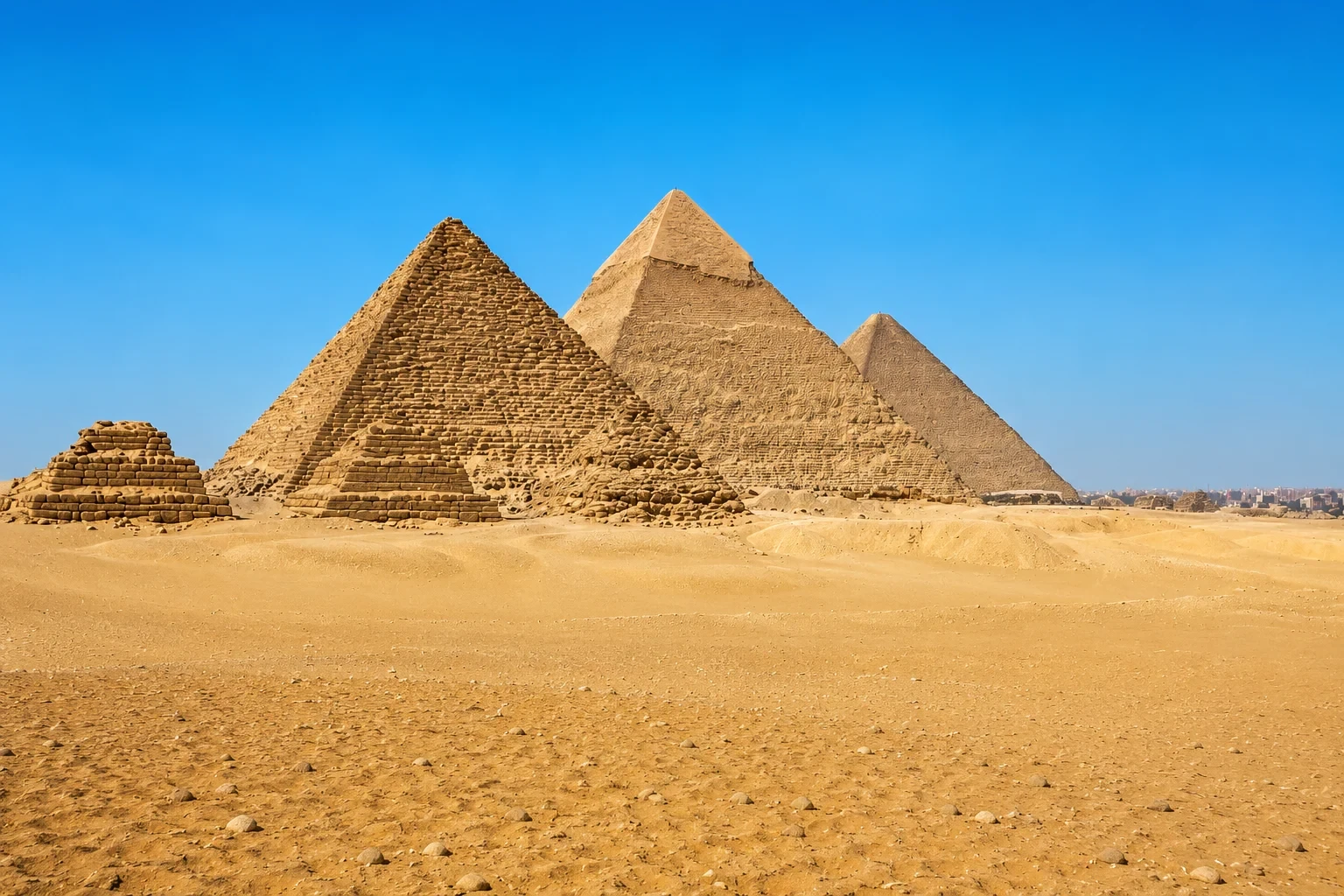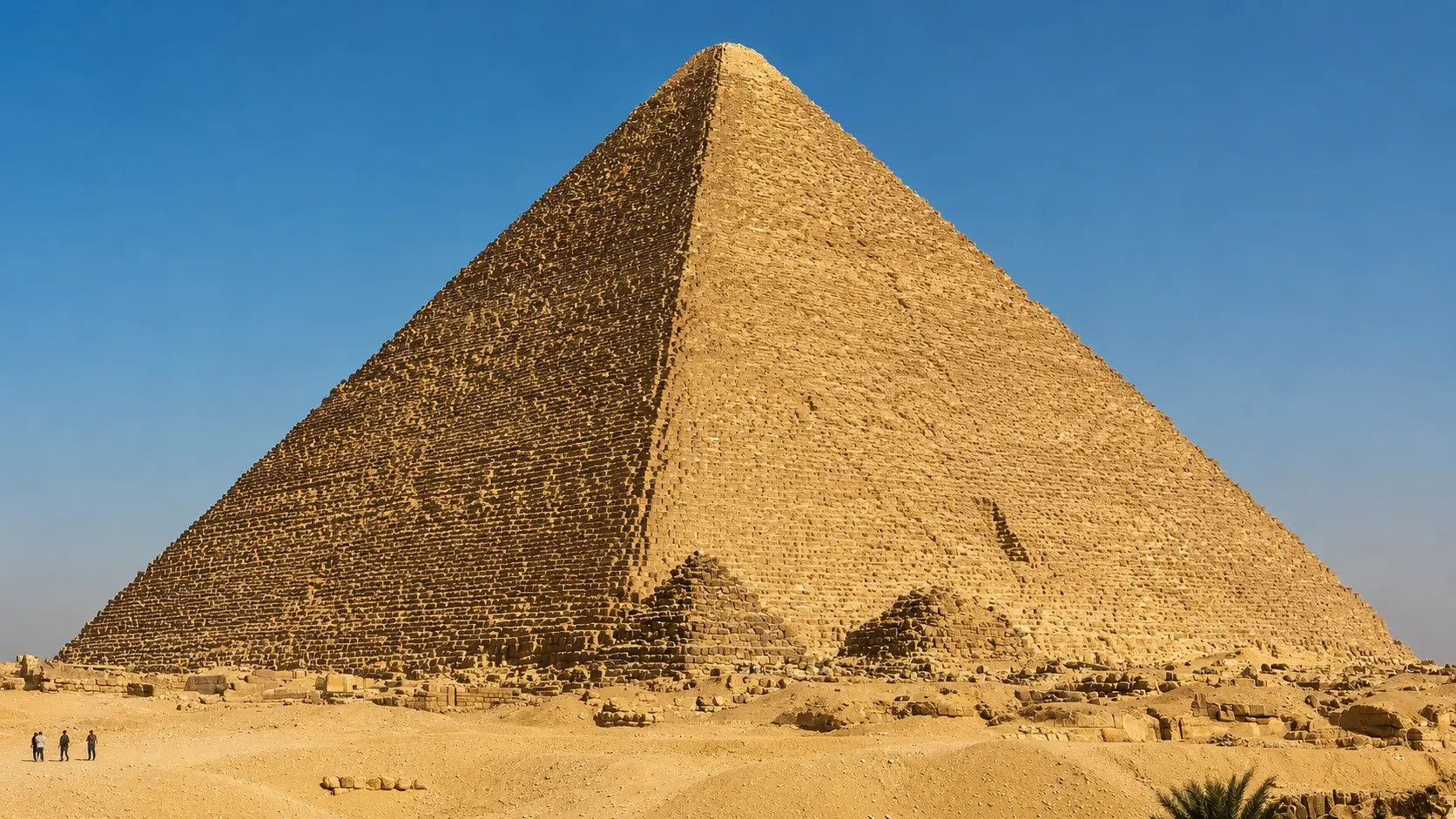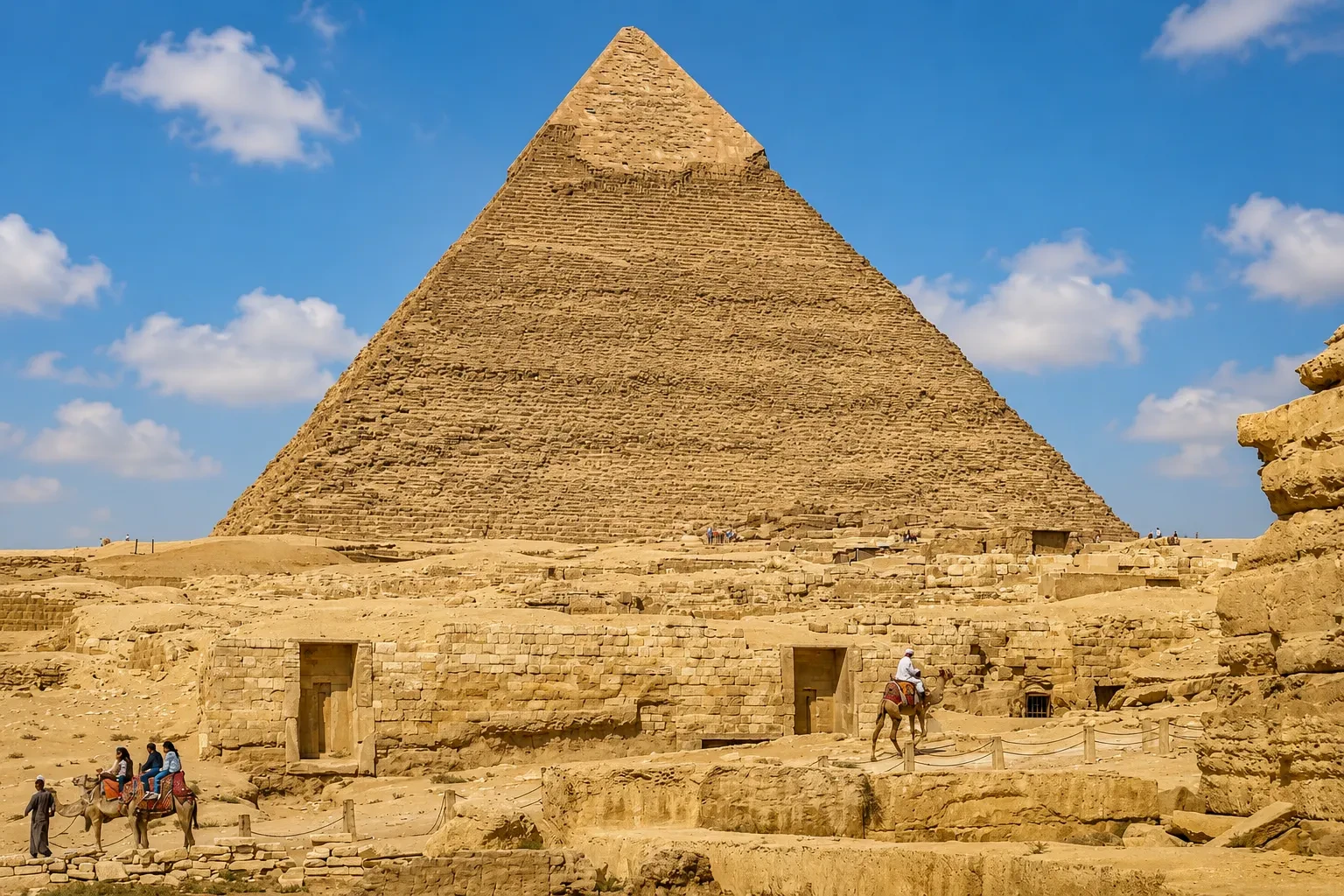


The Dahshur Pyramids are the most architecturally informative, the most historically consequential, and in the specific context of understanding the complete evolutionary development of the ancient Egyptian pyramid building tradition the single most important and the most personally illuminating pyramid monuments accessible at any heritage site in the complete Greater Cairo area, a complex of royal pyramid monuments built primarily by the pharaoh Sneferu, founder of the Egyptian Old Kingdom 4th Dynasty and father of Khufu the builder of the Great Pyramid of Giza, on the desert plateau of the Dahshur necropolis approximately 40 kilometers south of central Cairo in a location whose relative remoteness from the tourist infrastructure of the northern Giza and Saqqara sites gives it a quality of desert isolation and personal archaeological immediacy that the more heavily visited northern pyramid sites cannot provide in the same undiluted and the same personally affecting form. The Dahshur pyramids are the crucial architectural missing link between the Saqqara Step Pyramid, the world's oldest complete monumental stone building whose six-stepped form represents the starting point of the ancient Egyptian pyramid building tradition, and the supreme smooth-sided true pyramids of the Giza Pyramids Complex whose perfection of geometric form and astronomical precision are the most universally recognized ancient architectural achievements in the history of the world, with the extraordinary Bent Pyramid of Sneferu providing the most completely extraordinary and the most personally instructive single ancient monument demonstration of the specific moment of architectural transition between the stepped and the smooth-sided pyramid form in the complete ancient Egyptian building tradition. This extraordinary site is featured in Cairo Tours, Egypt Classic Tours, and Egypt Short Break Tours, all of which WOW Egypt Tours proudly offers to travelers from around the world as part of Egypt Tours Packages and Egypt Travel Packages that encompass the extraordinary ancient heritage of Cairo and the complete Egyptian Nile Valley civilization.
The Dahshur Pyramids Egypt site encompasses two of the most historically significant and the most personally extraordinary pyramid monuments in the complete Egyptian heritage record, the extraordinary Bent Pyramid of Sneferu whose unique double-angled profile rising first at approximately 54 degrees and then shifting to approximately 43 degrees near the mid-point of its height documents in its visible physical form the single most dramatic and the most personally legible ancient construction decision preserved in any ancient Egyptian monument, and the Red Pyramid of Sneferu whose perfectly smooth-sided true pyramid form of approximately 104 meters in height and whose interior chamber system of three consecutive corbelled rooms accessible to visitors through the original northern entrance passage makes it simultaneously the world's first true smooth-sided pyramid and the most easily accessible pyramid interior in the complete Greater Cairo area, together with the substantial ruins of the Middle Kingdom 12th Dynasty pyramids of Amenemhat II, Senusret III, and Amenemhat III whose physical remains on the Dahshur plateau extend the heritage significance of the site from the Old Kingdom 4th Dynasty royal monument programme into the Middle Kingdom pyramid-building tradition in the most geographically concentrated and the most chronologically comprehensive succession of royal pyramid monuments available at any single heritage site in the complete Greater Cairo archaeological landscape. WOW Egypt Tours includes the Dahshur Pyramids as an essential destination in all comprehensive Cairo Tours, Egypt Classic Tours, Egypt Short Break Tours, Egypt Family Tours, Egypt Budget Tours, and all Egypt Tour Packages that encompass the extraordinary ancient heritage of the Egyptian capital region.

What Are The Dahshur Pyramids?
The Dahshur Pyramids are a group of ancient Egyptian royal pyramid monuments located on the Dahshur desert plateau in Giza Governorate, approximately 40 kilometers south of central Cairo and approximately 10 kilometers south of the Saqqara Step Pyramid Complex, whose most significant surviving monuments encompass the extraordinary Bent Pyramid of Sneferu and the Red Pyramid of Sneferu from the Old Kingdom 4th Dynasty built approximately 2600 BCE, the Black Pyramid of Amenemhat III and the White Pyramid of Amenemhat II from the Middle Kingdom 12th Dynasty, and the ruins of additional Middle Kingdom pyramid monuments whose combined presence on the Dahshur plateau gives the site its most extraordinary chronological range of royal pyramid monument heritage, spanning more than four hundred years of ancient Egyptian pyramid construction from the pioneering experimental monuments of Sneferu through the Middle Kingdom restoration of the pyramid building tradition under the powerful 12th Dynasty pharaohs. The Dahshur plateau site is significantly less visited than the Giza and Saqqara pyramid sites, giving it a quality of personal desert exploration and individual heritage engagement with the ancient monuments in a relatively uncrowded environment that the most popular Greater Cairo pyramid sites cannot provide, and whose specific character of isolated desert majesty, of massive ancient pyramids rising from the open desert floor without the modern urban development that surrounds the Giza plateau on three sides, gives the Dahshur visit a quality of ancient landscape authenticity and personal archaeological immediacy that the visitor who experiences it for the first time consistently describes as one of the most personally extraordinary and the most atmospherically complete ancient desert heritage encounters available at any accessible pyramid site in the complete Greater Cairo area.
Who Built The Dahshur Pyramids?
The primary builder of the Dahshur Pyramids is the pharaoh Sneferu, the first pharaoh of the Egyptian Old Kingdom 4th Dynasty, the father of Khufu the builder of the Great Pyramid of Giza, and the most prolific and the most architecturally ambitious pyramid builder in the complete ancient Egyptian royal tradition, a pharaoh whose extraordinary pyramid construction programme encompassing at least three and possibly four major pyramid monuments represents the largest volume of stone quarried, transported, and assembled for a single pharaoh's funerary building programme in the complete ancient Egyptian pyramid-building sequence. Sneferu reigned approximately from 2613 to 2589 BCE as the son of the pharaoh Huni, the last ruler of the 3rd Dynasty, and succeeded to the Egyptian throne at the beginning of the 4th Dynasty whose extraordinary pyramid-building achievements, culminating in the Giza Great Pyramids of his successors Khufu, Khafre, and Menkaure, represent the most ambitious and the most completely extraordinary royal funerary construction programme in the complete history of ancient Egyptian civilization. The specific attribution of the Bent Pyramid and the Red Pyramid at Dahshur to Sneferu is established by ancient Egyptian administrative inscriptions recovered from the Dahshur plateau sites, by the graffiti of ancient Egyptian inspection teams whose dated administrative marks on the pyramid casing blocks provide some of the most direct available evidence for the construction chronology of the Sneferu pyramid programme, and by the ancient Egyptian historical tradition that consistently identifies Sneferu as the builder of the Dahshur pyramid monuments in the king lists and the administrative records of the complete ancient Egyptian documentary tradition.
The Middle Kingdom pyramids of the Dahshur plateau were built by the most powerful pharaohs of the 12th Dynasty during the approximately 2000 to 1800 BCE period of the Middle Kingdom's extraordinary cultural and political achievement, with the Black Pyramid attributed to Amenemhat III, one of the most celebrated and the most personally compelling pharaohs of the complete Middle Kingdom tradition, the White Pyramid attributed to Amenemhat II, and the subsidiary pyramid ruins of the plateau representing the remains of additional Middle Kingdom royal funerary installations whose less completely preserved physical character reflects both the substantially different construction tradition of the Middle Kingdom pyramid programme, which used mudbrick cores with limestone outer casings rather than the solid stone core construction of the Old Kingdom monuments, and the much greater vulnerability of the mudbrick construction to the weathering, quarrying, and robbing processes that have reduced the Middle Kingdom Dahshur monuments to their current ruined condition over the more than 3,500 years since their construction.
Sneferu: Egypt's Greatest Pyramid Builder
Sneferu's claim to the title of the greatest pyramid builder in the complete ancient Egyptian royal tradition rests not on the scale of any single monument but on the extraordinary total volume of stone used in his complete pyramid building programme, which encompassed the Bent Pyramid and the Red Pyramid at Dahshur, the Meidum Pyramid approximately 100 kilometers south of Cairo whose architectural development from a stepped to a smooth-sided form parallels in a different specific form the same evolutionary transition documented in the Bent Pyramid's unique double-angled profile, and possibly a fourth pyramid monument at Seila in the Faiyum region, together producing a total volume of approximately 3.5 million cubic meters of quarried and assembled stone that exceeds the total stone volume of the Great Pyramid of Khufu and makes Sneferu's complete pyramid programme the single most physically extensive royal funerary construction achievement in the history of the ancient world. The specific architectural significance of Sneferu's pyramid building programme for the complete history of ancient Egyptian architecture derives primarily from the extraordinary architectural experimentation documented in the Bent Pyramid and the Meidum Pyramid, whose progressive development from stepped to angled and ultimately to smooth-sided true pyramid form across the sequence of Sneferu's building career traces the most dramatic and the most consequential single architectural evolutionary trajectory in the complete ancient Egyptian building tradition, the development of the specific constructional and geometric understanding required to realize the perfectly smooth-sided true pyramid form whose first successful complete expression in the Red Pyramid of Sneferu at Dahshur was the most important architectural prerequisite for the supreme Giza achievements of Sneferu's son Khufu and his grandsons Khafre and Menkaure.
The ancient Egyptian historical tradition associated with Sneferu gives him one of the most personally sympathetic and the most humanly appealing royal characters available in the complete pharaonic historical record, presenting him in the Middle Kingdom literary tradition known as the Westcar Papyrus as a good-natured and somewhat playful monarch who amuses himself by having his court ladies row him across a palace lake in semi-transparent linen dresses, who is portrayed in a context of domestic ease and personal approachability that is entirely unlike the distant divine authority of most ancient Egyptian royal literary portraits, and who was revered in the historical memory of the later Egyptian population as a benevolent and just ruler whose personal generosity and personal accessibility to his subjects gave him a specific character of royal goodness that stands in direct contrast to the tradition of royal tyranny associated in the ancient Greek accounts of Herodotus with his son Khufu. Whether or not this specifically sympathetic literary portrait accurately reflects the historical Sneferu's specific royal character, it gives the Dahshur Pyramids a dimension of human biographical interest and personal royal identity that the purely architectural significance of the monuments themselves, however extraordinary, does not by itself provide, making the visit to the Dahshur pyramid site a heritage encounter with both the most architecturally instructive ancient Egyptian royal monuments and the most personally appealing ancient Egyptian royal biographical tradition simultaneously available at any single heritage site in the complete Greater Cairo area.
Dahshur Pyramids Location
The Dahshur Pyramids are located on the Dahshur desert plateau in Giza Governorate, approximately 40 kilometers south of central Cairo, approximately 10 kilometers south of the Saqqara Step Pyramid Complex, and approximately 5 kilometers south of the Memphis open-air museum at Mit Rahina, in a position on the desert plateau that places the monuments in the most completely open and the most personally accessible desert landscape setting of any pyramid monuments in the complete Greater Cairo area, with no modern urban development visible from the pyramid base viewpoints to the north, west, or south and only the agricultural landscape of the Nile Valley visible to the east in the most nearly authentic ancient desert pyramid landscape available to any visitor at any accessible pyramid site in the complete Egyptian heritage record. The Dahshur site is accessible from Cairo by the desert road through Giza and south through the Memphis area to the Dahshur plateau access point, with a total journey time from central Cairo of approximately 50 minutes to one hour by private vehicle. The Dahshur Pyramids are most naturally and most efficiently visited as the final component of the complete Greater Cairo southern heritage circuit combining Memphis, Saqqara, and Dahshur in a single day programme organized by WOW Egypt Tours, with the southernmost position of Dahshur making it the logical last destination of the southward progression of the circuit before the return journey northward to Cairo. WOW Egypt Tours provides private vehicle transportation from all Cairo hotels to Dahshur and organizes the complete Dahshur, Memphis, and Saqqara heritage circuit as part of all Cairo Tours and Egypt Tour Packages.
Dahshur Pyramids Fun Facts
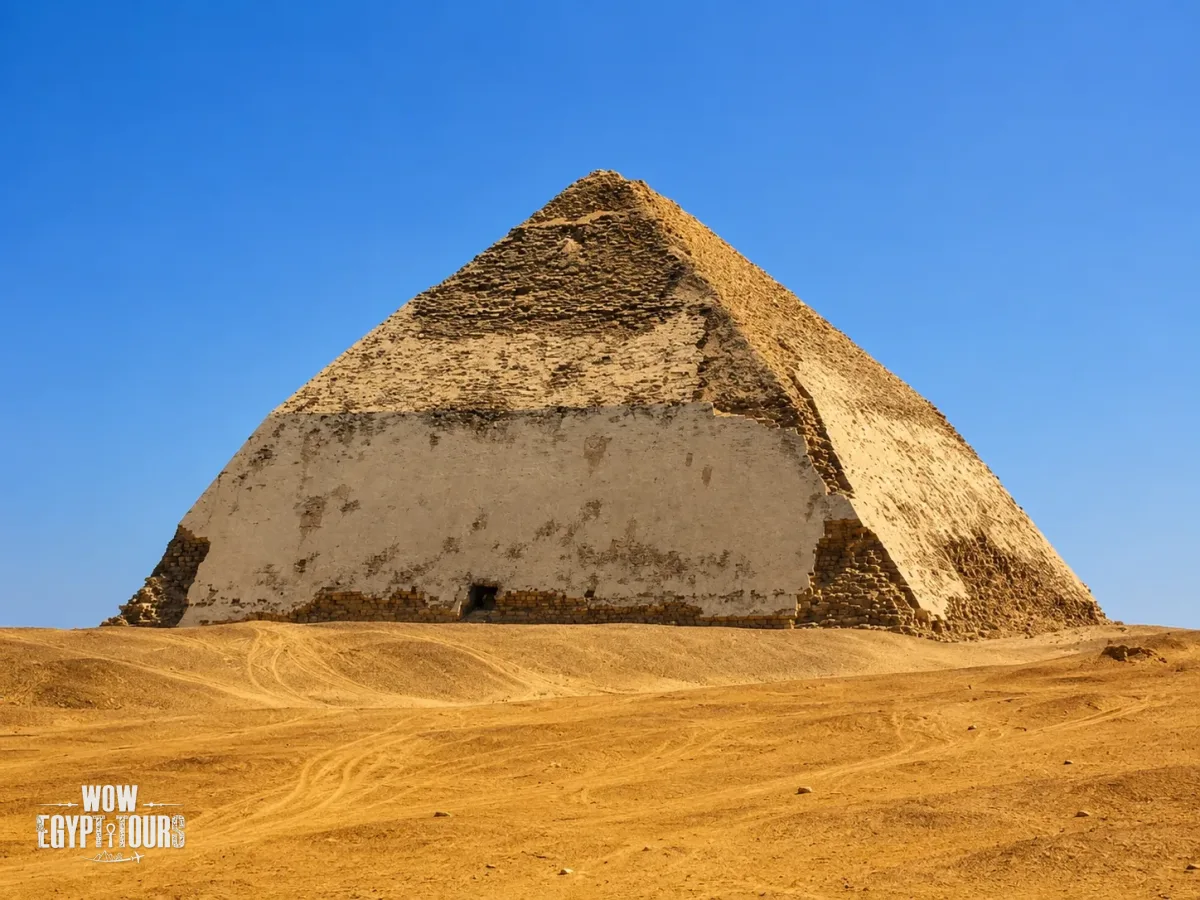
The Bent Pyramid of Sneferu is the best-preserved ancient Egyptian pyramid exterior in the complete Egyptian heritage record, retaining the most completely intact original limestone casing of any ancient Egyptian pyramid monument including all three of the Great Pyramids at Giza, with the vast majority of the original white Tura limestone outer casing surviving on all four faces of the monument in a quality and extent of original surface preservation that gives the Bent Pyramid a quality of ancient exterior visual completeness simply unavailable at any other accessible ancient Egyptian pyramid monument of the complete Old Kingdom period. The specific preservation of the original casing on the Bent Pyramid is the direct result of the pyramid's unique double-angled profile whose less steep upper section reduced the gravitational forces on the casing blocks compared to a standard-angled pyramid of the same height, combined with the relatively remote and relatively undervisited desert location of the Dahshur plateau whose distance from the major ancient and medieval urban centers reduced the intensity of the stone quarrying activity that stripped the casing from the more conveniently accessible Giza and Saqqara monuments in the medieval period. The extraordinary extent of the Bent Pyramid's surviving original casing gives every visitor who approaches the monument across the Dahshur desert plateau the most direct and the most personally affecting visual experience of what an ancient Egyptian pyramid looked like in its original smooth-sided, gleaming white exterior condition available at any accessible pyramid site in the complete Egyptian heritage record, an experience that even the surviving casing section at the top of the Middle Pyramid of Khafre at Giza can only partially replicate in the fraction of its original surface that survives.
Sneferu's complete pyramid building programme, encompassing the Bent Pyramid and the Red Pyramid at Dahshur and the Meidum Pyramid further south, represents the largest total volume of stone assembled for any single ancient Egyptian pharaoh's funerary construction programme in the complete pyramid-building tradition, a distinction whose specific numerical reality, approximately 3.5 million cubic meters of quarried and assembled stone across the complete Sneferu pyramid programme, exceeds the total stone volume of the Great Pyramid of Khufu alone and gives Sneferu the most compelling single claim to the title of the greatest pyramid builder in the complete ancient Egyptian royal tradition, a claim whose specific basis in the total stone volume of the complete building programme rather than the scale of any single monument gives it a statistical foundation and a scholarly credibility that distinguishes it clearly from the more immediately obvious claims based on individual monument scale that make the most impressive single ancient Egyptian monuments the most familiar subjects of popular comparative superlative in the heritage tourism vocabulary.
The Red Pyramid of Sneferu, accessible to visitors through its original northern entrance passage descending to three consecutive corbelled burial chambers, is the most practically accessible and the most visitor-comfortable pyramid interior in the complete Greater Cairo area, whose entry passage of approximately 63 meters descending at approximately 27 degrees to the first corbelled chamber is physically demanding but significantly less so than the narrow, warm, and extremely steep ascending passage of the Great Pyramid of Khufu, giving the Red Pyramid interior a character of accessible archaeological exploration that makes it the most practically suitable first pyramid interior experience for visitors who want the most complete and the most personally affecting ancient Egyptian pyramid interior encounter without the specific physical challenges of the Great Pyramid access route. The three consecutive corbelled chambers of the Red Pyramid interior, whose stepped vault ceilings of progressively refined corbelling technique represent the most completely realized and the most architecturally extraordinary corbelled chamber sequence in any accessible ancient Egyptian pyramid interior, provide an extraordinary architectural encounter with the most advanced pyramid interior engineering achievement of the complete Sneferu pyramid programme and the direct architectural predecessor of the Grand Gallery and King's Chamber corbelled vault system of the Khufu pyramid at Giza.
Why Is It Called Dahshur?
The name Dahshur, applied to the desert plateau site approximately 40 kilometers south of Cairo whose most important monuments are the Bent Pyramid and the Red Pyramid of Sneferu, is an Arabic toponym of ancient origin whose specific etymology has been variously proposed as a derivation from an ancient Egyptian place name whose original form and specific meaning in the ancient Egyptian geographical vocabulary have not been definitively established in the modern Egyptological scholarship. The most commonly cited proposed etymology connects the Arabic Dahshur to an ancient Egyptian original whose approximate phonological form would have been something like Djeser-kheper or a similar compound of ancient Egyptian words, but the specific phonological relationship between any proposed ancient Egyptian original and the Arabic Dahshur involves the kind of vowel elision and consonant transformation that makes confident etymology of ancient Egyptian place names in their Arabic successors particularly difficult and particularly uncertain in the cases where no unambiguous ancient documentary evidence for the ancient name of the specific site is available. The designation Pyramids is added to Dahshur in the standard international heritage tourism vocabulary to distinguish the archaeological site from the modern village of Dahshur in the same general area, and to immediately identify the site's primary heritage character as the location of multiple ancient Egyptian royal pyramid monuments rather than as a modern settlement or other kind of heritage destination. The individual pyramids of the Dahshur site carry their own specific designations whose etymologies are more transparent and more directly informative: the Bent Pyramid derives its name from the most immediately distinctive visual characteristic of the monument's unique double-angled profile, and the Red Pyramid derives its name from the reddish-pink color of the local limestone used in its core construction whose warm red-brown surface is most dramatically visible in the specific lighting conditions of the early morning and the late afternoon when the low-angle desert light illuminates the pyramid's red limestone core surface most completely and most beautifully.
Dahshur Pyramids History
The history of the Dahshur pyramid monuments begins with Sneferu's decision in approximately 2613 BCE to begin his royal pyramid building programme at Dahshur, following the completion or the substantial advancement of his earlier pyramid project at Meidum further south, with the construction of what would become the Bent Pyramid as his primary pyramid monument at the Dahshur plateau site. The specific sequence of Sneferu's pyramid building programme remains a subject of active scholarly discussion, with different Egyptologists proposing different chronological orderings of the Meidum, Bent, and Red Pyramid construction phases based on the available ancient documentary evidence, the archaeological evidence from the construction sequences at each site, and the architectural logic of the evolutionary development from stepped form to smooth-sided true pyramid that the sequence of monuments most plausibly embodies. The most widely accepted scholarly view holds that the Meidum Pyramid was begun as a stepped monument of the Saqqara tradition and progressively converted toward a smooth-sided true pyramid in an early attempt whose specific structural outcome remains debated, that the Bent Pyramid was then begun at Dahshur as a more ambitious attempt at the smooth-sided true pyramid form whose specific structural difficulties or design problems led to the remarkable mid-construction reduction in the angle of inclination that gives the monument its extraordinary distinctive profile, and that the Red Pyramid was then constructed at Dahshur using the new shallower angle of the Bent Pyramid's upper section throughout its complete height, achieving the first completely successful smooth-sided true pyramid in the history of ancient Egyptian architecture whose success directly enabled and directly inspired the more ambitious and more precisely executed smooth-sided true pyramids of Khufu, Khafre, and Menkaure at the Giza Plateau.
The Middle Kingdom history of the Dahshur plateau encompasses the ambitious pyramid building programme of the 12th Dynasty pharaohs who chose the Dahshur location for a sequence of royal pyramid monuments beginning with the pyramid of Amenemhat II (approximately 1929 to 1895 BCE), continuing with the pyramid of Senusret III (approximately 1878 to 1840 BCE) whose extraordinary granite burial chamber represents the most impressive Middle Kingdom pyramid burial installation preserved at any accessible Middle Kingdom pyramid site, and culminating with the Black Pyramid of Amenemhat III (approximately 1860 to 1814 BCE) whose extraordinary mudbrick core, visible as the most massive and the most imposing ruined pyramid mound on the Dahshur plateau since the complete stripping of its original limestone casing in the medieval period, gives the most powerfully atmospheric and the most personally extraordinary visual impression of any ruined pyramid monument in the complete Egyptian heritage landscape, its eroded dark mudbrick profile rising from the desert floor like a weathered natural outcrop rather than a human construction in the most completely extraordinary transformation of an ancient royal monument by the effects of millennia of desert weathering and human stone robbing available at any accessible ancient Egyptian pyramid site.
The modern archaeological investigation of the Dahshur Pyramids began with the comprehensive survey of the site conducted by Karl Richard Lepsius as part of his systematic survey of all the major ancient Egyptian monument sites from 1842 to 1845, which provided the first scientifically organized measurements and architectural drawings of the complete Dahshur monument group and established the baseline documentation that all subsequent Dahshur scholarship has refined and extended. The most consequential subsequent investigation of the Dahshur monuments includes Auguste Mariette's excavations in the 1860s and 1870s that recovered important objects from the vicinity of the Dahshur pyramid complexes, Jacques de Morgan's extraordinary discovery in 1894 to 1895 of the intact royal jewellery treasure hoards of the Middle Kingdom 12th Dynasty princesses in the subsidiary structures adjacent to the Amenemhat II and Senusret III pyramid complexes, and the ongoing programme of systematic archaeological investigation of the complete Dahshur plateau site by Egyptian and international teams that continues to generate significant new discoveries and new understanding of the complete monument complex in the most active period of Dahshur Egyptological investigation since the late 19th century discoveries of Jacques de Morgan.
The Story Of Ancient Egypt's Architectural Revolution At Dahshur
The story of how the ancient Egyptian pyramid building tradition achieved the technical and geometric understanding required to construct the smooth-sided true pyramid at Dahshur is the most intellectually fascinating and the most personally instructive chapter in the complete architectural history of the ancient world's most extraordinary monument building programme, a story whose central narrative is written most directly and most completely in the physical form of the Bent Pyramid itself, whose visible mid-height change of inclination angle from approximately 54 degrees to approximately 43 degrees is the most personally readable and the most immediately instructive ancient architectural decision preserved in any ancient Egyptian monument and the most direct evidence available at any accessible heritage site for the specific engineering challenge that the ancient Egyptian pyramid builders had to solve before the smooth-sided true pyramid of the Giza tradition became achievable. The scholarly debate about the specific reason for the Bent Pyramid's extraordinary change of angle has generated a range of proposed explanations from the most structurally conservative, that the ancient builders identified specific signs of structural instability in the lower pyramid body and responded by reducing the angle to limit the additional load on the already-stressed lower masonry, to the more historically circumstantial, that the death of the pharaoh was imminent and the angle was reduced to allow the monument to be completed more quickly in his remaining lifetime, with the current scholarly consensus tending toward the structural explanation based on the specific evidence of cracking and subsidence in the lower pyramid body that has been identified by detailed engineering investigation of the monument's fabric.
Whatever the specific engineering or administrative reason for the Bent Pyramid's dramatic mid-construction angle change, the physical consequence of that decision in the form of the Bent Pyramid's unique double-angled profile gives every visitor who approaches the monument across the Dahshur desert plateau an immediate and an entirely intuitive visual understanding of the specific architectural and engineering challenge that the ancient pyramid builders were working through in the Sneferu building programme, an understanding that no amount of explanatory text or museum display can provide with the same clarity and the same personal immediacy as the direct visual encounter with the monument whose physical form is the most complete and the most directly legible record of the ancient builders' progressive working-through of the technical problems of smooth-sided pyramid construction available at any accessible ancient Egyptian heritage site. The Red Pyramid, standing immediately north of the Bent Pyramid on the same Dahshur plateau, completes the Dahshur narrative of architectural evolution by demonstrating the successful resolution of the construction challenge in the first perfectly smooth-sided true pyramid in the history of ancient Egyptian architecture, its complete shallow-angled smooth-sided form demonstrating that the ancient builders had learned from the Bent Pyramid experience the specific structural requirements and the specific construction management practices that made the smooth-sided true pyramid achievable at the scale and precision that Sneferu's Red Pyramid demonstrates and that Khufu's Great Pyramid at Giza perfects to the extraordinary degree of geometric precision and astronomical alignment that gives it its most universally celebrated architectural character.
Dahshur Pyramids Key Attractions And Features
The Bent Pyramid Of Sneferu
The Bent Pyramid of Sneferu, rising from the Dahshur desert plateau to its current height of approximately 101 meters in its extraordinary double-angled profile of approximately 54 degrees inclination for the lower section and approximately 43 degrees inclination for the upper section, is the single most architecturally extraordinary and the single most personally instructive ancient Egyptian pyramid monument accessible at any heritage site in the complete Greater Cairo area, a monument whose unique physical form embodies in the most directly legible way available in the entire ancient Egyptian monumental heritage record the specific moment of architectural crisis and architectural resolution that defined the most consequential developmental phase of the ancient Egyptian pyramid building tradition. The Bent Pyramid also distinguishes itself from every other ancient Egyptian pyramid monument accessible in the Greater Cairo area by the extraordinary extent of its surviving original limestone casing, whose vast majority covers all four faces of the monument in the most completely preserved ancient Egyptian pyramid exterior surface available at any accessible pyramid site in the complete Egyptian heritage record, giving visitors who approach and circumnavigate the Bent Pyramid the most direct and the most personally affecting visual experience of the original smooth-cased ancient Egyptian pyramid exterior that any accessible ancient Egyptian pyramid monument can provide, including the partial casing survival at the top of the Khafre Pyramid at Giza. The valley temple of the Bent Pyramid, located approximately 700 meters east of the pyramid at the edge of the desert plateau, preserves some of the most remarkable ancient Egyptian Old Kingdom relief carving panels accessible at any pyramid complex site outside the mastaba tomb programme of Saqqara, with representations of the nome deities of ancient Egypt and the personified royal estates in a sculptural programme of considerable artistic quality and considerable historical significance for the understanding of the complete Sneferu royal funerary complex.
The Red Pyramid Of Sneferu
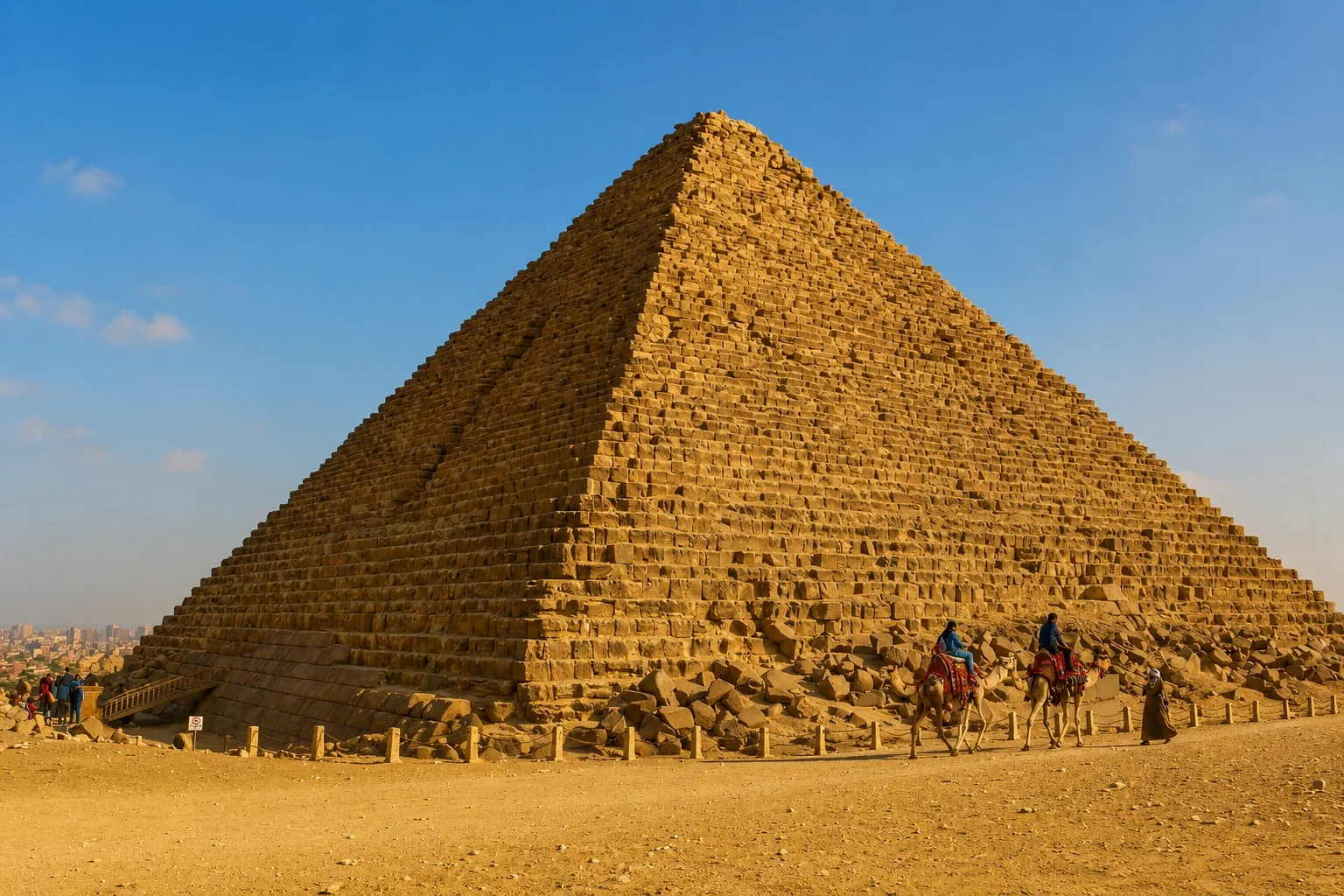
The Red Pyramid of Sneferu, standing immediately north of the Bent Pyramid on the Dahshur plateau and rising to its current height of approximately 104 meters from a square base of approximately 220 meters on each side, is the world's first true smooth-sided pyramid, the monument whose successful realization of the perfectly smooth-sided pyramid form at the approximately 43-degree angle that the Bent Pyramid experience had identified as the sustainable inclination for a pyramid of this scale made the subsequent construction of the supreme Giza pyramids architecturally possible and historically inevitable. The Red Pyramid's name derives from the reddish-pink color of the local Dahshur limestone used in the core construction of the monument whose surface, stripped of its original white Tura limestone casing in the medieval period, reveals the warm red-brown of the underlying local stone in the most dramatically beautiful and the most personally extraordinary red pyramid skyline color available at any sunset or sunrise viewing at any accessible ancient Egyptian pyramid monument site in the complete Greater Cairo area. The Red Pyramid's interior, accessible to visitors through the original northern entrance passage at the base of the pyramid's north face, provides the most accessible and the most visitor-friendly pyramid interior experience in the complete Greater Cairo area, its descending passage of approximately 63 meters leading to three consecutive corbelled chambers whose progressively refined corbelled vault ceilings rise to heights of approximately 12 to 13 meters in the most architecturally extraordinary and the most personally affecting corbelled chamber sequence accessible to visitors at any ancient Egyptian pyramid interior site, a sequence whose specific technical achievement of high corbelled vaults in the most stable and the most precisely constructed form available in the complete Sneferu pyramid interior programme directly anticipates and makes possible the even more ambitious corbelled vault engineering of the Grand Gallery in the Khufu pyramid at Giza.
The Bent Pyramid Interior
The Bent Pyramid's interior, accessible to visitors when open through a careful and somewhat demanding exploration of the pyramid's two separate entrance passages on the western and northern faces of the monument, provides one of the most extraordinary and the most personally instructive ancient Egyptian pyramid interior encounters available at any accessible pyramid site in the complete Greater Cairo area, a specifically dual-passage interior system whose two distinct entry points, each leading through descending passages to a different section of the internal chamber system, reflects the unique double-entrance design tradition of the Sneferu pyramid programme and gives the Bent Pyramid interior a character of architectural complexity and personal discovery that the single-entrance interior systems of most other accessible ancient Egyptian pyramid monuments cannot quite replicate in the same form. The western entrance of the Bent Pyramid leads through a descending passage to the lower chamber of the internal programme, whose corbelled vault ceiling and original portcullis granite blocking stones in the most completely intact ancient Egyptian pyramid security installation preserved at any accessible pyramid interior in the Greater Cairo area give the lower chamber visit its most immediately historically dramatic and its most personally affecting ancient security programme encounter. The northern entrance leads through a separate descending passage to the upper chamber whose corbelled vault ceiling of remarkable height and whose specific position in the upper section of the pyramid body give the complete dual-chamber interior visit the most architecturally complex and the most personally rewarding pyramid interior experience available at any accessible ancient Egyptian pyramid site in the complete Dahshur heritage area.
The Satellite Pyramid Of The Bent Pyramid
The small satellite pyramid immediately south of the Bent Pyramid at Dahshur, one of the most completely preserved and the most historically informative of the subsidiary pyramid structures associated with any Old Kingdom pyramid complex accessible at any heritage site in the complete Greater Cairo area, retains more of its original exterior limestone casing than any other subsidiary pyramid monument in the complete Egyptian pyramid-building heritage record and provides visitors with the most completely and the most personally affecting visual model of an ancient Egyptian pyramid in its original smooth-sided cased form at a physically accessible scale, its approximately 25-meter height and approximately 52-meter base giving a monument of sufficiently human scale that the relationship between the pyramid's original smooth-sided cased appearance and the personal physical experience of approaching and circumnavigating it is the most completely and the most immediately personally legible ancient Egyptian pyramid encounter available at a scale that makes the complete visual impact of the smooth-sided ancient pyramid form accessible without the overwhelming cognitive challenge of the scale relationship that the Great Pyramids present to the individual human body. The satellite pyramid's extraordinary preservation is the most direct and the most personally vivid demonstration of what all the ancient Egyptian pyramids looked like in their original smooth-sided cased condition before the medieval quarrying of casing stone for the construction of medieval Cairo removed the brilliant white limestone surface from virtually every accessible ancient Egyptian pyramid monument in the complete Memphite necropolis zone.
The Black Pyramid Of Amenemhat III
The Black Pyramid of Amenemhat III, the most impressive and the most atmospherically extraordinary of the Middle Kingdom pyramid ruins on the Dahshur plateau, rises from the desert floor as a massive eroded mound of dark mudbrick whose weathered profile gives it a quality of geological and historical grandeur entirely unlike the crisp geometric precision of the surviving Old Kingdom limestone pyramids of the same plateau, its dark mud-colored profile against the pale desert sky creating the most dramatically evocative and the most personally affecting single silhouette of any pyramid ruin in the complete Greater Cairo heritage landscape and giving the Dahshur plateau visit a dimension of temporal depth and heritage variety that the purely Old Kingdom pyramid sites of Giza cannot provide. The Black Pyramid was originally planned as the primary pyramid monument of Amenemhat III, one of the most powerful and the most administratively accomplished pharaohs of the complete Middle Kingdom 12th Dynasty tradition, but was abandoned as the primary royal burial site before completion when signs of structural instability in the mudbrick core and water table problems in the underground chamber system made the monument unsuitable for its primary funerary purpose, with Amenemhat III ultimately buried in a second pyramid at Hawara in the Faiyum region. The abandonment of the Black Pyramid as an active royal funerary installation before completion gives it a specifically incomplete and specifically poignant character in the complete Dahshur heritage landscape, a monument of extraordinary ambition left unfinished and ultimately unfulfilled that gives the visitor who understands its specific history the most directly human and the most personally affecting encounter with the contingent reality of ancient Egyptian royal funerary planning as a programme subject to the same practical limitations and the same structural realities as any other human construction enterprise in the complete history of the ancient world.
The Middle Kingdom Princess Jewellery Hoards
The most celebrated and the most internationally significant heritage discoveries associated with the Dahshur pyramid complexes are the extraordinary jewellery hoards of the Middle Kingdom 12th Dynasty royal princesses discovered in the subsidiary burial installations adjacent to the Amenemhat II and Senusret III pyramid complexes by the French Egyptologist Jacques de Morgan in 1894 to 1895, collections of ancient Egyptian goldsmithing of such extraordinary technical quality, such completely extraordinary artistic refinement, and such completely extraordinary state of preservation that they are universally recognized as the finest ancient Egyptian jewellery of any period in the complete Egyptian national heritage collection and among the most beautiful and the most personally affecting ancient luxury objects in any museum collection in the world. The Dahshur princess jewellery, encompassing the extraordinary diadems, pectorals, collars, bracelets, and anklets of the princesses Mereret, Sit-Hathor-Yunet, and Nefrupiah whose burial equipment was recovered with a completeness of preservation essentially without parallel in the complete Middle Kingdom funerary heritage record, is currently distributed between the Egyptian Museum in Cairo and the Metropolitan Museum of Art in New York, giving the Dahshur site an institutional heritage legacy of extraordinary significance in two of the most important museum collections in the complete world heritage landscape.
The Desert Landscape And The Pyramid Panorama
Beyond the specific architectural and archaeological significance of the individual Dahshur pyramid monuments, the complete Dahshur plateau visit provides the most completely authentic and the most personally extraordinary desert pyramid landscape experience available at any accessible ancient Egyptian pyramid site in the complete Greater Cairo area, a panoramic desert view from the Dahshur plateau surface encompassing the Bent Pyramid and the Red Pyramid of the Old Kingdom programme, the ruined mounds of the Middle Kingdom pyramids, and the open desert extending in every direction to horizons unobstructed by the modern urban development that surrounds the Giza Plateau on three sides, creating the most nearly authentic ancient desert landscape setting for a pyramid monument visit available at any accessible ancient Egyptian pyramid site in the complete Greater Cairo heritage area. The specific quality of standing between the Bent Pyramid and the Red Pyramid on the open Dahshur desert plateau and experiencing the two great Sneferu monuments in the most complete spatial relationship available at their actual ancient landscape positions, with the stepped-angle Bent Pyramid on the southern skyline and the true smooth-sided Red Pyramid on the northern skyline, gives the visitor the most complete and the most personally affecting understanding of the architectural evolutionary narrative that the Dahshur monuments embody, the specific visual transition from the problematic angled experiment to the successful smooth-sided achievement that the paired monuments represent in the most directly readable and the most personally compelling architectural history lesson available at any accessible ancient monument site in the complete Egyptian heritage landscape.
Why Are The Dahshur Pyramids Important?
The Dahshur Pyramids are important for reasons spanning the architectural history of the ancient Egyptian pyramid building tradition, the specific royal biography of Sneferu as the most prolific and the most architecturally significant pyramid builder in the complete ancient Egyptian royal tradition, the extraordinary jewellery legacy of the Middle Kingdom princess burial hoards that give Dahshur one of the most significant and the most internationally celebrated luxury object heritage contributions of any ancient Egyptian site in the complete national collection, and the broader UNESCO World Heritage significance of Dahshur as a primary component of the most extraordinary concentration of ancient royal pyramid monument heritage in the complete world heritage record. As an architectural heritage site, Dahshur provides the most completely accessible and the most directly instructive ancient documentary evidence for the specific developmental process through which the ancient Egyptian pyramid building tradition evolved from the stepped form of Saqqara to the smooth-sided true pyramid form of Giza in the most consequential single architectural evolutionary trajectory in the history of the ancient world. As a royal heritage biography, Dahshur gives Sneferu, the most prolific pyramid builder in ancient Egyptian history and the father of the dynasty that produced the Giza Great Pyramids, his most direct and his most personally engaging monumental representation in the complete Greater Cairo heritage landscape. WOW Egypt Tours includes the Dahshur Pyramids as an essential destination in all comprehensive Cairo Tours, Egypt Classic Tours, and all Egypt Tour Packages encompassing the complete Greater Cairo ancient heritage circuit.
What Are Some Interesting Facts About The Dahshur Pyramids?
Sneferu Built More Pyramid Volume Than Any Other Pharaoh
The total volume of stone used in Sneferu's complete pyramid building programme, encompassing the Bent Pyramid and the Red Pyramid at Dahshur and the Meidum Pyramid further south and possibly a fourth pyramid at Seila, is approximately 3.5 million cubic meters of quarried and assembled stone, exceeding the total stone volume of the Great Pyramid of Khufu and making Sneferu's complete programme the single most physically extensive individual royal funerary construction achievement in the history of the ancient world. This extraordinary statistical fact, which establishes Sneferu as the most prolific pyramid builder in the complete ancient Egyptian pharaonic tradition despite the relatively modest scale of his individual monuments compared to his son Khufu's single supreme achievement, gives the Dahshur visit its most immediately extraordinary biographical context as the primary monument site of the most ambitious and the most physically extensive single pharaoh's construction programme in the history of the ancient Egyptian state.
The Best-Preserved Pyramid Exterior In Egypt
The Bent Pyramid retains the largest surviving proportion of original ancient Egyptian pyramid exterior limestone casing of any pyramid monument in the complete Egyptian heritage record, with the vast majority of the original white Tura limestone outer casing intact on all four faces in a quality and an extent of ancient surface preservation that gives the Bent Pyramid a quality of original exterior visual completeness simply unavailable at any other accessible ancient Egyptian pyramid monument. The extraordinary preservation of the Bent Pyramid's original casing gives every visitor who approaches the monument across the Dahshur desert plateau the most direct and the most personally affecting visual encounter with the original white smooth-sided appearance of an ancient Egyptian pyramid available at any accessible heritage site in the complete Egyptian heritage record, an experience of such completely extraordinary ancient visual authenticity that it consistently astonishes visitors who encounter it with no prior knowledge of its specific condition.
The Princess Jewellery Discovered In 1894
Jacques de Morgan's extraordinary discovery in 1894 to 1895 of the intact jewellery hoards of the Middle Kingdom 12th Dynasty princesses Mereret, Sit-Hathor-Yunet, and Nefrupiah in the subsidiary burial installations adjacent to the Amenemhat II and Senusret III pyramid complexes at Dahshur is one of the most personally dramatic and the most institutionally consequential archaeological discovery events in the complete history of Middle Kingdom Egyptian archaeology, producing a collection of ancient Egyptian goldsmithing and luxury object production of such extraordinary technical quality and such completely extraordinary artistic refinement that the Dahshur princess jewellery is universally recognized as the finest ancient Egyptian jewellery of any period in the complete Egyptian national heritage collection and among the most beautiful ancient luxury objects in any museum collection in the world.
What Is So Special About The Dahshur Pyramids?
The Archaeological Missing Link
What makes the Dahshur Pyramids uniquely and incomparably special in the complete ancient Egyptian heritage landscape is their position as the architectural missing link between the Saqqara Step Pyramid and the Giza Great Pyramids, the monuments that most completely and most directly embody the specific architectural evolutionary process through which the ancient Egyptian pyramid building tradition achieved the smooth-sided true pyramid form whose supreme expression at Giza is the most universally recognized ancient architectural achievement in the history of the world. The Bent Pyramid and the Red Pyramid together tell the story of this architectural evolution more directly, more personally, and more completely than any amount of scholarly explanation can, the Bent Pyramid's visible double-angled profile showing the specific problem that had to be solved and the specific solution that was applied in the most directly readable ancient architectural document of any ancient building programme's developmental challenge, and the Red Pyramid's perfectly smooth-sided form showing the first successful complete resolution of that challenge in the most directly inspiring ancient architectural achievement that made the Giza pyramid perfection possible. No other pair of ancient monuments anywhere in the complete world heritage landscape embodies in their physical forms a comparable narrative of architectural problem-solving and architectural evolutionary achievement with the same clarity, the same personal immediacy, and the same historical consequence.
Desert Solitude And Ancient Grandeur
The Dahshur Pyramids are also uniquely special for the specific quality of personal desert encounter they provide, the experience of visiting major ancient Egyptian pyramid monuments in a relatively uncrowded and a relatively undeveloped desert landscape whose specific character of open desert horizon, of the massive ancient pyramids visible from many kilometers across the open desert floor, and of the relative absence of the modern commercial and visitor infrastructure that has transformed the Giza plateau's immediate surroundings into an extension of the Cairo metropolitan area gives the Dahshur visit a quality of desert archaeological authenticity and personal ancient landscape engagement that the more popular northern pyramid sites in their specific urban context cannot quite replicate in the same form. The visitor who has experienced both the Giza plateau and the Dahshur plateau consistently identifies the specific quality of personal ancient desert atmosphere that Dahshur provides as one of the most completely distinctive and the most permanently memorable dimensions of the complete Greater Cairo pyramid heritage experience, a quality whose specific character of solitary encounter with very large ancient monuments in a genuinely open desert landscape gives the Dahshur visit a specific personal heritage impact that complements and extends rather than duplicates the very different but equally extraordinary personal impact of the Giza plateau experience.
The Dahshur Pyramids Through The Ages
The complete history of the Dahshur pyramid monuments from the extraordinary architectural experimentation of Sneferu's Old Kingdom building programme in approximately 2600 BCE through the Middle Kingdom royal investment of the 12th Dynasty pharaohs approximately 600 years later, through the progressive medieval quarrying of the limestone casing from the most accessible monuments and the natural weathering of the mudbrick Middle Kingdom pyramids into their current ruined mounds, through Karl Richard Lepsius's systematic survey of 1842 to 1845, Jacques de Morgan's extraordinary princess jewellery discoveries of 1894 to 1895, and the ongoing Egyptian and international archaeological investigation of the complete Dahshur plateau heritage in the most active period of systematic Dahshur Egyptological investigation since the late 19th century, traces a monument heritage biography of extraordinary variety and extraordinary personal consequence whose most recent chapters of active archaeological investigation and ongoing discovery give the Dahshur site a quality of living archaeological excitement entirely appropriate to the monuments whose specific architectural significance as the crucial missing link in the complete ancient Egyptian pyramid building tradition makes them the most historically informative and the most intellectually consequential ancient pyramid monuments accessible at any single heritage site in the complete Greater Cairo area.
The Dahshur Pyramids And UNESCO
The Dahshur Pyramids are protected as primary components of the UNESCO World Heritage Site designated in 1979 as Memphis and its Necropolis: the Pyramid Fields from Giza to Dahshur, recognized as a heritage of outstanding universal value for the extraordinary concentration of ancient Egyptian pharaonic civilization heritage encompassing the complete sequence of ancient Egyptian pyramid architectural development from the world's oldest monumental stone building at Saqqara through the crucial transitional monuments at Dahshur to the supreme smooth-sided achievements of the Giza Plateau, in the most geographically concentrated and the most chronologically comprehensive UNESCO World Heritage designation of ancient Egyptian pyramid monument heritage available anywhere in the complete world heritage record. The UNESCO designation specifically encompasses the Bent Pyramid and the Red Pyramid of Sneferu, the Middle Kingdom pyramid monuments of the 12th Dynasty, and the complete associated funerary complex remains of the Dahshur plateau as components of the Outstanding Universal Value of the complete Memphis Necropolis inscription. The Egyptian government and the UNESCO World Heritage Committee are engaged in ongoing collaboration on the conservation management of the complete Dahshur heritage zone, addressing the specific conservation challenges of the extraordinary Bent Pyramid casing preservation programme and the ongoing investigation and protection of the Middle Kingdom pyramid ruins whose specific vulnerability to weathering and human interference makes them the most urgent conservation management priority of any pyramid monument group in the complete Greater Cairo UNESCO World Heritage property.
Best Time To Visit The Dahshur Pyramids
The best time to visit the Dahshur Pyramids is during the cooler months from October through April when the desert plateau climate provides the most comfortable conditions for the outdoor exploration of the pyramid site, the circumnavigation of the Bent Pyramid's original casing exterior, the walk between the Bent and Red Pyramids across the open desert floor, and the pyramid interior visits. The winter months of December through February offer the most extraordinary quality of low-angle desert light that illuminates the Bent Pyramid's surviving white limestone casing and the Red Pyramid's distinctive red-brown limestone core surface in the most dramatically beautiful photography conditions available at the Dahshur site, with the early morning eastern light on the pyramid faces and the late afternoon western light creating the most completely extraordinary natural lighting compositions of any time in the complete daily and seasonal cycle at the site. The summer months bring very hot desert temperatures that make the extended outdoor walking programme between the pyramid monuments most demanding, though the Red Pyramid interior with its consistently cool underground temperature provides a welcome relief from the surface heat whose specific refreshment quality in the context of the summer desert environment gives the underground chamber visit an additional personal comfort dimension beyond its purely archaeological significance. WOW Egypt Tours organizes Dahshur pyramid visits throughout the year and advises on optimal seasonal timing within the complete Greater Cairo southern heritage circuit.
Dahshur Pyramids Opening Hours
The Dahshur Pyramids site is open daily from 8:00 AM to 5:00 PM throughout the year. The Red Pyramid interior is accessible during site visiting hours. The Bent Pyramid exterior is accessible throughout visiting hours, with the interior access subject to availability and site management conditions confirmed at time of booking with WOW Egypt Tours. The Middle Kingdom pyramid ruins including the Black Pyramid of Amenemhat III are accessible throughout site visiting hours as part of the general site admission. All visiting hours are subject to adjustment for Egyptian national holidays and specific site management requirements, and current hours should be confirmed at time of booking.
Dahshur Pyramids Entrance Fees
Dahshur site general admission (includes exterior access to all monuments): EGP 200 for adults, EGP 100 for students.
Red Pyramid interior (included in general admission or with small additional fee, confirmed at time of booking): current pricing confirmed with WOW Egypt Tours at time of booking.
All Dahshur site entrance fees are included in the Cairo Tours and Egypt Tour Packages organized by WOW Egypt Tours as part of the complete Greater Cairo southern heritage circuit combining Dahshur with Memphis and Saqqara. Fees are subject to periodic adjustment and current rates should be confirmed at time of booking.
How To Get To The Dahshur Pyramids
The Dahshur Pyramids are located approximately 40 kilometers south of central Cairo on the desert plateau west of the Nile Valley agricultural landscape, accessible by private vehicle from Cairo via the desert road through Giza and south through the Memphis area and then west to the Dahshur plateau access road, with a total journey time from central Cairo of approximately 50 minutes to one hour. The Dahshur site is not conveniently accessible by public transport from Cairo and the private vehicle organized by WOW Egypt Tours as part of the complete Greater Cairo southern heritage circuit is the most practical and the most personally efficient approach for all international visitors. Dahshur is most naturally positioned as the final southward destination of the Greater Cairo southern heritage circuit whose programme moves from Saqqara to Memphis to Dahshur in a southward progression and returns to Cairo from Dahshur as the most logistically efficient sequence of the complete three-site southern heritage day programme.
How Long To Spend At The Dahshur Pyramids
A minimum of one and a half to two hours at Dahshur is required for a programme that covers the exterior circumnavigation of the Bent Pyramid with its original casing examination and the guide's complete architectural evolution narrative, the Red Pyramid exterior approach and interior visit through the descending passage to the three corbelled chambers, and a view of the Black Pyramid of Amenemhat III from the accessible approach across the desert floor. A more completely satisfying Dahshur programme of two and a half to three hours allows the most thorough engagement with the complete site including the Bent Pyramid valley temple remains, the satellite pyramid exterior examination, the complete Red Pyramid interior with careful examination of all three corbelled chambers, and the most contemplative and most personally rewarding open desert exploration of the complete plateau panorama from the most revealing viewpoints between the major monuments. Dahshur is most naturally combined with Saqqara and Memphis in the complete Greater Cairo southern heritage day programme whose overall timing is organized by WOW Egypt Tours to allocate the most practically efficient and the most personally satisfying time at each southern heritage site. WOW Egypt Tours designs all southern heritage circuit programmes with full attention to the time requirements of each site within the most enjoyable and the most comprehensively satisfying complete day programme.
Tips For Visiting The Dahshur Pyramids
Approach the Bent Pyramid from the southeastern direction first, walking toward the monument from the desert floor approach where the complete double-angled profile is most clearly visible in a single unobstructed view that allows the most complete and the most personally instructive visual appreciation of the unique architectural character that gives the Bent Pyramid its most fundamental heritage significance as the most directly readable ancient record of the architectural problem that defined the crucial developmental moment of the ancient Egyptian pyramid building tradition. Ask your licensed Egyptology guide from WOW Egypt Tours to explain the specific scholarly debate about the reasons for the angle change, the structural evidence for instability in the lower pyramid body, and the specific engineering logic of the decision to reduce the angle to the approximately 43-degree inclination that then became the standard angle for the Red Pyramid and subsequently for the Giza Great Pyramids, as the combination of the expert guide narrative with the direct visual encounter with the monument's extraordinary profile creates the most complete and the most personally instructive understanding of this crucial architectural moment available at any accessible heritage site in the world. For the Red Pyramid interior visit, ensure that all visitors in the group are physically comfortable with the demands of the descending entry passage, which requires bending significantly for several sections and involves a descent of approximately 63 meters at approximately 27 degrees before reaching the first corbelled chamber, and carry a torch or ensure the site's available lighting is sufficient for the interior programme. Do not miss the satellite pyramid immediately south of the Bent Pyramid, asking the guide specifically to explain its extraordinary casing preservation and its significance as the best surviving model of an ancient Egyptian pyramid in its original smooth-sided cased form. For the most dramatically beautiful photography of both pyramids, visit in the late afternoon when the warm western light creates the most completely extraordinary natural lighting conditions on the Bent Pyramid's white casing and the Red Pyramid's warm red-brown surface simultaneously.
What To Wear At The Dahshur Pyramids
The Dahshur Pyramids visit is an entirely outdoor programme in the open desert landscape of the Dahshur plateau with very limited natural shade at any point between the major monument sites, requiring practical sun-protection clothing appropriate for extended outdoor exposure in a completely exposed desert environment. Lightweight breathable long-sleeved clothing covering the arms and legs, a wide-brimmed hat, high-SPF sunscreen, and UV-protective sunglasses are absolutely essential for comfortable outdoor exploration of the Dahshur site throughout the year. Sturdy walking shoes with good ankle support and grip are strongly recommended for the sandy desert floor between monuments and the limestone rock surface of the plateau edge areas whose uneven terrain requires more robust footwear than the urban walking surfaces of the Cairo city centre heritage sites. For the Red Pyramid interior visit, comfortable clothing allowing free movement in the stooped and bent posture required for sections of the descending passage is important, and the consistently cool underground temperature of the pyramid interior makes a light layer useful in the summer months when the temperature difference between the exterior desert heat and the underground chamber can be significant. Carry at least two liters of water per person for the complete Dahshur desert site programme whose physical demands of outdoor walking in the desert environment require adequate hydration throughout the visit. Modest clothing covering the shoulders and knees is appropriate in the Egyptian cultural context throughout the site visit.
Photography At The Dahshur Pyramids
The Dahshur Pyramids provide the most architecturally distinctive and the most historically unique pyramid photography subjects of any ancient Egyptian pyramid site in the complete Greater Cairo area, encompassing the Bent Pyramid's extraordinary double-angled profile that is unlike any other ancient pyramid silhouette in the world and whose specific photography from the southeastern approach gives the most completely and the most dramatically readable single-image representation of the architectural evolution narrative that the monument embodies, the Red Pyramid's warm red-brown limestone surface in the late afternoon light whose extraordinary color and texture creates the most dramatically beautiful sunset pyramid photography subject of any accessible ancient Egyptian pyramid monument, the satellite pyramid's completely preserved white limestone casing surface in the morning light whose extraordinary completeness of ancient surface preservation creates the most authentic and the most personally affecting ancient pyramid exterior photography available at any accessible ancient Egyptian pyramid site, and the extraordinary panoramic desert landscape photography of the complete Dahshur plateau with both Sneferu pyramids visible in a single composition across the open desert floor that provides the most completely extraordinary and the most personally distinctive ancient desert pyramid landscape photography available at any accessible heritage site in the complete Greater Cairo area. Photography is freely permitted throughout the Dahshur site including the Red Pyramid interior where a torch or the available site lighting assists the photography of the three extraordinary corbelled vault chambers.
Dahshur Pyramids Tours
Greater Cairo Southern Heritage Circuit: Memphis, Saqqara, And Dahshur
This comprehensive southern heritage day programme from Cairo combines the world's oldest complete monumental stone building at Saqqara, the ancient city capital of Memphis, and the crucial architectural missing links of the Dahshur pyramid tradition in the most completely organized and the most personally enriching single-day ancient Egyptian heritage programme available in the complete Greater Cairo southern heritage area, covering the complete evolutionary sequence from the revolutionary Saqqara Step Pyramid through the Dahshur experimental monuments to the full understanding of the architectural achievement that makes the Giza Great Pyramids possible and inevitable.
What Is Covered
Private vehicle from Cairo hotel with morning departure. Saqqara: Step Pyramid and Djoser complex with colonnade entrance, Heb-Sed court, and serdab, Unas Pyramid exterior and optional interior with Pyramid Texts, Serapeum underground gallery, Mereruka mastaba tomb with painted relief programme. Memphis: Ramesses II colossal statue and alabaster sphinx. Lunch. Dahshur: Bent Pyramid exterior circumnavigation with original casing examination, satellite pyramid visit, Bent Pyramid valley temple remains, Red Pyramid exterior and interior with descending passage and three corbelled chambers, Black Pyramid of Amenemhat III approach, complete panoramic desert plateau view encompassing both Sneferu pyramids. Return to Cairo hotel in the late afternoon.
Duration
Full day from Cairo hotel, approximately 9 to 10 hours.
Includes
Private vehicle, licensed Egyptology guide, all site entrance fees for Memphis, Saqqara, and Dahshur including Serapeum, mastaba tomb, and Red Pyramid interior fees, lunch, and all logistics. Through WOW Egypt Tours Cairo Tours.
Complete Greater Cairo Pyramid Heritage Circuit: Giza, Saqqara, Memphis, And Dahshur
This extraordinary two-day Cairo ancient heritage programme covers the complete sequence of ancient Egyptian pyramid architectural development from its revolutionary beginning at the Saqqara Step Pyramid through the crucial experimental monuments of Dahshur to the supreme and universally celebrated achievements of the Giza Plateau, giving every visitor the most completely historically organized and the most personally enriching encounter with the complete ancient Egyptian pyramid building tradition available in the Greater Cairo heritage landscape.
What Is Covered
Day 1: Complete Giza Plateau programme including all three Great Pyramids, the Great Sphinx, the Valley Temple of Khafre, and the panoramic desert viewpoint. Afternoon: Grand Egyptian Museum.
Day 2: Memphis, Saqqara, and Dahshur complete southern heritage circuit as detailed above. Return to Cairo hotel.
Duration
2 Days from Cairo hotel.
Includes
Private vehicle both days, licensed Egyptology guide, all site entrance fees, lunch both days, and all logistics. Through WOW Egypt Tours Cairo Tours.
Combine The Dahshur Pyramids With Your Egypt Tours Package
The Dahshur Pyramids are included as an essential destination in the Greater Cairo southern heritage circuit across the full range of WOW Egypt Tours travel products. Browse the options below to find the Egypt experience that includes Dahshur.
Egypt Tour Packages: Multi-day guided Egypt tours organized by duration, including 2 Days Egypt Packages, 3 Days Egypt Packages, 4 Days Egypt Packages, 5 Days Egypt Packages, 6 Days Egypt Packages, 7 Days Egypt Packages, 8 Days Egypt Packages, 10 Days Egypt Packages, and longer itineraries. Dahshur is included in Egypt Tour Packages of 5 days and above as part of the complete Greater Cairo southern heritage circuit combining Dahshur with Memphis and Saqqara. All packages include private vehicle, licensed Egyptology guide, accommodation, all site entrance fees, and all logistics.
Egypt Travel Packages: Themed Egypt travel packages including Egypt Honeymoon Travel Packages, Egypt Budget Travel Packages, Egypt Family Travel Packages, Egypt Luxury Travel Packages, Egypt Adventure Travel Packages, Egypt Cultural Travel Packages, and Egypt Christmas and New Year Travel Packages. Dahshur is featured in Cultural and Classic themed packages as the crucial architectural missing link between the Step Pyramid and the Giza Great Pyramids and as the primary monument site of Sneferu, the most prolific pyramid builder in the complete ancient Egyptian royal tradition.
Egypt Classic Tours: The most popular and the most comprehensively balanced Egypt travel programme, combining the complete Giza Plateau programme with the Greater Cairo southern heritage circuit of Memphis, Saqqara, and Dahshur, and the Nile Valley heritage of Luxor and Aswan, in the most complete and the most personally satisfying introduction to the ancient Egyptian world available in any organized Egypt itinerary. Dahshur is the architectural culmination of the southern heritage circuit that gives the Egypt Classic Tours programme its most complete chronological coverage of the ancient Egyptian pyramid building evolutionary tradition.
Egypt Short Break Tours: Focused short duration Egypt travel programmes for travelers with limited time. Dahshur is included in Egypt Short Break Tours of 4 days and above as part of the Greater Cairo southern heritage circuit, with the Bent Pyramid and Red Pyramid combination providing the most essential and the most personally instructive architectural heritage encounter of the complete southern pyramid tradition in the most efficiently organized short programme format.
Egypt Family Tours: Family-friendly Egypt travel programmes in which the Bent Pyramid's extraordinary visual oddity, the fascinating engineering story of why the angle changed mid-construction, the accessible Red Pyramid interior with its three remarkable corbelled chambers, and the extraordinary atmospheric ruins of the Black Pyramid together provide one of the most varied and the most personally engaging heritage programmes for families with children of all ages in the complete Greater Cairo southern heritage circuit.
Egypt Budget Tours: Value-focused Egypt travel programmes providing access to the Dahshur Pyramids including the Bent Pyramid original casing exterior, the Red Pyramid interior, and the complete plateau panorama at the most economical pricing available from any professional Egyptian tour operator, ensuring that the world's first true smooth-sided pyramid and the most extraordinary ancient pyramid architectural evolution narrative are accessible to travelers at every budget level.
Egypt Nile Cruises: All-inclusive Nile River Cruise programmes combining the ancient pharaonic heritage of Luxor and Aswan with Cairo extensions that include Dahshur as part of the complete Greater Cairo southern heritage circuit for the most historically complete Cairo programme complement to the Nile Valley cruise experience.
Nile River Cruises: All WOW Egypt Tours Nile cruise options. Dahshur is available as part of the Greater Cairo southern heritage circuit Cairo extension from the beginning or end of any Nile River Cruise itinerary.
Luxor Aswan Nile Cruises: Dahshur combined with Saqqara and Memphis is the primary Greater Cairo southern heritage programme for any Luxor-Aswan Nile cruise Cairo extension, completing the most chronologically comprehensive coverage of the ancient Egyptian pyramid building tradition from the Step Pyramid at Saqqara to the experimental monuments at Dahshur to the supreme achievements at Giza.
Dahabiya Nile Cruises: Dahshur available as part of the Greater Cairo southern heritage circuit for travelers combining the most intimate private Nile sailing experience with the world's first true smooth-sided pyramid and the crucial architectural evolutionary narrative of the complete ancient Egyptian pyramid building tradition.
Lake Nasser Cruises: Dahshur available as part of the Cairo extension for travelers combining the extraordinary Nubian heritage of Lake Nasser with the crucial architectural missing links of the complete ancient Egyptian pyramid building tradition at Dahshur.
Cairo Tours: The complete range of guided day tour programmes available from Cairo hotels, including the Greater Cairo southern heritage circuit combining Memphis, Saqqara, and Dahshur, the complete Greater Cairo pyramid circuit combining Giza, Memphis, Saqqara, and Dahshur in a two-day programme, the Islamic Cairo programme covering the Khan El Khalili, El Moez Street, Saladin Citadel, and Muhammad Ali Mosque, and the Coptic Cairo programme covering the Hanging Church, Coptic Museum, and Ben Ezra Synagogue. All Cairo Tours include private vehicle, licensed Egyptology guide, all entrance fees, and all logistics organized by WOW Egypt Tours.
Nearby Attractions To The Dahshur Pyramids
The Dahshur Pyramids are positioned at the southern end of the Greater Cairo ancient pyramid heritage zone, with the most immediately proximate and the most naturally combined nearby heritage destinations extending northward along the same desert plateau and Nile Valley corridor that connects the complete sequence of ancient Egyptian pyramid monuments from Dahshur to Giza. The most immediately adjacent and the most naturally combined nearby heritage destinations are the Memphis open-air museum approximately 5 kilometers north and the Saqqara Step Pyramid Complex approximately 10 kilometers north, together with which Dahshur forms the most completely organized and the most personally enriching Greater Cairo southern heritage circuit whose combination of the ancient capital city remains, the world's oldest monumental stone building, and the crucial architectural evolutionary monuments of the pyramid building tradition gives the day programme its most comprehensive and its most chronologically complete ancient Egyptian heritage coverage of any single-day programme available in the complete Greater Cairo area.
To the north, the Giza Pyramids Complex approximately 42 kilometers north provides the supreme architectural culmination of the pyramid building tradition whose evolutionary origin in the Saqqara Step Pyramid and whose crucial developmental phase in the Dahshur Bent and Red Pyramids the complete southern heritage circuit most completely and most personally illuminates. The Great Pyramid of Khufu, the Middle Pyramid of Khafre, and the Small Pyramid of Menkaure at Giza are the direct architectural descendants of Sneferu's Red Pyramid at Dahshur, and the visit to Dahshur gives the subsequent or prior Giza visit its most complete and its most personally instructive architectural historical context in the most direct ancient documentary form available at any accessible heritage site. The Grand Egyptian Museum and the Egyptian Museum in Cairo house the Dahshur princess jewellery hoards of the Middle Kingdom 12th Dynasty royal women and the sculptural heritage of the complete Sneferu and Middle Kingdom pyramid programme in the most important institutional collection context for the Dahshur heritage in the complete Greater Cairo museum landscape. All these destinations are organized by WOW Egypt Tours as part of comprehensive Cairo Tours and Egypt Tour Packages encompassing the extraordinary heritage of Cairo the Capital of Egypt and its pharaonic legacy.
Frequently Asked Questions About The Dahshur Pyramids
What are the Dahshur Pyramids?
The Dahshur Pyramids are a group of ancient Egyptian royal pyramid monuments on the Dahshur desert plateau approximately 40 kilometers south of Cairo, primarily built by the pharaoh Sneferu of the Old Kingdom 4th Dynasty (approximately 2600 BCE) and the Middle Kingdom 12th Dynasty pharaohs (approximately 2000 to 1800 BCE). The most important monuments are the extraordinary Bent Pyramid of Sneferu with its unique double-angled profile, the Red Pyramid of Sneferu as the world's first true smooth-sided pyramid, and the Black Pyramid of Amenemhat III. They are featured in Cairo Tours, Egypt Classic Tours, and Egypt Short Break Tours offered by WOW Egypt Tours.
Why is the Bent Pyramid bent?
The Bent Pyramid's extraordinary double-angled profile, rising at approximately 54 degrees for the lower section and then shifting to approximately 43 degrees for the upper section at approximately mid-height, is the result of a dramatic mid-construction design decision to reduce the angle of inclination. The most widely accepted scholarly explanation is that the ancient builders identified specific signs of structural instability or stress in the lower pyramid body and reduced the angle to limit the additional load that the upper pyramid would impose on the already-stressed lower masonry. The angle reduction allowed the construction to continue safely to completion while preserving the structural integrity of the complete monument, though at the cost of the unique double-angled profile that has made the Bent Pyramid the most architecturally extraordinary and the most intellectually fascinating pyramid monument in the complete Egyptian heritage record.
What is the Red Pyramid?
The Red Pyramid of Sneferu is the world's first true smooth-sided pyramid, built immediately after the Bent Pyramid using the approximately 43-degree angle of inclination that the Bent Pyramid experience had identified as the sustainable construction angle for a pyramid of this scale. It stands approximately 104 meters tall from a square base of approximately 220 meters, gets its name from the reddish-pink color of the local Dahshur limestone used in its core construction, and contains one of the most accessible and the most physically rewarding pyramid interiors in the Greater Cairo area, with three consecutive corbelled chambers accessible through a descending passage of approximately 63 meters.
Who was Sneferu?
Sneferu was the first pharaoh of the Egyptian Old Kingdom 4th Dynasty (reigning approximately 2613 to 2589 BCE), the father of Khufu the builder of the Great Pyramid of Giza, and the most prolific pyramid builder in the complete ancient Egyptian royal tradition whose total pyramid construction programme of approximately 3.5 million cubic meters of assembled stone exceeds the total volume of the Great Pyramid of Khufu alone. The ancient Egyptian literary tradition portrays Sneferu as a benevolent and approachable monarch in direct contrast to the more tyrannical portraits of his son Khufu in the same literary tradition.
Can I enter the pyramids at Dahshur?
Yes. The Red Pyramid interior is accessible to visitors through the original northern entrance passage descending approximately 63 meters to three consecutive corbelled chambers whose vault ceilings rise to approximately 12 to 13 meters in the most architecturally extraordinary corbelled chamber sequence accessible at any pyramid interior in the Greater Cairo area. The Red Pyramid interior is the most accessible and the most visitor-comfortable pyramid interior in the complete Greater Cairo area, significantly less physically demanding than the Great Pyramid's ascending passage climb. The Bent Pyramid interior availability is subject to site management conditions confirmed at time of booking with WOW Egypt Tours.
What is the Black Pyramid at Dahshur?
The Black Pyramid is the ruined pyramid monument of the Middle Kingdom 12th Dynasty pharaoh Amenemhat III (approximately 1860 to 1814 BCE), whose massive mudbrick core has weathered to a dark mound after the complete stripping of its original limestone casing in the medieval period, creating the most dramatically evocative and the most atmospherically extraordinary pyramid ruin silhouette in the complete Egyptian heritage landscape. The pyramid was abandoned as a royal burial site when structural instability and water table problems in the underground chamber system made it unsuitable for its primary funerary purpose, with Amenemhat III ultimately buried in his second pyramid at Hawara.
What is the princess jewellery from Dahshur?
The Middle Kingdom princess jewellery hoards discovered by Jacques de Morgan in 1894 to 1895 in the subsidiary burial installations adjacent to the Amenemhat II and Senusret III pyramid complexes at Dahshur are collections of extraordinary ancient Egyptian goldsmithing including pectorals, diadems, collars, bracelets, and anklets of the princesses Mereret, Sit-Hathor-Yunet, and Nefrupiah, universally recognized as the finest ancient Egyptian jewellery in the complete national collection and among the most beautiful ancient luxury objects in any world museum, now distributed between the Egyptian Museum in Cairo and the Metropolitan Museum of Art in New York.
Why is the Bent Pyramid's casing so well preserved?
The Bent Pyramid retains the largest surviving proportion of its original white Tura limestone casing of any ancient Egyptian pyramid monument because its unique double-angled form's less steep upper section reduced the gravitational forces on the casing blocks compared to a standard-angled pyramid, combined with the relatively remote Dahshur location whose distance from major ancient and medieval urban centers reduced the intensity of the stone quarrying that stripped the casing from the more accessible northern pyramid monuments. The extraordinary preservation gives visitors the most authentic visual experience of the original smooth white ancient Egyptian pyramid exterior available at any accessible pyramid site in the complete Egyptian heritage record.
How does Dahshur connect to the Giza Pyramids?
The Dahshur Bent and Red Pyramids are the crucial architectural missing links between the Saqqara Step Pyramid and the Giza Great Pyramids, documenting the specific architectural learning process through which the ancient Egyptian builders achieved the smooth-sided true pyramid form. The Red Pyramid's approximately 43-degree inclination became the model for all subsequent true pyramid construction, directly enabling Khufu's Great Pyramid at Giza which was built by Sneferu's son only one generation after Sneferu completed the Red Pyramid at Dahshur.
What other sites can I combine with Dahshur?
The most natural and the most historically organized combination is the Greater Cairo southern heritage circuit combining Dahshur with the Memphis open-air museum (ancient city remains, Ramesses II colossus, alabaster sphinx) approximately 5 kilometers north and the Saqqara Step Pyramid Complex approximately 10 kilometers north in the most comprehensive and the most chronologically complete single-day ancient Egyptian pyramid heritage programme available from any Cairo hotel base.
How do I book a Dahshur Pyramids tour with WOW Egypt Tours?
You can book any Cairo Tours programme, Egypt Classic Tours package, Egypt Short Break Tours programme, Egypt Family Tours, Egypt Budget Tours, Egypt Tours Package, or Egypt Travel Package that includes Dahshur directly through WOW Egypt Tours. Our team of travel specialists will arrange private vehicle, licensed Egyptology guide, all Dahshur site entrance fees including Red Pyramid interior, and the most complete and the most personally extraordinary guided encounter with the world's first true smooth-sided pyramid, the most architecturally extraordinary and the most historically instructive ancient Egyptian pyramid monument available at any accessible heritage site, and the crucial missing link in the evolutionary story that connects the world's oldest pyramid at Saqqara with the world's most extraordinary pyramid at Giza available through any Egyptian heritage tour operator.