
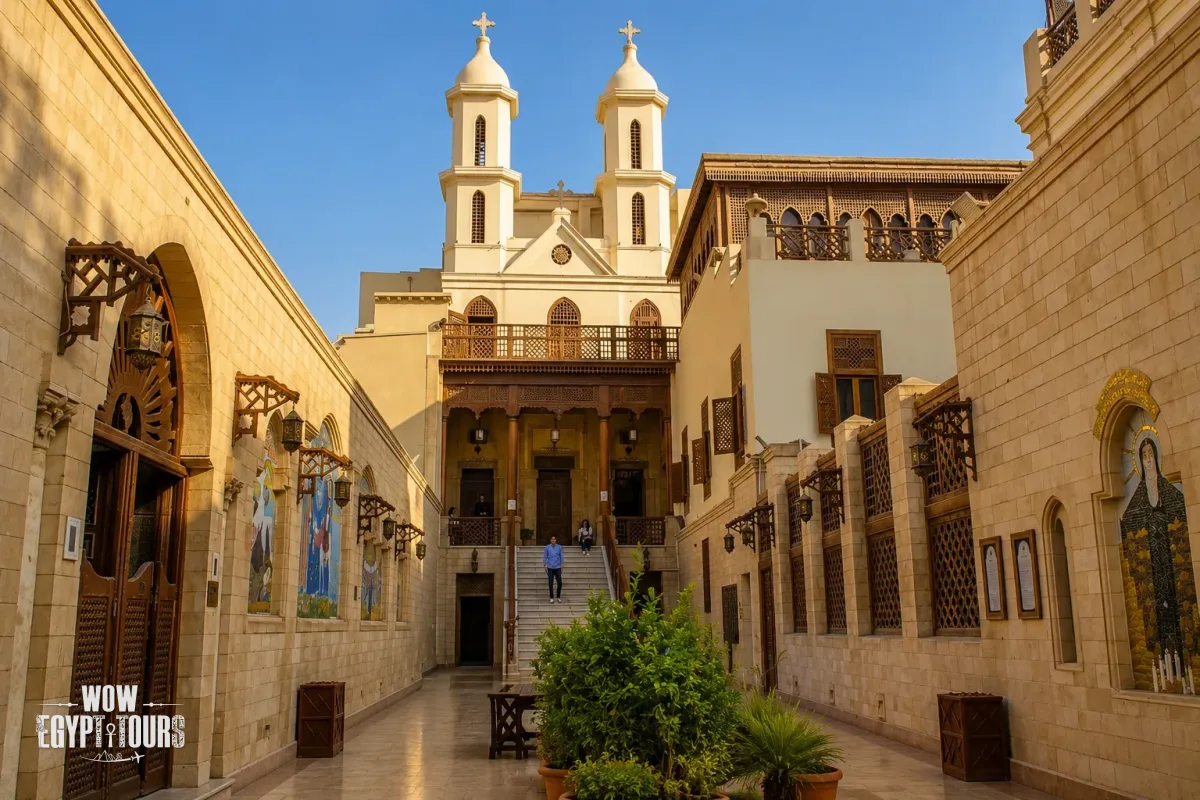

The Hanging Church, whose official designation as the Saint Virgin Mary's Coptic Orthodox Church in Arabic al-Mu'allaqa, meaning the Suspended or the Hanging, refers to the most extraordinary and the most immediately personally affecting single architectural characteristic of the building whose nave is suspended over the southern gatehouse towers of the ancient Roman fortress of Babylon in the most dramatically and the most historically extraordinary structural position of any ancient Christian church accessible at any heritage site in the complete Egyptian capital, is the most celebrated, the most personally beloved, and the most internationally recognized of all the ancient Coptic Orthodox churches in Egypt and one of the oldest and the most historically significant Christian places of worship accessible at any heritage destination in the complete African and Middle Eastern world. Built into and above the massive stone fabric of the Roman Babylon Fortress whose construction in the 1st century CE and whose subsequent use as the primary Roman military installation at the apex of the Nile Delta gave the Old Cairo heritage area its most ancient surviving physical structure, the Hanging Church gives every visitor who enters its extraordinarily beautiful interior of ancient wooden ceilings, magnificent iconostasis screens of carved wood inlaid with ivory and ebony, extraordinary collection of ancient Coptic icons covering every wall of the nave and sanctuary, and the most completely atmospheric and the most personally affecting ancient Christian sacred interior accessible at any heritage church in the complete Egyptian capital the most immediately personal and the most completely extraordinary encounter with the living Coptic Christian heritage tradition of Egypt in its most ancient, its most personally beautiful, and its most institutionally consequential available architectural expression. The Hanging Church is the physical heart of the most completely extraordinary multi-faith heritage neighborhood in the complete Egyptian capital, the Old Cairo Coptic heritage district whose walking-distance concentration of the oldest mosque in Africa at the adjacent Amr Ibn Al-Ass Mosque, the oldest synagogue in Egypt at the Ben Ezra Synagogue, and the most comprehensive Coptic heritage museum in the complete world at the adjacent Coptic Museum gives the Hanging Church its most complete and its most personally extraordinary multi-faith heritage context of any accessible ancient Christian church in the complete Egyptian heritage landscape. This extraordinary monument is featured in Cairo Tours, Egypt Classic Tours, and Egypt Short Break Tours, all of which WOW Egypt Tours proudly offers to travelers from around the world as part of Egypt Tours Packages and Egypt Travel Packages that encompass the extraordinary multi-faith and ancient heritage of Cairo and the complete Egyptian Nile Valley civilization.
The Hanging Church Cairo is not simply a beautiful ancient church however extraordinary its architectural character and however celebrated its collection of Coptic Christian art; it is the primary living institution of the ancient Coptic Orthodox Christian tradition in the most personally affecting and the most completely atmospheric ancient church environment accessible to visitors in the complete Egyptian capital, an active place of Christian worship of extraordinary historical depth whose ongoing daily programme of Coptic Orthodox liturgy, Coptic Christian prayer, and Coptic Christian devotional activity gives every visitor who enters it the most direct and the most personally affecting encounter with the living Coptic Christian tradition in its most historically primary and its most institutionally consequential contemporary expression available at any accessible heritage church in the complete Egyptian capital. The Coptic Christian community of Egypt, whose specific historical identity as the most continuously ancient Christian community in the complete African heritage record, tracing its specific Christian origins directly to the apostolic mission of Saint Mark the Evangelist who is traditionally credited with bringing the Christian faith to Egypt in the 1st century CE in the most direct possible connection to the earliest generation of the complete Christian heritage, gives the Hanging Church's institutional significance a dimension of apostolic historical depth and personal Christian heritage authenticity that is simply without parallel at any other accessible Christian heritage monument in the complete Egyptian capital. WOW Egypt Tours includes the Hanging Church as an essential cultural heritage destination in all comprehensive Cairo Tours, Egypt Classic Tours, Egypt Short Break Tours, Egypt Family Tours, Egypt Budget Tours, and all Egypt Tour Packages that encompass the extraordinary multi-faith heritage of the Egyptian capital.

What Is The Hanging Church?
The Hanging Church is the most celebrated ancient Coptic Orthodox Christian church in Egypt and one of the oldest continuously active Christian places of worship accessible at any heritage destination in the complete African and Middle Eastern world, a church of extraordinary historical depth and extraordinary personal beauty located in the Old Cairo Coptic heritage district whose position suspended over the massive stone towers of the southern gatehouse of the ancient Roman Babylon Fortress gives it both its most immediately distinctive architectural characteristic of the hanging or suspended nave and its most ancient and its most personally extraordinary physical relationship with the pre-Christian Roman military heritage of the Egyptian capital that is preserved in the fortress fabric beneath and around the church building. The church's official designation as the Saint Virgin Mary's Coptic Orthodox Church identifies its primary theological dedication to the Virgin Mary, the most universally venerated figure in the complete Coptic Christian theological and devotional tradition whose specific centrality in the Coptic Orthodox liturgical programme and the Coptic Orthodox iconographic tradition gives the Hanging Church's extraordinary collection of ancient Coptic icons and its complete decorative programme the most personally affecting and the most immediately accessible devotional character of any accessible ancient Coptic church interior in the complete Egyptian heritage landscape.
The current building of the Hanging Church is the product of more than a thousand years of successive construction, reconstruction, renovation, and architectural enrichment whose accumulated layers of Christian devotional art and architectural heritage give the interior its most completely extraordinary and the most personally overwhelming character as the most visually rich and the most personally affecting ancient Coptic church interior accessible at any heritage site in the complete Egyptian capital. The earliest construction at the Hanging Church site is traditionally dated to the late 3rd or early 4th century CE, making the founding of the church broadly contemporary with the most consequential transition in the complete history of the Christian church in Egypt, the formal recognition of Christianity by the Roman Emperor Constantine following the Edict of Milan in 313 CE that ended the Roman persecution of the Christian community and inaugurated the most productive and the most architecturally ambitious period of early Christian church building in the complete Egyptian heritage record. The current building's most celebrated and its most personally extraordinary architectural elements date primarily from the medieval Coptic period of the 10th through 13th centuries CE, giving the church's interior its most historically layered and its most personally extraordinary decorative character as the accumulated product of more than a thousand years of Coptic Christian artistic tradition and devotional enrichment in the most continuously active and the most institutionally consequential ancient Christian church in the complete Egyptian capital.
Who Built The Hanging Church?
The founding of the Hanging Church at the Old Cairo Babylon Fortress site is attributed in the Coptic historical tradition to the earliest period of formal Christian presence in the Egyptian capital area, with various ancient sources proposing founding dates ranging from the late Roman period of the 3rd century CE to the early Byzantine period of the 4th century CE, a range of founding date attribution that reflects both the genuine historical uncertainty of the specific founding moment and the profound importance that the Coptic Christian tradition attaches to the maximum possible antiquity of its most celebrated church in the most direct available connection to the earliest possible period of the Christian heritage in the Egyptian capital area. The most historically credible scholarly assessment suggests that the original church at the Hanging Church site was established in the 4th century CE, following the Edict of Milan's formal legalization of Christianity and the subsequent rapid expansion of Christian church building throughout the Roman Empire and its Egyptian province, with the specific selection of the Babylon Fortress southern gatehouse towers as the foundation structure for the church reflecting both the practical availability of the fortress's massive stone towers as a building platform and the specific political circumstances of the early Christian community in the Egyptian capital whose access to urban building sites may have been constrained by the complex social and political dynamics of the late Roman and early Byzantine Egyptian urban environment.
The most historically documented and the most architecturally consequential of the Hanging Church's founding and rebuilding events is the comprehensive reconstruction of the church in the 10th century CE under the patronage of the Coptic Patriarch Abraham ibn Zaraa, whose specific architectural vision of creating the most beautiful and the most completely extraordinary Coptic church interior in the complete Egyptian heritage record gave the Hanging Church the primary elements of its current architectural character, including the extraordinary iconostasis screens, the nave marble columns, and the wooden ceiling programme that together give the current interior its most immediately personal and the most completely affecting decorative heritage quality. The subsequent contributions of successive Coptic Patriarchs, wealthy Coptic Christian donors, and devoted Coptic Christian communities to the progressive enrichment of the Hanging Church's interior decorative programme across the complete medieval and early modern Coptic period gave the church the most accumulated and the most personally extraordinary collection of ancient Coptic devotional art and ancient Coptic architectural heritage accessible at any single ancient Coptic church in the complete Egyptian capital, a heritage accumulation whose specific depth and variety gives the Hanging Church its most distinctive and its most institutionally consequential character as the primary repository of the finest and the most personally affecting examples of the ancient Coptic Christian artistic tradition accessible to visitors at any heritage monument in the complete Cairo Coptic heritage district.
The Coptic Christian Heritage Of Egypt
The Coptic Christian community of Egypt is the most ancient continuously existing Christian community in the complete African heritage record, tracing its specific Christian origins to the apostolic mission of Saint Mark the Evangelist, the author of the earliest of the four canonical Gospels, who according to the universal tradition of the Coptic Orthodox Church brought the Christian faith to Alexandria in approximately 42 CE in the most direct possible connection between the Egyptian Christian community and the earliest generation of the complete Christian heritage following the life, death, and resurrection of Jesus Christ. The specific Coptic claim to apostolic foundation by Saint Mark gives the Egyptian Christian community a historical precedence and a theological authority of the most profound possible character in the complete Christian heritage record, a foundation whose direct connection to one of the four Evangelists of the canonical New Testament gives the Coptic Orthodox Church its most fundamental and its most personally affecting claim to the most ancient and the most apostolically authoritative Christian heritage in the complete African religious tradition. The Coptic Orthodox Church of Alexandria, whose primate the Pope of Alexandria and Patriarch of the See of Saint Mark holds the most ancient patriarchal throne in the complete Christian heritage record of the African continent, has maintained the most continuous institutional existence of any Christian denomination in the complete African heritage record from its apostolic founding in the 1st century CE through the Roman persecutions of the 2nd and 3rd centuries, the Byzantine period, the Arab Islamic conquest of 641 CE, the complete medieval Islamic period of the Fatimid, Ayyubid, Mamluk, and Ottoman Egyptian governance, and the modern era to the present day.
The specific significance of Egypt in the complete early Christian heritage record extends far beyond the apostolic mission of Saint Mark to encompass the Holy Family's flight into Egypt documented in the Gospel of Matthew, which the Coptic Orthodox tradition commemorates with the most comprehensive and the most personally affecting pilgrimage route of any Marian devotional tradition in the complete African Christian heritage record, tracing the specific route of the Holy Family's journey through the Egyptian Nile Valley during their period of refuge in Egypt from the persecution of King Herod in a continuous pilgrimage tradition whose specific historical significance gives the complete Egyptian Christian heritage landscape its most directly Gospel-connected and its most personally affecting dimension of apostolic Christian presence in the physical geography of the Egyptian Nile Valley. The specific connection of the Old Cairo Babylon Fortress area to the Holy Family's Egypt sojourn, which the Coptic traditional narrative identifies as one of the specific locations visited by the Holy Family during their Egyptian journey, gives the Hanging Church and the complete Old Cairo Coptic heritage district its most personally affecting and its most theologically profound dimension of early Christian historical presence in the most ancient and the most continuously inhabited Christian sacred landscape of the complete Egyptian capital area.
Hanging Church Location
The Hanging Church is located in the Old Cairo Coptic heritage district, also known as the Babylon district for the ancient Roman fortress of Babylon whose southern gatehouse towers form the physical foundation of the church building, approximately 5 kilometers south of the modern Cairo city center in the most concentrated and the most personally extraordinary multi-faith heritage area of the complete Egyptian capital. The church is accessible from central Cairo by taxi or private vehicle in approximately 20 to 25 minutes, by the Cairo Metro to Mar Girgis station on Line 1 and then a very short walk of approximately 2 to 3 minutes through the entrance gate of the Coptic heritage enclosure, or by private vehicle as part of the complete Old Cairo multi-faith heritage programme organized by WOW Egypt Tours. The church is most naturally and most efficiently visited as the central and the most personally extraordinary destination of the complete Old Cairo multi-faith heritage programme combining the Hanging Church with the immediately adjacent Coptic Museum, the Ben Ezra Synagogue, the St George Church, the St Virgin Mary Church, and the adjacent Amr Ibn Al-Ass Mosque in the most completely satisfying and the most personally extraordinary multi-faith heritage day programme available from any Cairo hotel base. WOW Egypt Tours provides private vehicle transportation from all Cairo hotels to the Hanging Church and organizes the complete Old Cairo multi-faith heritage programme as part of all Cairo Tours and Egypt Tour Packages.
Hanging Church Fun Facts
The Hanging Church derives its most celebrated and its most immediately personally extraordinary name from the specific architectural circumstance of its nave being physically suspended over the two towers of the southern gatehouse of the Roman Babylon Fortress, whose massive stone construction of approximately 1st century CE date provides the physical foundation on which the church's floor is elevated approximately 6 meters above the surrounding street level, giving the church building its most immediately dramatic and its most personally affecting architectural characteristic of appearing to hang in space above the ancient Roman fortress fabric that supports it from below. The specific experience of entering the Hanging Church through the steep external staircase of 29 marble steps that ascends from the street level of the surrounding Coptic heritage enclosure to the church's elevated entrance level, ascending through the narrow staircase flanked by the ancient Roman fortress stone fabric visible through the gaps in the surrounding structure, gives the Hanging Church visit its most extraordinary and its most personally dramatic approach experience, the specific recognition that the 29 steps of the entrance staircase have been climbed by Christian worshippers ascending to the same church for more than fifteen centuries in the most continuously personal and the most directly physically connective heritage encounter with the living Christian devotional tradition available at any accessible ancient Christian church in the complete Egyptian capital.
The Hanging Church has served as the seat of the Coptic Orthodox Patriarchate of Alexandria for extended periods of its institutional history, giving it a specific institutional significance within the complete Coptic Orthodox Church hierarchy that exceeds its local identity as the primary church of the Old Cairo Coptic heritage district and gives it the most directly patriarchal and the most institutionally authoritative character of any accessible Coptic church in the complete Egyptian capital. The specific periods during which the Hanging Church served as the seat of the Coptic Patriarch, encompassing several centuries of the complete medieval Coptic period when the Patriarch's residence was established at the Babylon Fortress area rather than in Alexandria, give the church a dimension of institutional centrality in the complete Coptic Orthodox Church's historical experience that is reflected in the extraordinary quality and the extraordinary completeness of its decorative programme, whose specific richness and variety reflect the accumulated investment of the most devoted and the most institutionally prominent members of the Coptic Orthodox community across the complete span of the church's more than fifteen-century institutional existence.
The extraordinary ivory and ebony inlaid iconostasis screen of the Hanging Church, the most celebrated and the most personally extraordinary single decorative element of the complete church interior, is widely recognized by scholars of the Coptic decorative arts tradition as the most beautiful and the most technically accomplished example of the ancient Coptic wood inlay tradition accessible at any Coptic church in the complete Egyptian heritage record, a screen of such extraordinary technical mastery in the most demanding of all the ancient Coptic woodworking techniques and of such completely extraordinary visual beauty in its specific combination of the warm ivory inlay against the dark ebony of the screen's wooden frame that it gives the Hanging Church's interior its single most immediately personally affecting and the most universally celebrated decorative masterwork of any Coptic church accessible in the complete Egyptian heritage landscape.
Why Is It Called The Hanging Church?
The Hanging Church takes its most immediately recognizable and the most internationally celebrated English-language name from the direct translation of the Arabic name al-Mu'allaqa, whose specific root verb alaqa, meaning to hang or to suspend, was applied to the church in the Arabic geographical and religious literature of the medieval Islamic period to describe the most immediately extraordinary architectural characteristic of the building, the specific fact that the church's nave is physically elevated above the surrounding ground level by the ancient Roman fortress towers on which it rests, creating the visual impression of a church that is literally hanging or suspended above the ancient stone fabric that supports it from below. The Arabic designation al-Mu'allaqa is the most universally used name for the church in all Arabic-language religious, historical, and geographical literature from the medieval Islamic period through the modern era, giving it a history of Arabic-language designation of nearly fourteen centuries that is longer than the English-language designation's usage by many centuries and that reflects the specific character of the church's most immediately distinctive architectural heritage quality in the most concise and the most directly descriptive Arabic compound that the Islamic and Christian Arabic literary traditions have applied to the building. The official English-language designation as the Saint Virgin Mary's Coptic Orthodox Church, reflecting the church's primary theological dedication to the Virgin Mary, is the most institutionally formal and the most liturgically appropriate designation for the building in the standard ecclesiastical convention of the Coptic Orthodox Church, though the informal and internationally recognized designation as the Hanging Church remains the most universally used and the most immediately personally informative English-language name for the most celebrated Coptic church in the complete Egyptian capital in every context of international heritage tourism, scholarly publication, and popular cultural reference to the Old Cairo Coptic heritage district.
Hanging Church History
The history of the Hanging Church from its earliest establishment at the Babylon Fortress site in the late 3rd or early 4th century CE through the Byzantine period's progressive enrichment of the church's fabric, the Arab Islamic conquest of 641 CE and the subsequent remarkable survival and continuous institutional existence of the church through the complete sequence of Islamic political authorities that governed Egypt from the 7th century CE to the present day, the medieval Coptic period's extraordinary programme of decorative enrichment that gave the church its most celebrated iconostasis screens and its most treasured icon collection, the Ottoman period's continued use and conservative maintenance of the church's fabric, and the modern era's systematic heritage conservation and heritage management programmes traces one of the most extraordinary and the most personally consequential single heritage institution biographies of any ancient Christian church accessible at any heritage destination in the complete African and Middle Eastern world, a biography whose most fundamental characteristic is the extraordinary institutional resilience and the extraordinary devotional persistence of the Coptic Christian community's attachment to this specific church across more than fifteen centuries of the most dramatic political, religious, and social transformations in the complete history of the Egyptian capital area.
The most consequential architectural transformation in the complete history of the Hanging Church's fabric is the major reconstruction of the 10th century CE under the Coptic Patriarch Abraham ibn Zaraa, whose specific architectural and decorative vision gave the church the primary elements of its current extraordinary interior character including the magnificent iconostasis screens of carved and inlaid wood, the nave's marble column programme, and the complete decorative framework within which the subsequent centuries of icon painting, devotional object donation, and architectural enrichment have been organized to give the current interior its most completely extraordinary and its most personally overwhelming character as the richest and the most personally affecting ancient Coptic church interior accessible at any heritage site in the complete Egyptian capital. The church's specific history as the seat of the Coptic Orthodox Patriarchate for extended periods of the medieval Coptic period gave it the institutional authority and the practical financial resources to attract the most devoted and the most skilled Coptic Christian artists and craftsmen of the medieval period to the most ambitious and the most personally extraordinary programme of decorative enrichment available at any Coptic church in the complete Egyptian heritage landscape, giving the Hanging Church's interior the most completely extraordinary accumulated decorative heritage of any ancient Coptic church in the complete Egyptian capital whose specific richness and whose specific variety of ancient Coptic Christian art forms reflect the most consequential centuries of the complete Coptic artistic tradition's medieval flowering in the most prestigious and the most institutionally authoritative ecclesiastical setting available in the complete Coptic heritage landscape of medieval Egypt.
The Story Of Egypt's Most Beloved Ancient Christian Church
The story of the Hanging Church as Egypt's most beloved and most internationally celebrated ancient Christian church is the story of the extraordinary persistence of the Coptic Christian devotional tradition through the most challenging and the most personally dramatic circumstances of the complete medieval and early modern Egyptian political history, of a church that has remained the most personally cherished and the most institutionally central of all the ancient Coptic churches in the Egyptian capital across fifteen centuries of continuous Christian worship in the same extraordinary building in the most dramatic possible demonstration of the Coptic Christian community's attachment to the specific physical places of its most ancient and its most personally sacred devotional heritage. The Hanging Church's specific institutional biography, as a church that has provided the primary sacred space for the Coptic Christian community of the Egyptian capital through the Byzantine period, the Arab Islamic conquest, the Fatimid and Ayyubid periods, the Mamluk sultanate, the Ottoman era, and the modern Egyptian republic, gives it a quality of continuous Christian devotional presence at a single physical location over a temporal span of extraordinary depth that is simply without parallel at any other accessible ancient Coptic church in the complete Egyptian capital and that gives every visitor who enters it the most direct and the most personally affecting encounter with the living continuity of the ancient Coptic Christian tradition in its most historically primary and its most personally resonant available institutional form.
Hanging Church Key Attractions And Features
The Nave And Its Extraordinary Atmosphere
The nave of the Hanging Church is the single most personally extraordinary and the most completely affecting ancient Christian sacred interior space accessible at any heritage church in the complete Egyptian capital, a long central space divided into three aisles by two rows of ancient marble columns of considerable variety whose different materials, different heights, and different capitals reflect the accumulated result of centuries of successive column installation in the most characteristic and the most personally instructive architectural expression of the ancient Coptic building tradition's use of reused ancient architectural material in the service of the Christian devotional programme. The nave's most immediately extraordinary atmospheric quality derives from the specific combination of the ancient wooden ceiling whose extraordinary carved and painted decorative programme in the most traditional Coptic geometric and iconographic vocabulary creates the most complete and the most personally overwhelming ancient Coptic interior atmospheric ceiling experience of any accessible Coptic church in the complete Egyptian capital, the ancient icons whose presence on virtually every available wall surface creates the most completely icon-saturated ancient Christian interior atmosphere of any accessible heritage church in the complete Cairo Coptic heritage district, the ancient marble pulpit whose extraordinary carved stone decorated platform of the most refined Coptic decorative arts tradition gives the nave its most distinguished single architectural furnishing element, and the specific quality of ancient devotional atmosphere created by the continuous presence of Coptic Christian worshippers in the nave and sanctuary whose ongoing devotional activity gives the Hanging Church's interior a living religious character entirely unlike the heritage museum atmosphere of many comparable ancient churches in other contexts and entirely consistent with the Hanging Church's identity as the most continuously active and the most institutionally vital ancient Coptic Christian sacred space in the complete Egyptian capital.
The Three Iconostasis Screens
The Hanging Church possesses three extraordinary iconostasis screens that together constitute the most completely remarkable and the most personally extraordinary collection of ancient Coptic woodwork inlay art accessible at any heritage church in the complete Egyptian heritage landscape, screens whose specific combination of extraordinary technical mastery in the ancient Coptic wood inlay tradition, extraordinary visual beauty in the most refined available combination of ivory and ebony decorative material in the most complete geometric and iconographic inlay programme of any Coptic church furnishing, and extraordinary historical significance as the oldest and the most institutionally prestigious surviving examples of the medieval Coptic woodwork tradition give the Hanging Church's iconostasis programme its most completely extraordinary and its most personally affecting status as the supreme achievement of the complete medieval Coptic decorative woodworking art tradition accessible at any heritage monument in the complete Egyptian capital. The most celebrated and the most immediately extraordinary of the three iconostasis screens is the central screen of the sanctuary, whose specific programme of ivory and ebony inlay in the most complex and the most completely realized geometric pattern programme of any surviving medieval Coptic iconostasis screen creates a decorative surface of such extraordinary visual refinement and such completely extraordinary technical precision that every scholarly tradition of Coptic art history that has engaged with it has recognized it as the supreme individual example of the medieval Coptic inlay woodwork tradition in the complete Egyptian heritage record, a decorative achievement whose specific combination of material beauty, geometric complexity, and technical mastery is genuinely without parallel at any comparable Coptic or early Christian decorative woodwork accessible at any heritage church in the complete Egyptian capital or in the complete African and Middle Eastern world.
The Ancient Coptic Icon Collection
The Hanging Church houses one of the most remarkable and the most personally extraordinary collections of ancient Coptic icons accessible at any heritage church in the complete Egyptian capital, a collection of painted devotional images of the Virgin Mary, of Jesus Christ, of the Apostles, of the early Christian martyrs and saints of the Coptic Orthodox Church, and of the most important biblical narrative scenes of both the Old and New Testament traditions whose combined presence on virtually every available wall surface of the nave and sanctuary creates the most completely icon-saturated ancient Christian interior atmosphere of any accessible heritage church in the complete Cairo Coptic heritage district. The specific quality of the Hanging Church icon collection, whose individual icons range from the most recently painted devotional images of the modern Coptic artistic tradition through the most historically important and the most personally affecting ancient icons of the medieval Coptic period whose specific combination of the Byzantine iconographic tradition with the distinctively Egyptian Coptic stylistic vocabulary gives them a quality of devotional art entirely unique in the complete Christian heritage record, gives the church's interior its most immediately personal and its most directly devotionally affecting heritage dimension for every visitor who enters the Hanging Church with the most genuine interest in the living artistic tradition of the ancient Egyptian Christian community. The most celebrated individual icons in the Hanging Church collection include several extraordinary examples of the ancient Coptic icon painting tradition of the 8th and 9th centuries CE whose specific artistic quality of Byzantine-influenced yet distinctively Egyptian devotional portraiture gives them a heritage significance in the complete Coptic art history record that is recognized by every scholarly tradition of early Christian iconographic study as the most important and the most personally affecting surviving examples of the early medieval Egyptian Christian devotional painting tradition accessible at any heritage church in the complete Egyptian capital.
The Marble Pulpit And The Ancient Columns
The marble pulpit of the Hanging Church, standing in the center of the nave to the right of the primary entrance as one of the most immediately personally extraordinary and the most architecturally distinguished single furnishing elements of the complete church interior, is the most refined and the most completely realized example of the ancient Coptic carved stone decorative arts tradition accessible at any heritage church in the complete Egyptian capital, a platform of extraordinary beauty whose specific programme of carved geometric and floral decoration in the most refined available Coptic stone carving tradition and whose specific form of the elevated preaching platform raised on multiple carved stone columns gives it a quality of personal artistic distinction and personal heritage significance entirely appropriate to the primary preaching and Gospel reading furnishing of the most celebrated and the most institutionally prestigious Coptic church in the complete Egyptian capital. The two rows of ancient marble columns that divide the nave into its three aisles, whose considerable variety of column material, column height, and column capital style reflects the accumulated result of more than fifteen centuries of successive column installation and occasional replacement in the most characteristic and the most personally instructive archaeological evidence for the Coptic building tradition's consistent practice of incorporating reused ancient architectural material from the abundant ancient Egyptian and Roman heritage of the Old Cairo area into the most sacred and the most institutionally important buildings of the Coptic Christian community, give the Hanging Church nave its most immediately archaeologically fascinating and its most personally historically resonant structural programme, each ancient column a specific archaeological artifact in its own right whose specific material origin and whose specific period of manufacture give the complete nave column collection its most extraordinary range of ancient material heritage from different periods of the complete Egyptian architectural tradition.
The Chapel Of Takla Haymanot
The Chapel of Takla Haymanot, one of several subsidiary chapels accessible within the complete Hanging Church building complex, is dedicated to the extraordinary Ethiopian Christian saint whose specific veneration within the Coptic Orthodox tradition reflects the deep historical and theological connection between the Egyptian Coptic Orthodox Church and the Ethiopian Orthodox Christian tradition, whose specific apostolic bond of shared Coptic patriarchal authority maintained from the 4th century CE through the 20th century gives the Egyptian-Ethiopian Christian relationship its most consequential and its most personally affecting institutional heritage dimension in the complete African Christian heritage record. The chapel's specific dedication to an Ethiopian saint gives the Hanging Church a dimension of specifically African Christian heritage outreach that is entirely appropriate to the institution's identity as the primary centre of the most ancient continuous Christian tradition on the African continent and gives every visitor who explores the complete church complex the most complete and the most personally extraordinary encounter with the complete breadth of the Coptic Orthodox Church's African Christian heritage programme beyond the specific Egyptian institutional context of the primary nave and sanctuary.
The Roman Babylon Fortress Foundation
The ancient Roman Babylon Fortress fabric whose massive stone gatehouse towers form the physical foundation of the Hanging Church is perhaps the most personally extraordinary and the most archaeologically significant single structural element of the complete Hanging Church heritage, a physical survival from the Roman imperial period of the 1st century CE whose continued presence beneath and around the church building gives the Hanging Church its most dramatic and its most personally affecting single dimension of historical temporal depth, the direct physical encounter with the Roman imperial military heritage of the Egyptian capital in the stone fabric of the same structure that supports the most celebrated ancient Coptic Christian church in the complete Egyptian capital above it. The specific portions of the Roman fortress fabric visible to visitors at the church's entrance, through the windows of the staircase approach, and in the visible exposed stone sections of the fortress towers that form the church's physical foundation, give the Hanging Church its most immediately personal and its most directly physically extraordinary heritage encounter with the pre-Christian Roman heritage of the Old Cairo area, connecting the visitor simultaneously to the Roman imperial military tradition of the Egyptian capital, the early Christian community that established its most prestigious church on this specific ancient Roman structure, and the living Coptic Christian community that has maintained the same extraordinary church across more than fifteen centuries of continuous devotional use in the most completely personally affecting single heritage encounter with the three successive civilizational traditions of the Old Cairo heritage area available at any single point in the complete Egyptian capital.
The Ancient Wooden Ceiling
The extraordinary ancient wooden ceiling of the Hanging Church nave, whose specific programme of carved and painted geometric decoration in the most traditional Coptic decorative vocabulary gives the interior its most immediately personally affecting single overhead heritage element, is the most completely extraordinary example of the ancient Coptic carved wooden ceiling tradition accessible at any heritage church in the complete Egyptian capital, a ceiling of such completely extraordinary decorative complexity, such completely personal visual beauty, and such completely extraordinary historical depth in the accumulated devotional investment of the Coptic Christian community that it gives the church interior its most immediately overwhelming single decorative impression and its most personally extraordinary single heritage ceiling encounter of any accessible Coptic church in the complete Egyptian capital. The ceiling's specific decorative programme, whose geometric interlace and arabesque patterns in the most complete available expression of the medieval Coptic decorative vocabulary creates a continuous overhead surface of extraordinary visual richness and personal decorative impact, gives the Hanging Church its most immediately distinctive and the most personally memorable single overhead architectural character in the complete spectrum of ancient Coptic church interior ceiling heritage accessible at any heritage monument in the complete Egyptian capital.
The Baptistery And The Subsidiary Chapels
The complete Hanging Church building complex encompasses beyond the primary nave and sanctuary a baptistery of considerable historical significance and several subsidiary chapels of different periods and different theological dedications whose combined institutional programme gives the complete church a quality of multi-functional sacred complexity and personal heritage variety entirely appropriate to the most institutionally important and the most personally prestigious ancient Coptic church in the complete Egyptian capital. The baptistery's specific architectural form and its specific liturgical function as the primary sacramental space of the Coptic Christian initiation tradition give it a dimension of personal theological significance entirely complementary to the primary congregational character of the nave and sanctuary, giving the complete Hanging Church visit a range of sacred spatial experiences from the most communal and the most publicly devotional to the most intimate and the most personally sacramental that is simply unavailable at most accessible ancient Coptic churches in the complete Egyptian heritage landscape. The subsidiary chapels of the complete complex, each dedicated to a different saint or theological mystery of the Coptic Orthodox liturgical programme, give the complete Hanging Church visit its most varied and its most personally comprehensive engagement with the complete range of the Coptic Orthodox devotional tradition available at any accessible ancient Coptic church in the complete Egyptian capital.
Why Is The Hanging Church Important?
The Hanging Church is important for reasons spanning the complete history of the Coptic Christian religious tradition in Egypt, the specific architectural heritage of the ancient Coptic church building tradition in its most celebrated and its most personally extraordinary surviving expression in the Egyptian capital, the decorative arts significance of the extraordinary iconostasis screens and the ancient icon collection as the most complete and the most personally affecting repository of the medieval Coptic artistic tradition accessible at any heritage church in the complete Egyptian capital, the institutional heritage of the Coptic Orthodox Patriarchate's historic connection to the church as the primary Patriarchal residence for extended periods of the medieval Coptic period, and the broader cultural significance of the Hanging Church as the primary physical anchor of the most extraordinary multi-faith heritage neighborhood in the complete Egyptian capital whose combination of the oldest Coptic church, the oldest mosque in Africa, and the oldest synagogue in Egypt within walking distance of each other gives the complete Old Cairo heritage district its most completely extraordinary and the most personally affecting multi-faith heritage character. As a religious heritage monument, the Hanging Church is simultaneously the most historically significant and the most personally extraordinary ancient Coptic Christian sacred space accessible in the complete Egyptian capital, whose specific combination of extraordinary architectural heritage, extraordinary decorative art, and living devotional practice gives it an institutional significance and a personal heritage impact that is genuinely without parallel at any other accessible ancient Coptic church in the complete Egyptian heritage landscape. WOW Egypt Tours includes the Hanging Church as an essential destination in all comprehensive Cairo Tours, Egypt Classic Tours, and all Egypt Tour Packages encompassing the extraordinary multi-faith heritage of the Egyptian capital.
What Are Some Interesting Facts About The Hanging Church?
Suspended Over A Roman Fortress
The most immediately extraordinary and the most personally fascinating physical fact about the Hanging Church is the specific architectural circumstance of its nave being physically elevated approximately 6 meters above the surrounding street level by the ancient Roman Babylon Fortress gateway towers whose 1st century CE stone construction provides the foundation on which the church building rests, creating the visual impression and the architectural reality of a church that literally hangs above the ancient Roman fortress fabric that supports it from below. This specific structural relationship between the Christian church and the Roman military fortification, in which the most celebrated ancient Coptic Christian sacred space in the Egyptian capital is physically dependent on the structural support of a Roman imperial military installation that predates it by several centuries, gives the Hanging Church its most immediately personally extraordinary heritage quality and its most completely personal architectural character as the church whose entire devotional life has been conducted in a space physically suspended above the ancient stone of the Roman imperial world in the most dramatic and the most personally instructive available demonstration of the transition from the Roman imperial to the early Christian cultural tradition in the physical heritage of the Old Cairo area.
Twenty-Nine Steps To Heaven
The 29 marble steps of the Hanging Church's external entrance staircase, ascending from the street level of the surrounding Coptic heritage enclosure to the church's elevated entrance level through the narrow staircase that passes beside the visible ancient Roman fortress stone fabric, have been climbed by Christian worshippers and Christian pilgrims ascending to the same ancient church for more than fifteen centuries in the most continuously performed physical act of Christian devotional approach available at any accessible heritage church in the complete Egyptian capital. The specific number of 29 steps has been variously interpreted in the Coptic devotional tradition as carrying specific symbolic significance in relation to the 29 books of the Coptic Orthodox biblical canon or other devotionally significant numerical patterns of the Coptic Christian theological tradition, though the most practically accurate explanation of the specific step count is the most straightforwardly practical one of the number of steps required to bridge the specific vertical height difference between the surrounding street level and the elevated floor level of the church's nave that rests on the Roman fortress towers approximately 6 meters above. The specific experience of ascending the 29 steps of the Hanging Church entrance staircase, passing the ancient stone fabric of the Roman fortress visible through the staircase walls, gives every visitor the most direct and the most personally affecting physical encounter with the transition between the Roman imperial heritage and the early Christian heritage of the Old Cairo area available at any accessible heritage site in the complete Egyptian capital.
The Holy Family Tradition
The Coptic Orthodox Christian tradition identifies the Old Cairo Babylon Fortress area, immediately adjacent to the Hanging Church site, as one of the specific locations visited by the Holy Family during their documented journey through Egypt as described in the Gospel of Matthew, giving the complete Old Cairo Coptic heritage district and specifically the Hanging Church a dimension of direct apostolic connection to the most personally sacred event in the complete Christian heritage record, the physical presence of the Virgin Mary, the infant Jesus, and Saint Joseph in the specific geographical area of the Egyptian capital that the Hanging Church has served as the primary sacred space of the Coptic Christian community for more than fifteen centuries. The specific Coptic tradition of the Holy Family's Egyptian sojourn, which traces a complete and geographically detailed route through the Egyptian Nile Valley from the northeastern entry into Egypt at Sinai through the complete Delta and Nile Valley landscape to the southernmost point of the family's Egyptian journey and back, gives the complete Egyptian Coptic Christian heritage landscape a dimension of personal Gospel connection and personal Marian devotional significance that is simply without parallel at any comparable Christian heritage landscape in the complete African heritage record and that gives the Hanging Church its most personally profound and its most theologically extraordinary heritage dimension for Christian visitors whose specific theological and devotional engagement with the Marian tradition of the Coptic Orthodox Church gives the church visit its most completely extraordinary personal Christian heritage experience.
What Is So Special About The Hanging Church?
The Most Beloved Ancient Church In Egypt
What makes the Hanging Church uniquely and incomparably special in the complete Egyptian heritage landscape is the extraordinary combination of architectural uniqueness, decorative art excellence, devotional atmospheric richness, and living Christian community vitality that gives it a quality of total heritage achievement simply unavailable at any other accessible ancient Coptic church in the complete Egyptian capital. The specific quality of entering the Hanging Church through the ancient staircase over the Roman fortress towers, ascending into the nave whose extraordinary ancient wooden ceiling, magnificent iconostasis screens, and walls covered with ancient Coptic icons create the most completely icon-saturated and the most personally devotionally overwhelming ancient Christian interior atmosphere accessible at any heritage church in the complete Egyptian capital, and encountering the living Coptic Christian devotional tradition in the ongoing prayer and worship of the Coptic community for whom this specific church has been the primary sacred space of the Egyptian capital for more than fifteen centuries, creates a quality of personal heritage impact and personal religious and cultural encounter that is genuinely unlike anything available at any other accessible heritage destination in the complete Egyptian capital and that gives the Hanging Church its most fundamental and its most completely extraordinary identity as the place where the living Coptic Christian heritage tradition of Egypt is most completely, most personally, and most beautifully itself in the most ancient and the most continuously active institutional form available to any heritage visitor at any accessible heritage church in the complete Egyptian capital.
Where Egypt's Oldest Christian Heritage Lives
The Hanging Church is also uniquely special for the specific quality of apostolic historical continuity it embodies, the direct institutional connection to the most ancient Christian community in the complete African heritage record whose specific apostolic foundation through Saint Mark the Evangelist in the 1st century CE gives the complete Coptic Christian heritage tradition its most directly apostolic and its most personally extraordinary claim to the most ancient continuously existing Christian institutional presence in the complete history of Christian civilization in Africa, a claim whose most personally accessible and most completely affecting expression in the physical heritage of the Egyptian capital is precisely this ancient church in the Old Cairo Coptic heritage district whose fifteen-century continuous devotional use gives every visitor who enters it the most direct and the most personally affecting physical encounter with the living continuity of the ancient Egyptian Christian heritage in its most historically primary and its most institutionally consequential available form.
The Hanging Church Through The Ages
The complete narrative of the Hanging Church from its earliest establishment at the Babylon Fortress site in the 3rd or 4th century CE through the Byzantine period's formal recognition of Christianity and the subsequent expansion of the church's importance as the primary Coptic church of the Egyptian capital area, through the Arab Islamic conquest of 641 CE and the remarkable survival of the Coptic Christian community and its primary church through the transition to Islamic governance, through the medieval period's extraordinary decorative enrichment under Patriarch Abraham ibn Zaraa and subsequent Coptic Christian patrons, through the extended periods of Coptic Patriarchal residence that gave the church its most consequential institutional authority in the complete Coptic hierarchy, through the Ottoman period's continued maintenance and conservative preservation of the church's fabric, and through the modern era's systematic heritage conservation and international recognition as one of the most important ancient Christian heritage monuments in the complete African heritage record, traces the most extraordinary and the most personally affecting institutional heritage biography of any ancient Christian church accessible at any heritage destination in the complete Egyptian capital, a biography whose most fundamental characteristic is the extraordinary continuity of Coptic Christian devotional life at the same physical location over fifteen centuries of the most dramatic political, social, and religious transformations in the complete history of the Egyptian capital area.
The Hanging Church And UNESCO
The Hanging Church is protected as a primary Coptic Christian heritage component of the UNESCO World Heritage Site designated in 1979 as Historic Cairo, recognized as a heritage of outstanding universal value for the extraordinary concentration of Islamic, Coptic Christian, and Jewish heritage in the historic core of Cairo that includes the Hanging Church as its most historically significant and its most internationally recognized ancient Coptic Christian sacred building alongside the complete Islamic heritage of the Fatimid, Mamluk, and Ottoman historic quarters. The UNESCO Historic Cairo inscription specifically acknowledges the Hanging Church as an essential component of the outstanding universal value of the complete Historic Cairo World Heritage designation in its most multi-faith and its most historically comprehensive expression, the single ancient Coptic church whose specific combination of architectural heritage, decorative art heritage, and fifteen-century institutional continuity gives the complete Historic Cairo inscription its most ancient and its most personally extraordinary Christian heritage component. The Egyptian government and the UNESCO World Heritage Committee are engaged in ongoing collaboration on the conservation management of the Hanging Church, addressing the specific conservation challenges of an active place of Christian worship with an extraordinary decorative art programme in the specific climatic and environmental conditions of the Old Cairo heritage district.
Best Time To Visit The Hanging Church
The Hanging Church is most naturally and most efficiently visited as part of the complete Old Cairo multi-faith heritage programme combining the church with the immediately adjacent Coptic Museum, Ben Ezra Synagogue, St George Church, St Virgin Mary Church, and the nearby Amr Ibn Al-Ass Mosque in the most personally extraordinary and the most completely satisfying multi-faith heritage day programme available from any Cairo hotel base. The morning hours from approximately 9:00 AM to noon are the most recommended visiting period for the most manageable visitor density conditions and the most atmospheric natural light quality in the nave, whose specific quality of filtered morning light through the ancient windows creates the most extraordinary and the most personally affecting illumination of the iconostasis screens and the ancient icon collection available at any time of the complete daily visiting cycle. Sunday mornings from approximately 7:00 AM to 11:00 AM see the Hanging Church most completely alive with the most active and the most personally extraordinary Coptic Orthodox Sunday liturgy in the most complete and the most personally affecting expression of the living Coptic Christian devotional tradition, but this same liturgical activity makes the standard heritage visit programme most practically challenging and most appropriately deferential to the worship needs of the active congregation during this specific period. Visiting hours outside the liturgy times provide the most practically accessible and the most personally comfortable heritage visit. The cooler months of October through April provide the most comfortable visiting conditions. WOW Egypt Tours advises on optimal timing within the complete Old Cairo multi-faith heritage programme.
Hanging Church Opening Hours
The Hanging Church is open to visitors daily from 9:00 AM to 5:00 PM, with the most significant variation in visiting conditions occurring during the Sunday liturgy from approximately 7:00 AM to 11:00 AM when the church is most actively engaged in Coptic Orthodox worship. The church is an active place of Coptic Orthodox worship and visiting arrangements must respect the liturgical schedule and the requirements of the worshipping community. All visiting hours are subject to adjustment for Coptic Christian holy days and special religious occasions whose specific schedule in the Coptic Orthodox liturgical calendar should be confirmed at time of booking with WOW Egypt Tours.
Hanging Church Entrance Fees
The Hanging Church is accessible without an admission fee as an active place of Coptic Orthodox Christian worship, making the most celebrated ancient Coptic church in the Egyptian capital freely accessible to all visitors of every religious background without any charge. The adjacent Coptic Museum, which shares the same Coptic heritage enclosure and which houses the most comprehensive collection of Coptic Christian art and material culture in the complete world, carries its own separate admission fee whose current rate should be confirmed at time of booking with WOW Egypt Tours. All logistics for the complete Old Cairo multi-faith heritage programme including the Hanging Church are organized by WOW Egypt Tours as part of all Cairo Tours and Egypt Tour Packages.
How To Get To The Hanging Church
The Hanging Church is located in the Old Cairo Coptic heritage district approximately 5 kilometers south of the Cairo city center, accessible by the Cairo Metro to Mar Girgis station on Line 1 and then a 2 to 3 minute walk through the entrance gate of the Coptic heritage enclosure in the most conveniently direct public transport approach of any heritage monument in the complete Old Cairo district, by private vehicle from central Cairo in approximately 20 to 25 minutes, or by taxi from any point in central or southern Cairo. The private vehicle organized by WOW Egypt Tours as part of the complete Old Cairo multi-faith heritage programme is the most practically efficient approach for international visitors whose complete Old Cairo programme encompasses multiple heritage destinations within the same district and requires the most organized and the most personally convenient movement between the various sites of the complete multi-faith heritage programme.
How Long To Spend At The Hanging Church
A minimum of 45 minutes to one hour at the Hanging Church is required for the most complete available programme encompassing the guided historical introduction to the Coptic Christian heritage of Egypt, the ascent of the 29 external steps with the Roman fortress fabric observation, the complete nave exploration with the guided explanation of the iconostasis screens, the ancient icon collection, the marble pulpit, the ancient ceiling, and the nave marble columns, and the subsidiary chapel visits. A more completely satisfying Hanging Church programme of one to one and a half hours allows the most thorough and the most personally rewarding engagement with all primary elements of the church's extraordinary interior heritage in the most unhurried and the most personally contemplative format. The Hanging Church is most naturally combined with the immediately adjacent Coptic Museum in the most complete and the most personally satisfying combined programme of the complete Old Cairo Coptic heritage district, giving the complete Coptic heritage visit a museum collection complement of extraordinary depth and extraordinary variety that enriches the direct church interior experience with the most comprehensive available scholarly context for the Coptic Christian art tradition represented in the church's decorative programme. WOW Egypt Tours organizes the complete Old Cairo multi-faith heritage programme with appropriate time allocation for the Hanging Church within the most personally satisfying overall programme sequence.
Tips For Visiting The Hanging Church
Ask your licensed guide from WOW Egypt Tours to provide the complete historical narrative of the Coptic Christian heritage of Egypt, Saint Mark's apostolic founding of the Egyptian Christian community, and the specific connection between the Hanging Church site and the Holy Family's Egypt journey before entering the church, as the combination of this complete devotional and historical context with the direct physical encounter with the oldest and the most celebrated ancient Coptic church in the Egyptian capital gives the Hanging Church visit its most personally extraordinary and its most completely affecting heritage experience. Stand before each of the three iconostasis screens and ask your guide to explain the specific technical achievement of the ivory and ebony inlay programme, the specific iconographic programme of the icons displayed on each screen, and the specific historical period of each screen's construction, as the combination of the technical, iconographic, and historical narrative with the direct visual encounter with the extraordinary screens gives the iconostasis programme visit its most complete and the most personally enriching heritage experience available at any accessible Coptic heritage monument in the complete Egyptian capital. Visit the subsidiary chapels after the primary nave programme, as the specific devotional atmosphere of the smaller and the more intimate chapels gives the complete church visit a dimension of personal sacred spatial variety and personal devotional intimacy that the primary nave's more publicly communal character cannot provide in the same form. Bring a head covering if you do not have one as women will be asked to cover their hair before entering the nave.
What To Wear At The Hanging Church
The Hanging Church is an active Coptic Orthodox Christian place of worship requiring appropriately modest and respectful visiting clothing for all visitors regardless of religious background. Modest clothing covering the shoulders and the knees is required for all visitors. Women are required to cover their hair before entering the church's nave and interior spaces and may be provided with a head covering at the church entrance. Shoes may be removed before entering certain interior spaces at the request of the church staff, though shoe removal is not universally required in all accessible areas of the Hanging Church as it is in Islamic mosque visits. Quiet, respectful comportment throughout the church visit is the most appropriate and the most personally courteous approach to visiting an active place of Christian worship whose ongoing devotional activity should be treated with the same genuine personal respect that any active sacred space of any religious tradition deserves from heritage visitors whose primary motivation is historical and cultural rather than specifically devotional. Comfortable walking shoes with good support are recommended for the entrance staircase ascent and the complete exploration of the church complex whose various chapels and subsidiary spaces require comfortable pedestrian movement through different levels and different building sections.
Photography At The Hanging Church
Photography for personal non-commercial purposes is generally permitted in the Hanging Church, though the specific permission of church staff should be sought before photographing the most sacred interior spaces including the sanctuary area behind the iconostasis screens and any spaces where active liturgical celebrations are in progress. The most extraordinary photography subjects of the complete Hanging Church visit include the exterior staircase approach with the visible Roman fortress stone fabric, the complete nave interior with its extraordinary ceiling, iconostasis screens, and icon-covered walls, the close-up detail photography of the ivory and ebony inlay work of the central iconostasis screen, the ancient marble pulpit in its nave setting, and the ancient columns of the nave with their varied capital designs. The most personally affecting and the most completely extraordinary photography of the Hanging Church interior is achieved in the morning natural light when the filtered light through the ancient windows illuminates the iconostasis screens and the icon collection in the most warm and the most completely beautiful natural light available at any time of the complete daily visiting cycle. Respectful practice of not photographing individual worshippers without their permission and not using flash photography in the vicinity of fragile ancient artworks is the most appropriate and the most personally courteous approach to heritage photography at this most celebrated and most personally sacred ancient Christian heritage monument in the complete Egyptian capital.
Hanging Church Tours
Old Cairo Multi-Faith Heritage Day: Hanging Church, Coptic Museum, And Ben Ezra Synagogue
This comprehensive Old Cairo multi-faith heritage programme combines the most celebrated ancient Coptic church in Egypt with the most comprehensive Coptic heritage museum in the world and one of the oldest Jewish heritage sites in Africa in the most personally extraordinary and the most completely multi-faith single heritage day programme available from any Cairo hotel base, encompassing the three primary Abrahamic religious heritage traditions of Christianity, Judaism, and Islam in their most ancient and their most personally affecting Egyptian expression within walking distance of each other in the Old Cairo Coptic heritage district.
What Is Covered
Private vehicle from Cairo hotel with morning departure. Hanging Church: 29-step entrance staircase ascent with Roman fortress fabric, complete nave programme with iconostasis screens and ancient icon collection, marble pulpit, ancient ceiling, and subsidiary chapels. Coptic Museum: the most comprehensive collection of Coptic Christian art and material culture in the world. Ben Ezra Synagogue: the oldest synagogue in Egypt. St George Church and St Virgin Mary Church. Amr Ibn Al-Ass Mosque: the oldest mosque in Africa. Return to Cairo hotel or onward transport to the Islamic Cairo northern or southern heritage district.
Duration
Half day to full day from Cairo hotel, approximately 3 to 5 hours depending on programme scope.
Includes
Private vehicle, licensed multi-faith Cairo guide, Coptic Museum admission, and all logistics. Through WOW Egypt Tours Cairo Tours.
Complete Cairo Multi-Faith And Multi-Period Heritage
This extraordinary two-day Cairo heritage programme combines the ancient Egyptian heritage of the Giza Plateau and the Grand Egyptian Museum with the complete multi-faith heritage of Old Cairo including the Hanging Church, the Coptic Museum, the Ben Ezra Synagogue, and the Amr Ibn Al-Ass Mosque, and the supreme Islamic heritage of El Moez Street and the Saladin Citadel, in the most completely multi-dimensional and the most personally extraordinary Cairo heritage programme available.
What Is Covered
Day 1: Giza Pyramids and Grand Egyptian Museum.
Day 2: Old Cairo multi-faith morning programme: Hanging Church, Coptic Museum, Ben Ezra Synagogue, Amr Ibn Al-Ass Mosque. Afternoon: El Moez Street, Khan El Khalili, Sultan Hassan Mosque, and Saladin Citadel. Return to Cairo hotel.
Duration
2 Days from Cairo hotel.
Includes
Private vehicle both days, licensed guide, all entrance fees, lunch both days, and all logistics. Through WOW Egypt Tours Cairo Tours.
Combine The Hanging Church With Your Egypt Tours Package
The Hanging Church is featured as an essential multi-faith heritage destination across the full range of WOW Egypt Tours travel products. Browse the options below to find the Egypt experience that includes the Hanging Church.
Egypt Tour Packages: Multi-day guided Egypt tours organized by duration, including 2 Days Egypt Packages, 3 Days Egypt Packages, 4 Days Egypt Packages, 5 Days Egypt Packages, 6 Days Egypt Packages, 7 Days Egypt Packages, 8 Days Egypt Packages, 10 Days Egypt Packages, and longer itineraries. The Hanging Church is included in all Egypt Tour Packages of 4 days and above as part of the complete Old Cairo multi-faith heritage programme combined with the Coptic Museum, Ben Ezra Synagogue, and Amr Ibn Al-Ass Mosque. All packages include private vehicle, licensed guide, accommodation, all entrance fees, and all logistics.
Egypt Travel Packages: Themed Egypt travel packages including Egypt Honeymoon Travel Packages, Egypt Budget Travel Packages, Egypt Family Travel Packages, Egypt Luxury Travel Packages, Egypt Adventure Travel Packages, Egypt Cultural Travel Packages, and Egypt Christmas and New Year Travel Packages. The Hanging Church is featured in every Egypt Travel Package category as the most celebrated ancient Coptic church in Egypt and the most personally extraordinary ancient Christian sacred space accessible in the complete Egyptian capital.
Egypt Classic Tours: The most popular and the most comprehensively balanced Egypt travel programme, combining the ancient Egyptian heritage of Cairo with the Hanging Church, Coptic Museum, Ben Ezra Synagogue, and the complete Old Cairo multi-faith heritage programme, the medieval Islamic heritage of El Moez Street and the Saladin Citadel, and the Nile Valley heritage of Luxor and Aswan in the most complete and the most personally satisfying introduction to the complete Egyptian heritage available in any organized Egypt itinerary.
Egypt Short Break Tours: Focused short duration Egypt travel programmes for travelers with limited time. The Hanging Church is included in Egypt Short Break Tours of 3 days and above as the primary Coptic Christian heritage destination of the Old Cairo multi-faith district, combined with the Coptic Museum and Ben Ezra Synagogue in the most efficiently organized and the most personally satisfying compact multi-faith heritage programme.
Egypt Family Tours: Family-friendly Egypt travel programmes in which the Hanging Church's extraordinary suspended-over-a-fortress architectural story, the magnificent iconostasis screens, the Holy Family connection, and the extraordinary multi-faith neighborhood of churches, synagogue, and mosque within walking distance of each other together provide one of the most varied and the most personally engaging heritage programmes for families with children of all ages.
Egypt Budget Tours: Value-focused Egypt travel programmes providing access to the Hanging Church without any admission fee as an active place of worship, making the most celebrated ancient Coptic Christian church in Egypt the most historically significant and the most personally extraordinary free heritage destination of the complete Old Cairo multi-faith heritage district.
Egypt Nile Cruises: All-inclusive Nile River Cruise programmes combining the ancient pharaonic heritage of Luxor and Aswan with Cairo extensions that include the Hanging Church as part of the complete Old Cairo multi-faith heritage programme.
Nile River Cruises: All WOW Egypt Tours Nile cruise options. The Hanging Church is available as part of the Old Cairo multi-faith heritage programme in the Cairo extension from the beginning or end of any Nile River Cruise itinerary.
Luxor Aswan Nile Cruises: The Hanging Church combined with the Coptic Museum, Ben Ezra Synagogue, and Amr Ibn Al-Ass Mosque is the primary Old Cairo multi-faith heritage programme for any Luxor-Aswan Nile cruise Cairo extension, providing the most personally extraordinary multi-faith heritage complement to the ancient pharaonic monument heritage of the Nile Valley cruise.
Dahabiya Nile Cruises: The Hanging Church available as part of the Old Cairo multi-faith heritage programme for travelers combining the most intimate private Nile sailing experience with the oldest and the most celebrated ancient Coptic Christian church in the Egyptian capital.
Lake Nasser Cruises: The Hanging Church available as part of the Cairo extension for travelers combining the extraordinary Nubian heritage of Lake Nasser with the most celebrated ancient Coptic Christian heritage monument of the complete Egyptian capital.
Cairo Tours: The complete range of guided day tour programmes available from Cairo hotels, including the Old Cairo multi-faith heritage day combining the Hanging Church with the Coptic Museum, Ben Ezra Synagogue, St George Church, St Virgin Mary Church, and Amr Ibn Al-Ass Mosque, the complete Cairo multi-faith and Islamic heritage day combining the Hanging Church with El Moez Street, Khan El Khalili, Al Azhar Mosque, Saladin Citadel, Muhammad Ali Mosque, Sultan Hassan Mosque, and Mosque of Ibn Tulun. All Cairo Tours include private vehicle, licensed guide, all entrance fees, and all logistics organized by WOW Egypt Tours.
Nearby Attractions To The Hanging Church
The Hanging Church is positioned at the heart of the Old Cairo Coptic heritage district in the most concentrated and the most personally extraordinary multi-faith heritage area of the complete Egyptian capital, immediately surrounded by heritage monuments of the most extraordinary individual significance in every direction within the walking-distance Coptic heritage enclosure and the immediately adjacent Old Cairo district. The most immediately proximate and the most naturally combined nearby heritage destinations are the other primary Coptic and Jewish monuments of the same Old Cairo heritage enclosure and its immediate surroundings accessible by very short walks through the ancient lanes of the historic Coptic quarter.
The Coptic Museum, immediately adjacent to the Hanging Church within the same Coptic heritage enclosure and sharing the same ancient walled compound, is the most naturally combined and the most institutionally essential complement to the Hanging Church visit, its extraordinary collection of Coptic Christian art providing the most complete available scholarly and artistic context for the icon collection and the decorative arts of the church whose specific heritage can only be fully understood in the broader context of the Coptic artistic tradition most completely represented in the museum's extraordinary collection. The Ben Ezra Synagogue, the oldest synagogue in Egypt, is accessible within the same Coptic heritage enclosure by a very short walk, giving the complete Old Cairo multi-faith visit its most naturally organized and its most personally affecting three-faith heritage programme within a single enclosed compound. The St George Church and the St Virgin Mary Church are accessible within the same Old Cairo heritage area. The Amr Ibn Al-Ass Mosque, the oldest mosque in Africa, is accessible from the Coptic heritage enclosure by a very short walk through the adjacent historic lanes of the Old Cairo Fustat district, completing the most extraordinary walking-distance multi-faith heritage programme of the three primary Abrahamic religious traditions in their most ancient Egyptian expressions available at any accessible heritage district in the complete world. All these destinations are organized by WOW Egypt Tours as part of comprehensive Cairo Tours and Egypt Tour Packages encompassing the extraordinary multi-faith heritage of Cairo the Capital of Egypt.
Frequently Asked Questions About The Hanging Church
What is the Hanging Church?
The Hanging Church, officially the Saint Virgin Mary's Coptic Orthodox Church, is the most celebrated ancient Coptic Christian church in Egypt, located in the Old Cairo Coptic heritage district and founded in approximately the 3rd to 4th century CE. It is called the Hanging Church because its nave is physically suspended over the towers of the Roman Babylon Fortress approximately 6 meters above street level. It features extraordinary ivory and ebony inlaid iconostasis screens, a magnificent collection of ancient Coptic icons, an ancient carved wooden ceiling, and a marble pulpit of exceptional quality. It is featured in Cairo Tours, Egypt Classic Tours, and Egypt Short Break Tours offered by WOW Egypt Tours.
Why is it called the Hanging Church?
The Hanging Church takes its name from the Arabic al-Mu'allaqa, meaning the Suspended or the Hanging, referring to the specific architectural circumstance of the church's nave being physically suspended over the two stone towers of the southern gatehouse of the Roman Babylon Fortress, raising the church's floor approximately 6 meters above the surrounding street level and creating the visual impression of a church that literally hangs above the ancient Roman fortress fabric that supports it from below. The 29 marble steps of the external entrance staircase ascending from street level to the elevated church entrance give every visitor the direct physical experience of the suspended nature that gives the church its most celebrated and its most personally extraordinary name.
Who are the Coptic Christians of Egypt?
The Coptic Christians of Egypt are the most ancient continuously existing Christian community in the complete African heritage record, traditionally tracing their Christian origins to the apostolic mission of Saint Mark the Evangelist who brought the Christian faith to Alexandria in approximately 42 CE. The Coptic Orthodox Church of Alexandria, whose Pope and Patriarch holds the most ancient patriarchal throne in the African Christian heritage, has maintained continuous institutional existence from its apostolic founding through the Roman persecutions, the Byzantine period, the Arab Islamic conquest, and the complete medieval and modern periods of Egyptian history to the present day, making it the most historically ancient and the most apostolically authentic Christian community in the complete African heritage record.
What is the iconostasis screen at the Hanging Church?
The Hanging Church possesses three iconostasis screens, of which the central screen of the sanctuary is the most celebrated and the most universally admired, featuring extraordinary ivory and ebony inlay work in the most complex and the most completely realized geometric pattern programme of any surviving medieval Coptic iconostasis screen. Universally recognized by scholars of Coptic decorative arts as the supreme individual example of the medieval Coptic inlay woodwork tradition in the complete Egyptian heritage record, the screen's specific combination of material beauty, geometric complexity, and technical mastery is without parallel at any comparable Coptic church furnishing accessible in the complete Egyptian heritage landscape.
Is the Hanging Church the oldest church in Egypt?
The Hanging Church is among the oldest Christian churches in Egypt, with its founding traditionally dated to the late 3rd or early 4th century CE. It is the oldest continuously active church in the Egyptian capital area and the most celebrated ancient Coptic church in Egypt. The specific question of which church is the oldest in Egypt overall involves several competing claims from different Coptic heritage sites across the complete Egyptian Nile Valley, but the Hanging Church's combination of extreme antiquity, continuous institutional existence, and extraordinary architectural and artistic heritage gives it the most personally extraordinary claim to the title of Egypt's most important ancient Christian heritage monument regardless of the precise founding date attributions of specific competing heritage sites.
What is the Holy Family connection to the Hanging Church?
The Coptic Orthodox Christian tradition identifies the Old Cairo Babylon Fortress area, immediately adjacent to the Hanging Church site, as one of the specific locations visited by the Holy Family (the Virgin Mary, the infant Jesus, and Saint Joseph) during their documented journey through Egypt as described in the Gospel of Matthew. This apostolic connection gives the complete Old Cairo Coptic heritage district and specifically the Hanging Church a dimension of direct Gospel historical presence that is the most personally sacred and the most theologically profound heritage dimension of the complete church visit for Christian visitors engaged with the Marian devotional tradition of the Coptic Orthodox Church.
Can non-Christians visit the Hanging Church?
Yes. The Hanging Church welcomes visitors of all religious backgrounds as an active Coptic Orthodox Christian place of worship that is also one of the most important ancient Christian heritage monuments in the complete African world. Modest clothing covering the shoulders and the knees is required. Women must cover their hair. Quiet, respectful comportment throughout the visit is the most appropriate and the most personally courteous approach to visiting an active sacred space of the Coptic Orthodox Christian tradition. There is no admission fee.
What other sites are adjacent to the Hanging Church?
The Hanging Church is located within the Coptic heritage enclosure that also contains the Coptic Museum (the most comprehensive Coptic Christian art collection in the world), the Ben Ezra Synagogue (the oldest synagogue in Egypt), the St George Church, and the St Virgin Mary Church, all within a very short walking distance of each other. The Amr Ibn Al-Ass Mosque, the oldest mosque in Africa, is accessible by a very short walk through the adjacent historic streets of the Old Cairo Fustat district.
How do I book a Hanging Church tour with WOW Egypt Tours?
You can book any Cairo Tours programme, Egypt Classic Tours package, Egypt Short Break Tours programme, Egypt Family Tours, Egypt Budget Tours, Egypt Tours Package, or Egypt Travel Package that includes the Hanging Church directly through WOW Egypt Tours. Our team of travel specialists will arrange private vehicle, licensed multi-faith Cairo guide, the complete Hanging Church heritage programme encompassing the 29-step Roman fortress staircase ascent, the extraordinary iconostasis screens, the ancient icon collection, the marble pulpit, and the complete historical narrative of Egypt's most celebrated ancient Coptic Christian heritage church, combined with the Coptic Museum, Ben Ezra Synagogue, and Amr Ibn Al-Ass Mosque in the most complete and the most personally extraordinary Old Cairo multi-faith heritage programme available through any Egyptian heritage tour operator.